
Life, 1911-10-26 · page 18 of 50
Life — October 26, 1911 — page 18: what you’re looking at
What you’re looking at
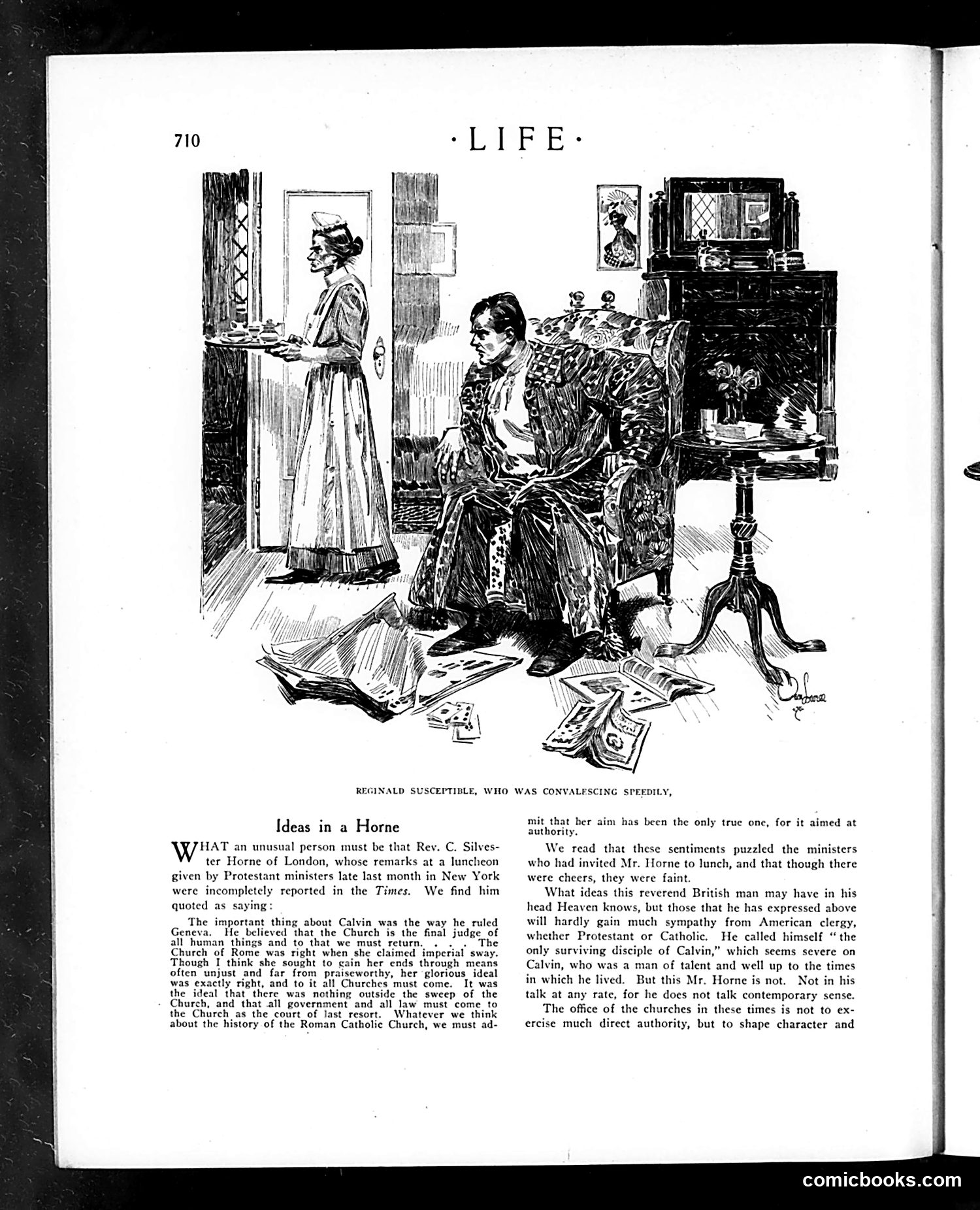
This page satirizes **Rev. C. Silvester Horne**, a British Protestant minister who spoke at a New York luncheon. The cartoon shows "Reginald Susceptible" convalessing—a visual pun on someone easily influenced while recovering. The satire targets Horne's controversial statements praising the Roman Catholic Church's historical claim to absolute authority over all government and law, despite acknowledging the Church used "unjust" means. Horne, who called himself "the only surviving disciple of Calvin," expressed views that directly contradicted his Protestant identity. Life mocks this as dangerously out-of-touch reasoning. The magazine argues that modern churches should shape character and guide morality—not exercise direct political authority—a position reflecting early 20th-century American Protestant liberalism's rejection of religious authoritarianism. The faint cheers from the assembled ministers underscore the audience's discomfort with such retrograde ecclesiastical claims.
📄 Transcribed text from this page (OCR, searchable)
Machine-transcribed from the original scan — historical spelling and the odd misread are preserved.
REGINALD SUSCEPTIBLE, WHO WAS CONVALFSCING SPEEDILY, Ideas in a Horne HAT an unusual person must be that Rey. C. Silves- ter Horne of London, whose remarks at a luncheon given by Protestant ministers late last month in New York were incompletely reported in the Times. We find him quoted as saying: The important thing about Calvin was the way he ruled Geneva. He believed that the Church is the final judge of all human things and to that we must return... . The Church of Rome was right when she claimed imperial sway. Though I think she sought to cain her ends through means often unjust and far from praiseworthy, her glorious ideal was exactly right, and to it all Churches ‘must come. It was the ideal that there was nothing outside the sweep of the Church, and that all government and all law must come to the Church as the court of last resort. Whatever we think about the history of the Roman Catholic Church, we must ad- mit that her aim has been the only true one, for it aimed at authority. We read that these sentiments puzzled the ministers who had invited Mr. Horne to lunch, and that though there were cheers, they were faint. What ideas this reverend British man may have in his head Heaven knows, but those that he has expressed above will hardly gain much sympathy from American clergy, whether Protestant or Catholic. He called himself “the only surviving disciple of Calvin,” which seems severe on Calvin, who was a man of talent and well up to the times in which he lived. But this Mr. Horne is not. Not in his talk at any rate, for he does not talk contemporary sense. The office of the churches in these times is not to ex- ercise much direct authority, but to shape character and comicbooks.com