
A complete issue · 48 pages · 1911
Life — October 12, 1911
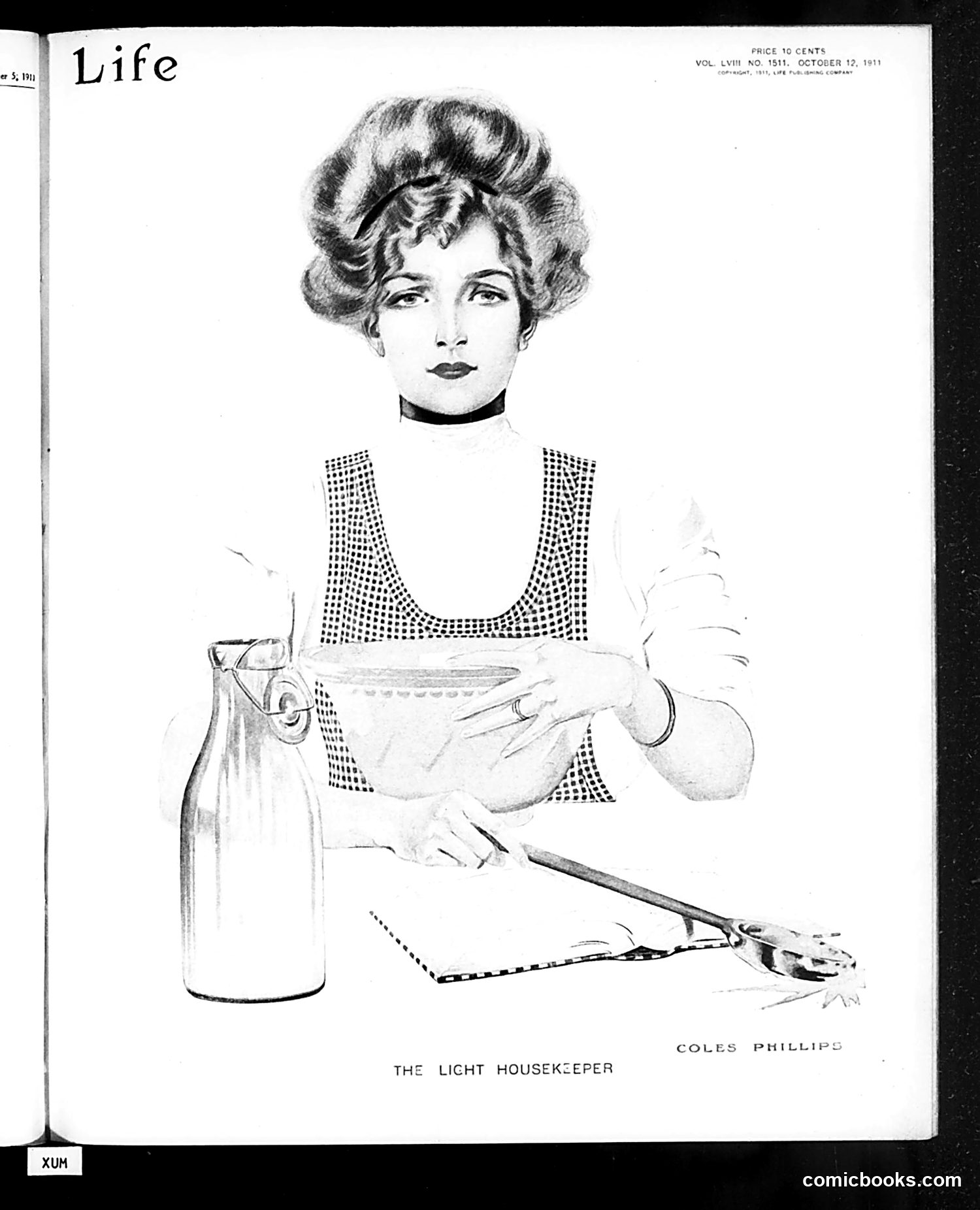
This October 1911 *Life* magazine cover presents a gentle domestic satire. The illustration shows a fashionable woman in a modern, minimalist outfit holding cleaning supplies—a dustpan and brush alongside what appears to be a cleaning product bottle. The title "The Light Housekeeper" is a pun: she's a "light" housekeeper both because her outfit is minimal/modern and because she uses modern cleaning products to make housekeeping easier and less labor-intensive. The satire likely mocks the emerging trend of women adopting "scientific housekeeping" and modern domestic conveniences, presenting them as fashionable rather than practical. Coles Phillips's distinctive illustration style—with simplified forms and elegant lines—was typical of high-end magazine covers of this era.
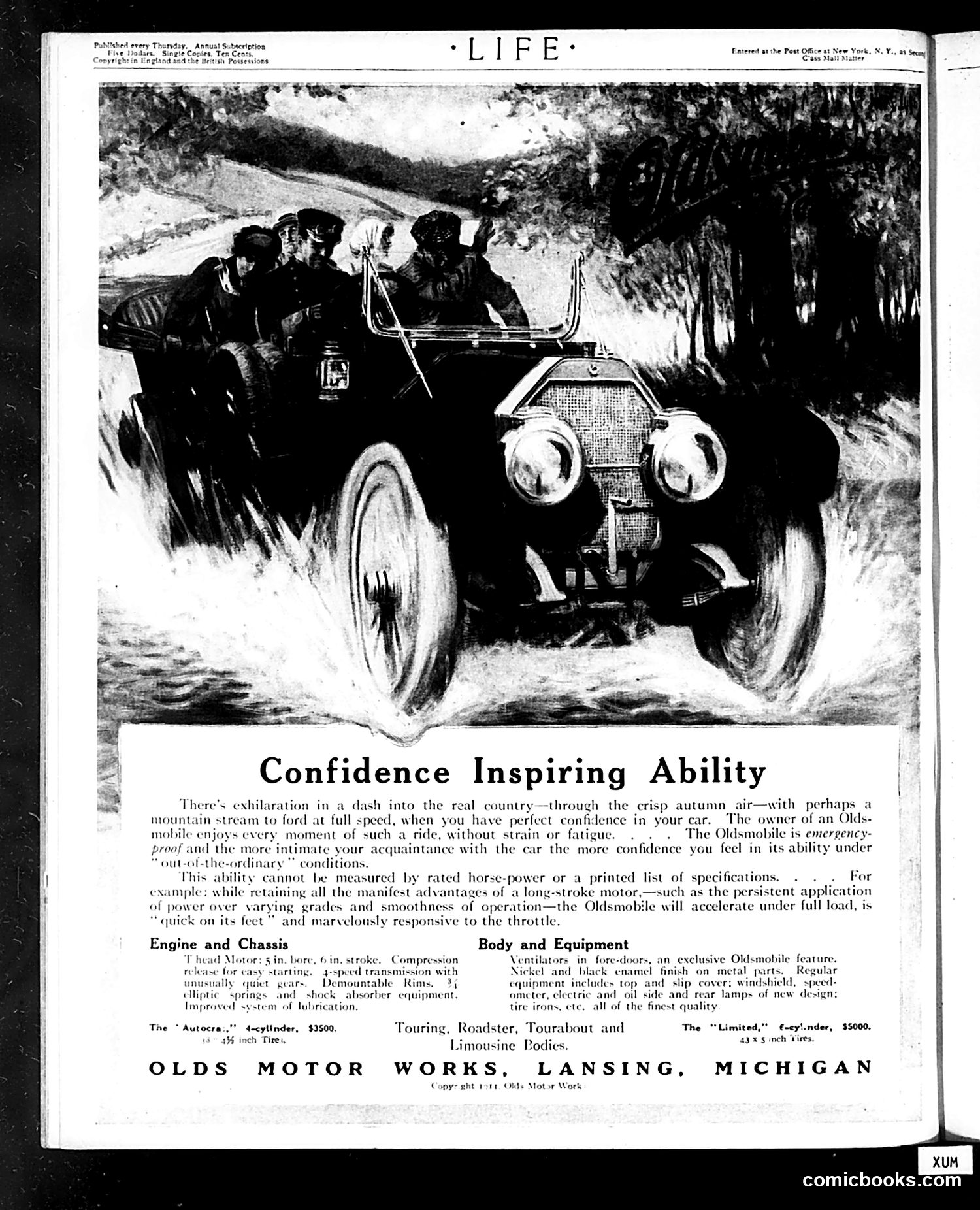
This page is **primarily an automobile advertisement**, not satirical content. It's a LIFE magazine ad for Oldsmobile Motor Works (Lansing, Michigan) promoting their car models. The illustration shows a car full of passengers driving through scenic countryside, meant to evoke leisure and adventure. The headline "Confidence Inspiring Ability" is a marketing pitch emphasizing the vehicle's reliability and smooth performance. The ad copy highlights technical features (6-cylinder engine, improved lubrication system) and various body styles available (Touring, Roadster, Limousine). Prices listed range from $2500 to $5000. This represents early 20th-century automotive advertising—using aspirational imagery of outdoor recreation and mechanical superiority to sell cars to affluent consumers. There's no apparent political satire on this page.
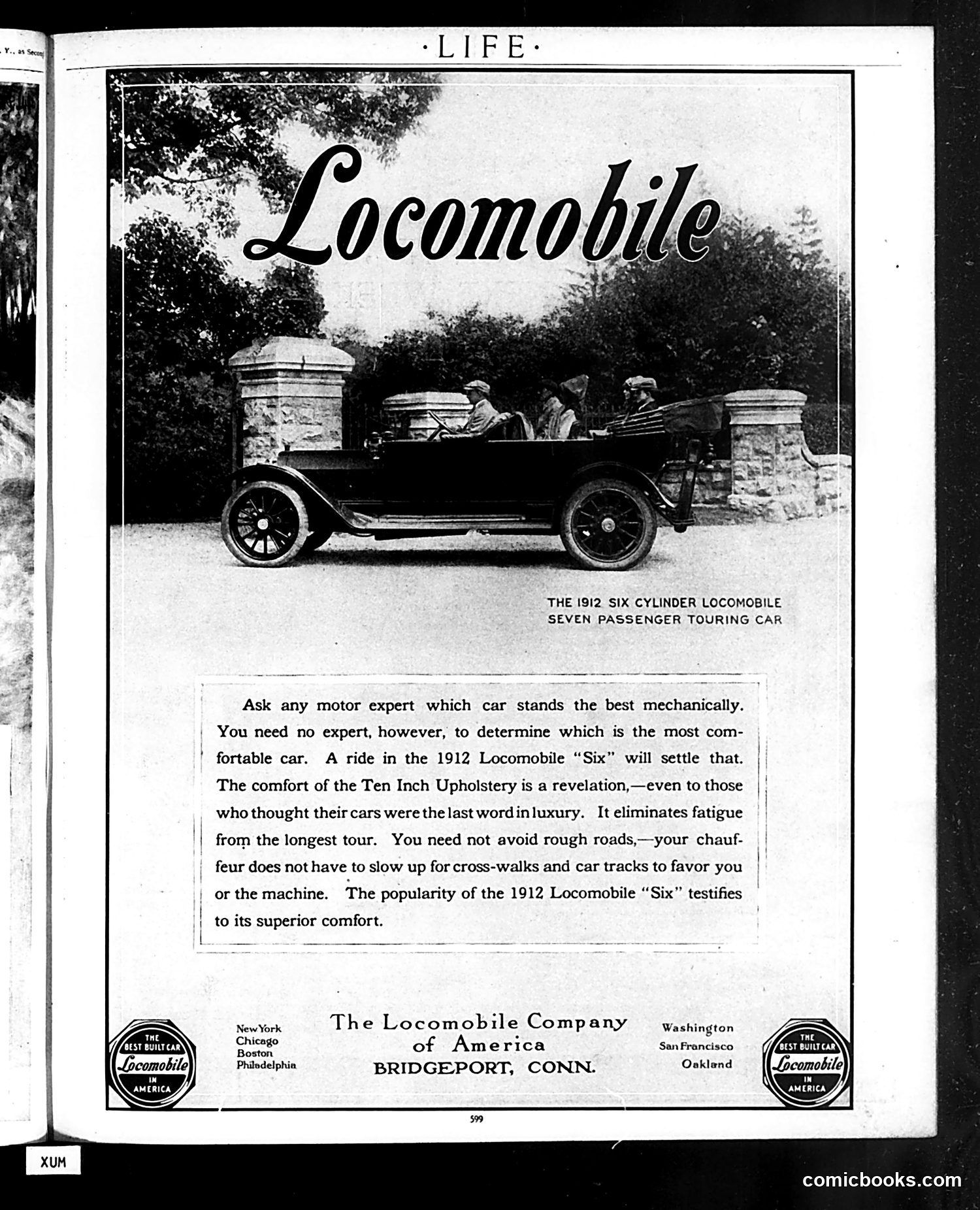
This is **not a cartoon or satire page** — it's a straightforward automobile advertisement from *Life* magazine. The page advertises the 1912 Locomotive "Six," a seven-passenger touring car manufactured by the Locomobile Company of America (based in Bridgeport, Connecticut). The advertisement includes a photograph of the vehicle with passengers and emphasizes its mechanical superiority and comfort features, particularly its "Ten Inch Upholstery." The ad's marketing pitch targets affluent buyers, claiming the car needs no expert endorsement to prove its comfort and that it handles rough roads without requiring special driving accommodation. The company had multiple U.S. locations (New York, Chicago, Boston, Philadelphia, Washington, San Francisco, Oakland). This reflects early 1910s automotive marketing to wealthy consumers.
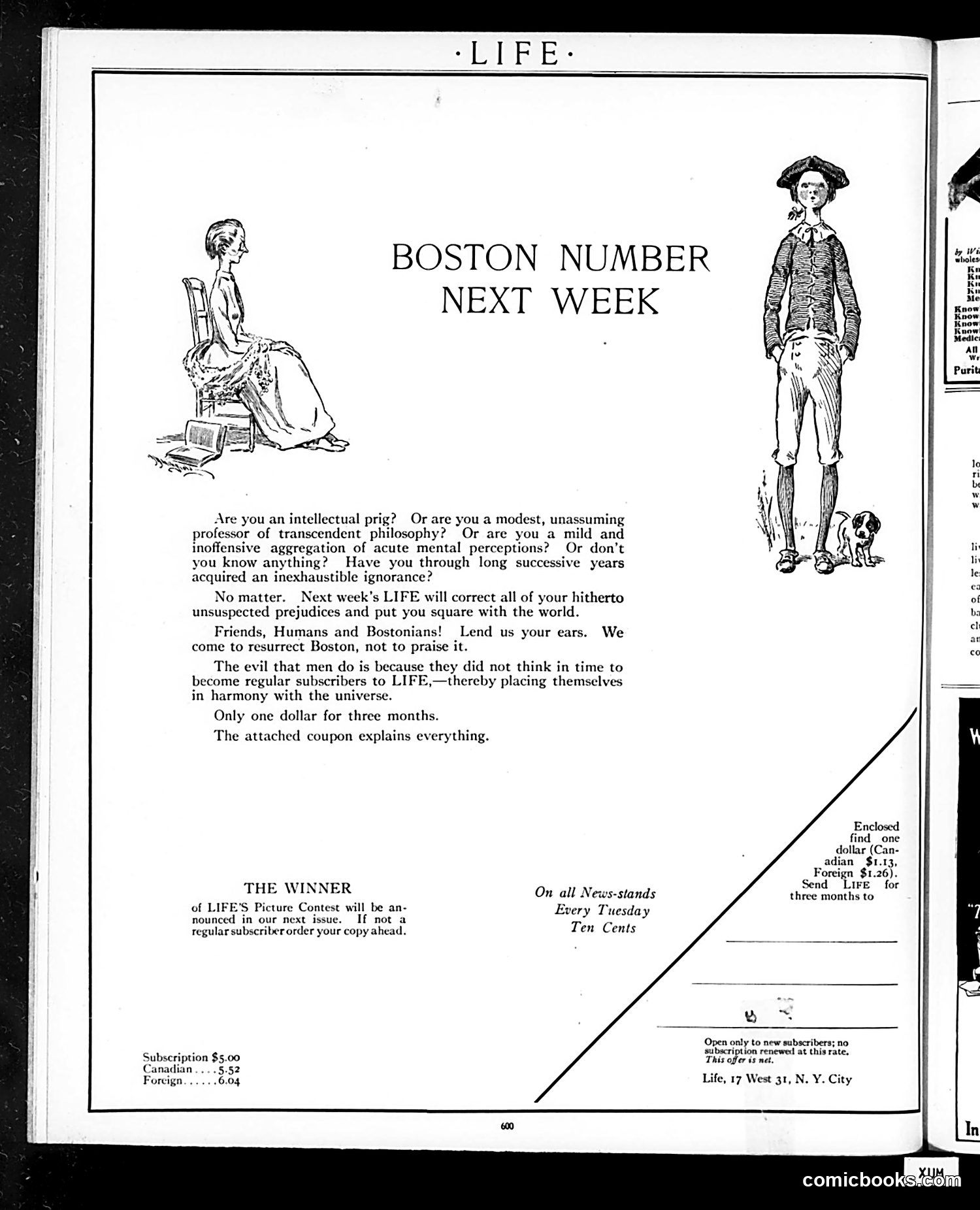
This page is primarily a **subscription advertisement** for Life magazine's Boston edition, using humor to mock intellectualism and encourage subscriptions. The ad features two illustrated figures—a seated woman surrounded by books and a standing man in colonial-era dress with a small dog. The text satirizes Boston's reputation for intellectual pretension, mocking "intellectual prigs" and "professors of transcendent philosophy" while claiming Life will "correct all of your hitherto unsuspected prejudices." The humor relies on **Boston stereotypes**: the city was historically associated with elite academia, transcendentalism, and cultural superiority. The colonial figure likely references Boston's historical importance. The ad offers a subscription for one dollar for three months, positioning Life as a corrective to Boston's perceived stuffiness—essentially selling irreverent satire as an antidote to the city's self-regard.
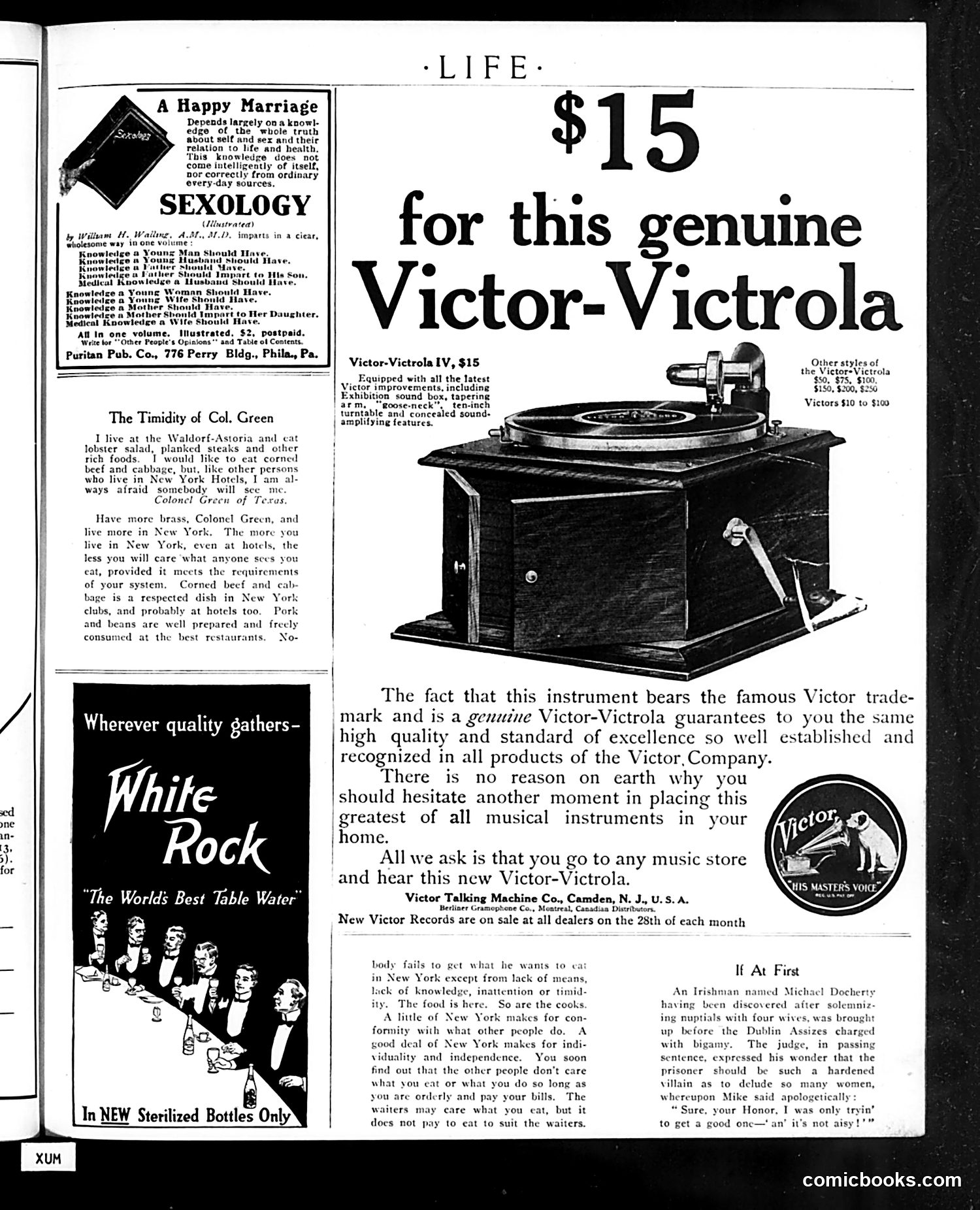
This page is primarily **advertising rather than satirical content**. The dominant feature is a large Victor-Victrola phonograph advertisement ($15), emphasizing the machine's quality and the Victor Company's established reputation ("His Master's Voice" trademark visible). The left column contains two unrelated items: a book advertisement for "Sexology" by William H. Walling, and a brief humorous anecdote titled "The Timidity of Col. Green" mocking a wealthy man's timidity about eating corned beef in fancy New York hotels—social satire about class anxieties rather than political commentary. A "White Rock" water advertisement appears at bottom left. This is a typical Life magazine page mixing advertising with light social humor, not political cartooning.
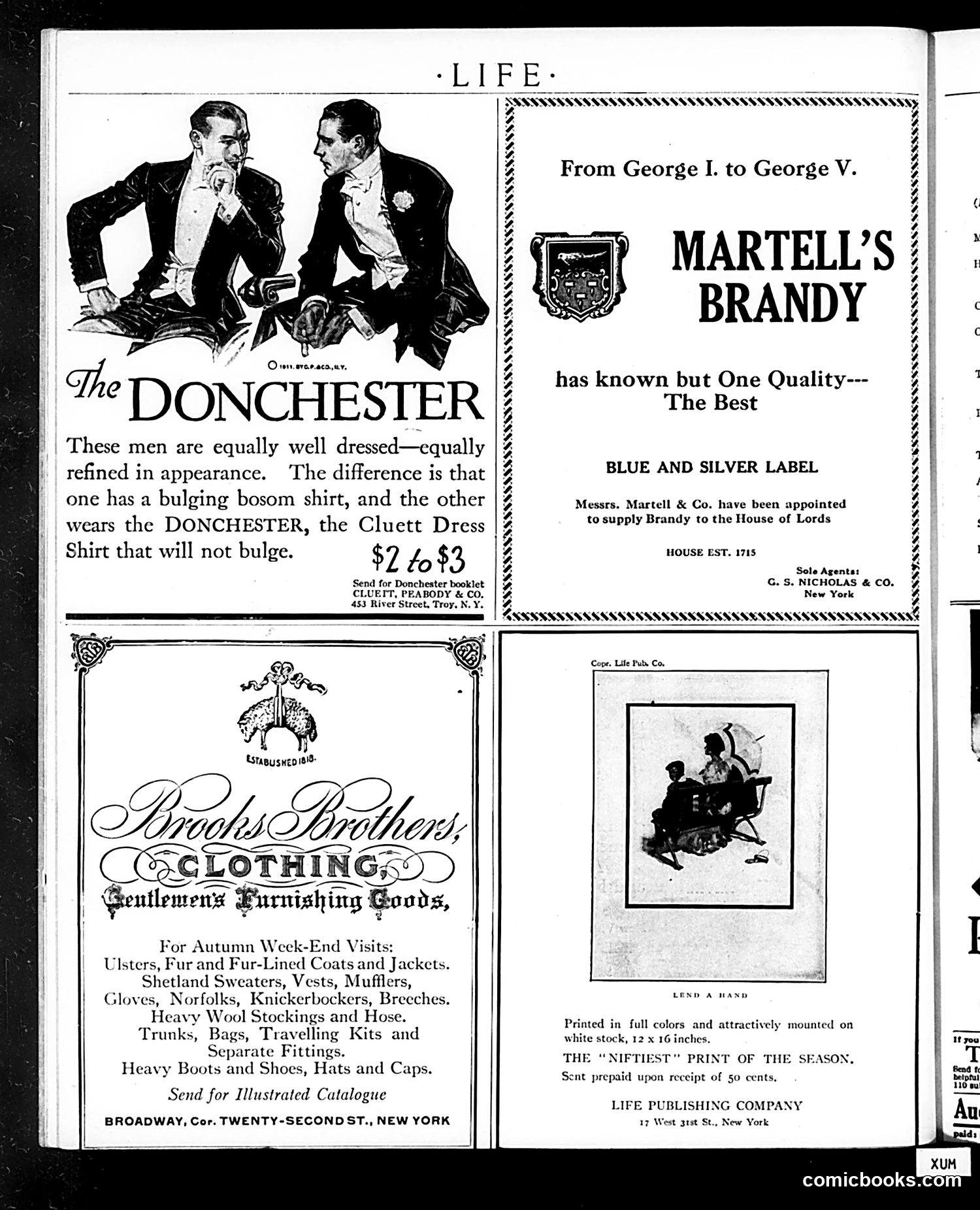
This page is primarily **advertising**, not satire. The main cartoon depicts two well-dressed men in formal wear, illustrating a product comparison: one wears a traditional dress shirt with a "bulging bosom" (starched front), while the other wears the "Donchester" shirt, which maintains a flat, refined appearance. The humor is gentle and commercial rather than political—it's a visual gag showing the practical advantage of this shirt style for formal occasions. The advertisement emphasizes that despite equal refinement in appearance, the Donchester prevents the unflattering bulge of older shirt designs. The page also contains unrelated advertisements for Brooks Brothers clothing and Martell's Brandy, typical of Life magazine's revenue model.
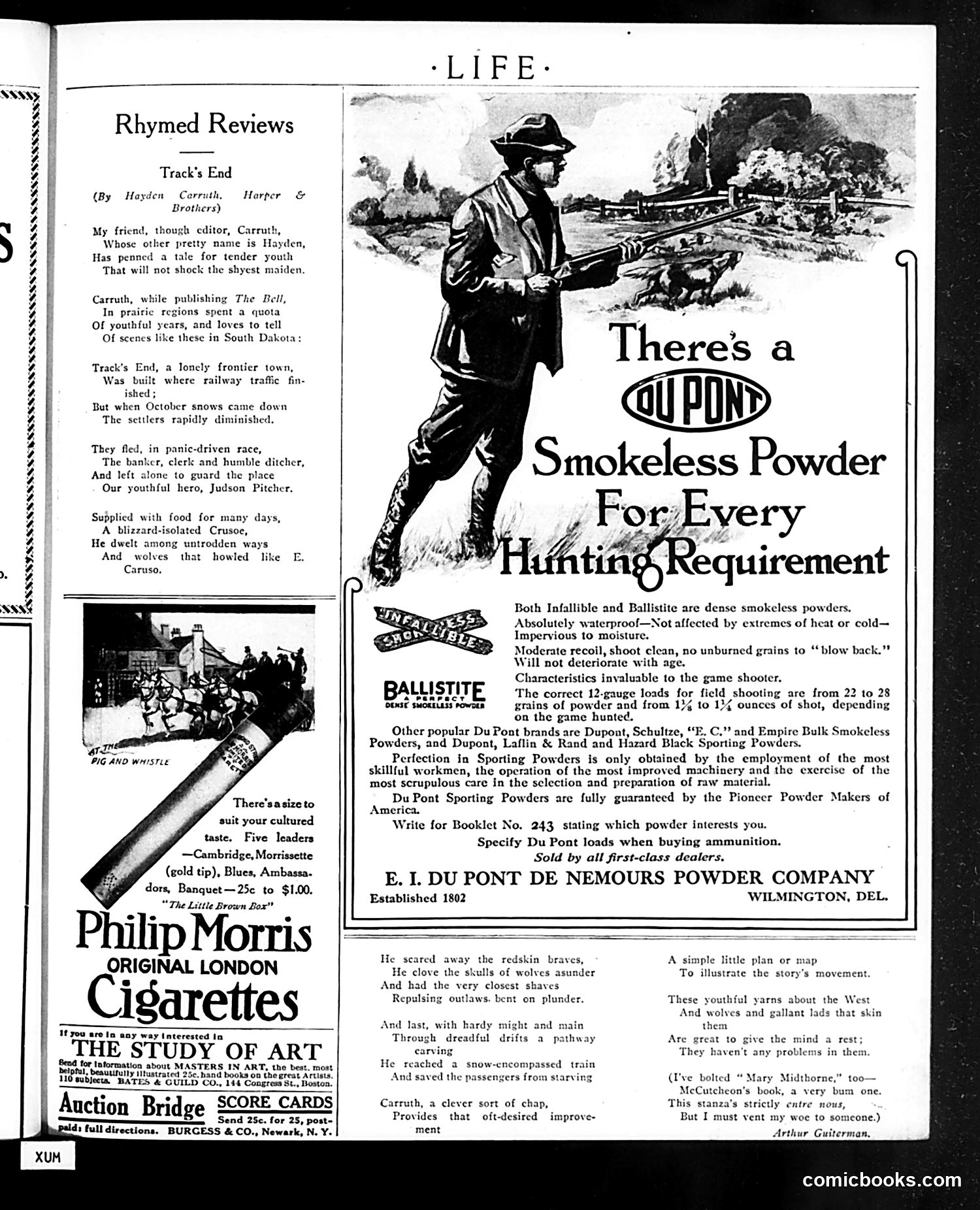
This page is primarily **advertising, not satire or political commentary**. The dominant content consists of two large advertisements: 1. **Du Pont Smokeless Powder** (right side): Features an illustrated frontiersman and promotes hunting ammunition, emphasizing reliability in extreme conditions. 2. **Philip Morris Cigarettes** (lower left): An advertisement for "Original London Cigarettes," claiming superiority among five leading brands. Additional minor ads include score cards for Auction Bridge and a reference to "The Study of Art" exhibition. The left column contains **"Track's End," a rhymed poem** by Hayden, Carruth, Harper & Bradford about frontier settlement and survival—literary content, not political satire. This appears to be a typical early 20th-century *Life* magazine page mixing advertisements with light entertainment and literary content.
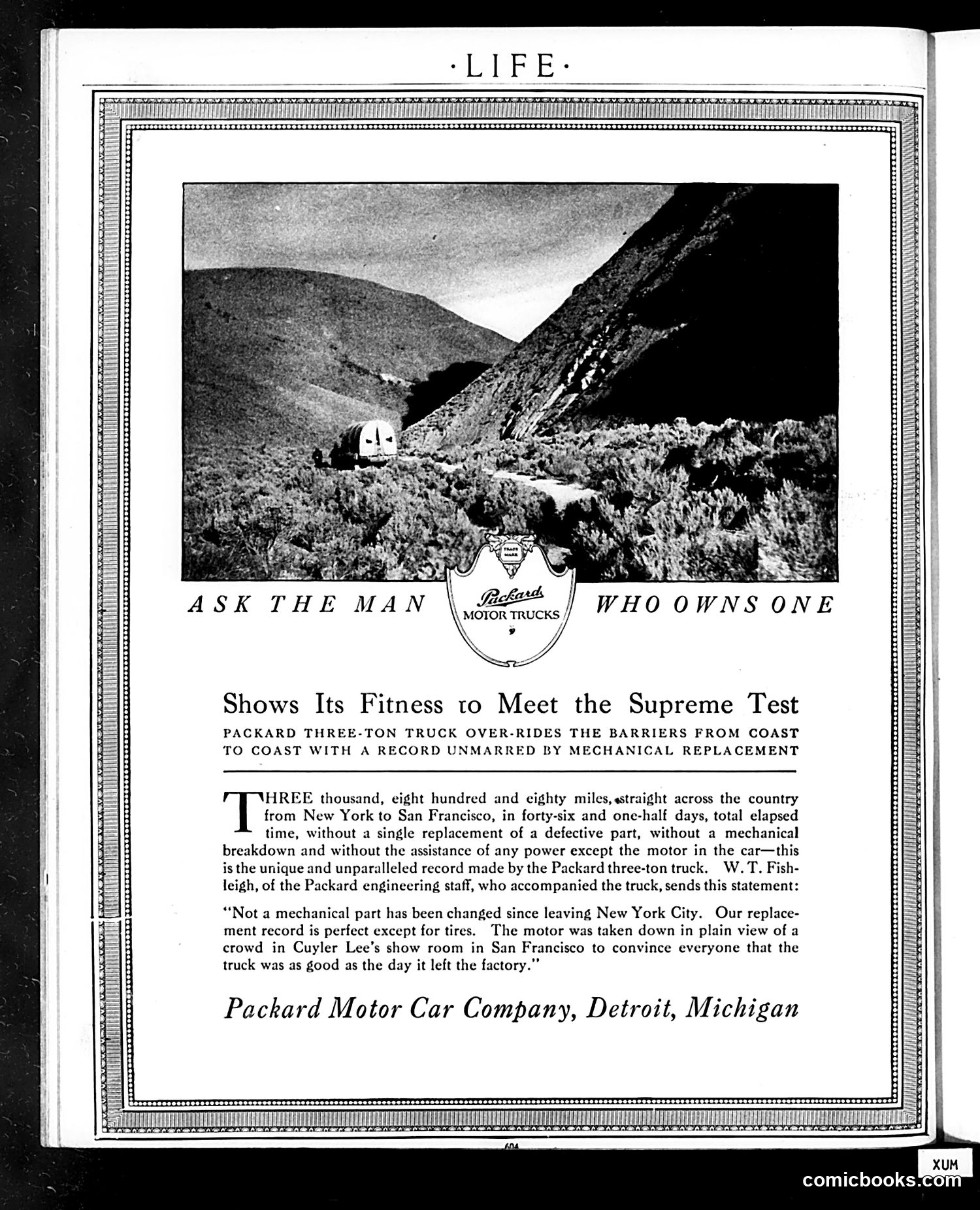
This is an **advertisement**, not a cartoon or satire. It promotes Packard Motor Trucks, a Detroit-based manufacturer. The ad describes a cross-country endurance test: a Packard three-ton truck traveled 3,880 miles from New York to San Francisco in 46.5 days without a single mechanical part replacement (except tires). The accompanying photograph shows the truck navigating rough, mountainous terrain. The advertisement's claim—"Ask the Man Who Owns One"—was a common Packard slogan. The ad emphasizes the truck's reliability and durability as marketing appeals to potential commercial buyers, using the extreme feat as proof of the vehicle's engineering quality and ability to handle demanding conditions. This was typical early-20th-century automotive marketing strategy.
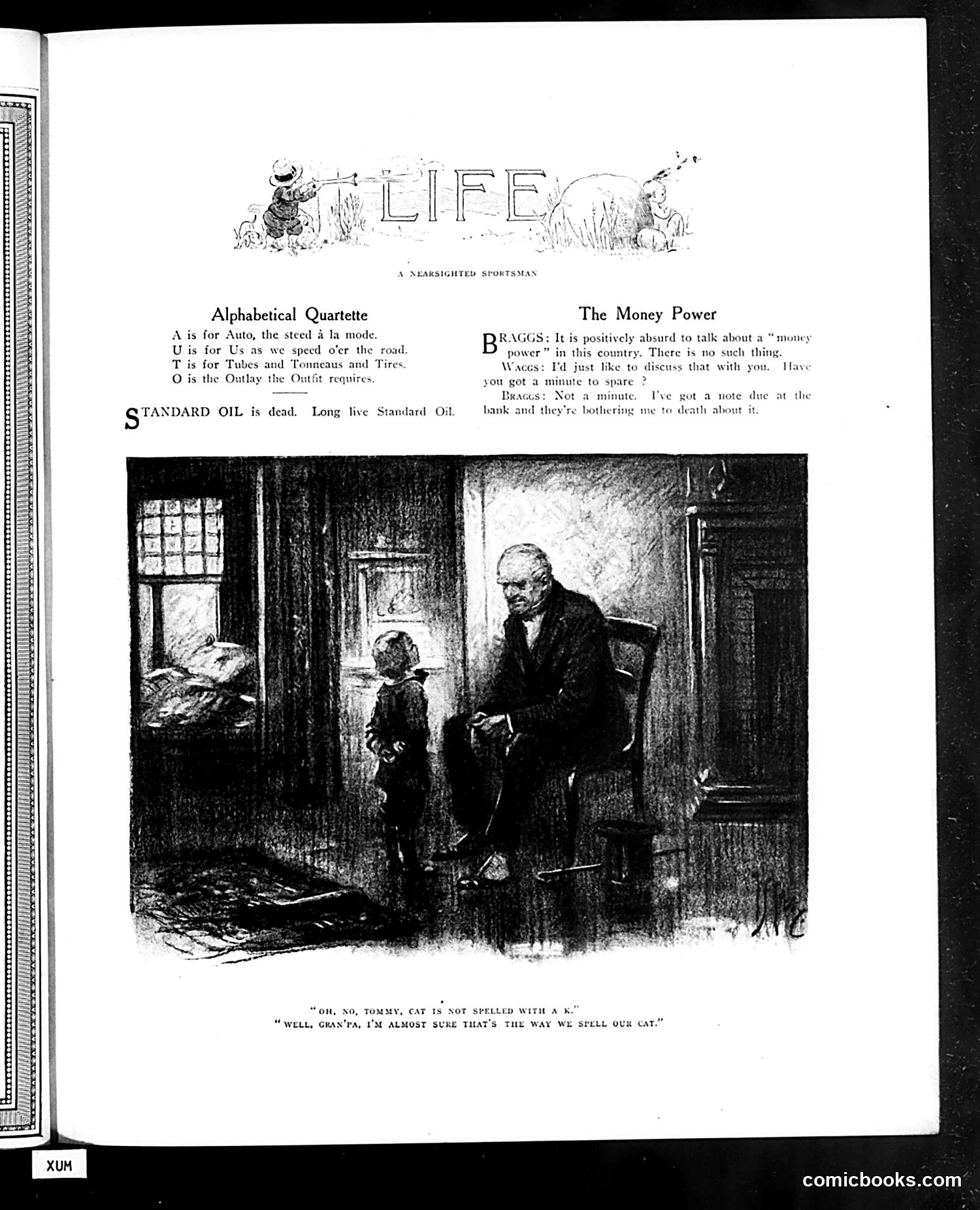
This satirical piece depicts a conversation between two figures identified as **Braggs** and **Wags** about "money power" in the country. Wags claims there is "no such thing," while Braggs counters that he has a bank note and people are "bothering me to death about it." The illustration shows an older gentleman (likely representing a wealthy banker or financier) speaking with a younger, working-class boy in a modest interior setting. The satire appears to critique the **denial of plutocratic influence** in America—mocking claims that concentrated wealth holds no power while depicting the reality that money creates social obligations and hardship for ordinary people. It's commentary on class inequality and the pervasive influence of capital in American society.
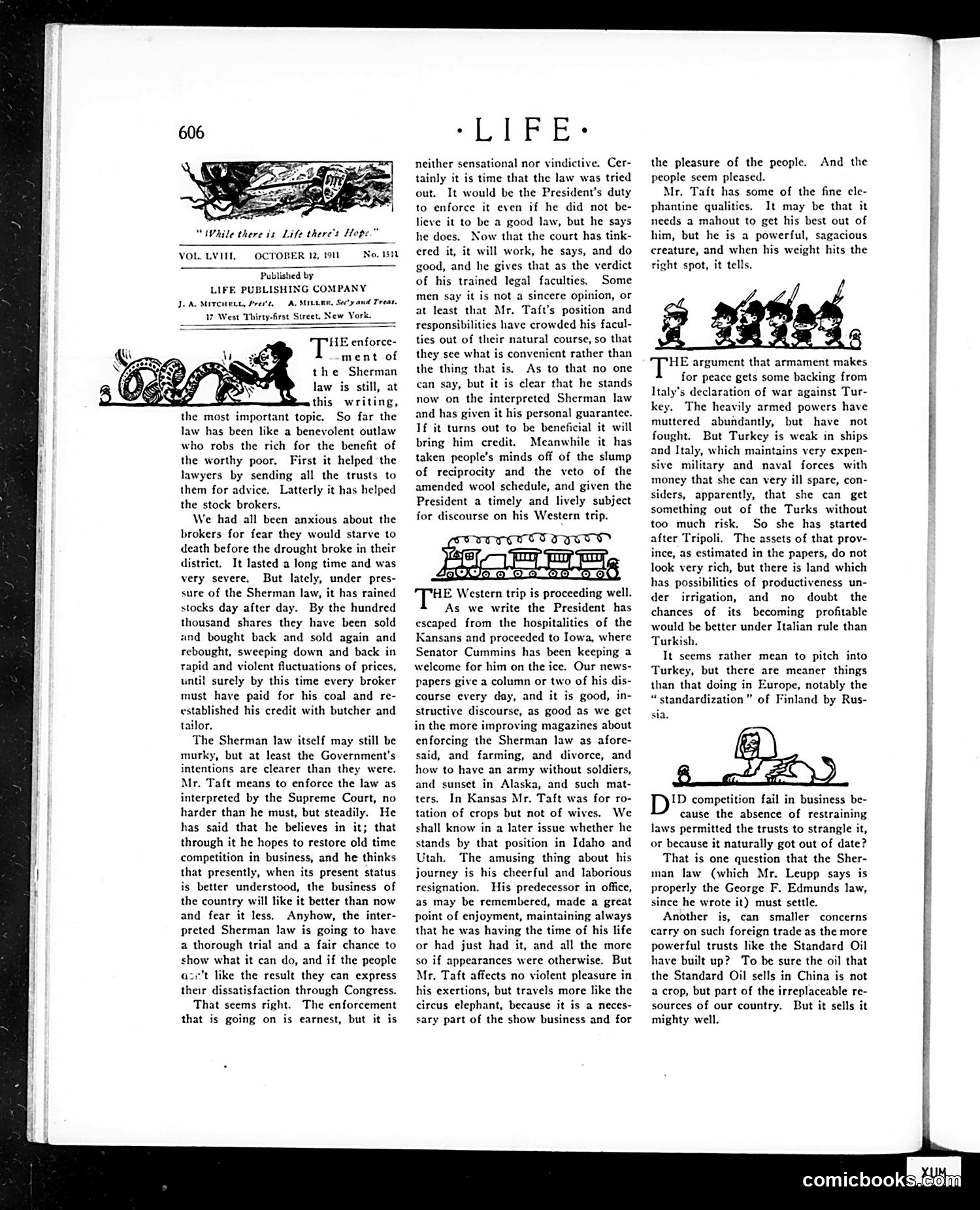
This October 1911 *Life* magazine page discusses enforcement of the Sherman Antitrust Act under President Taft's administration. The text criticizes the law as a "benevolent outlaw" that helps wealthy brokers while harming legitimate business, noting it has caused stock market turmoil. The commentary references Taft's "Western trip" (likely a speaking tour) and mentions Senator Cummins welcoming him in Iowa. The article defends Taft's enforcement efforts as sincere, despite concerns it's destabilizing business. The cartoons (visible but small) appear to illustrate these business and legal themes, though specific figures are difficult to identify clearly in this reproduction. The overall message critiques antitrust policy's unintended economic consequences.
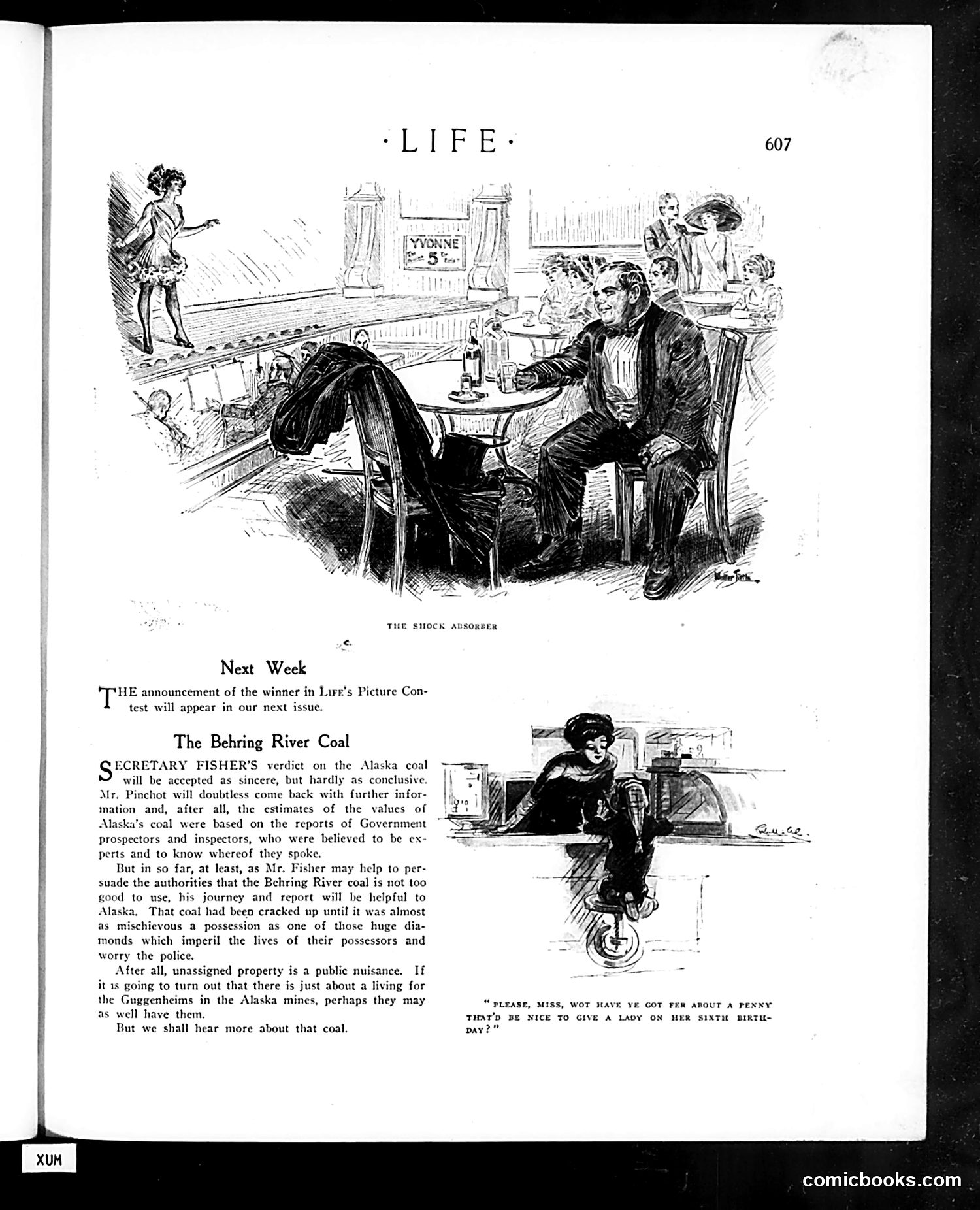
**Top Cartoon ("The Shock Absorber"):** A man sits at what appears to be a bar or restaurant, looking stunned while a woman departs. The title suggests he's been emotionally impacted by an interaction with her—likely a rejection or unexpected statement. **Bottom Cartoon:** A woman performs a bicycle stunt, apparently popping a wheelie or similar trick. The caption reads: "PLEASE, MISS, WOT HAVE YE GOT FER ABOUT A PENNY THAT'D BE NICE TO GIVE A LADY ON HER SIXTH BIRTHDAY?" The humor appears to involve a man's awkward or inappropriate request to a woman performing the stunt—mixing admiration with an odd gift-giving proposition. **Article:** Discusses Secretary Fisher's verdict on Alaskan coal reserves, debating whether the Bering River coal has genuine value or represents worthless property.
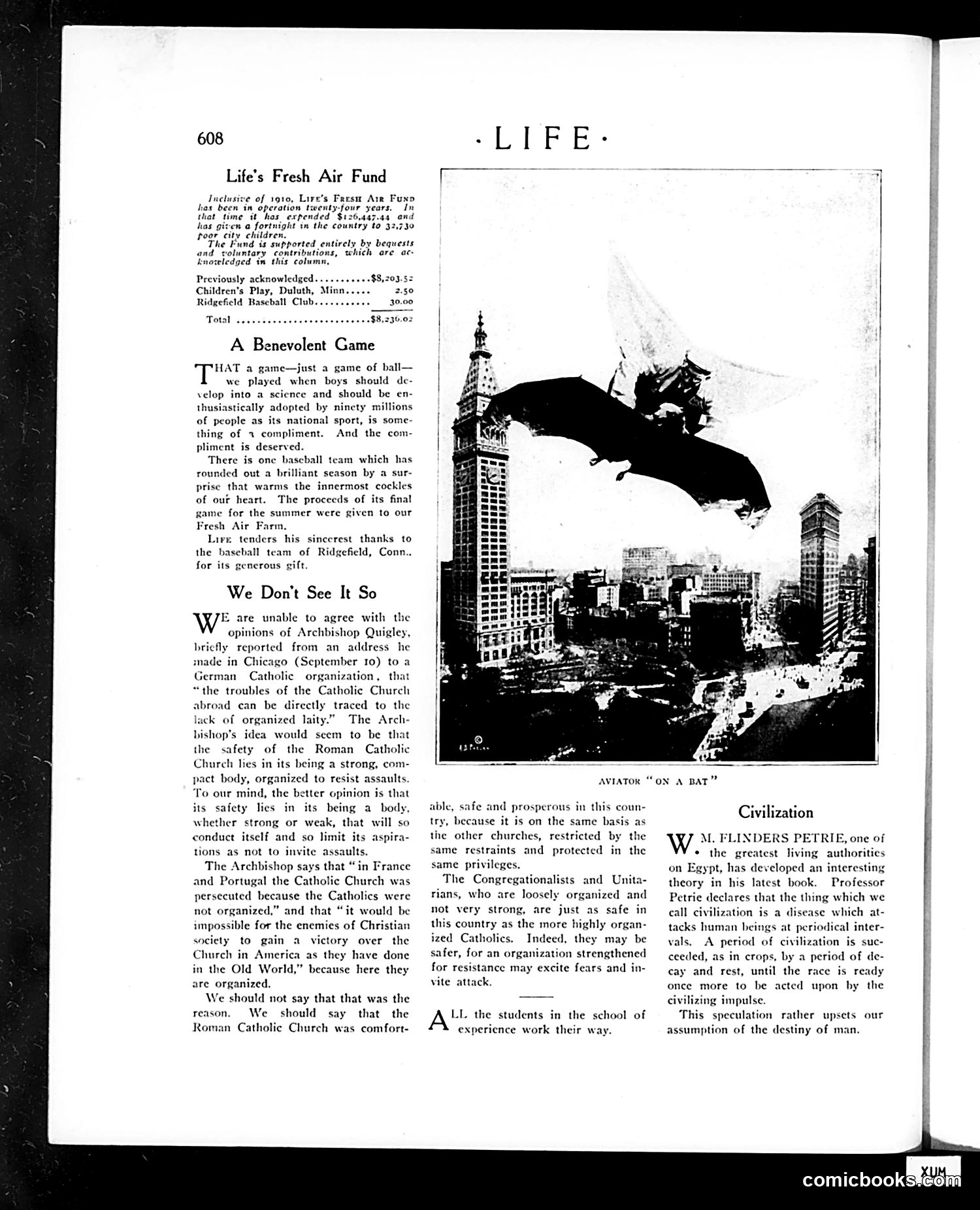
This page contains three distinct sections: **Life's Fresh Air Fund** (top left): A charitable fundraising notice listing donations totaling $8,526.02 for a Fresh Air Fund, supporting children's recreation. **"A Benevolent Game"** (middle left): An editorial praising baseball as beneficial to American society, thanking the Ridgefield Baseball Club for donating game proceeds to the Fresh Air Fund. **"We Don't See It So"** (bottom left): A critical editorial response to Archbishop Quirley's claims that American Catholics are safer from persecution than European Catholics. Life's editors argue the Roman Catholic Church's strength in America comes from being well-organized to resist attacks—not from inherent American tolerance—and dispute the Archbishop's comparison. **"Civilization"** (right): An article by W.M. Flinders Petrie theorizing that civilizations cycle through periods of activity and rest. The airplane illustration depicts modern technological progress.
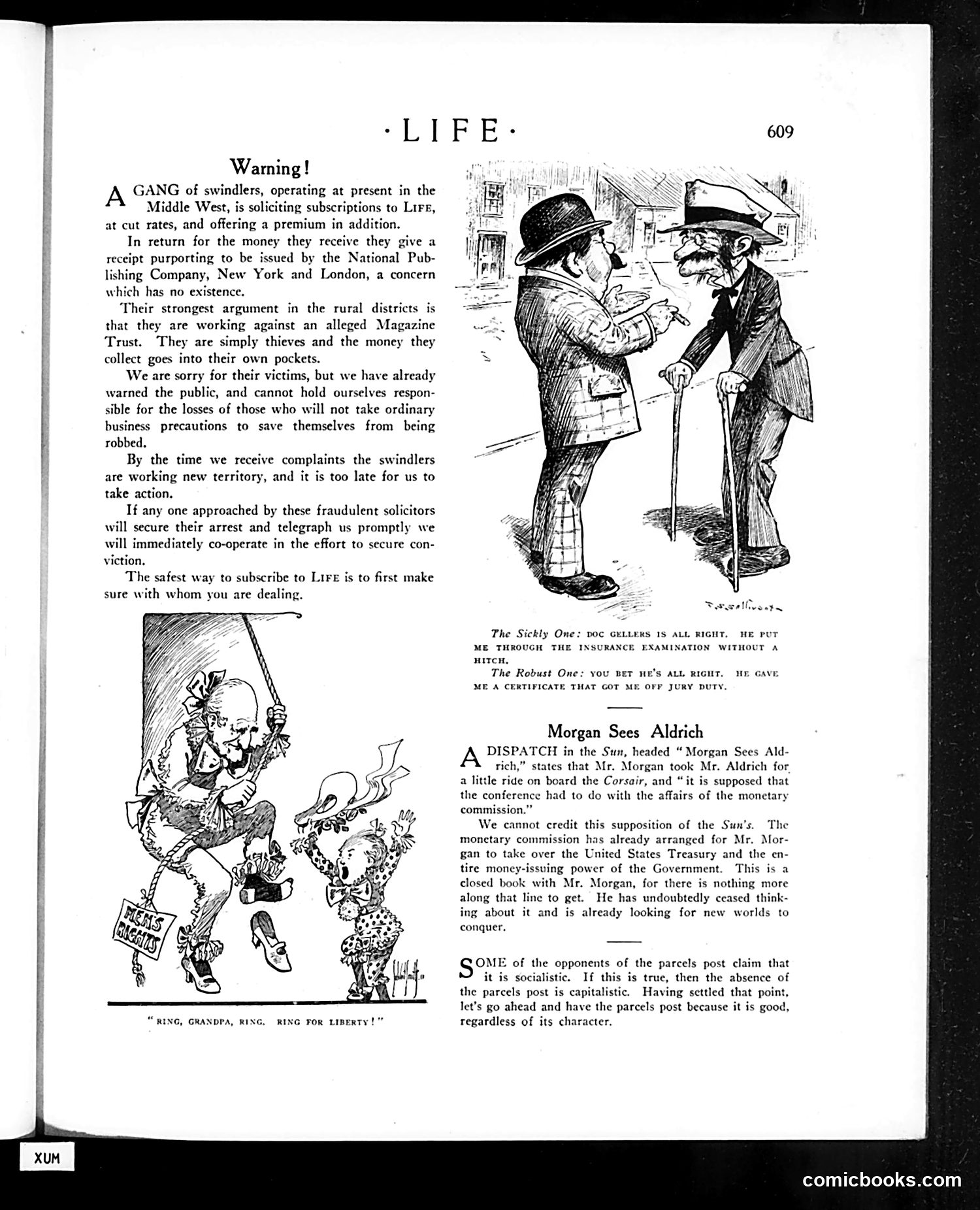
This page contains two distinct items: 1. **"Warning!" Editorial**: LIFE warns readers about subscription fraud in the Midwest. Swindlers falsely claim to represent a "National Publishing Company" (which doesn't exist) to collect money. LIFE advises readers to verify whom they're dealing with and promises to help prosecute anyone approaching readers with fraudulent solicitations. 2. **Political Cartoons**: - Upper cartoon: Satirizes two types—"The Sickly One" (insurance examiners) and "The Robust One" (likely a jury member)—suggesting corruption in insurance and legal proceedings. - Lower cartoon labeled "Ring, Grandpa, Ring for Liberty!" depicts figures in chains, appearing to satirize restrictions on freedom, though the specific reference is unclear without additional context.
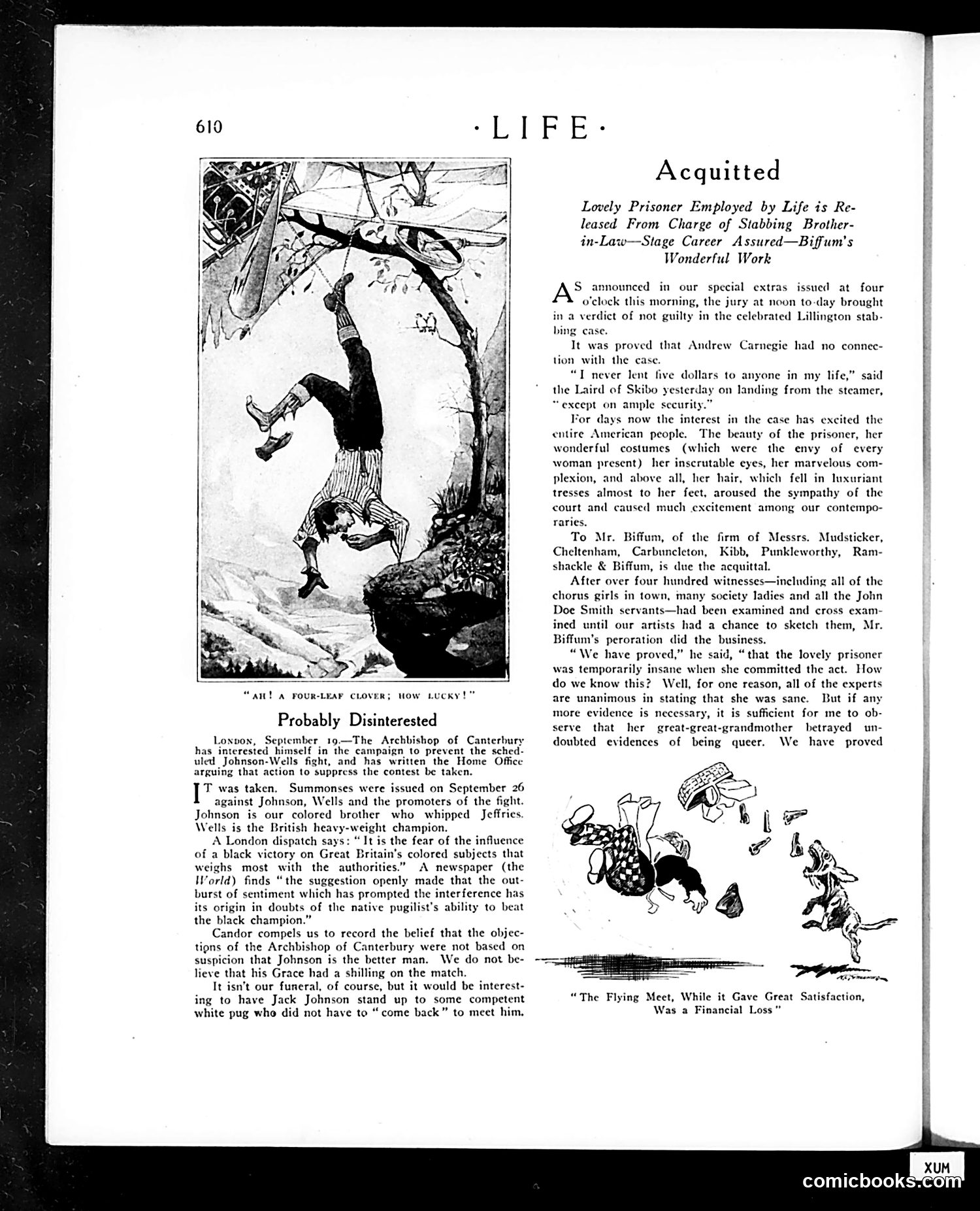
This page contains two distinct articles: **"Acquitted"** discusses a high-profile murder trial (the "Lillington stabbing case"). The accompanying illustration shows a woman hanging upside down from a tree branch, labeled "Ah! A Four-Leaf Clover; How Lucky!" This visual pun satirizes the acquittal—the woman's inverted position suggests she "got away" with her crime through sheer luck, as if finding a four-leaf clover. **"Probably Disinterested"** reports on the Archbishop of Canterbury's involvement in preventing a scheduled boxing match between Jack Johnson (described as "our colored brother") and Wells. The article critiques the Archbishop's interference, suggesting racial bias influenced the decision. The accompanying cartoon shows chaotic figures, likely mocking the controversy surrounding Johnson, a Black boxer whose prominence generated significant racial tensions in early 20th-century Britain.
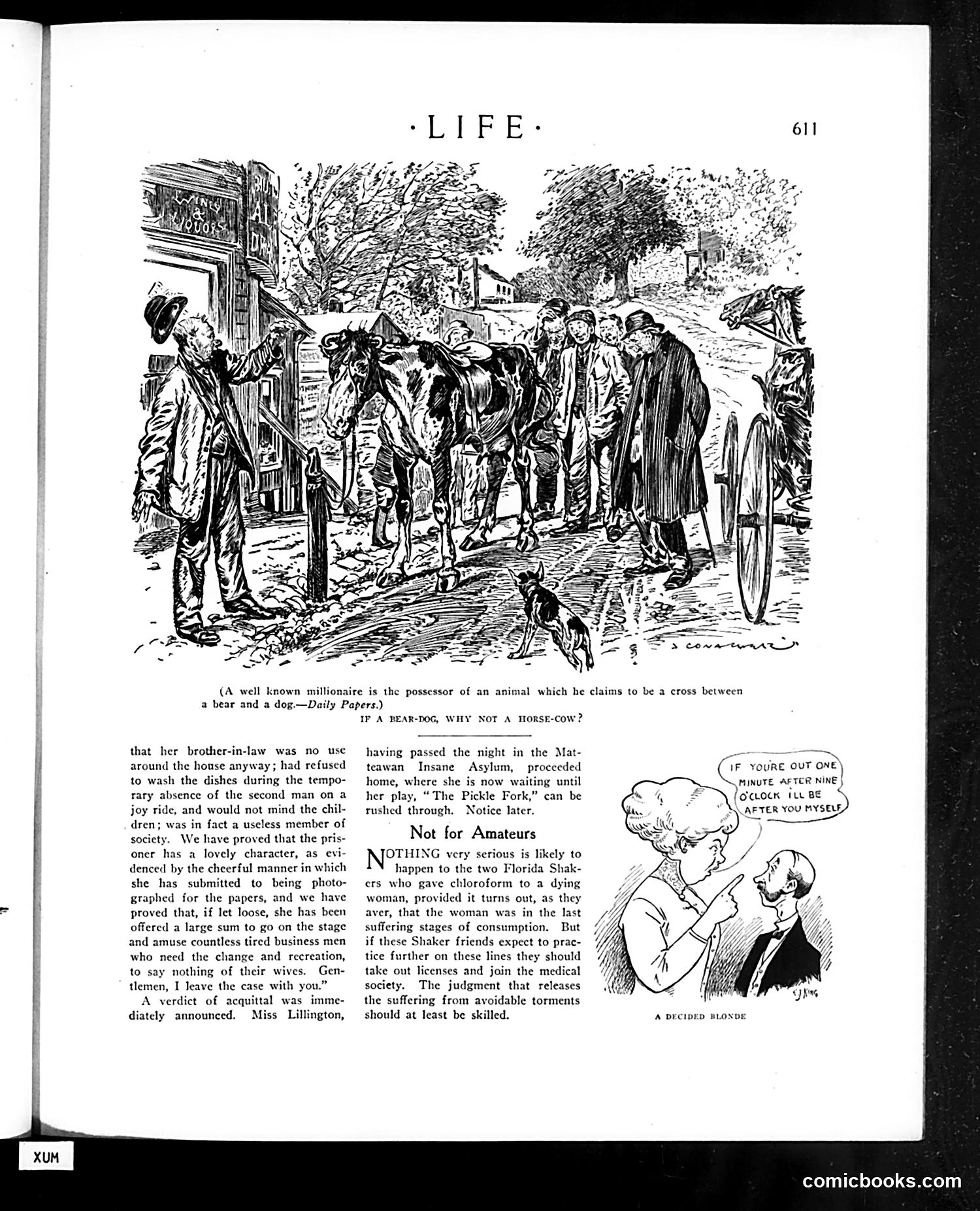
This page contains two satirical pieces: **Top cartoon**: Mocks a wealthy millionaire's claimed "bear-dog" hybrid animal by showing a street scene where people discuss the absurdity. The satire ridicules both sensationalist newspaper reporting (which breathlessly covered the millionaire's claim) and the gullibility of the wealthy elite. **"Not for Amateurs" article**: Critiques a recent legal case involving two Florida Shakers (a religious sect) who administered chloroform to a dying consumptive woman. The piece sarcastically suggests that while releasing terminal patients from suffering might be justifiable, such mercy killings should only be performed by licensed medical professionals—not amateurs. It's a biting commentary on both medical ethics and religious extremism. **Small cartoon ("A Decided Blonde")**: A brief joke featuring a woman, likely satirizing gender relations or female behavior of the era. The page exemplifies *Life*'s satirical style: using contemporary scandals and news stories to critique society's absurdities, from tabloid sensationalism to dangerous religious practices.
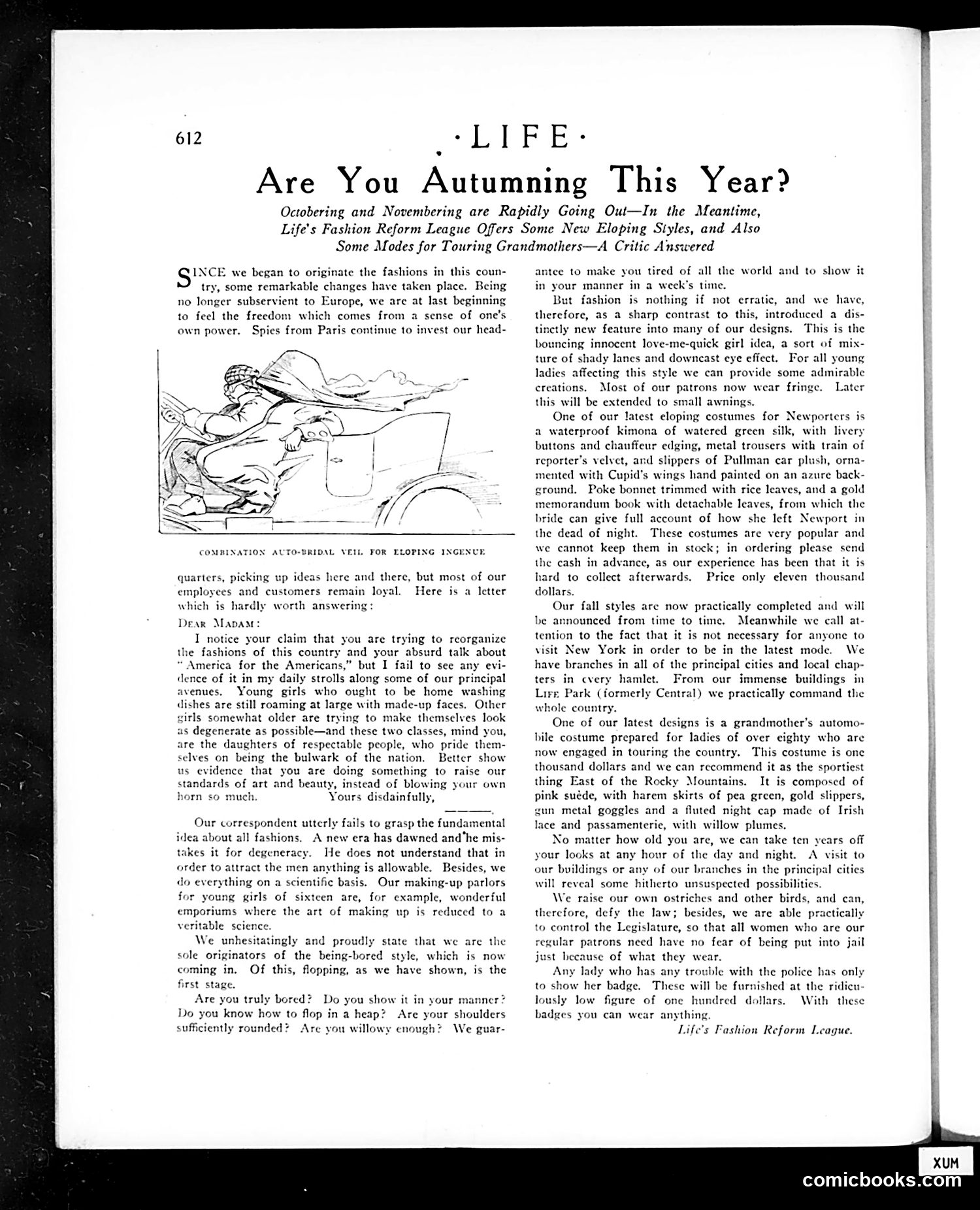
This is satirical social commentary disguised as fashion advice. Life's "Fashion Reform League" is a fictional entity mocking both: 1. **American fashion pretension**: The piece parodies the claim that American designers now originate styles independently from Paris, positioning this as patriotic liberation. 2. **Youth behavior concerns**: A letter criticizes young girls wearing makeup and adopting "degenerate" styles. Life's response—claiming to scientifically manufacture the "being-bored style" and "love-me-quick girl idea" through makeup parlors—satirizes both moral panic about youth and the commercialization of femininity. 3. **Conspicuous consumption**: The absurdly expensive "eloping costume" ($11,000) for Newport socialites, complete with ridiculous details (Cupid-wing slippers, memorandum book for documenting elopement), mocks wealthy women's wasteful, frivolous fashion spending. The cartoon illustration shows exaggerated female figures, reinforcing the satire's visual mockery of affected fashion poses.
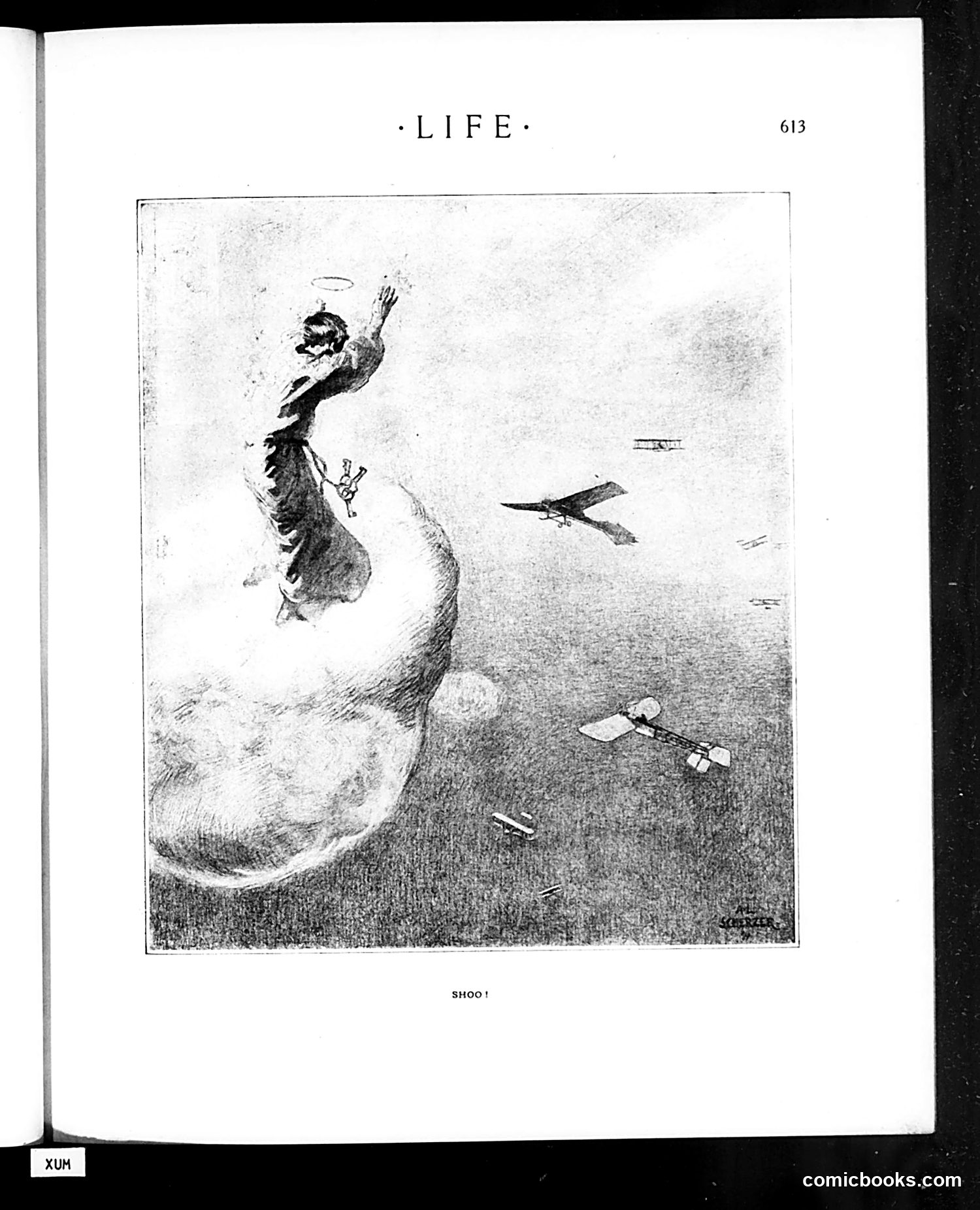
This satirical cartoon depicts a figure being chased away by aircraft and weapons. The central character appears to be a caricatured person in distress, positioned on what looks like a curved landmass or peninsula, gesturing defensively upward at approaching planes and dropping bombs or shells. The caption "SHOO!" suggests someone being forcibly expelled or driven out. Without more context about the specific publication date, the exact political target remains unclear, though the imagery suggests this comments on military conflict or invasion—possibly relating to World War I or II-era aviation warfare. The cartoon uses exaggeration and visual metaphor to mock or criticize a particular political figure or nation's predicament during armed conflict.
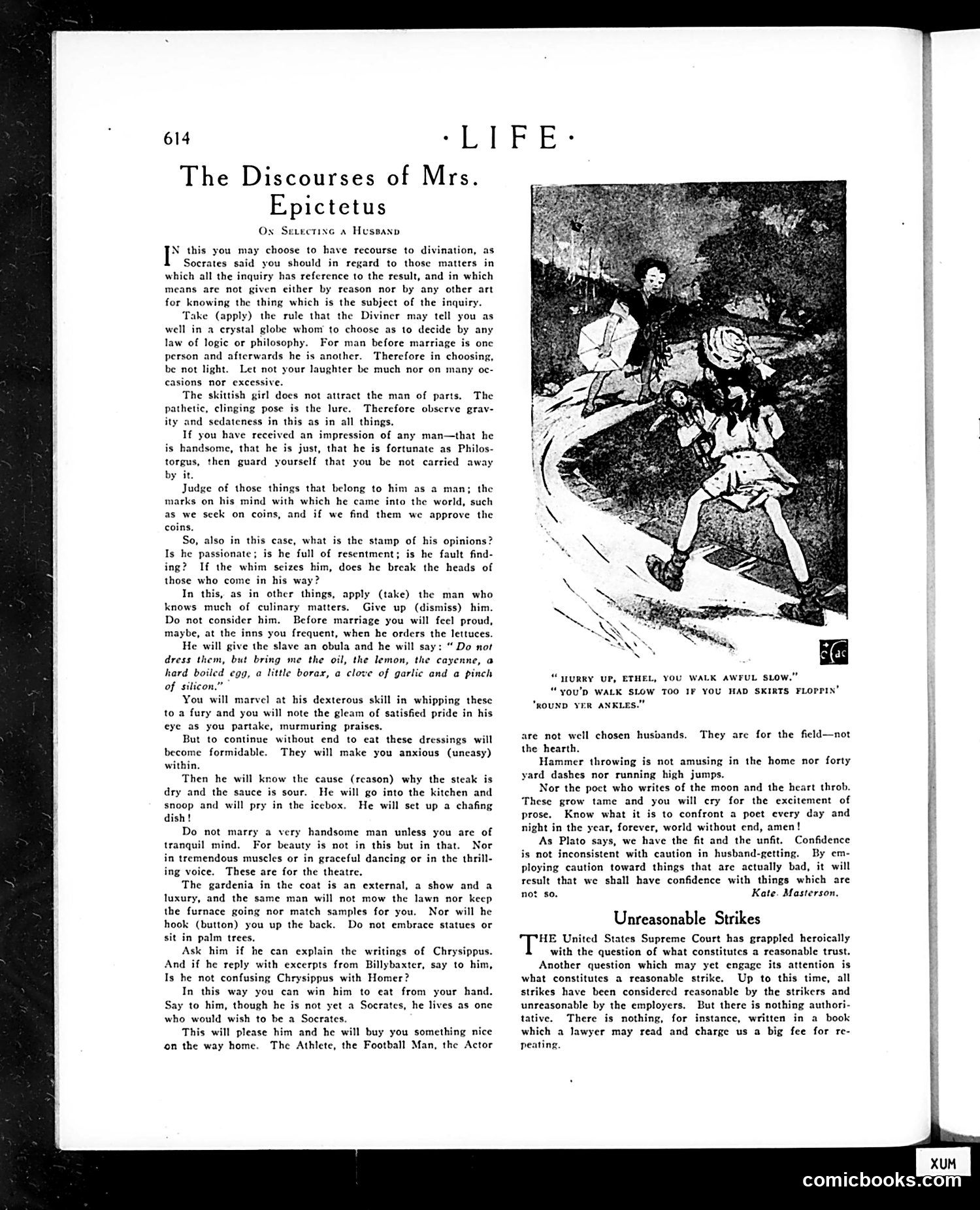
This satirical piece mocks Victorian-era marriage advice by parodying the ancient philosopher Epictetus's stoic teachings. The text humorously applies philosophical principles to mundane husband-hunting—advising women to judge men's character rather than appearance, yet simultaneously offering absurd practical warnings (avoid handsome men, football players, poets). The cartoon caption appears to reference women's fashion complaints: a woman protests walking slowly due to her long skirts with "floppins" hems, a common early-20th-century annoyance. The satire targets both the pretentious application of classical philosophy to domestic matters and contemporary expectations that women should be demure, calculating, and focused solely on securing a suitable provider-husband—while accepting the physical constraints and limitations imposed by fashion norms of the era.
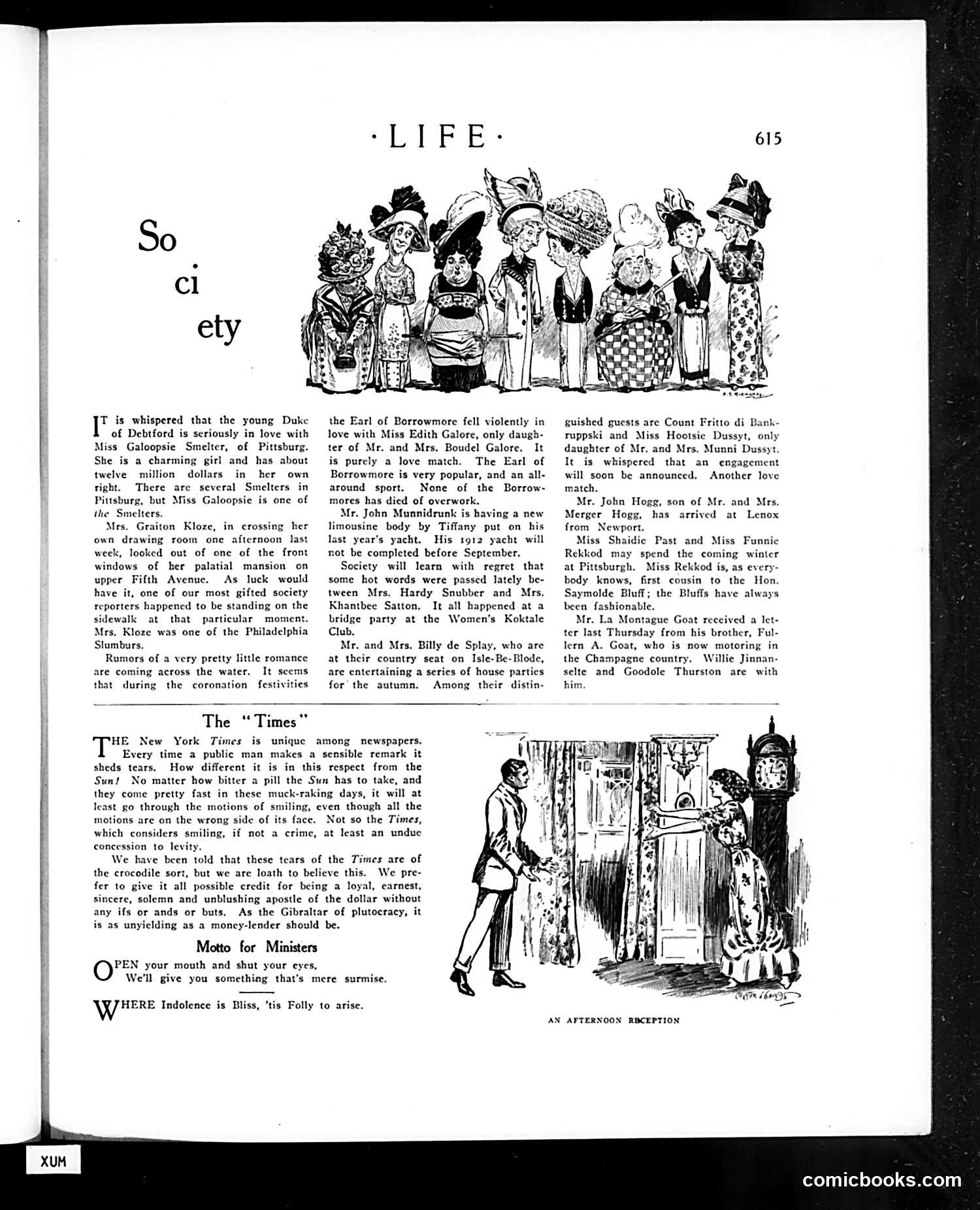
This page from *Life* magazine satirizes wealthy American high society through gossipy social announcements with absurdly transparent fictional names—"Miss Galoopsie Smelter" (Pittsburgh steel heiress), "the Earl of Borrowmore," "Mr. John Munnidrunk" (clearly a drunk)—mocking the pretensions and superficiality of the upper class. The humor derives from the thinly-veiled caricatures highlighting that elite society marriages are purely financial transactions ("twelve million dollars in her own right"). The accompanying essay mocks the *New York Times* as humorless and overly serious compared to other newspapers, portraying it as an obsequious defender of plutocracy and big business—"the Gibraltar of plutocracy"—willing to suppress humor in service of the wealthy. The cartoon "An Afternoon Reception" depicts a visitor at a society event, likely illustrating the stilted formality of such gatherings. Overall, the page satirizes Gilded Age wealth, mercenary marriages, and the press's cozy relationship with the wealthy elite.
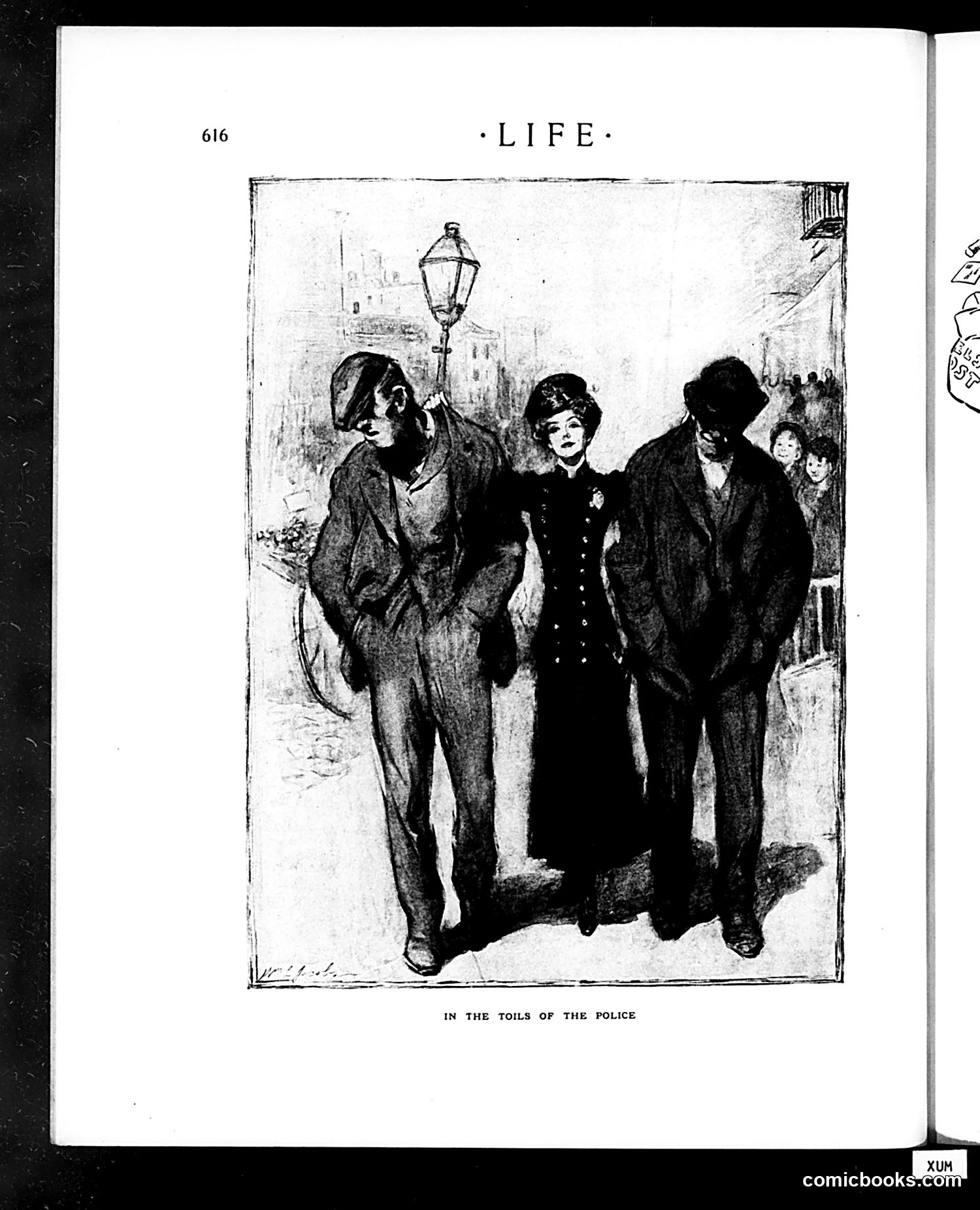
This illustration depicts three men escorting a woman down a street under a gas lamp, with additional figures visible in the background. The caption suggests a police-related scenario. The image appears to satirize arrest or police custody, with the woman as the central figure being detained or escorted by authorities. The formal Victorian-era clothing and street setting indicate this is from the late 19th or early 20th century. Without additional context identifying the specific figures or the publication date, I cannot determine which particular incident, crime, or political event this cartoon references. The satire likely commented on a contemporary scandal, arrest, or police matter that *Life* magazine's readers would have recognized, but that context is not evident from the image alone.
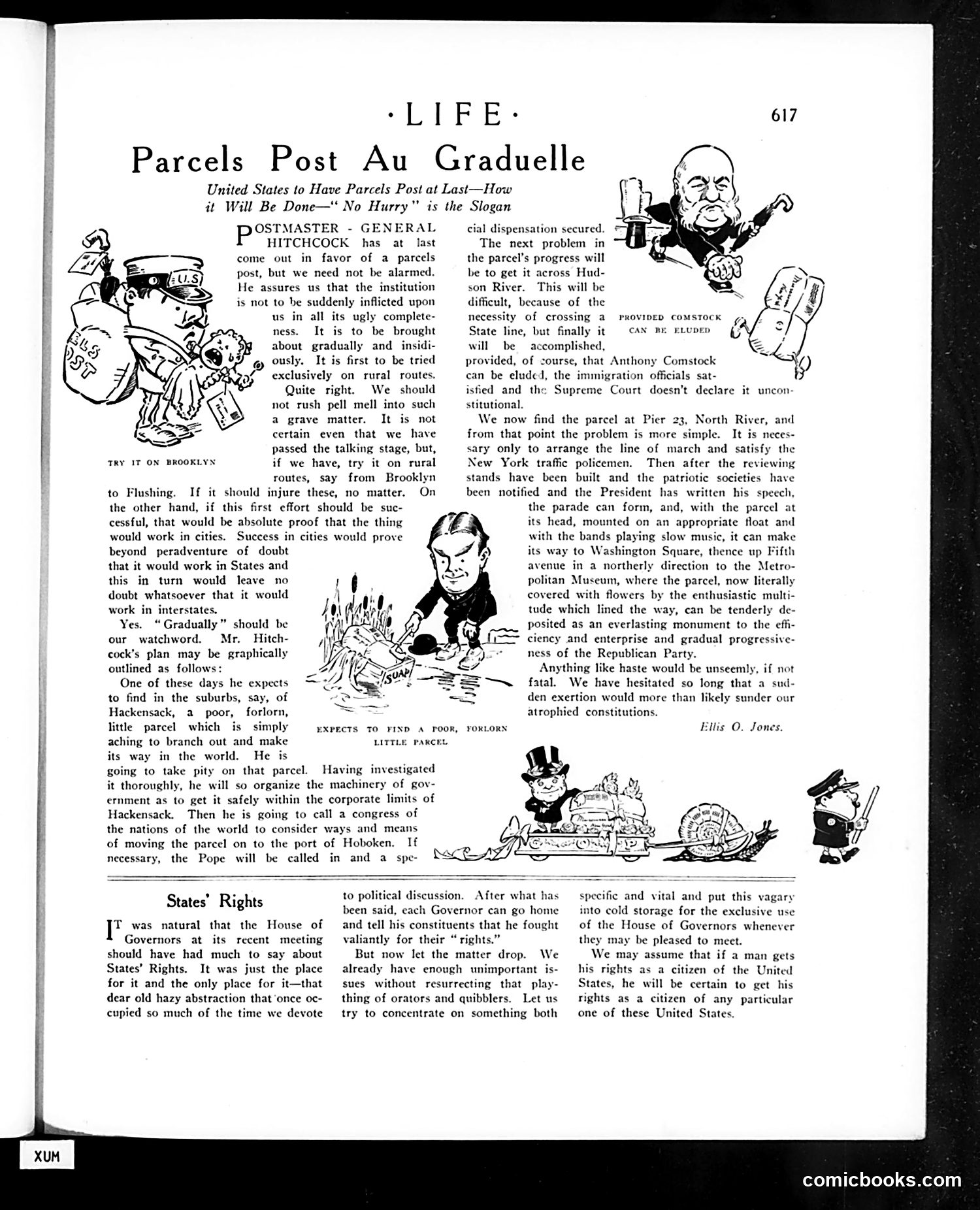
This satirical piece mocks Postmaster-General Hitchcock's extremely cautious approach to implementing parcel post service in America. The cartoon ridicules the glacial pace of bureaucratic expansion—suggesting the government would only trial it on rural routes (Brooklyn to Flushing), then require congressional approval, papal involvement, and even the cooperation of Anthony Comstock (a real anti-vice crusader infamous for censorship) before a parcel could cross state lines. The humor escalates absurdly: a simple parcel's journey to Washington Square becomes an elaborate parade with presidential speeches and flower arrangements—treating modest mail delivery like a momentous national event requiring years of deliberation. The text's subtitle, "No Hurry" is the slogan, captures the core joke: American government's paralyzing caution toward modernization. The piece advocates for decisive action rather than endless procedural delay.
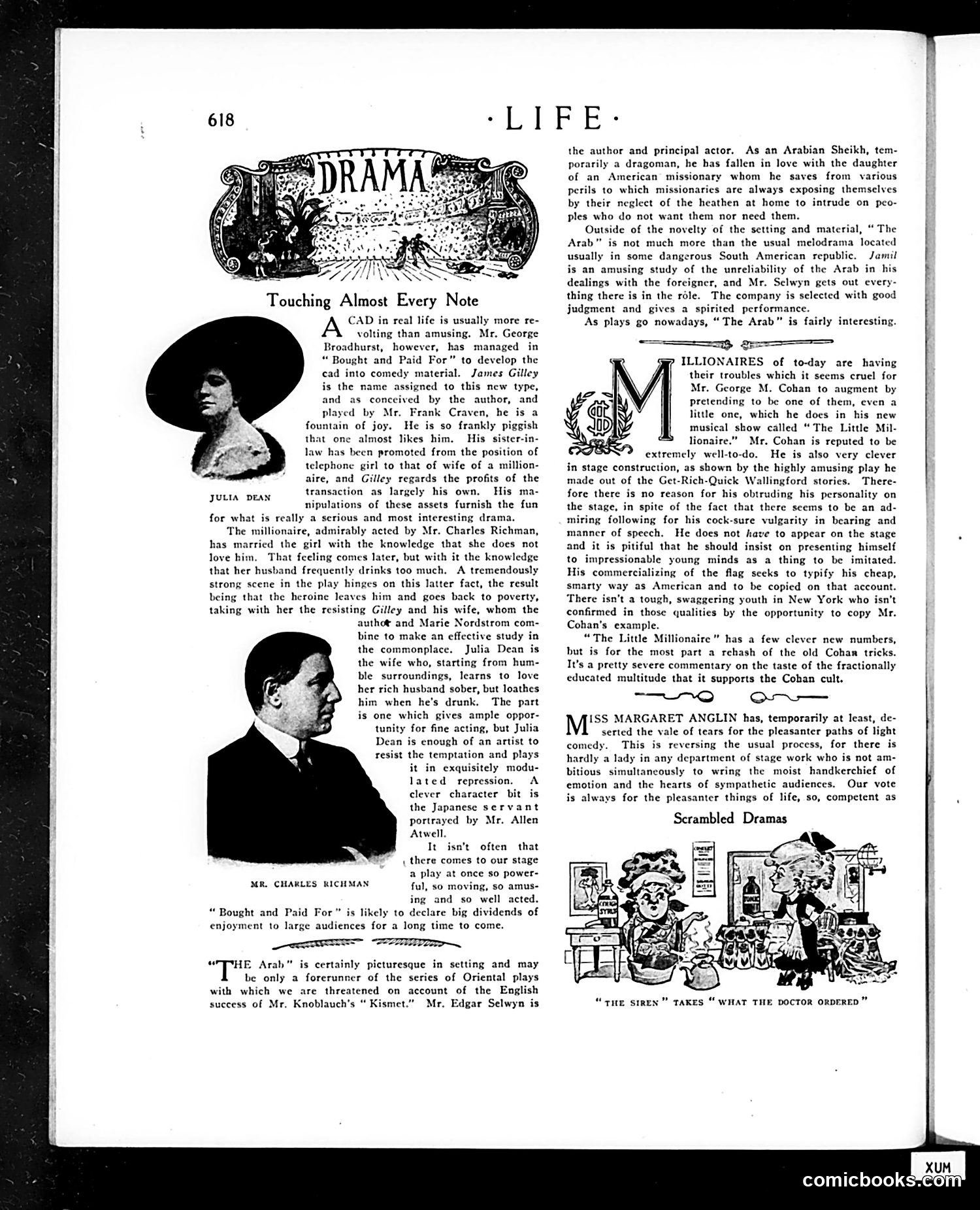
This page reviews three theatrical productions from the early 1900s: **"Bought and Paid For"**: A comedy about a "cad" named James Gilley (played by Frank Craven) who exploits his sister-in-law after she marries a wealthy man. The reviewer praises how the playwright transforms this morally reprehensible character into entertainment, with strong performances by Charles Richman and Julia Dean. **"The Arab"**: An orientalist melodrama where author Edgar Selwyn plays an Arabian Sheikh who falls for an American missionary's daughter. The critic dismisses it as formulaic—merely a standard melodrama relocated to exotic settings, capitalizing on the success of "Kismet." **"The Little Millionaire"**: George M. Cohan's musical where he plays a minor millionaire. The reviewer criticizes Cohan's self-indulgent stage presence and "cock-sure vulgarity," questioning why someone wealthy would need to profit from performing. The tone reflects period theatrical criticism—elitist and focused on character acting and moral instruction through drama.
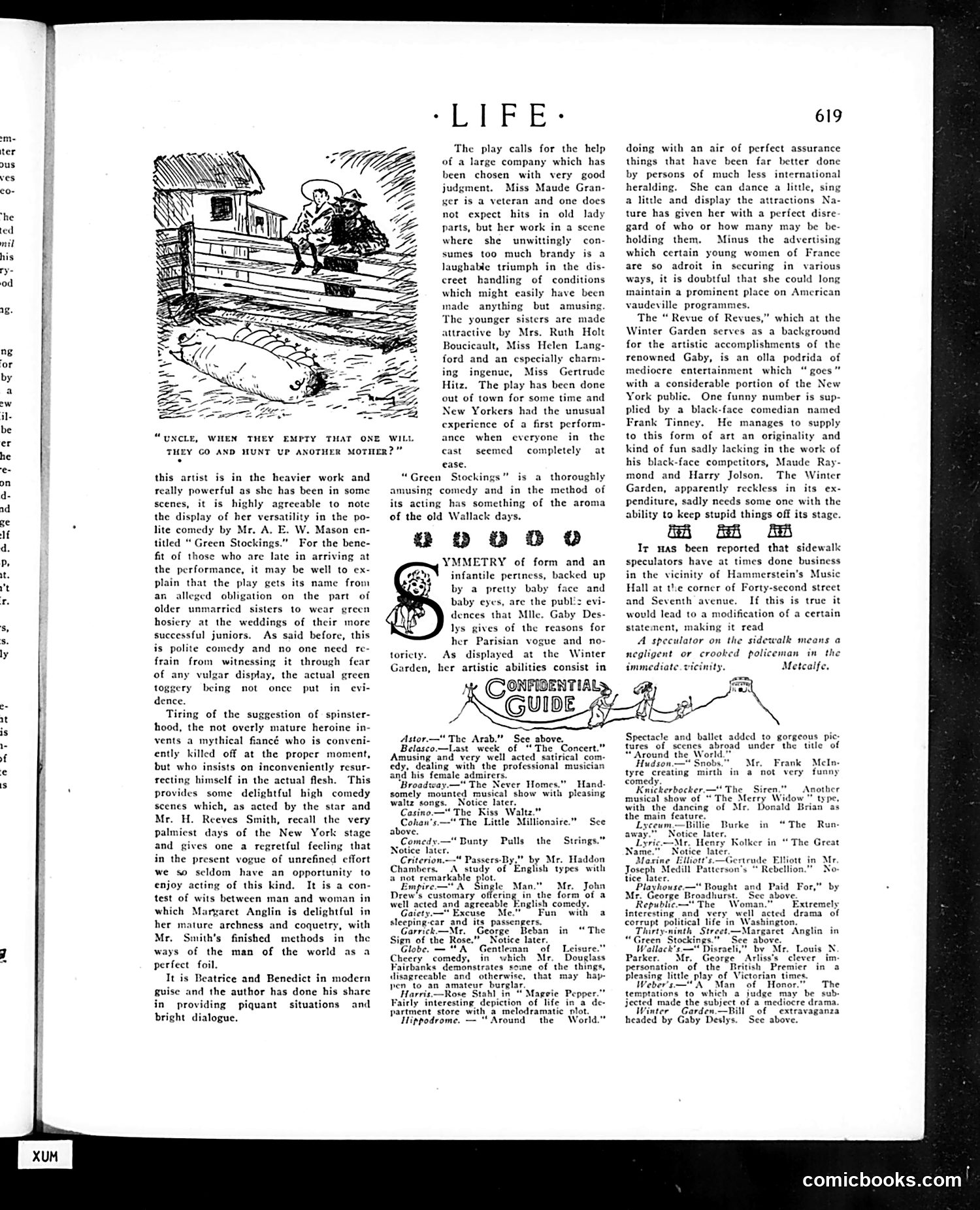
This page contains theater reviews rather than political cartoons. The main illustration shows a domestic scene with the caption "UNCLE, WHEN THEY EMPTY THAT ONE WILL THEY GO AND HUNT UP ANOTHER MOTHER?" — appearing to satirize large families and population concerns common to early 20th-century American humor. The reviews discuss Broadway productions, particularly praising "Green Stockings," a comedy about unmarried sisters wearing green hosiery at younger sisters' weddings. The reviewer notes the play's wit and polished acting, comparing it favorably to classical theater ("Beatrice and Benedict in modern guise"). A separate notice discusses performer Mlle. Gaby Deslys, describing her as embodying "symmetry of form and infantile pertness." The page reflects early 1900s entertainment culture, focusing on legitimate theater rather than political satire, with a "Confidential Guide" section listing other current shows.
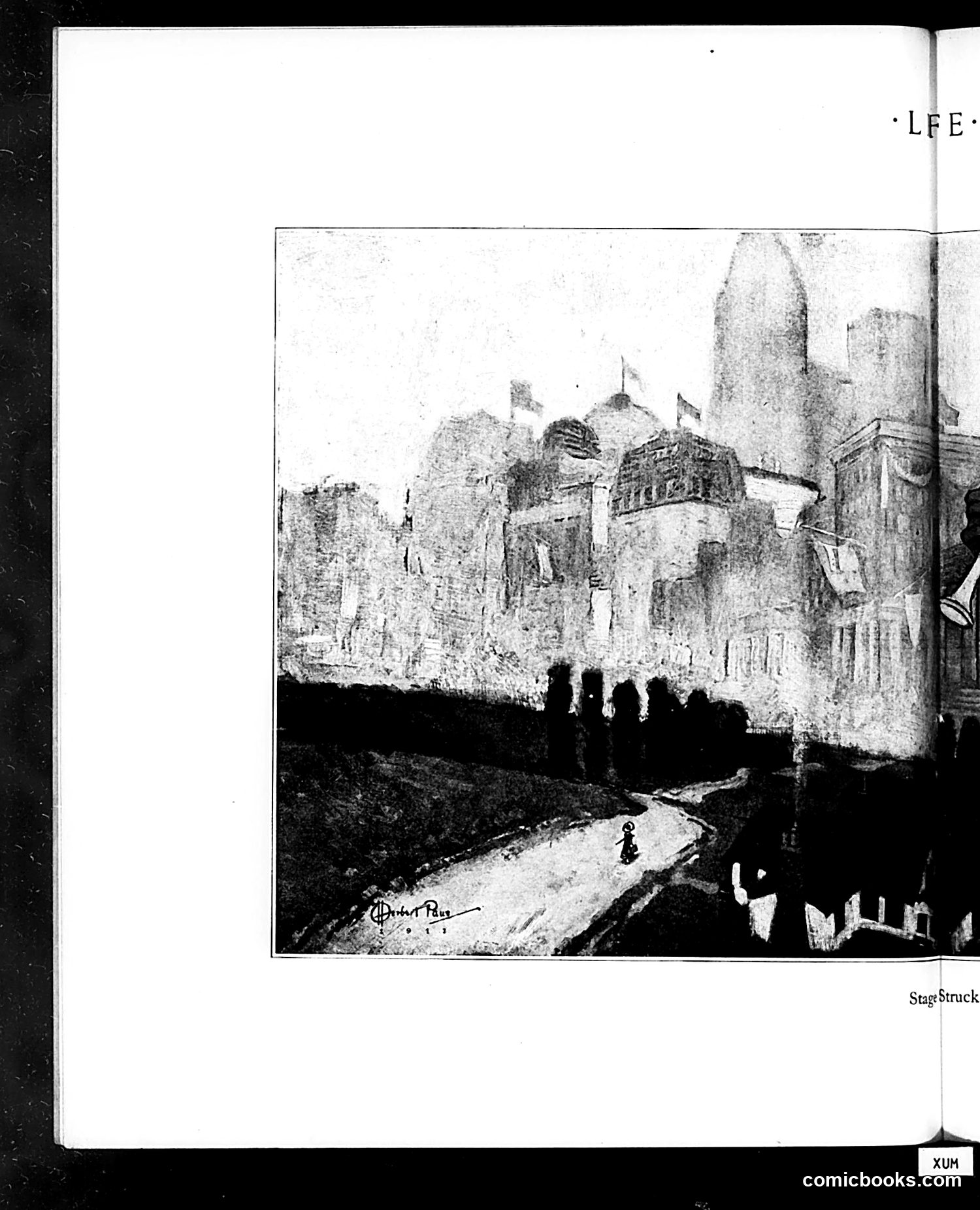
This appears to be an illustration showing a theatrical or architectural scene rather than a political cartoon. The image depicts a medieval castle or fortified structure with towers and flags, viewed from a distance along a winding path. Silhouetted figures appear in the foreground on the right side. The caption "Stage Struck" suggests this is theatrical scenery or a stage set design, possibly for a production involving a castle setting. The signature visible on the image appears to be "Orson Ross" or similar. Without additional context about which Life magazine issue this appears in or what theatrical production it references, the specific satirical point remains unclear. It could be commentary on elaborate theatrical productions or stagecraft, but the exact target of the satire cannot be determined from the image and text alone.
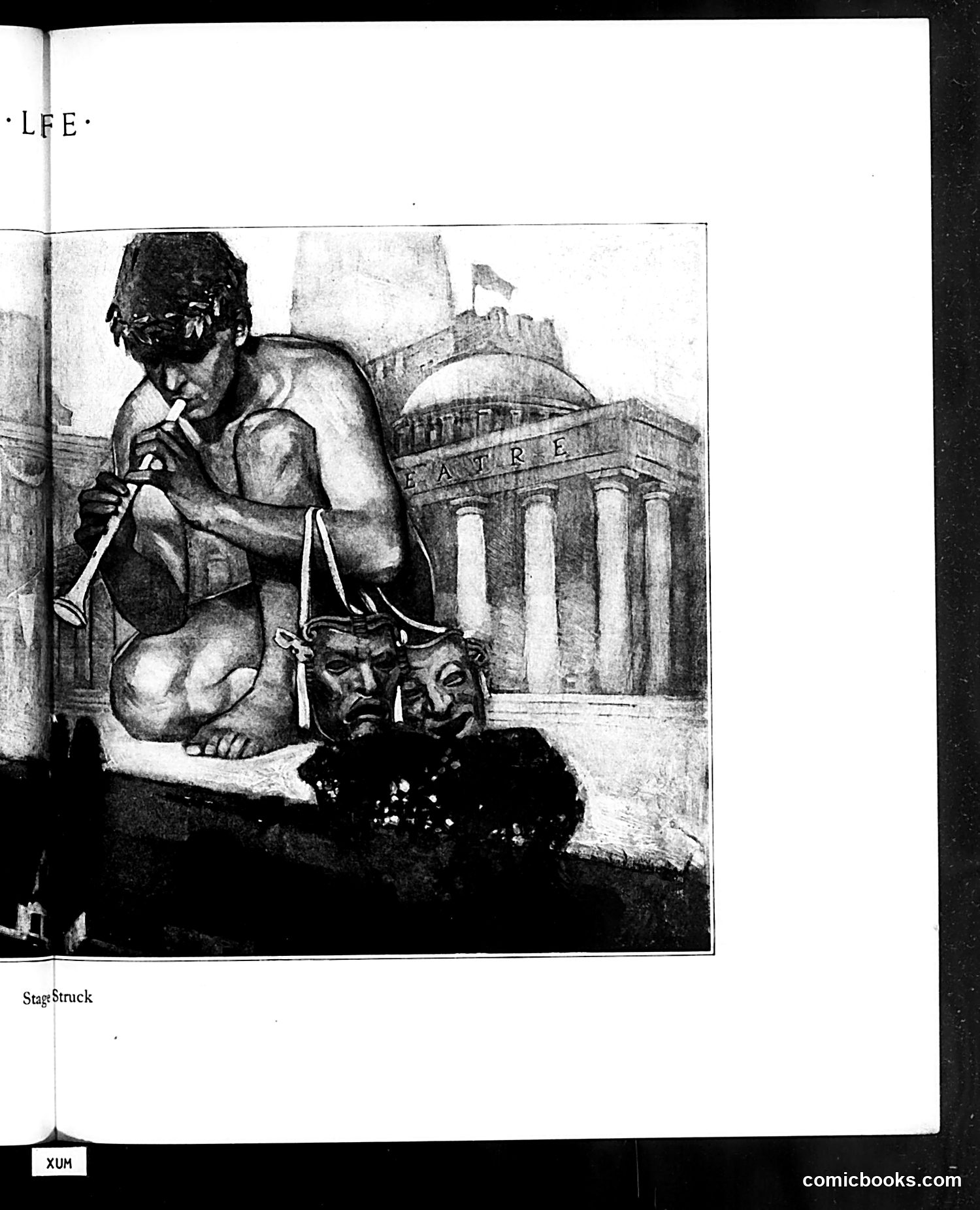
This satirical cartoon depicts a classical figure (appearing to be a reference to ancient drama or theater) sitting cross-legged while holding theatrical masks—the traditional symbols of comedy and tragedy. Behind him stands a classical building with columns, resembling a Greek or Roman temple. The title "Stagestruck" suggests commentary on theatrical ambition or obsession with stage performance. The juxtaposition of the classical figure contemplating the masks against the grand architectural backdrop likely satirizes either: - The pretension of theatrical performers or audiences - The enduring influence of classical drama on contemporary theater - Someone's theatrical aspirations or affected behavior Without additional context or publication date visible, the specific target of satire remains unclear, but the image mocks theatrical or dramatic affectation through classical reference.
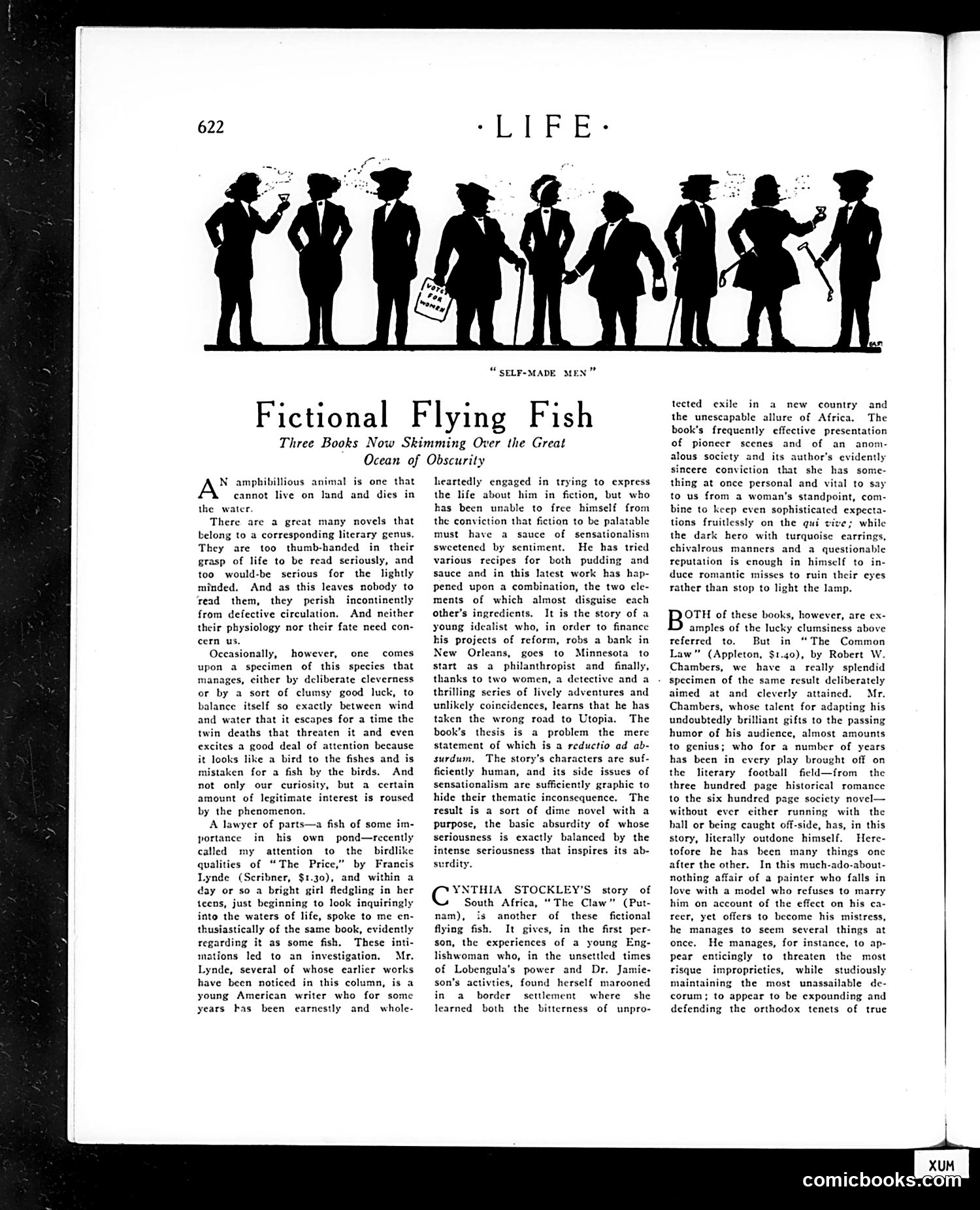
The silhouette cartoon titled "Self-Made Men" depicts nine figures in business attire—a satirical commentary on the self-made man myth popular in American culture. The page reviews three mediocre novels using the metaphor of "fictional flying fish"—books that awkwardly balance between serious literature and popular entertainment, belonging fully to neither genre. Life critiques Francis Lynde's *The Price*, about an idealistic bank robber who turns philanthropist, as a poorly conceived "dime novel with a purpose." Similarly, Cynthia Stockley's *The Claw*, set in colonial South Africa during the Lobengula and Jameson era, is dismissed as overwrought melodrama despite occasional effective passages. The satire mocks novels attempting simultaneously to entertain and moralize—works too sensational for serious readers but too earnest for light entertainment. Life suggests such books, lacking clear identity, die from poor circulation and critical neglect.
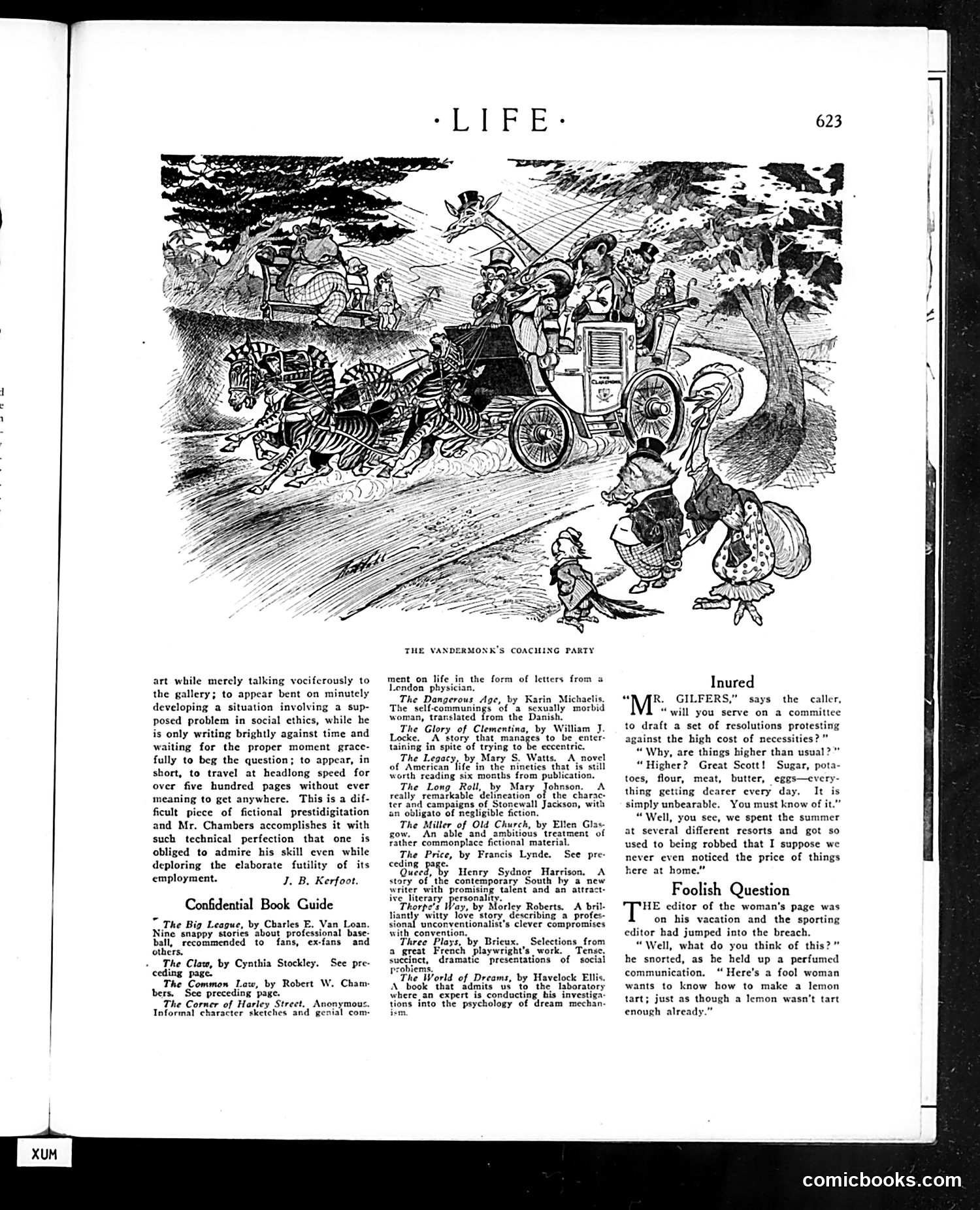
The main illustration depicts a chaotic coaching party — apparently wealthy vacationers on an outing — with exaggerated, caricatured figures in a deliberately absurd scene. The satire targets the leisure class and their pretensions. The two text pieces below offer social commentary. "Inured" mocks the wealthy for becoming so accustomed to being "robbed" at vacation resorts that they no longer notice inflated prices at home — satirizing both their obliviousness and the exploitation of tourists. "Foolish Question" ridicules a male sports editor filling in for the women's page editor, presenting his dismissive attitude toward domestic/cooking advice as absurd (the joke being his obtuse literalism about a "lemon tart"). Together, the page satirizes class blindness, gender roles, and journalistic pretension through humor aimed at early 20th-century American readers.
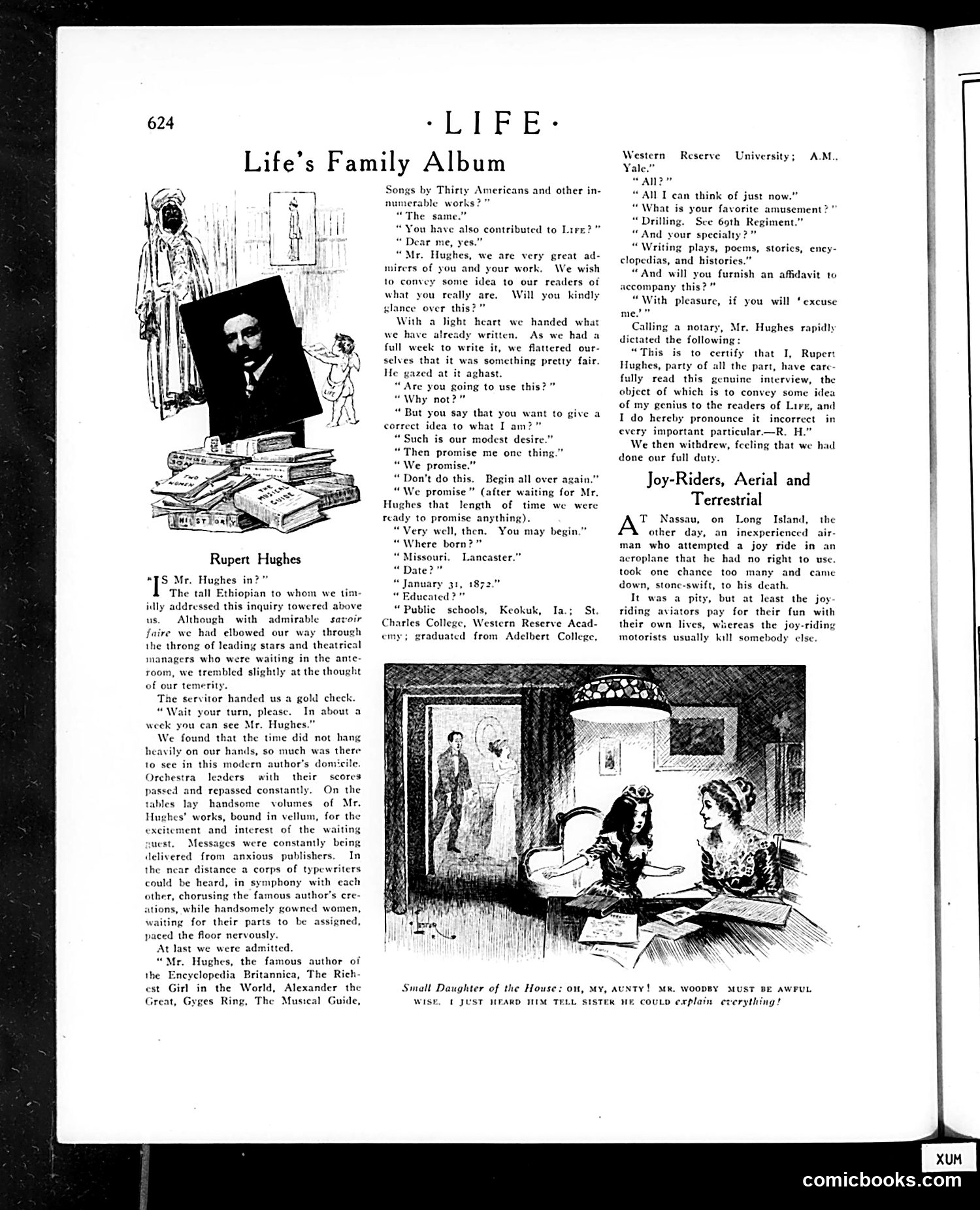
This page satirizes **Rupert Hughes**, a prolific early-20th-century author and playwright. The humor operates on multiple levels: **The Main Satire**: The interview format mocks Hughes's extreme productivity and self-importance. The writer submits an article about Hughes, who finds it "incorrect in every important particular" and demands a complete rewrite—then signs an affidavit pronouncing the corrected version equally wrong. This absurdist loop ridicules both Hughes's impossible standards and the obsequious nature of celebrity journalism. **Social Context**: Hughes was genuinely famous for writing numerous works (encyclopedias, plays, histories). The satire exaggerates this into parody, showing his office mobbed with theatrical people, typists, and anxious writers—a swipe at celebrity worship and publishing industry desperation. **The Secondary Cartoon**: The bottom illustration satirizes wealthy people's casual danger-seeking. Joy-riding aviators at least risk only themselves, while motorists (joy-riders in cars) endanger the general public—a commentary on reckless automobile culture and class privilege. The tone is affectionate mockery typical of Life's satirical approach to prominent figures.
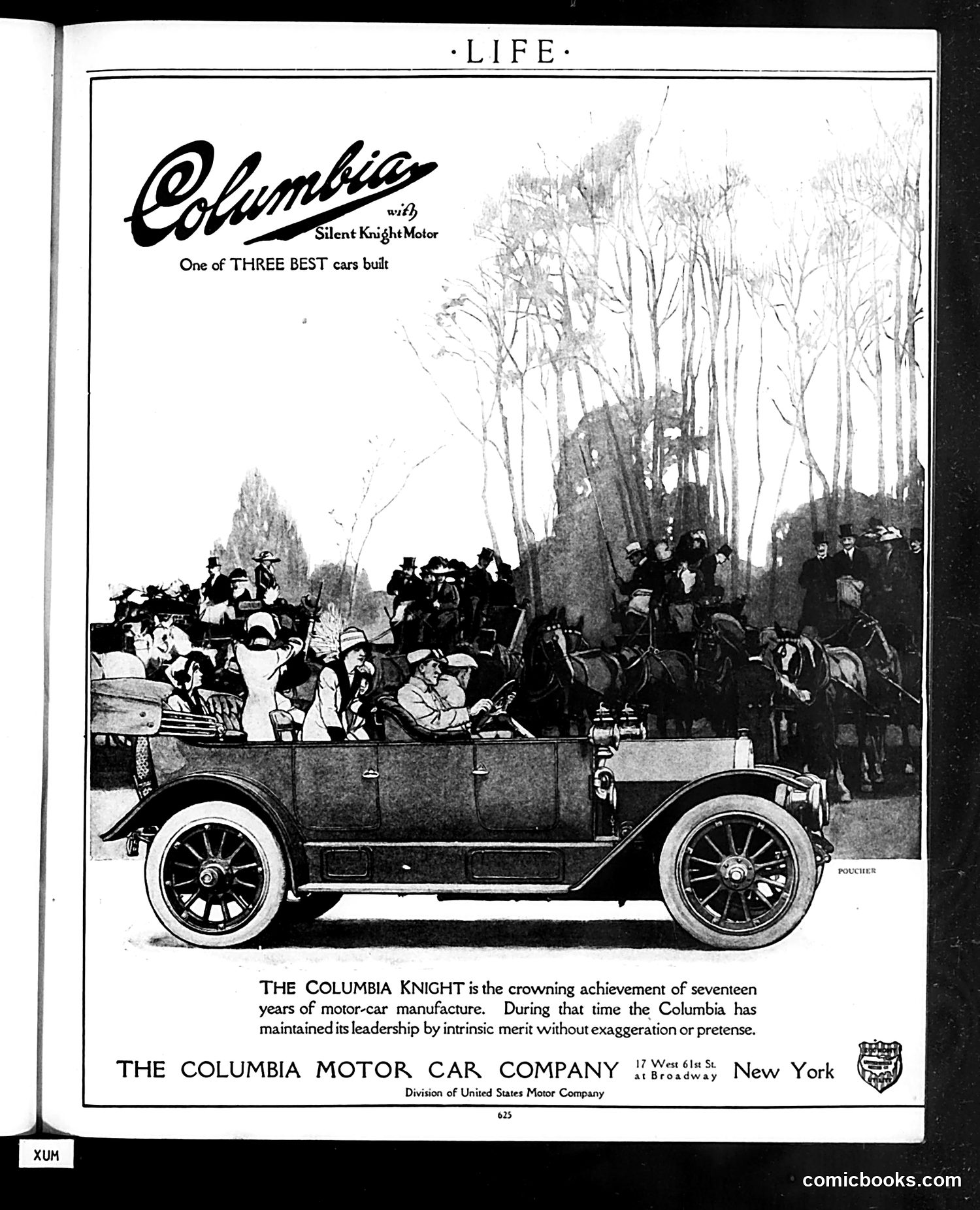
This is a **straightforward advertisement**, not satire or political commentary. The page promotes the Columbia Knight automobile, manufactured by the Columbia Motor Car Company in New York (a division of United States Motor Company). The ad claims the Columbia is "one of THREE BEST cars built" and emphasizes 17 years of manufacturing history and "leadership by intrinsic merit without exaggeration or pretense"—ironically claiming no exaggeration while making a bold "best cars" claim. The illustration shows a truck-body vehicle loaded with well-dressed passengers at what appears to be a formal outdoor gathering, with mounted horsemen in the background. This imagery suggests the car's reliability and capacity for social occasions. The tone is typical early-automotive-era advertising: appeals to quality, heritage, and respectability. No specific historical figures or satirical targets are evident.
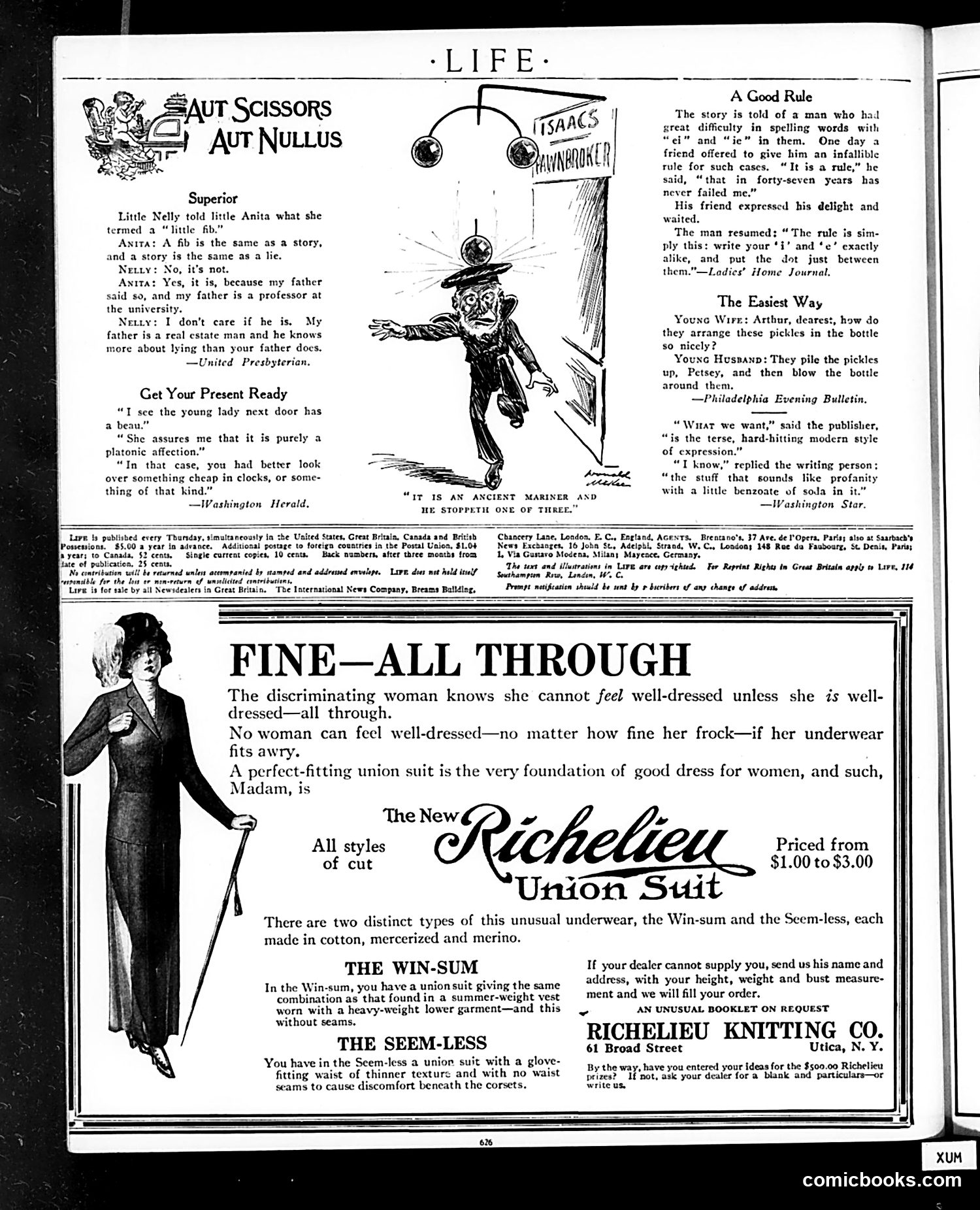
This page mixes humor columns with advertising. The top section contains several brief jokes: - **"Aut Scissors Aut Nullus"**: A children's debate about whether fibs equal lies, satirizing how children invoke parental authority (a professor father vs. a real estate father who "knows more about lying"). - **"Get Your Present Ready"**: A joke about a young woman's suitor, where the punchline suggests if affection is "platonic," buy cheap gifts. - **"A Good Rule"**: Mocks a supposedly infallible spelling rule that turns out to be useless advice. - **"The Easiest Way"** and other quips: Brief domestic humor and editorial satire. The **main illustration** (center) shows a caricatured figure juggling or manipulating pendulums labeled "ISAAC" and "RAWBROKER"—likely satirizing financial manipulation or marketplace chicanery, though the specific reference is unclear. The **lower half** is a full-page advertisement for **Richelieu Union Suits** (women's undergarments), emphasizing that proper underwear is foundational to appearing well-dressed—typical early 20th-century advertising messaging.
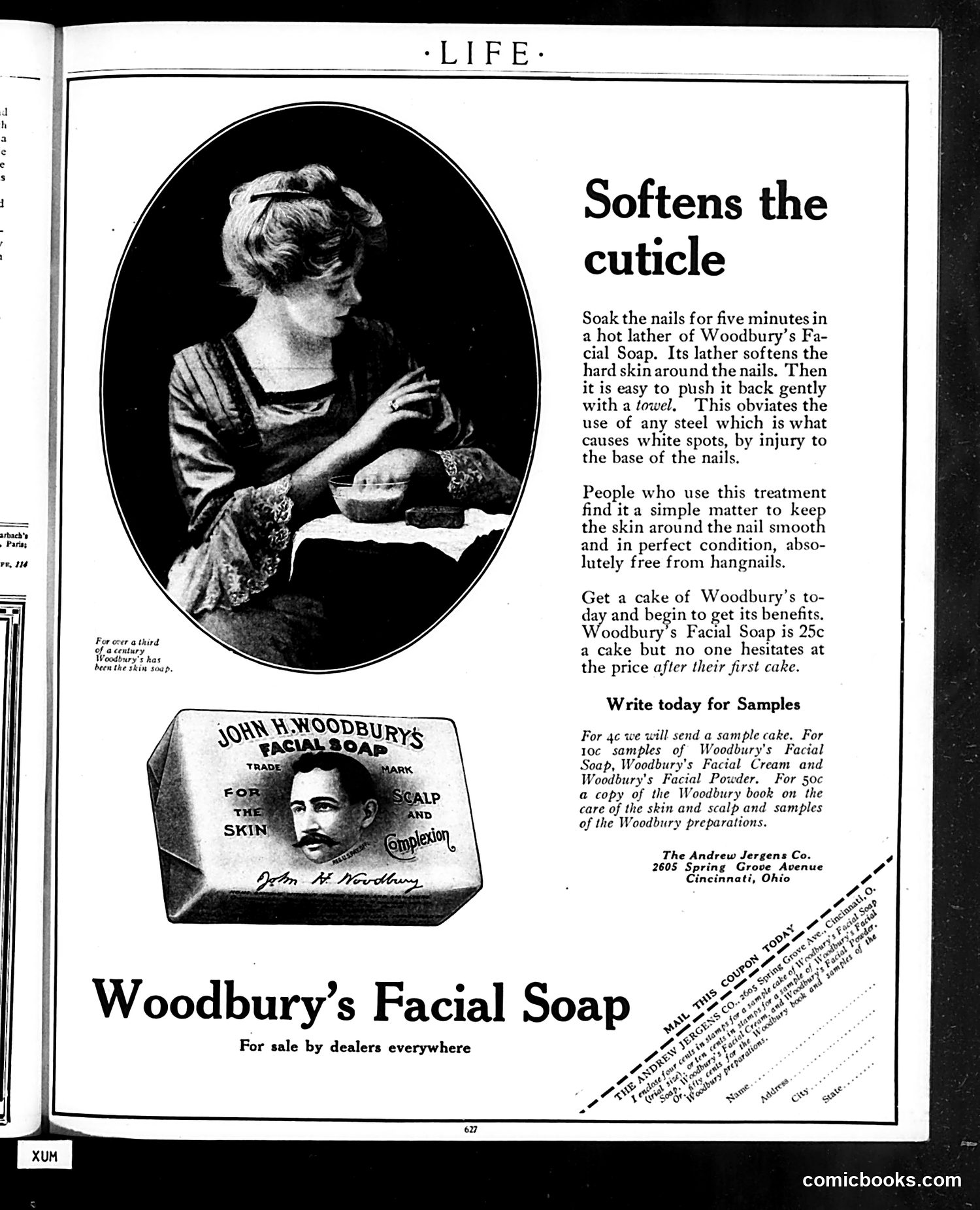
This is a **beauty product advertisement**, not a political cartoon. It promotes Woodbury's Facial Soap, claiming over a third-century of use. The page features a photograph of a woman demonstrating proper nail care: soaking nails in hot soapy lather, then gently pushing back cuticles with a towel rather than steel tools (which allegedly cause white spots and hangnails). The advertisement emphasizes that while the soap costs 25 cents per cake, customers won't hesitate after trying it. It offers free and low-cost samples and instructional materials about skincare. The soap bar image includes John H. Woodbury's portrait—the apparent founder or namesake product. The messaging targets middle-class women concerned with grooming standards of the era, positioning proper nail and skin care as achievable through this commercial product. There is no satire or political content visible on this page.
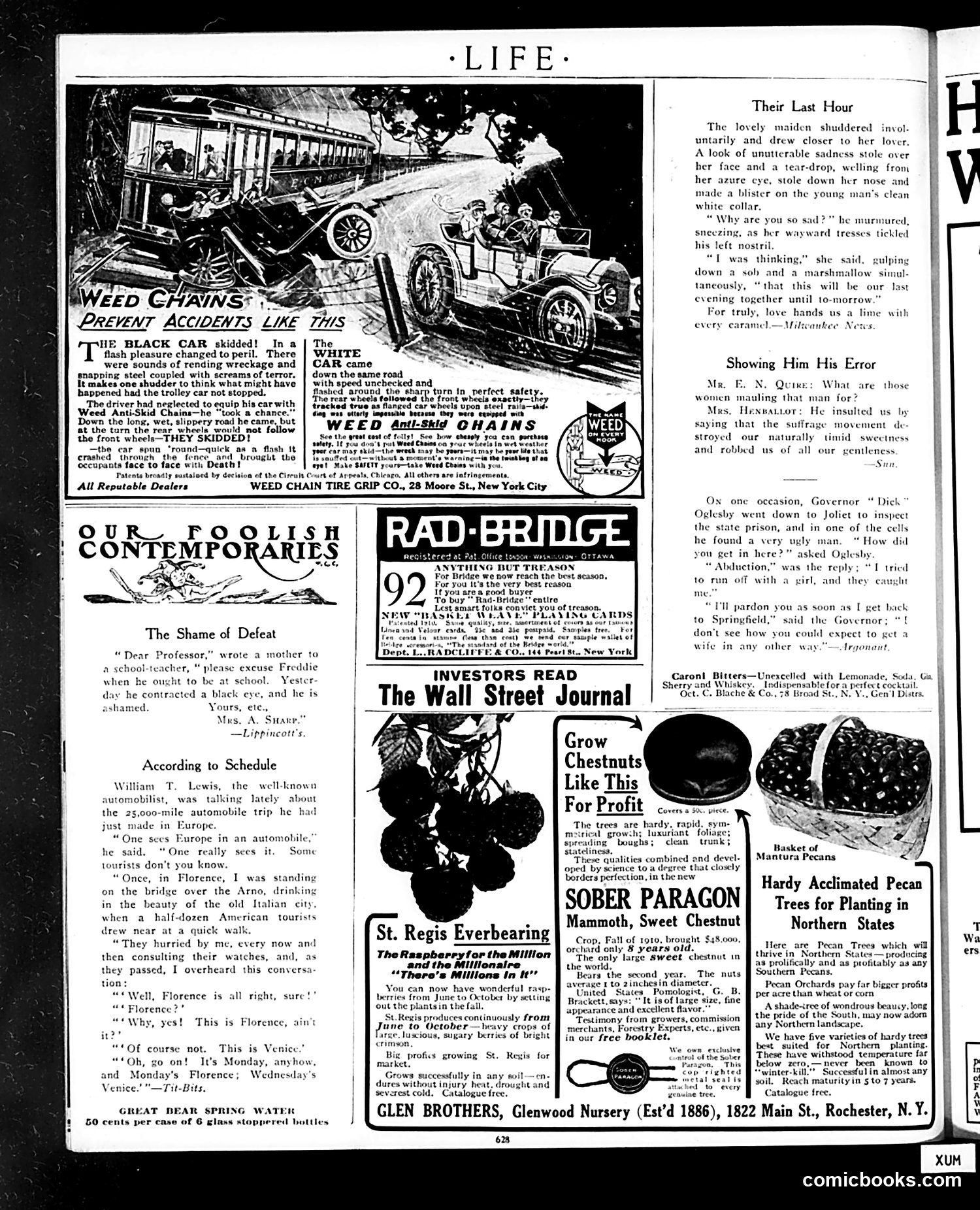
This page combines **satirical humor pieces** with **period advertisements**: The main satirical content includes: 1. **"Their Last Hour"** — A romantic parody mocking sentimental melodrama. A couple's tearful goodbye is undercut by absurd physical comedy (tears creating blisters, hair tickling noses). 2. **"Showing Him His Error"** — Brief dialogue satirizing anti-suffrage arguments, presenting a man's claim that women's suffrage "destroyed our natural timid [nature]" as obviously ridiculous. 3. **"According to Schedule"** — Humor about American tourists rushing through Europe on strict schedules, unable to appreciate destinations. The punchline: tourists confuse Venice with Florence because "Monday's Florence; Wednesday's Venice." 4. **"The Shame of Defeat"** — A mother's note excusing her son from school for contracting a "black eye." The advertisements (Weed Chains, Rad-Bridge, etc.) are typical period commercial content promoting automobile safety and agricultural products. The page reflects early 20th-century American life, automobiles, and emerging women's suffrage debates.
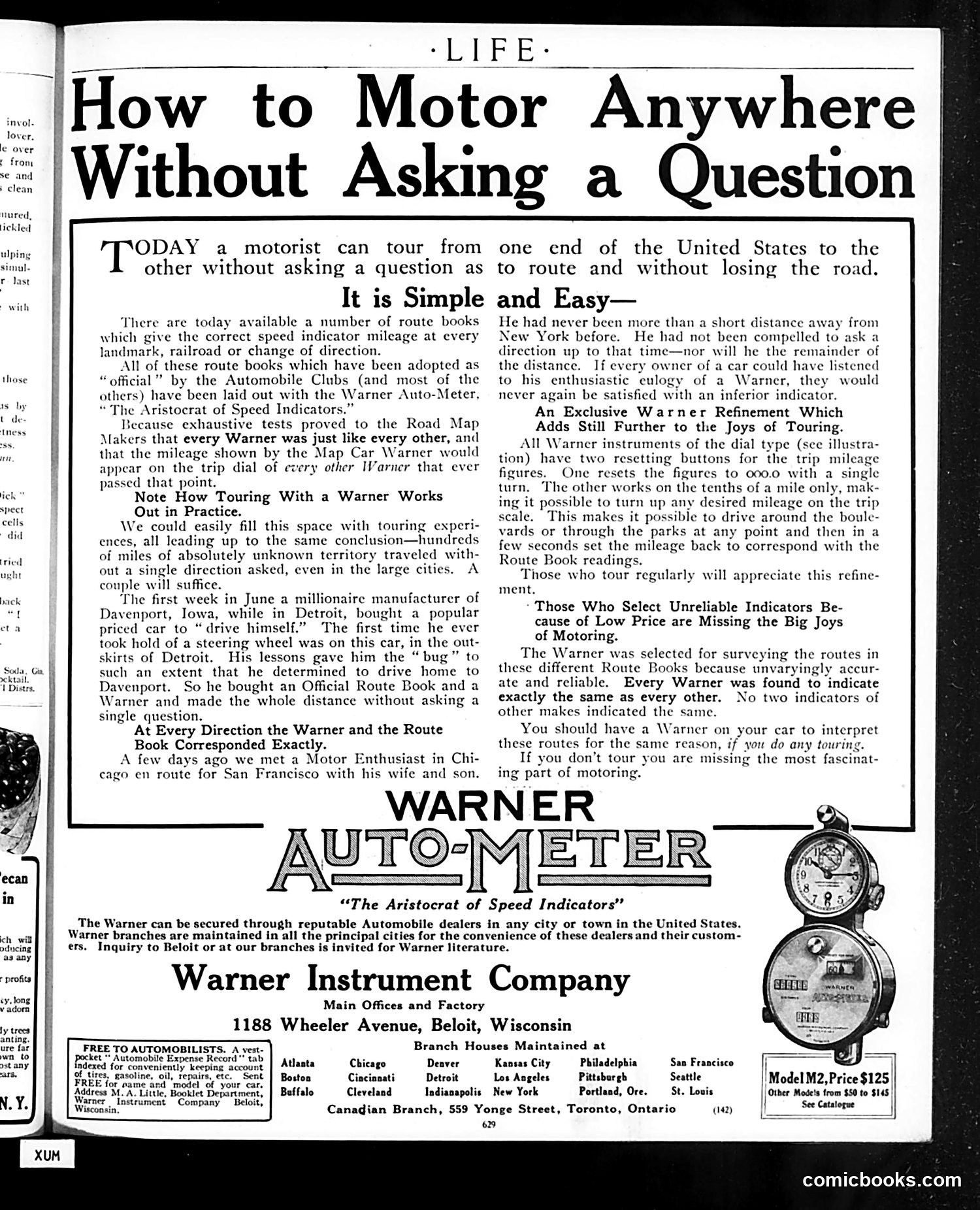
This is primarily a **product advertisement**, not satire or political commentary. It promotes the Warner Auto-Meter speedometer/odometer to early motorists (circa 1910s-1920s). The page's humor is gentle and practical rather than satirical: it highlights how reliable speed indicators solve a real problem for automobile tourists—getting lost. The anecdotes (a Detroit manufacturer successfully driving to Iowa as a first-time driver; a Chicago family reaching San Francisco) celebrate automotive independence and the freedom of the open road. The advertisement emphasizes that Warner instruments were standardized and used to survey official route books, making navigation possible without asking for directions—a notable achievement when automobile travel was still novel. The appeal targets affluent motorists proud of their self-reliance and adventurousness. No identifiable political figures or caricatures appear. This is commercial copy showcasing early 20th-century American optimism about automobile technology and leisure travel.
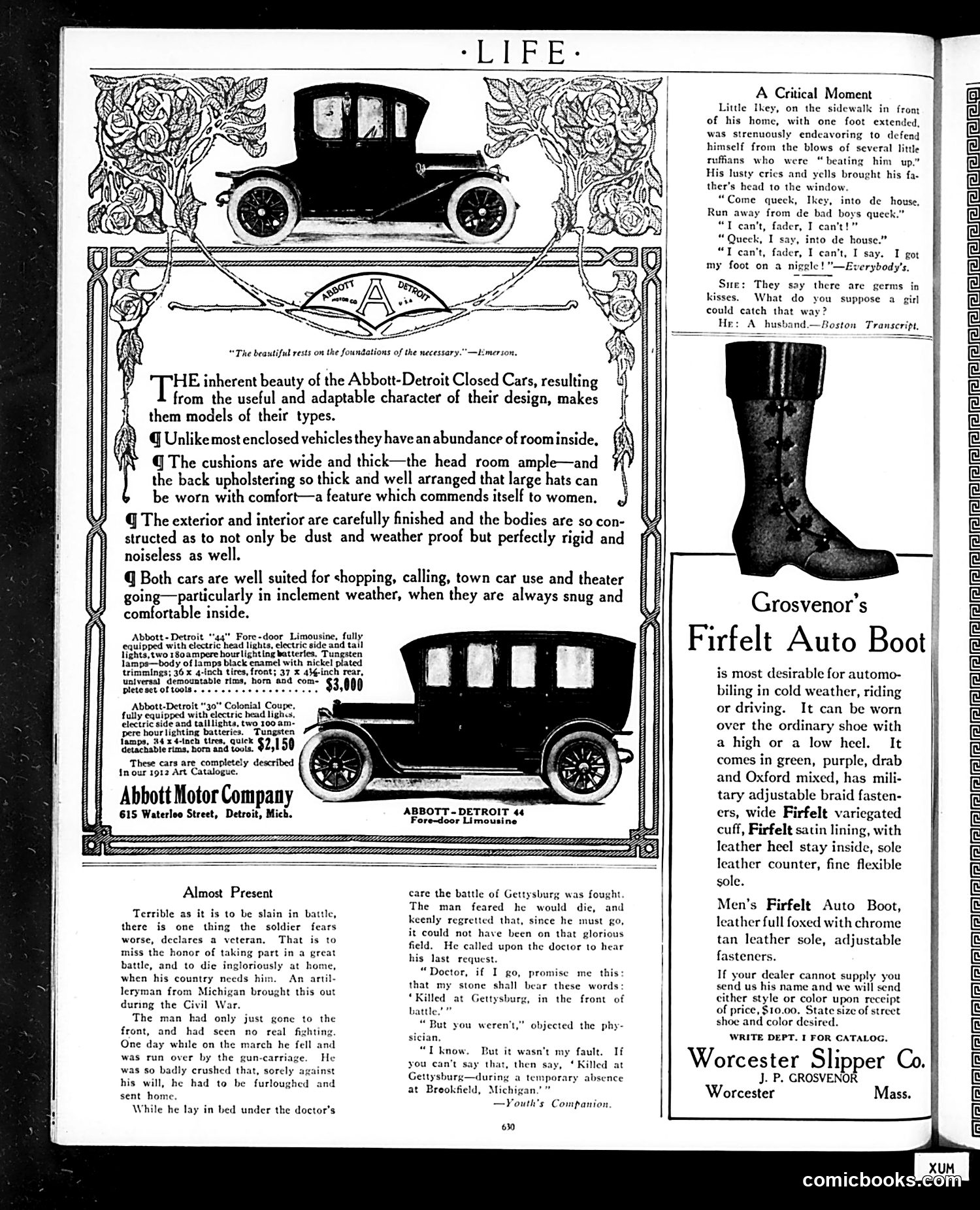
This page is primarily **advertising** for Abbott-Detroit automobiles, alongside period humor pieces. The main satirical content includes: **"Almost Present"**: A Civil War anecdote where a soldier, accidentally injured and furloughed before the Battle of Gettysburg, requests his tombstone read "Killed at Gettysburg"—despite not actually fighting there. The joke mocks his desire for martial glory over honest reality. **"A Critical Moment"**: A brief ethnic humor piece (common to early 1900s Life) depicting a Jewish boy ("Ikey") being beaten and refusing his father's calls to escape because he has his foot on another boy. The humor relies on period stereotypes. **"Sue"**: A brief, crude joke about germs in kisses. The bulk of the page promotes Abbott-Detroit closed automobiles, emphasizing comfort features—spacious interiors, thick cushions, ample headroom for women's hats—positioning them as superior enclosed vehicles for shopping, theater, and inclement weather. Additional advertisements promote the Grosvenor Firfelt Auto Boot and Worcester Slipper Co.
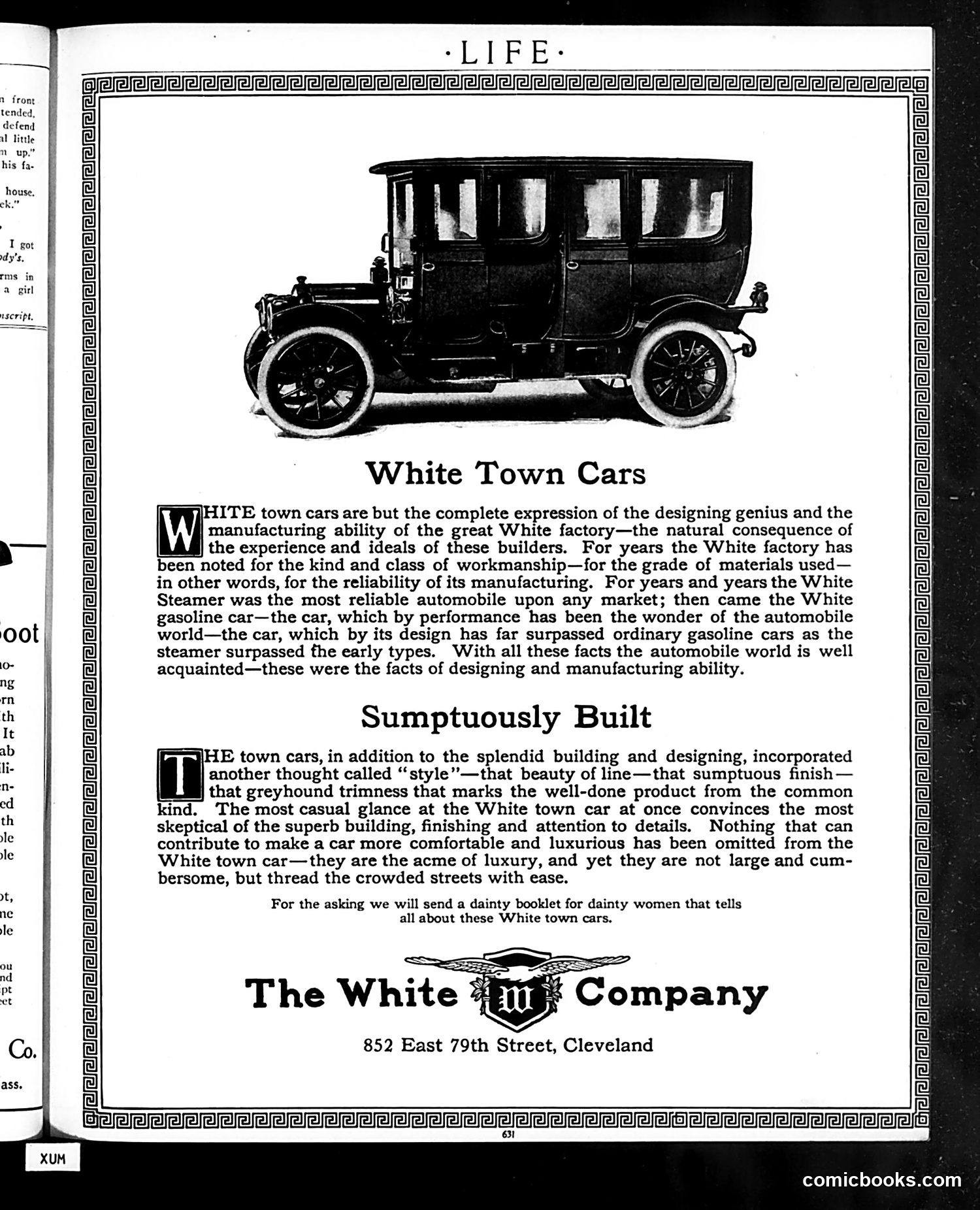
This is **not a cartoon or satire**—it's a straightforward automobile advertisement from *Life* magazine, likely from the 1910s-1920s era. **What it is:** A full-page ad for the White Company's luxury automobile, specifically their "town car" model, manufactured in Cleveland, Ohio. **The pitch:** The ad emphasizes White's reputation for reliability (their steamers were "most reliable" on the market) and argues their gasoline cars now match that quality while adding luxury styling. Key selling points include superior craftsmanship, elegant design ("greyhound trimness"), comfort, and the practical advantage of being compact enough to navigate crowded city streets—important for wealthy urban buyers. **Notable detail:** The ad offers "a dainty booklet for dainty women," reflecting early 20th-century gender marketing assumptions about car-buying decisions or influence. This represents how premium automotive manufacturers positioned themselves during the transition from steam to gasoline vehicles.
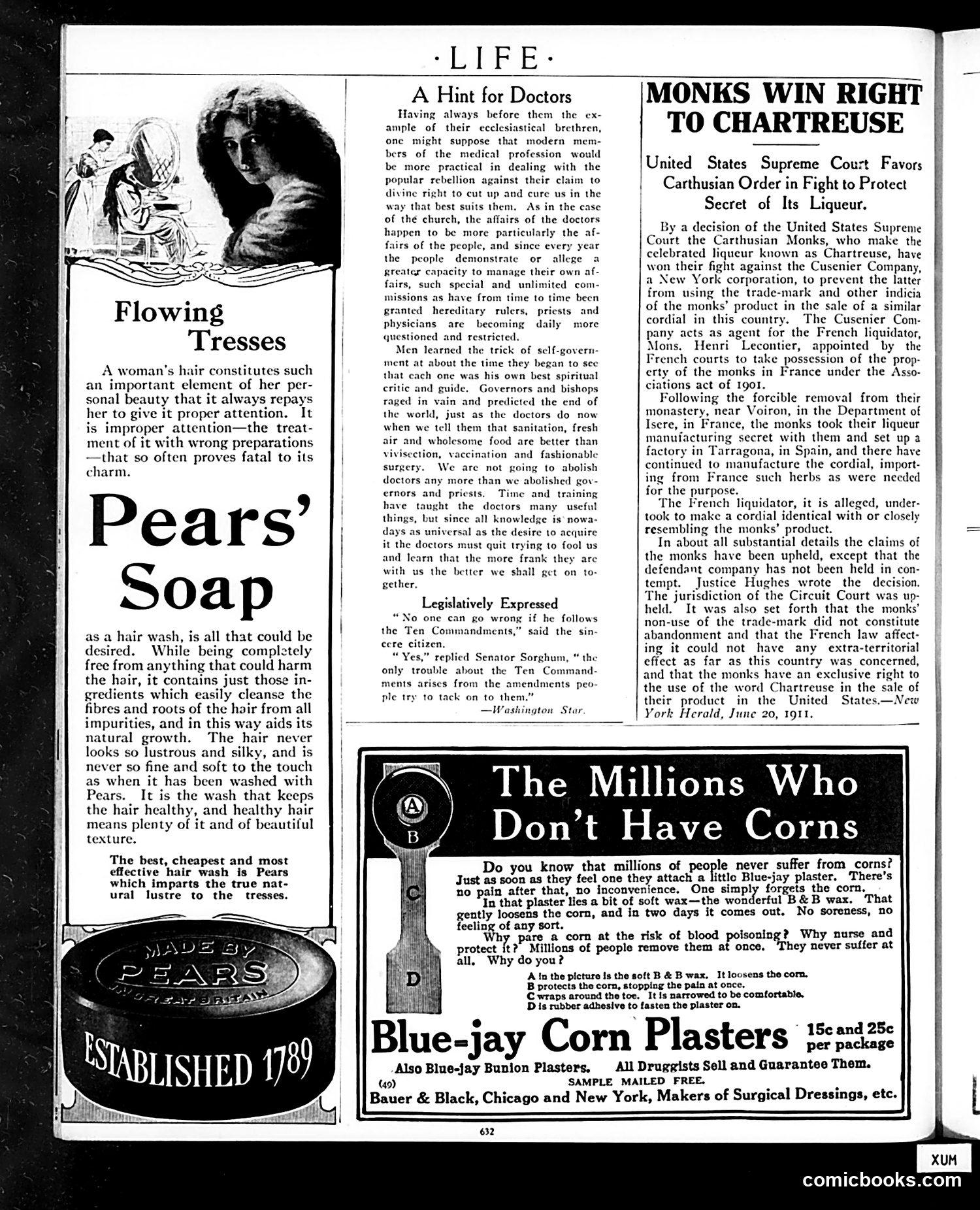
This page contains **advertising and news content**, not political cartoons. The main items are: 1. **Pears' Soap advertisement** (left): A traditional beauty product ad emphasizing hair care, established 1789. 2. **"A Hint for Doctors"** (center): A satirical editorial criticizing the medical profession's resistance to public input and scientific improvements. It compares doctors to clergy, arguing both professions resist oversight. The piece mocks doctors' opposition to sanitation, fresh air, and proper food in favor of "vivisection, vaccination and fashionable surgery"—suggesting doctors were slow to embrace modern preventive medicine. 3. **Monks Win Right to Chartreuse** (right): News coverage of a U.S. Supreme Court decision protecting Carthusian monks' trademark for their liqueur against a French company trying to market a similar product. 4. **Blue-jay Corn Plasters advertisement** (bottom): A commercial product promoting corn relief. The page reflects early 20th-century concerns about professional authority and consumer protection.
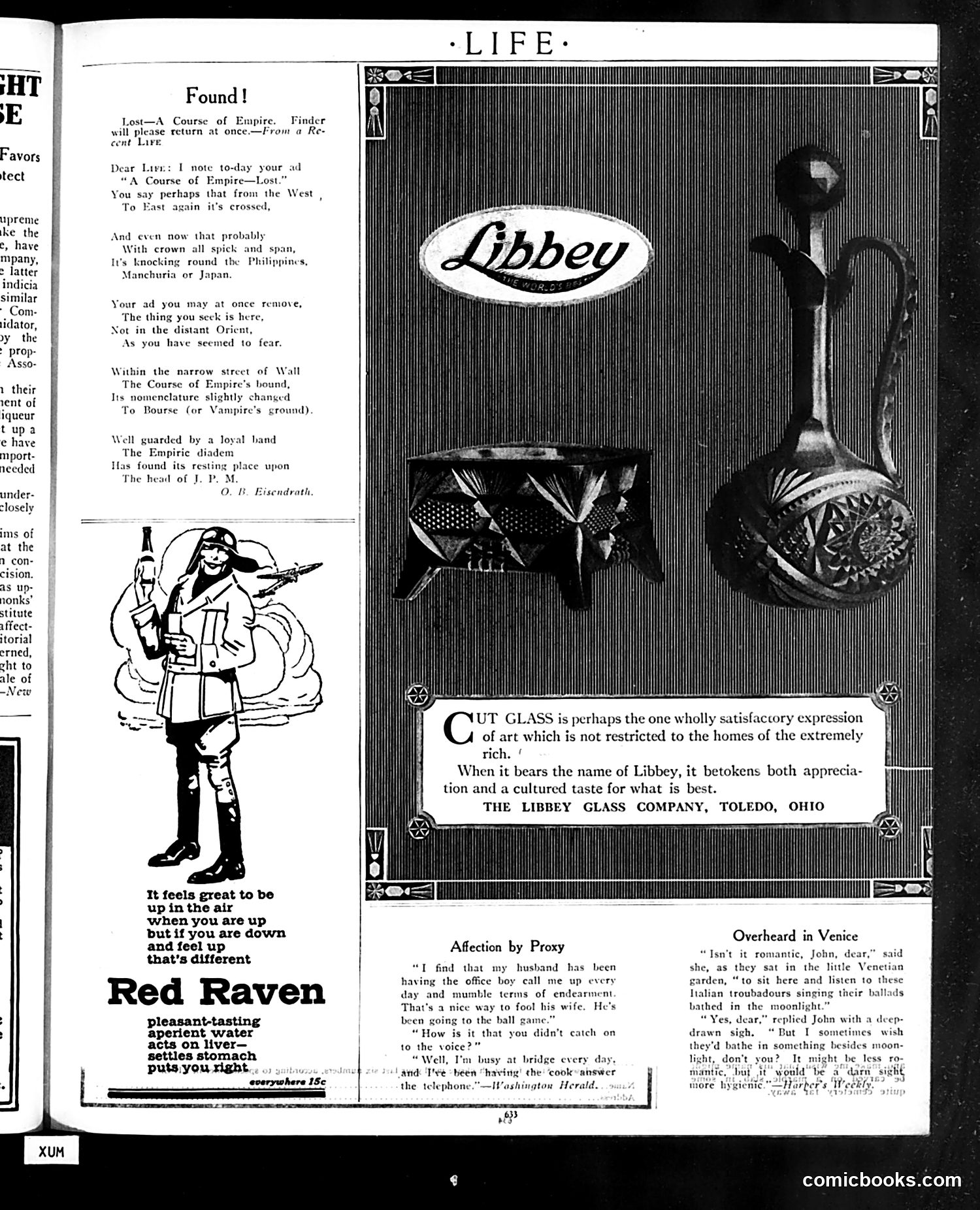
This page contains two distinct pieces: **Left side:** A poem titled "Found!" about a lost book ("A Course of Empire") that has allegedly traveled from West to East and is now circulating in the Philippines, Manchuria, or Japan. The accompanying cartoon shows a soldier/adventurer, satirizing the idea of imperial expansion and cultural dissemination. The joke appears to mock American imperial pretensions—the notion that Western cultural products are being "found" and spread across Asia. **Right side:** A Libbey Glass Company advertisement featuring decorative cut glass, claiming it represents accessible art for non-wealthy households. **Bottom:** Two short humor pieces: "Affection by Proxy" mocks a husband who has his office boy call his wife daily with endearments to fool her, and "Overheard in Venice" jokes about romance and infidelity in a Venetian garden setting. The page is primarily commercial content with light satirical humor typical of early 20th-century Life magazine's mix of advertising and comic commentary.
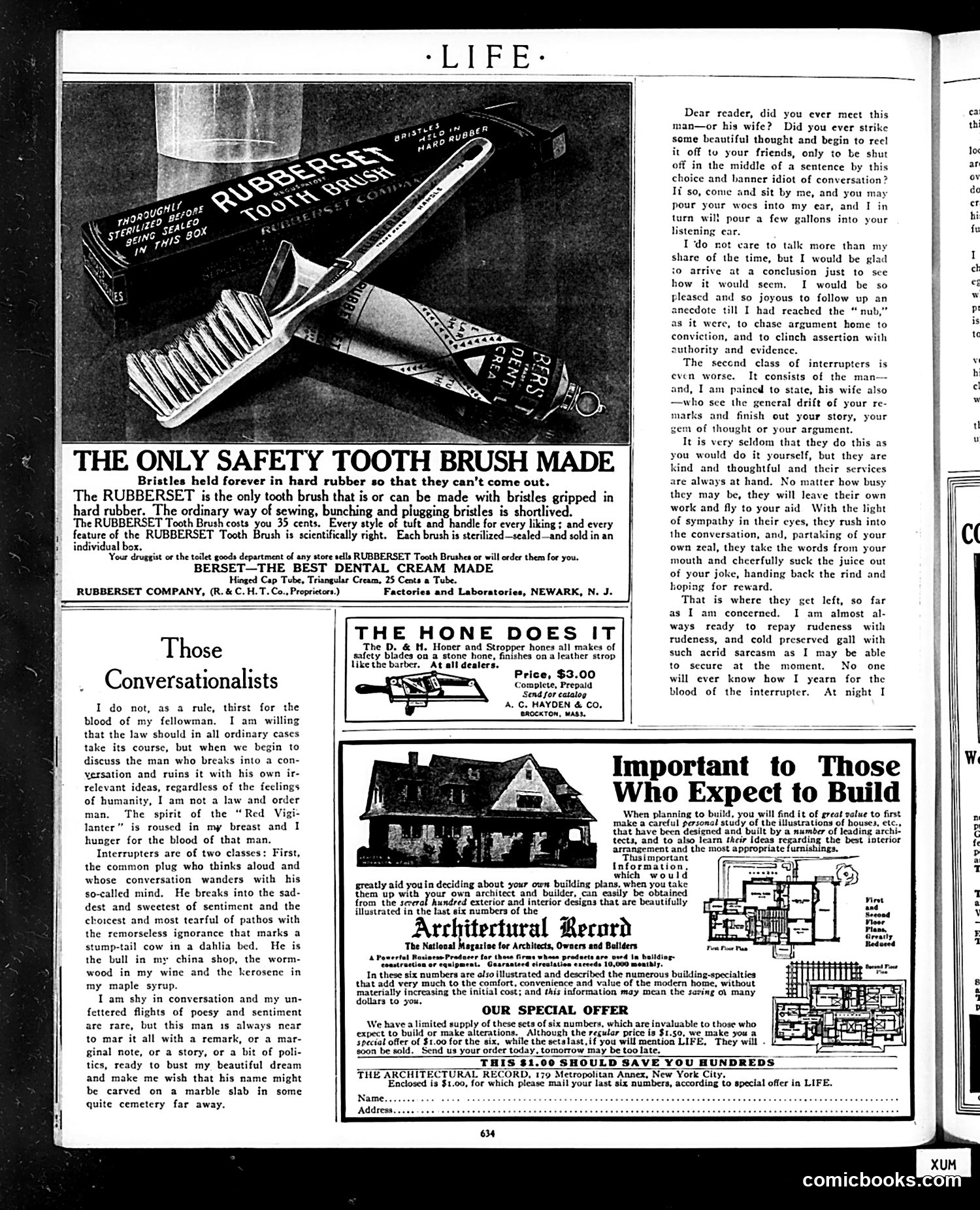
This page is primarily **advertising and editorial content**, not political satire. The main features are: **"Those Conversationalists"** (essay): A humorous social commentary by an unnamed author complaining about two types of people who interrupt conversations—those who dominate discussion and those who finish others' sentences. The author describes his frustration with these "interrupters" and fantasizes about responding with "acrid sarcasm." This is genteel, observational humor about social etiquette rather than political satire. **Advertisements dominate the page:** - Rubberset Tooth Brush ("the only safety tooth brush") - D. & M. Honer and Stropper (sharpening tool) - Architectural Record magazine - Building design services There are no political cartoons or caricatures. This is a typical early 20th-century *Life* magazine page mixing light social humor with commercial advertisements, reflecting middle-class anxieties about proper behavior.
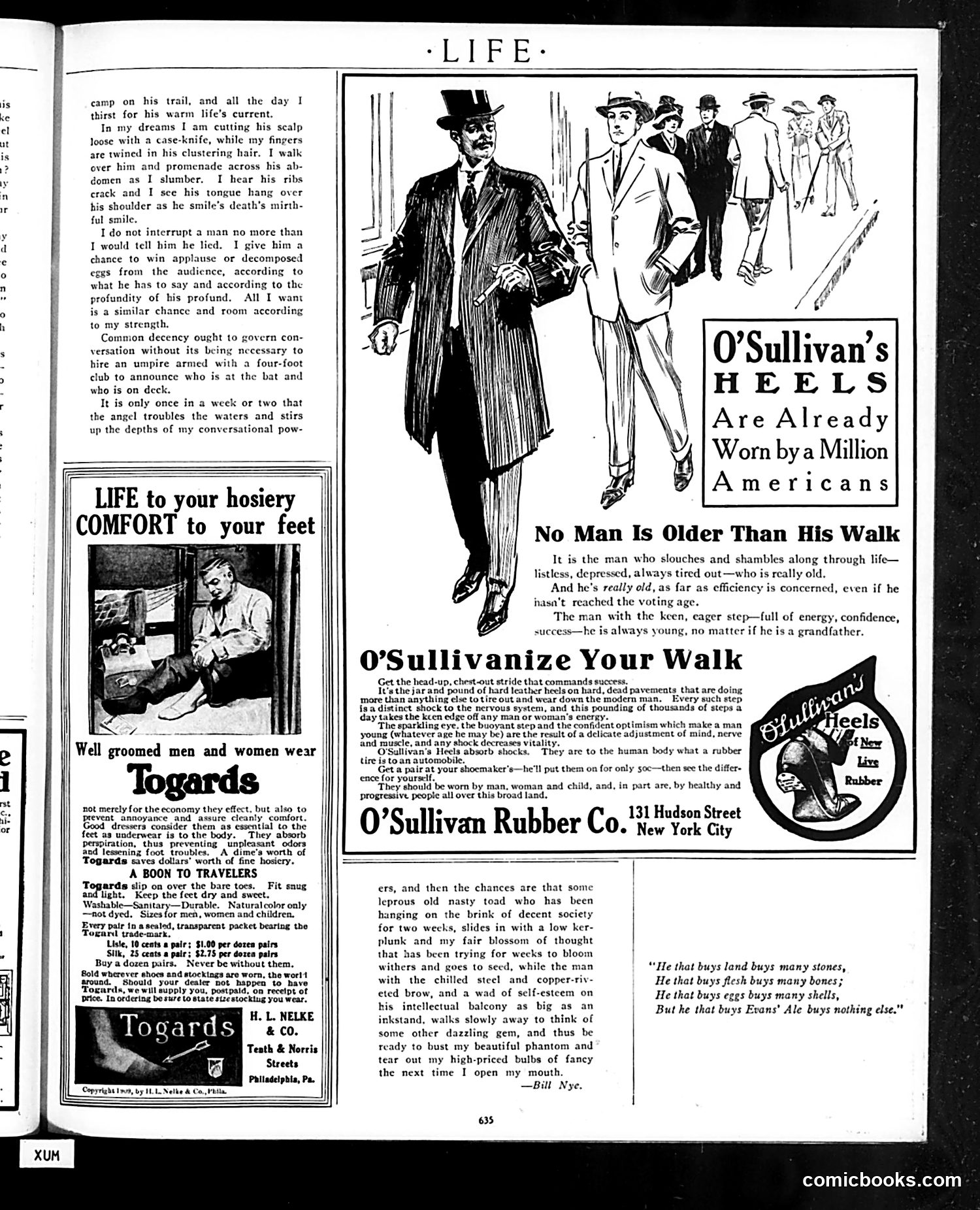
This page is primarily **advertising**, not political satire. The dominant content is a full-page ad for O'Sullivan Rubber Heels (a shoe product), which uses pseudo-philosophical messaging to market its product. **The "satire"** is actually marketing rhetoric disguised as life wisdom. The ad claims that a person's vitality and youth are determined by their walking posture and gait—and conveniently, O'Sullivan Heels (with shock-absorbing rubber) enable the energetic, confident stride associated with success and youth. The illustration shows well-dressed men walking with upright posture, contrasting the slouching "old" man with the vigorous "young" one. The text equates poor posture with depression and age, while good posture signals energy and success. This reflects **early 20th-century consumer culture**: using pseudoscientific health claims and psychological messaging to sell mundane products as lifestyle solutions. The smaller Togards hosiery ad uses similar appeals to comfort and propriety.
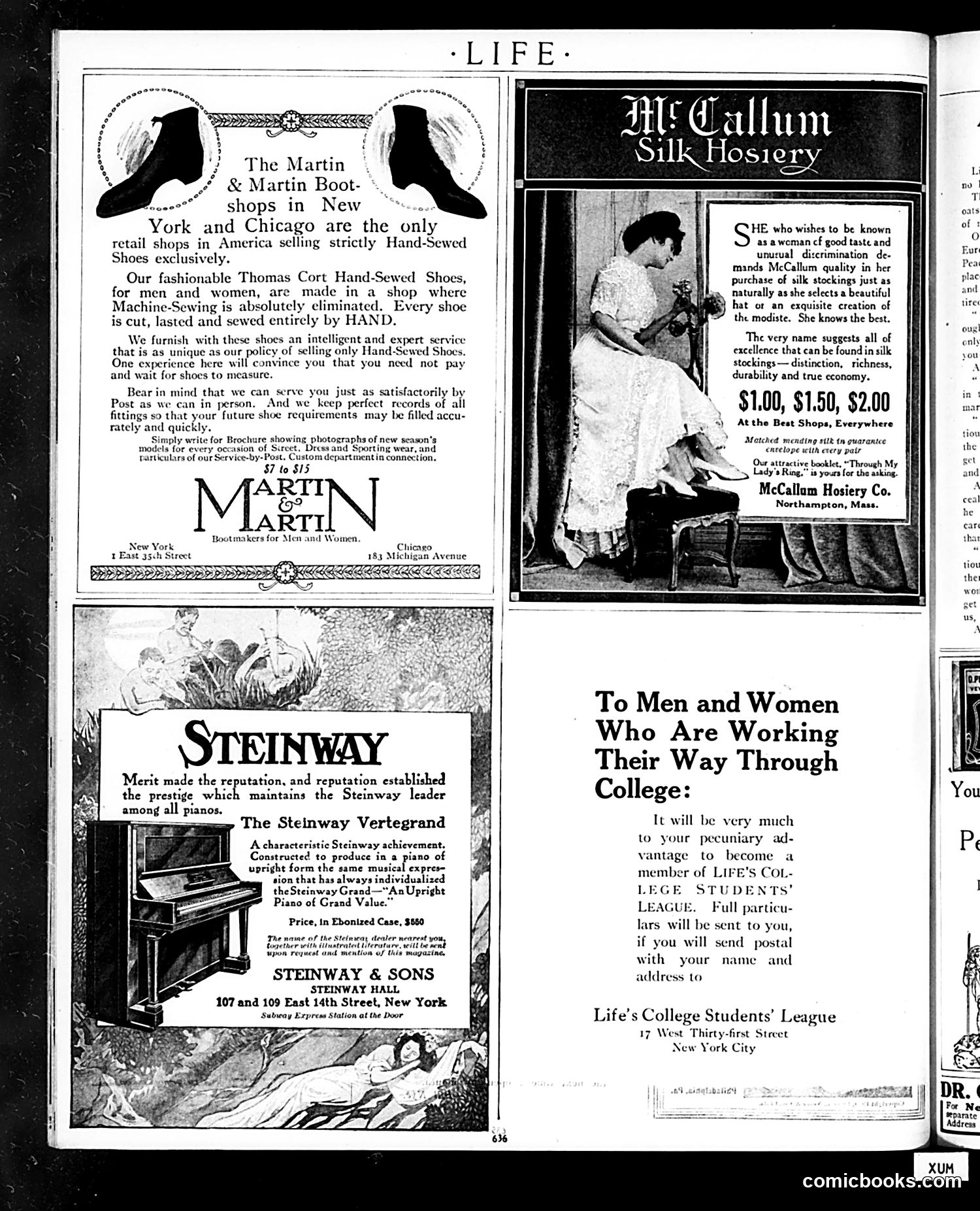
This is primarily an **advertising page** rather than satirical content. It contains four product advertisements typical of early 20th-century magazines: 1. **Martin & Martin Boots** — emphasizes hand-sewn craftsmanship and custom service, positioning luxury footwear as superior to machine-made alternatives. 2. **Steinway Pianos** — promotes their "Vertegrand" upright model, leveraging the brand's prestige for grand pianos into a smaller, more affordable format ($650). 3. **McCallum Silk Hosiery** — targets women concerned with "good taste" and "discrimination," using gendered language about fashion discernment. Prices range $1.00-$2.00. 4. **Life's College Students' League** — a membership recruitment ad offering financial advantages to working students. The ads reflect period values: craftsmanship over industrial production, aspirational consumption, and gendered marketing appeals. No political satire or caricature is present on this particular page.
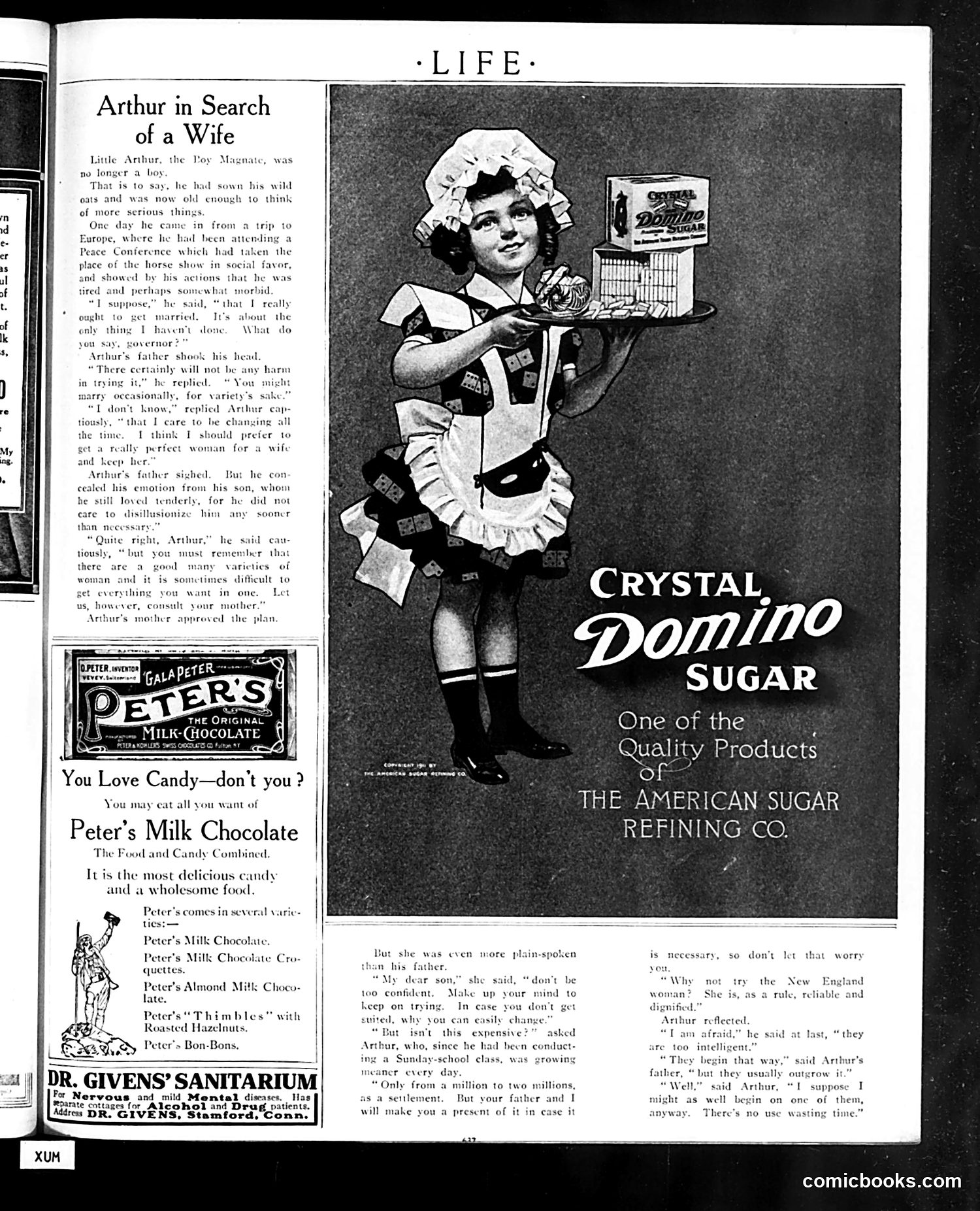
This is a satirical story about "Little Arthur, the Boy Magnate"—a wealthy young man recently returned from the Peace Conference in Europe who decides it's time to marry. The humor centers on Arthur's naive assumption he can find a "perfect woman" meeting all his specifications, while his parents gently reality-check him: his father notes women come in "varieties" and you can't get "everything you want in one"; his mother warns that even docile women "usually outgrow it." The satire targets wealthy young men's unrealistic marital expectations and the old-money assumption that any problem (including finding a wife) can be solved through wealth and deliberation. The "Boy Magnate" likely refers to a wealthy industrialist's son—a common figure in Life's satirical commentary on American wealth and privilege.
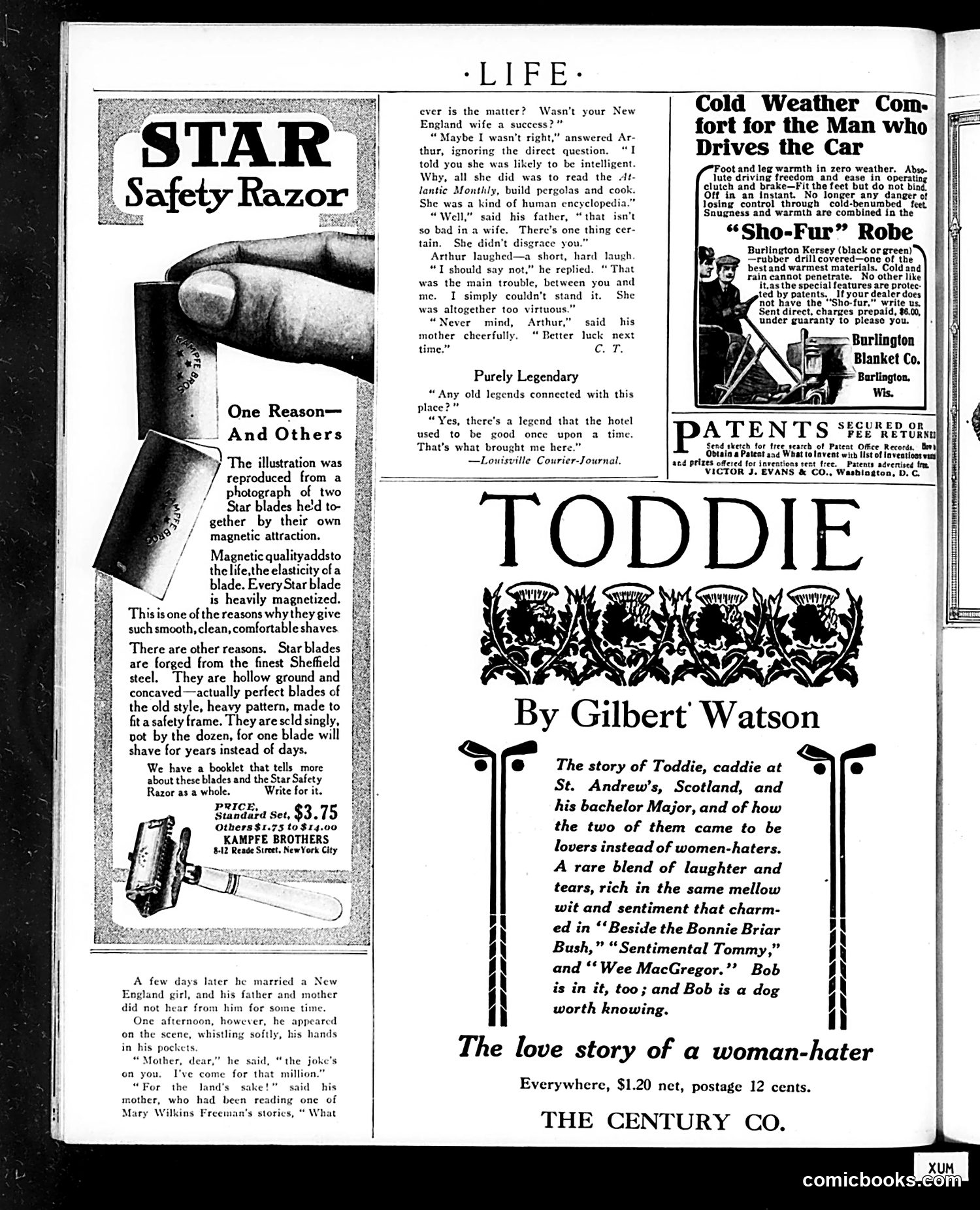
This page contains advertisements and two separate narrative pieces rather than political cartoons. **Star Safety Razor Advertisement** (left): A product ad emphasizing the razor's magnetic properties and Sheffield steel construction, positioned as superior to competitors. No satire evident—straightforward marketing. **"Purely Legendary" Joke**: A brief humorous anecdote mocking hotel quality, suggesting the establishment's reputation has declined significantly. The joke relies on cynicism about service standards. **Arthur's Marriage Story** (center): A satirical narrative about a man who marries a New England woman specifically chosen for intelligence. The joke's premise: she proves *too virtuous and accomplished* (reading Atlantic Monthly, building pergolas, cooking), which he finds unbearable. The satire mocks both his superficiality and perhaps period attitudes about wives being ornamental rather than intellectual. **"Toddie" Book Advertisement** (right): A literary promotion for Gilbert Watson's novel about Scottish characters and relationships. The page is primarily **advertising-focused** with incidental humor reflecting early 20th-century domestic gender attitudes.
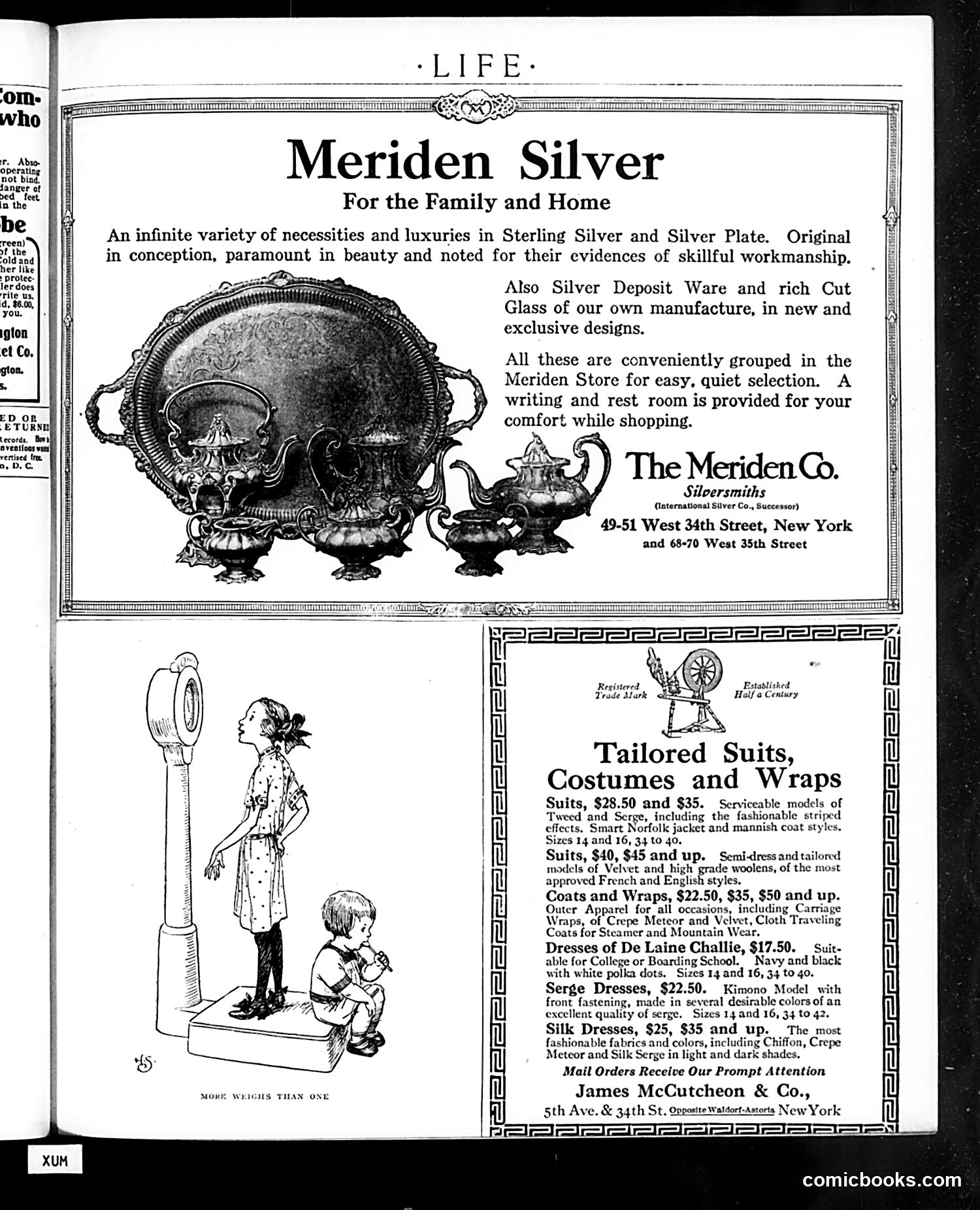
This page is **primarily advertising**, not satire or political commentary. It contains two unrelated product advertisements typical of early 20th-century Life magazine: 1. **Meriden Silver** (top): An ad for sterling silver and silver plate housewares, emphasizing quality craftsmanship and shopping amenities like rest rooms. 2. **James McCutcheon & Co.** (bottom right): Clothing advertisement for tailored suits, wraps, and dresses with specific prices and styles. 3. **Left illustration** ("More Weighs Than One"): A small cartoon showing a woman and child on a weighing scale, likely promoting scales or related products, though the connection is unclear. This is a standard magazine page mixing commercial advertisements with minimal editorial content—typical of how Life magazine monetized its publication in the early 1900s. There is no identifiable political satire or social commentary present.
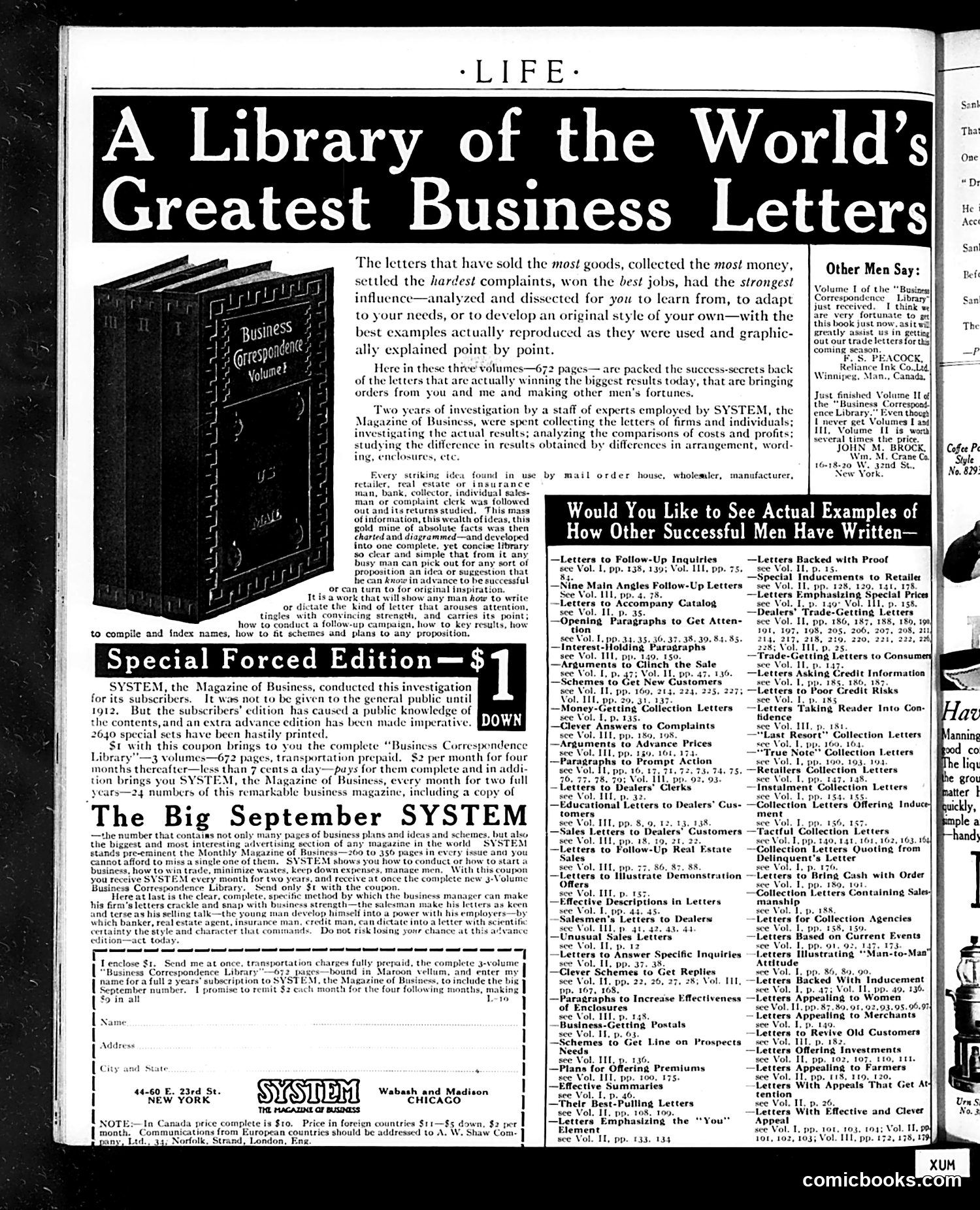
This is **not a cartoon or satirical content** — it's a **full-page advertisement** for a business reference book titled "A Library of the World's Greatest Business Letters." The ad promotes a three-volume collection compiled by *SYSTEM*, a business magazine, containing 672 pages of actual successful business correspondence. The pitch emphasizes that these are real letters that "sold the most goods, collected the most money, settled the hardest complaints, won the best jobs." The marketing approach appeals to early-20th-century businessmen by promising they can learn from competitors' successful techniques — covering collection letters, sales pitches, catalog accompaniments, and complaint responses. A two-year investigation by business experts supposedly analyzed which letter strategies produced the best results. The testimonial quotes from satisfied customers ("Other Men Say") and the special $1 introductory price offer are standard period advertising tactics. This reflects the era's growing interest in systematizing business practices through study and imitation. **No satirical content is present** — this is straightforward commercial promotion.
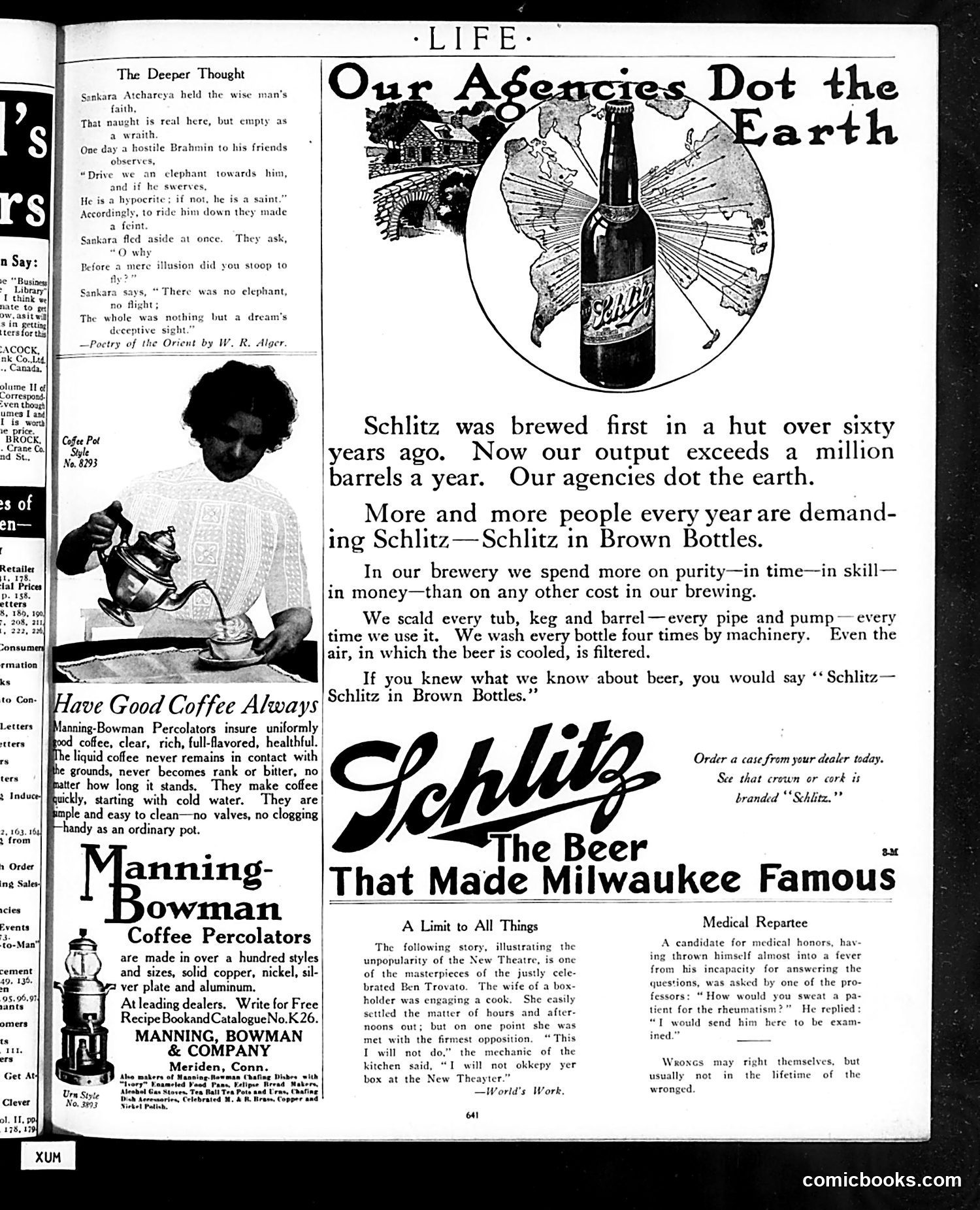
This page combines **advertising with satirical content** typical of Life magazine's format. The main content features two advertisements: 1. **Schlitz Beer ad** (dominant): Positioned as corporate messaging boasting of industrial scale ("a million barrels a year") and manufacturing purity standards. The circular illustration shows a beer bottle with globe imagery, emphasizing global reach. This appears straightforward advertising rather than satire. 2. **Manning-Bowman Coffee Percolators ad** (left sidebar): Standard product advertisement highlighting convenience features. The **satirical content** consists of three short pieces: - "The Deeper Thought": A philosophical anecdote about illusion versus reality (from Oriental poetry) - "A Limit to All Things": A brief story mocking the unpopularity of a theater production - "Medical Repartee": A joke about an incompetent medical student The page primarily serves as **advertising space**, with satirical vignettes filling gaps—typical of Life's mixed-content approach. The satire targets pretentious theater and medical pomposity, not the advertisements themselves.
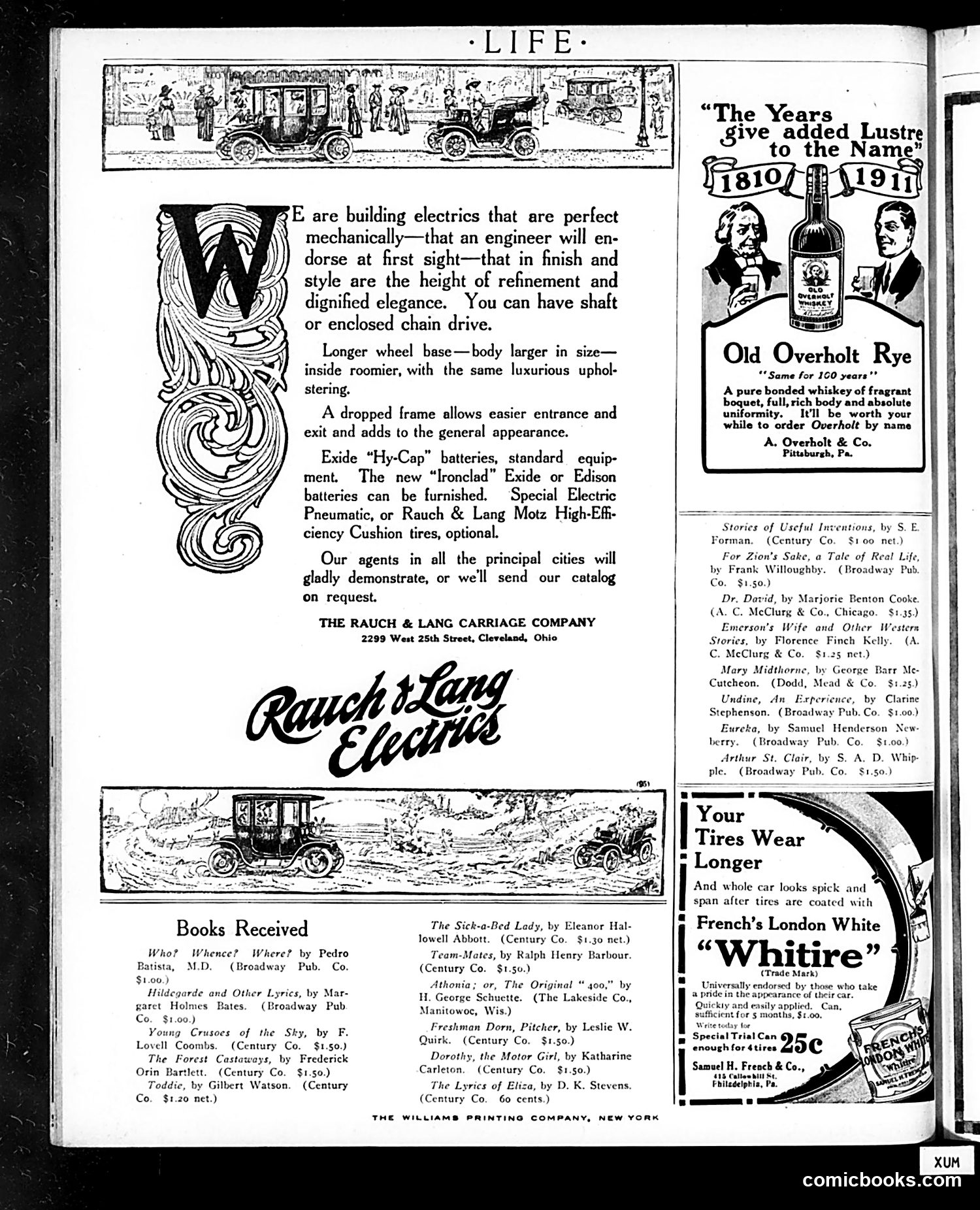
This page is primarily **advertisements and book reviews**, not satirical content. There are no political cartoons or caricatures to analyze. The page features: **Advertising:** The Rauch & Lang Carriage Company promotes electric automobiles (a then-modern technology), emphasizing mechanical perfection, luxury upholstery, and battery options. Old Overholt Rye whiskey advertises its century-long reputation. French's "Whitire" tire coating promises to keep cars looking pristine. **Content:** A "Books Received" section lists recent publications from major publishers like Century Co. and Broadway Publishing, representing popular contemporary literature—titles suggesting adventure stories, romance, and humor typical of early 1900s readers. **Historical Context:** This reflects 1911 America when electric cars competed seriously with gasoline vehicles, whiskey was legal and heavily advertised, and advertising emphasized luxury and refinement for affluent readers of *Life* magazine. There is no satire or political commentary visible on this page—it's a standard magazine layout mixing commercial advertising with cultural content.
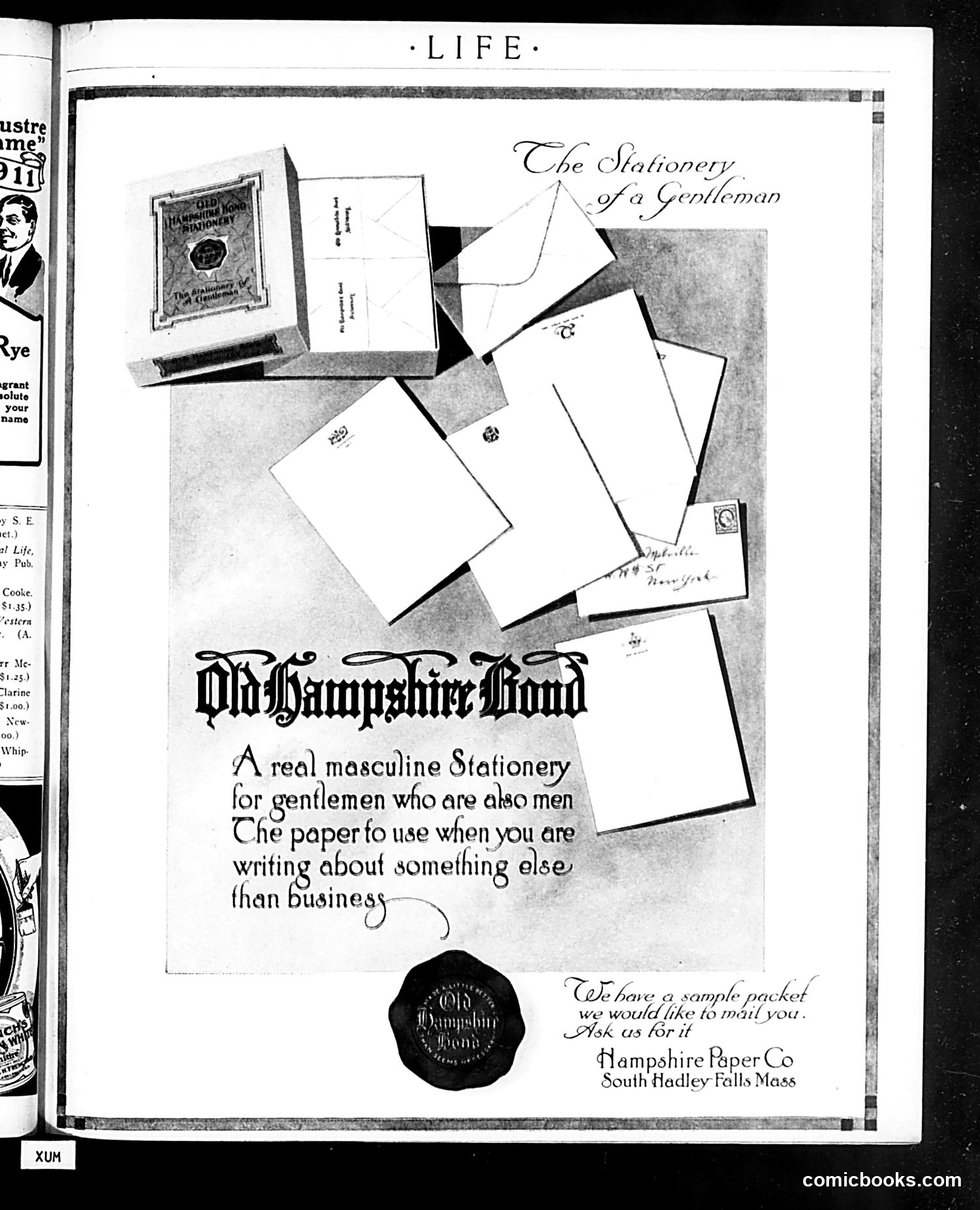
This is primarily a **product advertisement**, not political satire. It promotes "Old Hampshire Bond" stationery from Hampshire Paper Co. (South Hadley Falls, Mass.). The ad's humor targets **gender expectations and masculinity**. It markets the paper as "a real masculine Stationery for gentlemen who are also men"—a deliberately redundant, tongue-in-cheek phrase suggesting that using nice stationery was sometimes considered unmanly or effeminate. The tagline "the paper to use when you are writing about something else than business" humorously implies personal/romantic correspondence required special, more refined paper than practical business letters. The visual display shows various letter formats and envelopes with a decorative box of stationery. The ad offers sample packets to interested customers—a standard direct-mail marketing tactic of the era.
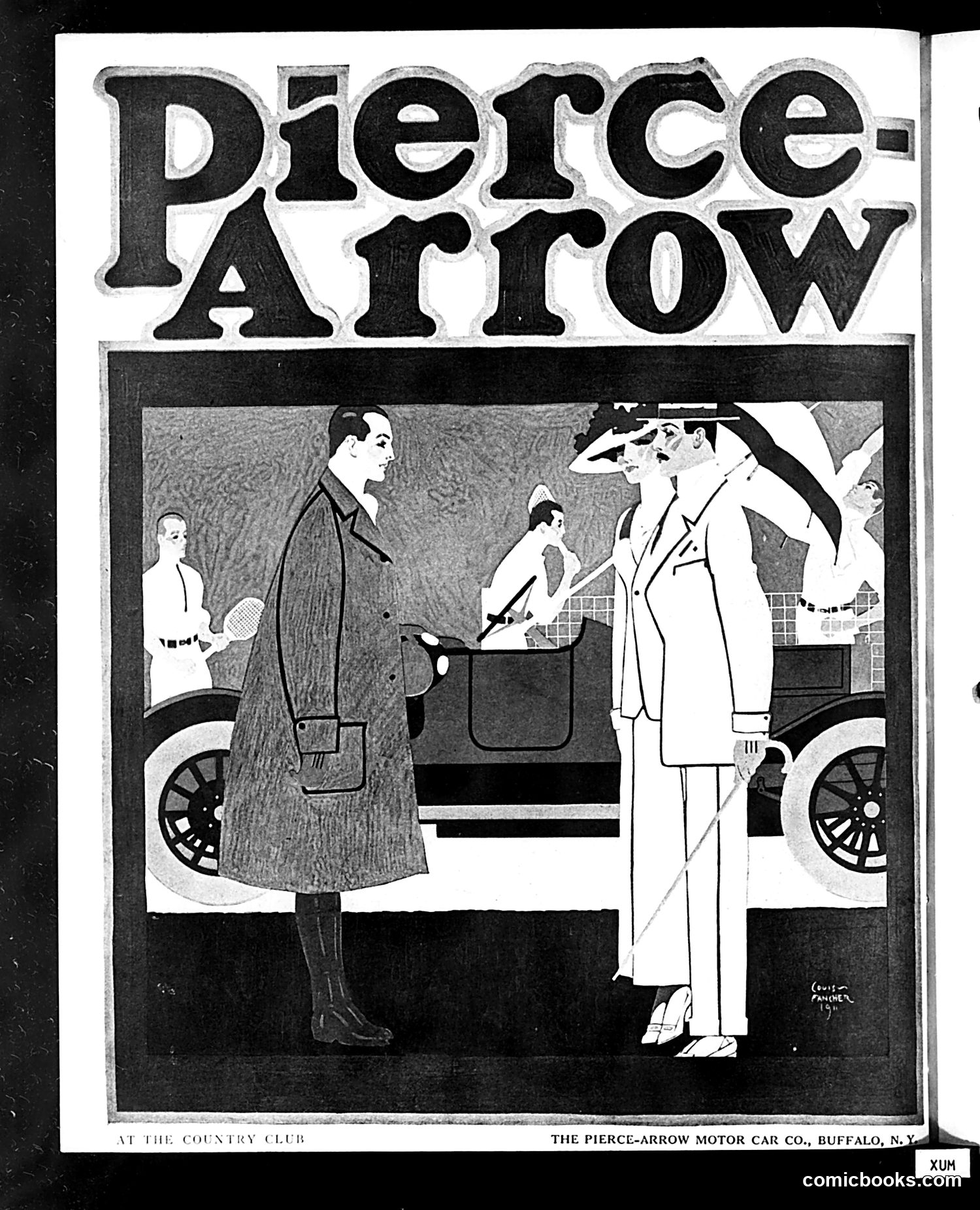
This is primarily a **Pierce-Arrow automobile advertisement** disguised as satirical commentary. The illustration depicts two fashionably dressed men at a country club, with elegantly dressed figures visible in the car and background. The satire likely mocks **wealthy leisure culture** and automobile advertising's aspirational messaging. The caption "At the Country Club" suggests the Pierce-Arrow motor car represents upward mobility and social status—the vehicle as a symbol of belonging to exclusive clubs. The art deco styling and fashionable dress of the figures emphasize how auto advertising targeted affluent consumers by associating cars with sophisticated recreation and social prestige. While nominally appearing as Life magazine's satirical content, this functions primarily as **luxury brand promotion** to the magazine's wealthy readership.