
Life, 1911-10-12 · page 18 of 48
Life — October 12, 1911 — page 18: what you’re looking at
What you’re looking at
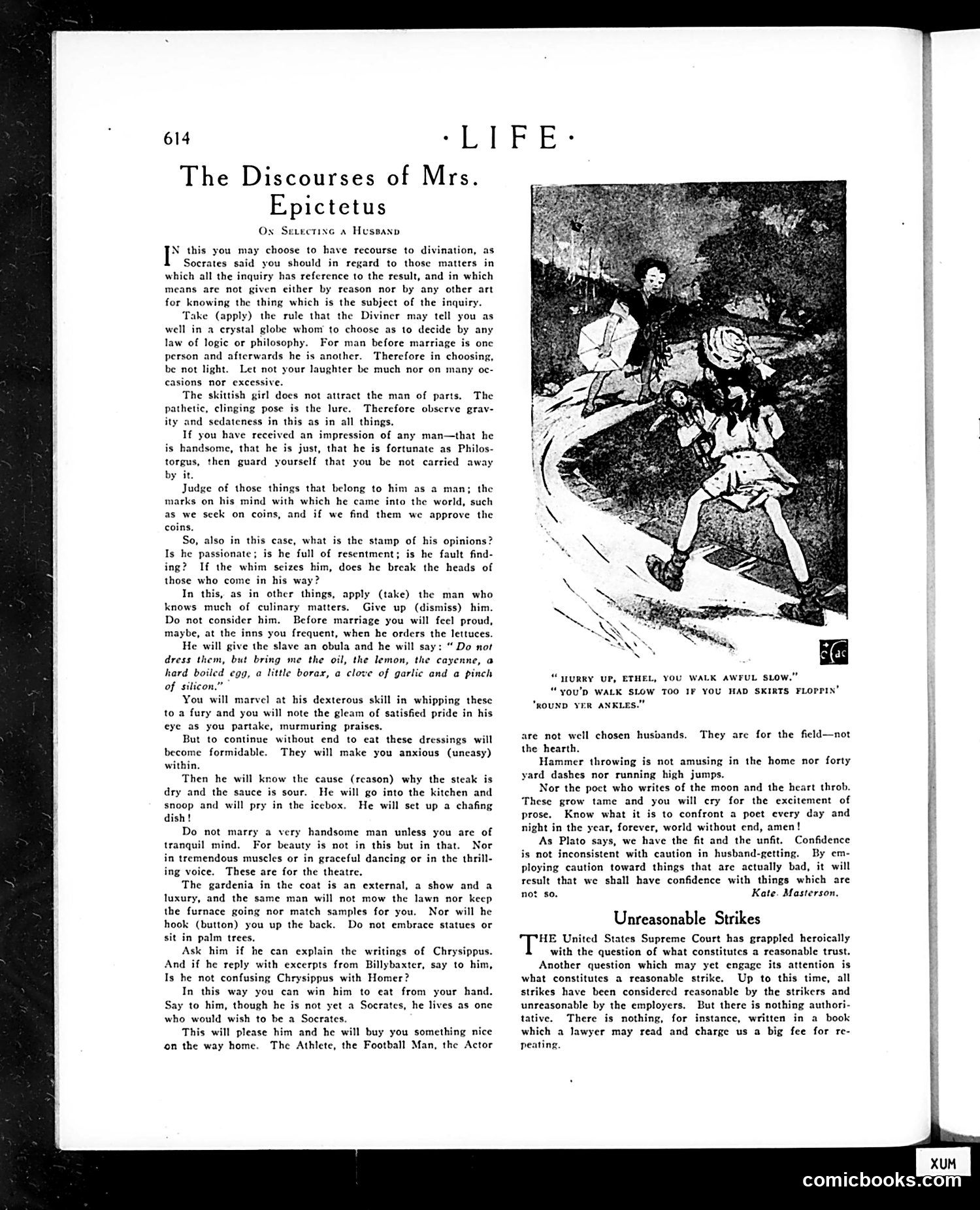
This satirical piece mocks Victorian-era marriage advice by parodying the ancient philosopher Epictetus's stoic teachings. The text humorously applies philosophical principles to mundane husband-hunting—advising women to judge men's character rather than appearance, yet simultaneously offering absurd practical warnings (avoid handsome men, football players, poets). The cartoon caption appears to reference women's fashion complaints: a woman protests walking slowly due to her long skirts with "floppins" hems, a common early-20th-century annoyance. The satire targets both the pretentious application of classical philosophy to domestic matters and contemporary expectations that women should be demure, calculating, and focused solely on securing a suitable provider-husband—while accepting the physical constraints and limitations imposed by fashion norms of the era.
📄 Transcribed text from this page (OCR, searchable)
Machine-transcribed from the original scan — historical spelling and the odd misread are preserved.
614 -LIFE- The Discourses of Mrs. Epictetus Ox Serectixe a Hussanp N this you may choose to have recourse to divination, as Socrates said you should in regard to those matters in which all the inquiry has reference to the result, and in which means are not given either by reason nor by any other art for knowing the thing which is the subject of the inquiry. Take (apply) the rule that the Diviner may tell you as well in a crystal globe whom to choose as to decide by any law of logic or philosophy. For man before marriage is one person and afterwards he is another. Therefore in choosing, be not light. Let not your laughter be much nor on many oc- casions nor excessive. The skittish girl does not attract the man of parts, The pathetic, clinging pose is the lure. Therefore observe grav- ity and sedateness in this as in all things. If you have received an impression of any man—that he is handsome, that he is just, that he is fortunate as Philos- torgus, then guard yourself that you be not carried away by Judge of those things that belong to him as a man; the marks on his mind with which he came into the world, such as we scck on coins, and if we find them we approve the coins. So, also in this case, what is the stamp of his opinions? Is he passionate; is he full of resentment; is he fault find- ing? If the whim seizes him, does he break the heads of those who come in his way? In this, as in other things, apply (take) the man who knows much of culinary matters. Give up (dismiss) him. Do not consider him. Before marriage you will feel proud, maybe, at the inns you frequent, when he orders the lettuces. He will give the slave an obula and he will say: “Do not dress them, but bring me the oil, the lemon, the cayenne, a hard boiled egg, a little borax, a clove of garlic and a pinch of silicon.” You will marvel at his dexterous skill in whipping these to a fury and you will note the gleam of satisfied pride in his eye as you partake, murmuring praises. But to continue without end to eat these dressings will become formidable. They will make you anxious (uncasy) within. Then he will know the cause (reason) why the steak is dry and the sauce is sour. He will go into the kitchen and snoop and will pry in the icebox. He will set up a chafing dish! Do not marry a very handsome man unless you are of tranquil mind. For beauty is not in this but in that. Nor in tremendous muscles or in graceful dancing or in the thrill- ing voice. These are for the theatre. The gardenia in the coat is an external, a show and a luxury, and the same man will not mow the lawn nor keep the furnace going nor match samples for you. Nor will he hook (button) you up the back. Do not embrace statues or sit in palm trees. Ask him if he can explain the writings of Chrysippus. And if he reply with excerpts from Billybaxter, say to him, Is he not confusing Chrysippus with Homer? In this way you can win him to eat from your hand. Say to him, though he is not yet a Socrates, he lives as one who would wish to be a Socrates. This will please him and he will buy you something nice ‘on the way home. The Athlete, the Football Man, the Actor “HURRY UP, ETHEL, YOU WALK AWFUL SLOW,” “you'p WALK SLOW TOO IF YOU HAD SKIRTS FLOPPIN’ "ROUND YER ANKLES.” are not well chosen husbands. They are for the field—not the hearth. Hammer throwing is not amusing in the home nor forty yard dashes nor running high jumps. Nor the poct who writes of the moon and the heart throb. These grow tame and you will cry for the excitement of prose. Know what it is to confront a poet every day and night in the year, forever, world without end, amen! ‘As Plato says, we have the fit and the unfit. Confidence is not inconsistent with caution in husband-getting. By em: ploying caution toward things that are actually bad, it will result that we shall have confidence with things which are not so. Kate. Masterson, Unreasonable Strikes HE United States Supreme Court has grappled heroically with the question of what constitutes a reasonable trust. Another question which may yet engage its attention is what constitutes a reasonable strike. Up to this time, all strikes have been considered reasonable by the strikers and unreasonable by the employers. But there is nothing authori- tative. There is nothing, for instance, written in a book which a lawyer may read and charge us a big fee for re- peating. comicbooks -co