
Life, 1911-10-12 · page 10 of 48
Life — October 12, 1911 — page 10: what you’re looking at
What you’re looking at
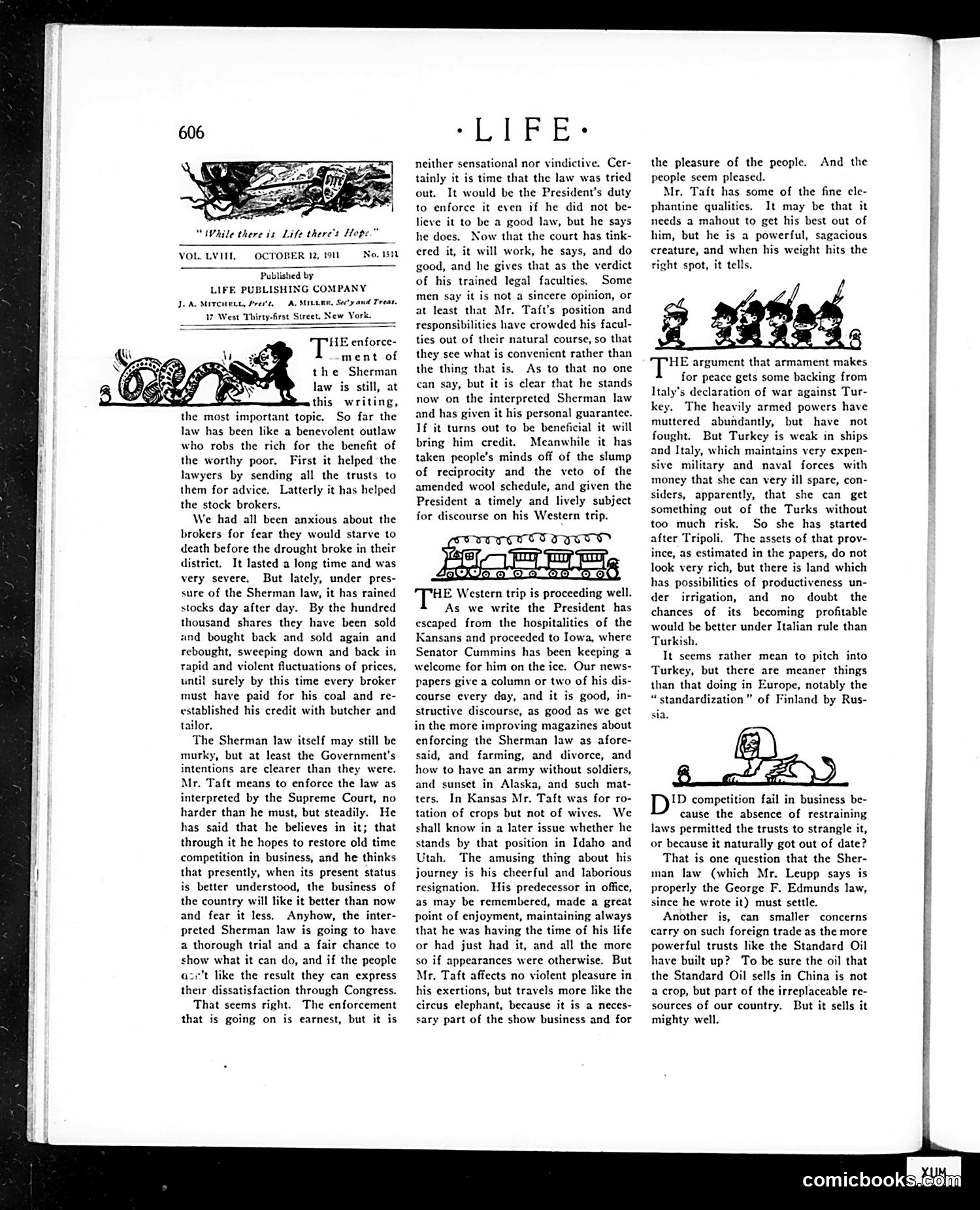
This October 1911 *Life* magazine page discusses enforcement of the Sherman Antitrust Act under President Taft's administration. The text criticizes the law as a "benevolent outlaw" that helps wealthy brokers while harming legitimate business, noting it has caused stock market turmoil. The commentary references Taft's "Western trip" (likely a speaking tour) and mentions Senator Cummins welcoming him in Iowa. The article defends Taft's enforcement efforts as sincere, despite concerns it's destabilizing business. The cartoons (visible but small) appear to illustrate these business and legal themes, though specific figures are difficult to identify clearly in this reproduction. The overall message critiques antitrust policy's unintended economic consequences.
📄 Transcribed text from this page (OCR, searchable)
Machine-transcribed from the original scan — historical spelling and the odd misread are preserved.
“While there is Life there's Hope.” VOL. LVI, OCTOBER 12, 1911 No, 1528 Published by LIFE PUBLISHING COMPANY HE enforce- ment of the Sherman law is still, at this writing, the most important topi So far the law has been like a benevolent outlaw who robs the rich for the benefit of the worthy poor. First it helped the lawyers by sending all the trusts to them for advice. Latterly it has helped the stock brokers. We had all been anxious about the brokers for fear they would starve to death before the drought broke in their district. It lasted a long time and was very severe. But lately, under pres- sure of the Sherman law, it has rained stocks day after day. By the hundred thousand shares they have been sold and bought back and sold again and rebought, sweeping down and back in rapid and violent fluctuations of prices, until surely by this time every broker must have paid for his coal and re- established his credit with butcher and tailor. The Sherman law itself may still be murky, but at least the Government's intentions are clearer than they were. Mr. Taft means to enforce the law as interpreted by the Supreme Court, no harder than he must, but steadily. He has said that he believes in it; that through it he hopes to restore old time competition in business, and he thinks that presently, when its present status is better understood, the business of the country will like it better than now and fear it less. Anyhow, the inter- preted Sherman law is going to have a thorough trial and a fair chance to show what it can do, and if the people acr’t like the result they can express their dissatisfaction through Congress. That seems right. The enforcement that is going on is earnest, but it is ‘Lie & « neither sensational nor vindictive. Cer- tainly it is time that the law was tried out. It would be the President’s duty to enforce it even if he did not be- lieve it to be a good law, but he says he does. Now that the court has tink- ered it, it will work, he says, and do good, and he gives that as the verdict of his trained legal faculties. Some men say it is not a sincere opinion, or at least that Mr. Taft's position and responsibilities have crowded his facul- ties out of their natural course, so that they see what is convenient rather than the thing that is. As to that no one can say, but it is clear that he stands now on the interpreted Sherman law and has given it his personal guarantee. If it turns out to be beneficial it will bring him credit. Meanwhile it has taken people’s minds off of the slump of reciprocity and the veto of the amended wool schedule, and given the President a timely and lively subject for discourse on his Western trip. TH Western trip is proceeding well. As we write the President has escaped from the hospitalitics of the Kansans and proceeded to Iowa, where Senator Cummins has been keeping a welcome for him on the ice. Our news- papers give a column or two of his dis- course every day, and it is good, in- structive discourse, as good as we get in the more improving magazines about enforcing the Sherman law as afore- said, and farming, and divorce, and how to have an army without soldiers, and sunset in Alaska, and such mat- ters. In Kansas Mr. Taft was for ro- tation of crops but not of es. We shall know in a later issue whether he stands by that position in Idaho and Utah. The amusing thing about his journey is his cheerful and laborious resignation. His predecessor in office, as may be remembered, made a great point of enjoyment, maintaining always that he was having the time of his life or had just had it, and all the more so if appearances were otherwise. But Mr. Taft affects no violent pleasure in his exertions, but travels more like the circus elephant, because it is a neces- sary part of the show business and for the pleasure of the people. And the people seem pleased. Mr. Taft has some of the fine cle- phantine qualities. It may be that it needs a mahout to get his best out of him, but he is a powerful, sagacious creature, and when his weight hits the right spot, it tells. HE argument that armament makes for peace gets some backing from Italy’s declaration of war against Tur- key. The heavily armed powers have muttered abundantly, but have not fought. But Turkey is weak in ships and Italy, which maintains very expen- sive military and naval forces with money that she can very ill spare, con- siders, apparently, that she can get something out of the Turks without too much risk, So she has started after Tripoli. The assets of that prov- ince, as estimated in the papers, do not look very rich, but there is land which has possibilities of productiveness un- der irrigation, and no doubt the chances of its becoming profitable would be better under Italian rule than Turkish, It seems rather mean to pitch into Turkey, but there are meaner things than that doing in Europe, notably the “ standardization” of Finland by Rus- sia, D” competition fail in business be- cause the absence of restraining laws permitted the trusts to strangle it, or because it naturally got out of date? That is one question that the Sher- man law (which Mr. Leupp says is properly the George F. Edmunds law, since he wrote it) must settle. Another is, can smaller concerns carry on such foreign trade as the more powerful trusts like the Standard Oil have built up? To be sure the oil that the Standard Oil sells in China is not a crop, but part of the irreplaceable re- sources of our country. But it sells it mighty well. comicbookMeom