
Life, 1911-10-12 · page 26 of 48
Life — October 12, 1911 — page 26: what you’re looking at
What you’re looking at
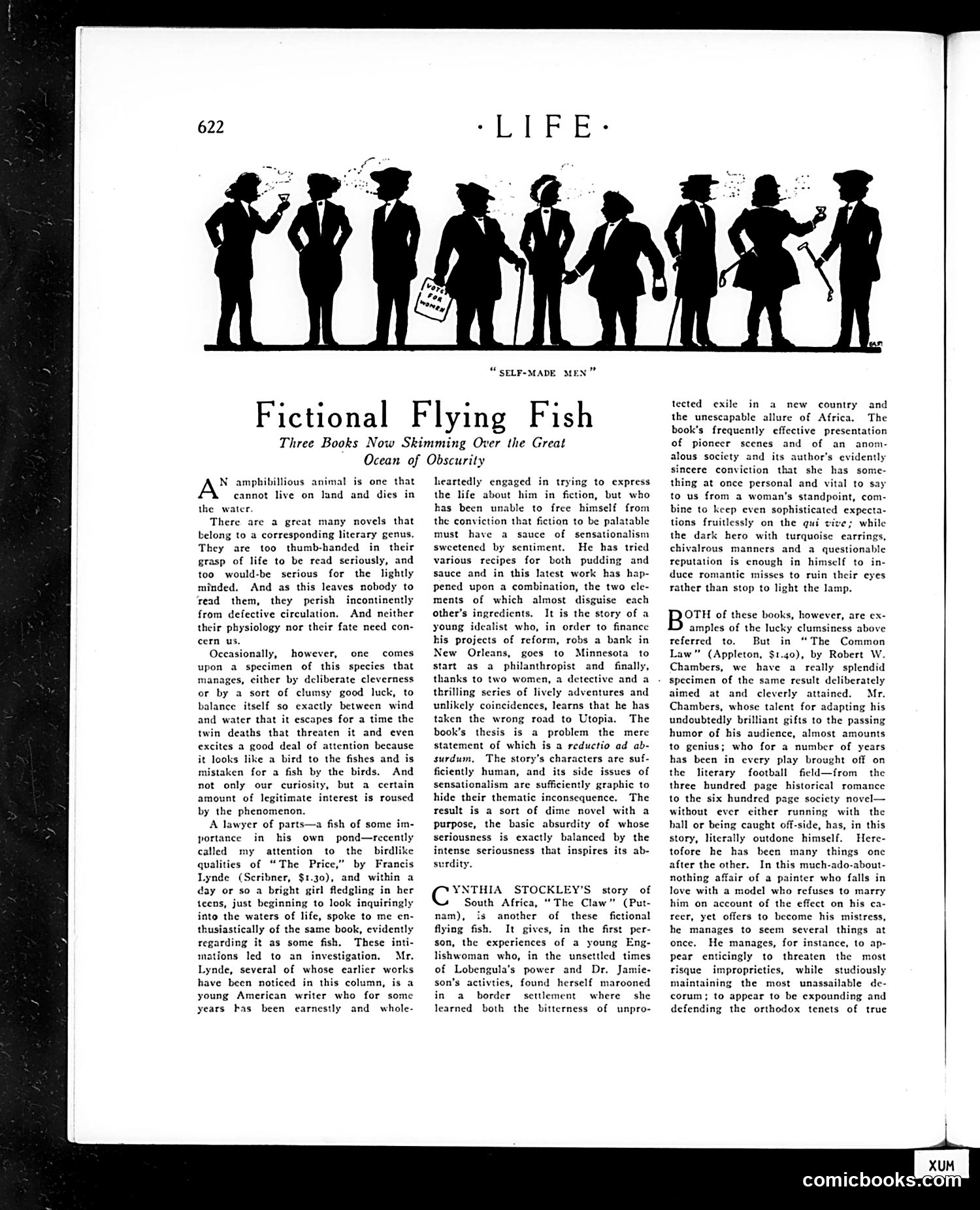
The silhouette cartoon titled "Self-Made Men" depicts nine figures in business attire—a satirical commentary on the self-made man myth popular in American culture. The page reviews three mediocre novels using the metaphor of "fictional flying fish"—books that awkwardly balance between serious literature and popular entertainment, belonging fully to neither genre. Life critiques Francis Lynde's *The Price*, about an idealistic bank robber who turns philanthropist, as a poorly conceived "dime novel with a purpose." Similarly, Cynthia Stockley's *The Claw*, set in colonial South Africa during the Lobengula and Jameson era, is dismissed as overwrought melodrama despite occasional effective passages. The satire mocks novels attempting simultaneously to entertain and moralize—works too sensational for serious readers but too earnest for light entertainment. Life suggests such books, lacking clear identity, die from poor circulation and critical neglect.
📄 Transcribed text from this page (OCR, searchable)
Machine-transcribed from the original scan — historical spelling and the odd misread are preserved.
Fictional Flying Fish Three Books Now Skimming Over the Great Ocean of Obscurity AS amphibillious animal is one that cannot live on land and dies in the water. There are a great many novels that belong to a corresponding literary genus. They are too thumb-handed in their grasp of life to be read seriously, and too would-be serious for the lightly minded. And as this leaves nobody to read them, they perish incontinently from defective circulation. And neither their physiology nor their fate need con- cern us. Occasionally, however, one comes upon a specimen of this species that manages, cither by deliberate cleverness or by a sort of clumsy good luck, to balance itself so exactly between wind and water that it escapes for a time the twin deaths that threaten it and even excites a good deal of attention because it looks like a bird to the fishes and is mistaken for a fish by the birds. And not only our curiosity, but a certain amount of legitimate interest is roused by the phenomenon. A lawyer of parts—a fish of some im- portance in his own pond—recently called my attention to the birdlike qualities of “The Pric by Francis Lynde (Scribner, $1.30), and within a day or so a bright girl fledgling in her teens, just beginning to look inquiringly into the waters of life, spoke to me en- thusiastically of the same book, evidently regarding it as some fish. These inti- mations led to an i igatic Mr. Lynde, several of whose earlier works have been noticed in this column, is a young American writer who for some years kas been earnestly and whole- heartedly engaged in trying to express the life about him in fiction, but who has been unable to free himself from the conviction that fiction to be palatable must have a sauce of sensationalism sweetened by sentiment. He has tried various recipes for both pudding and sauce and in this latest work has hap- pened upon a combination, the two cle- ments of which almost disguise cach other’s ingredients. It is the story of a young idealist who, in order to finance his projects of reform, robs a bank in New Orleans, gocs to Minnesota to start as a philanthropist and finally, thanks to two women, a detective and a thrilling series of lively adventures and unlikely coincidences, learns that he has taken the wrong road to Utopia. The book’s thesis is a problem the mere statement of which is a reductio ad ab- surdum, The story’s characters are suf- ficiently human, and its side issues of sensationalism are sufficiently graphic to hide their thematic inconsequence. The result is a sort of dime novel with a purpose, the basic absurdity of whose seriousness is exactly balanced by the intense seriousness that inspires its ab- surdity. YNTHIA STOCKLEY’S story of South Africa, “The Claw” (Put- nam), is another of these fictional flying fish. It gives, in the first per- son, the experiences of a young Eng- lishwoman who, in the unsettled times of Lobengula’s power and Dr. Jamie- son's activties, found herself marooned in a border settlement’ where she learned both the bitterness of unpro- tected exile in a new country and the unescapable allure of Africa. The book's frequently effective presentation of pioneer scenes and of an alous society and its author's evidently sincere conviction that she has some- thing at once personal and vital to say to us from a woman's standpoint, com- bine to keep even sophisticated expecta- tions fruitlessly on the qui vive; while the dark hero with turquoise earrings, chivalrous manners and a questionable reputation is enough in himself to in- duce romantic misses to ruin their eyes rather than stop to light the lamp. anom- OTH of these books, however, are : amples of the lucky clumsiness above referred to. But in “The Common Law” (Appleton, $1.40), by Robert W. Chambers, we have a really splendid specimen of the same result deliberately aimed at and cleverly attained. Mr. Chambers, whose talent for adapting his undoubtedly brilliant gifts to the passing humor of his audience, almost amounts to genius; who for a number of years has been in every play brought off on the literary football field—from the three hundred page historical romance to the six hundred page society novel— without ever either running with the hall or being caught off-side, has, in this story, literally outdone himself. Here- tofore he has been many things one after the other. In this much-ado-about- nothing affair of a painter who falls in love with a model who refuses to marry him on account of the effect on reer, yet offers to become his m he manages to seem several things at once. He manages, for instance, to ap- pear enticingly to threaten the most risque improprictics, while studiously maintaining the most unassailable de- corum; to appear to be expounding and defending the orthodox tenets of true comicbook $.CO)