
Life, 1911-10-12 · page 12 of 48
Life — October 12, 1911 — page 12: what you’re looking at
What you’re looking at
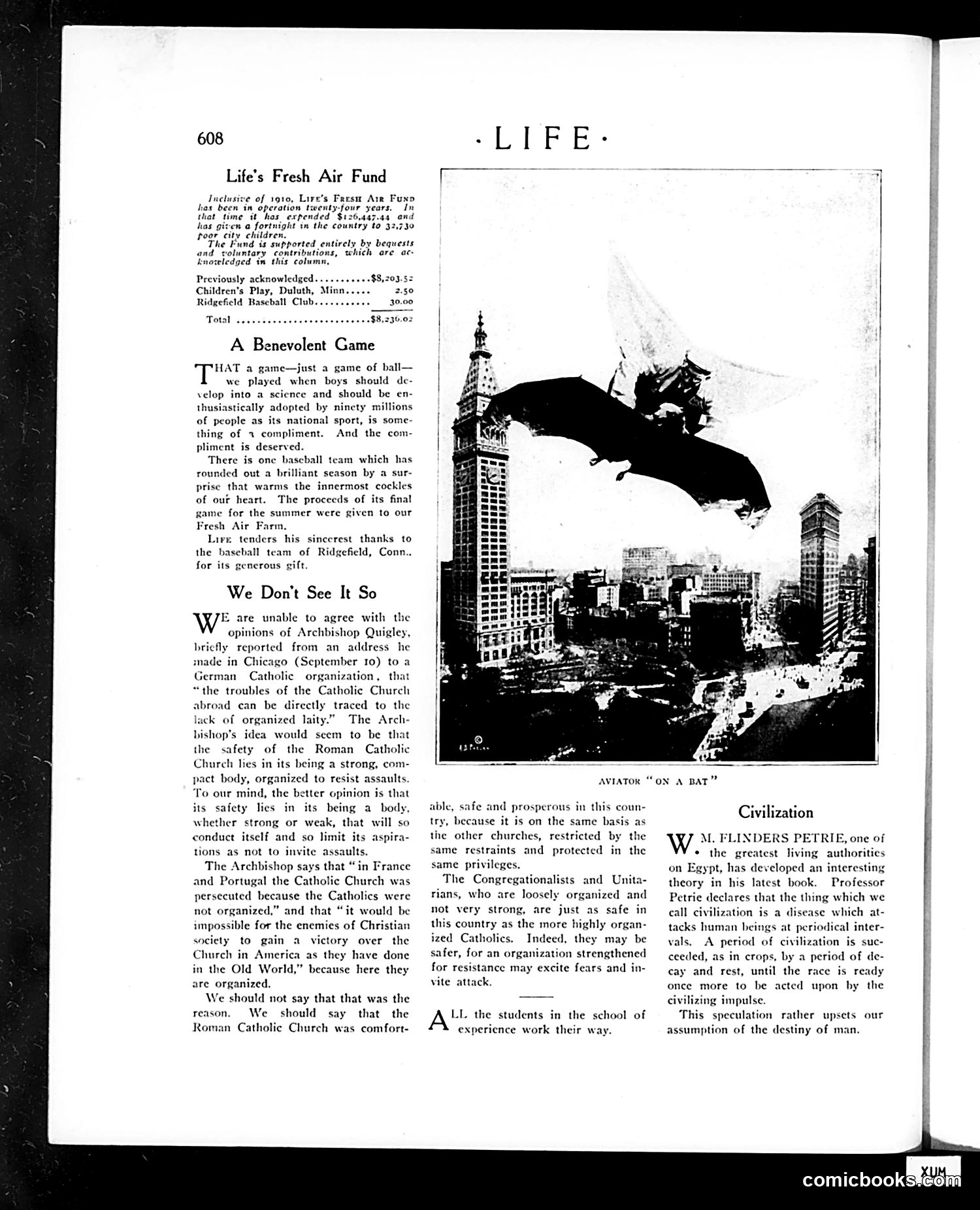
This page contains three distinct sections: **Life's Fresh Air Fund** (top left): A charitable fundraising notice listing donations totaling $8,526.02 for a Fresh Air Fund, supporting children's recreation. **"A Benevolent Game"** (middle left): An editorial praising baseball as beneficial to American society, thanking the Ridgefield Baseball Club for donating game proceeds to the Fresh Air Fund. **"We Don't See It So"** (bottom left): A critical editorial response to Archbishop Quirley's claims that American Catholics are safer from persecution than European Catholics. Life's editors argue the Roman Catholic Church's strength in America comes from being well-organized to resist attacks—not from inherent American tolerance—and dispute the Archbishop's comparison. **"Civilization"** (right): An article by W.M. Flinders Petrie theorizing that civilizations cycle through periods of activity and rest. The airplane illustration depicts modern technological progress.
📄 Transcribed text from this page (OCR, searchable)
Machine-transcribed from the original scan — historical spelling and the odd misread are preserved.
608 Life’s Fresh Air Fund Inclusive of 1910, Lire’s Fees Arr Fux has been in operation twenty-four years. In that time it has expended $126,447.44 and has given @ fortnight in the country 0 32,730 foor city children. The Fund is supporte and voluntary contributic knoreledged in this column, entirely by bequests which are ac- +$8,203 < so 30.00 Previously acknowledged. Children’s Play, Duluth, M Ridgefield Baseball Club. Total A Benevolent Game HAT a game—just a game of ball— we played when boys should de- velop into a science and should be en- thusiastically adopted by nincty millions of people as its national sport, is some- thing of 1 compliment. And the com- pliment is deserved. There is onc baseball team which has rounded out a brilliant season by a sur- prise that warms the innermost cockles of out heart. The proceeds of its final game for the summer were given to our Fresh Air Farm, Lire tenders his sincerest thanks to the baseball team of Ridgefield, Conn... for its generous gift We Don't See It So W are unable to agree with the opinions of Archbishop Quigley, briefly reported from an address he made in Chicago (September 10) to a German Catholic organization, that the troubles of the Catholic Church abroad can be directly traced to the lack of organized laity.” The Arch- bishop’s idea would seem to be that the safety of the Roman Catholic Church lies in its being a strong, com- t body, organized to resist assaults. ‘o our mind, the better opinion is that its safety lies in its being a body, whether strong or weak, that will so conduct itself and so limit its aspira- tions as not to invite assaults, The Archbishop says that “in France and Portugal the Catholic Church was persecuted because the Catholics were not organized,” and that “it would be impossible for the enemies of Christian society to gain a victory over the Church in America as they have done in the Old World,” because here they are organized. We should not say that that was the reason. We should say that the Roman Catholic Church was comfort- AVIATOR able, safe and prosperous in this coun- try, because it is on the same basis as the other churches, restricted by the same restraints and protected in the same privileges. The Congregationalists and Unita- rians, who are loosely organized and not very strong, are just as safe in this country as the more highly organ- ized Catholics. Indeed, they may be safer, for an organization strengthened for resistance may excite fears and in- vite attack, A L. the students in the school of experience work their way. “on A BAT” Civilization M. FLINDERS PETRIE, one of * the greatest living authorities on Egypt, has developed an interesting theory in his latest book. Professor Petrie declares that the thing which we call civilization is a disease which at- tacks human beings at periodical inter- vals, A period of civilization is suc- ceeded, as in crops, by a period of de- cay and rest, until the race is ready once more to be acted upon by the civilizing impulse. This speculation rather upsets our assumption of the destiny of man.