
Life, 1911-10-12 · page 22 of 48
Life — October 12, 1911 — page 22: what you’re looking at
What you’re looking at
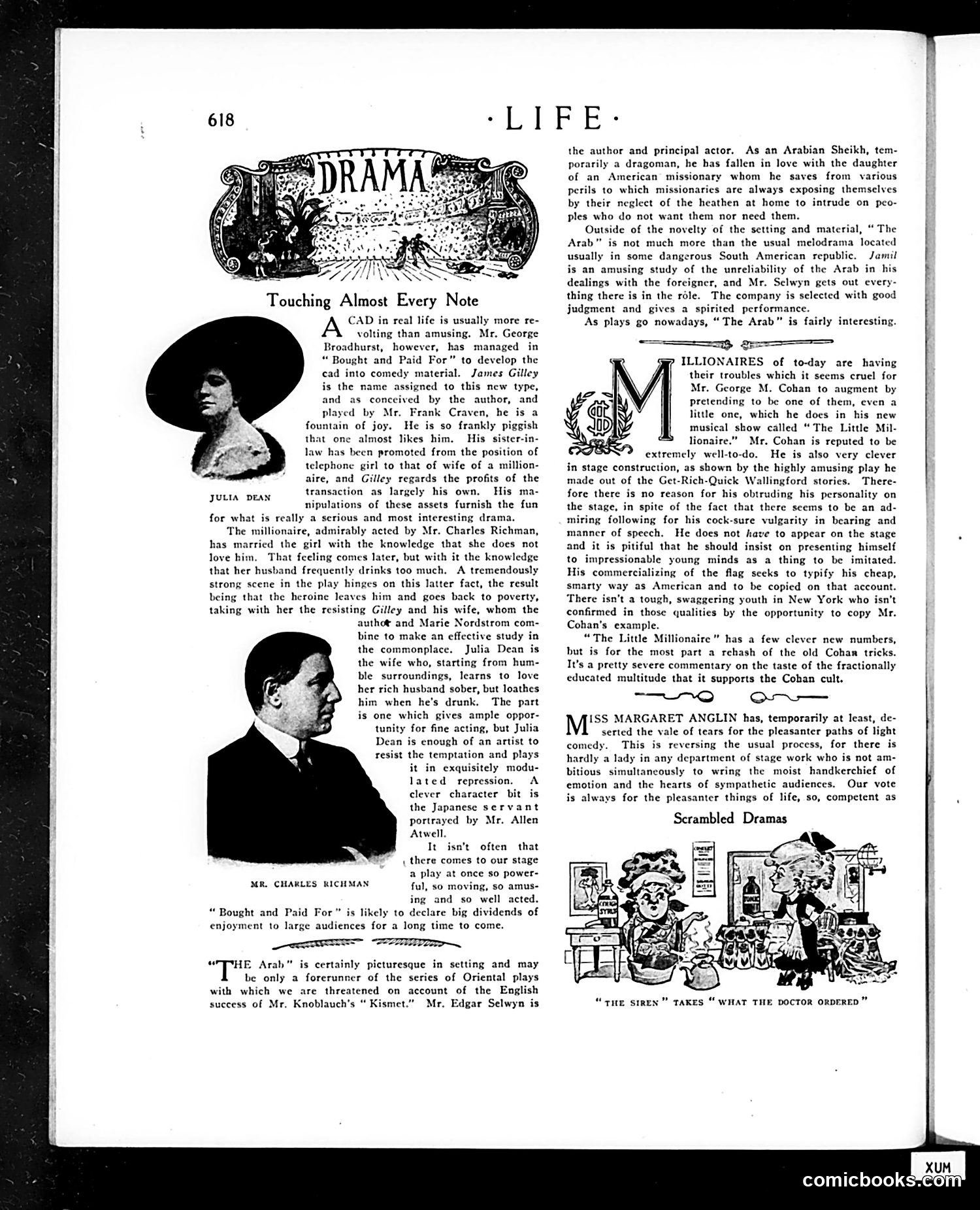
This page reviews three theatrical productions from the early 1900s: **"Bought and Paid For"**: A comedy about a "cad" named James Gilley (played by Frank Craven) who exploits his sister-in-law after she marries a wealthy man. The reviewer praises how the playwright transforms this morally reprehensible character into entertainment, with strong performances by Charles Richman and Julia Dean. **"The Arab"**: An orientalist melodrama where author Edgar Selwyn plays an Arabian Sheikh who falls for an American missionary's daughter. The critic dismisses it as formulaic—merely a standard melodrama relocated to exotic settings, capitalizing on the success of "Kismet." **"The Little Millionaire"**: George M. Cohan's musical where he plays a minor millionaire. The reviewer criticizes Cohan's self-indulgent stage presence and "cock-sure vulgarity," questioning why someone wealthy would need to profit from performing. The tone reflects period theatrical criticism—elitist and focused on character acting and moral instruction through drama.
📄 Transcribed text from this page (OCR, searchable)
Machine-transcribed from the original scan — historical spelling and the odd misread are preserved.
CAD in real life is usually more re- volting than amusing. Mr. George Broadhurst, however, has managed in “ Bought and Paid For” to develop the cad into comedy material. James Gilley is the name assigned to this new type, and as conceived by the author, and played by Mr. Frank Craven, he is a fountain of joy. He is so frankly piggish that one almost likes him. His sister-in- law has been promoted from the position of telephone girl to that of wife of a million- aire, and Gilley regards the profits of the transaction as largely his own, His ma- nipulations of these assets furnish the fun for what is really a serious and most interesting drama. The millionaire, admirably acted by Mr. Charles Richman, has married the girl with the knowledge that she does not love him. That feeling comes later, but with it the knowledge that her husband frequently drinks too much. A tremendously strong scene in the play hinges on this latter fact, the result being that the heroine leaves him and goes back to poverty, taking with her the resisting Gilley and his wife, whom the authot and Marie Nordstrom com- bine to make an effective study in the commonplace. Julia Dean is the wife who, starting from hum- ble surroundings, learns to love her rich husband sober, but loathes him when he's drunk. The part is one which gives ample oppor- tunity for fine acting, but Julia Dean is enough of an artist to resist the temptation and plays it in exquisitely modu- lated repression. A clever character bit is the Japanese servant portrayed by Mr. Allen Atwell, It isn’t often that there comes to our stage a play at once so power- ful, so moving, so amus- ing and so well acted. “ Bought and Paid For” is likely to declare big dividends of enjoyment to large audiences for a long time to come. SS" OTT bs ‘HE Arab” is certainly picturesque in setting and may be only a forerunner of the series of Oriental plays with which we are threatened on account of the English success of Mr. Knoblauch’s “ Kismet.” Mr. Edgar Selwyn is JULIA DEAN MR. CHARLES RICHMAN ¢ LIP: the author and principal actor, As an Arabian Sheikh, tem- porarily a dragoman, he has fallen in love with the daughter of an American missionary whom he saves from various perils to which narics are always exposing themselves by their neglect of the heathen at home to intrude on peo- ples who do not want them nor need them. Outside of the novelty of the setting and material, “ The Arab" is not much more than the usual melodrama located usually in some dangerous South American republic. Jamil is an amusing study of the unreliability of the Arab in his dealings with the forcigner, and Mr. Sclwyn gets out every- thing there is in the rdle. The company is selected with good judgment and gives a spirited performance. As plays go nowadays, “The Arab” is fairly interesting. cd ILLIONAIRES of to-day are having their troubles which it seems cruel for Mr. George M. Cohan to augment by pretending to be one of them, even a little one, which he docs in his new musical show called “The Little Mil- lionaire.” Mr. Cohan is reputed to be extremely well-to-do. He is also very clever in stage construction, as shown by the highly amusing play he made out of the Get-Rich-Quick Wallingford stories. There- fore there is no reason for his obtruding his personality on the stage, in spite of the fact that there seems to be an ad- miring following for his cock-sure vulgarity in bearing and manner of specch. He does not have to appear on the stage and it is pitiful that he should insist on presenting himself to impressionable young minds as a thing to be imitated. His commercializing of the flag seeks to typify his cheap, smarty way as American and to be copied on that account. There isn't a tough, swaggering youth in New York who isn’t confirmed in those qualities by the opportunity to copy Mr. Cohan’s example. The Little Millionaire” has a few clever new numbers, but is for the most part a rehash of the old Cohan tricks. It’s a pretty severe commentary on the taste of the fractionally educated multitude that it supports the Coban cult. ion ams) on ISS MARGARET ANGLIN has, temporarily at least, de- serted the vale of tears for the pleasanter paths of light comed: This is reversing the usual process, for there is hardly a lady in any department of stage work who is not am- bitious simultaneously to wring the moist handkerchief of emotion and the hearts of sympathetic audiences. Our vote is always for the pleasanter things of life, so, competent as Scrambled Dramas | “THE SIREN” TAKES “ WHAT THE DOCTOR ORDERED” comicbookseom