
A complete issue · 42 pages · 1911
Life — May 18, 1911
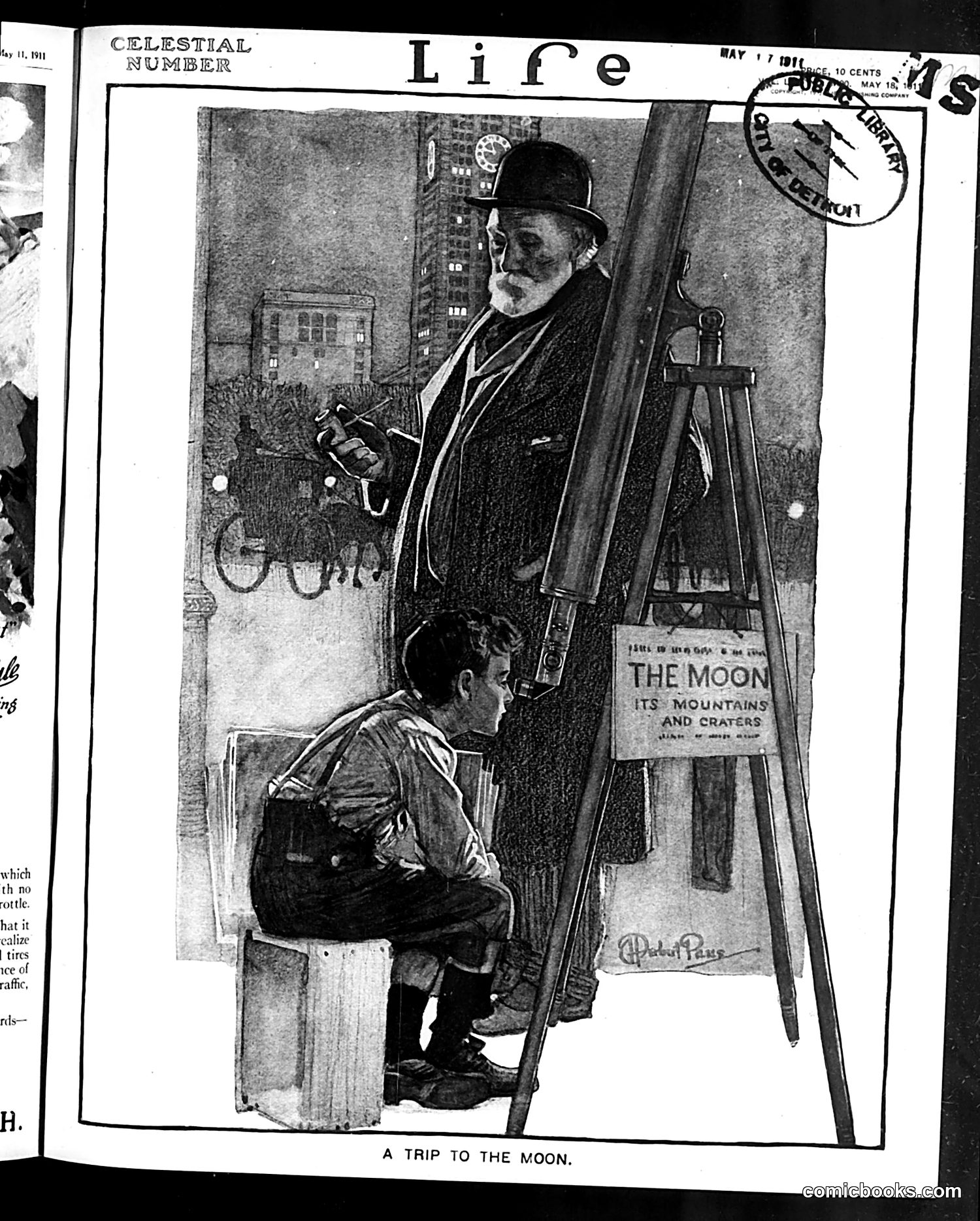
This satirical illustration depicts an elderly astronomer or scientist showing a young boy a telescope pointed at the moon. The sign reads "The Moon: Its Mountains and Craters," suggesting a lecture or demonstration about lunar observation. The satire likely mocks popular fascination with space exploration and astronomical claims circa 1911. The contrast between the earnest, bearded scientist and the innocent child viewer suggests commentary on how scientific wonder—or perhaps exaggeration—captivates the public imagination. The title "A Trip to the Moon" may reference contemporary sci-fi literature like Jules Verne's works, which were widely popular. The joke appears to be about the gap between scientific aspiration and actual human capability during this pre-spaceflight era.
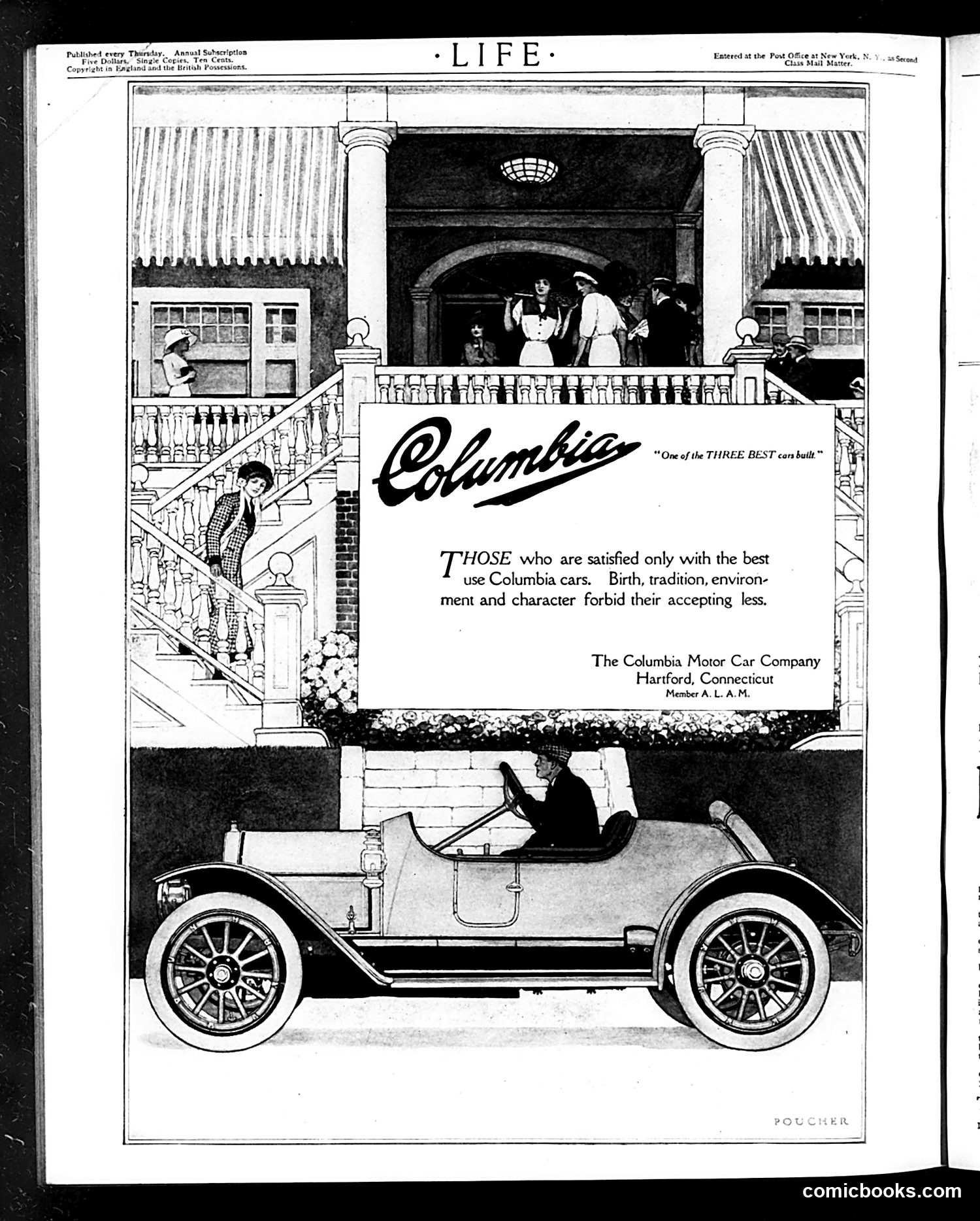
This page is primarily a **Columbia Motor Car Company advertisement**, not satire. The ad appears in *Life* magazine and features an illustration by Poucher showing an elegant townhouse scene above a side-view of the Columbia automobile. The advertisement's tagline—"One of the THREE BEST car built"—appeals to affluent buyers by suggesting the car embodies "Birth, tradition, environment and character." The copy explicitly states: "Those who are satisfied only with the best use Columbia cars." This is straightforward luxury marketing targeting the wealthy elite, not political satire. The upscale domestic setting (with well-dressed figures on stairs and balconies) is meant to associate the vehicle with refined, upper-class living rather than make any satirical point.
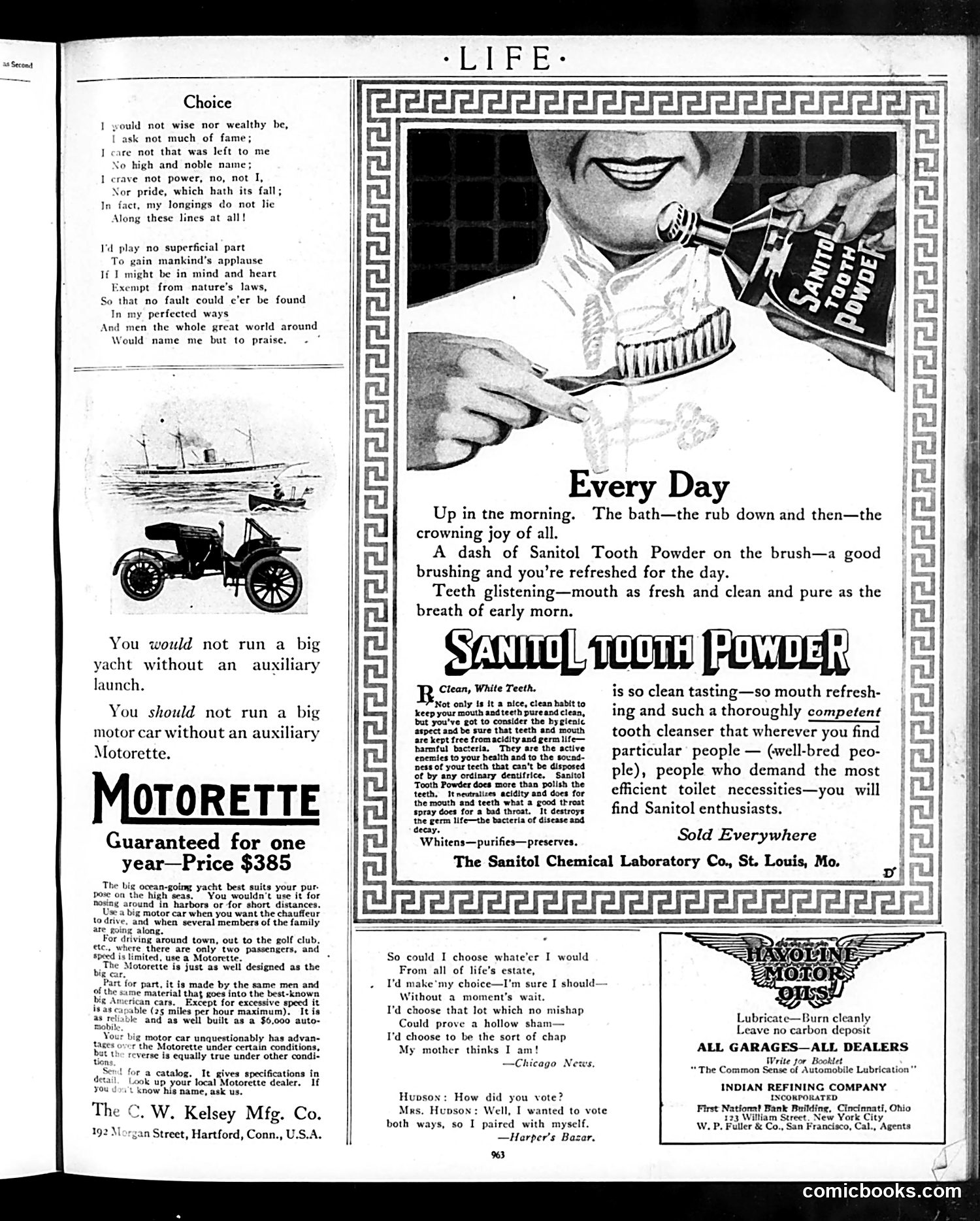
This page is primarily **advertising**, not political satire. It contains three distinct ads: 1. **"Choice" poem** (left): A philosophical verse accompanying ads for a **Motorette** (an auxiliary motorette engine for cars, priced at $385) 2. **Sanitol Tooth Powder** (center): The main ad features a smiling person applying tooth powder, emphasizing cleanliness and freshness. The copy stresses it's a "competent tooth cleanser" used by "well-bred people." 3. **Vasoline and Indian Refining Company** (bottom right): Advertisement for lubricating oil for automobiles. The page reflects early 20th-century consumer culture—promoting personal hygiene products, automotive accessories, and industrial lubricants to an upwardly mobile readership. No political cartoons or social satire are present.
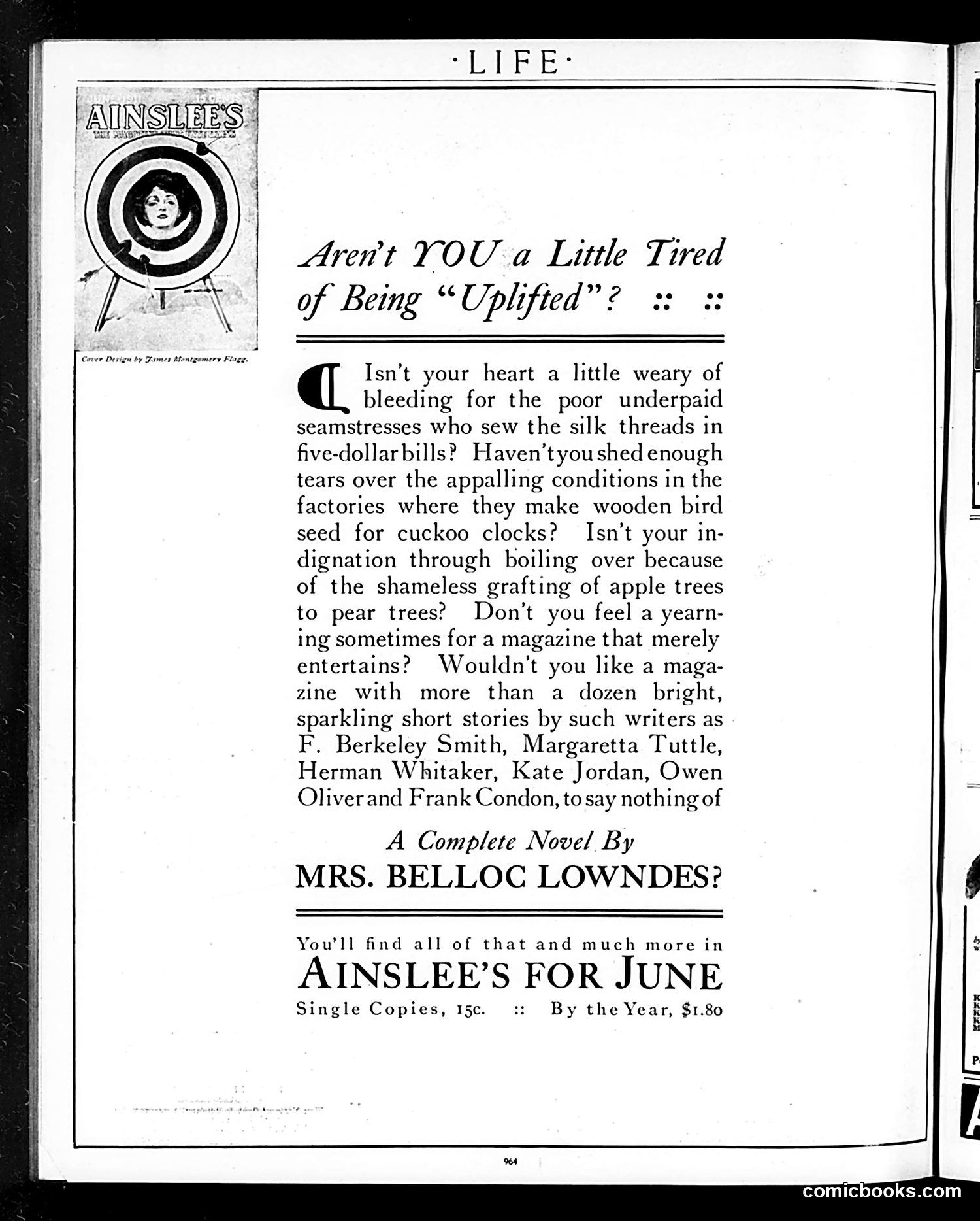
This page is primarily **advertising for Ainslee's magazine** (June issue), not political satire. The ad uses ironic rhetoric to mock readers' apparent fatigue with "uplifting" content. The copy sarcastically asks if readers are tired of sentimental stories about struggling seamstresses and moral tales about factory conditions—appeals to social conscience common in early 20th-century magazines. It then pivots to promise entertainment instead: short stories by popular writers like F. Berkeley Smith and Herman Whitaker, plus a complete novel by Mrs. Belloc Lowndes. The small circular target design (top left) with a woman's face appears to be Ainslee's logo/masthead design. The satire targets magazine readers who claimed to want serious social content but actually preferred escapist fiction.
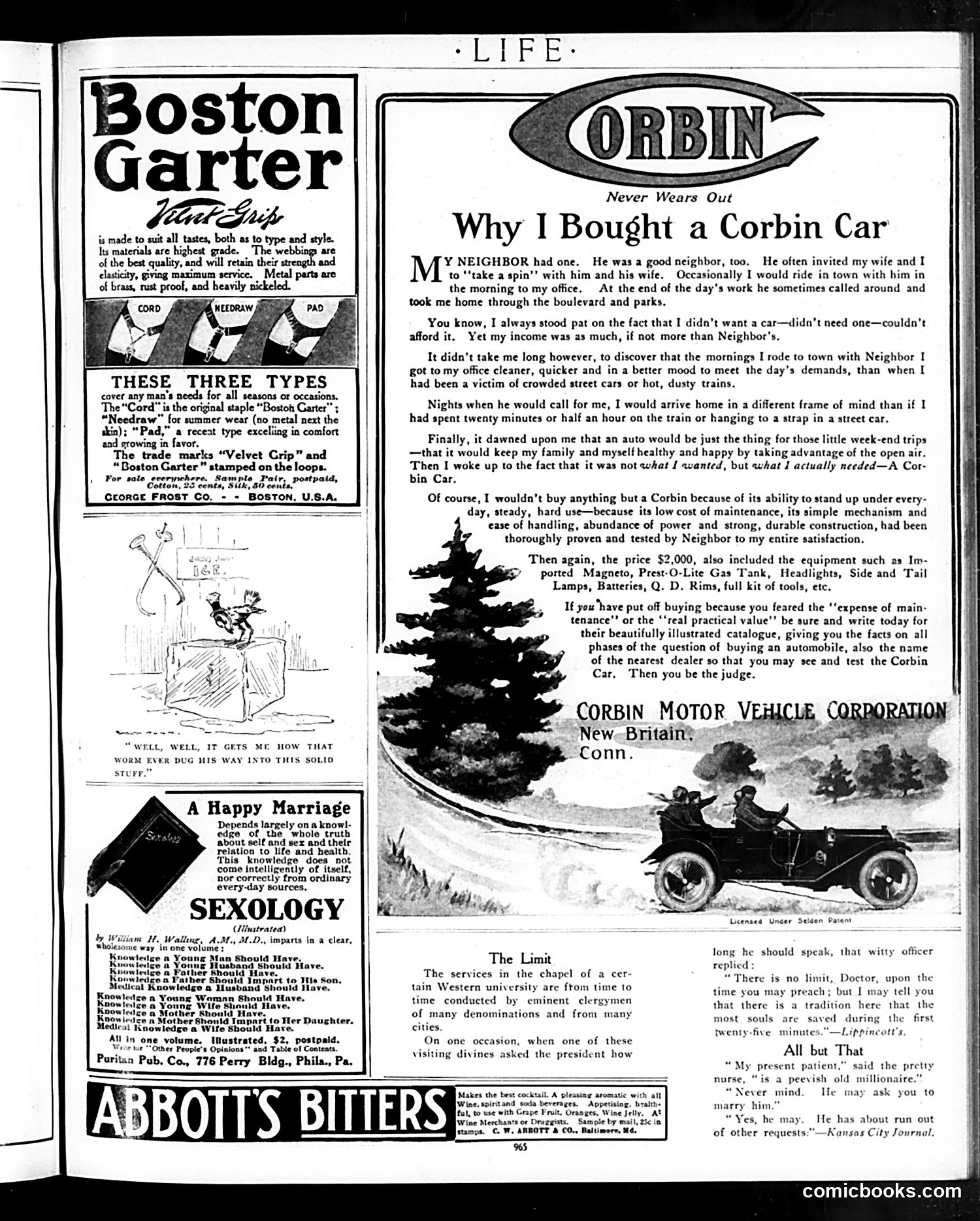
This page is primarily **advertising and consumer content** rather than political satire. The main items are: 1. **Boston Garter ad** (top left): Promotes men's garters with three types for different occasions—practical product advertising. 2. **Corbin Car ad** (right, dominant): A testimonial about why the author bought a Corbin automobile, emphasizing reliability, low maintenance costs, and practicality over a competitor's vehicle. This is straightforward automotive marketing. 3. **Minor content**: A cartoon about a husband hiding things in furniture (domestic humor), a book advertisement for "Sexology," and Abbott's Bitters ad (bottom). **No political satire is evident.** The page reflects early 20th-century consumer culture and gender-specific product marketing (garters, automobiles). The humor is domestic rather than satirical.
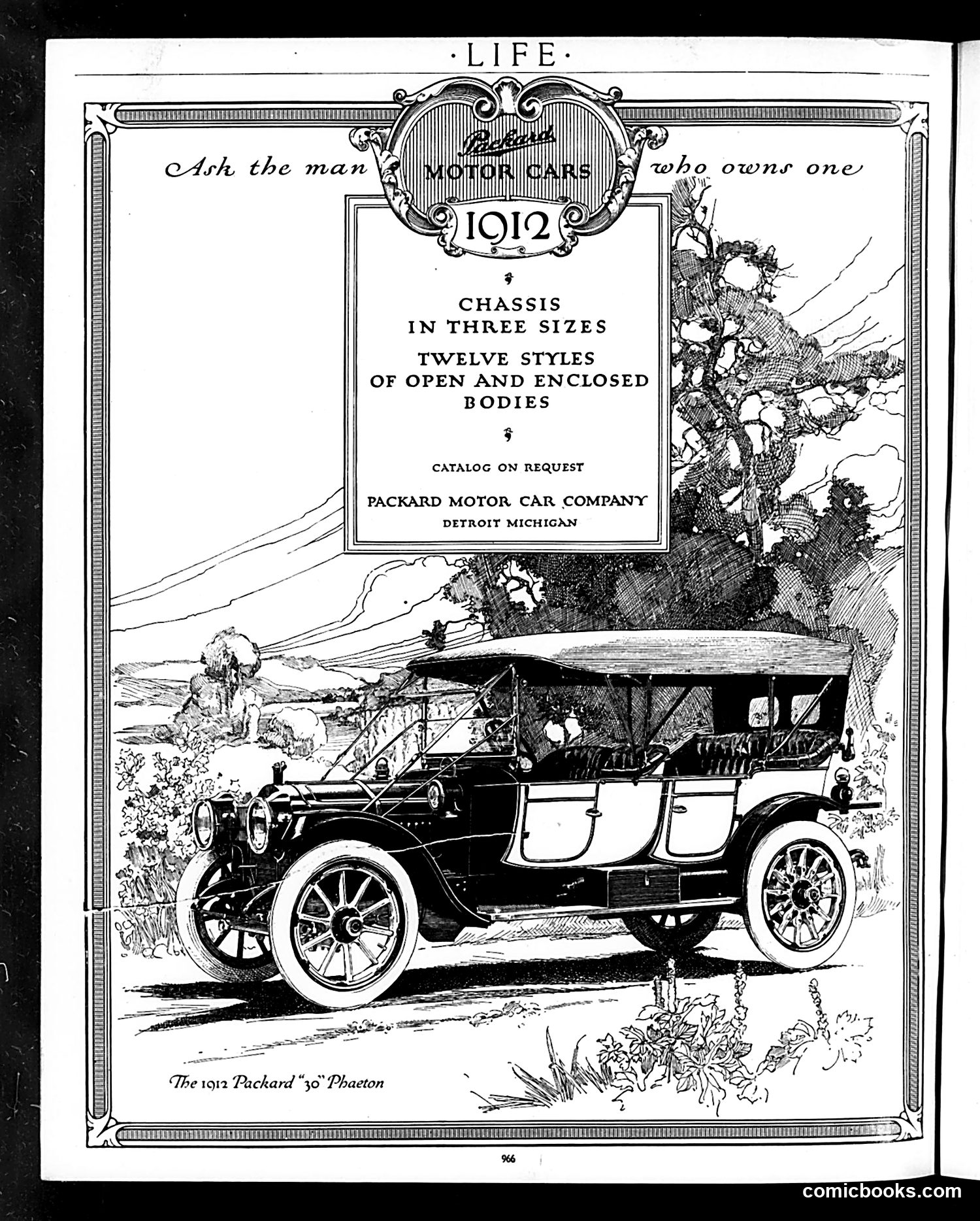
This is primarily a **Packard Motor Car Company advertisement**, not a political cartoon. It appears in *Life* magazine's 1912 advertising section. The ad promotes the Packard automobile chassis, available in three sizes with twelve body style options (open and enclosed). The featured image shows the "1912 Packard '30' Phaeton"—a luxury touring car with an open-air configuration and multiple passenger seats. The satirical headline—"Ask the man who owns one"—was Packard's famous advertising slogan, implying that satisfied owners would enthusiastically endorse the vehicle. The bucolic landscape illustration (countryside setting with trees and pastoral scenery) positions the automobile as enabling leisurely, countryside travel for affluent buyers. This represents early automotive marketing targeting wealthy consumers.
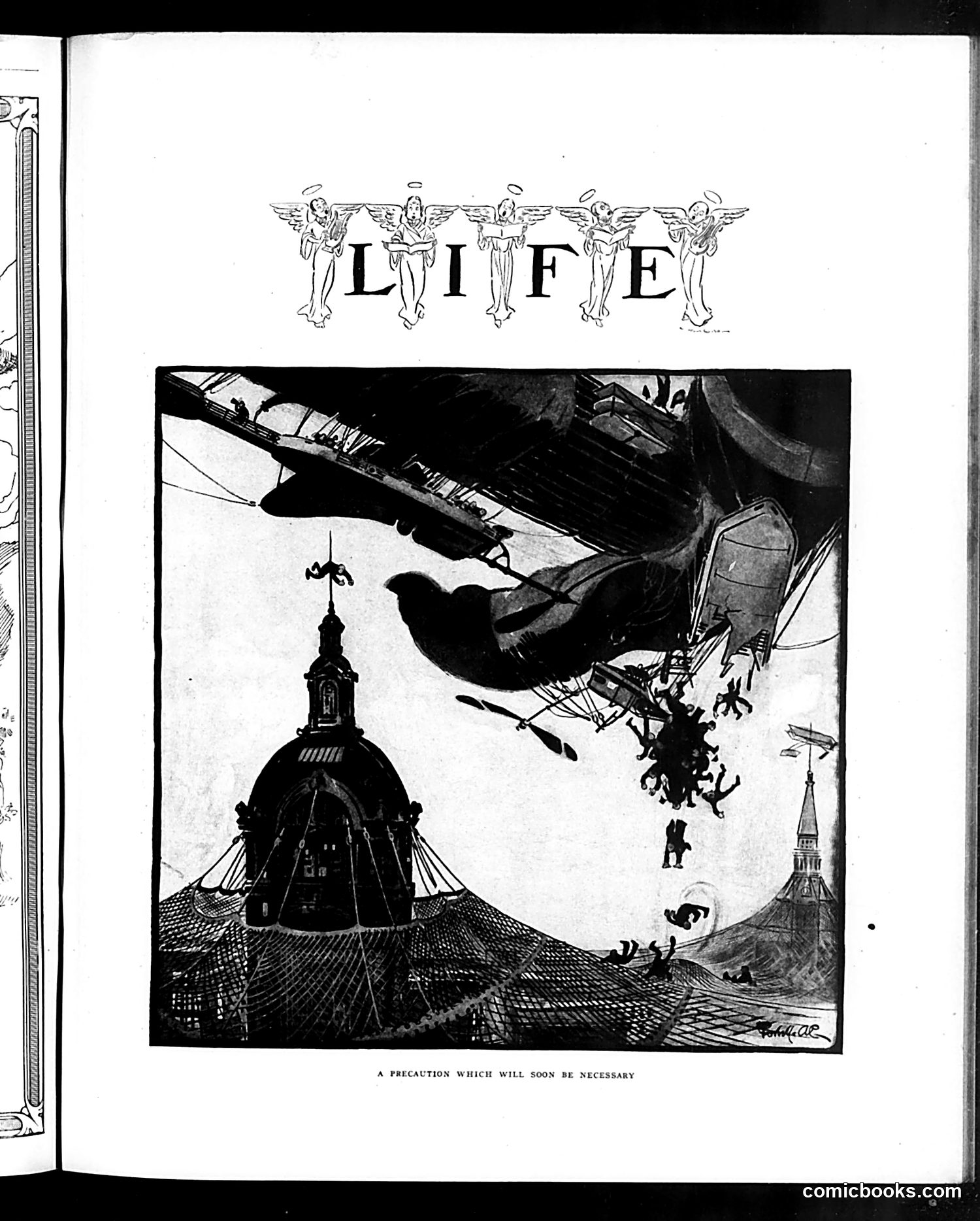
This is a satirical cartoon from *Life* magazine showing an airship or dirigible dropping bombs near a domed cathedral (likely St. Paul's in London, based on the architecture). The caption suggests that air defense measures will soon become necessary. The cartoon appears to reference early 20th-century anxieties about aerial bombardment—a then-novel military threat. The image depicts aircraft attacking a major religious/civic landmark, with people visible below in apparent danger or evacuation. The satire likely comments on either the growing inevitability of such threats in modern warfare, or criticizes inadequate civil defense preparations. The tone is dark and prescient, treating future aerial attacks as an accepted certainty rather than mere speculation. This reflects pre-WWI or early-war period concerns about emerging aviation technology as a weapon.
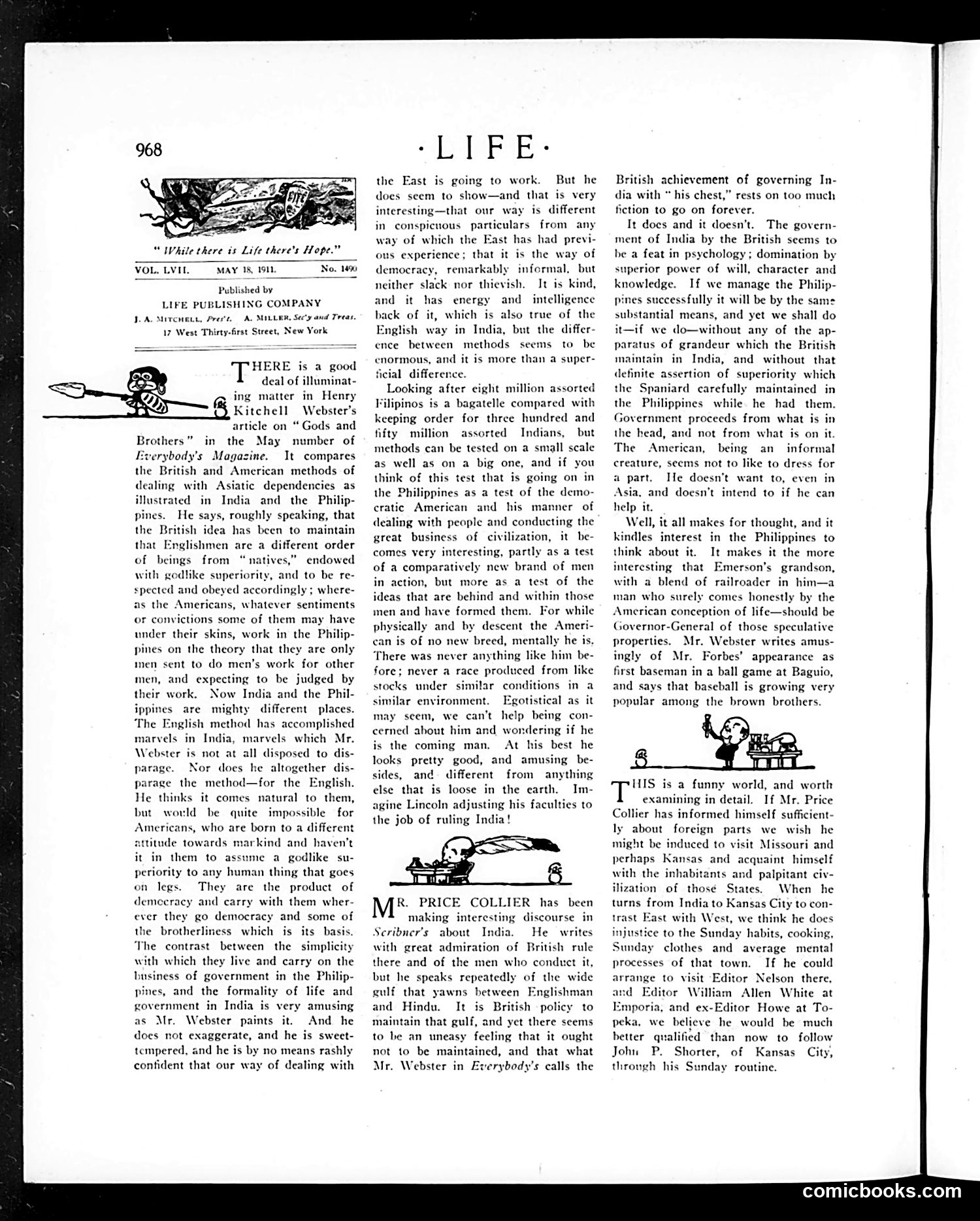
This page discusses American governance in the Philippines, contrasting British and American colonial methods. The text analyzes Henry Mitchell Webster's article on "Gods and Brothers" in *Everybody's Magazine*, comparing how Britain and America handle dependent territories. The small cartoons illustrate the article's points about colonial administration. One depicts a figure adjusting to governing responsibilities (likely representing American colonial governance), while another shows contrast between approaches. The page includes commentary by Price Collier on India and British rule, discussing the cultural gulf between English and Hindu populations. A final note mentions visiting American cities' "Sunday habits" and processes as comparative subjects. The overall satire critiques American colonial attitudes while examining different imperial governance philosophies of the early 20th century.
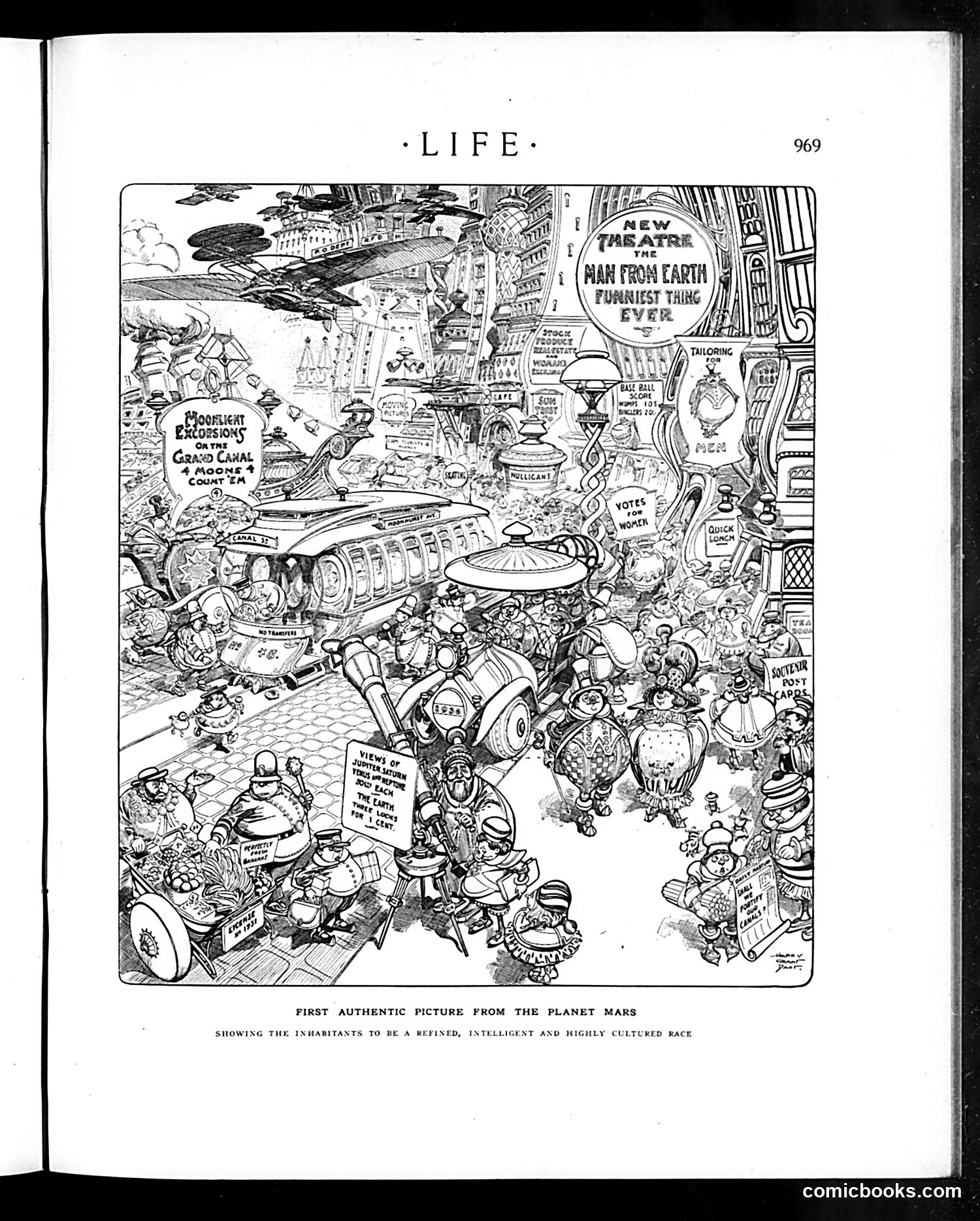
This is a satirical illustration titled "First Authentic Picture from the Planet Mars," depicting Martian inhabitants as "a refined, intelligent and highly cultured race." The joke is visual irony: the supposed "advanced civilization" is actually a chaotic, crowded marketplace or fair filled with absurd contraptions, bizarre vehicles, and comical alien creatures. Various signs advertise ridiculous products and services ("New Theatre," "Man From Earth," "Votes for Women"). The satire appears to mock contemporary American society by presenting it as the height of Martian sophistication—suggesting that early 20th-century American commercial culture, technological gadgetry, and social movements (notably women's suffrage) are fundamentally absurd and chaotic, despite being presented as signs of progress. The dense, intricate linework and abundance of visual gags exemplify Life magazine's sophisticated humor style.
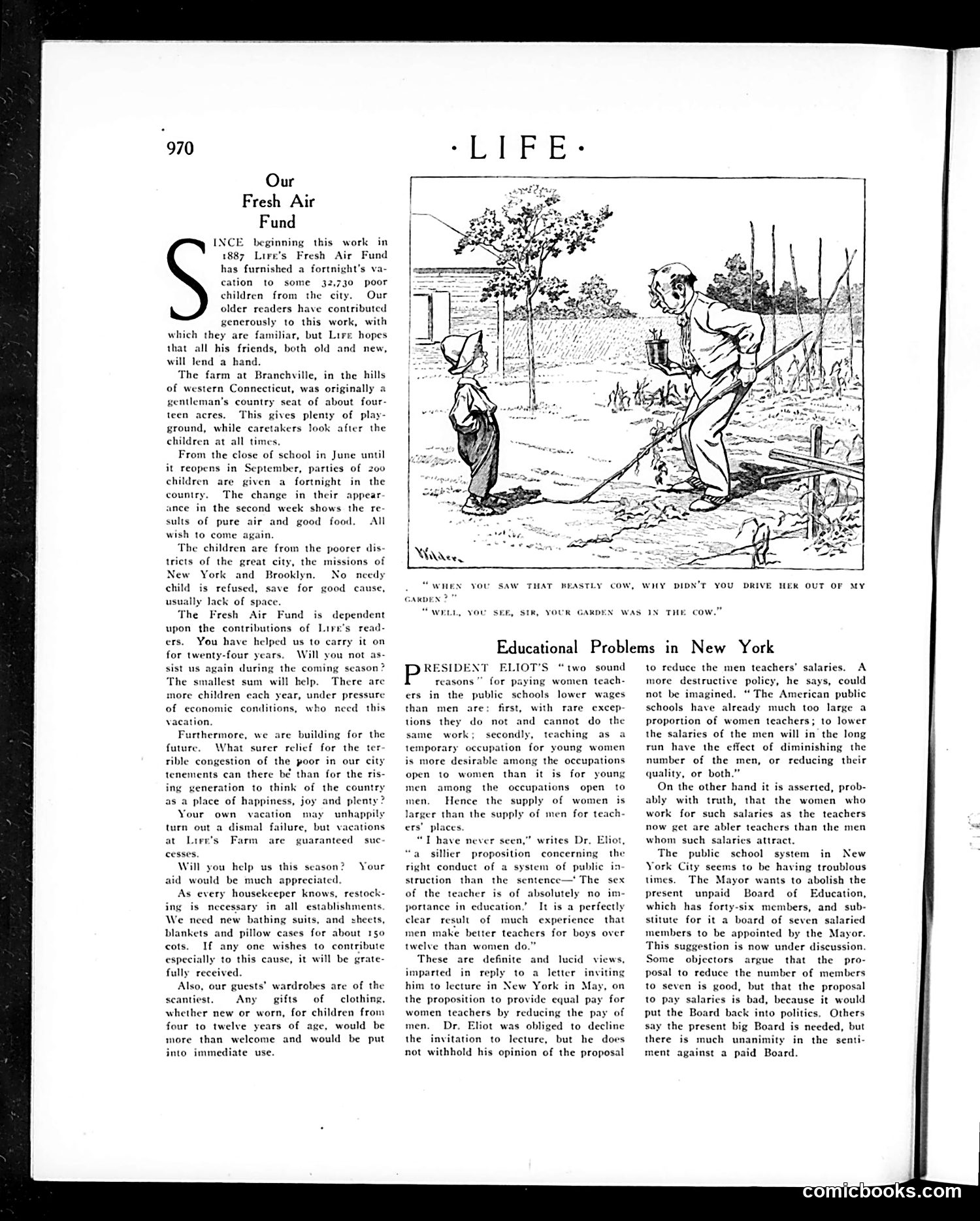
The cartoon illustrates Life magazine's "Fresh Air Fund," a charitable initiative providing poor urban children countryside vacations. The scene depicts a rural setting where a boy, clearly from the city, has apparently let a cow into a gentleman's garden. The farmer confronts him: "Now, you saw that beastly cow, why didn't you drive her out of my garden?" The boy responds: "Well, you see, sir, your garden was in the cow." The joke relies on the boy's innocent misunderstanding of spatial relationships—confusing the garden's location with the cow's perspective. It satirizes urban children's unfamiliarity with rural life and farm management, a common theme in early 20th-century "fish-out-of-water" humor about city kids encountering countryside realities.
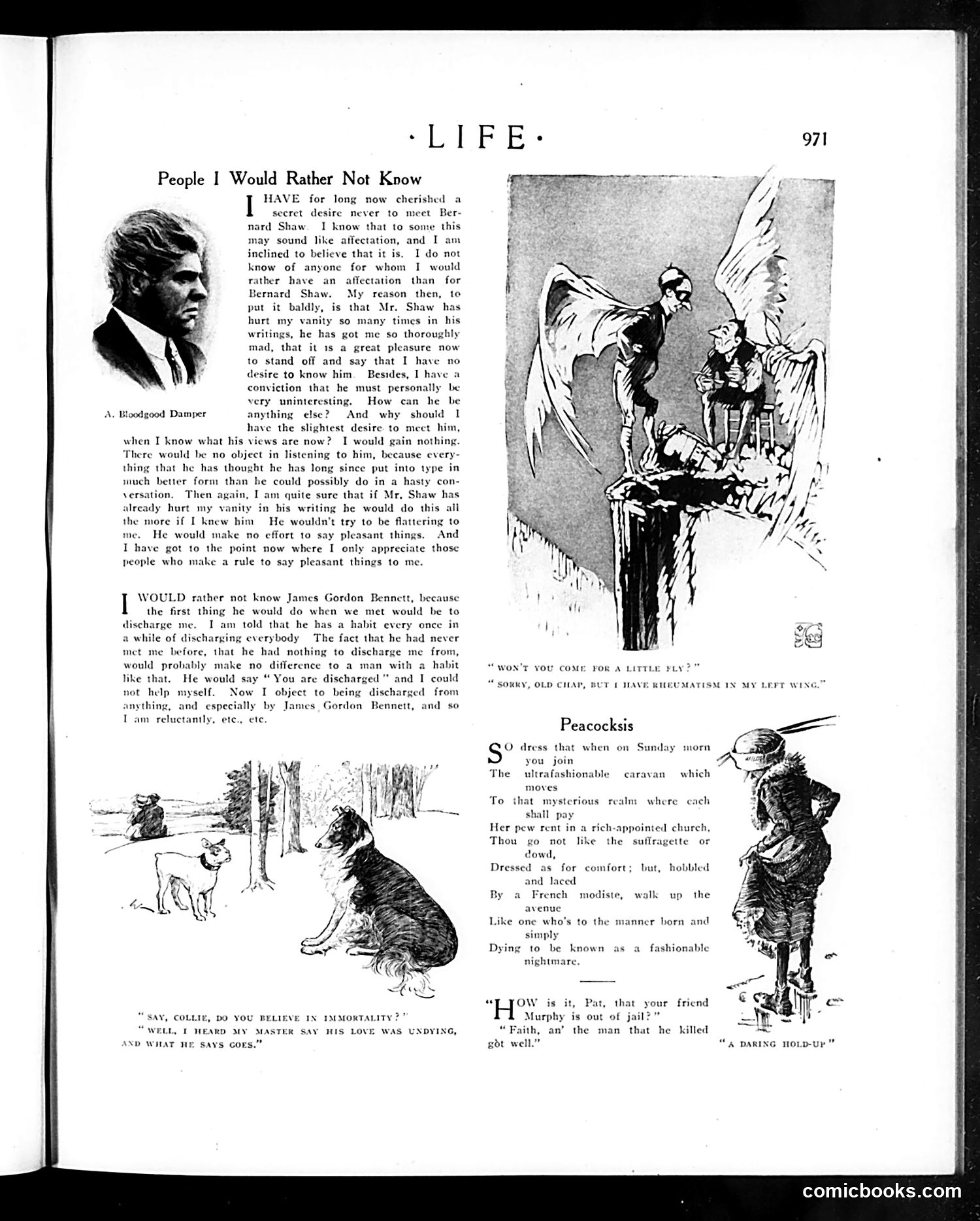
This page contains three distinct pieces of satire: 1. **"People I Would Rather Not Know"** — A portrait sketch labeled "A. Bloodgood Damper" accompanies text expressing the author's desire to avoid meeting Bernard Shaw, whose prolific writings have made him thoroughly disliked. The piece also mentions James Gordon Bennett, criticizing his habit of discharging employees. 2. **"Peacocksis"** — A poem mocking fashionable Sunday church attendance, satirizing wealthy women who parade in expensive carriages and French fashions while claiming religious devotion. 3. **Cartoon illustrations** show conversational scenes — one depicting a dog discussing immortality, another showing what appears to be a daring criminal escape ("A Daring Hold-Up"). The page satirizes social pretension, literary celebrities, and fashionable hypocrisy typical of Life's editorial stance.
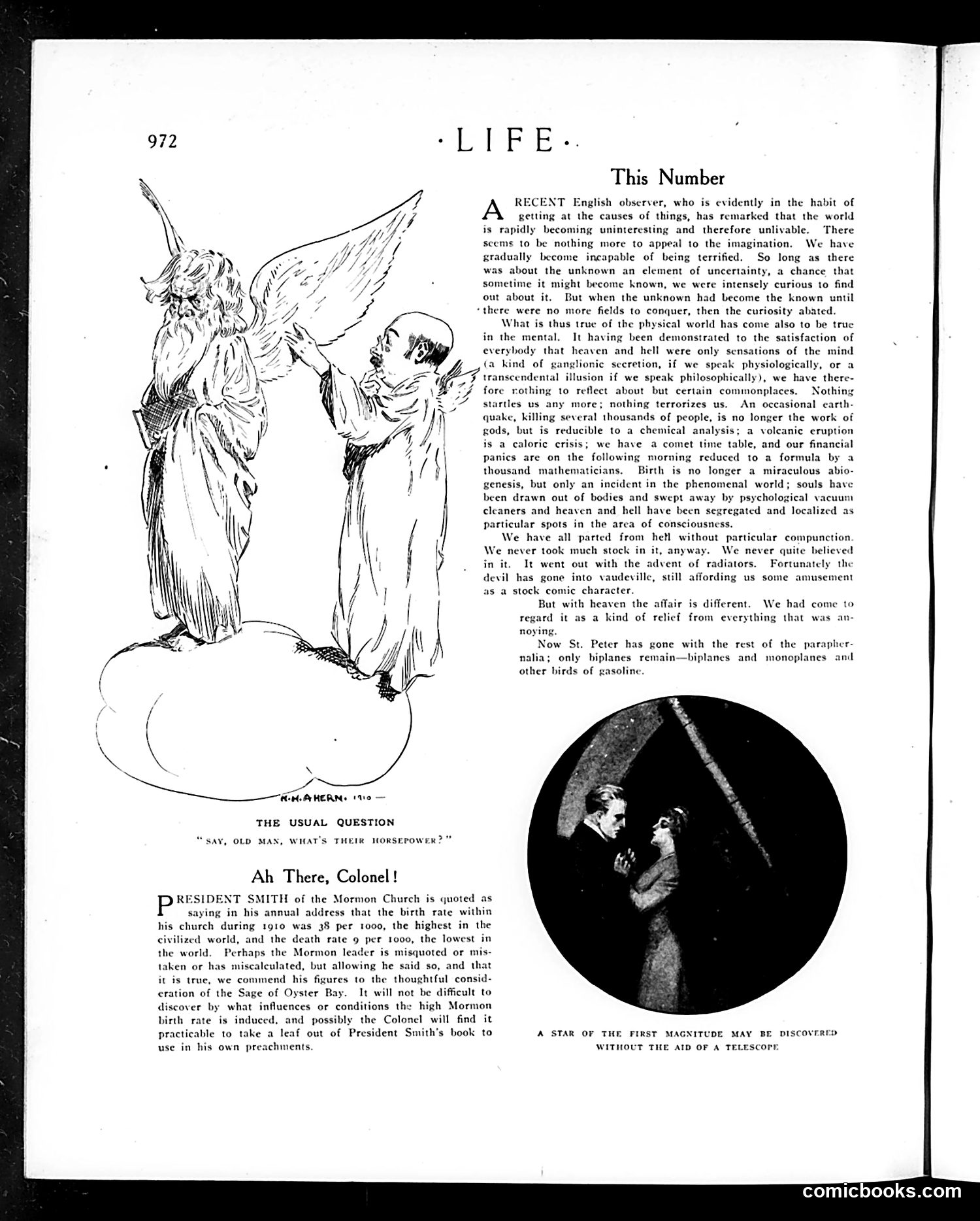
**"The Usual Question" cartoon** depicts an angel asking an old man "Say, old man, what's their horsepower?" — a joke about modern obsession with automobiles replacing traditional heavenly concerns. The angel and man stand on clouds, making this an afterlife scene where even celestial beings care about cars. **"Ah There, Colonel!" article** discusses President Smith of the Mormon Church, citing 1910 birth/death statistics (38 per 1,000 births; 9 per 1,000 deaths). The text humorously suggests looking at "Oyster Bay" statistics for comparison — likely referencing Theodore Roosevelt's location — to understand demographic influences on the Mormon Church's high birth rate. The circular photograph shows two men in conversation, though their identities aren't specified in visible text.
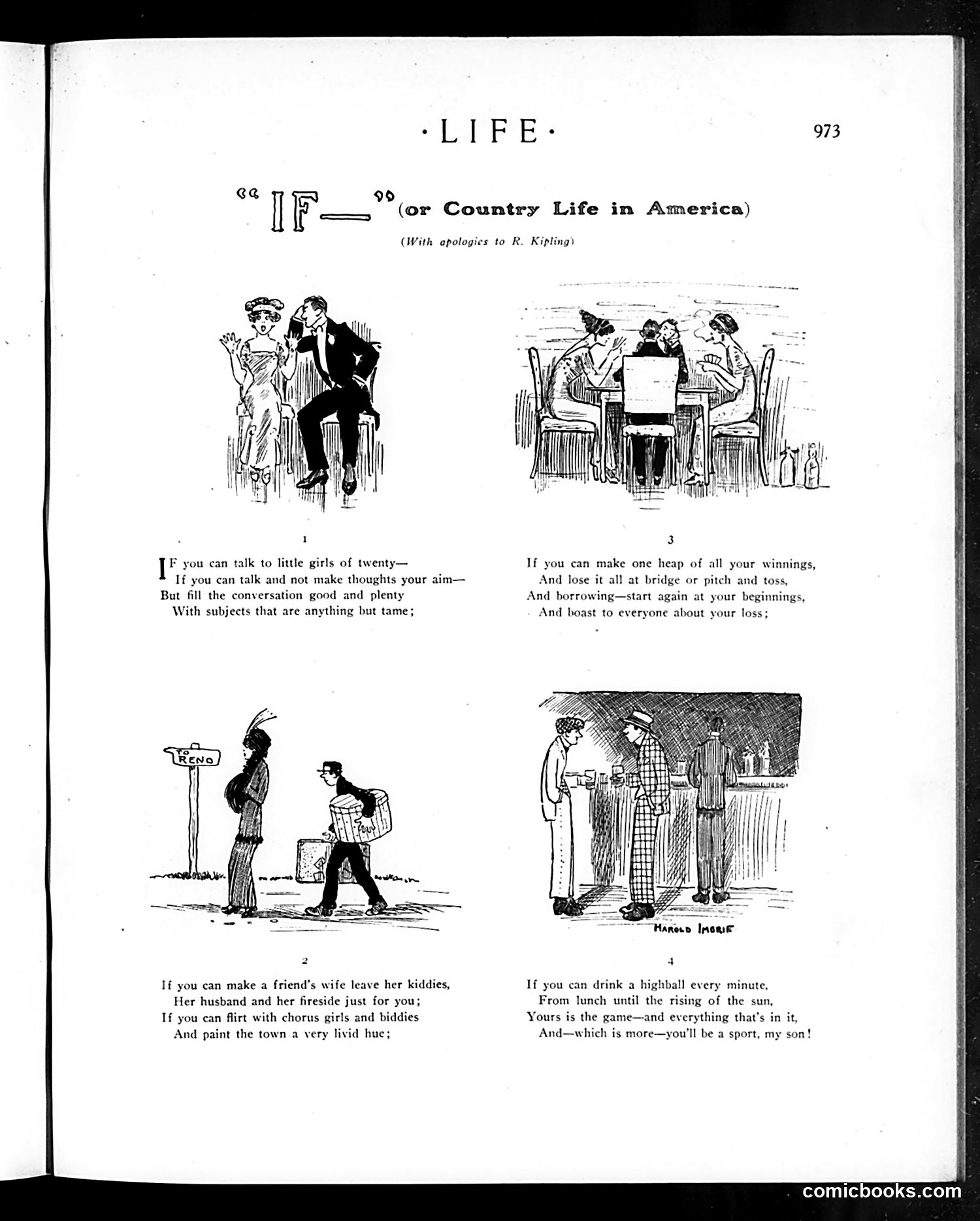
This satirical piece parodies Rudyard Kipling's famous poem "If——," substituting Kipling's virtuous ideals with cynical American pursuits. Each numbered section presents a "condition for success" in American life: 1. **Idle socializing** over substance 2. **Seducing married women** and flirting with chorus girls 3. **Gambling** (losing at cards/dice then bragging about losses) 4. **Heavy drinking** from lunch to sunset The cartoons illustrate these vices—tennis, infidelity, gambling, and bar culture. The satire critiques American materialism, moral decay, and shallow leisure pursuits among the well-to-do. By inverting Kipling's moral framework (which celebrated restraint and integrity), Life mocks contemporary American society's actual values, suggesting that success derives not from virtue but from vice and self-indulgence.
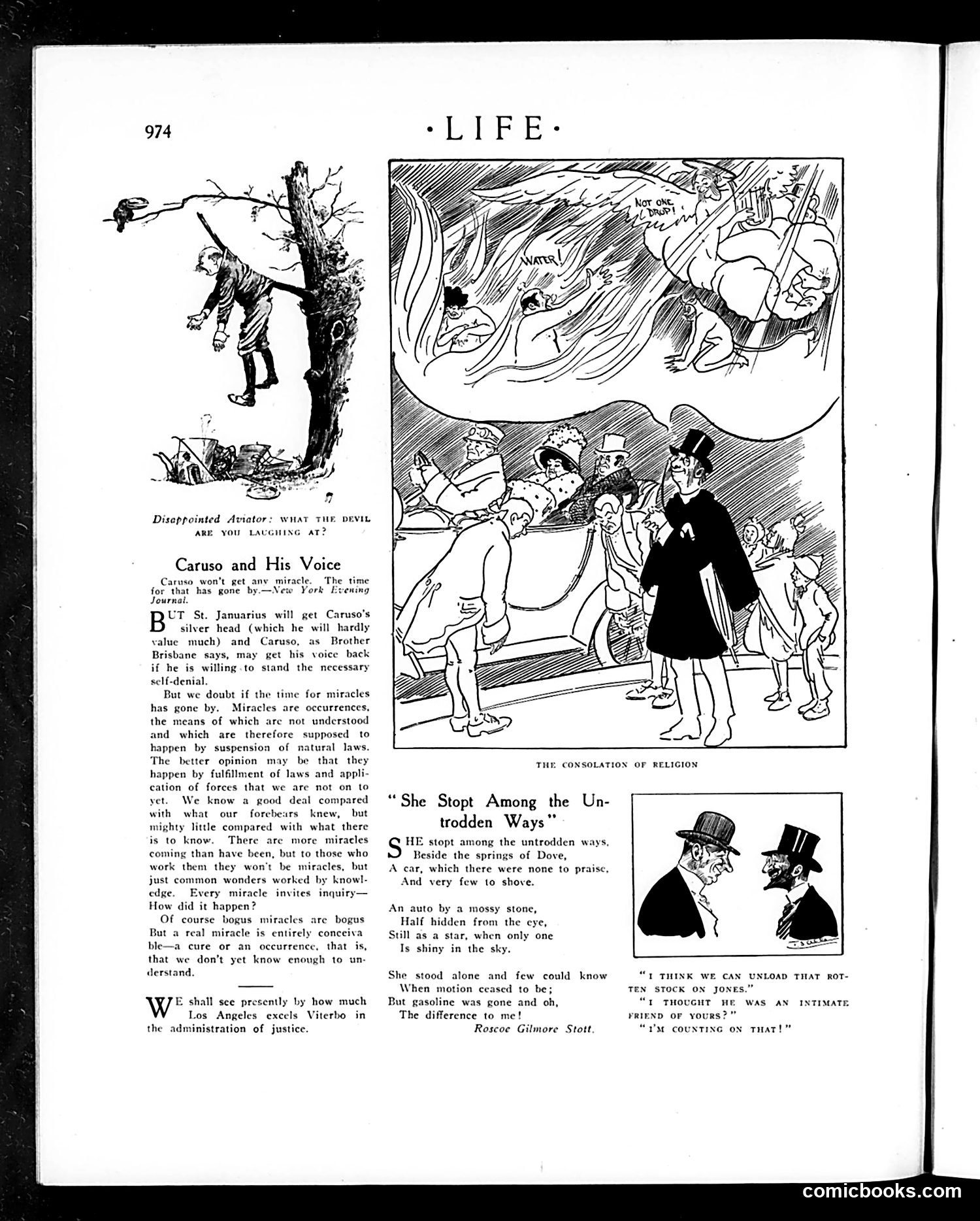
This page contains several distinct satirical items: **"Caruso and His Voice"** references the famous opera singer Enrico Caruso, apparently discussing whether he might recover his voice through religious intervention (St. Januarius). The piece debates whether "miracles" are genuinely supernatural or simply phenomena we don't yet understand scientifically—a skeptical take on religious claims. **"She Stopt Among the Untrodden Ways"** parodies Wordsworth's Romantic poem, replacing his idealized nature subject with a broken-down automobile. The joke: a car abandoned by the roadside, whose absence of gas creates emotional loss—mocking both sentimental poetry and early automotive culture's frequent mechanical failures. **The cartoon dialogue** at bottom depicts two men discussing unloading "rotten stock on Jones," revealing they're counting on exploiting him despite claiming friendship—satirizing dishonest business practices and false camaraderie in commercial dealings. The **"Disappointed Aviator"** sketch (upper left) appears unrelated, possibly from another article.
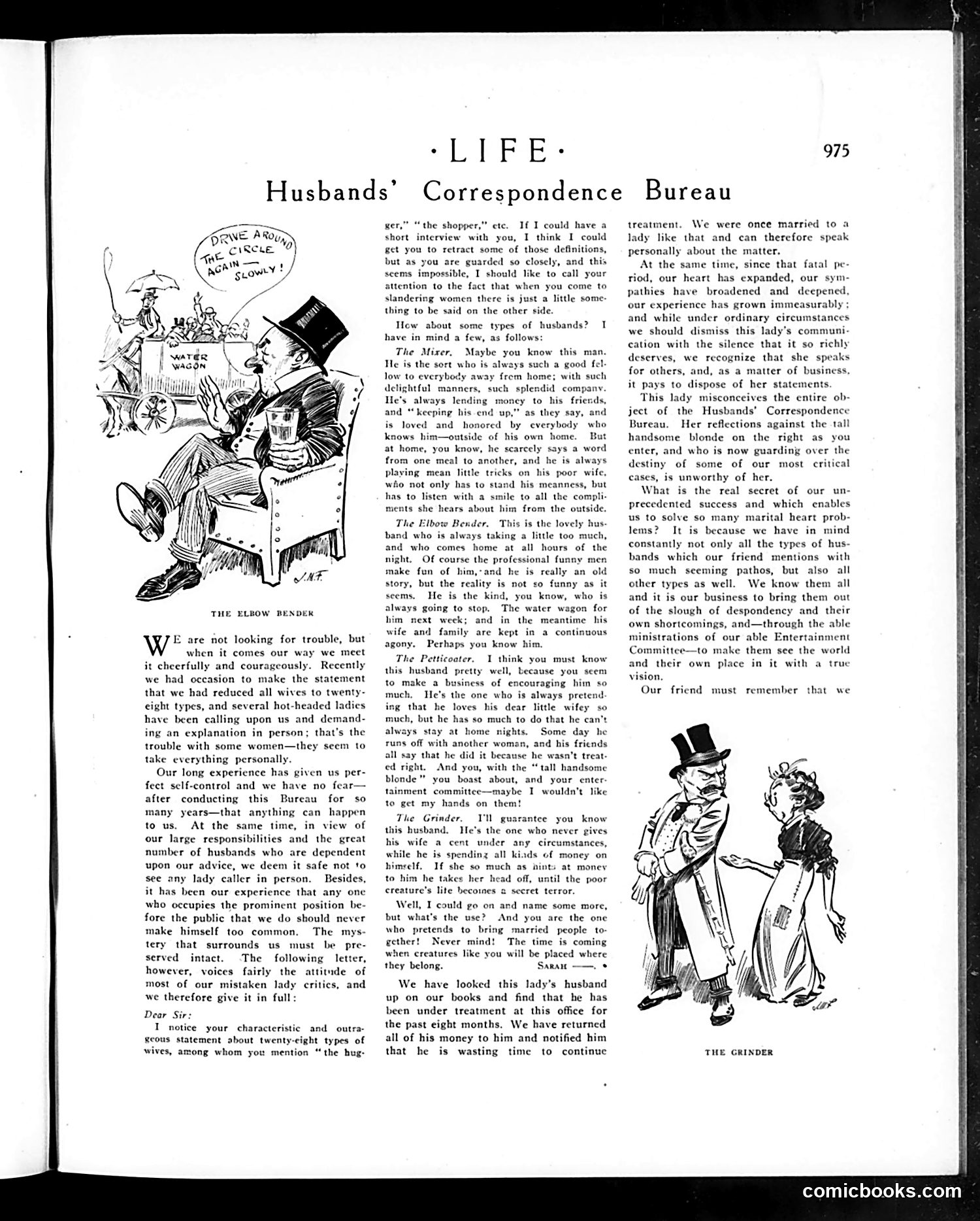
This page satirizes the magazine's own "Husbands' Correspondence Bureau"—a fictional advice column that had categorized wives into 28 types. An angry female reader responds by cataloging husband types instead, turning the satirical tables. The illustrations show caricatured male stereotypes: "The Elbow Bender" (a drunk), "The Grinder" (a miser), and others. The letter describes husbands who are charming publicly but mean at home, chronic drinkers, unfaithful philanderers, and financial abusers. The satire's point: Life's flippant reduction of women to types deserves critique—especially when examining actual marital problems like domestic cruelty, alcoholism, and financial control. The woman's letter treats serious issues (infidelity, abuse) with the same mock-clinical tone Life used, exposing how trivializing women's complaints about real harm was itself the problem. The magazine acknowledges this smartly by publishing her full response.
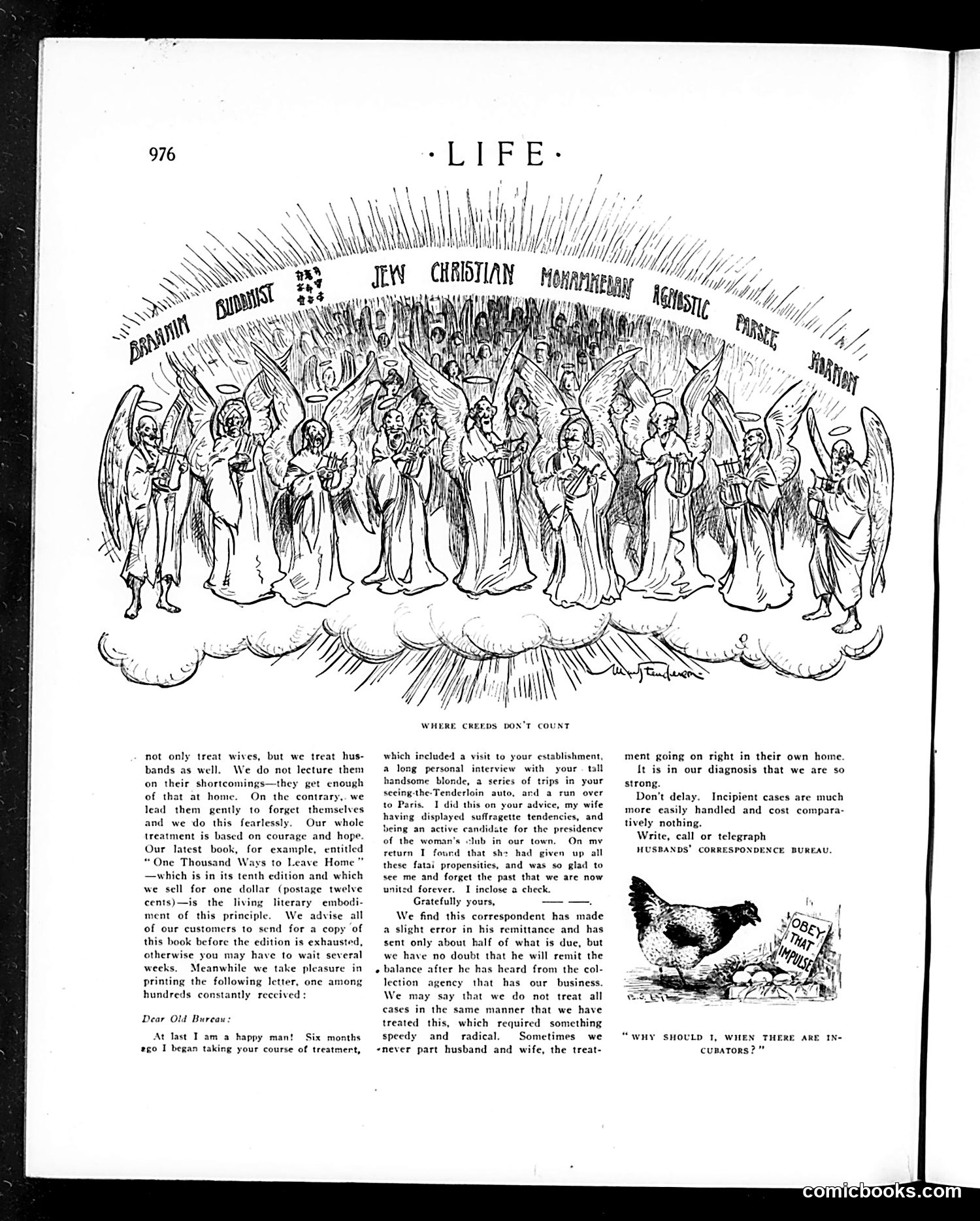
This is a satirical advertisement for a fictional "Husbands' Correspondence Bureau"—a fake service that claims to "treat" wives with suffragette and independence-minded tendencies by separating them from their husbands. The joke targets early 1900s anxieties about the women's suffrage movement. The cartoon depicts the bureau as offering treatments (including visits to red-light districts like the Tenderloin, trips to Paris) to distract wives from political activism. The sample testimonial describes a wife who abandoned her presidential ambitions for the women's club once her husband took the "treatment." The satire works on multiple levels: it mocks both the misogyny of men threatened by women's rights AND the absurdity of such schemes. The final caption—"Why should I, when there are incubators?"—references a popular eugenics debate of the era, darkly suggesting reproductive technology might replace wives altogether. This is Life magazine's biting social commentary on gender politics and anti-suffrage sentiment.
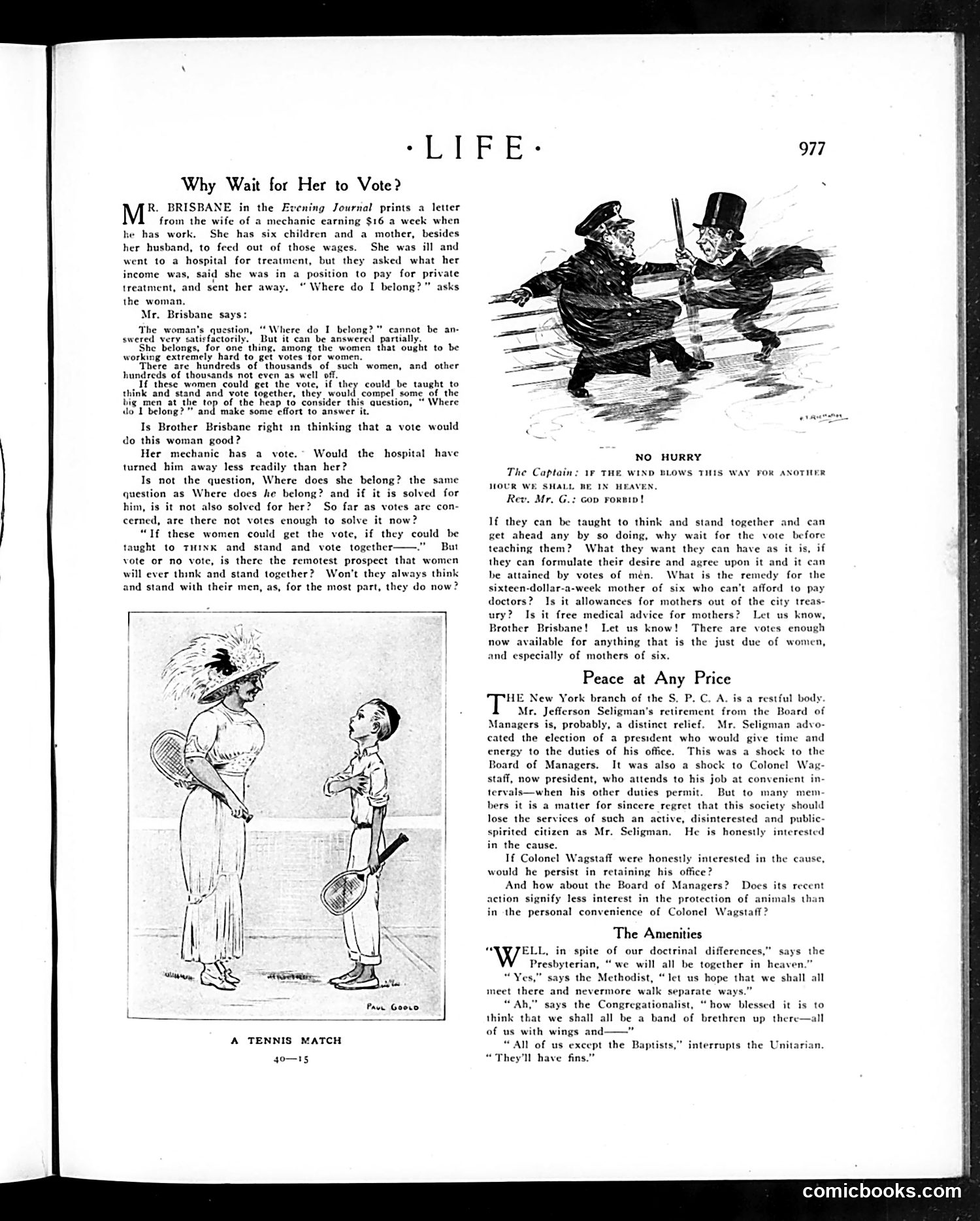
This page contains three satirical commentaries on early 20th-century American social issues: **"Why Wait for Her to Vote?"** debates women's suffrage through a real case: a mechanic's wife earning poverty wages was denied hospital care. Columnist Brisbane argues women need voting power to compel social reform. The editorial response challenges this, asking whether votes alone solve poverty—and whether women will ever vote independently of their husbands. The implicit critique: suffrage won't help if women lack economic independence or political solidarity. **"A Tennis Match"** cartoon (artist Paul Gould) depicts a size-mismatched tennis game, likely satirizing social inequality or unfair competition. **"No Hurry"** mocks clergy complacency about heaven rather than earthly justice. **"Peace at Any Price"** criticizes the S.P.C.A. (animal welfare society) for tolerating an inactive president (Colonel Wagstaff) rather than demanding accountability—suggesting the organization prioritizes harmony over its stated mission of animal protection. The page's overall theme: institutional failure to serve vulnerable populations (poor mothers, animals) due to leadership indifference.
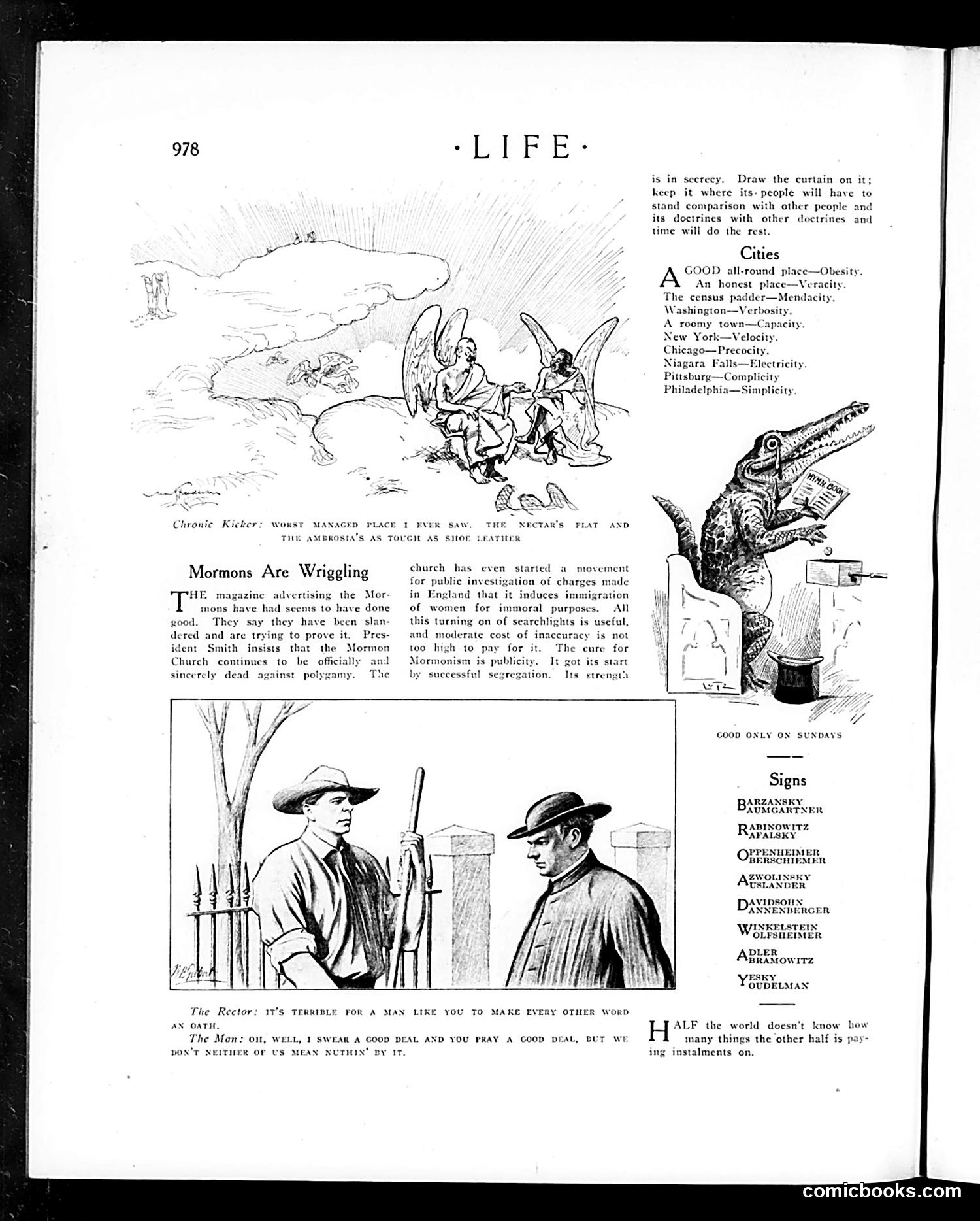
This page satirizes **Mormonism and its public relations efforts**. The main article "Mormons Are Wriggling" critiques the Church of Jesus Christ of Latter-day Saints for launching an advertising campaign to counter allegations of immorality and polygamy. The author argues that publicity—"drawing the curtain" on their practices—is the real solution, not advertising claims of respectability. The cartoon below shows a **Rector and a working man** in dialogue about swearing and prayer. The joke mocks religious hypocrisy: both engage in their respective practices (cursing and praying) without genuine sincerity or meaning behind the words. The "Cities" section uses humorous personification to mock American urban characteristics—New York as "Velocity," Washington as "Verbosity"—typical period satire of contemporary life and politics. The **"Signs" section lists Jewish surnames**, likely mocking a particular trend or stereotype contemporary to the publication's era, though context here is unclear without additional page information.
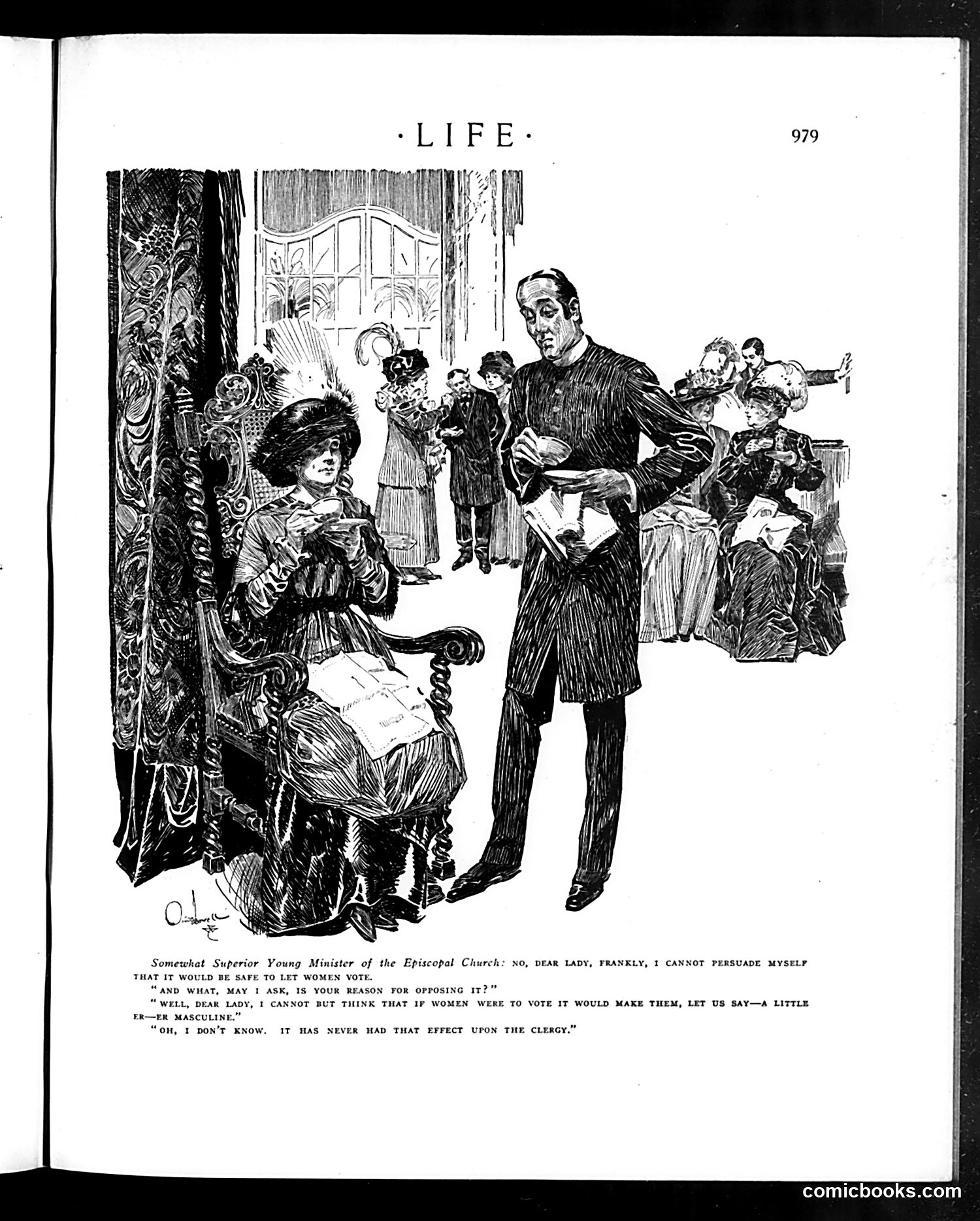
This satirical cartoon from *Life* magazine mocks an Episcopal clergyman's opposition to women's suffrage. The minister argues that voting would make women "masculine," revealing the absurdity of anti-suffrage rhetoric. The woman's witty retort—"It has never had that effect upon the clergy"—suggests that male clergy, despite voting rights, haven't become notably masculine themselves, undercutting his logic. The cartoon appears to date from the women's suffrage movement era (pre-1920), when such arguments were common. The satire targets both religious hypocrisy and the paternalistic attitudes of educated men who claimed to protect women by denying them political participation. The "somewhat superior" minister's pompous demeanor emphasizes the condescension suffragists faced from authority figures.
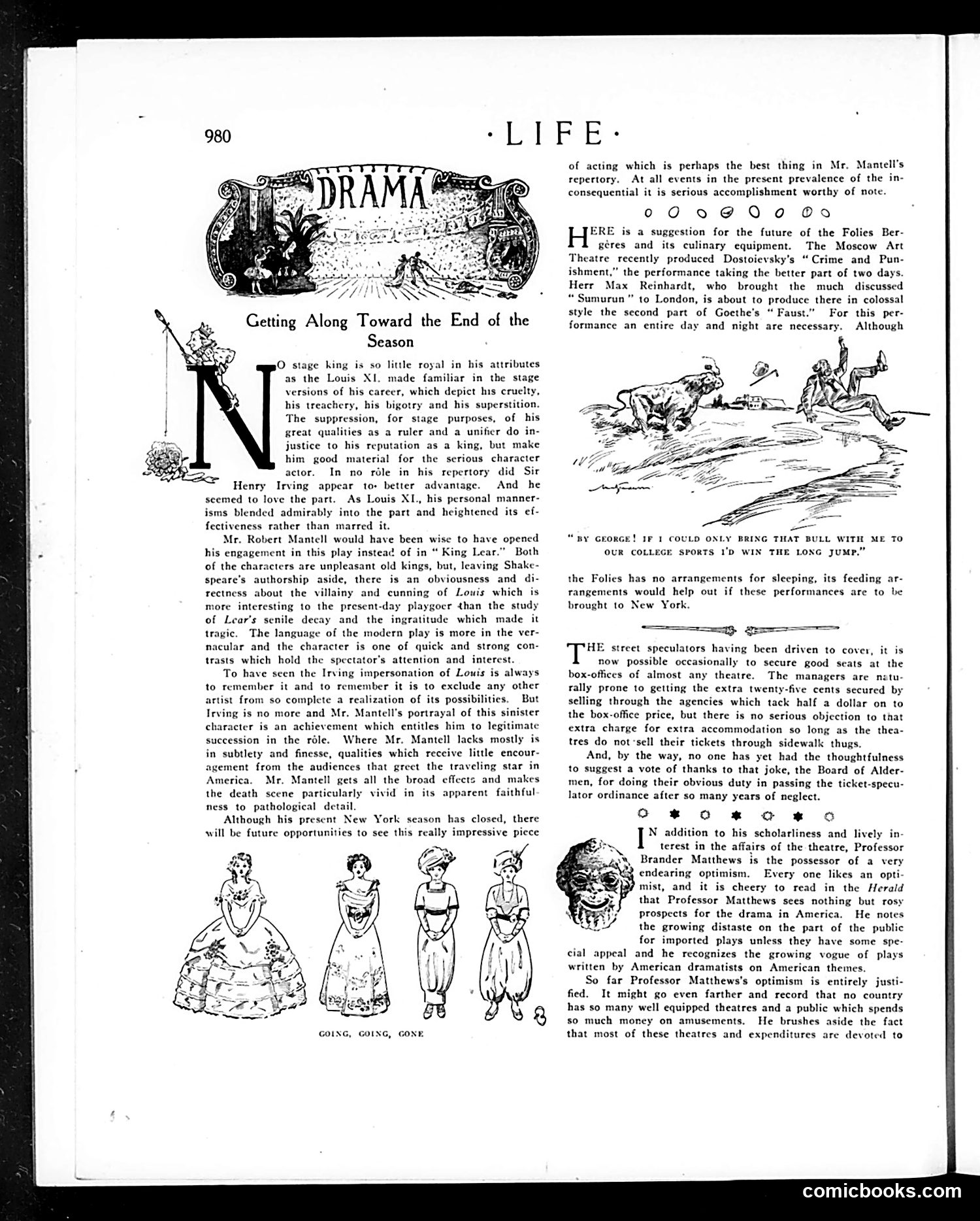
This page discusses theatrical productions and includes social commentary typical of early 20th-century American satire. The main article praises actor Sir Henry Irving's portrayal of King Louis XI and critiques Robert Mantell's attempt at the same role, arguing Irving's interpretation was superior in subtlety. The text suggests Mantell's version appeals to traveling audiences who prefer "broad effects" over nuance. A small cartoon captioned "BY GEORGE! IF I COULD ONLY BRING THAT BULL WITH ME TO OUR COLLEGE SPORTS I'D WIN THE LONG JUMP" depicts a figure observing a bull, mocking college athletics by suggesting brute animal strength would guarantee athletic victory—a jab at the emphasis on physical prowess over intellectual development in American collegiate culture. The fashion illustration labeled "GOING, GOING, GONE" shows four women's dress silhouettes, likely satirizing changing women's fashion trends of the era.
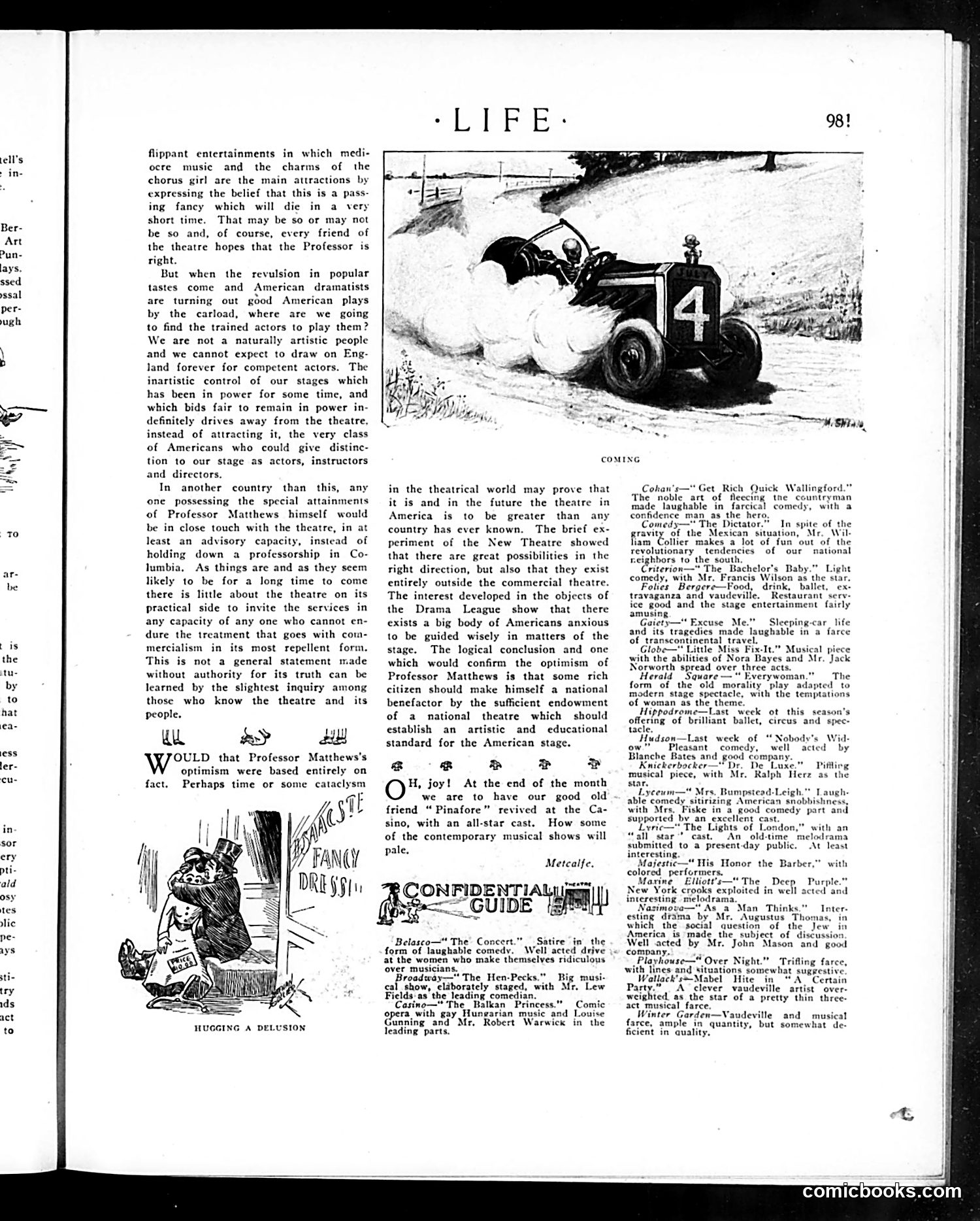
This page presents a cultural criticism essay about American theater, accompanied by two cartoons. ## Main Cartoon: "Hugging a Delusion" The large cartoon depicts a figure embracing or clinging to something labeled "FANCY DRESS" or similar theatrical imagery—likely representing the embrace of superficial, commercially-driven entertainment over serious drama. ## The Argument The text criticizes American theater's commercial control, arguing it drives away serious artists and actors. It mentions "Professor Matthews" (likely referring to Brander Matthews, a Columbia University drama professor) who believes mediocre entertainment with chorus girls is a passing fancy. The author counters that America lacks trained dramatic actors and needs patronage to establish a national theater with artistic standards—not commercial ones. ## References The page includes theatrical reviews of shows like "Pinafore," "The Dictator," and "Rich Quick Wallingford," suggesting contemporary Broadway productions that exemplify both serious and frivolous entertainment. ## The Satire The overall critique mocks American theater's commercialism and argues that artistic merit requires wealthy patronage and institutional support, not market-driven popularity.
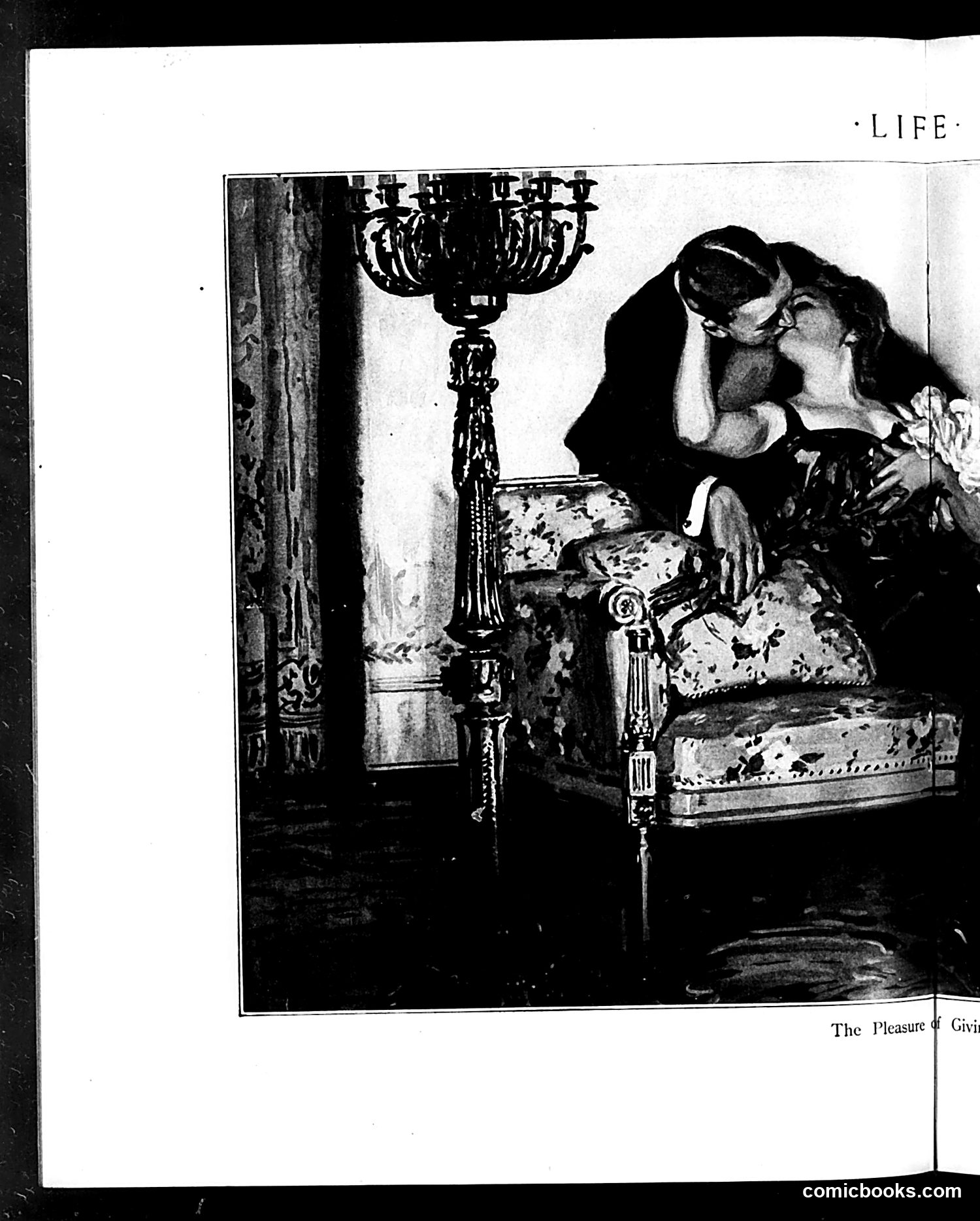
This page from *Life* magazine shows a romantic scene between a man and woman in an ornate interior setting, with the caption "The Pleasure of Givi[ng]" (text appears cut off). The image itself is a straightforward romantic illustration rather than political satire—it depicts an intimate moment between two figures in what appears to be an affluent domestic space, complete with decorative elements like a candelabra and patterned furniture. Without the complete caption text, the specific satirical point is unclear. The incomplete OCR suggests the title may reference "giving" in some social or romantic context, but the full meaning and any intended commentary cannot be reliably determined from the visible information alone.
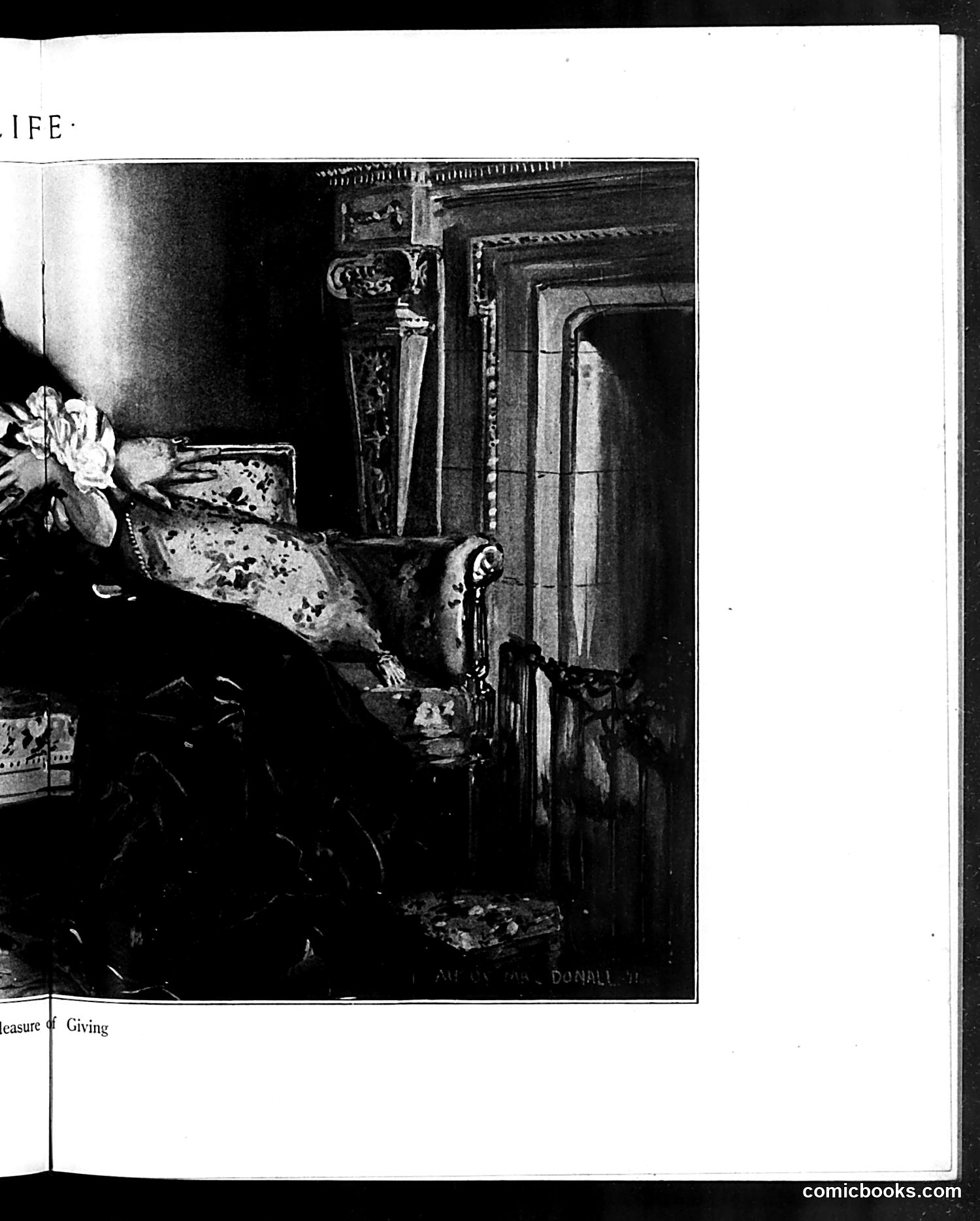
This page from *Life* magazine appears to be a satirical illustration titled "Pleasure of Giving" (visible at bottom left). The black and white image shows an elegantly dressed figure in what appears to be a wealthy interior setting, with ornate furniture and decorative elements visible. The figure seems to be in a posture suggesting leisure or comfort. The satire likely critiques wealthy individuals' self-congratulatory attitudes about charitable giving or philanthropy. The ironic title "Pleasure of Giving" combined with the luxurious setting suggests the cartoon mocks the idea that the wealthy derive personal satisfaction from generosity—implying their "giving" benefits themselves more than those in need. This reflects *Life*'s typical Gilded Age social commentary on class disparities and hypocritical benevolence. The OCR text is too corrupted to provide additional context about the specific publication date or artist.
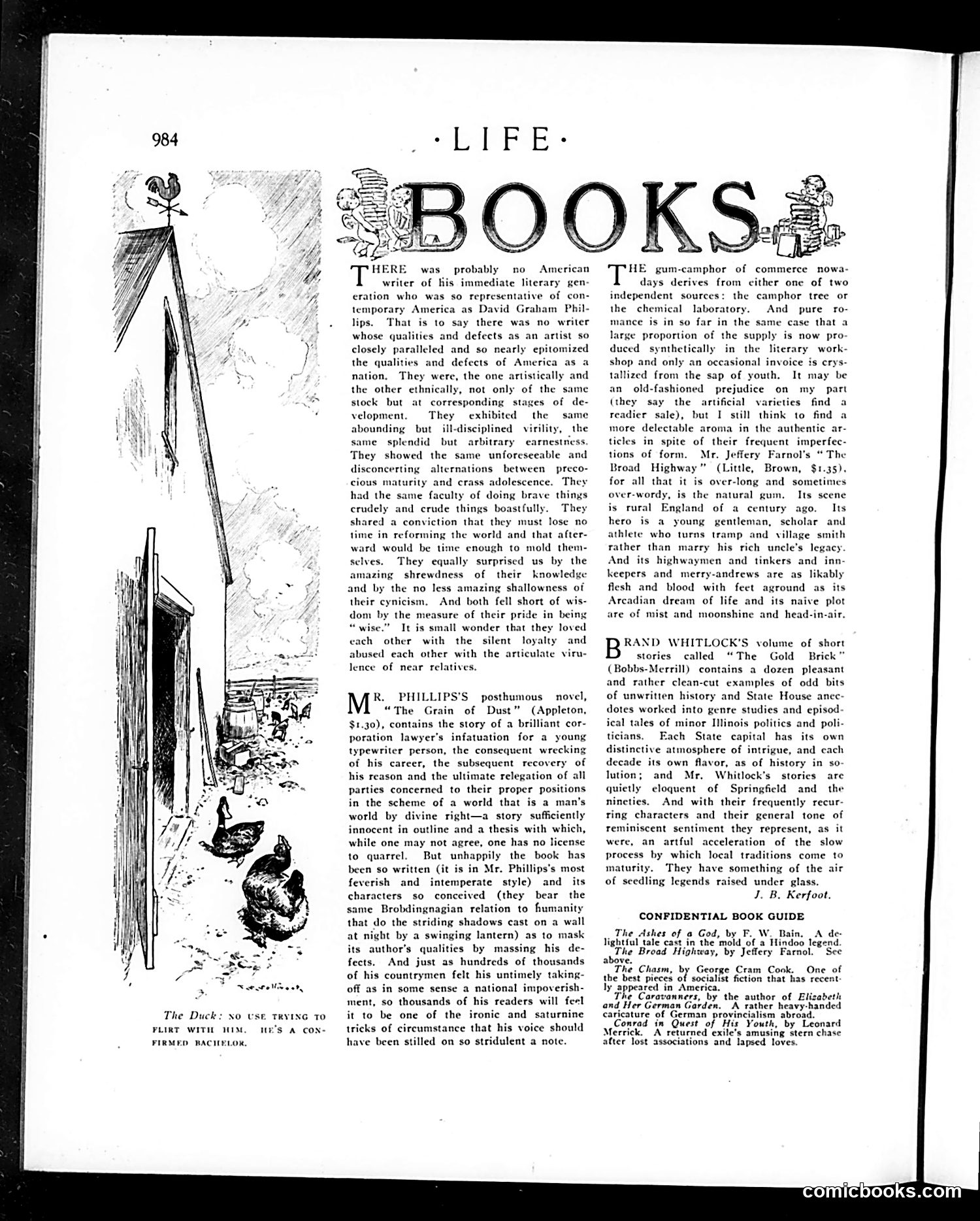
This page reviews three novels, with a small cartoon at bottom left. **The cartoon** shows a duck declining romantic advances, captioned "No use trying to flirt with him. He's a confirmed bachelor"—a simple visual gag requiring no political context. **The main content** discusses David Graham Phillips's posthumous novel *The Grain of Dust*, praising Phillips as representative of American character while critiquing his overwrought, intemperate writing style. The reviewer argues Phillips masked his talents through excessive stylistic flourishes. The page also reviews Jeffrey Farnol's *The Broad Highway*, celebrating its "authentic" romantic appeal over artificially manufactured contemporary fiction—a commentary on literary authenticity versus commercial formula. **The satire is literary, not political**: Life's editors position themselves as sophisticated arbiters of taste, mourning Phillips's death while faulting his artistic execution, and endorsing "natural" storytelling over synthetic modern approaches. This reflects early 20th-century genteel literary criticism's tensions between realism and romanticism.
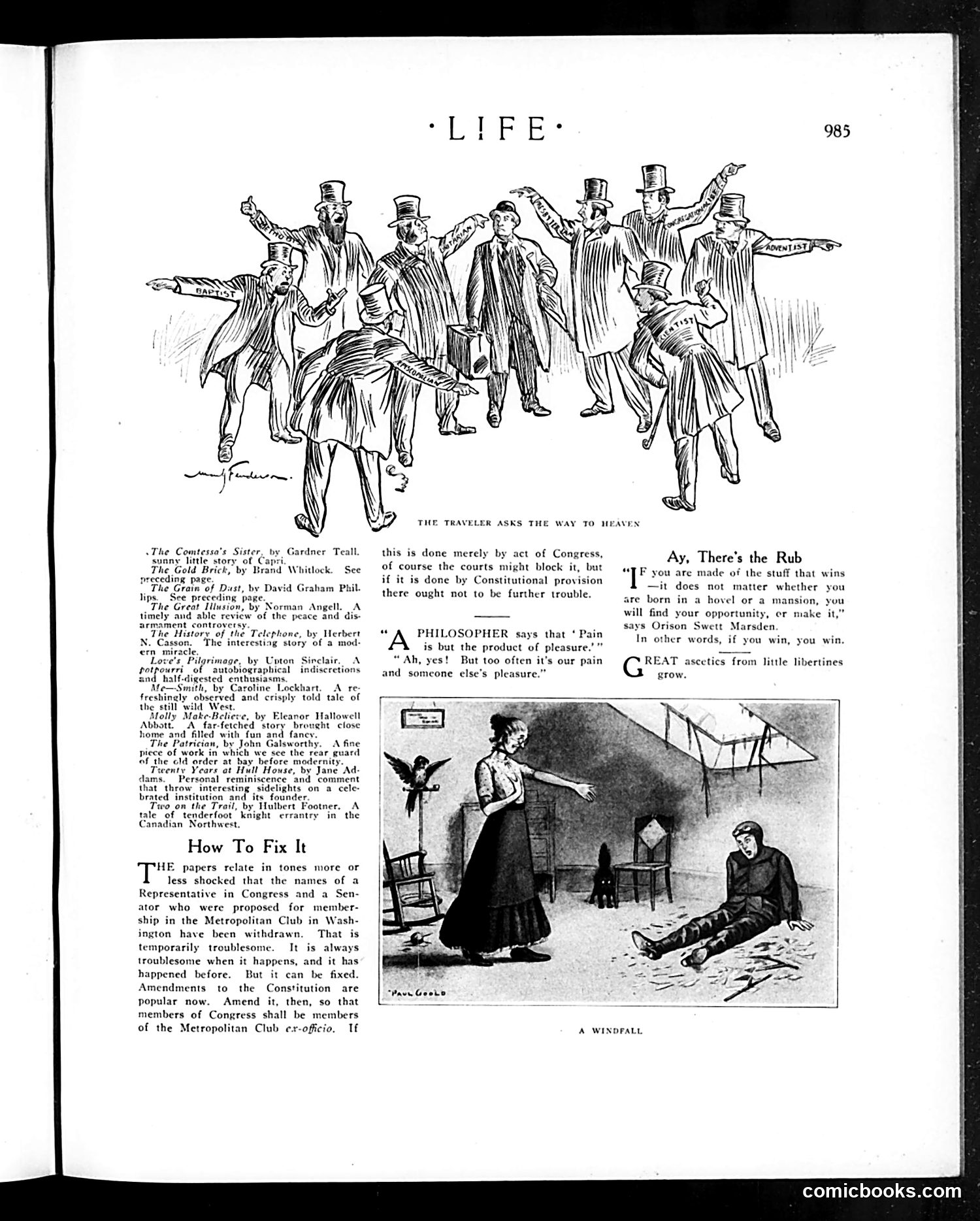
**Top Cartoon: "The Traveler Asks the Way to Heaven"** The illustration shows a group of well-dressed men in top hats gesturing broadly—appearing to give conflicting directions. The satire targets American political/social elites offering contradictory moral or philosophical guidance. The joke suggests that even authorities cannot agree on the "right path." **"How To Fix It" Section** This satirizes a contemporary scandal: congressmen proposed for the exclusive Metropolitan Club in Washington were rejected for membership, likely due to class or social barriers. The author sardonically proposes amending the Constitution to automatically grant Congress members club membership, mocking both the absurdity of solving social problems through constitutional amendments (which were "popular now") and the pretentiousness of excluding elected officials from elite establishments. **Philosophical Quotes** Two brief witticisms comment on pleasure, pain, and success—typical Life magazine filler emphasizing that winning matters regardless of birthright. **"A Windfall" Illustration** Shows a woman discovering a fallen figure—likely depicting sudden, unexpected fortune or misfortune.
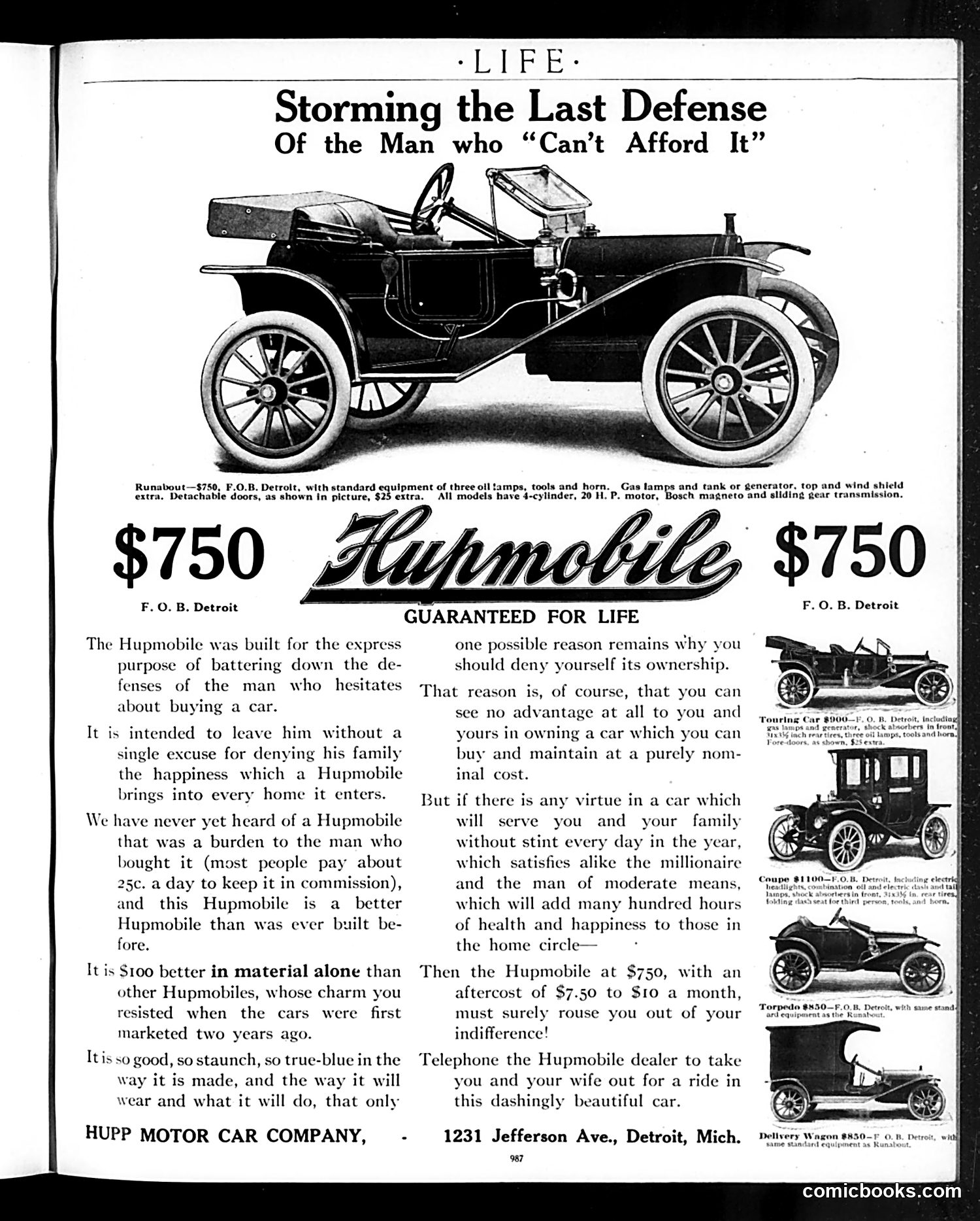
This is primarily a **car advertisement**, not political satire. The Hupmobile Motor Car Company markets their $750 automobile to middle-class Americans by addressing common objections to car ownership. The headline's military language—"Storming the Last Defense"—humorously frames the sales pitch as an assault on the hesitant buyer's resistance. The copy uses satirical tone to mock the excuse "I can't afford it," arguing that at roughly 25 cents daily maintenance, ownership is actually affordable for ordinary families. The advertisement appeals to aspirational values: family happiness, health, leisure time, and social mobility. The multiple vehicle illustrations (touring car, coupe, roadster, delivery wagon) show the brand's range. The satire lies in the *aggressive sales language* itself—the ad playfully acknowledges it's pressuring reluctant buyers while presenting the car as nearly indispensable to modern domestic life. This reflects early-1910s automotive marketing when car ownership was becoming normalized among the middle class rather than remaining a luxury.
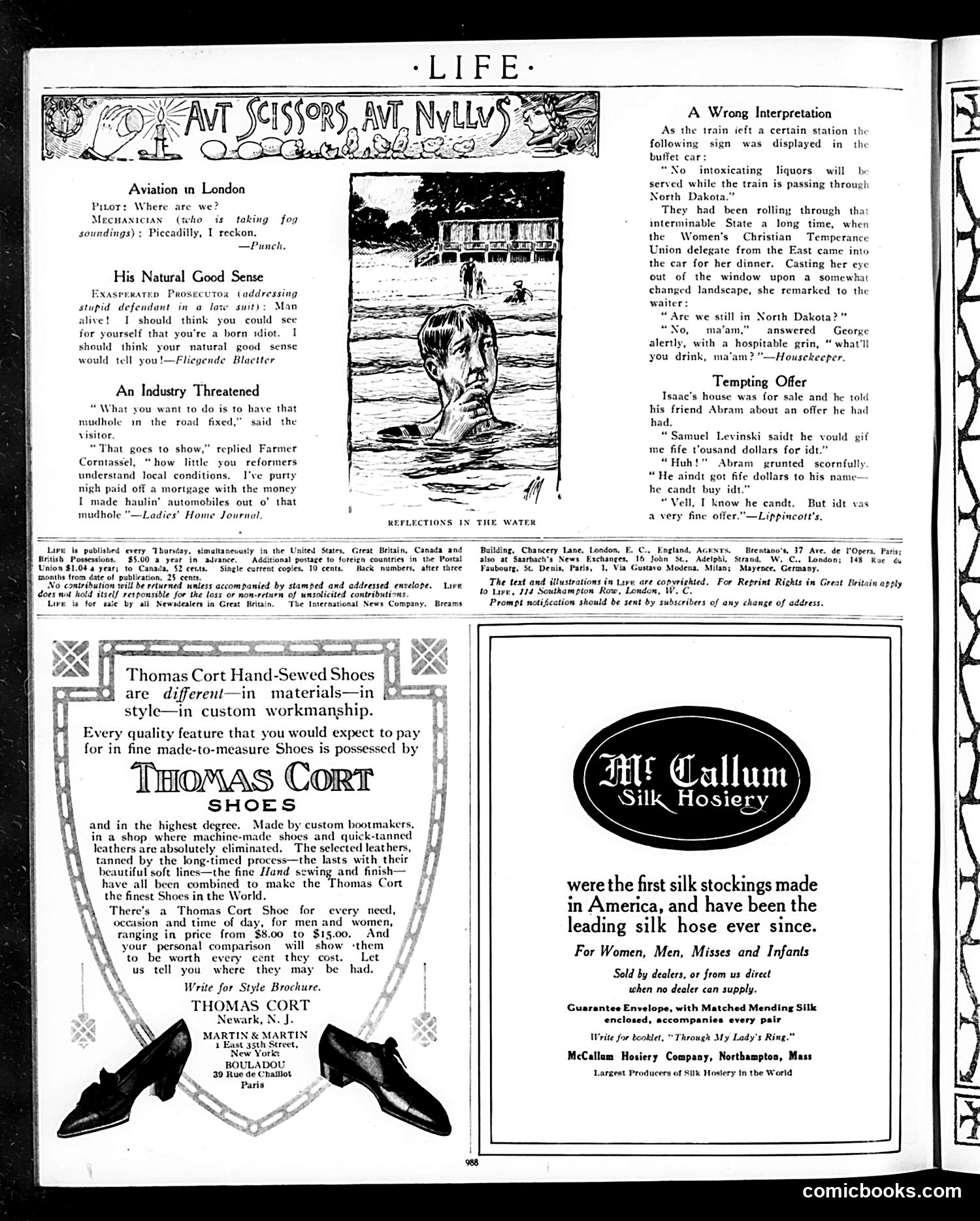
This page contains several brief satirical pieces typical of early 20th-century Life magazine humor: **"Aviation in London"** — A quick joke about early airplane technology, with a pilot and mechanic discussing their location using fog as a navigation reference point, suggesting early aviation's primitive methods. **"His Natural Good Sense"** — A courtroom satire where a prosecutor tells a defendant he's obviously an idiot, implying the defendant should recognize this through "natural good sense"—absurdist humor about legal proceedings. **"An Industry Threatened"** — Rural satire where a farmer opposes fixing a mudhole in the road because he profits from pulling stuck automobiles out of it, mocking both rural resistance to progress and unintended economic consequences. **"A Wrong Interpretation"** — A temperance joke: a Women's Christian Temperance Union delegate sees a sign prohibiting liquor in North Dakota, assumes they've left the state when the landscape changes, and orders a drink—satirizing prohibition advocates' confusion or hypocrisy. **"Tempting Offer"** — Jewish dialect humor (period-typical) about a poor man's worthless offer to buy property, playing on the irony that a bad offer can still be "fine." The page is otherwise dominated by period advertisements for shoes and silk hosiery.
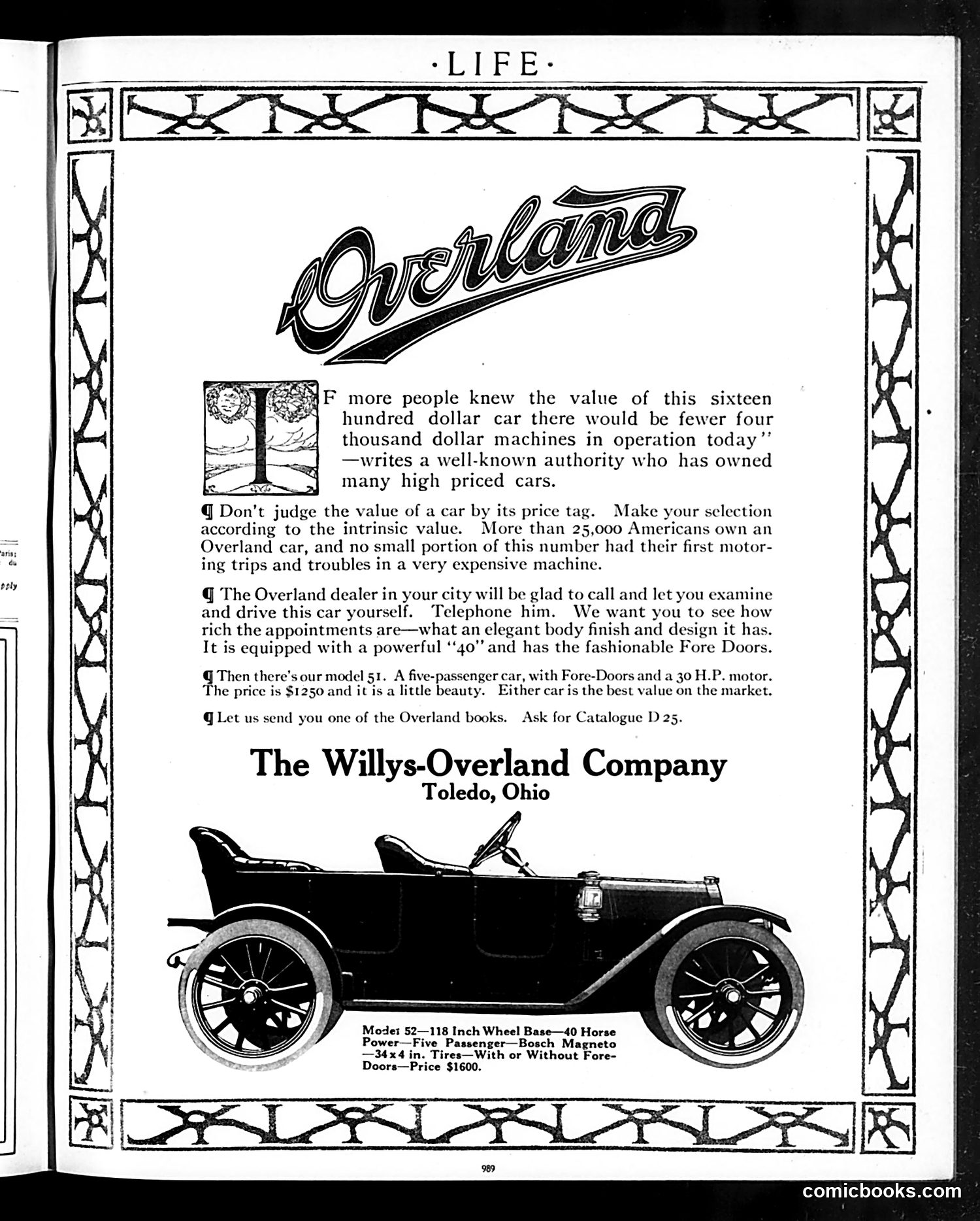
The page advertises the Overland car, manufactured by the Willys-Overland Company in Toledo, Ohio. It's a straightforward marketing pitch arguing that buyers shouldn't judge cars solely by price—that the Overland offers superior "intrinsic value" compared to more expensive competitors. The ad cites that 25,000 Americans owned Overlands and suggests potential buyers contact local dealers for test drives. Two models are highlighted: Model 52 ($1,600, 40 horsepower, five-passenger) and Model 51 ($1,250, 30 horsepower). Both feature "Fore Doors" (front-opening doors), which the ad emphasizes as a desirable luxury feature. The unattributed quote at top—"fewer four thousand dollar machines in operation"—is the advertisement's central argument: if people understood the Overland's value, they'd stop buying expensive alternatives.
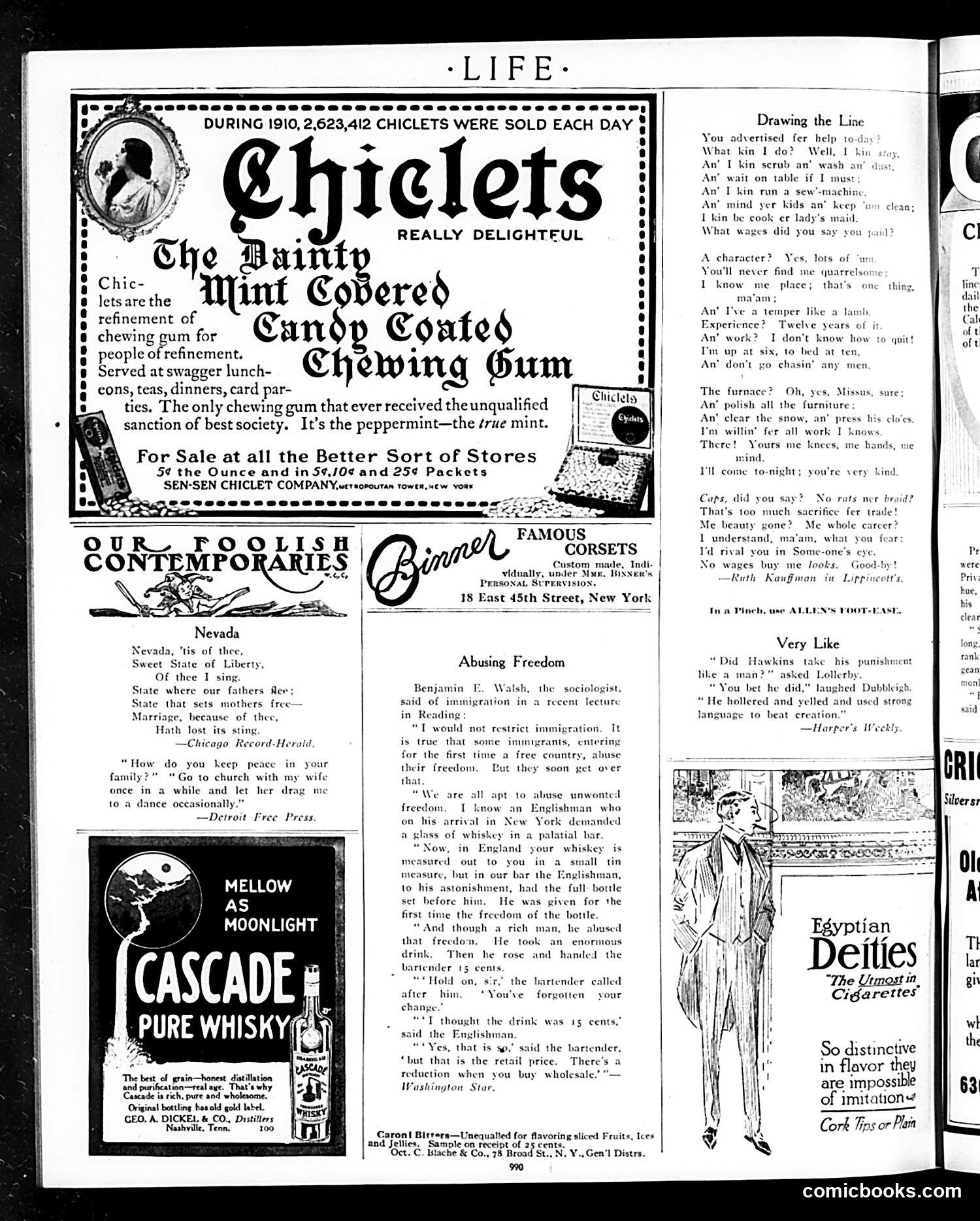
This page is primarily **advertising** with some short humorous pieces interspersed. The major elements include: **Chiclets Advertisement**: Claims 2.6 million sold daily in 1910, marketing mint-coated chewing gum as refined enough for "best society" — satirizing the pretentious association of mass-market products with upper-class status. **"Drawing the Line"**: A poem about a prospective maid listing her qualifications (scrubbing, cooking, childcare, furnace maintenance) while negotiating wages. The satire appears to critique either the exploitation of domestic servants or their unrealistic expectations—context unclear without full text. **"Abusing Freedom"**: An anecdote about an Englishman newly arrived in America who misunderstands bar pricing, thinking whiskey costs 15 cents everywhere. The satire targets immigrants' naiveté about American commercial practices. The page also contains ads for Cascade whiskey, Binner corsets, and Egyptian Deities cigarettes. The overall tone reflects early 20th-century American attitudes toward immigration, class, and consumer culture.
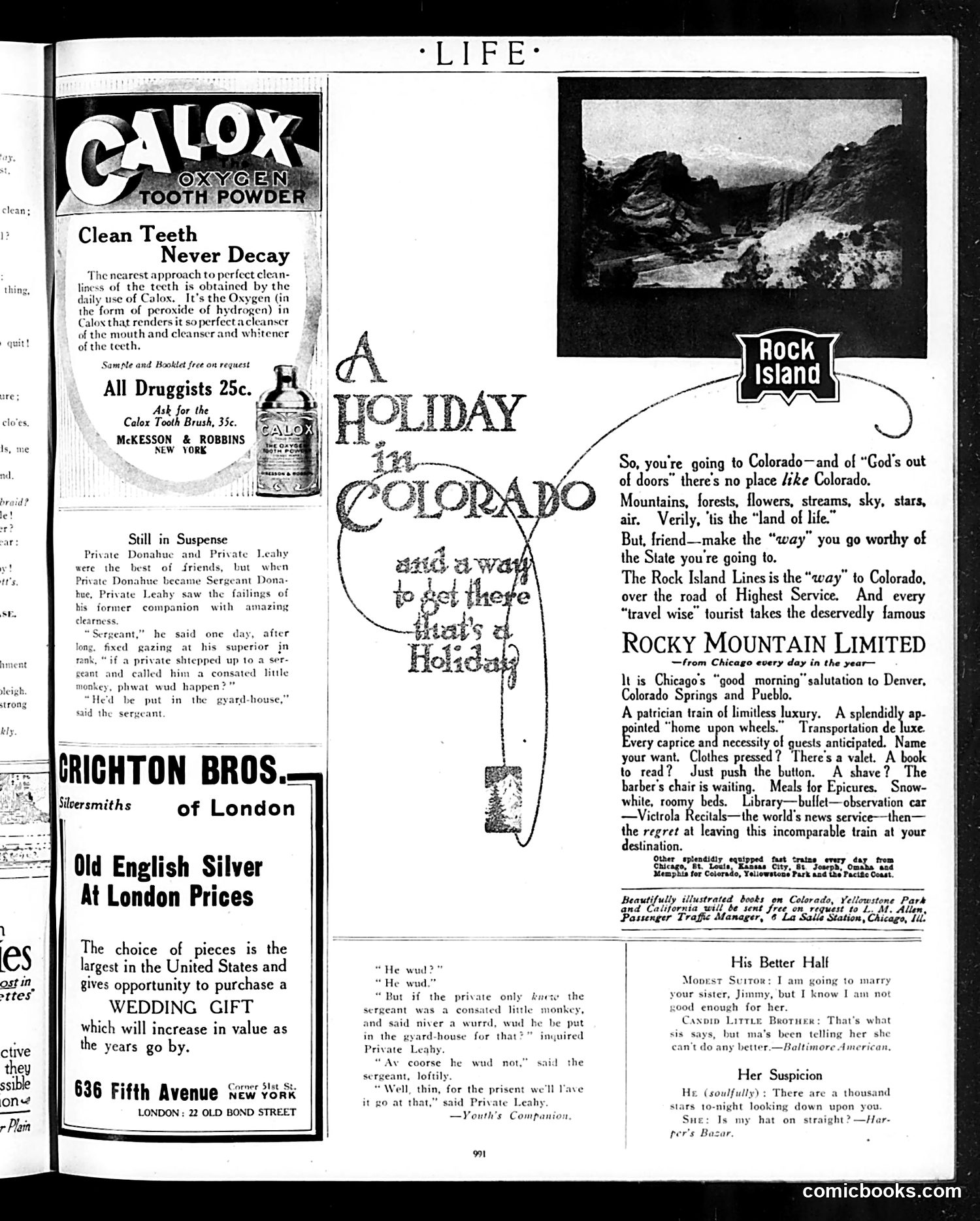
This page mixes advertisements with humor content typical of early 20th-century Life magazine. **Main Content:** The central feature is a travel advertisement for the Rock Island Lines railroad promoting the "Rocky Mountain Limited" train to Colorado. The ad uses romantic language about nature ("God's out of doors") to encourage tourism while emphasizing the train's luxury amenities—valets, dining, observation cars, and Victrola entertainment. **Humor Sections:** Three brief comedic pieces appear: 1. **"Still in Suspense"** (Irish dialect humor): A dialogue between soldiers where Private Leahy cleverly exploits a loophole—if he merely *thinks* his sergeant is incompetent but says nothing, he won't face punishment. The joke plays on military hierarchy and Irish-accented English stereotypes. 2. **"His Better Half"**: A suitor admits unworthiness to marry; the brother reveals the sister agrees, but their mother disagrees—typical "battle of the sexes" humor. 3. **"Her Suspicion"**: A woman romantically addressed ignores the sentiment, concerned only with her hat appearance—mocking female vanity. **Advertisements** include Calox tooth powder and English silverware for wedding gifts.
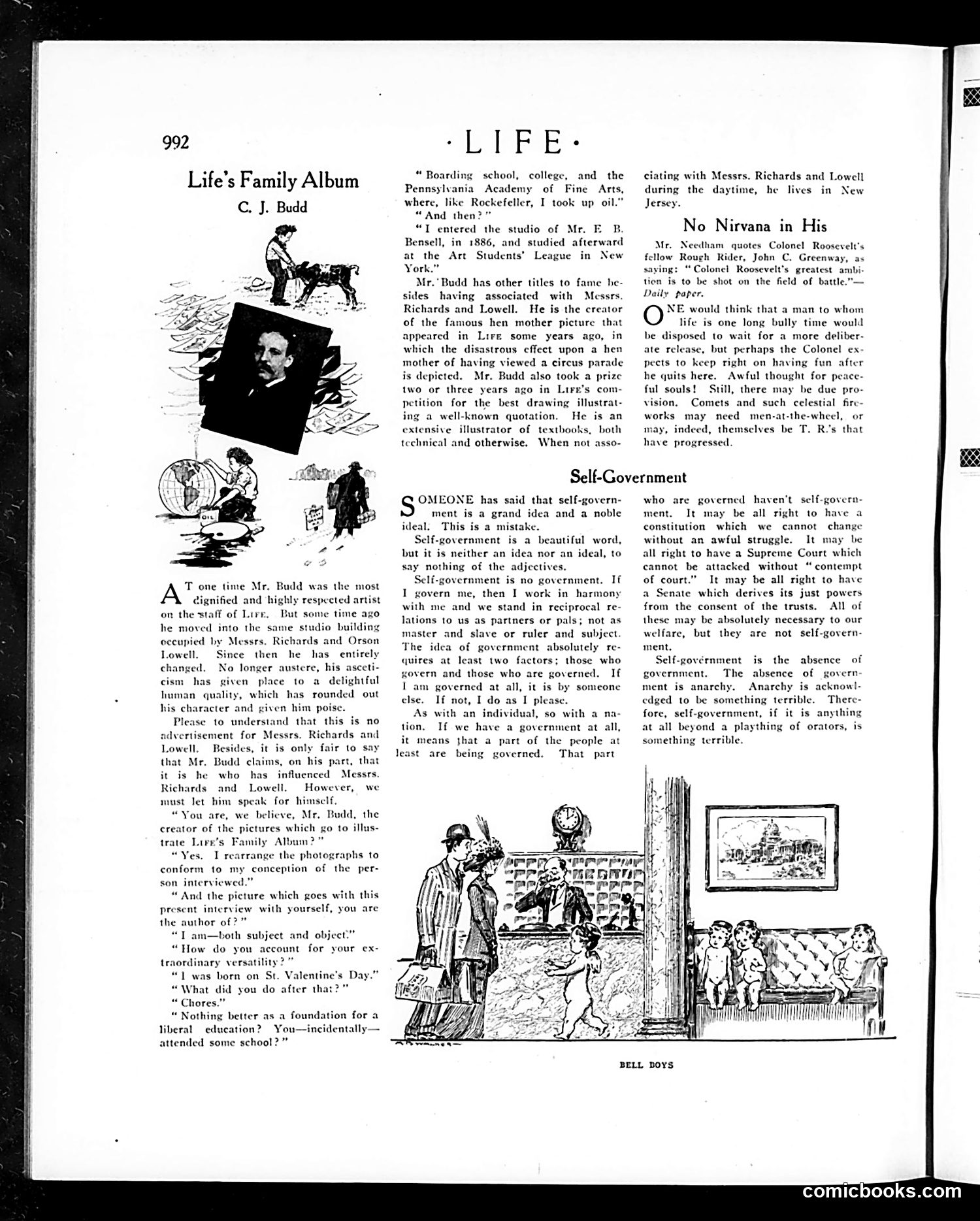
**"Life's Family Album" by C.J. Budd:** This is a light satirical interview with artist C.J. Budd, illustrating Life magazine's tradition of self-promotional humor. The piece jokes that Budd improved as a person after moving into a studio with artists Richards and Lowell, though Budd claims *he* influenced *them*. The interview uses playful irony about his artistic credentials and versatility. **"No Nirvana in His":** A brief jab at Theodore Roosevelt. Quoting a Rough Rider colleague saying Roosevelt's greatest ambition is "to be shot on the field of battle," Life sarcastically suggests TR apparently expects to enjoy the afterlife as much as earthly adventure—a humorous dig at Roosevelt's aggressive, adventurous public persona. **"Self-Government":** A philosophical satire arguing that "self-government" is a linguistic contradiction—true government requires both rulers *and* the ruled, so self-governing individuals simply do as they please. The piece uses this logical deconstruction to critique the political concept itself, suggesting governmental power fundamentally requires subjection.
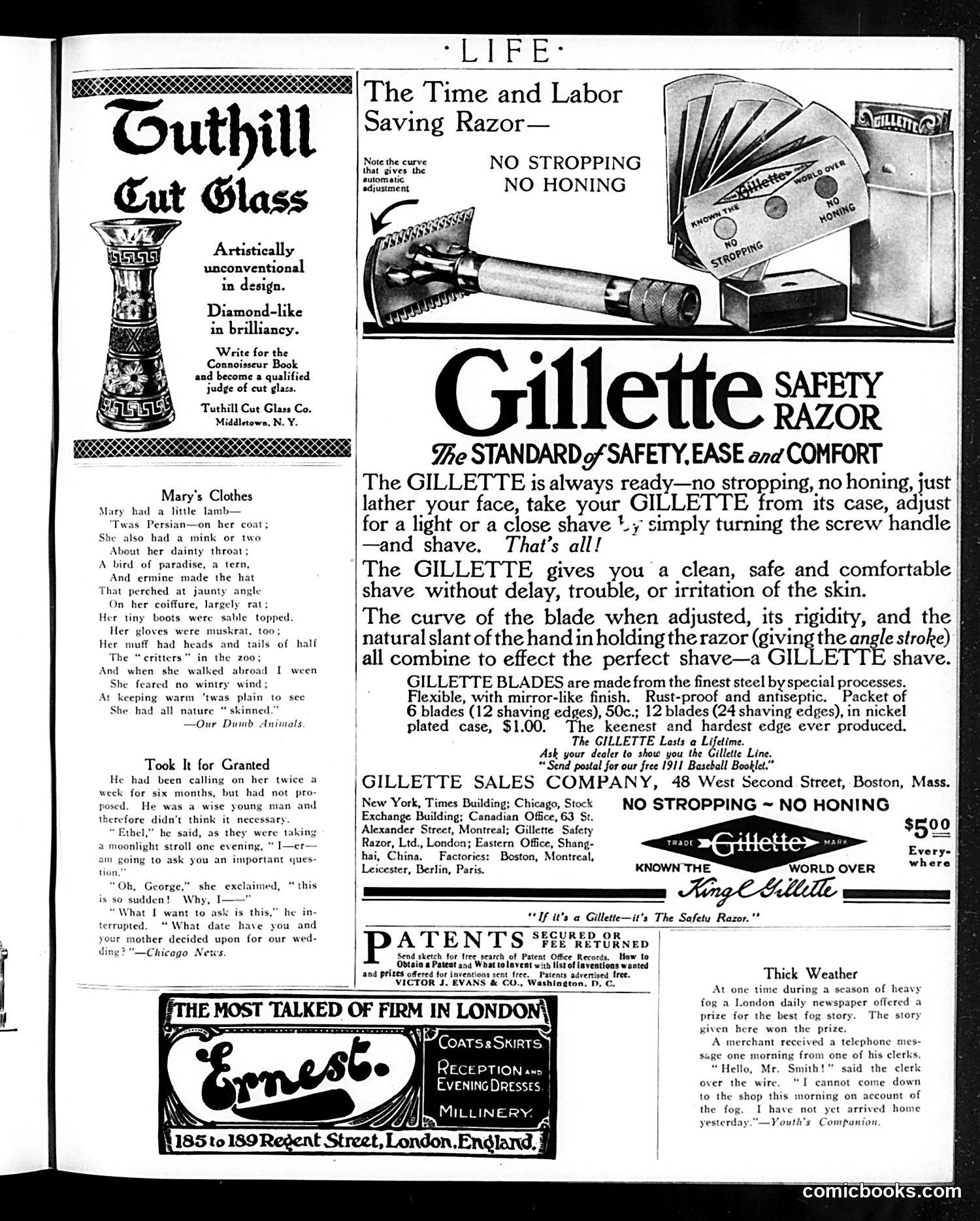
This page is primarily **advertising**, with minimal satirical content. The main features are: **Advertisements:** - **Gillette Safety Razor**: A major ad emphasizing convenience ("no stropping, no honing") — targeting men's grooming routines of the era - **Tuthill Cut Glass**: Luxury glassware - **Ernest clothing firm** (London): High-end fashion - **Patent services** **Literary Content:** - "Mary's Clothes": A humorous poem (attributed to "Our Dumb Animals") satirizing fashionable women who wear multiple exotic furs and animal parts as status symbols — likely mocking excessive materialism and fashion excess - "Took It for Granted": A brief joke about a presumptuous suitor - "Thick Weather": A humorous anecdote about London fog, where a clerk claims he "cannot come down to the shop" because he "have not yet arrived home yesterday" — absurdist humor playing on the thickness of the fog The page reflects early 1910s consumer culture and gendered humor typical of Life magazine's satirical approach.
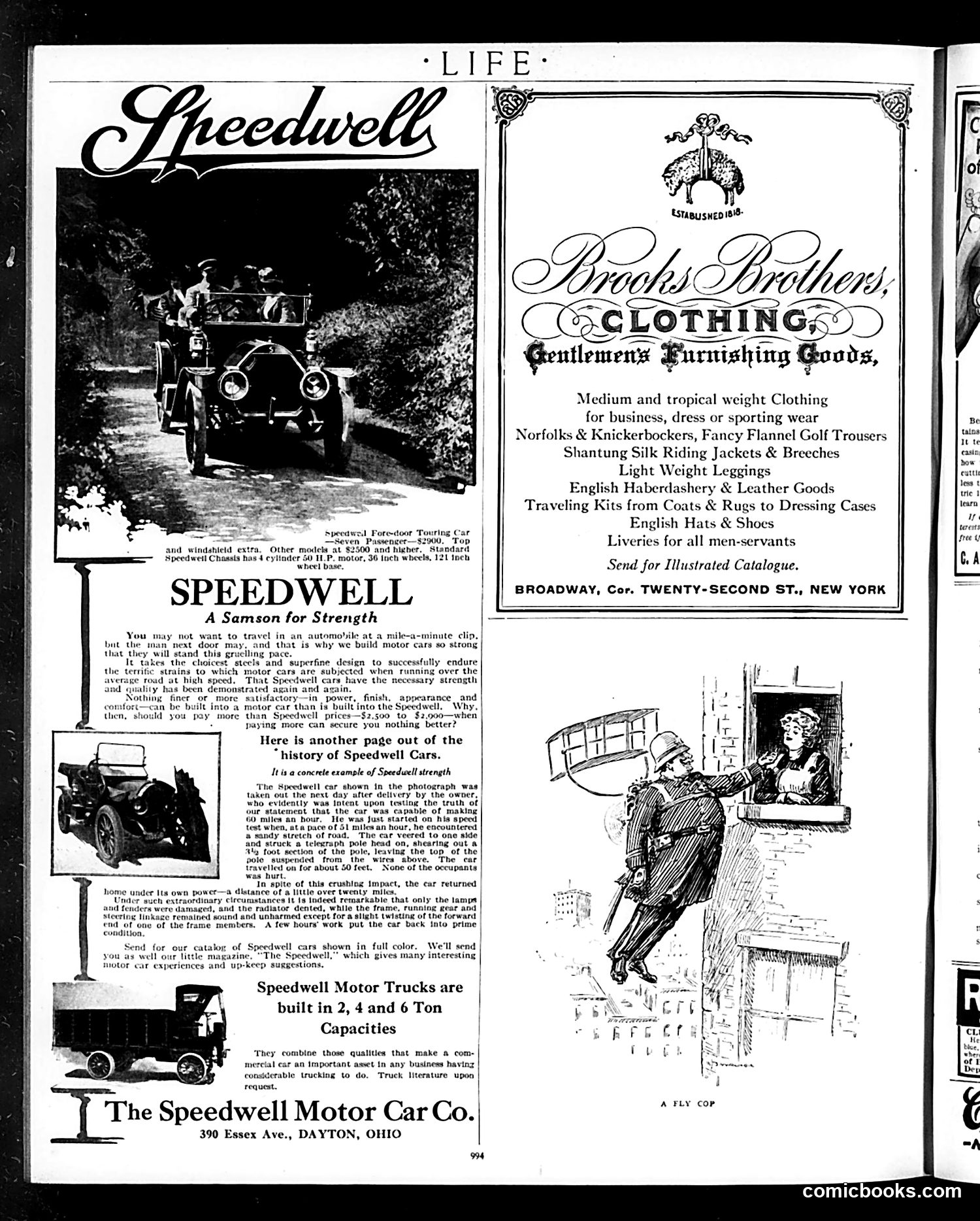
This is primarily an **advertising page** from Life magazine, not a political cartoon. It contains two main advertisements: **Left side:** Speedwell Motor Car Company advertises their automobiles as exceptionally strong and durable. They illustrate this with a dramatic anecdote: a Speedwell car traveling at 51 mph hit a telegraph pole, yet the vehicle remained structurally sound despite the violent impact. The ad uses this "true story" to demonstrate superior engineering and justify the car's $2,500-$2,900 price point. They also advertise Speedwell motor trucks in 2, 4, and 6-ton capacities. **Right side:** Brooks Brothers advertises gentlemen's clothing and furnishings—suits, riding jackets, golf trousers, leather goods, and "liveries for all men-servants." **Right margin illustration:** A small cartoon titled "A Fly Cop" appears to be unrelated editorial content, depicting what looks like a police officer or authority figure. The page reflects early 20th-century consumer culture emphasizing product durability and class-conscious fashion.
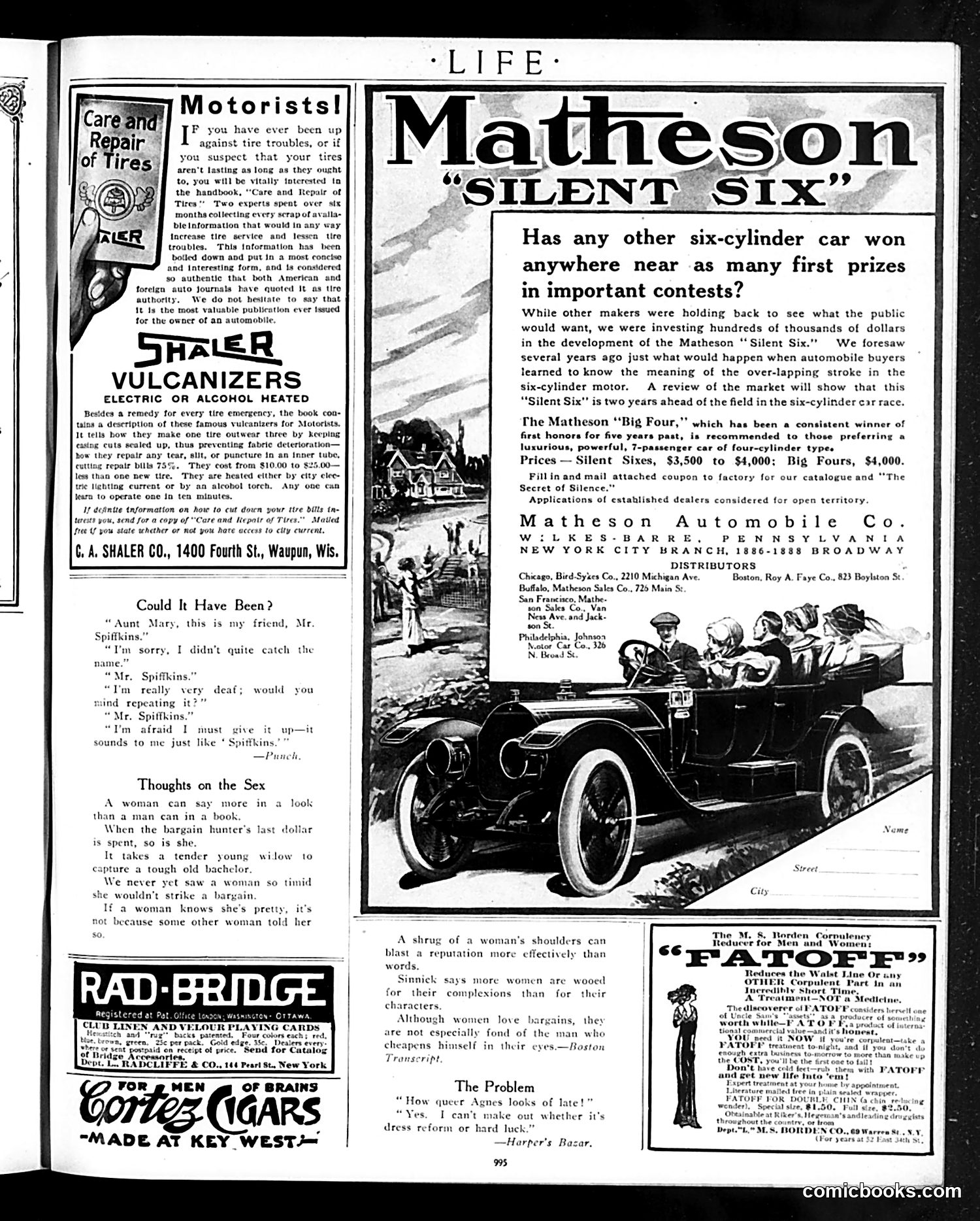
This page is primarily **advertising-driven**, dominated by a large Matheson automobile advertisement featuring a luxury six-cylinder car. The ad's headline challenges competitors, claiming the Matheson "Silent Six" has won more first prizes in contests than any rival six-cylinder vehicle. This reflects early automotive industry competition through racing and performance demonstrations—a common marketing strategy when automobiles were still novel luxury goods. The page also contains **period humor and satirical content**: a brief joke about mishearing the name "Spiffkins," and a section titled "Thoughts on the Sex" offering cynical observations about women—typical of the era's gender commentary in magazines. Supporting advertisements include tire repair products (Shaler Vulcanizers) and playing cards, reflecting typical consumer goods of the 1910s-1920s era. The content overall represents early automotive advertising culture and period social humor rather than political satire.
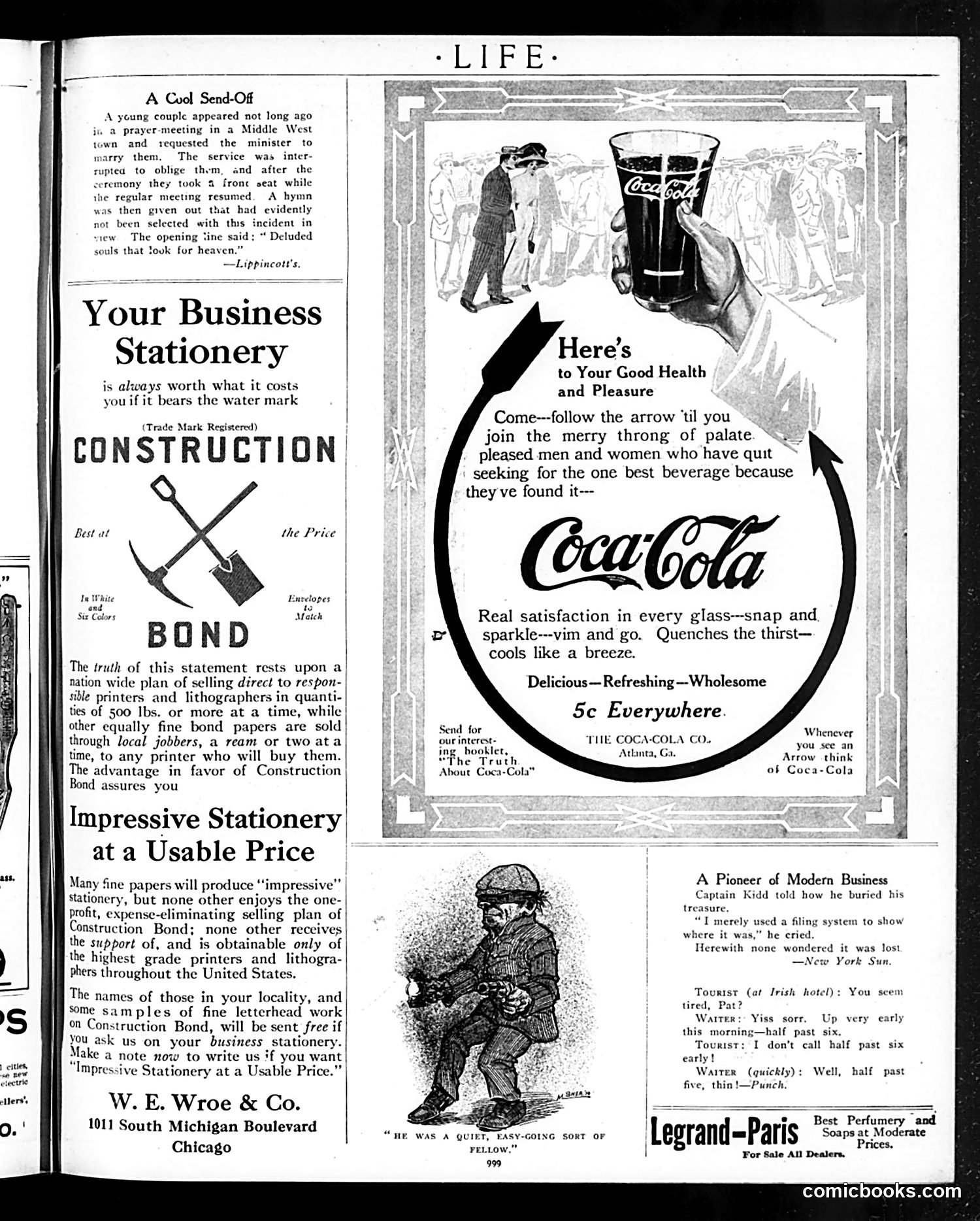
This page from *Life* magazine is primarily **advertising and humor content**, not political satire. The main items are: 1. **"A Cool Send-Off"** — A joke about a newly married couple sitting in church during a hymn that begins "Deluded souls that look for heaven," implying their hasty marriage was unwise. 2. **Construction Bond stationery advertisement** — A straightforward business ad promoting quality paper with direct-to-printer pricing. 3. **Coca-Cola advertisement** — Shows a hand offering a bottle, inviting readers to join "pleased men and women" who've found their "one best beverage." Standard early advertising copy emphasizing refreshment. 4. **"A Pioneer of Modern Business"** — A brief anecdote about Captain Kidd using a "filing system" (unclear reference, possibly wordplay). 5. **Tourist/Waiter exchange** — A brief joke about Irish hospitality and differing concepts of early rising. The page contains **no political cartoons or social commentary** — it's essentially a collection of light humor pieces interspersed with period advertisements.
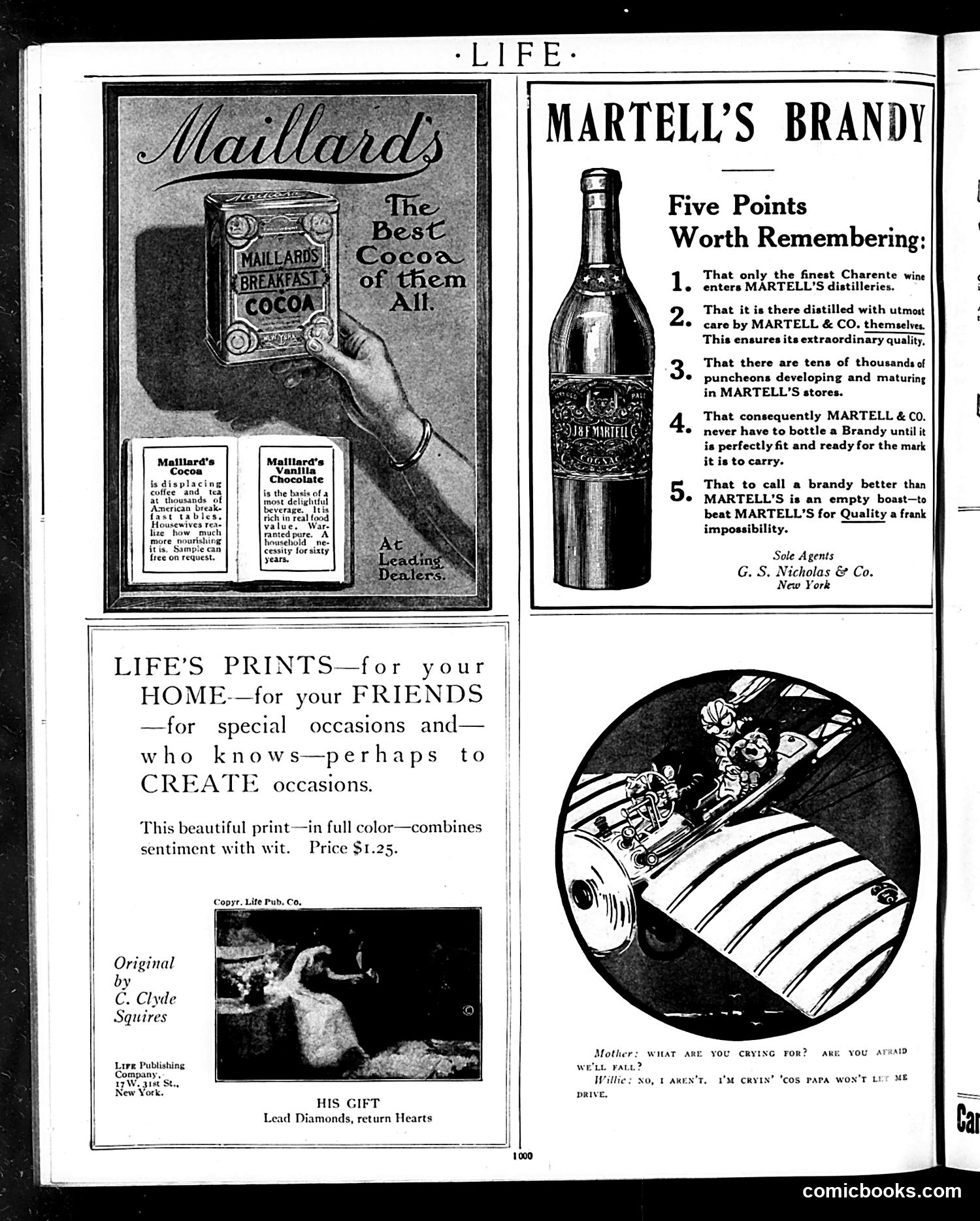
This page is primarily **advertisements** (Maillard's Cocoa, Martell's Brandy) with one small cartoon at bottom right. The cartoon shows a **child crying in what appears to be an automobile**, with dialogue between the child ("Willie") and his mother. The joke is domestic and reflects early 20th-century anxieties: the child isn't afraid of the novel danger of cars—he's upset because his father won't let him *drive* one. The humor works on multiple levels: it presents a child's preposterous demand (driving), suggests cars were becoming common enough that even children expected access, and mocks parental concern about automotive safety by showing the child indifferent to actual danger but demanding control of the vehicle. The print advertisement below offers Life's colored prints for home decoration at $1.25, credited to artist C. Clyde Squires. The overall page reflects a prosperous, consumer-focused magazine aimed at middle-class readers.
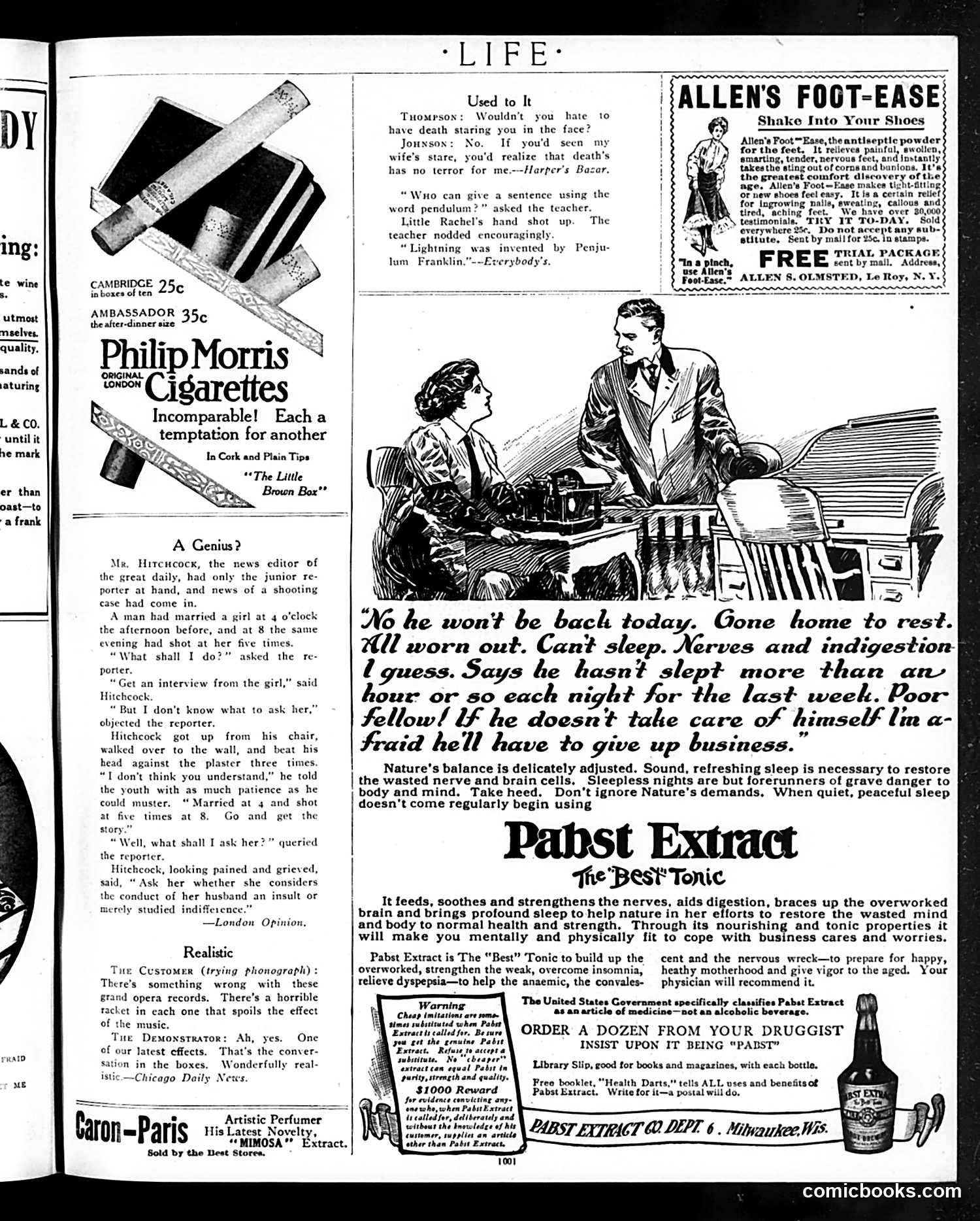
This page contains primarily **advertisements and brief humorous anecdotes** rather than political cartoons. The main content includes: **Advertisements:** Philip Morris cigarettes, Allen's Foot-Ease powder, Pabst Extract tonic, and Caron-Paris perfume dominate the page. **Short humor pieces:** - "A Genius?" depicts a newspaper editor instructing a junior reporter to interview a woman whose husband shot at her five times the day after their marriage—the joke being the editor's exasperation at having to explain the obvious newsworthiness. - "Realistic" jokes about a phonograph's "conversation in the box" being mistaken for defective recording. - Brief quips about marriage and grammar. **Social context:** The Pabst Extract advertisement reflects early 20th-century patent medicine culture, promoting tonics as cure-alls for nervousness and insomnia—conditions tied to modern business stress. The page targets middle-class readers with light satire on journalism, domestic life, and consumerism, while heavily promoting commercial products as solutions to everyday ailments.
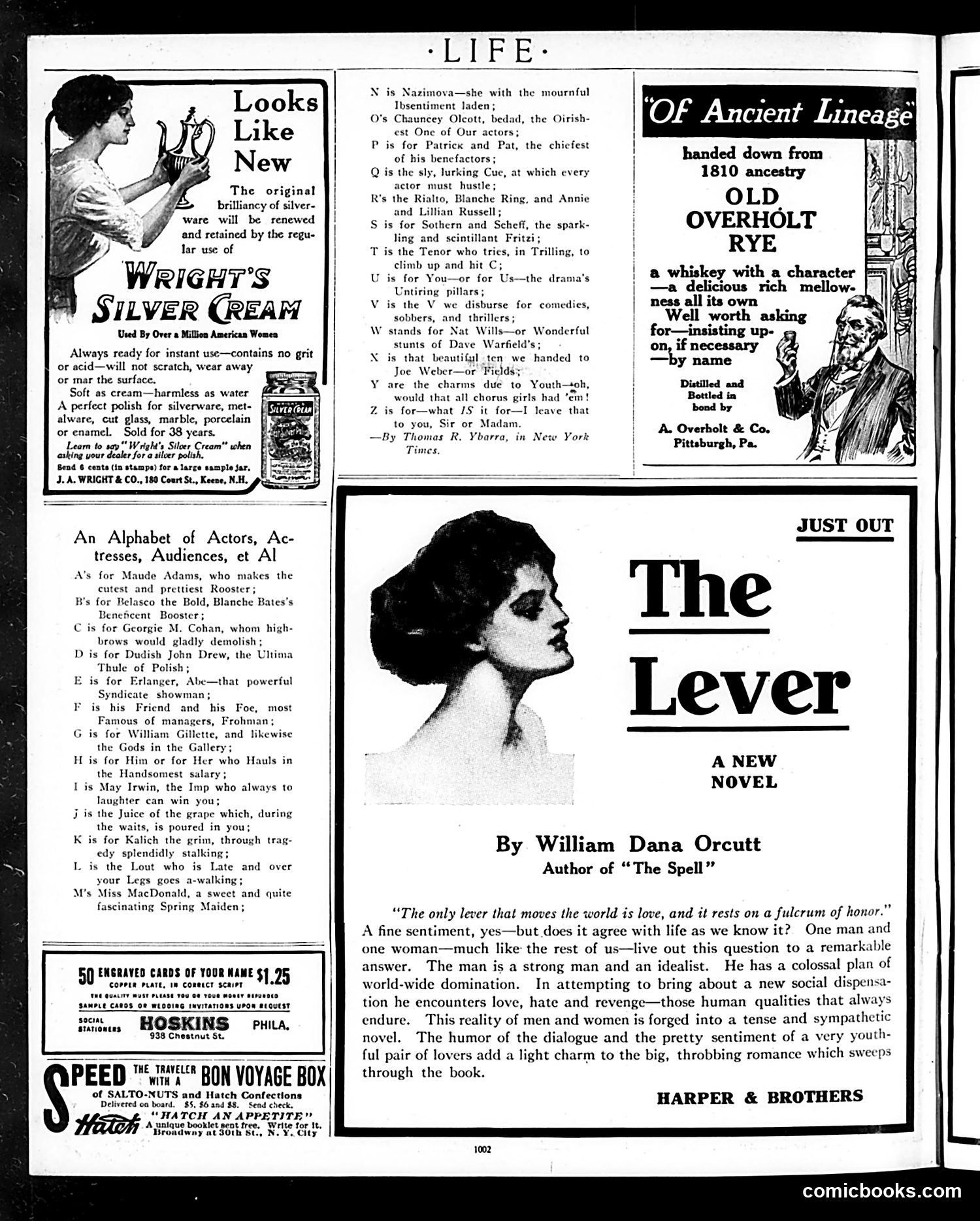
This page is primarily **advertising and literary promotion** rather than political satire. The main content includes: **"An Alphabet of Actors, Actresses, Audiences, et Al"** — a humorous poem by Thomas R. Ybarra listing theatrical personalities of the early 1900s (Maude Adams, John Drew, William Gillette, Lillian Russell, etc.). Each letter represents someone or something in theater culture, with light mockery—Cohan is someone "highbrows would gladly demolish," and chorus girls are reduced to their charms. **Commercial advertisements** dominate: Wright's Silver Cream polish, engraved cards, and Overholt Rye whiskey promoting "ancient lineage" ancestry. **Book promotion** for William Dana Orcutt's novel *The Lever*, emphasizing romantic conflict between idealism and worldly realities. The theatrical alphabet represents in-jokes for readers familiar with Broadway personalities of the era, with gentle rather than pointed satire—typical of *Life* magazine's entertainment-focused content.
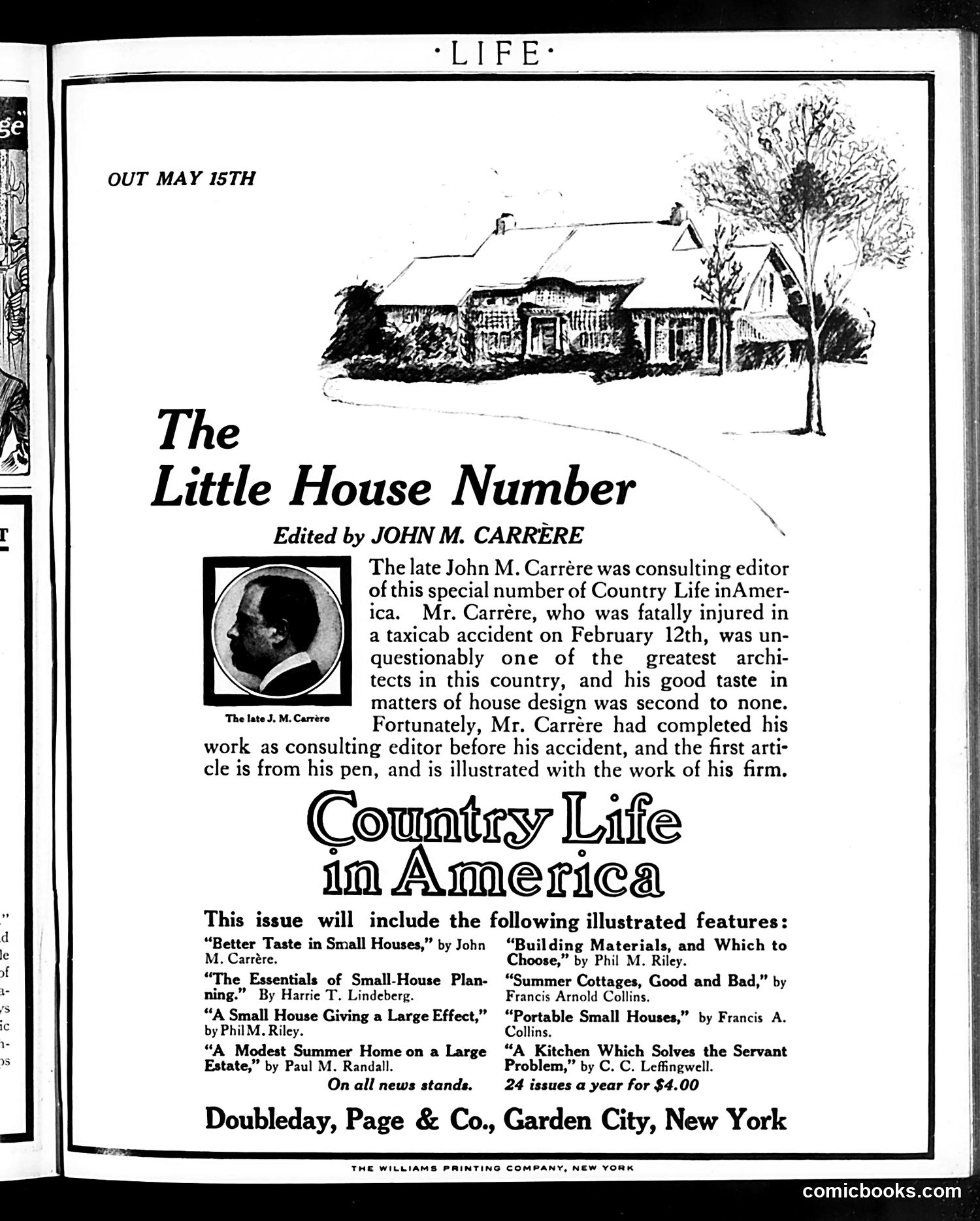
This is primarily an **advertisement/title page**, not a cartoon. It announces a special issue of *Country Life in America* magazine (May 15th) dedicated to residential architecture and design. The page memorializes **John M. Carrère**, a prominent American architect who died in a taxicab accident on February 12th. The magazine honors him by publishing his final work as consulting editor—a feature on small house design. His portrait appears in the center. The issue promises articles on practical home construction: small-house planning, cost-effective design, summer cottages, portable homes, and kitchen efficiency (notably addressing "the servant problem"—reflecting early 20th-century middle-class concerns about household help availability). This represents the genteel, design-conscious culture of the American upper-middle class, where *Life* and *Country Life* magazines served as arbiters of taste and style. The subscription cost was $4.00 annually for 24 issues.
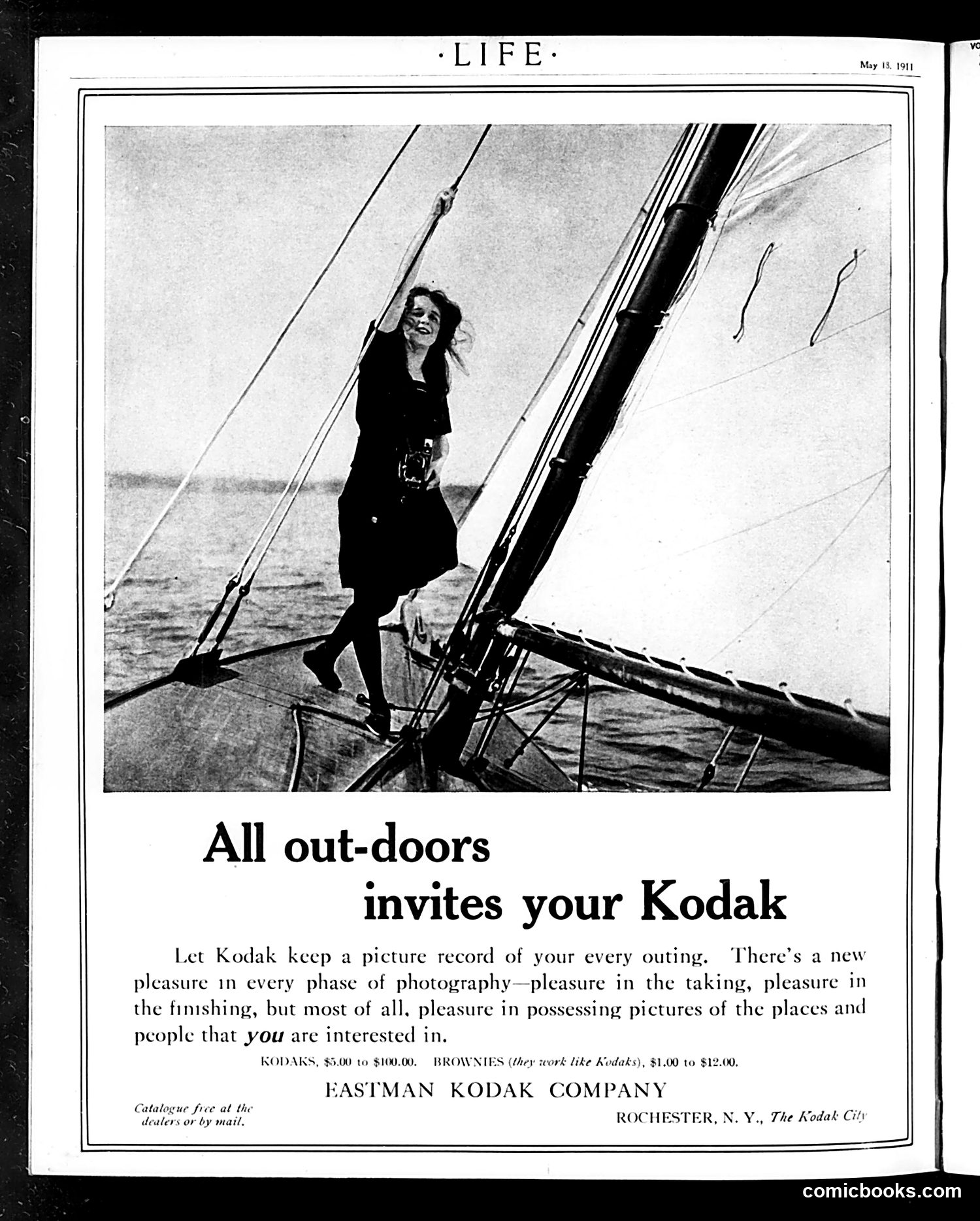
This is primarily a **Kodak camera advertisement**, not political satire. It depicts a woman on a sailboat, gazing out at the water while holding camera equipment, symbolizing leisure and outdoor adventure. The ad's message: Kodak cameras enable people to document their recreational activities and preserve memories. The tagline "All out-doors invites your Kodak" suggests photography should accompany any outdoor experience—sailing, hiking, etc. The copy emphasizes the "pleasure" throughout photography's lifecycle: taking pictures, developing them, and owning the finished prints. This reflects early 20th-century camera marketing that positioned photography as an accessible hobby for the affluent middle class. Price points ($5–$100 for Kodaks; $1–$12 for Brownies) indicate Kodak offered cameras across different economic levels, democratizing what had been an expensive pursuit.