
Life, 1911-05-18 · page 8 of 42
Life — May 18, 1911 — page 8: what you’re looking at
What you’re looking at
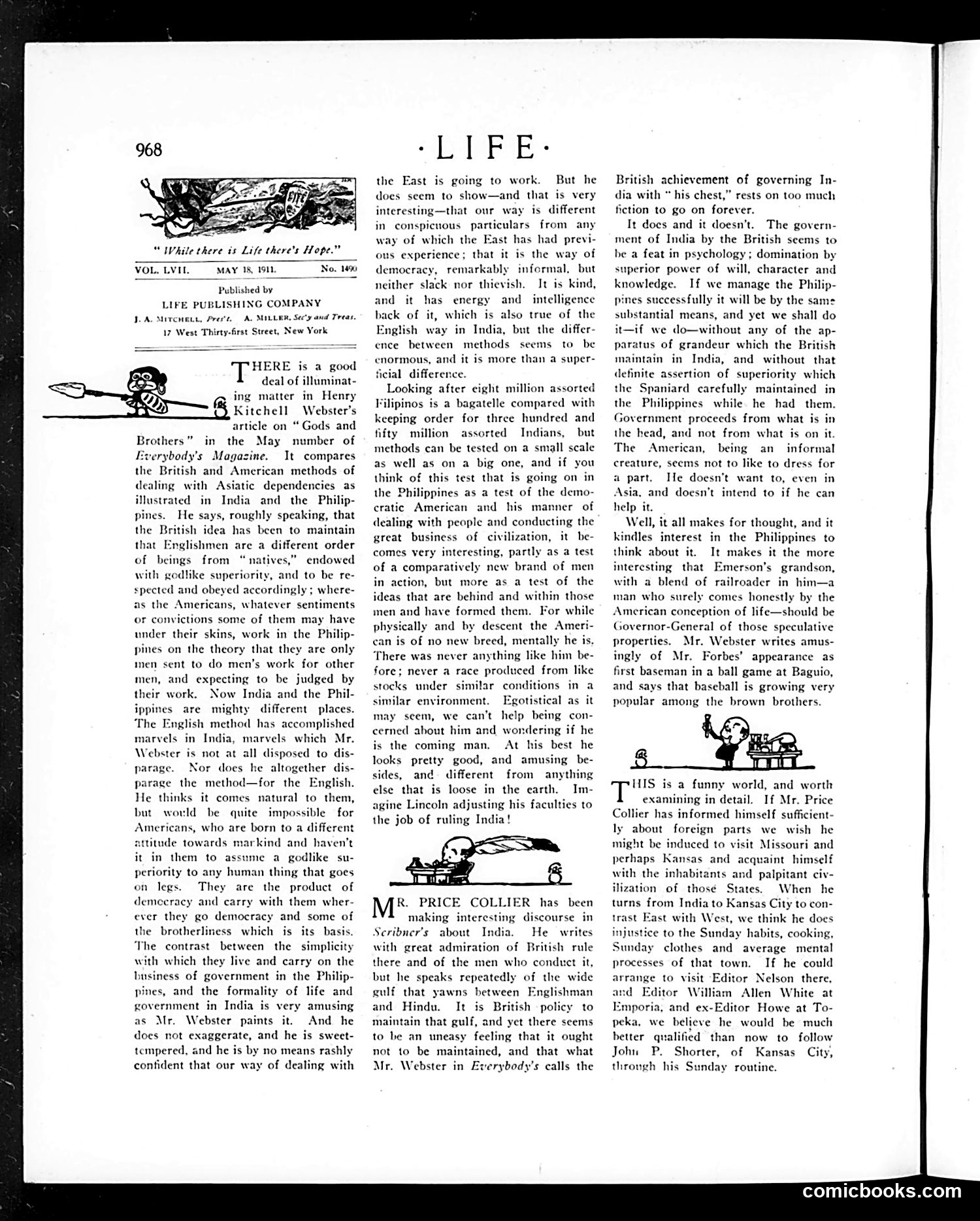
This page discusses American governance in the Philippines, contrasting British and American colonial methods. The text analyzes Henry Mitchell Webster's article on "Gods and Brothers" in *Everybody's Magazine*, comparing how Britain and America handle dependent territories. The small cartoons illustrate the article's points about colonial administration. One depicts a figure adjusting to governing responsibilities (likely representing American colonial governance), while another shows contrast between approaches. The page includes commentary by Price Collier on India and British rule, discussing the cultural gulf between English and Hindu populations. A final note mentions visiting American cities' "Sunday habits" and processes as comparative subjects. The overall satire critiques American colonial attitudes while examining different imperial governance philosophies of the early 20th century.
📄 Transcribed text from this page (OCR, searchable)
Machine-transcribed from the original scan — historical spelling and the odd misread are preserved.
“ While there is Life there's Hope.” VOL. LVIL. MAY 18, 1911. No. 1490 Published by LIFE PUBLISHING COMPANY JA. Mevemenn, Pret, A, MILLER, Sec'y and Treas, 17 West Thirty-first Street, New York HERE is a good deal of illuminat- ing matter in Henry Kitchell Webster’s article on “Gods and Brothers” in the May number of Everybody's Magazine. It compares the British and American methods of dealing with Asiatic dependencies as illustrated in India and the Philip- pines. He says, roughly speaking, that the British idea has been to maintain that Englishmen are a different order of beings from “natives,” endowed with godlike superiority, and to be re- spected and obeyed accordingly ; where- the Americans, whatever sentiments or convictions some of them may have under their skins, work in the Philip- pines on the theory that they are only men sent to do men’s work for other men, and expecting to be judged by their work. Now India and the Phil- ippines are mighty different places. The English method has accomplished marvels in India, marvels which Mr. Webster is not at all disposed to dis- parage. Nor does he altogether dis- parage the method—for the English. He thinks it comes natural to them, but would be quite impossible for Americans, who are born to a different titude towards markind and haven't it in them to assume a godlike su- periority to any human thing that goes on legs. They are the product of demecracy and carry with them wher- ever they go democracy and some of the brotherliness which is its basis. ‘The contrast between the simplicity with which they live and carry on the business of government in the Philip- pines, and the formality of life and government in India is very amusing as Mr. Webster paints it. And he does not exaggerate, and he is sweet- tempered, and he is by no means rashly confident that our way of dealing with << R PE the East is going to work. But he does seem to show—and that is very interesting—that our way is different in conspicuous particulars from any way of which the East has had previ- ous experience; that it is the way of democracy, remarkably informal, but neither slack nor thievish. It is kind, and it has energy and_ intelligence back of it, which is also true of the English way in India, but the differ- ence between methods seems to be enormous, and it is more than a super- ficial difference. Looking after cight million assorted Filipinos is a bagatelle compared with keeping order for three hundred and fifty million assorted Indians, but methods can be tested on a small scale as well as on a big one, and if you think of this test that is going on in the Philippines as a test of the demo- cratic American and his manner of dealing with people and conducting the great business of civilization, it be- comes very interesting, partly as a test of a comparatively new brand of men in action, but more as a test of the ideas that are behind and within those men and have formed them. For while physically and by descent the Ameri- an is of no new breed, mentally he is. There was never anything like him be- fore; never a race produced from like stocks under similar conditions in a similar environment. Egotistical as it may seem, we can't help being con- cerned about him and wondering if he is the coming man. At his best he looks pretty good, and amusing be- sides, and different from anything else that is loose in the earth. Im- agine Lincoln adjusting his faculties to the job of ruling India! M® PRICE COLLIER has been making interesting discourse in Seribner’s about India. He writes with great admiration of British rule there and of the men who conduct it, but he speaks repeatedly of the wide gulf that yawns between Englishman and Hindu. It is British policy to maintain that gulf, and yet there seems to be an uneasy feeling that it ought not to be maintained, and that what Mr. Webster in Everybody's calls the British achievement of governing In- dia with “ his chest,” rests on too much fiction to go on forever. It docs and it doesn’t. The govern- ment of India by the British seems to be a feat in psychology ; domination by superior power of will, character and knowledge. If we manage the Philip- pines successfully it will be by the sam- substantial means, and yet we shall do it—if we do—without any of the ap- paratus of grandeur which the British maintain in India, and without that definite assertion of superiority which the Spaniard carefully maintained in the Philippines while he had them. Government proceeds from what is in the head, and not from what is on it. The American, being an informal creature, seems not to like to dress for a part. He doesn’t want to, even in Asia, and doesn't intend to if he can help it. Well, it all makes for thought, and it kindles interest in the Philippines to think about it. It makes it the more interesting that Emerson’s grandson, with a blend of railroader in him—a man who surely comes honestly by the American conception of life—should be Governor-General of those speculative properties. Mr. Webster writes amus- ingly of Mr. Forbes’ appearance as first baseman in a ball game at Baguio, and says that baseball is growing very popular among the brown brothers. Tas a funny world, and worth examining in detail. If Mr. Price Collier has informed himself sufficient- ly about foreign parts we wish he might be induced to visit Missouri and perhaps Kansas and acquaint himself with the inhabitants and palpitant civ- ilization of those States. When he turns from India to Kansas City to con- trast East with West, we think he does injustice to the Sunday habits, cooking, Sunday clothes and average mental processes of that town. If he could arrange to visit Editor Nelson there, and Editor William Allen White at imporia, and ex-Editor Howe at To- pek, believe he would be much better qualified than now to follow Johu P. Shorter, of Kansas City, through his Sunday routine. comicbooks.com