
Life, 1911-05-18 · page 10 of 42
Life — May 18, 1911 — page 10: what you’re looking at
What you’re looking at
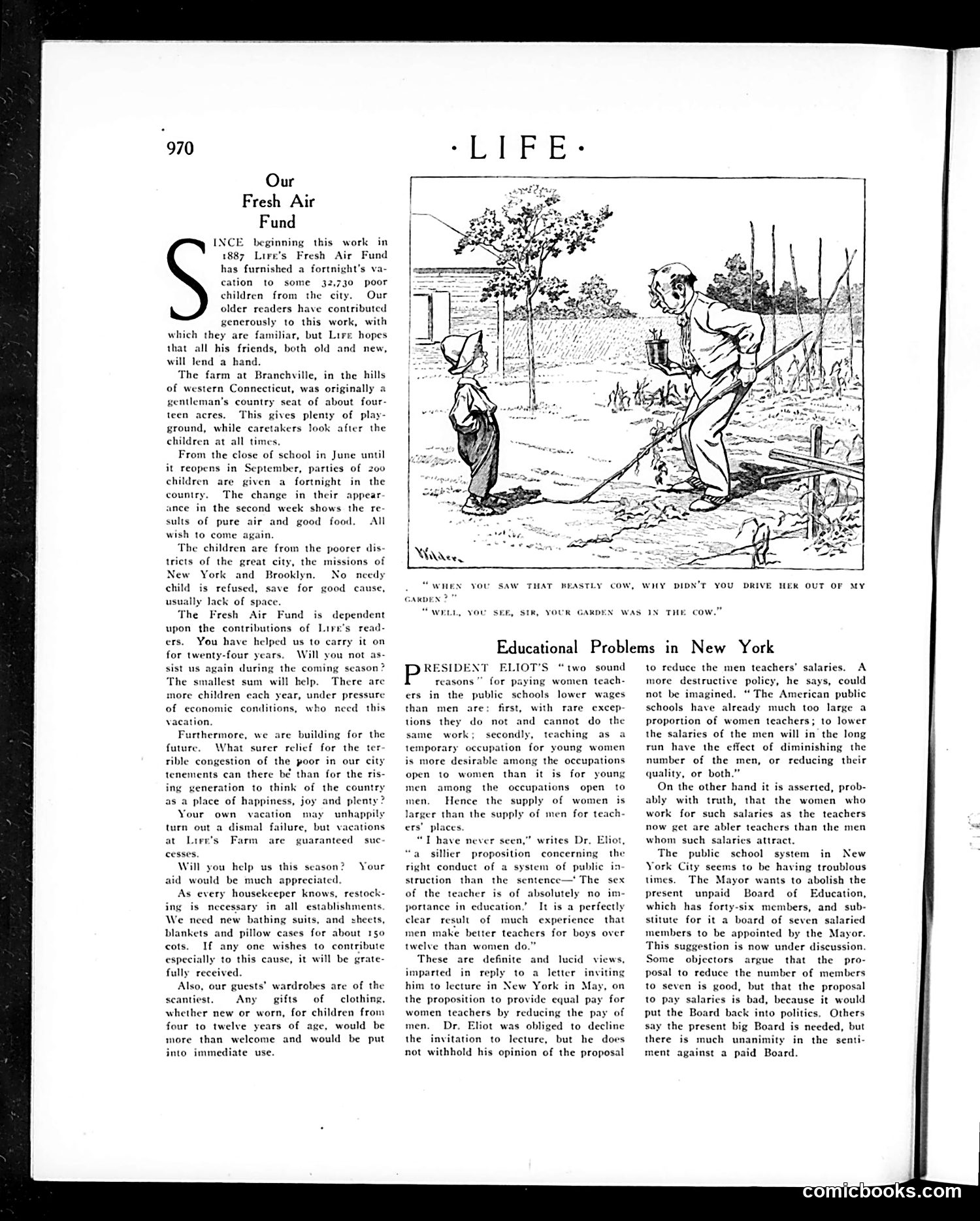
The cartoon illustrates Life magazine's "Fresh Air Fund," a charitable initiative providing poor urban children countryside vacations. The scene depicts a rural setting where a boy, clearly from the city, has apparently let a cow into a gentleman's garden. The farmer confronts him: "Now, you saw that beastly cow, why didn't you drive her out of my garden?" The boy responds: "Well, you see, sir, your garden was in the cow." The joke relies on the boy's innocent misunderstanding of spatial relationships—confusing the garden's location with the cow's perspective. It satirizes urban children's unfamiliarity with rural life and farm management, a common theme in early 20th-century "fish-out-of-water" humor about city kids encountering countryside realities.
📄 Transcribed text from this page (OCR, searchable)
Machine-transcribed from the original scan — historical spelling and the odd misread are preserved.
Our Fresh Air Fund INCE beginning this work in 1887 Lire’s Fresh Air Fund has furnished a fortnight’s va- cation to some 30 poor children from the city. Our older readers have contributed generously to this work, with which they are familiar, but Lire hopes that all his friends, both old and new, will lend a hand. The farm at Branchville, in the hills of western Connecticut, was originally a country seat of about four- teen acres. This gives plenty of play- ground, while caretakers look after the children at all times, From the close of school in June until it reopens in September, parties of 200 children are given a fortnight in the country, The change in their appear ance in the second week shows the r sults of pure air and good food. All wish to come again The children are from the poorer dis- tricts of the great city, the missions of New York and Brooklyn. No child is refused, save for good cause, usually lack of space. The Fresh Air Fund upon the contributions of Lire’s read- ers. You have helped us to carry it on for twenty-four years. Will you not as- sist us again during the coming season? The smallest sum will help. There are more children each year, under pressure who need this gentleman’ needy is dependent of economic conditions, vacation. Furthermore, we are building for the future. What surer relief for the ter rible congestion of the poor in our city tenements can there bé than for the ris- ing generation to think of the country as a place of happiness, joy and plenty? Your own vacation may unhappily turn out a dismal failure, but vacations at Lin's Farm are gu cesses. Will you help us this. sease aid would be much appreciated. s every housekeeper knows, restock- ing is necessary in all We need new bathing suits, and sheets, blankets and pillow cases for about 150 cots. If any one wishes to contribute specially to this cause, it will be grate- fully received. Also, our guests’ wardrobes are of the scantiest. gifts of clothing. whether new or worn, for children from four to twelve years of age, would be more than welcome and would be put into immediate use. ranteed establishments. Any “WHEN YOU SAW THAT MRASTLY GARDEN ? WELL, YOU SEE cow, WHY DIDN’T YOU DRIVE MEK OUT OF MY SIR, YOUR GARDEN Was IN THE cow. Educational Problems in New York ELIOT'S “two sound for paying women teach- P RESIDENT reasons * ers in the public schools lower wages than men are: first, with rare excep tions they do not and cannot do the same work; secondly, teaching as a temporary occupation for young women is more desirable among the occupations open to women than it is for young men among the occupations open to men. Hence the supply of women is larger than the supply of men for teach- ers’ places, “T have never seen,” writes Dr. a. sillier proposition concerning the right conduct of a system of public in struction than the sentence— The sex of the teacher is of portance in education.’ It is a perfectly clear result of much experience that men make better teachers for boys over twelve than women do.” These are definite and lucid views, imparted in reply to a letter inviting him to lecture in New York in May, on the proposition to provide equal pay for women teachers by reducing the pay of men. Dr. Eliot was obliged to decline the invitation to lecture, but he does not withhold his opinion of the proposal bsolutely no i to reduce the men teachers’ salaries. A more destructive policy, he says, could not be imagined. “The American public schools have already much too large a proportion of women teachers; to lower the salaries of the men will in’ the long run have the effect of diminishing the number of the men, or reducing their quality, or both.” On the other hand it is asserted, prob- ably with truth, that the women who work for such salaries as the teachers now get are abler teachers than the men whom such salaries attract. The public school system in New York City seems to be having troublous times. The Mayor wants to abolish the present unpaid Board of Education, which has forty-six members, and sub- stitute for it a board of seven salaried members to be appointed by the Mayor. This suggestion is now under discussion. Some objectors argue that the pro- posal to reduce the number of members to seven is good, but that the proposal to pay salaries is bad, because it would put the Board back into politics. Others say the present big Board is needed, but there is much unanimity in the senti- ment against a paid Board. comicbooks.com