
Life, 1911-05-18 · page 24 of 42
Life — May 18, 1911 — page 24: what you’re looking at
What you’re looking at
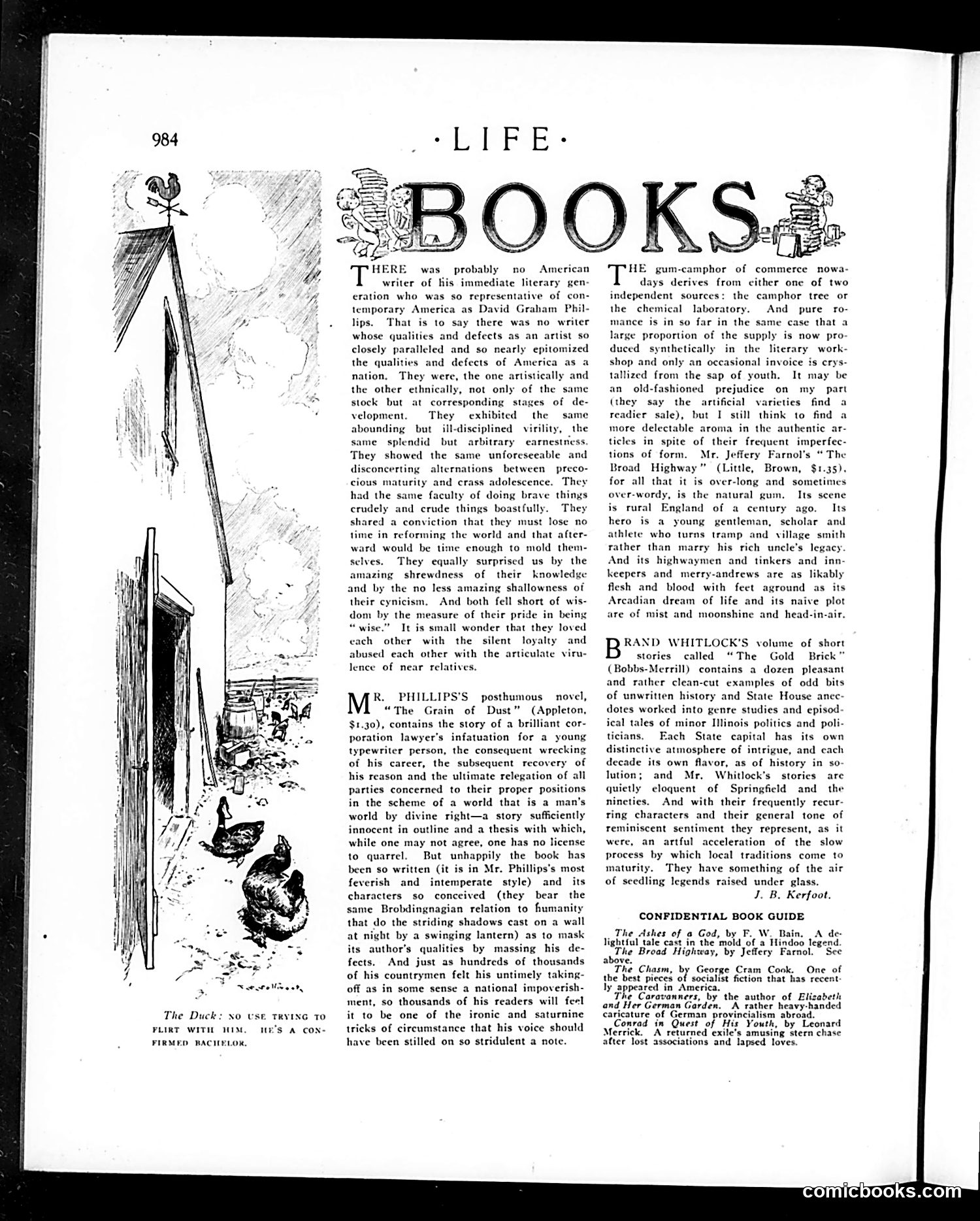
This page reviews three novels, with a small cartoon at bottom left. **The cartoon** shows a duck declining romantic advances, captioned "No use trying to flirt with him. He's a confirmed bachelor"—a simple visual gag requiring no political context. **The main content** discusses David Graham Phillips's posthumous novel *The Grain of Dust*, praising Phillips as representative of American character while critiquing his overwrought, intemperate writing style. The reviewer argues Phillips masked his talents through excessive stylistic flourishes. The page also reviews Jeffrey Farnol's *The Broad Highway*, celebrating its "authentic" romantic appeal over artificially manufactured contemporary fiction—a commentary on literary authenticity versus commercial formula. **The satire is literary, not political**: Life's editors position themselves as sophisticated arbiters of taste, mourning Phillips's death while faulting his artistic execution, and endorsing "natural" storytelling over synthetic modern approaches. This reflects early 20th-century genteel literary criticism's tensions between realism and romanticism.
📄 Transcribed text from this page (OCR, searchable)
Machine-transcribed from the original scan — historical spelling and the odd misread are preserved.
Neer eeery The Duck: No Use TRYING TO PLIRT WITH WIM. 1S A CON- FIRMED BACHELOR, HERE was probably no American writer of His immediate literary gen- eration who was so representative of con- temporary America as David Graham Phil- lips. That is to say there was no writer whose qualities and defects as an artist so closely paralleled and so nearly epitomized the qualities and defects of America as a nation, They were, the one artistically and the other ethnically, not only of the same stock but at corresponding stages of de- velopment. They exhibited the same abounding but ill-disciplined virility, the same splendid but arbitrary earnestness. They showed the same unforeseeable and disconcerting alternations between preco- cious maturity and crass adolescence. They had the same faculty of doing brave things crudely and crude things boastfully. They shared a conviction that they must lose no time in reforming the world and that after- ward would be time enough to mold them- selves. They equally surprised us by the amazing shrewdness of their knowledge and by the no less amazing shallowness of their cynicism. And both fell short of wis- dom by the measure of their pride in being “wise.” It is small wonder that they loved ach other with the silent loyalty and abused each other with the articulate viru- lence of near relative M* PHILLIPS’S posthumous novel, “The Grain of Dust” (Appleton, $1.30), contains the story of a brilliant cor- poration lawyer's infatuation for a young typewriter person, the consequent wrecking of his career, the subsequent recovery of his reason and the ultimate relegation of all parties concerned to their proper positions in the scheme of a world that is a man’s world by divine right—a story sufficiently innocent in outline and a thesis with which, while one may not agree, one has no license to quarrel. But unhappily the book has been so written (it is in Mr. Phillips's most feverish and intemperate style) and_ its characters so conceived (they bear the same Brobdingnagian relation to humanity that do the striding shadows cast on a wall at night by a swinging lantern) as to mask its author's qualities by massing his de- fects, And just as hundreds of thousands of his countrymen felt his untimely taking- off as in some sense a national impoverish- ment, so thousands of his readers will feel it to be one of the ironic and saturnine tricks of circumstance that his voice should have been stilled on so stridulent a note. HE gum-camphor of commerce nowa- days derives from cither one of two independent sources: the camphor tree oF the chemical laboratory. And pure ro- mance is in so far in the same case that a large proportion of the supply is now pro: duced synthetically in the literary work- shop and only an occasional invoice is erys- tallized from the sap of youth. It may be an old-fashioned prejudice on my part (they say the artificial varieties find a readier sale), but I still think to find a more delectable aroma in the authentic ar- ticles in spite of their frequent imperfec- tions of form. Mr. Jeffery Farnol’s “ The Broad Highway" (Little, Brown, $1.35). for all that it is over-long and sometimes is the natural gum. Its scene England of a century ago. Its hero is a young gentleman, scholar and athlete who turns tramp and village smith rather than marry his rich uncle’s legacy And its highwaymen and tinkers and inn- keepers and merry-andrews are as likably flesh and blood with fect aground as its Arcadian dream of life and its naive plot are of mist and moonshine and head-in-air. over-word is rural E RAND WHITLOCK'’S volume of short stories called “The Gold Bric! (Bobbs-Merrill) contains a dozen pleasant and rather clean-cut examples of odd bits of unwritten history and State House ance- dotes worked into genre studies and episod- ical tales of minor Illinois politics and poli- ticians, Each State capital has its own distinctive atmosphere of intrigue, and cach decade its own flavor, as of history in so- lution; and Mr. Whitlock’s stories are quietly eloquent of Springfield and the nincties. And with their frequently recur- ring characters and their general tone of reminiscent sentiment they represent, as it were, an artful acceleration of the slow process by which local traditions come to maturity. They have something of the air of seedling legends raised under glass. J. B. Kerfoot. CONFIDENTIAL BOOK GUIDE _ The Ashes of a God, by F. W. Bain, A de- lightful’tale cast in the ‘mold of a Hindoo legend The Broad Highway, by Jeffery Farnol. See above. The Chasm, by George Cram Cook. One of the best pieces of socialist fiction that has recent ly appeared in America. The Caravanners, by the author of Elizabeth and Her German Garden. A rather heavy-handed caricature of German provincialism abroad. Conrad in Quest of His Youth, by Leonard Merrick. A returned exile’s amusing stern chase after lost associations and lapsed loves. Comicbooks.com