
Life, 1911-05-18 · page 21 of 42
Life — May 18, 1911 — page 21: what you’re looking at
What you’re looking at
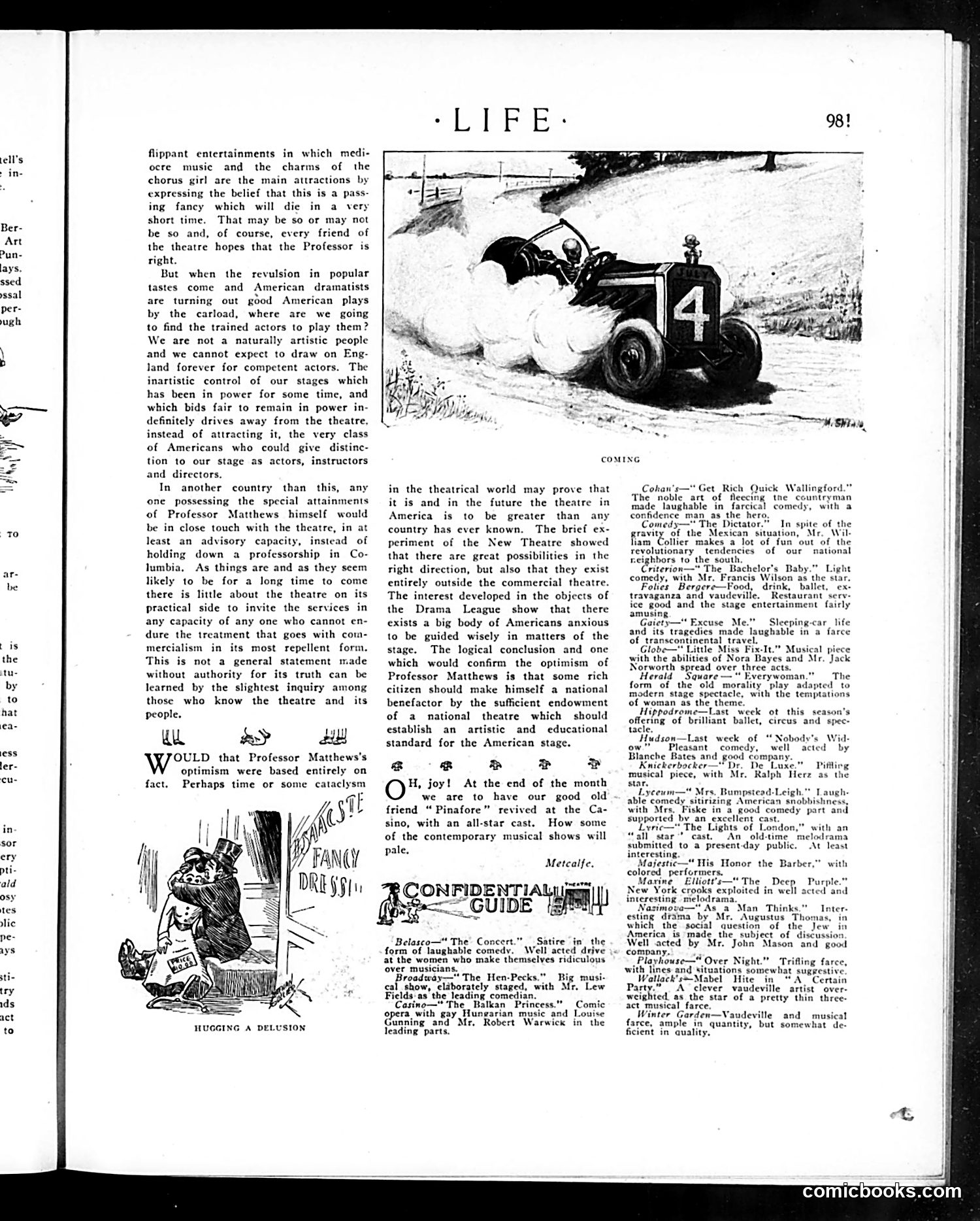
This page presents a cultural criticism essay about American theater, accompanied by two cartoons. ## Main Cartoon: "Hugging a Delusion" The large cartoon depicts a figure embracing or clinging to something labeled "FANCY DRESS" or similar theatrical imagery—likely representing the embrace of superficial, commercially-driven entertainment over serious drama. ## The Argument The text criticizes American theater's commercial control, arguing it drives away serious artists and actors. It mentions "Professor Matthews" (likely referring to Brander Matthews, a Columbia University drama professor) who believes mediocre entertainment with chorus girls is a passing fancy. The author counters that America lacks trained dramatic actors and needs patronage to establish a national theater with artistic standards—not commercial ones. ## References The page includes theatrical reviews of shows like "Pinafore," "The Dictator," and "Rich Quick Wallingford," suggesting contemporary Broadway productions that exemplify both serious and frivolous entertainment. ## The Satire The overall critique mocks American theater's commercialism and argues that artistic merit requires wealthy patronage and institutional support, not market-driven popularity.
📄 Transcribed text from this page (OCR, searchable)
Machine-transcribed from the original scan — historical spelling and the odd misread are preserved.
flippant entertainments in which medi- ocre music and the charms of the chorus girl are the main attractions by expressing the belief that this is a pass- ing fancy which will die in a very short time. That may be so or may not be so and, of course, every friend of the theatre hopes that the Professor is right. But when the revulsion in popular tastes come and American dramatists are turning out good American plays by the carload, where are we going to find the trained actors to play them? We are not a naturally artistic people and we cannot expect to draw on Eng- land forever for competent actors. The inartistic control of our stages which has been in power for some time, and which bids fair to remain in power in- definitely drives away from the theatre, instead of attracting it, the very class of Americans who could give distine- tion to our stage as actors, instructors and directors. In another country than this, any one possessing the special attainments of Professor Matthews himself would be in close touch with the theatre, in at least_ an advisory capacity, instead of holding down a professorship in Co- lumbia, As things are and as they seem likely to be for a long time to come there is little about the theatre on its practical side to invite the services in any capacity of any one who cannot en- dure the treatment that goes with com- mercialism in its most repellent form. This is not a general statement made without authority for its truth can be learned by the slightest inquiry among those who know the theatre and its people. LCs ay aid OULD that Professor Matthews's optimism were based entirely on Perhaps time or some cataclysm Ugo FANG fact. COMING in the theatrical world may prove that it is and in the future the theatre in America is to be greater than any country has ever known. The brief ex- periment of the New Theatre showed that there are great possibilities in the right direction, but also that they exist entirely outside the commercial theatre. The interest developed in the objects of the Drama League show that there exists a big body of Americans anxious to be guided wisely in matters of the stage. The logical conclusion and one which would confirm the optimism of Professor Matthews is that some rich citizen should make himself a national benefactor by the sufficient endowment of a national theatre which should establish an artistic and educational standard for the American stage. sg Cd a » ® Oo" joy! At the end of the month we are to have our good old friend “Pinafore” revived at the Ca- sino, with an all-star cast. How some of the contemporary musical shows will pale, Metcalfe. Belasco—" The Concert.” Satire “in the form of laughable comedy. Well acted drive at the women who make themselves ridiculous over musician Broadway—" The Hen-Pecks.”” cal show, elaborately stag Fields-as'the leading comedian. Casino—" The Balkan Princess.” Comic opera with gay Hungarian music and Louise Gunning and Mr. Robert Warwick in the Teading parts, ON FIDENTI. Big musi- Mr. Lew Cohan's— Rich Quick Wallingford.” The noble art of fleecing tne countryman made laughable in farcical comedy, with a confidence man_as the hero, Comedy—" The Dictator." In spite of the gravity of the Mexican situation, Mr. Wil- liam Collier makes a lot of fun ‘out of the olutionary tendencies of our national cighbors to the south, Criterion—" The Bachelor's Baby.” Light comedy, with Mr. Francis Wilson as the star. Folies Bergere—Food, drink, ballet, © travaganza and vaudeville, Restaurant ‘serv- ice good and the stage entertainment fairly amusing Gaicty—" Excuse Me.” Sleeping-car life and its tragedies made laughable in a farce of transcontinental travel. Globe—"' Little Miss Fix-It.” Musical piece with the abilities of Nora Bayes and Mr. Jack Norworth spread over, three acts. Herald Square — “ Everywoman.”” The form of the old morality play adapted to modern stage spectacle, with the temptations of woman as the theme. Hippodrome—Last week ot this season's offering of brilliant ballet, circus and spec- tacle. Hudson—Last week of “Nobody's Wi ow” Pleasant comedy, well acted by Blanche Bates and good company. Knickerbocker—" Dr. De Luxe.” Piffling th Mr. Ralph Herz as the Mrs, Bumpstead-Leigh.” Taugh- able comedy sitirizing American snobbishness, with Mrs. Fiske in a good comedy part and supported by an excellent cast. Lvric—" The Lights of London,” with an “ail star’ cast. An old-time melod submitted to a present-day public. interesting. Majestic—“ His Honor the Barber,” with colored performers. Marine Elliott’s—" The Deep Purple.” New Vork crooks exploited in well acted and ‘ast Asa Man Thinks.” Inter. esting drama by Mr. Augustus Thomas, in which the social question of the Jew. in America is made the subject of discussion Well acted by Mr. John Mason and. good company. _Playhouse—" Over Night.” Trifling farce, vith lines and situations somewhat suggestive Wallack's-Mabel Hite in ‘tA Certain Party.” A clever vaudeville artist’ over- weighted as the star of a pretty thin three- act musical farce. Winter Garden—Vaudeville and musical farce, ample in quantity, but somewhat de- ficient in quality. comicbooks.com