
Life, 1911-05-18 · page 32 of 42
Life — May 18, 1911 — page 32: what you’re looking at
What you’re looking at
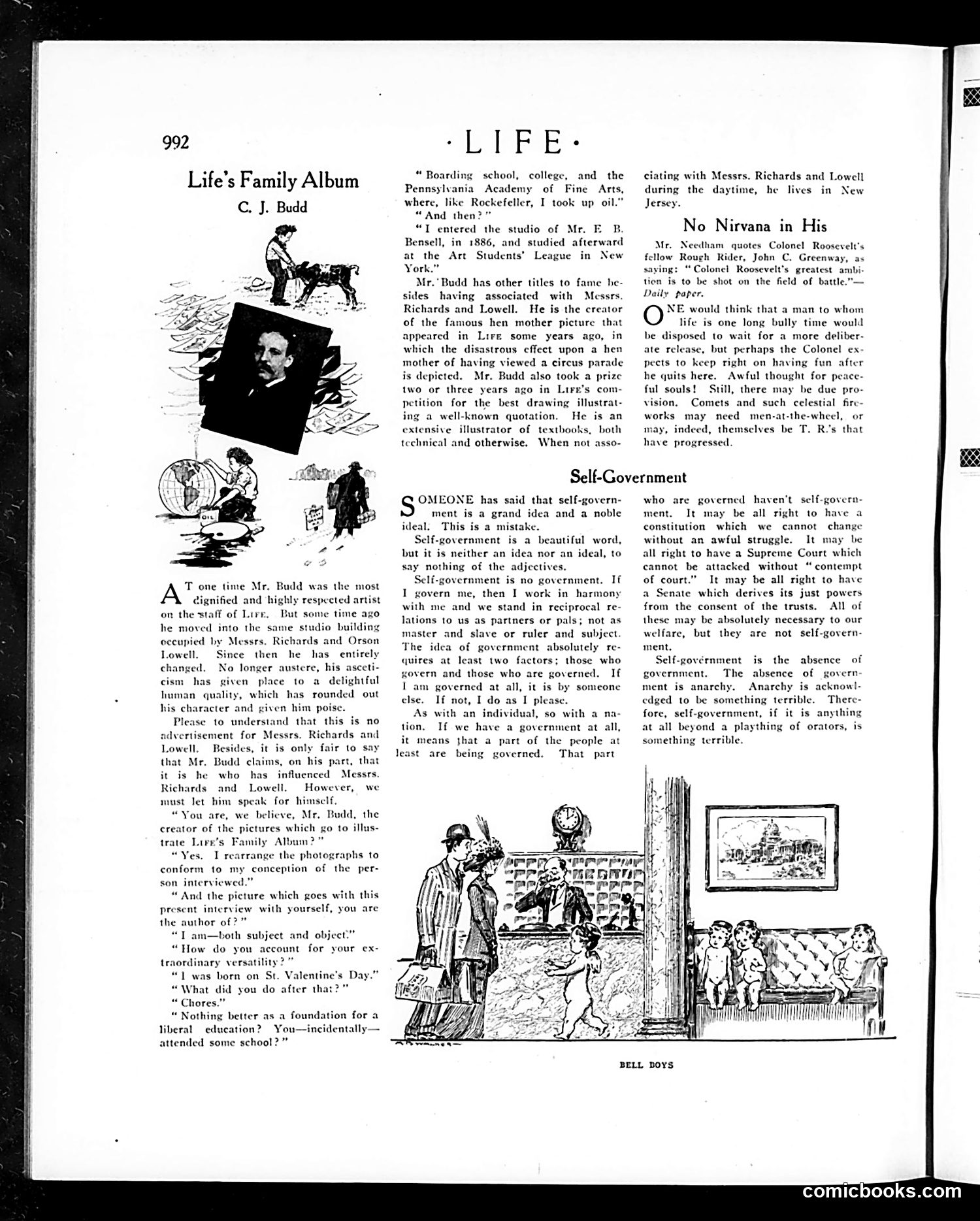
**"Life's Family Album" by C.J. Budd:** This is a light satirical interview with artist C.J. Budd, illustrating Life magazine's tradition of self-promotional humor. The piece jokes that Budd improved as a person after moving into a studio with artists Richards and Lowell, though Budd claims *he* influenced *them*. The interview uses playful irony about his artistic credentials and versatility. **"No Nirvana in His":** A brief jab at Theodore Roosevelt. Quoting a Rough Rider colleague saying Roosevelt's greatest ambition is "to be shot on the field of battle," Life sarcastically suggests TR apparently expects to enjoy the afterlife as much as earthly adventure—a humorous dig at Roosevelt's aggressive, adventurous public persona. **"Self-Government":** A philosophical satire arguing that "self-government" is a linguistic contradiction—true government requires both rulers *and* the ruled, so self-governing individuals simply do as they please. The piece uses this logical deconstruction to critique the political concept itself, suggesting governmental power fundamentally requires subjection.
📄 Transcribed text from this page (OCR, searchable)
Machine-transcribed from the original scan — historical spelling and the odd misread are preserved.
Family Album C. J. Budd T one time Mr. Budd was the most Cignified and highly respected artist on the staff of Lire, But some time ago he moved into the same studio building occupied by Messrs. Richards and Orson Lowell. Since then he has entirely changed. No longer austere, his asceti- cism has given place to a delightful human quality, which has rounded out his character and given him poise. Please to understand that this is no Ivertisement for Messrs. Richards and Lowell. Besides, it is only fair to say that Mr, Budd claims, on his part, that it is he who has influenced Messrs. Richards and Lowell. However, we must let him speak for himself. “You are, we believe, Mr. Budd, the creator of the pictures which go to illus- trate Lire’s Family Album?" “Yes, I rearrange the photographs to conform to my conception of the per- son interviewed.” “And the picture which goes with this present interview with yourself, you are the author of?” I am—both subject and object.” “How do you account for your ex- traordinary versatility?” “1 was born on St. Valentine's Day.” “What did you do after th “ Chore “ Nothing better as a foundation for a liberal education? You—incidentally— attended some school?” least =)0 IRPSE = “Boarding school, college, and the Pennsylvania Academy of Fine Arts, where, like Rockefeller, I took up oil.” “And then?” “T entered the studio of Mr. EB. Bensell, in 1886, and studied afterward at the Art Students’ League in New York.” Mr. "Budd has other titles to fame he- sides having associated with Messrs. Richards and Lowell. He is the creator of the famous hen mother picture that appeared in Lire some years ago, in which the disastrous effect upon a hen mother of having viewed a circus parade is depicted. Mr. Budd also took a prize two or three years ago in Lire’s com- petition for the best drawing illustrat- ing a well-known quotation. He is an extensive illustrator of textbooks, both technical and otherwise. When not asso- ciating with Messrs. Richards and Lowell during the daytime, he lives in New Jerse: No Nirvana in His Mr. Needham quotes Colonel Roosevelt's fellow Rough Kider, John C. Greenway, as saying: “Colonel Roosevelt's greatest ambi- tion is to be shot on the field of battle."— Daily paper. NE would think that a man to whom life is one long bully time would be disposed to wait for a more deliber- ate release, but perhaps the Colonel ex- pects to keep right on having fun after he quits here. Awful thought for peace- ful souls! Still, there may be due pro- vision. Comets and such celestial fire- works may need men-at-the-wheel, or may, indeed, themselves be T. R.’s that have progressed Self-Government OMEONE has said that self-govern- ment is a grand idea and a noble ideal. This is a mistake. Self-government is a beautiful word, Dut it is neither an idea nor an ideal, to say nothing of the adjectives. Seli-government is no government. If I govern me, then I work in harmony with me and we stand in reciprocal re- lations to us as partners or pals; not as master and slave or ruler and subject. The idea of government absolutely + quires at least two factors; those who govern and those who are governed. If I am governed at all, it is by someone If not, I do as I please. As with an individual, so with a na- tion, If we have a government at all, it means shat a part of the people at are being governed. That part else. TaalalaaTal PP EIT FA), who are governed haven't self-govern- ment. It may be all right to have a constitution which we cannot change without an awful struggle. It may be all right to have a Supreme Court which cannot be attacked without “contempt of court.” It may be all right to have a Senate which derives its just powers from the consent of the trusts. All of these may be absolutely necessary to our welfare, but they are not self-govern ment. Self-government is the absence of government, The absence of govern ment is anarchy. Anarchy is acknow!- edged to be something terrible. There- fore, self-government, if it is anything at all beyond a plaything of orators, is something terrible == = comicbooks.com