
Life, 1911-05-18 · page 20 of 42
Life — May 18, 1911 — page 20: what you’re looking at
What you’re looking at
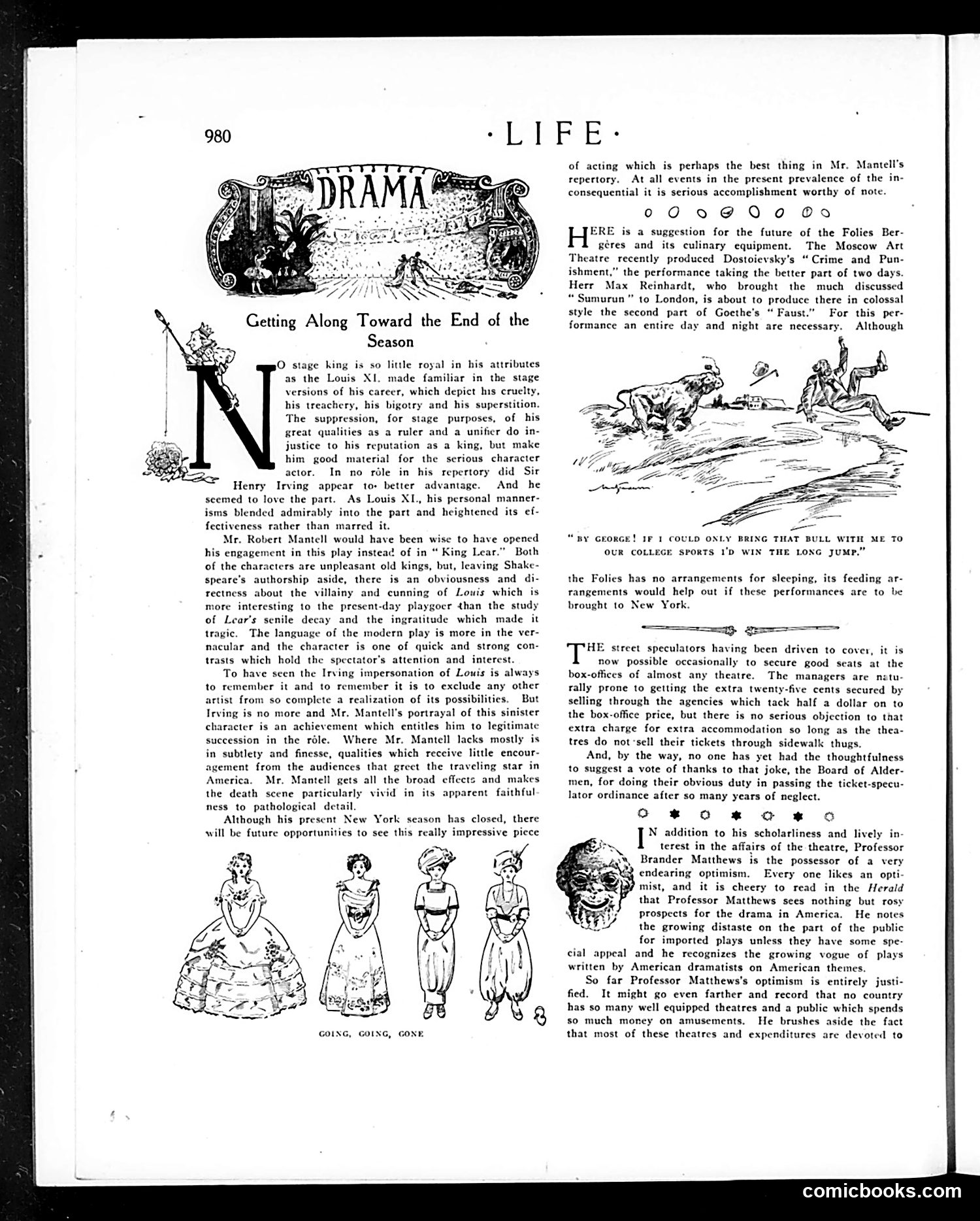
This page discusses theatrical productions and includes social commentary typical of early 20th-century American satire. The main article praises actor Sir Henry Irving's portrayal of King Louis XI and critiques Robert Mantell's attempt at the same role, arguing Irving's interpretation was superior in subtlety. The text suggests Mantell's version appeals to traveling audiences who prefer "broad effects" over nuance. A small cartoon captioned "BY GEORGE! IF I COULD ONLY BRING THAT BULL WITH ME TO OUR COLLEGE SPORTS I'D WIN THE LONG JUMP" depicts a figure observing a bull, mocking college athletics by suggesting brute animal strength would guarantee athletic victory—a jab at the emphasis on physical prowess over intellectual development in American collegiate culture. The fashion illustration labeled "GOING, GOING, GONE" shows four women's dress silhouettes, likely satirizing changing women's fashion trends of the era.
📄 Transcribed text from this page (OCR, searchable)
Machine-transcribed from the original scan — historical spelling and the odd misread are preserved.
em “LP PE « Season O stage king is so little royal in his attributes as the Louis XI. made familiar in the stage versions of his career, which depict his cruelty, his treachery, his bigotry and his superstition. The suppression, for stage purposes, of his great qualities as a ruler and a unifier do in- justice to his reputation as a king, but make him good material for the serious character actor. In no role in his repertory did Sir Henry Irving appear to better advantage. And he scemed to love the part. As Louis XL, his personal manner- isms blended admirably into the part and heightened its ef- fectiveness rather than marred it. Mr. Robert Mantell would have been wise to have opened his engagement in this play instead of in “ King Lear.” Both of the characters are unpleasant old kings, but, leaving Shake- speare’s authorship aside, there is an obviousness and di- rectness about the villainy and cunning of Louis which is more interesting to the present-day playgocr than the study of Lear's senile decay and the ingratitude which made it tragic. The language of the modern play is more in the ver- nacular and the character is one of quick and strong con- trasts which hold the spectator’s attention and interest. To have scen the Irving impersonation of Louis is always to remember it and to remember it is to exclude any other artist from so complete a realization of its possibilities. But Irving is no more and Mr. Mantell’s portrayal of this sinister character is an achievement which entitles him to legitimate succession in the réle. Where Mr. Mantell lacks mostly is in subtlety and finesse, qualities which receive little encour- agement from the audiences that greet the traveling star in America. Mr. Mantell gets all the broad effects and makes the death scene particularly vivid in its apparent faithful ness to pathological deta Although his present New York season has closed, there will be future opportunities to sce this really impressive picce GOING, GOING, GONE of acting which is perhaps the best thing in Mr. Mantell’s repertory. At all events in the present prevalence of the in- consequential it is serious accomplishment worthy of note. 000908000 008 H ERE is a suggestion for the future of the Folies Ber- géres and its culinary equipment. The Moscow Art Theatre recently produced Dostoievsky’s “Crime and Pun- ishment,” the performance taking the better part of two days. Herr Max Reinhardt, who brought the much discussed “Sumurun" to London, is about to produce there in colossal style the second part of Goethe's “Faust.” For this per- formance an entire day and night are necessary. Although “BY GEORGE! IF 1 COULD ONLY BRING THAT BULL WITH ME TO OUR COLLEGE SPORTS 1'D WIN THE LONG JUMP.” the Folies has no arrangements for sleeping, its feeding ar- rangements would help out if these performances are to be brought to New York. == T! street speculators having been driven to cover, it is now possible occasionally to secure good seats at the box-offices of almost any theatre. The managers are netu- rally prone to getting the extra twenty-five cents secured by selling through the agencies which tack half a dollar on to the box-office price, but there is no serious objection to that extra charge for extra accommodation so long as the thea- tres do not sell their tickets through sidewalk thugs. And, by the way, no one has yet had the thoughtfulness to suggest a vote of thanks to that joke, the Board of Alder- men, for doing their obvious duty in passing the ticket-specu- lator ordinance after so many years of neglect. o * OO * GO # 6 N addition to his scholarliness and ely in- terest in the affairs of the theatre, Professor Brander Matthews is the possessor of a very endearing optimism. Every one likes an opti- mist, and it is cheery to read in the Herald that Professor Matthews sees nothing but rosy prospects for the drama in America. He notes the growing distaste on the part of the public for imported plays unless they have some spe- cial appeal and he recognizes the growing vogue of plays written by American dramatists on American themes. So far Professor Matthews’s optimism is entirely justi- fied. It might go even farther and record that no country has so many well equipped theatres and a public which spends so much money on amusements. He brushes aside the fact that most of these theatres and expenditures are devoted to comicbooks.com