
Life, 1911-05-18 · page 17 of 42
Life — May 18, 1911 — page 17: what you’re looking at
What you’re looking at
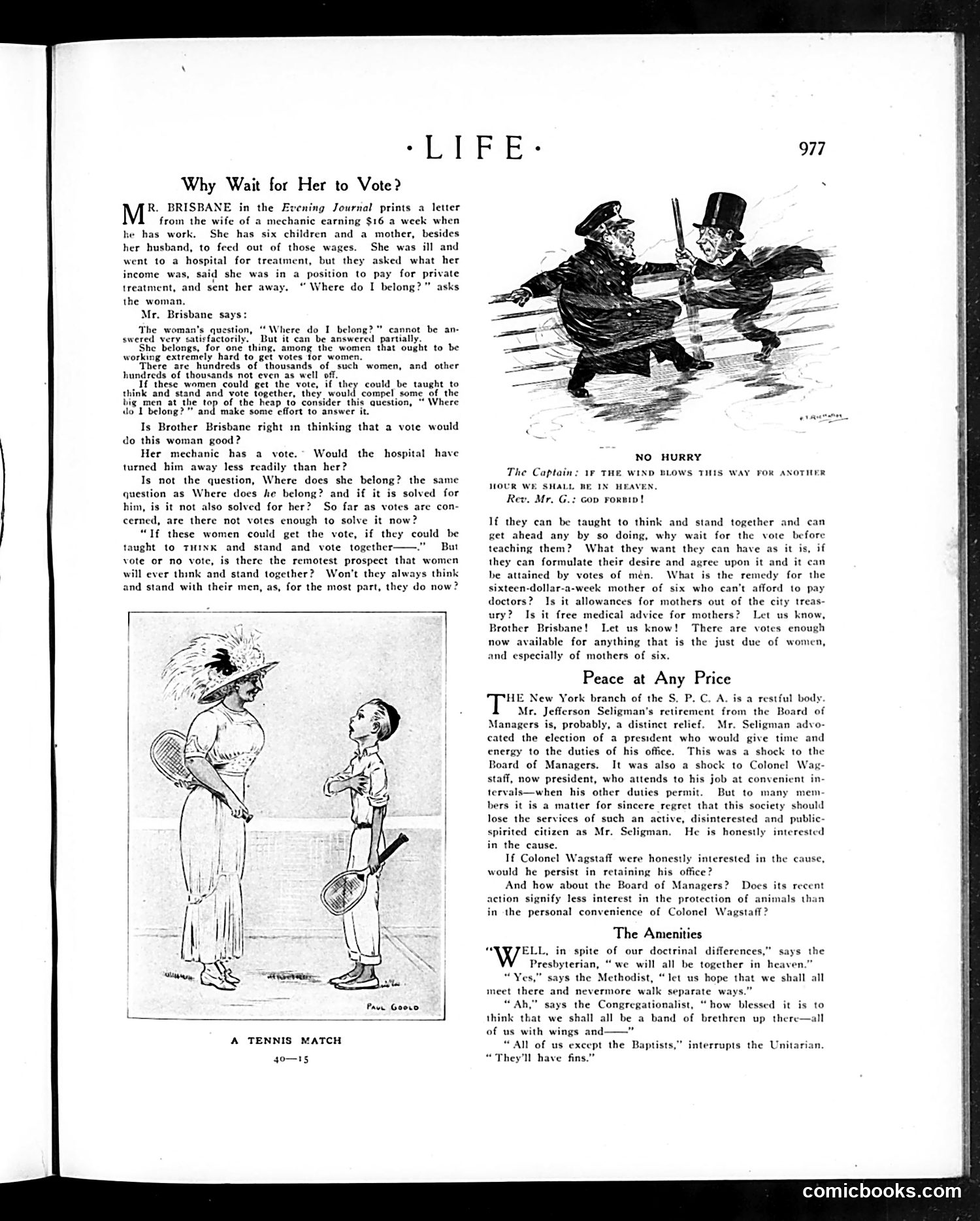
This page contains three satirical commentaries on early 20th-century American social issues: **"Why Wait for Her to Vote?"** debates women's suffrage through a real case: a mechanic's wife earning poverty wages was denied hospital care. Columnist Brisbane argues women need voting power to compel social reform. The editorial response challenges this, asking whether votes alone solve poverty—and whether women will ever vote independently of their husbands. The implicit critique: suffrage won't help if women lack economic independence or political solidarity. **"A Tennis Match"** cartoon (artist Paul Gould) depicts a size-mismatched tennis game, likely satirizing social inequality or unfair competition. **"No Hurry"** mocks clergy complacency about heaven rather than earthly justice. **"Peace at Any Price"** criticizes the S.P.C.A. (animal welfare society) for tolerating an inactive president (Colonel Wagstaff) rather than demanding accountability—suggesting the organization prioritizes harmony over its stated mission of animal protection. The page's overall theme: institutional failure to serve vulnerable populations (poor mothers, animals) due to leadership indifference.
📄 Transcribed text from this page (OCR, searchable)
Machine-transcribed from the original scan — historical spelling and the odd misread are preserved.
“ih T FE Why Wait for Her to Vote? R. BRISBANE in the Evening Journal prints a letter from the wife of a mechanic earning $16 a week when he has work. She has six children and a mother, besides her husband, to feed out of those wages. She was ill and went to a hospital for treatment, but they asked what her income was, said she was in a position to pay for private treatment, and sent her away, “ Where do I belong?” asks the woman. Mr. Brisbane says: The woman's question, ‘Where do I belong?” cannot be an- swered very satisfactorily.” But it can be answered partially. She belongs, for one ‘thing, among the women that ought to be working extremely hard to get votes for women. There are hundreds of thousands of such women, and other hundreds of thousands not even as well off. sif these women could get the vote, if they could, be taught to think and stand and vote together, they would compel some, of the big men at the top of the heap to consider this question, “ Where do 1 belong?” and make some effort to answer it. Is Brother Brisbane right in thinking that a vote would do this woman good? Her mechanic has a vote.~ Would the hospital have turned him away less readily than her? Is not the question, Where does she belong? the same question as Where does he belong? and if it is solved for him, is it not also solved for her? So far as votes are con- cerned, are there not votes enough to solve it now? “If these women could get the vote, if they could be taught to THINK and stand and vote together- But vote or no vote, is there the remotest prospect that women will ever think and stand together? Won't they always think and stand with their men, as, for the most part, they do now? A TENNIS MATCH 40-15 NO HURRY The Captain; 1F THE WIND BLOWS THIS WAY FOR ANOTHER MOUR WE SHALL WE IN HEAVEN. Rev. Mr. G.: Gop rornip! If they can be taught to think and stand together and can get ahead any by so doing, why wait for the vote before teaching them? What they want they can have as it is, if they can formulate their desire and agree upon it and it can be attained by votes of mén. What is the remedy for the sixteen-dollar-a-week mother of six who can't afford to pay doctors? Is it allowances for mothers out of the city treas ury? Is it free medical advice for mothers? Let us know, Brother Brisbane! Let us know! There are votes enough now available for anything that is the just due of women, and especially of mothers of six. Peace at Any Price HE New York branch of the S. P. C. A. is a restful body. Mr. Jefferson Seligman’s retirement from the Board of Managers is, probably, a distinct relief. Mr. Seligman advo- cated the election of a president who would give time and energy to the duties of his office. This was a shock to the Board of Managers. It was also a shock to Colonel Wai staff, now president, who attends to his job at convenient in- tervals—when his other duties permit. But to many mem- bers it is a matter for sincere regret that this society should lose the services of such an active, disinterested and public- spirited citizen as Mr. Seligman, He is honestly interested in the cause. If Colonel Wagstaff were honestly interested in the cause, would he persist in retaining his office? And how about the Board of Managers? action signify less interest in the protection of animals than in the personal convenience of Colonel Wagstaff? The Amenities ELL, in spite of our doctrinal differences,” says the Presbyterian, “we will all be together in heaven.” says the Methodist, “let us hope that we shall all meet there and nevermore walk separate ways.” “Ah,” says the Congregationalist, “how blessed it is to think that we shall all be a band of brethren up there—all of us with wings and—" “All of us except the Baptists,” interrupts the Unitarian. “They'll have fins.” Does its recent comicbooks.com