
A complete issue · 44 pages · 1911
Life — April 13, 1911
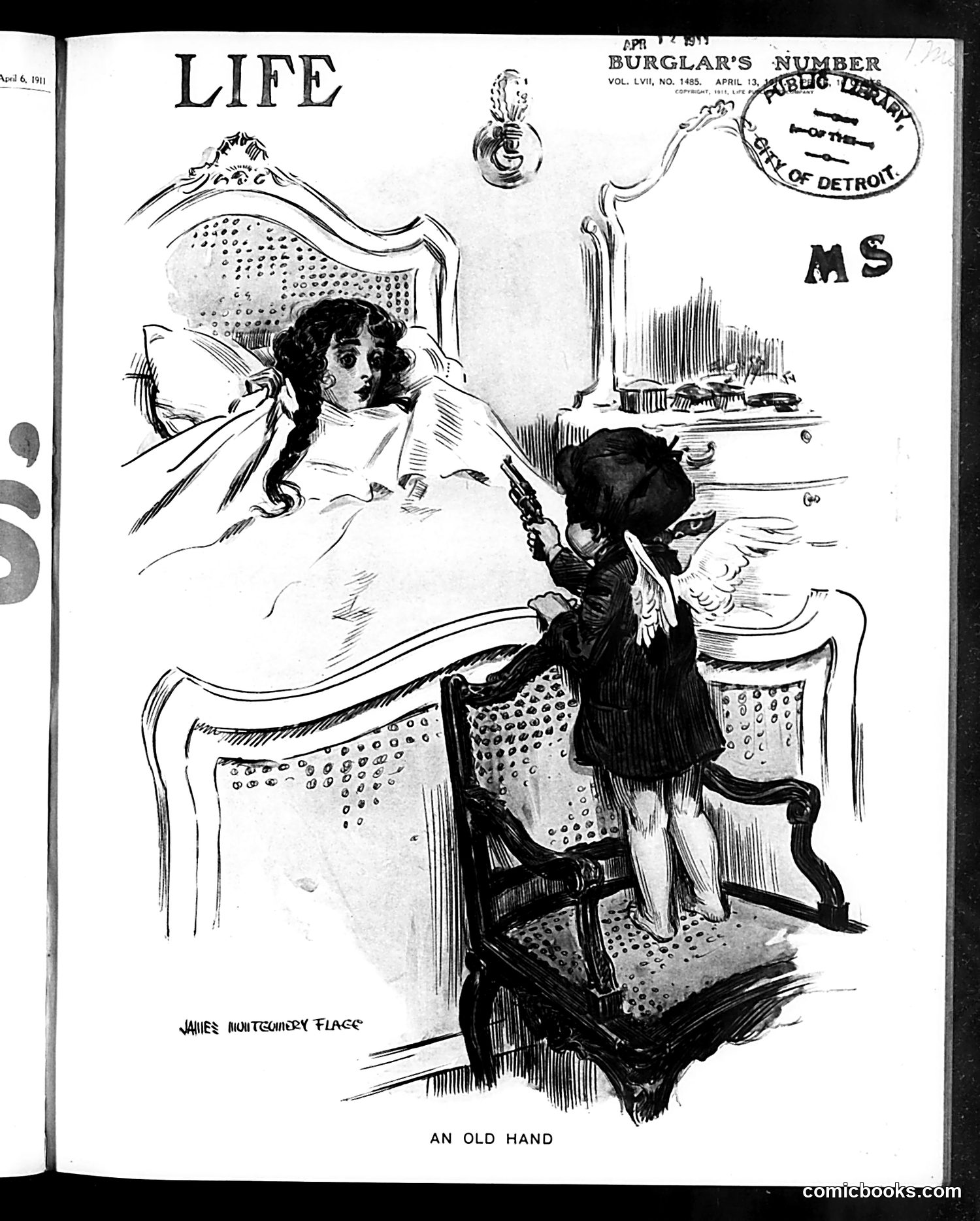
This illustration by James Montgomery Flagg depicts a scene titled "An Old Hand," showing a woman in bed gesturing toward a man seated beside her. The artwork appears to be satirizing romantic or marital dynamics, likely commentary on experienced or worldly behavior in intimate relationships. The cartoon's suggestive nature—with the woman's apparent directiveness and the man's formal attire contrasting with the bedroom setting—suggests Flagg is making a point about gender roles, seduction, or social expectations around courtship and relationships in early 20th-century America. Without additional context from the magazine's accompanying text, the specific satirical target remains somewhat unclear, though it appears to critique conventional attitudes toward romance or feminine agency.
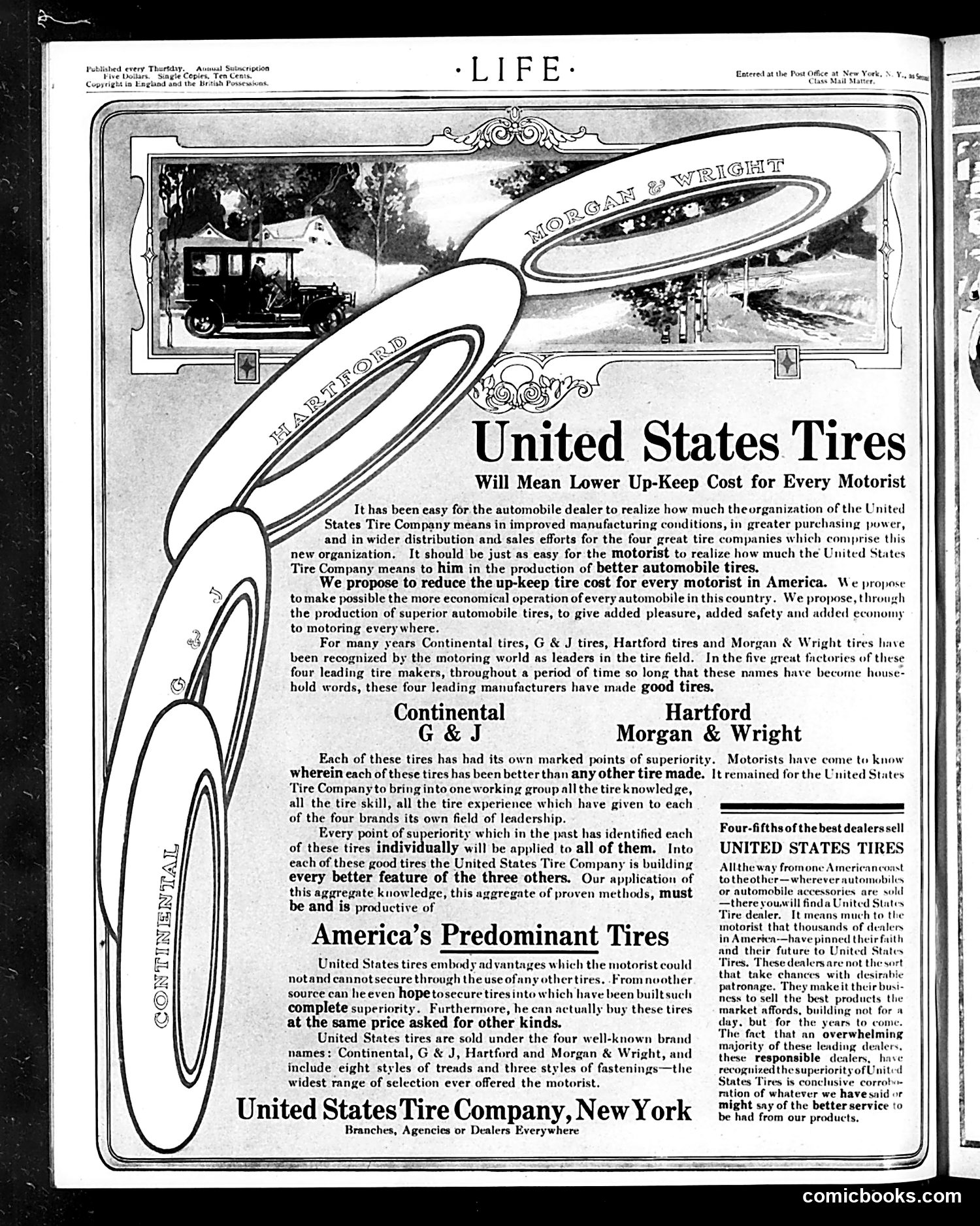
This page is **primarily an advertisement**, not satire or political cartoon. It's a United States Tire Company ad promoting their consolidation of four major tire manufacturers: Continental, G & J, Hartford, and Morgan & Wright. The decorative tire illustrations frame two photographs showing early automobiles, emphasizing the product's reliability and modernity. The text argues that this consolidation benefits motorists through improved manufacturing, distribution, and unified quality standards across brands. There is **no satirical cartoon or political commentary** here—it's straightforward commercial messaging typical of early 20th-century magazine advertising, designed to assure consumers that combining these companies would reduce costs and improve tire quality.
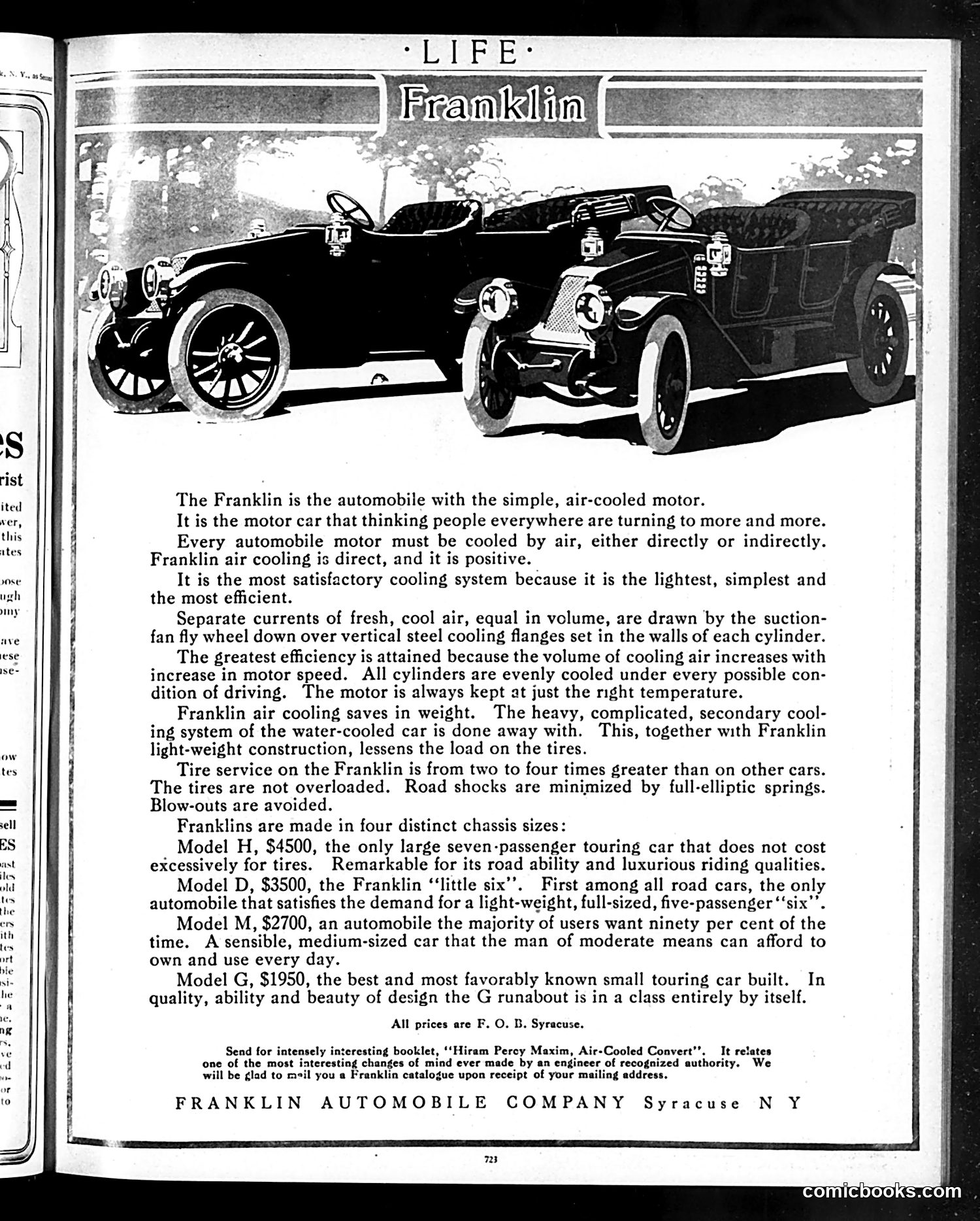
This is **not a cartoon or satirical content**—it's a straightforward automobile advertisement for Franklin cars, appearing in *Life* magazine. The page features three Franklin automobile models displayed at the top. The text promotes Franklin's signature feature: air-cooled engines rather than the water-cooling systems standard in competing vehicles. The advertisement emphasizes practical advantages: lighter weight, simplified mechanics, better tire longevity, and improved handling. Four specific models are listed with prices ranging from $1,950 to $4,500, positioning Franklin across different market segments from economy to luxury touring cars. The footer directs readers to request a detailed booklet about Franklin's air-cooling technology. This represents early automotive marketing emphasizing engineering innovation as a sales tool.
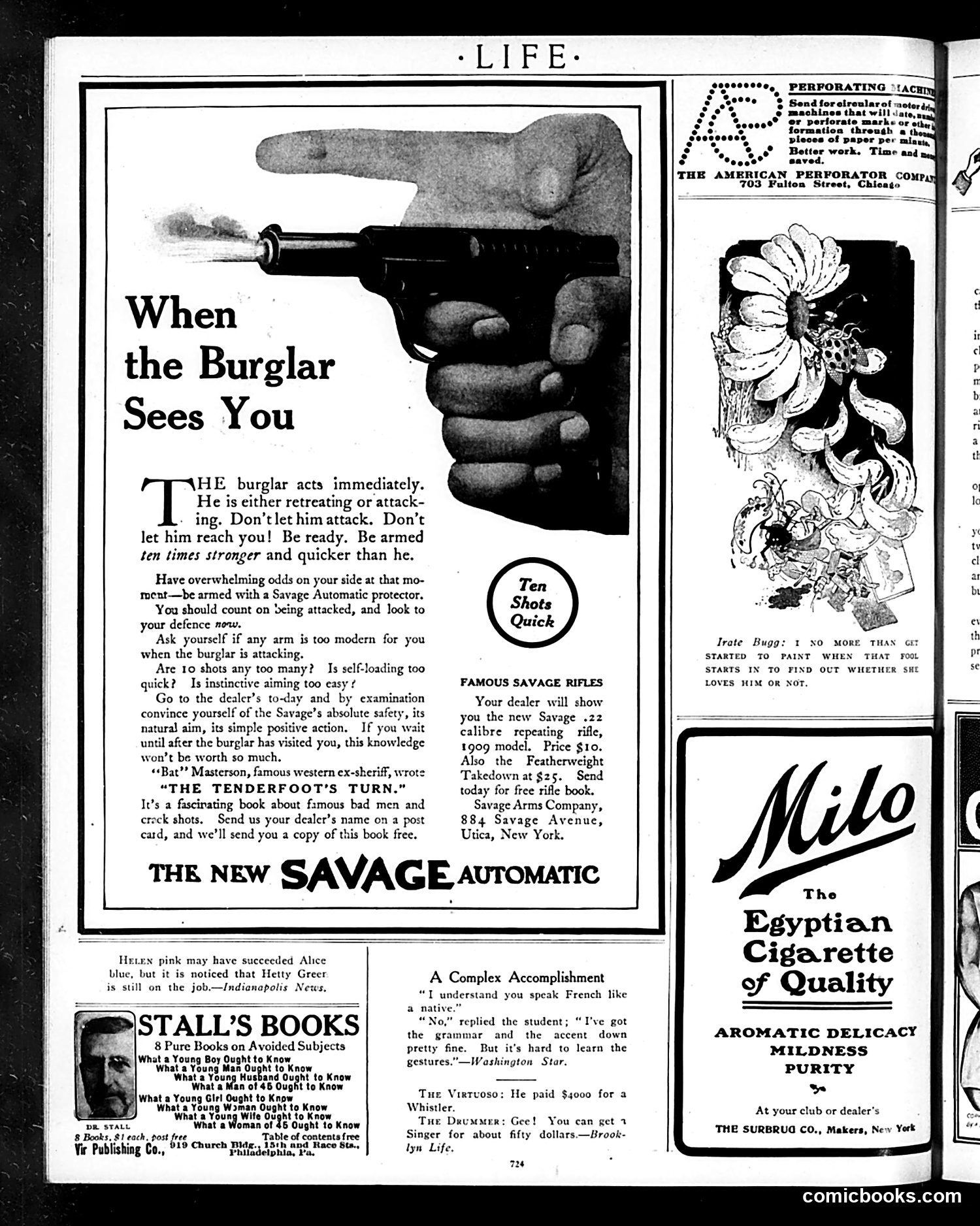
This page is primarily **advertising**, not political satire. The dominant content is a Savage Arms Company advertisement featuring an illustration of a hand holding a revolver with the headline "When the Burglar Sees You." The ad emphasizes home defense, recommending the Savage Automatic as protection against burglars, with testimonial-style copy from "Buffalo Bill" Masterson, a famous western ex-sheriff. The page also includes ads for Stall's Books (self-help guides), Milo Egyptian Cigarettes, and a brief humor item about mistaken identity. There's no identifiable political cartoon or satirical commentary here—just period product advertising typical of early 20th-century magazines, capitalizing on contemporary concerns about home security and crime.
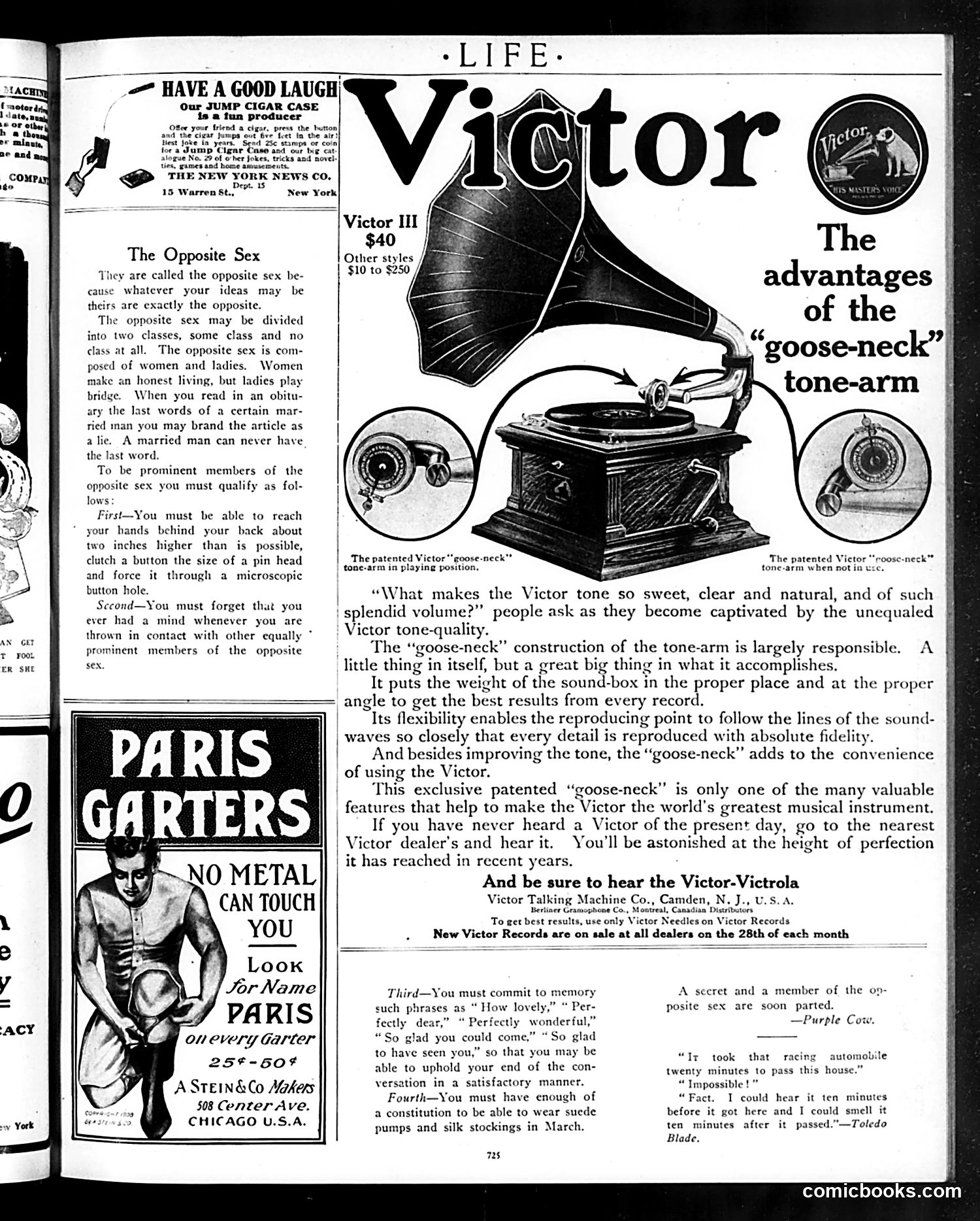
This page is **primarily advertising**, not political satire. The dominant content features a Victor Victrola (phonograph) advertisement highlighting its "goose-neck" tone-arm design as a technical innovation that improves sound quality and fidelity. The ad uses technical diagrams and testimonials to emphasize the device's superiority. A smaller sidebar advertisement for "Paris Garters" (men's sock supporters) appears on the left, using the marketing phrase "No Metal Can Touch You." The only editorial content is a brief piece titled "The Opposite Sex," offering lighthearted advice about courtship, suggesting women need various qualities like physical flexibility and constitution. This reflects early-20th-century gender attitudes but isn't satirical commentary—it's presented as earnest dating guidance.
This is a straightforward **advertisement, not satire or political content**. It's a full-page ad from Standard Oil Company promoting "Polarine" motor lubricants to early automobile owners. The ad makes product claims typical of the era: improved speed, easier hill-climbing, reduced breakdowns, and longer engine life. It emphasizes that thousands of motorists already use and recommend the product, and mentions a free "Polarine Pointers" booklet explaining engine care and troubleshooting. The page reflects early 1900s automotive culture when reliable lubricants were genuinely important for vehicle maintenance, and when Life magazine's pages included substantial advertising alongside editorial content. There is no political commentary or satire present.
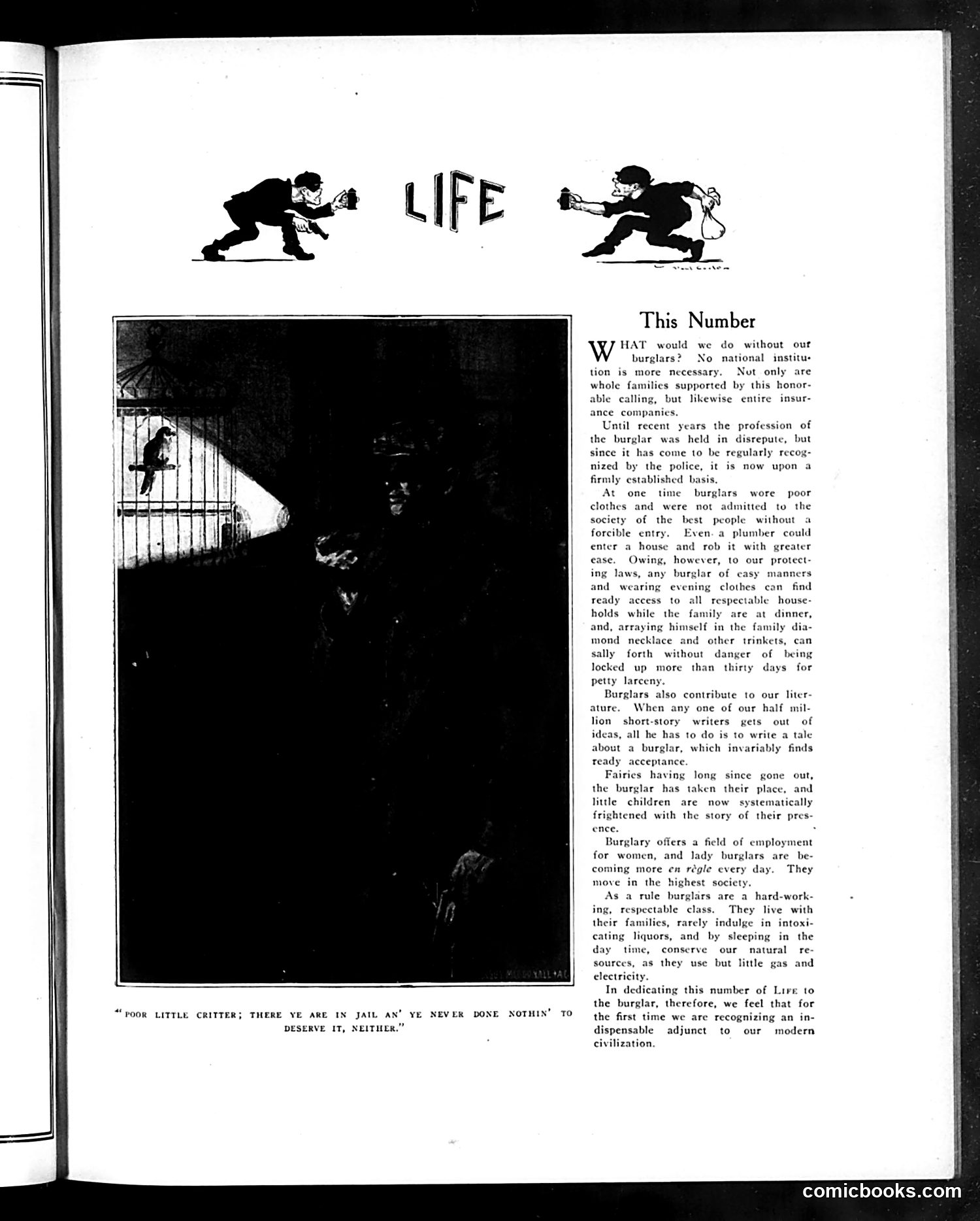
This page satirizes burglars as a social institution. The header illustration shows two figures in a tug-of-war over the word "LIFE," representing the ongoing conflict between burglars and society. The central photograph depicts a burglar climbing through a window with a rope, captioned with a quote suggesting burglars deserve jail time. The accompanying essay treats burglary with mock-serious tone, discussing how burglars have evolved from disreputable criminals into an established profession. It ironically notes that burglars now move in "highest society," that women burglars are increasingly common, and that burglary has become a standard plot device for short-story writers. The satire critiques how modern society has normalized or romanticized criminal behavior, treating burglars as respectable members of the social order worthy of literary attention.
The page features two small editorial cartoons accompanying commentary about civic engagement and voter apathy. **Top cartoon** (skull and crossbones): Illustrates the burning of the Albany State Library—a cautionary symbol representing loss of institutional records and historical knowledge. **Bottom cartoon** (sleeping figures): Depicts public indifference to politics, supporting the article's critique of low voter turnout in Milwaukee's primary elections. The text notes only 30% of registered voters participated, with nearly one-third of voters skipping school board and judicial elections entirely. The cartoons satirize American voter negligence and apathy, contrasting ideals of democratic participation with the reality of widespread disengagement from civic duties. The commentary advocates for informed, active citizenship rather than leaving governance to political machines and party elites.
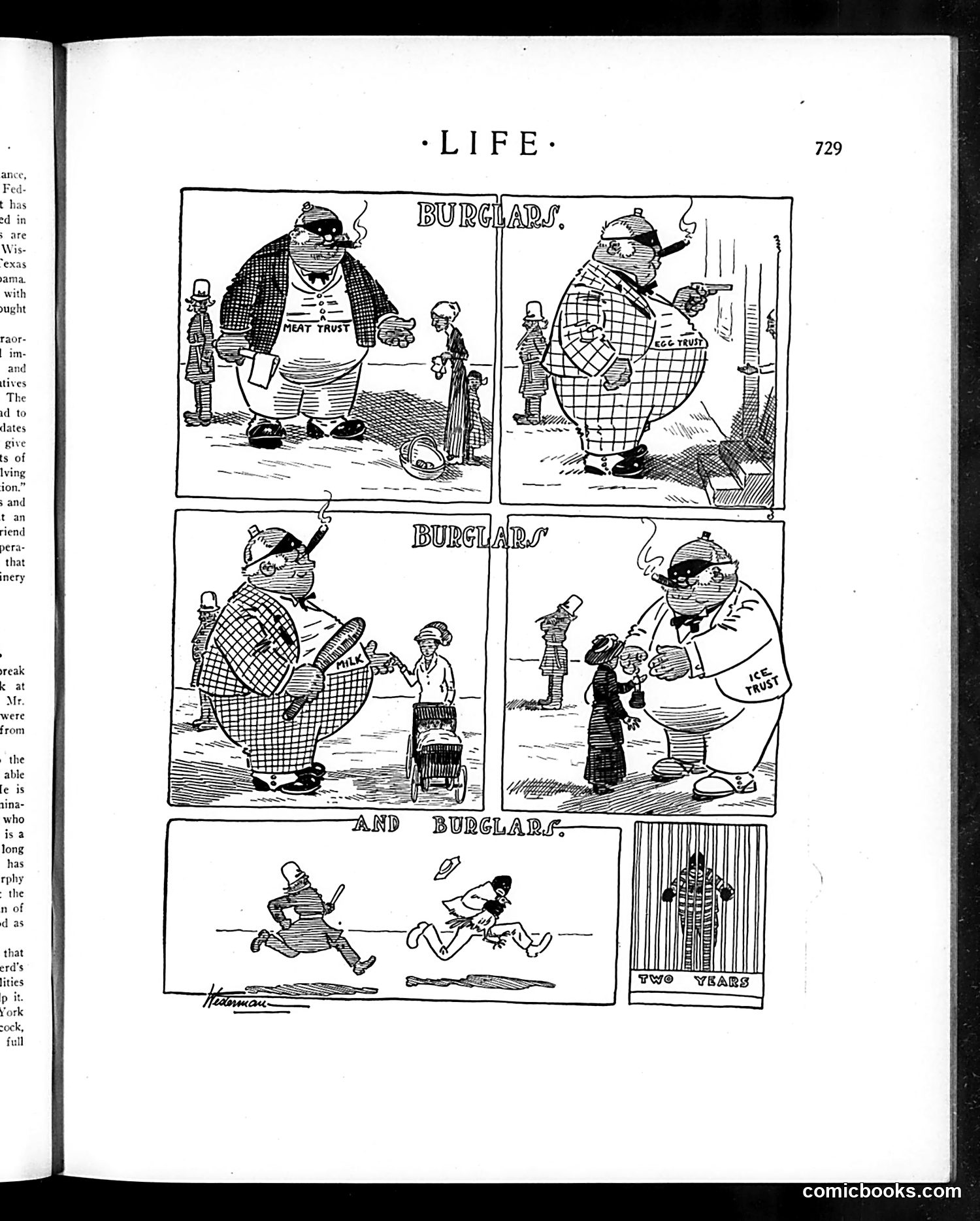
This comic strip satirizes the contrast between wealthy burglars and poor ones. The large, well-dressed burglar labeled "Meat Trust" and "Egg Trust" represents corporate monopolies who exploit consumers through price-fixing—depicted as legitimate "burglary" sanctioned by society. The smaller, ragged burglars represent common criminals who steal out of desperation. The final panel showing prison bars ("Two Years") underscores the hypocrisy: ordinary burglars face imprisonment while corporate "burglars" (the Meat and Egg Trusts) operate openly, stealing from the public through inflated prices. The cartoon critiques how wealthy industrialists commit economic theft with impunity while the poor are criminalized for actual theft.
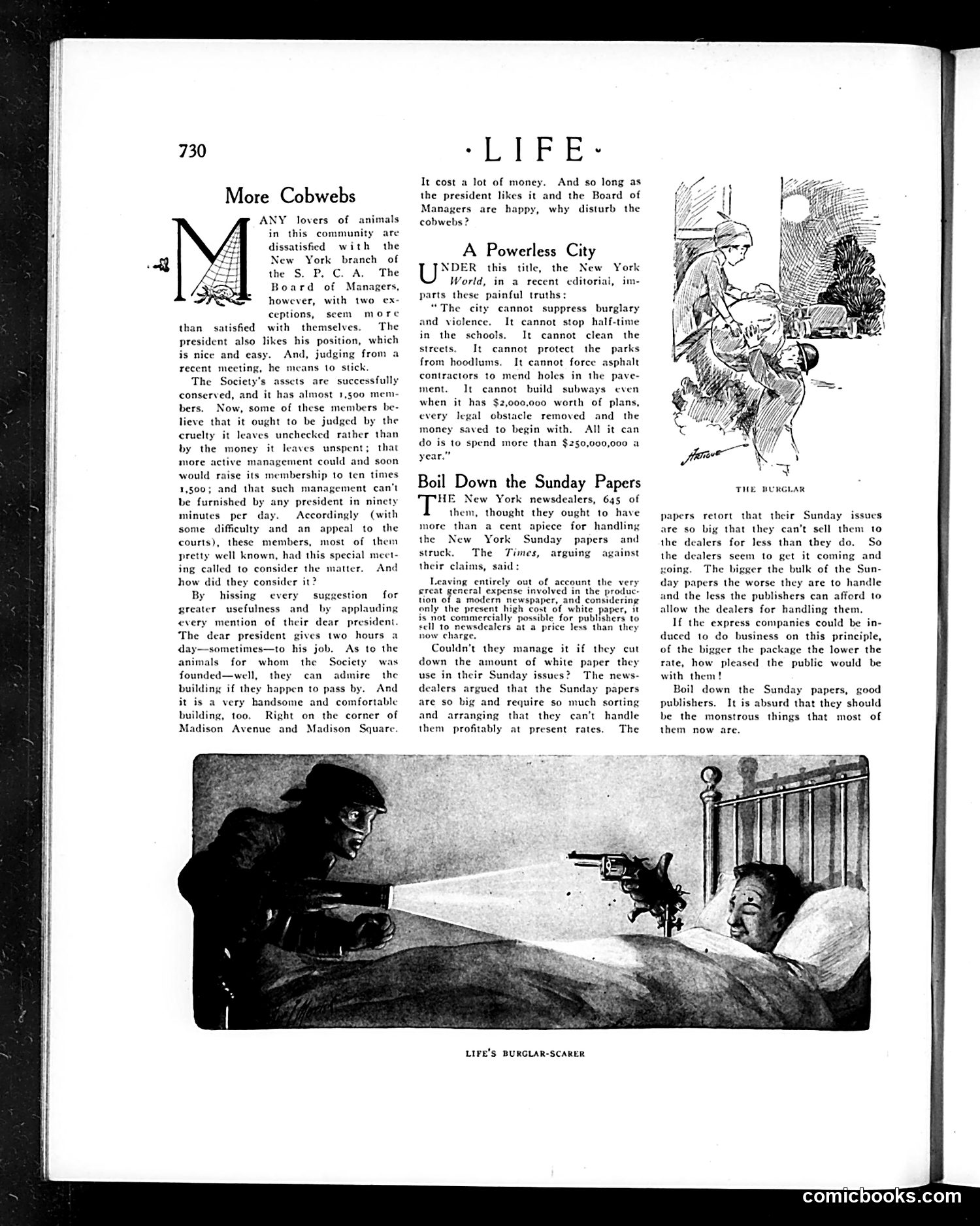
This page contains three satirical pieces about New York City governance and media: **"More Cobwebs"** criticizes the S.P.C.A.'s Board of Managers, suggesting they're ineffectual—their inaction allows animal cruelty to persist. The satire implies the board provides cover for poor management rather than actual oversight. **"A Powerless City"** quotes the *New York World* editorial arguing the city government is impotent: unable to stop crime, clean streets, or fix infrastructure despite having $2 million in available plans and $250,000 annual budget. **"Boil Down the Sunday Papers"** attacks newspaper publishers' claims that Sunday editions are too expensive to produce. The satire suggests publishers are simply unwilling to lower prices, making Sunday papers costlier than weekday editions. **"Life's Burglar-Scare"** illustration (bottom) depicts a humorous scene of a burglar confronting a bedridden man.
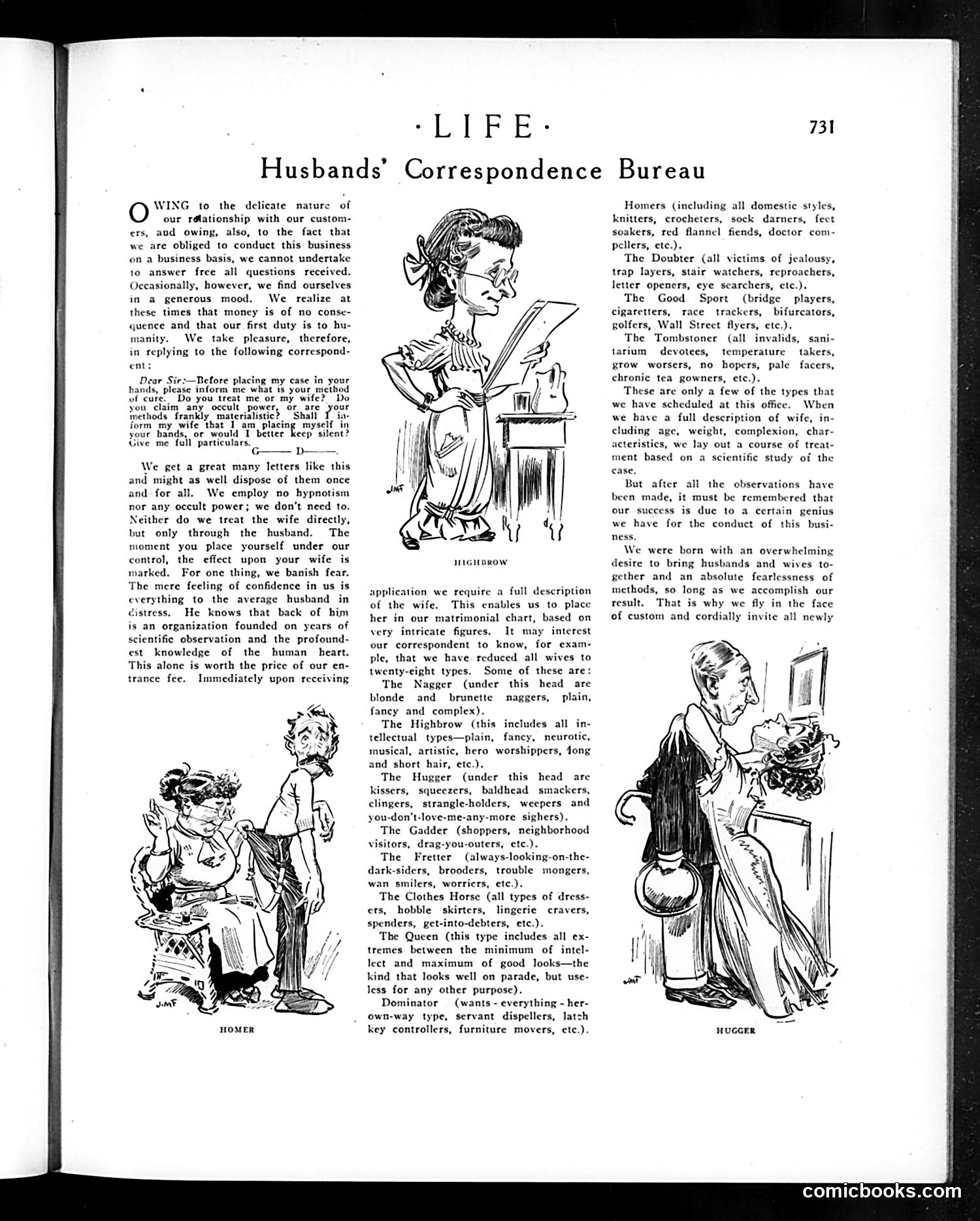
This page satirizes a fictional service claiming to scientifically categorize wives into twenty-eight personality types for husband-wife compatibility. The illustrations show humorous "wife types" with labels like "Homer" (domestic, naive), "Highbrow" (intellectual), and "Hugger" (affectionate/clingy). The satire mocks both pseudoscientific matrimonial matchmaking services popular in the early 20th century and rigid gender stereotyping. By reducing wives to standardized categories based on appearance and behavior, the article absurdly suggests marriages can be "scientifically" managed. The cartoons exaggerate each type's defining characteristics—the Homer as simple homemaker, the Highbrow as pretentious book-reader—to ridicule the premise that complex human personalities fit neat classifications.
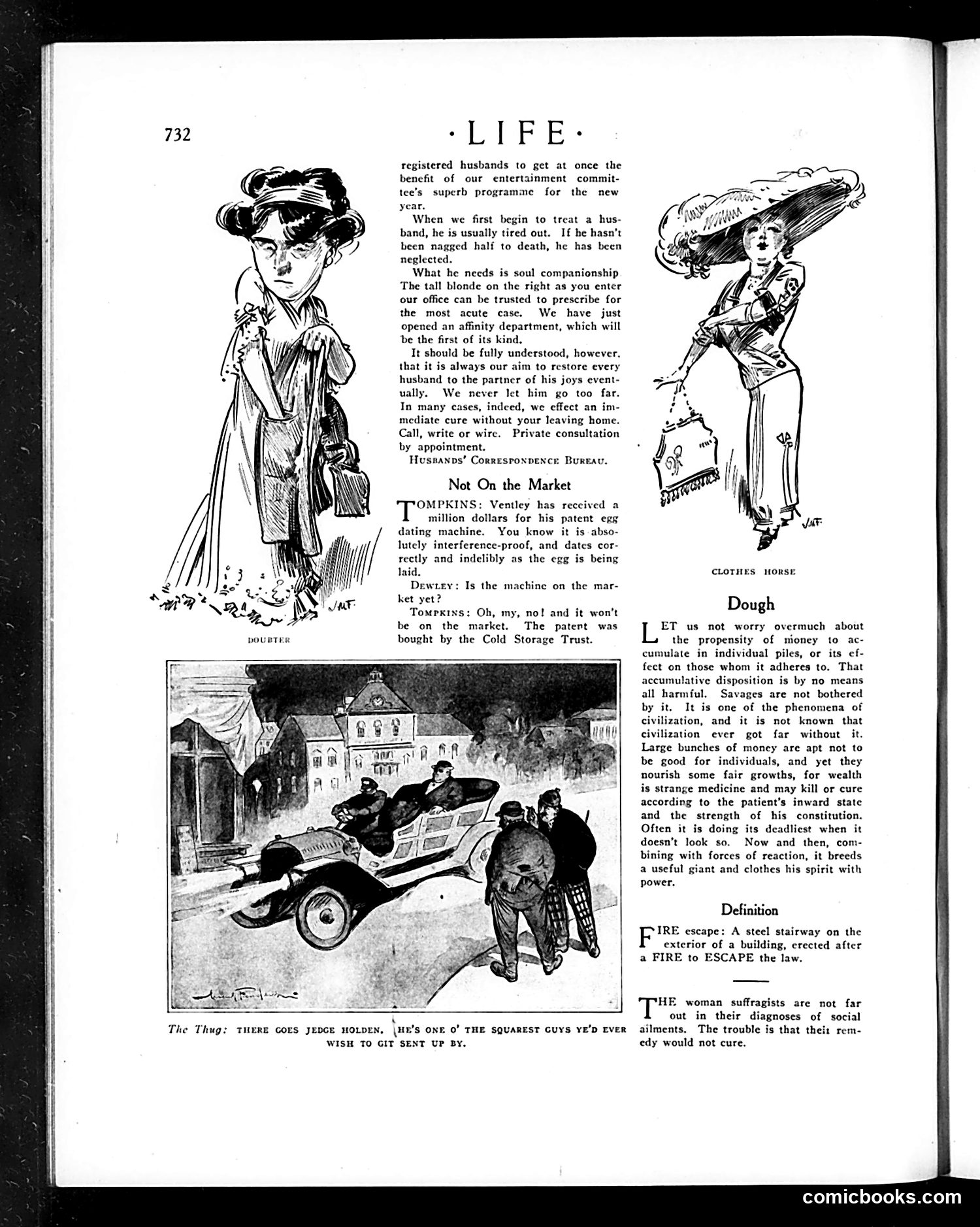
This page contains satirical commentary and illustrations typical of early 20th-century Life magazine. The main cartoon, titled "The Thug," depicts a car crash scene with the caption "There goes Jedge Holden. He's one of the squarest guys ye'd ever wish to git sent up by." The humor appears to mock a judge or authority figure (Jedge Holden) meeting misfortune, suggesting ironic commentary on law enforcement or judicial figures. The page also includes sections on marriage advice ("Husbands' Correspondence Bureau"), a patent discussion about egg-dating machines, and an essay on wealth ("Dough"). The illustrations—showing women in period dress—reflect satirical takes on contemporary social issues of the era, though specific political references aren't entirely clear without additional context.
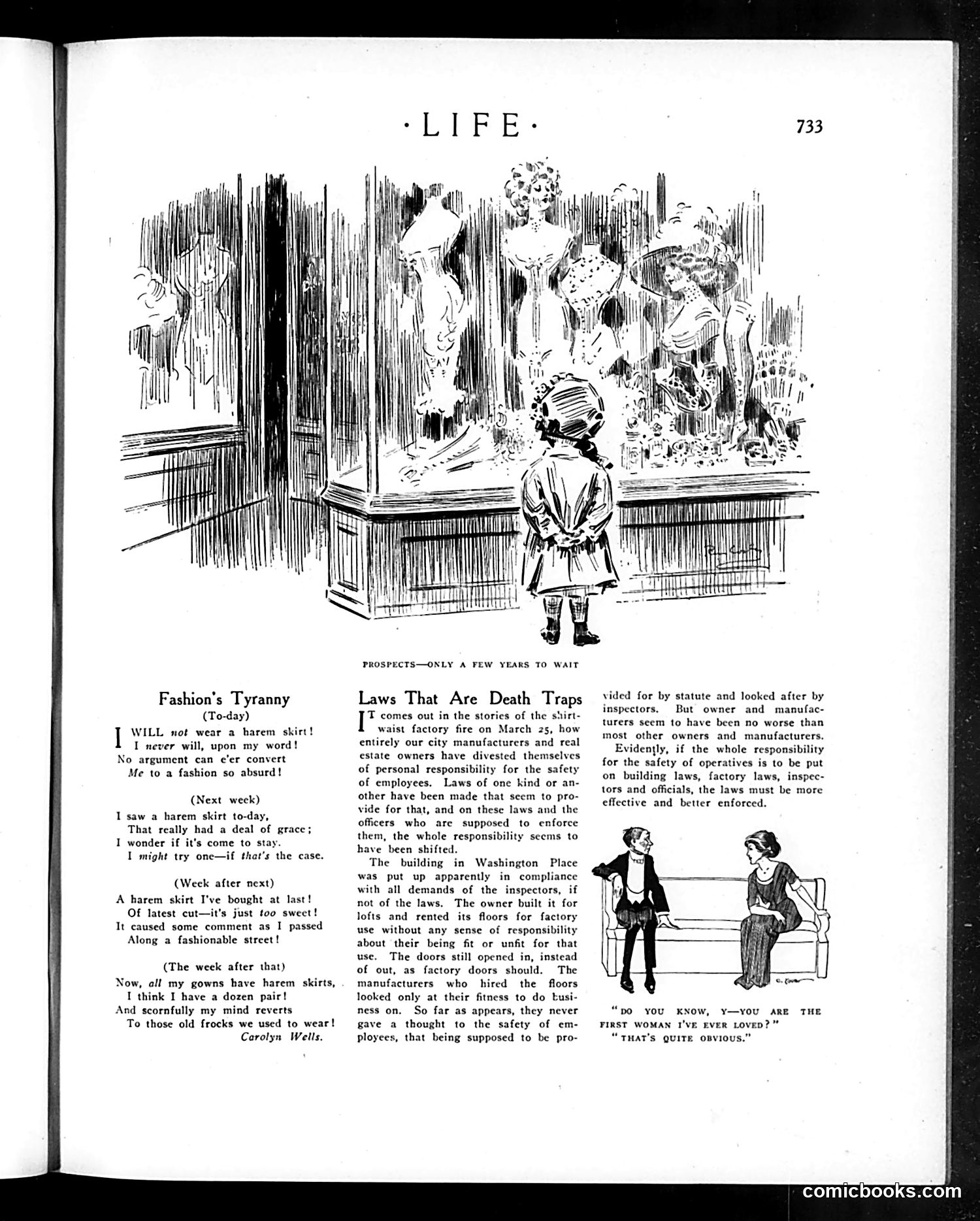
This page satirizes early 20th-century fashion trends and labor safety issues. **"Fashion's Tyranny"** (left column) mocks women's adoption of harem skirts—a controversial garment that restricted movement. The poem tracks a woman's reluctant acceptance of the style over successive weeks, suggesting fashion pressures override personal judgment. Carolyn Wells is credited as the author. **"Laws That Are Death Traps"** (right) discusses factory safety negligence, specifically referencing a March 25 shirtwaist factory fire. The article criticizes owners who ignore safety regulations while inspectors fail to enforce them, describing a building constructed in apparent compliance yet actually unsafe. The illustration shows two women in conversation, with dialogue questioning romantic priorities—likely commenting on distracted attention to serious social issues.
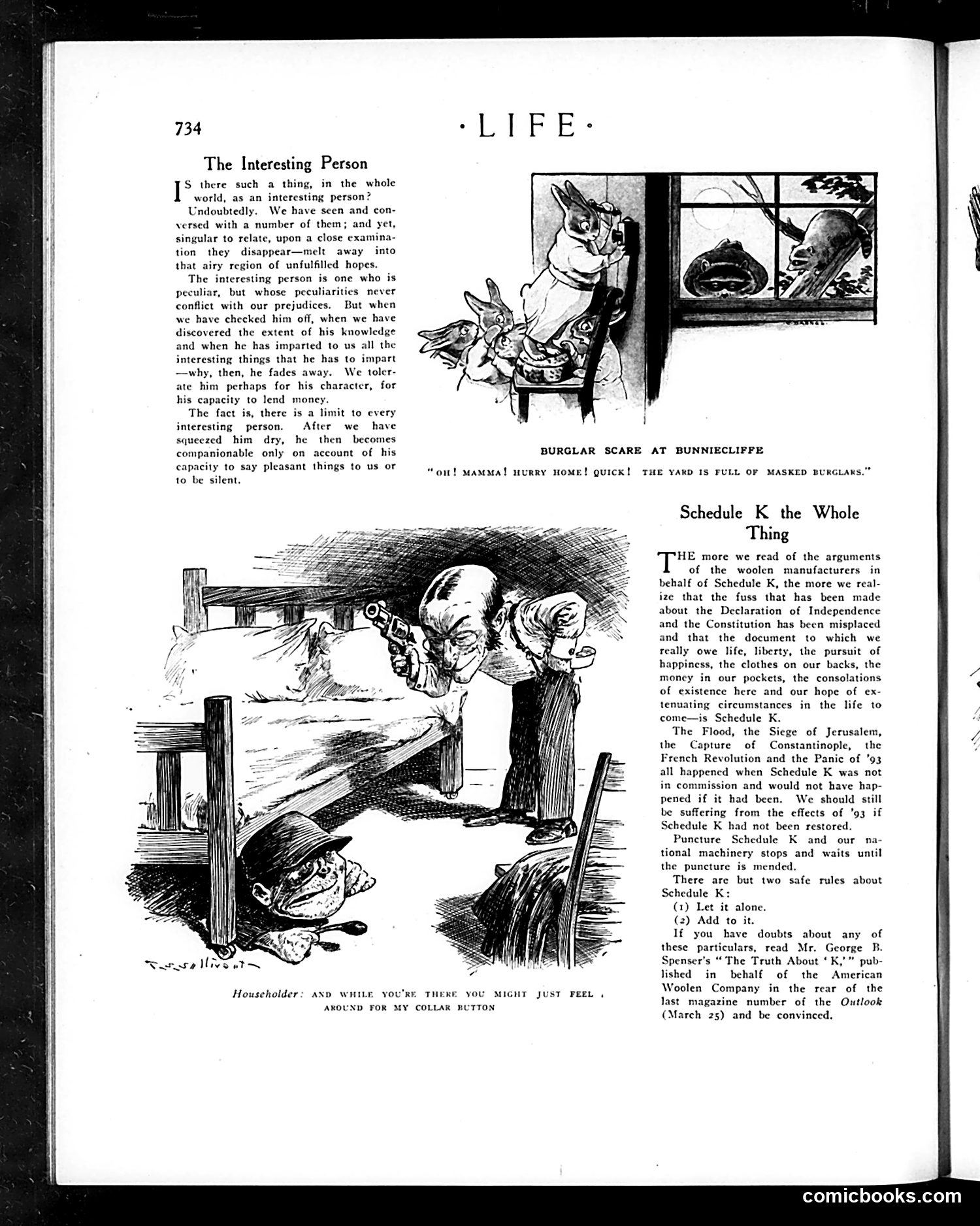
**"The Interesting Person"** (essay with illustration): A philosophical piece mocking how we exhaust people's utility. The cartoon shows a burglar threatening a householder, who casually asks him to find a lost collar button—treating the criminal as a servant. The satire suggests people lose interest once they've extracted all value from someone. **"Schedule K the Whole Thing"** (right column): Sharp mockery of protectionist tariff politics. "Schedule K" refers to wool tariff provisions championed by American textile manufacturers. Life sarcastically suggests this trade regulation is more important than the Declaration of Independence or Constitution, and that historical disasters occurred without it. The piece parodies manufacturers' propaganda (referencing a piece by George B. Spenser in *The Outlook*), implying their claims about Schedule K's national importance are absurdly exaggerated. The two rules—"let it alone" or "add to it"—mock the circular logic of protectionist arguments. Both pieces target self-interest masquerading as importance.
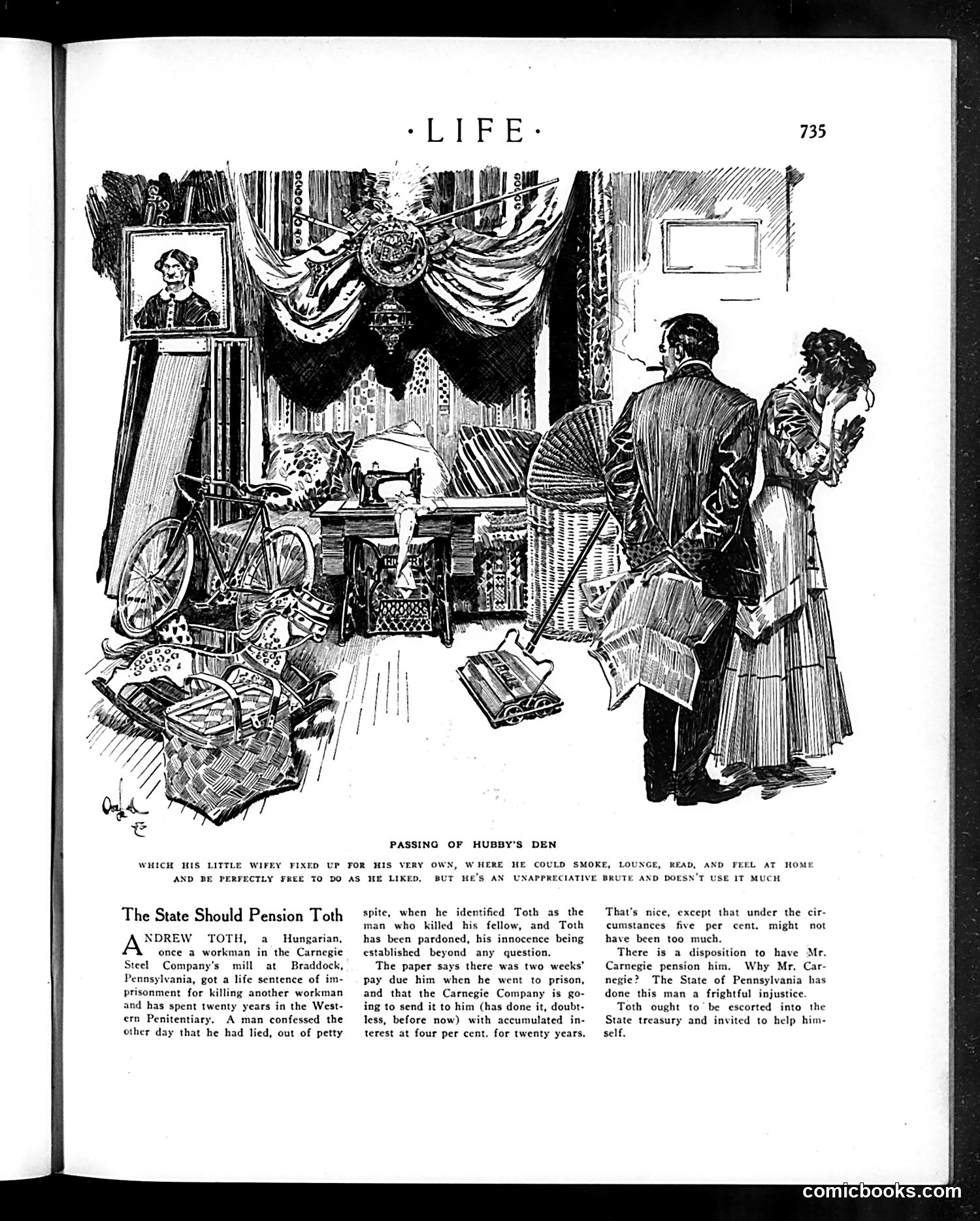
This page contains two separate pieces: **The Main Cartoon** ("Passing of Hubby's Den"): A domestic humor illustration showing a wife proudly displaying a man's decorated study/den she's created for him. The caption jokes that despite her effort to give him a comfortable space to relax, he's an "unappreciative brute" who doesn't use it much—a common marital complaint about husbands ignoring wives' domestic improvements. **The Political Article** ("The State Should Pension Toth"): A serious opinion piece about Andrew Toth, a Hungarian immigrant imprisoned 20 years in Pennsylvania's Western Penitentiary for murder. A witness later confessed to lying; Toth was exonerated. The article argues the *State* of Pennsylvania—not industrialist Andrew Carnegie—should compensate Toth for wrongful imprisonment, since the state caused the injustice. The author sarcastically suggests Toth should be invited to raid the state treasury directly, criticizing both Carnegie's limited gesture and Pennsylvania's inadequate responsibility.
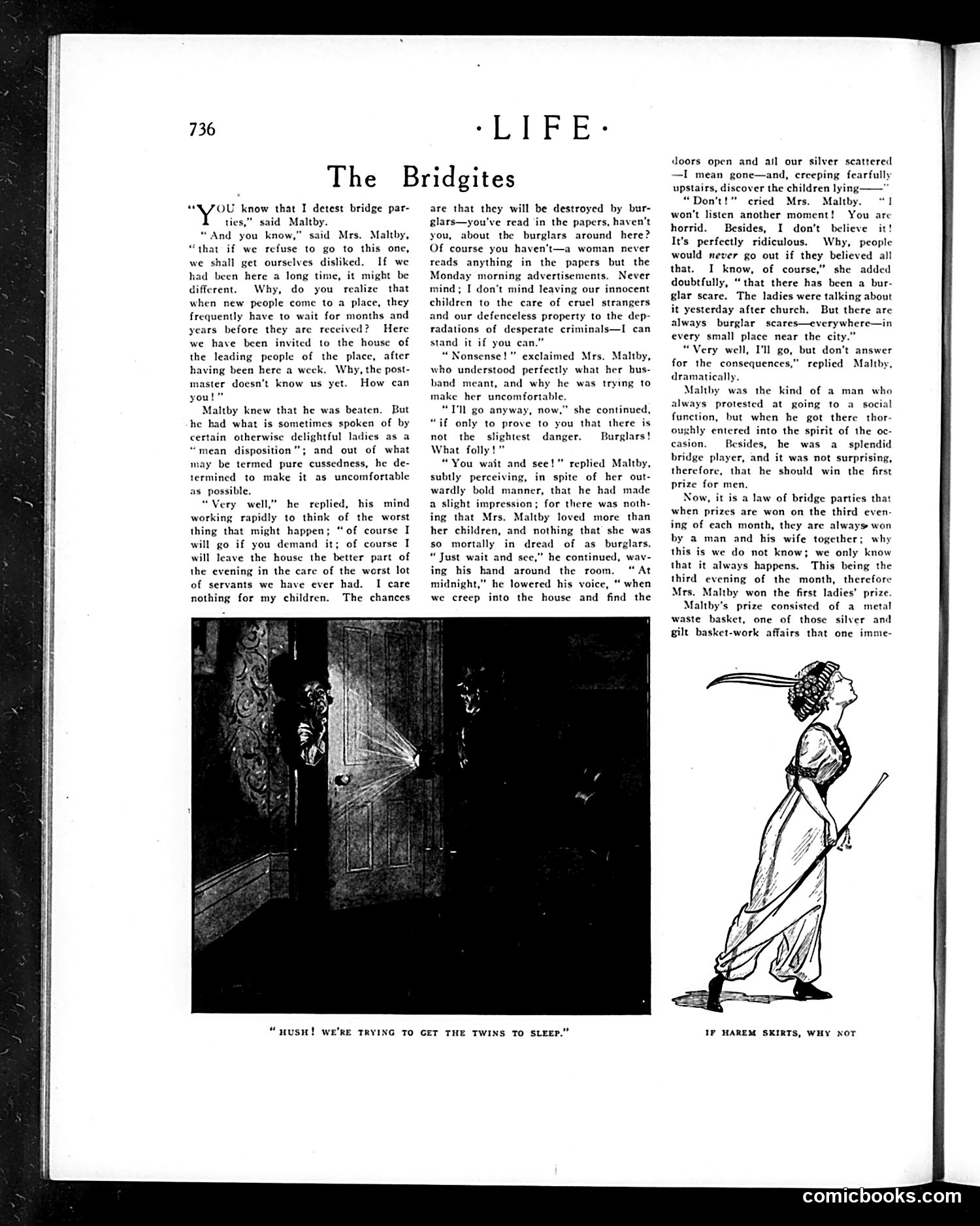
This is a domestic comedy story mocking early 20th-century social anxieties about fitting into new communities. Mr. Maltby protests attending a bridge party (a popular card game social event), reluctantly citing fears of burglars and servant neglect. His wife counters that refusing invitations from "the leading people" risks social ostracism—newcomers must prove themselves worthy. The satire targets both characters: Maltby's theatrical complaints and his wife's social desperation. The accompanying illustrations show the dramatic scene and a woman in elegant dress. The story reveals Maltby eventually attends and wins the bridge tournament prize alongside his wife—suggesting that social conformity, though tedious, has its rewards. The piece satirizes the rigid social hierarchies and anxieties of small-town American life, where acceptance requires careful social performance.
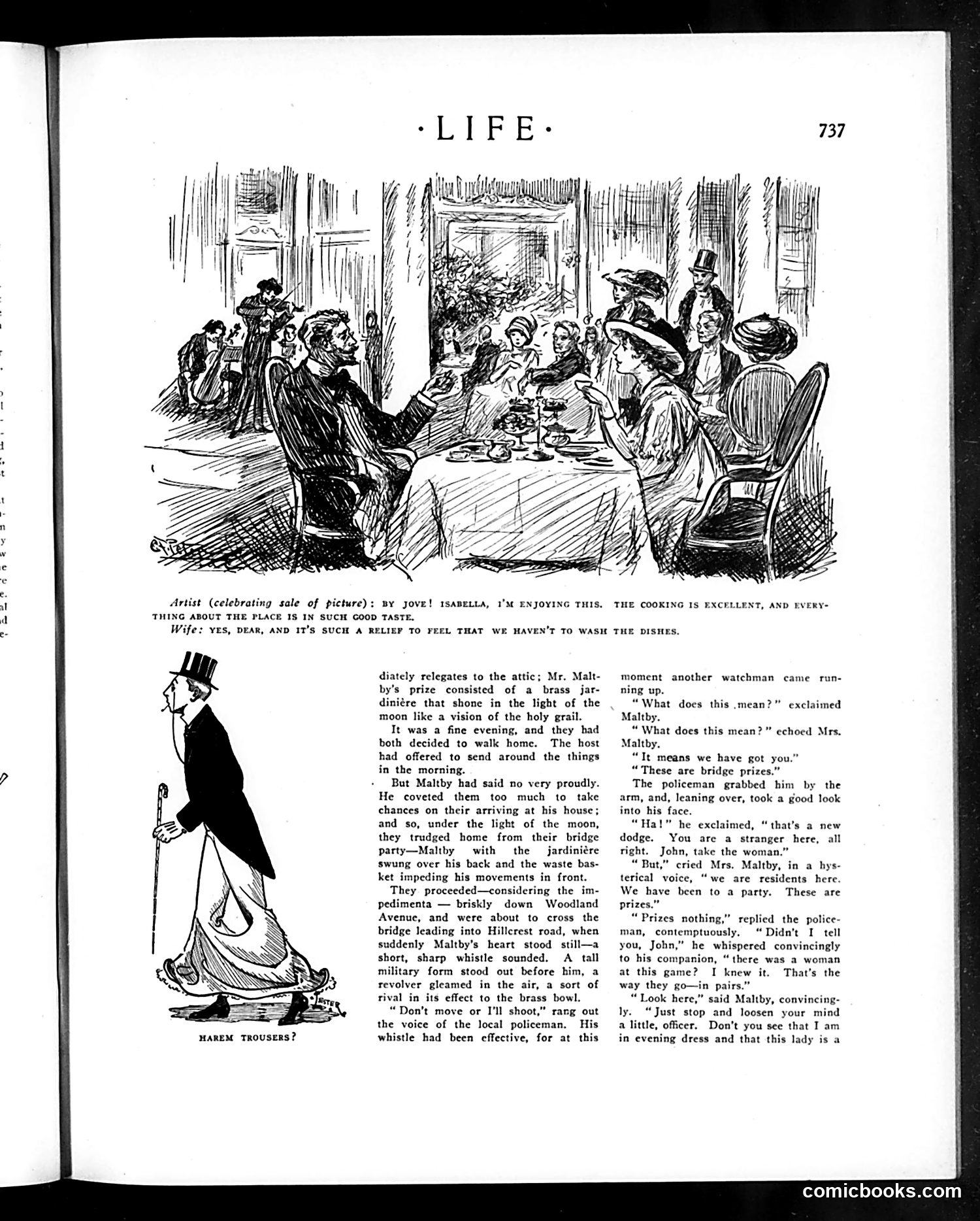
This page contains two satirical pieces about gender roles and social propriety in early 20th-century America. **Top cartoon:** An artist celebrates selling a painting to a wealthy couple. His wife jokes that the best part is not having to wash the dishes—satirizing how domestic labor fell entirely to wives regardless of household finances. **Bottom story:** A married couple leaving a bridge party is arrested by police while carrying home their prize (a brass jardiniére and waste basket). The officers assume they're criminals because a man and woman are out together at night carrying items—a "new dodge" or theft method. The story mocks both the obtuse police and period assumptions about proper behavior: respectable married couples shouldn't be seen carrying household goods through streets at night, and the suspicious pairing of a man and woman suggests illicit activity. The title "Harem Trousers?" (partially visible) appears unrelated or refers to another item on the page. The satire targets rigid Victorian/Edwardian social conventions and the absurdity of policing respectability.
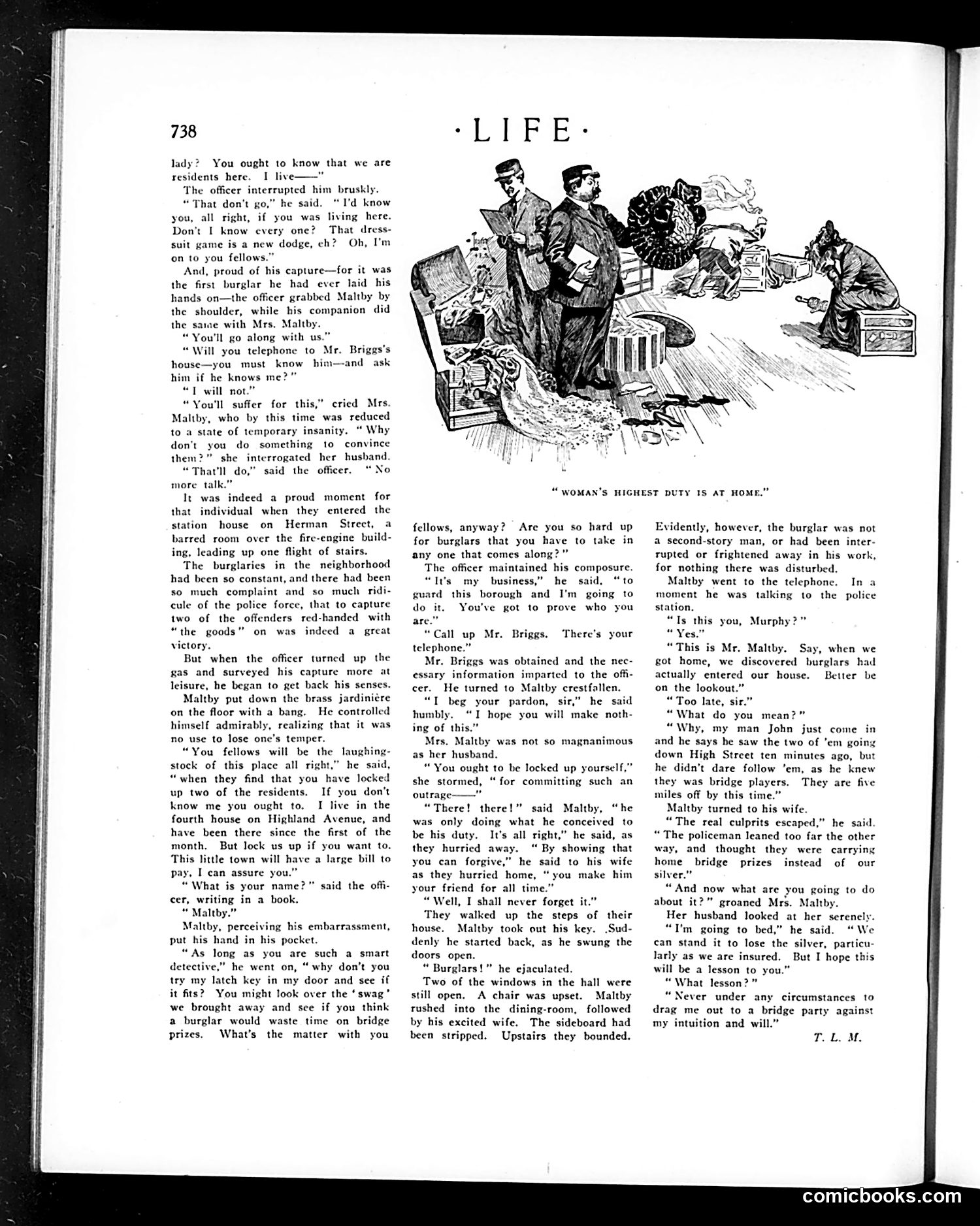
This page satirizes both police incompetence and marital dynamics of the era. The illustration caption—"Woman's Highest Duty Is at Home"—is ironic: it accompanies a story where a zealous officer wrongly arrests Mr. and Mrs. Maltby as burglars despite their protests that they're residents. The satire targets overzealous policing: the officer, proud to finally catch "burglars," ignores Maltby's reasonable explanations and dress-suit alibi. The humor lies in the officer's stubborn refusal to use basic detective work (trying the key, checking the "swag"). The caption's irony emerges when—after Maltby forgives the officer to demonstrate magnanimity to his wife—they discover *actual* burglars have struck their home. The wife's fury at the false arrest versus her husband's Christian forgiveness reflects period attitudes about women's domestic role and emotional volatility, presented here as somewhat absurd given the night's events.
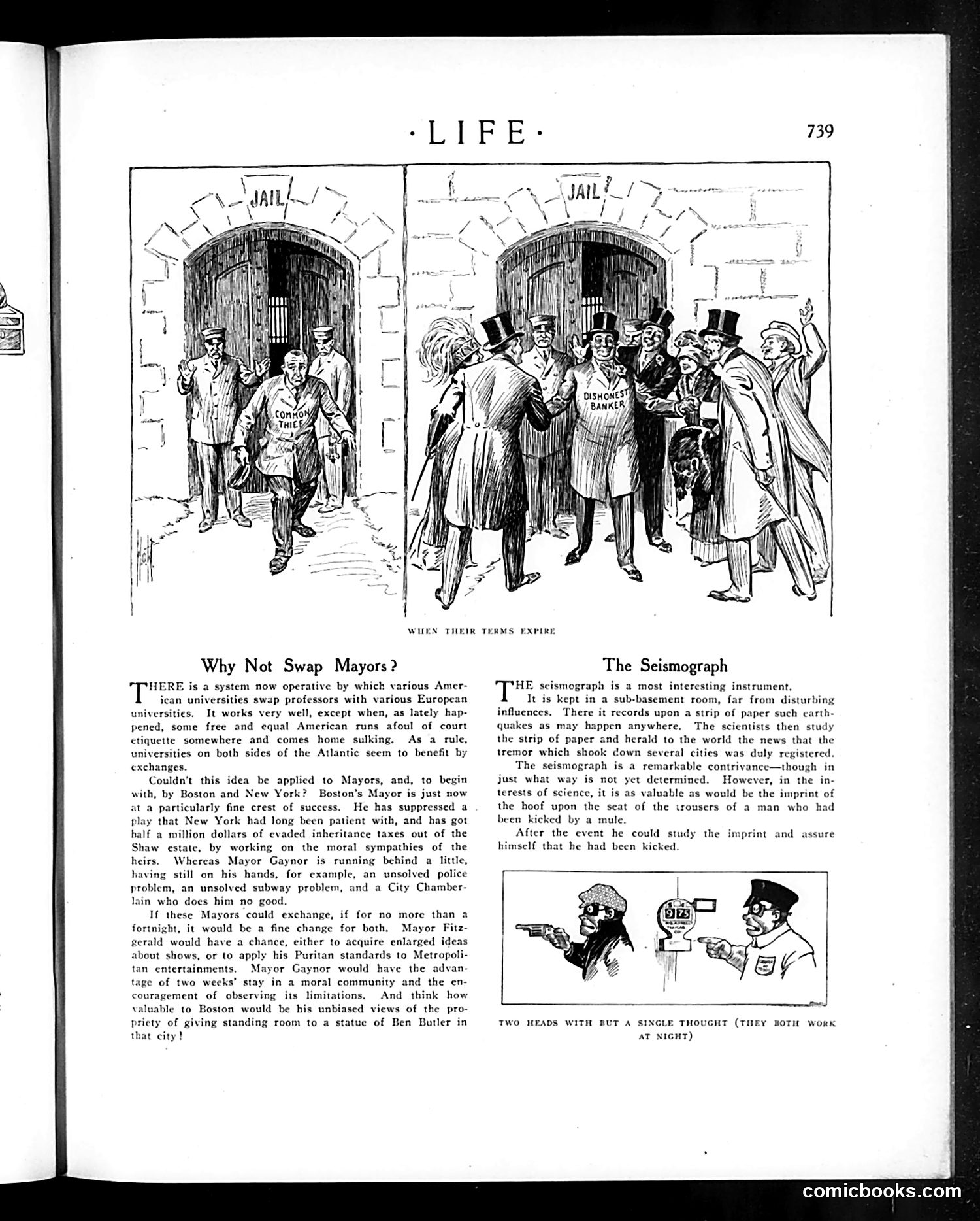
**"Why Not Swap Mayors?"** proposes exchanging Boston Mayor Fitzgerald with New York Mayor Gaynor. The cartoon ridicules both: Fitzgerald is portrayed as puritanical (he suppressed a play and extracted inheritance taxes through moral pressure), while Gaynor struggles with unsolved police and subway problems. The joke suggests each mayor could benefit from the other's environment—Fitzgerald applying his censorious standards to Broadway, Gaynor gaining moral instruction in Boston. The final jab references giving a statue to Ben Butler (a controversial Civil War general), sarcastically asking whether Boston's "propriety" would permit it. **"The Seismograph"** mocks the instrument as useless for practical purposes—comparing it to measuring a mule's hoof-print on someone's trousers after being kicked. Scientists celebrate recording earthquakes *after* cities are destroyed, offering no preventive value. The bottom cartoon "Two Heads with But a Single Thought" appears to satirize night-shift workers (likely police or officials), though specifics are unclear from the image alone.
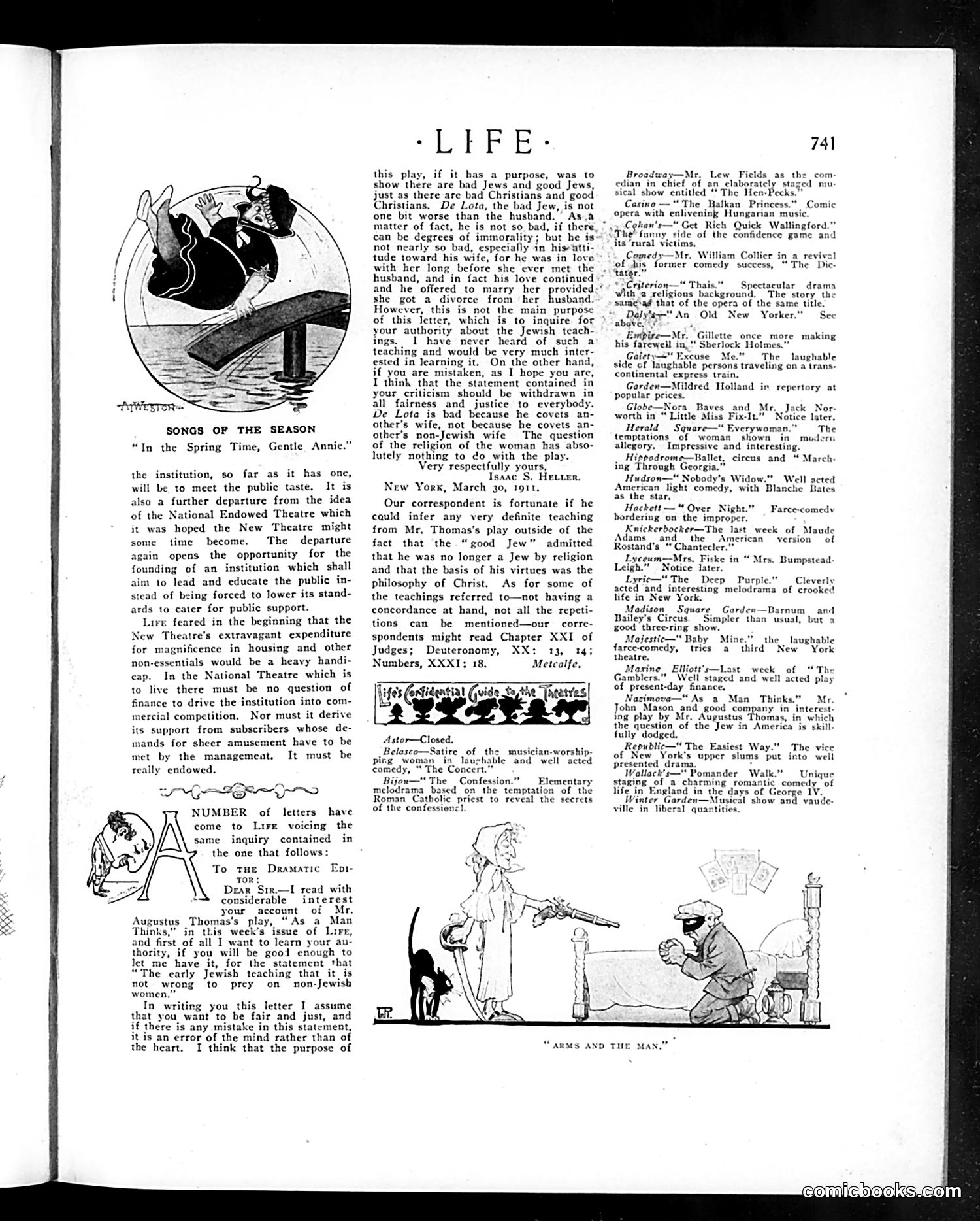
This page primarily features a **letter-to-editor debate** about Augustus Thomas's play "As a Man Thinks." A reader (Isaac S. Heller) challenges *Life*'s dramatic critic for claiming the play endorsed Jewish teachings permitting exploitation of non-Jewish women. Heller argues the play simply contrasts moral and immoral individuals regardless of religion, and demands the critic retract what he calls a misrepresentation. *Life*'s editor responds defensively, citing biblical passages (Judges, Deuteronomy, Numbers) as sources for such teachings—implying anti-Semitic views were indeed embedded in the play's themes. **The satire**: This exchange exposes how contemporary theater reinforced ethnic stereotypes. The editor's citation of scripture to justify anti-Jewish tropes represents *Life*'s willingness to legitimize bigoted characterizations under the guise of dramatic criticism. The controversy reveals early 20th-century tensions around Jewish representation and religious prejudice in American popular culture. The page also includes theater reviews and a cartoon titled "Arms and the Man" (visible at bottom).
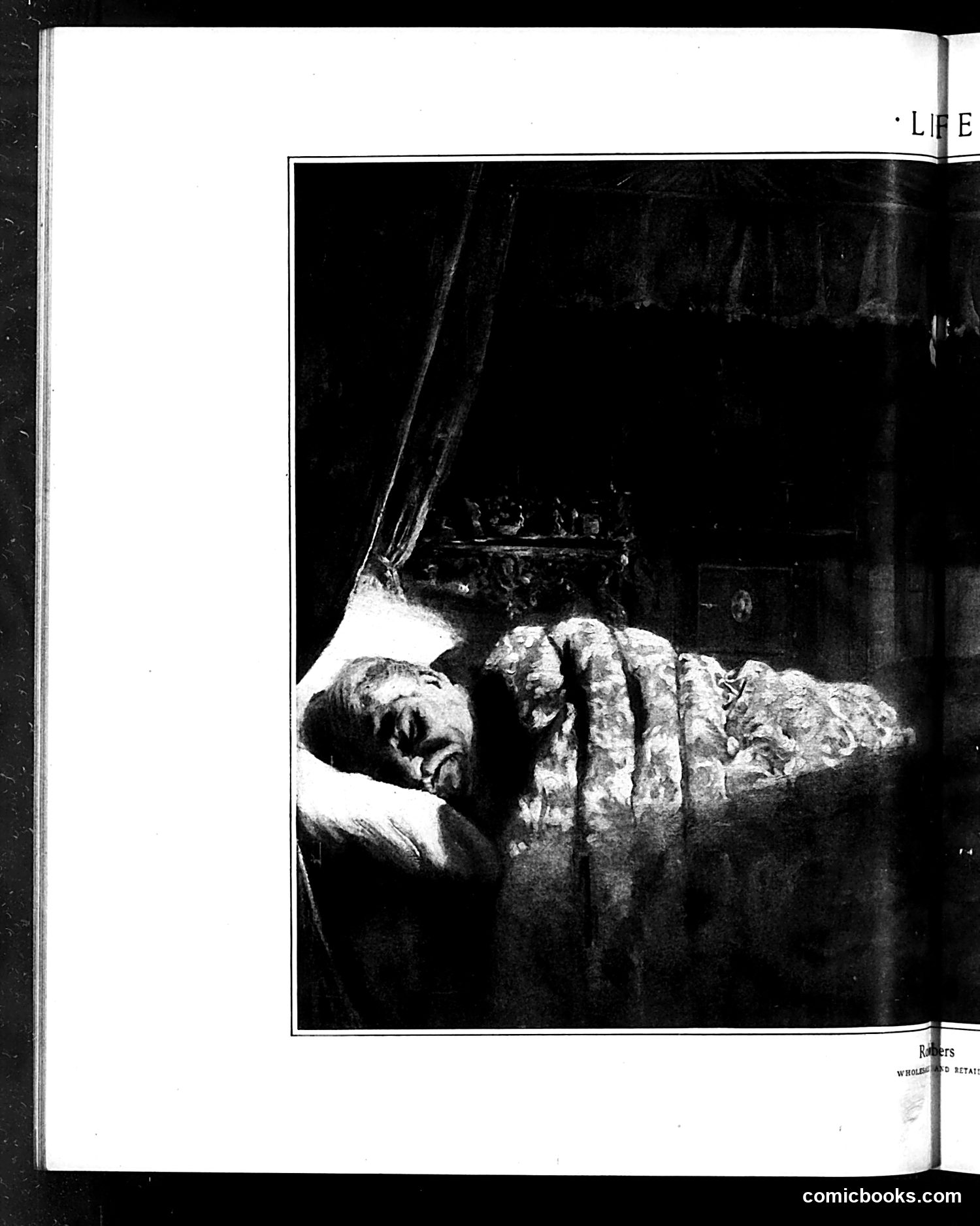
This black and white photograph shows a person lying in bed, appearing ill or deceased, with dramatic lighting from above. The image has a theatrical, staged quality typical of early 20th-century satirical magazine photography. However, **the OCR text provided ("comicbooks.com") appears to be a modern website watermark rather than original page content**, making it impossible to identify the specific political or social commentary this image was meant to convey. Without the original caption or accompanying text from Life magazine, I cannot reliably determine: - Who the figure represents - What event or situation is being satirized - The intended social or political message To properly analyze this as satire, the original article title and caption text would be essential.
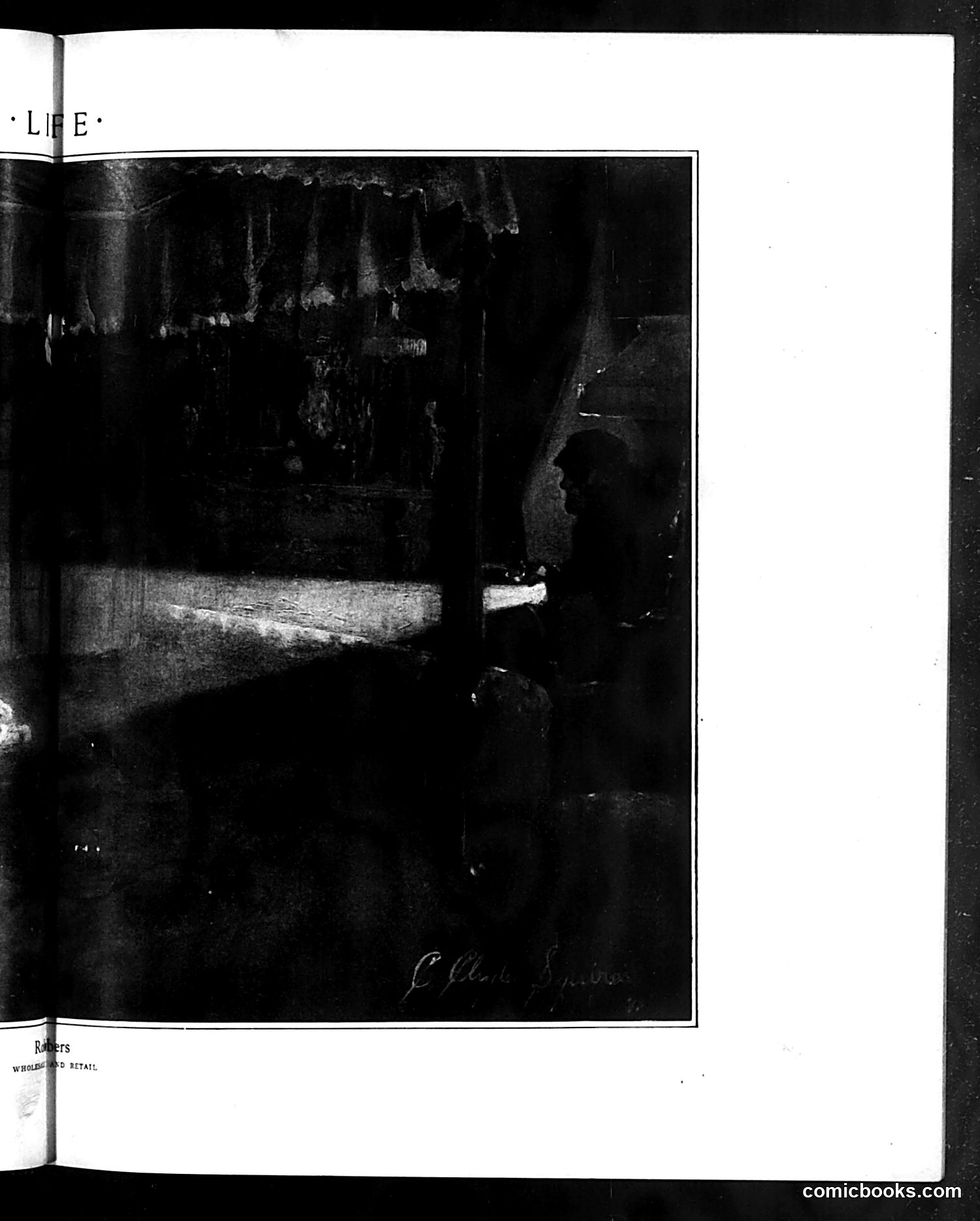
I can see this is a page from *Life* magazine with "LIFE" visible at the top left. However, the image quality is severely degraded—mostly dark/black with minimal visible detail. While there appears to be a photograph or illustration in the center panel, I cannot make out sufficient detail to identify specific figures, captions, or the subject matter clearly enough to explain the cartoon's meaning or political reference to a modern reader. The OCR text provided only shows "comicbooks.com" (a website notation, not historical content), offering no contextual clues about the satire's subject or intent. To provide accurate historical analysis as requested, I would need either a clearer image or additional OCR text from the actual page content.
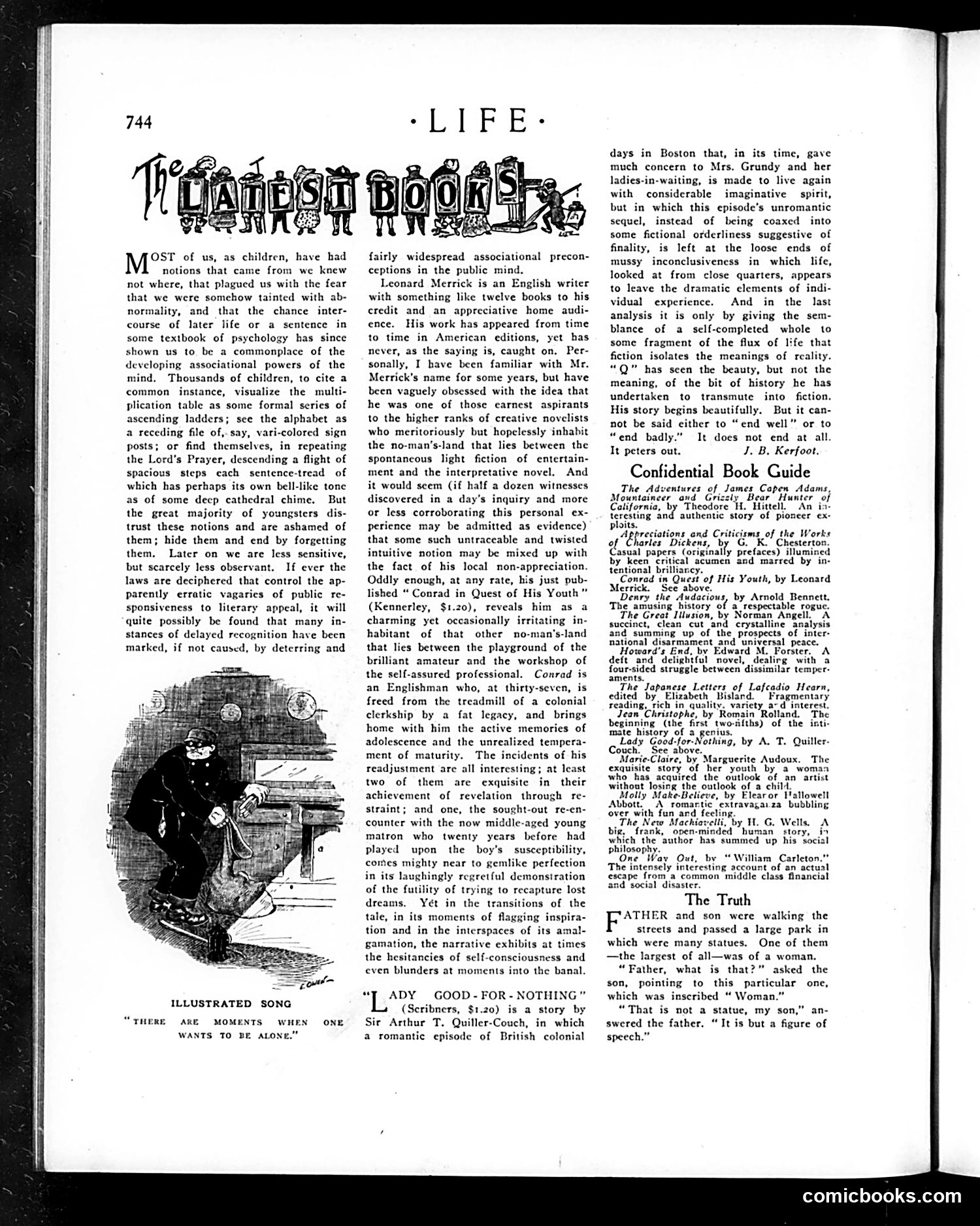
This page from *Life* magazine (a satirical publication, not the photo magazine) contains a critical essay on literature rather than political cartoons. The author discusses Leonard Merrick's novel *Conrad in Quest of His Youth*, noting that despite Merrick's substantial output (twelve books), his work hasn't achieved popular success in America—possibly due to preconceived notions about where his work fits literarily. The accompanying illustration shows a contemplative figure, accompanying a section titled "Illustrated Song: 'There Are Moments When One Wants to Be Alone.'" This appears to be a humorous visual commentary on solitude and introspection. The page also reviews other contemporary books by authors like Sir Arthur Quiller-Couch. Rather than political satire, this represents *Life's* cultural criticism function—using wit to analyze literature and reading habits of the educated American public.
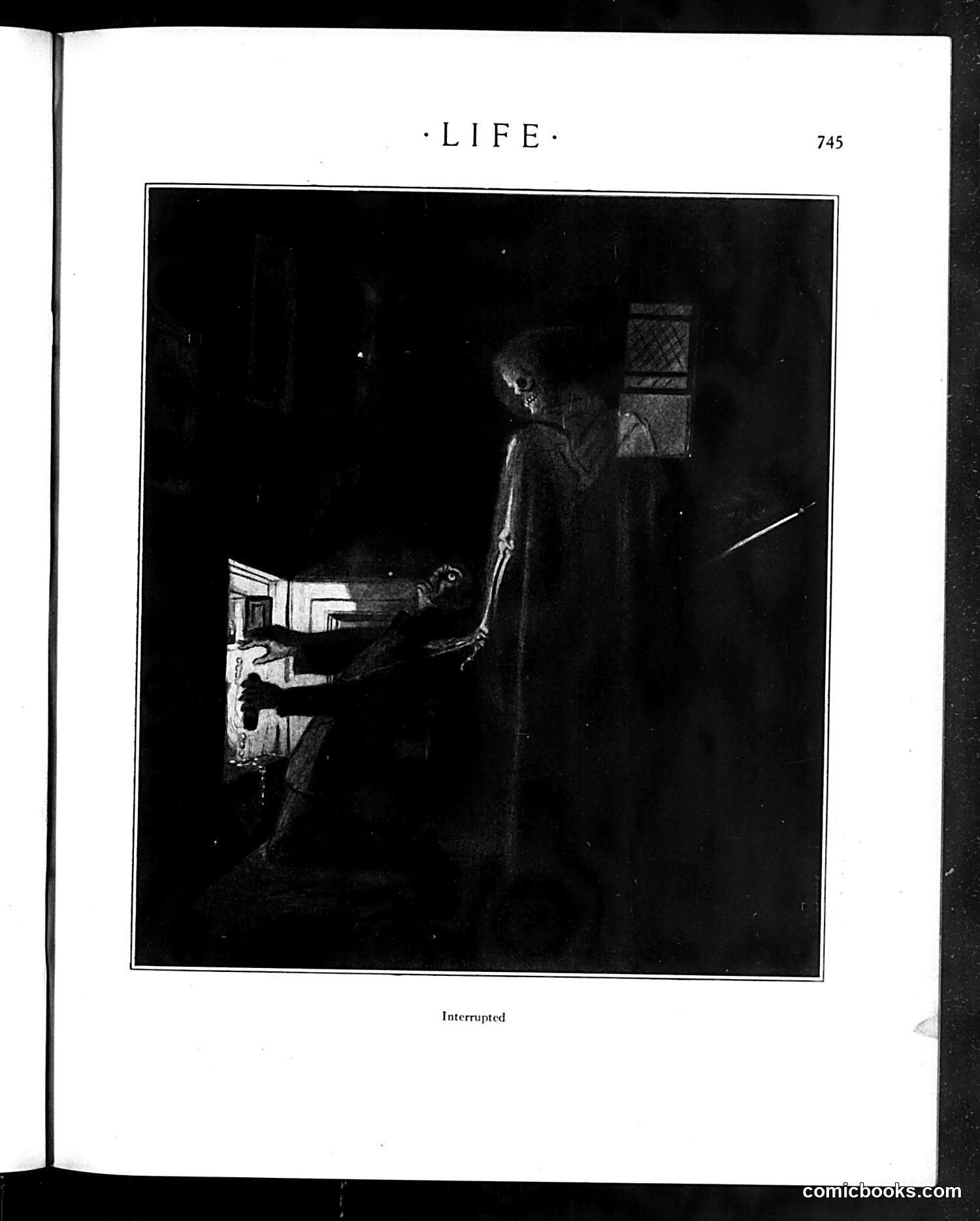
This darkly-lit illustration shows two figures in what appears to be an interior space. One person is seated at what looks like a desk or writing surface (illuminated in the lower left), while another stands nearby in shadow. The title "Interrupted" suggests a moment of disruption or intrusion. Without additional context from Life magazine's publication date or surrounding articles, the specific political or social reference remains unclear. However, the dramatic chiaroscuro lighting and compositional tension suggest this satirizes an awkward or compromising encounter—possibly commenting on espionage, infidelity, dishonest dealings, or unauthorized activity being discovered. The quality of the image and artistic style indicate this is serious satirical commentary rather than lighthearted humor.
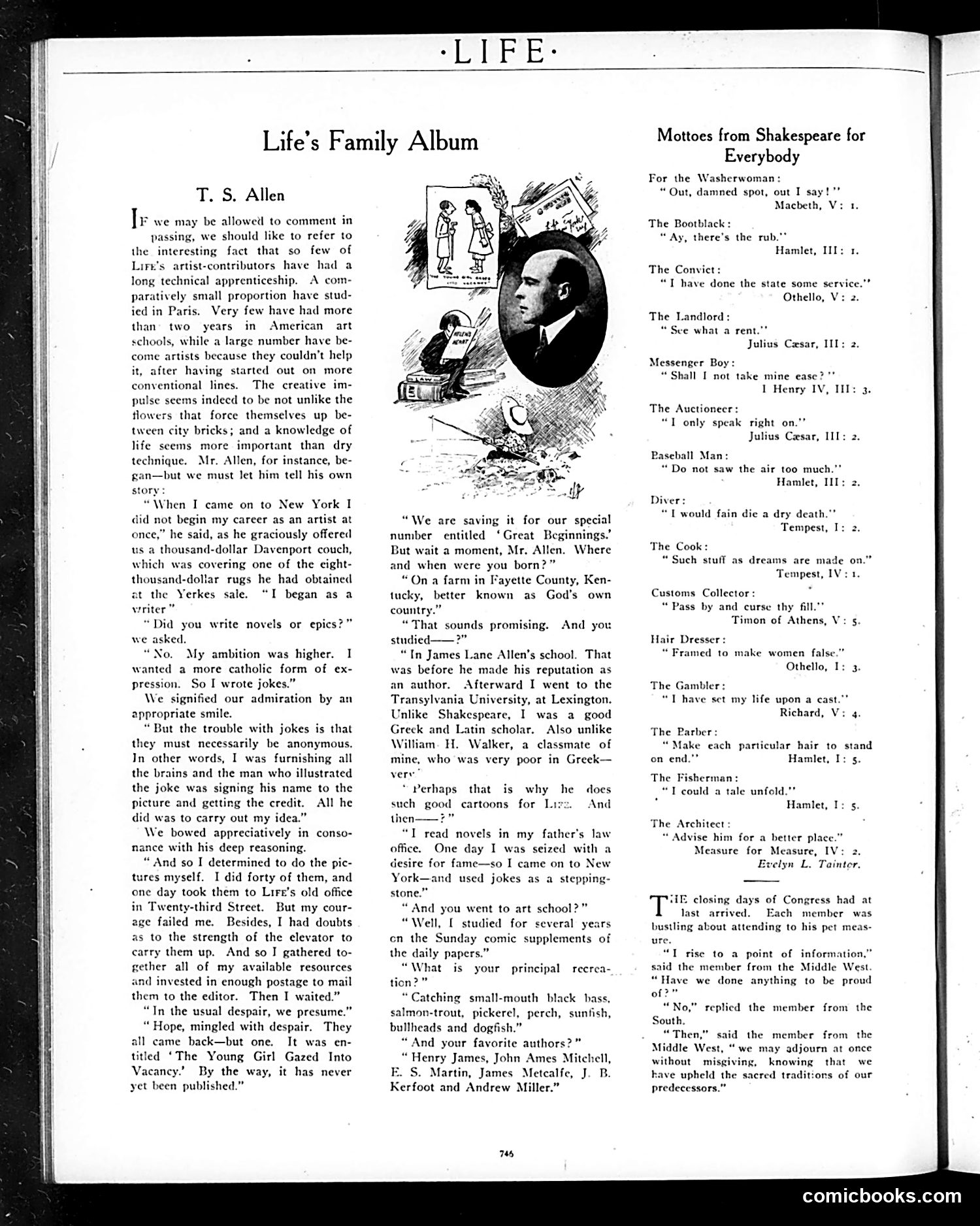
This page contains a humorous interview with T.S. Allen, a Life magazine artist-contributor, presented as "Life's Family Album." ## The Satire The joke centers on Allen's self-aggrandizing account of his career. He claims he wrote jokes for cartoonists but the illustrators received credit—a transparent exaggeration designed to inflate his own importance. The interviewer's repeated "appreciative" bows mock Allen's grandiosity. ## Key Comedic Elements - Allen describes his modest beginnings (Kentucky farm, self-taught artist) while surrounded by expensive possessions (thousand-dollar couch, Yerkes sale rugs)—highlighting pretension - He credits his success to mailing unsolicited cartoons, one of which Life allegedly never published - The right column offers Shakespeare quotes matched to common workers ("For the Washerwoman," "The Bootblack"), a separate satirical feature mocking how high culture gets applied to lowly professions The overall effect gently ridicules artistic vanity and the gap between humble origins and assumed sophistication—typical of Life's satirical humor targeting the American middle class.
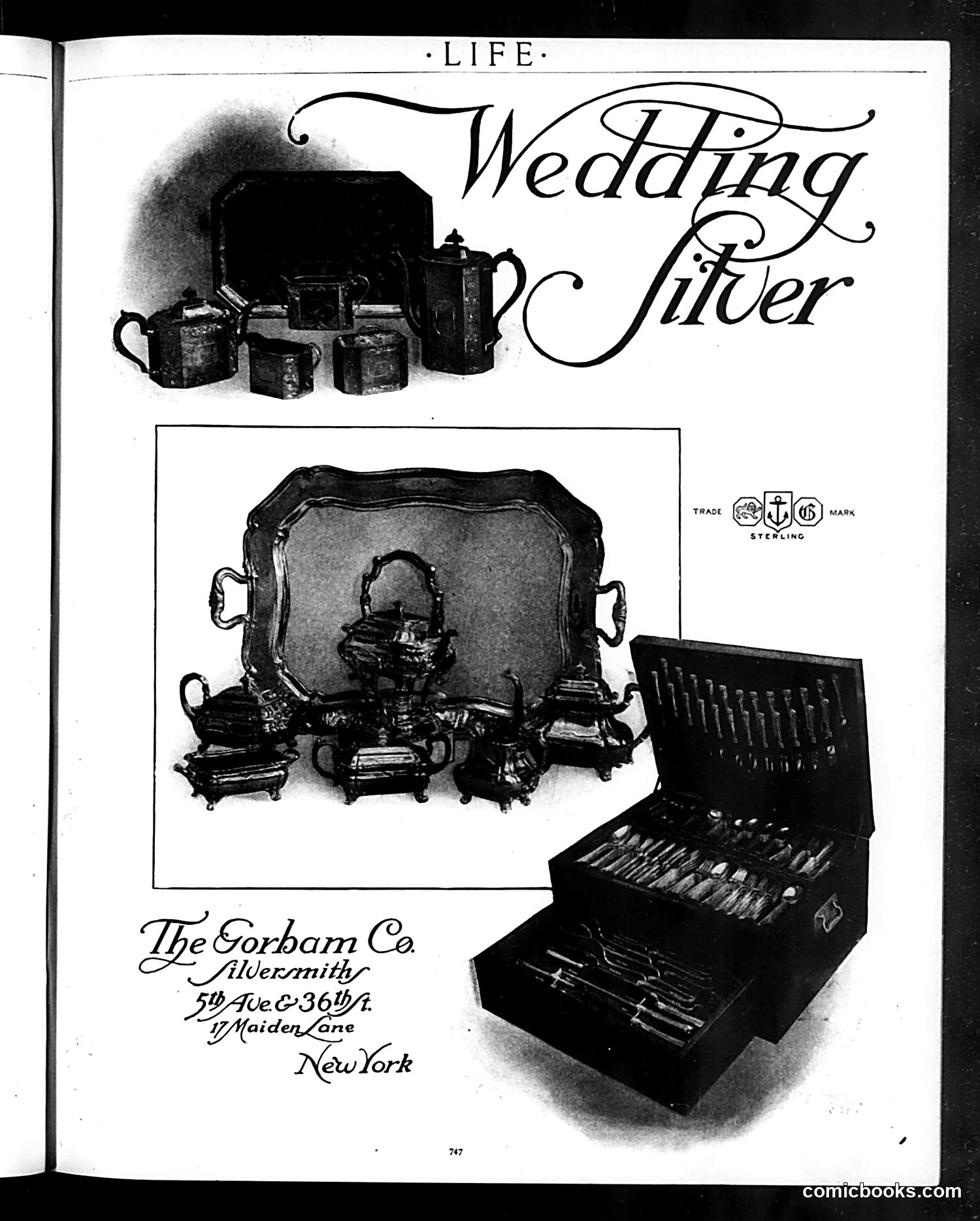
This page is primarily an **advertisement**, not a political cartoon. It promotes "Wedding Silver" products from The Gorham Co., a silversmiths located at 5th Ave & 36th Street in New York. The ad displays sterling silver tableware and serving pieces—teapots, trays, utensils, and a complete flatware set in an open case. The ornate decorative style and emphasis on "STERLING" mark indicates these are high-end luxury goods. The purpose is straightforward marketing targeting wedding gift-givers: the company is positioning its silverware as an appropriate, prestigious choice for newlyweds. No satire or political content is present; this is a straightforward commercial advertisement from *Life* magazine's advertising pages.
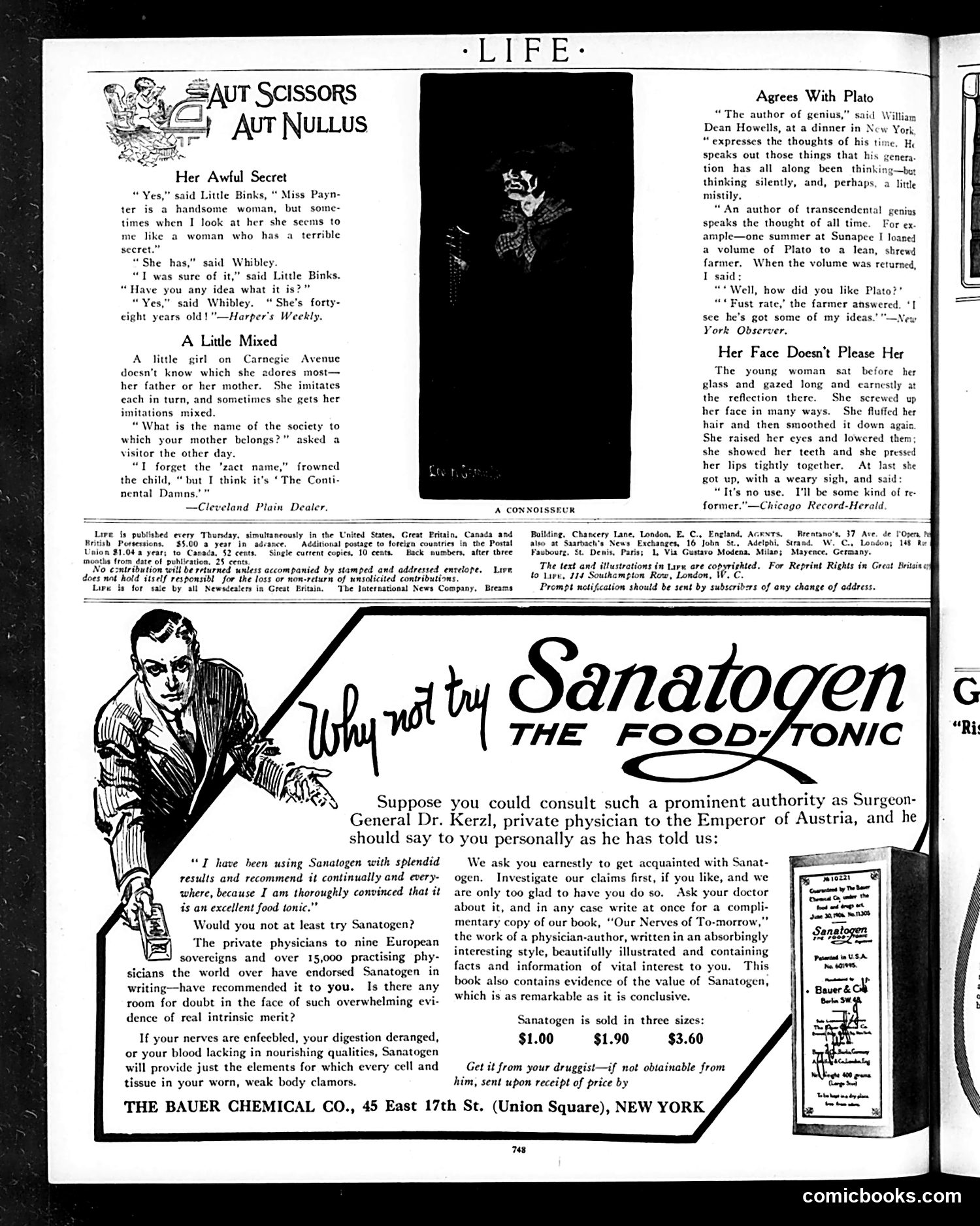
This page contains several satirical short pieces typical of early-20th-century *Life* magazine humor, plus a substantial advertisement. **The cartoons/jokes:** - "Her Awful Secret": A woman appears sophisticated but is actually 48 years old—the joke relies on period anxiety about aging and women's appearance. - "A Little Mixed": A child confuses her mother's club name ("Continental Dames" becomes "Continental Damns")—innocent malapropism humor. - "Her Face Doesn't Please Her": A woman scrutinizes her reflection obsessively, dissatisfied with her appearance. - A literary anecdote attributed to William Dean Howells about lending Plato to a farmer. **The advertisement** dominates the lower half: Sanatogen, a "food tonic," invokes Surgeon-General Dr. Kerzl of Austria as endorsement. This exploits early-1900s trust in medical authority and patent medicines (many unregulated, containing dubious ingredients). The ad promises to cure "enfebled nerves" and weak constitutions—common marketing language for tonics of this era. **Overall context:** The page reflects period preoccupations with women's looks, class-based humor, and faith in commercial "remedies" for modern ailments.
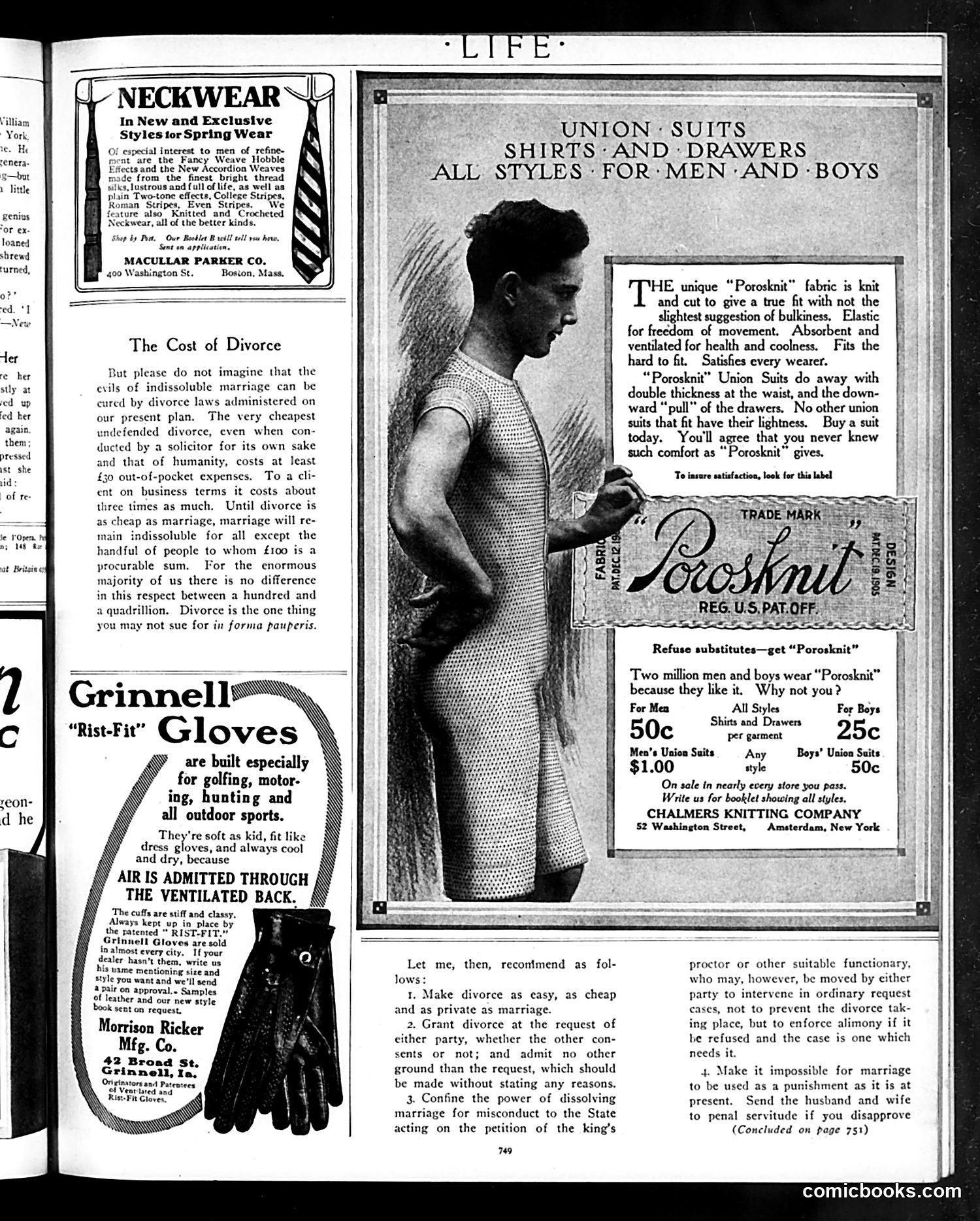
This page contains primarily **advertisements and opinion content**, not political cartoons. The main article, "The Cost of Divorce," argues for divorce reform. The author contends that while divorce laws exist, they remain practically inaccessible to ordinary people due to high legal costs (£30 minimum). He proposes making divorce as "easy, cheap and private as marriage"—radical for the era, when divorce was stigmatized and expensive. The four recommendations advocate: (1) streamlined, affordable divorce; (2) no-fault divorce; (3) restricting misconduct-based dissolution to the state; (4) preventing marriage from being weaponized as punishment. The surrounding **advertisements** promote menswear (neckwear, gloves, union suits) typical of early 20th-century catalogues—unremarkable today except as historical marketing artifacts. The page reflects early progressive thinking on marriage law, though divorce reform wouldn't gain mainstream acceptance for decades.
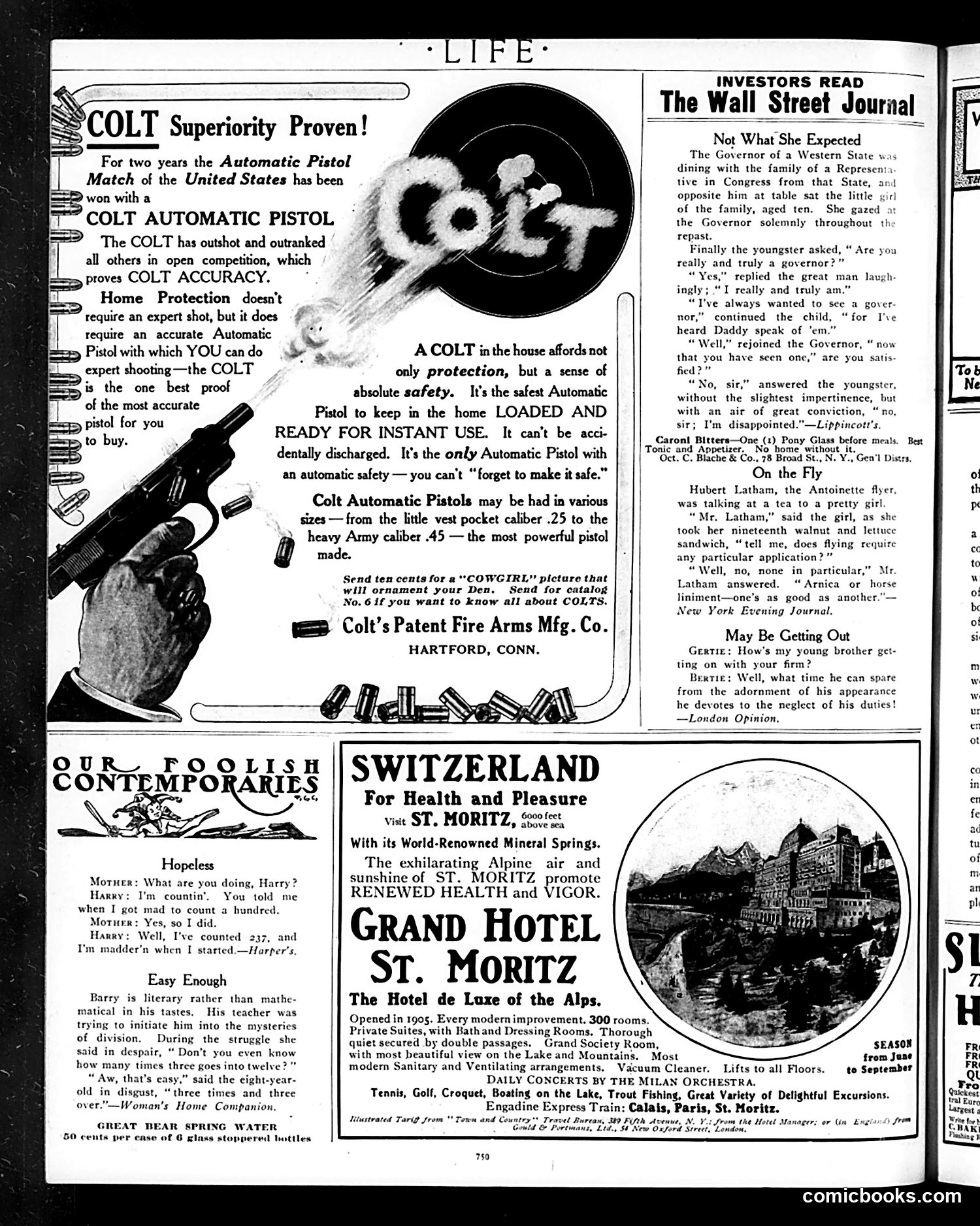
This page is primarily **advertising with minimal satire**. The dominant content includes: 1. **Colt Automatic Pistol advertisement** (left): Markets home defense firearms, emphasizing accuracy and an automatic safety feature. Notable is the "Cowgirl" incentive—reflecting early 1900s marketing tactics. 2. **"Our Foolish Contemporaries"** (bottom left): A humor section with three brief jokes poking fun at everyday situations—a child's counting during anger, a boy's mathematical confusion, and a question about a young man's work ethic. These are gentle domestic humor pieces, not political satire. 3. **Travel/luxury advertisements**: The Grand Hotel St. Moritz and mineral water ads promote Alpine tourism and health products. 4. **Right column anecdotes**: Humorous short stories about a governor disappointing a child's expectations and an aviator's casual attitude toward flying preparations. The page reflects **early 1900s consumer culture and advertising practices** rather than political cartooning. There is no identifiable political satire or caricature of public figures present.
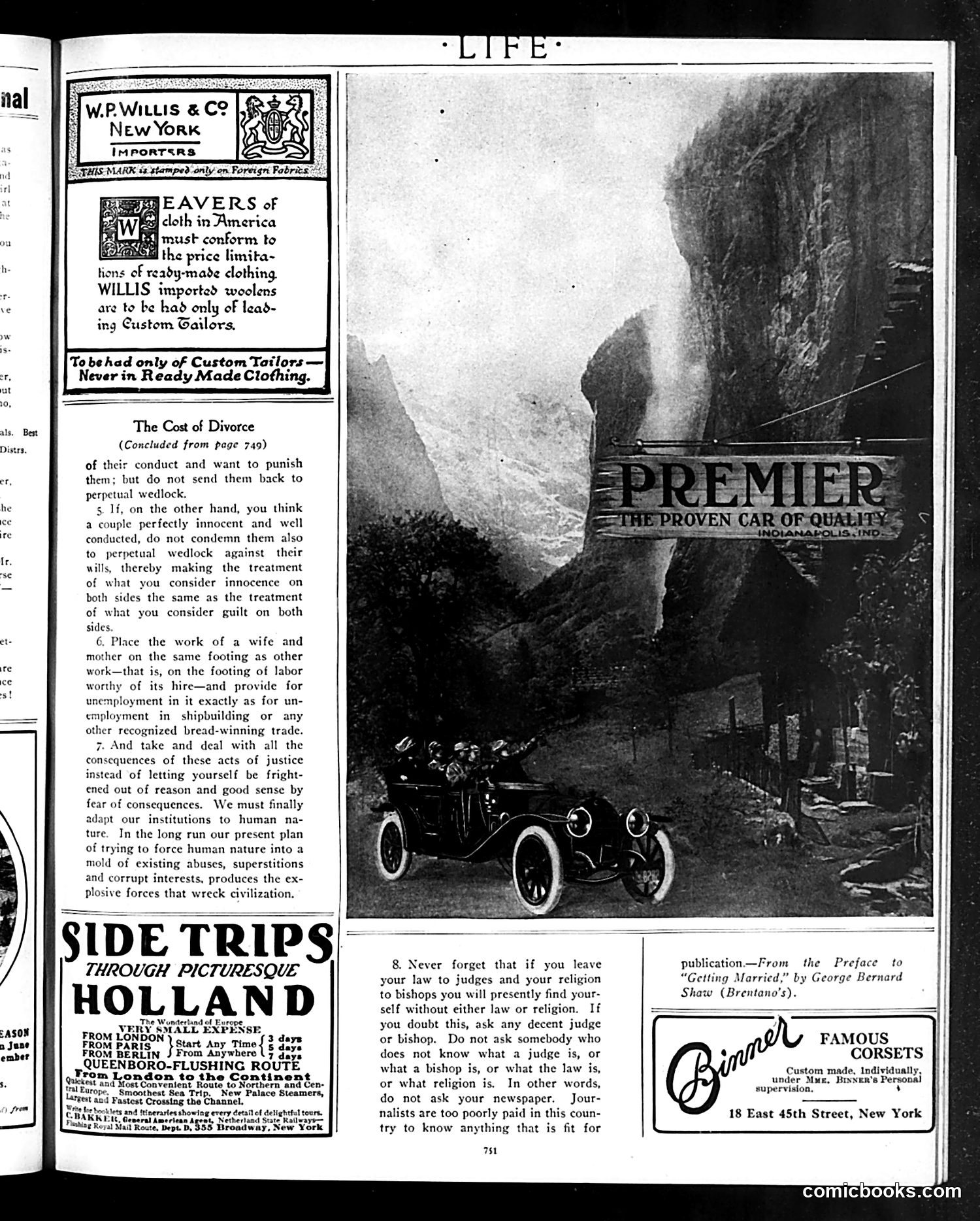
This page is primarily **advertising and editorial content**, not political satire. The main elements are: **Large Image (Right):** A Premier automobile advertisement showing a car navigating a dramatic mountain cliff road, emphasizing the vehicle's reliability and quality on treacherous terrain. The tagline reads "The Proven Car of Quality." **Left Column:** A continuation of an article titled "The Cost of Divorce," which appears to be excerpts from George Bernard Shaw's preface to his play "Getting Married." Shaw argues for reforming divorce and marriage laws, advocating for women's economic independence and criticizing institutions that force people into unhappy situations. **Advertisements:** Include W.P. Willis & Co. (imported woolens for custom tailors), travel packages through Holland, and Brimer corsets. The page represents typical early 20th-century magazine content mixing intellectual commentary (Shaw's progressive social views on marriage and women's labor) with commercial advertising, reflecting the magazine's satirical but advertising-dependent business model.
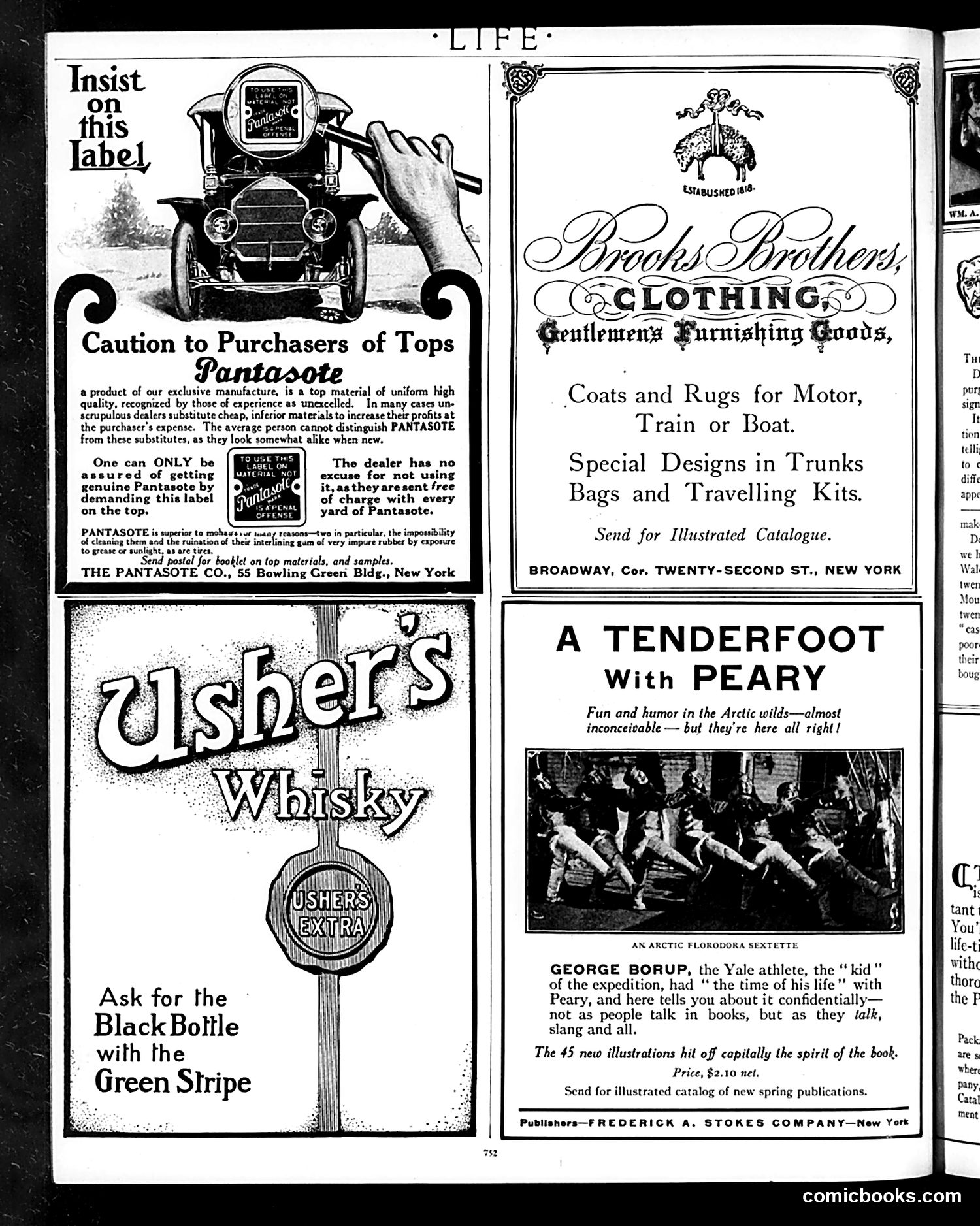
This page is primarily **advertising**, not political satire. It contains four distinct ads: 1. **Pantasote tops** (car convertible tops): A cautionary ad warning buyers to verify the genuine label, as unscrupulous dealers substitute cheap materials. This reflects early 1900s consumer fraud concerns. 2. **Brooks Brothers clothing**: A straightforward luxury goods advertisement for coats, rugs, and travel items. 3. **Usher's Whisky**: A simple product ad emphasizing the "black bottle with green stripe." 4. **"A Tenderfoot with Peary"**: A book advertisement featuring **George Borup**, a Yale athlete who accompanied Arctic explorer **Robert Peary** (likely on his 1909 North Pole expedition). The ad emphasizes the book's informal, colloquial tone and includes 45 illustrations. The "Arctic Florodora Sextette" photo caption appears to be humorous wordplay. The page reflects early 20th-century advertising and publishing rather than editorial satire.
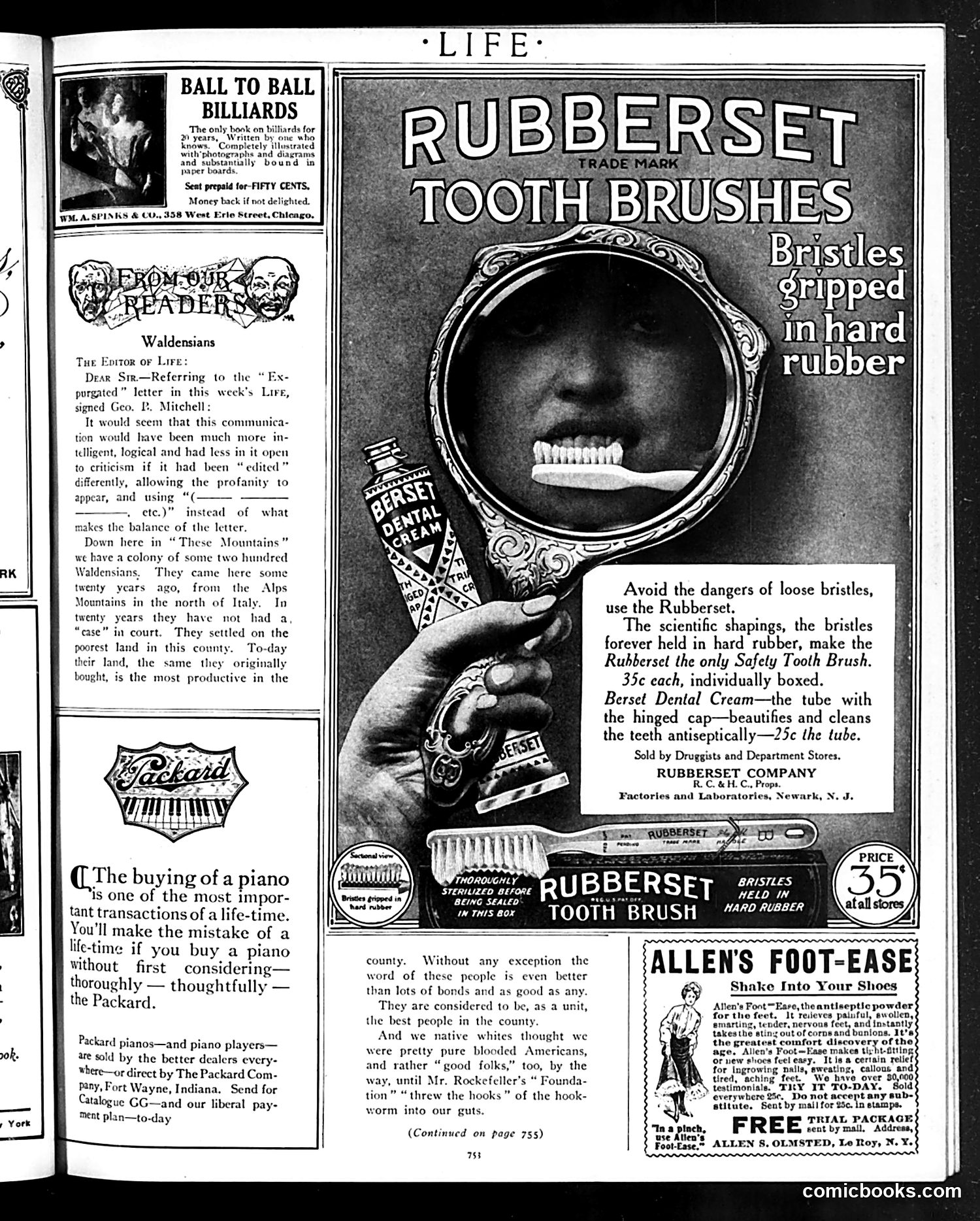
This page is primarily **advertising**, not satire or political commentary. The main content consists of four product advertisements: 1. **Ball to Ball Billiards** — a how-to book on billiards technique 2. **Rubberset Tooth Brushes** — the dominant advertisement, emphasizing safety bristles held in hard rubber to prevent loose bristles from falling out 3. **Packard Pianos** — promoting careful piano purchasing decisions 4. **Allen's Foot-Ease** — an antiseptic powder for foot problems The only editorial content is a "From Our Reader" letter about **Waldensians** — Italian Protestant immigrants living in American mountains. The writer praises their integrity and productivity, then references Rockefeller's foundation work combating hookworm disease in the rural South, suggesting these communities faced serious public health challenges. The page reflects early 20th-century consumer marketing and social reform awareness rather than political satire.
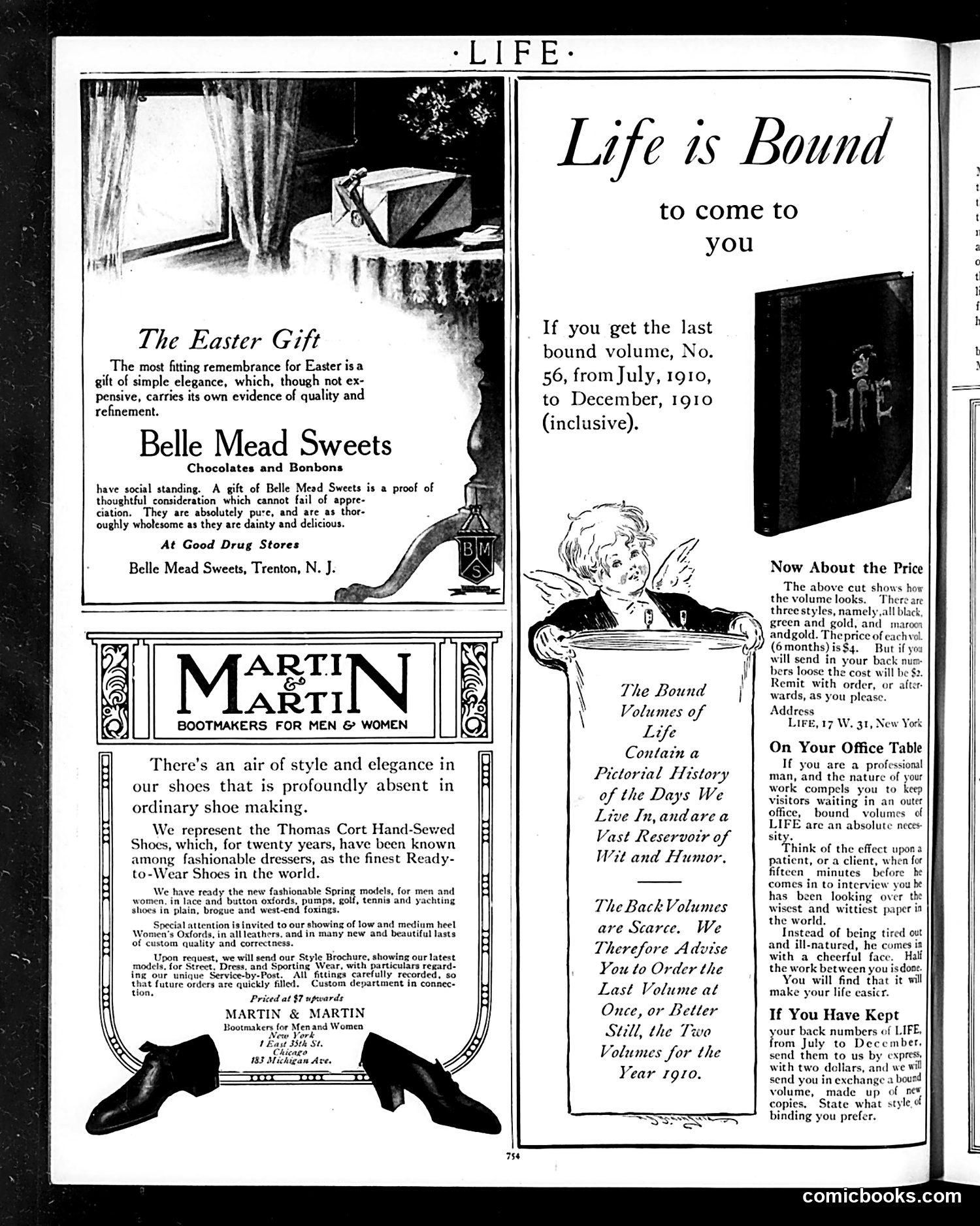
This page is primarily **advertising**, not satire or political commentary. It contains three distinct advertisements: 1. **Belle Mead Sweets** (top left): Easter gift advertisement for chocolates, emphasizing their "social standing" and purity—typical early 1900s marketing that framed luxury goods as markers of refined taste. 2. **Martin & Martin Bootmakers** (center): Shoe company advertisement highlighting their "Thomas Cort Hand-Sewed Shoes" as fashionable and superior to "ordinary shoe making." Includes illustrations of stylish footwear. 3. **Life Magazine Bound Volumes** (right): Promotional material encouraging readers to subscribe to complete collections of Life magazine from 1910, positioning the publication as essential office décor that would impress professional clients and patients waiting in reception areas. The page reflects early 20th-century consumer culture and advertising strategies emphasizing elegance, social status, and professional image.
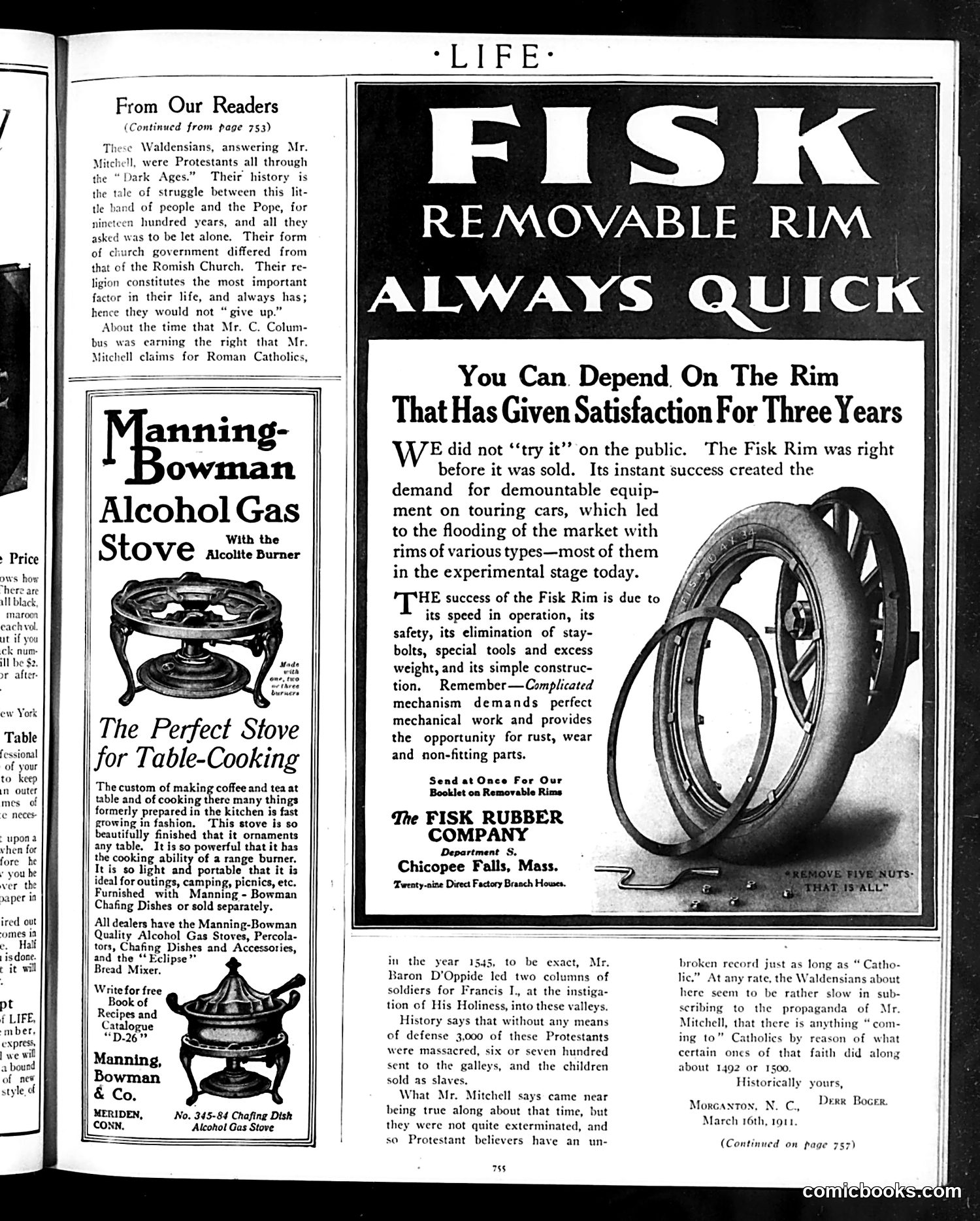
This page is primarily **advertising**, not political satire. It contains two product advertisements (Manning-Bowman Alcohol Gas Stove and Fisk Removable Rim automobile tires) flanking a "From Our Readers" letter section. The reader's letter discusses the **Waldensians**, a medieval Protestant sect persecuted by the Catholic Church. The writer (Derek Boger) responds to an earlier article by defending Waldensian Protestants' historical persecution—specifically referencing a 1545 massacre by French Catholic forces. He argues that Protestants have maintained continuous existence "just as long as Catholics," countering what appears to be a pro-Catholic argument by someone named Mitchell. The letter's broader context seems to be a debate about religious tolerance and historical wrongs. Boger concludes skeptically that local Catholics aren't successfully recruiting Protestants to their faith based on historical grievances. **For modern readers**: This reflects early 20th-century American Protestant-Catholic tensions over religious authority and historical memory—an audience genuinely engaged with centuries-old sectarian disputes.
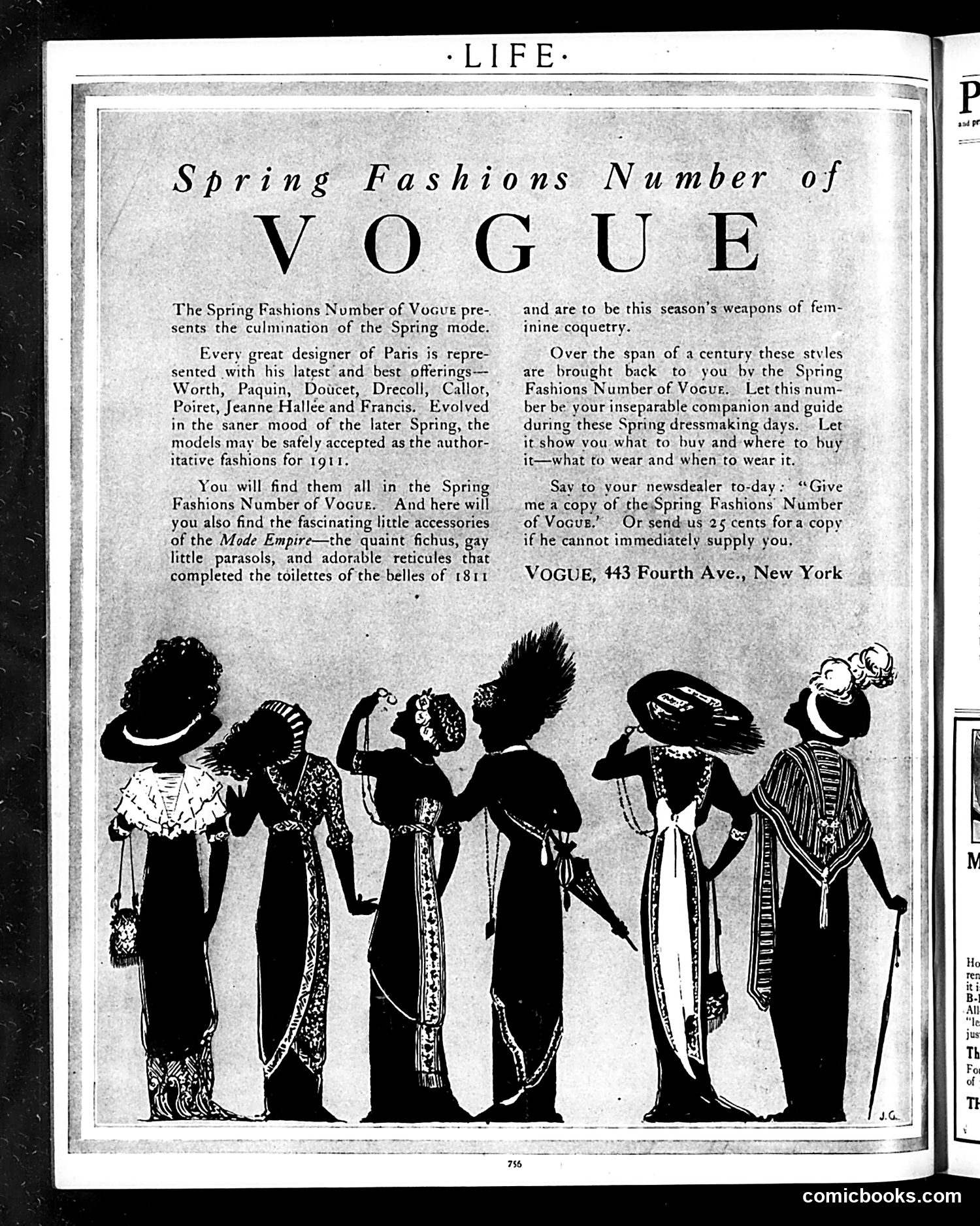
This is primarily an **advertisement for Vogue's Spring Fashions Number**, not political satire. The silhouette illustration depicts six fashionable women in Empire-waist gowns (referencing early 1800s styles), showcasing the season's trends. The text advertises that major Parisian designers—Worth, Paquin, Doucet, and others—are featured in this special issue. The key selling point is nostalgia: styles from "the belles of 1811" are being revived for spring 1911, presented as "weapons of feminine coquetry" alongside period accessories like parasols and reticules. The advertisement encourages readers to purchase the issue for guidance on "what to buy and where to buy it" during spring dressmaking season. This is **consumer marketing disguised within Life magazine**, leveraging fashion authority and historical romance to drive Vogue subscriptions.
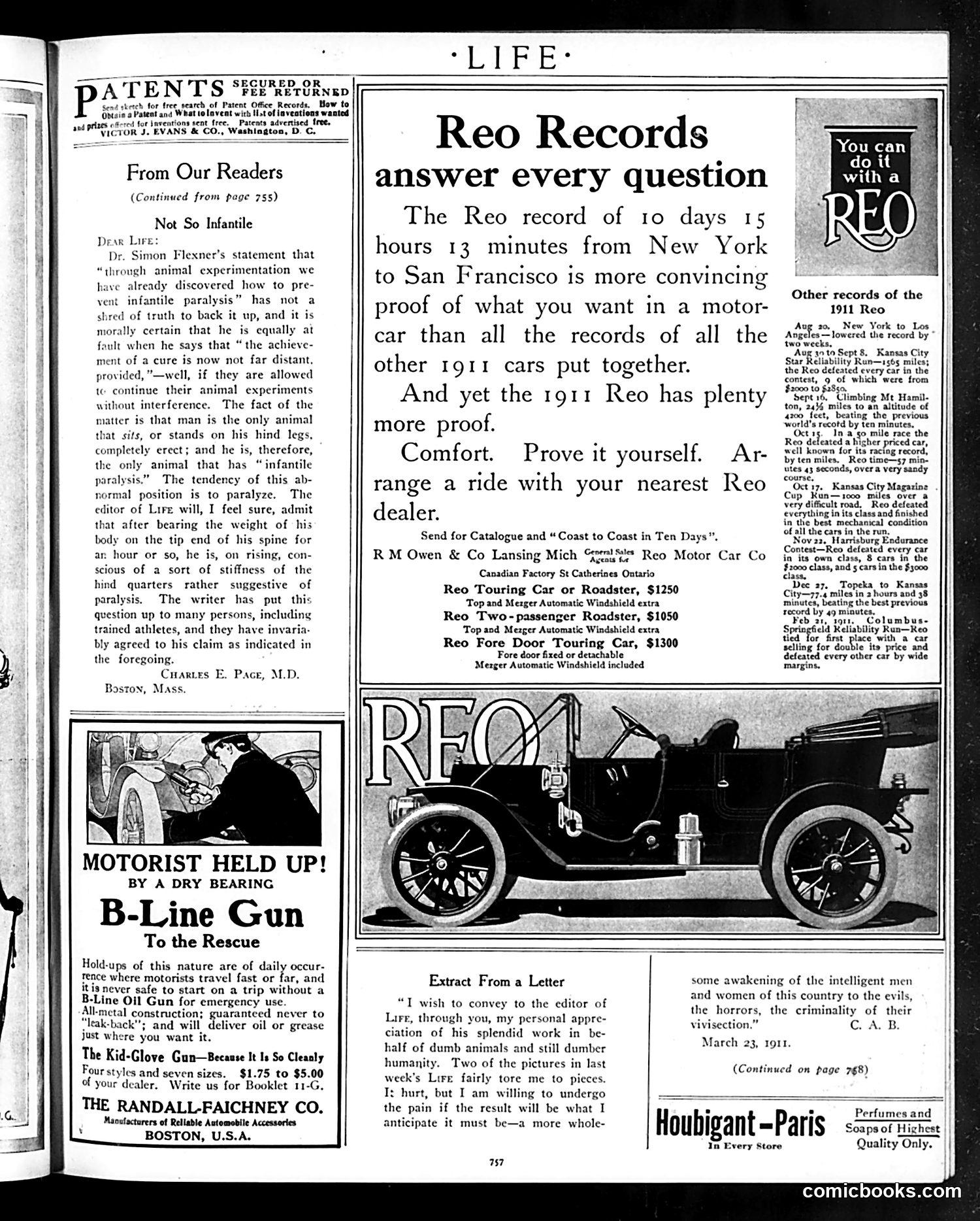
This page contains primarily **automobile advertising** rather than political cartoons. The dominant feature is a large **Reo automobile advertisement** promoting the 1911 Reo motorcar, emphasizing its impressive cross-country speed record (New York to San Francisco in 10 days, 15 hours). The "cartoon" element is minimal: a small illustration labeled **"Motorist Held Up! By a Dry Bearing"** advertises the B-Line Oil Gun—a pun playing on "hold-up" (robbery) versus mechanical breakdown. The joke is that motorists face emergencies from equipment failure, not just bandits. The page also includes a **reader letter** criticizing Dr. Simon Flexner's claims about preventing infantile paralysis through animal experimentation—a contemporary medical/scientific debate. Overall, this is primarily a **commercial advertising page** with minimal satirical content, reflecting Life magazine's mixed editorial-commercial format of the 1911 era.
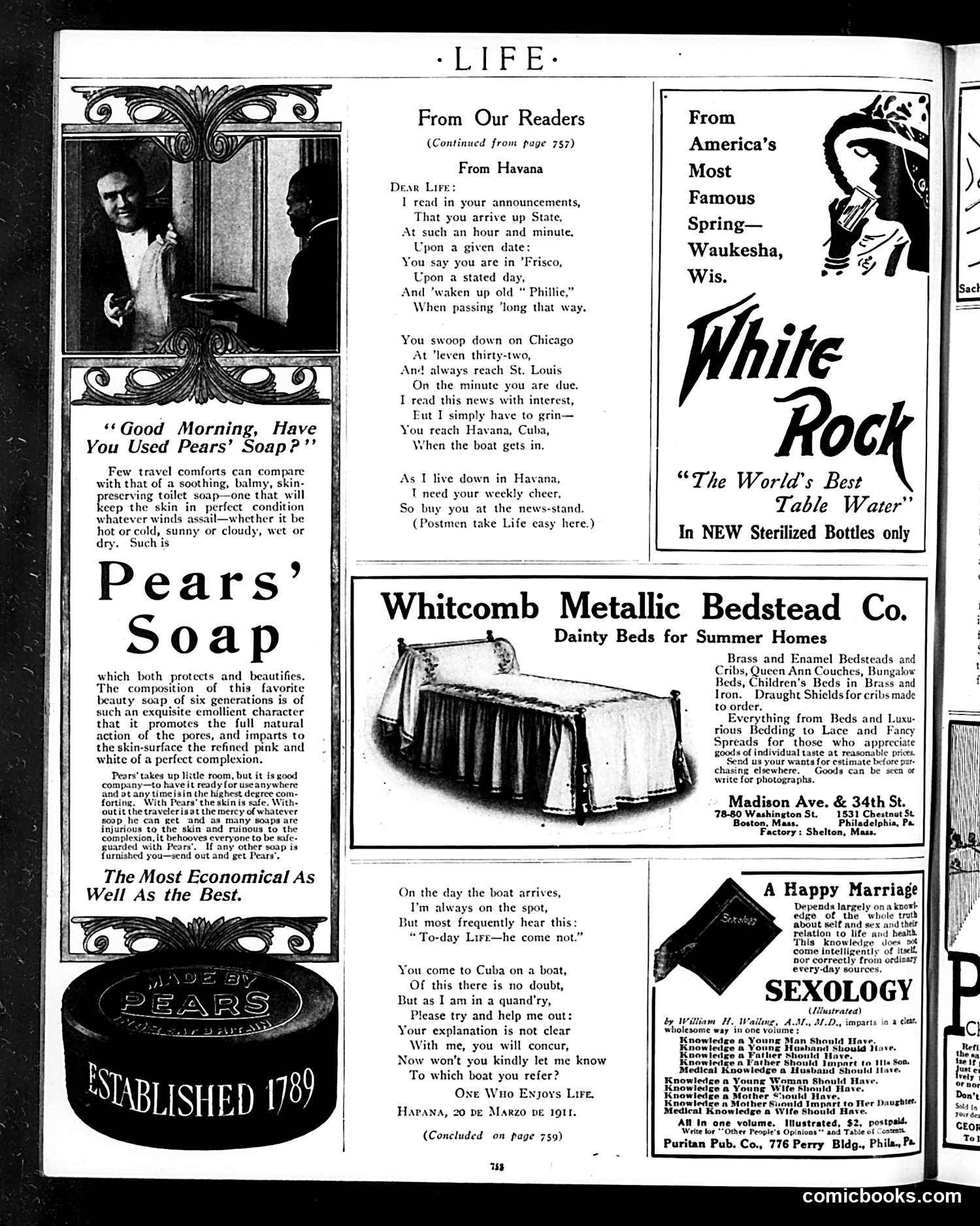
This page is primarily **advertising with one reader letter feature**. The main content is a humorous letter from a Havana resident complaining that Life magazine's announced train schedule—which boasts precise arrivals in cities like Chicago, St. Louis, and Philadelphia—fails to explain how the magazine reaches Cuba by boat. The writer jokes that Life arrives "when the boat gets in," making the punctuality claims absurd for overseas readers. The satirical point: Life was promoting its reliable distribution network, but the letter exposes the gap between U.S. domestic efficiency and international delivery. The letter writer plays dumb, feigning genuine confusion about which boat carries Life to Cuba—a gentle mockery of the magazine's self-promotion. The page otherwise features ads for Pears' Soap, White Rock mineral water, Whitcomb Bedsteads, and a "Sexology" book—typical early 20th-century commercial content.
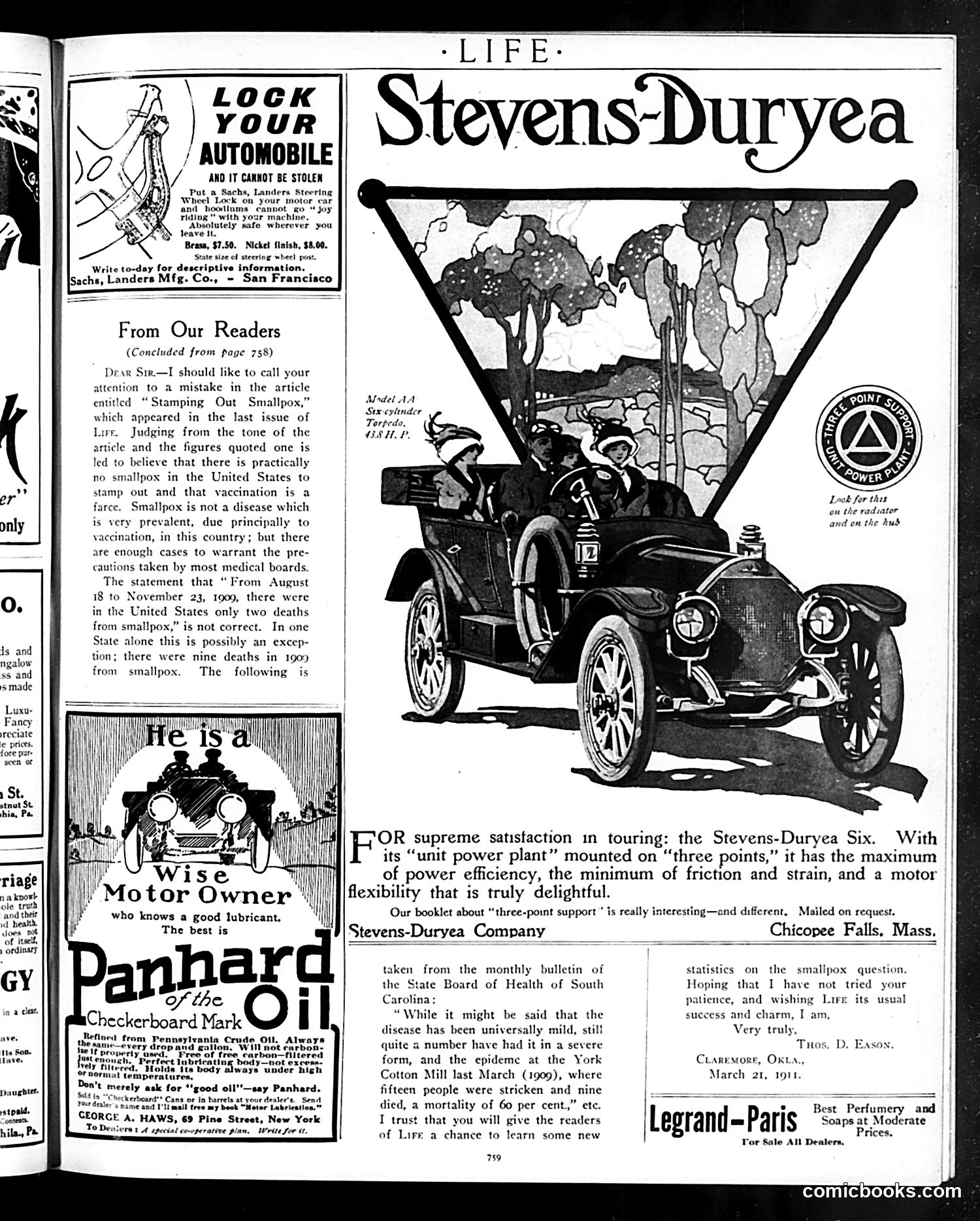
This page mixes advertisements with reader correspondence about public health. The main content is a letter correcting *Life*'s recent article "Stamping Out Smallpox," which apparently claimed vaccination had nearly eliminated the disease in America. A reader (T.D. Eason from Oklahoma) disputes this, citing actual death statistics—including a 1909 outbreak at a York Cotton Mill where 9 of 15 infected people died (60% mortality). He argues the article misrepresented the data by selectively quoting low national death figures while ignoring severe regional outbreaks. The satire is implicit: *Life* had downplayed smallpox as a non-threat to mock anti-vaccination sentiment or complacency, but the reader provides hard evidence the disease remained genuinely dangerous. The page otherwise contains period automobile and oil advertisements with no apparent satirical content.
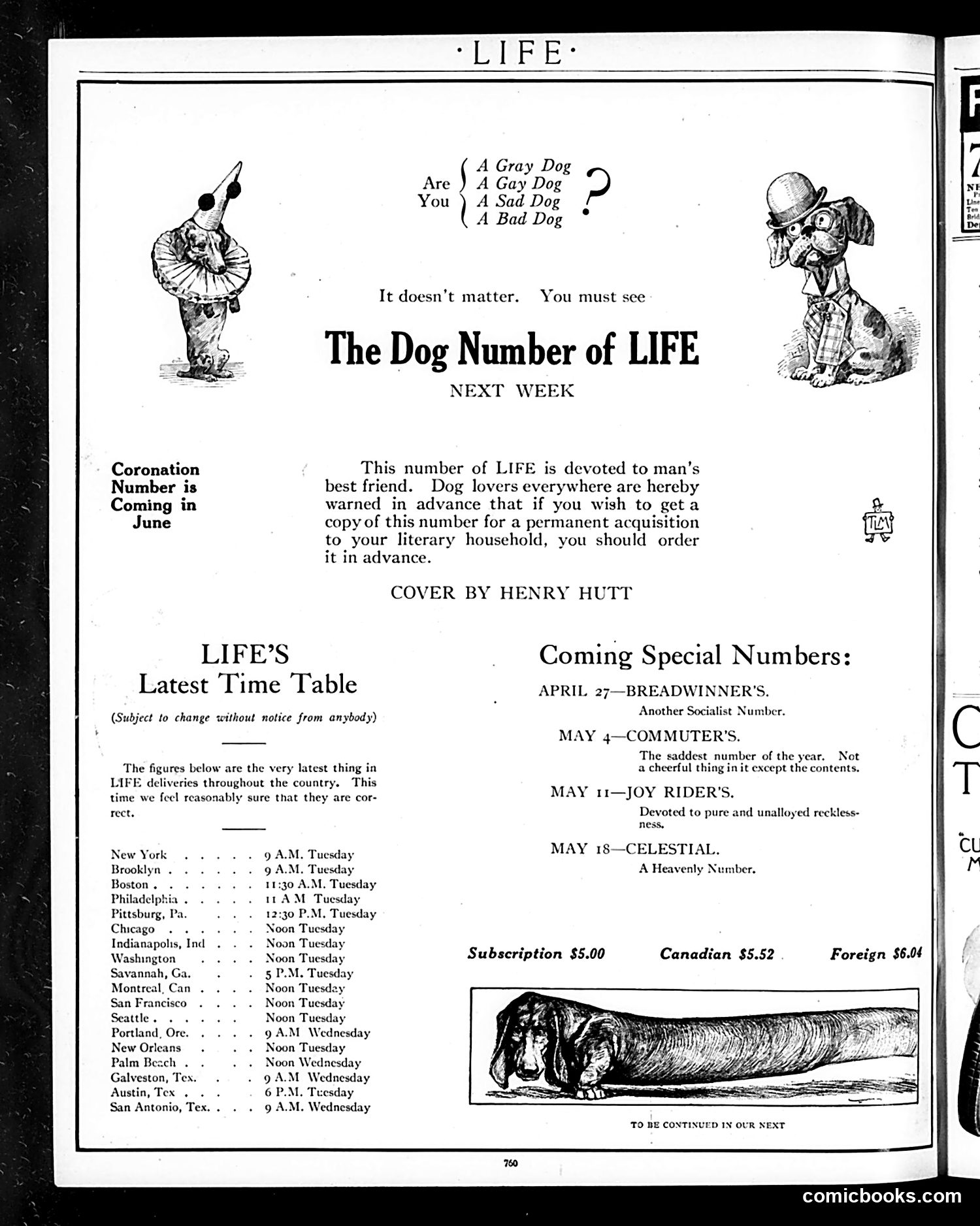
This is a **promotional advertisement** for an upcoming special issue devoted to dogs. The two illustrated figures—one in a party hat and one in a bowler hat—appear to be **whimsical characters** rather than political caricatures, used to humorously introduce the concept. The page uses satire by presenting dogs in human social categories ("Gray Dog," "Gay Dog," "Sad Dog," "Bad Dog"), suggesting that dogs, like people, fit into recognizable personality types. The copy warns readers to **pre-order this issue** because it will be so popular among "dog lovers everywhere." The page also advertises **upcoming themed issues**: a Coronation Number in June, and specialized editions targeting Breadwinners, Commuters, and Joy Riders—reflecting Life's practice of creating satirical issues aimed at specific social groups. The distribution table lists delivery times across American cities, emphasizing Life's national circulation during the early 20th century.
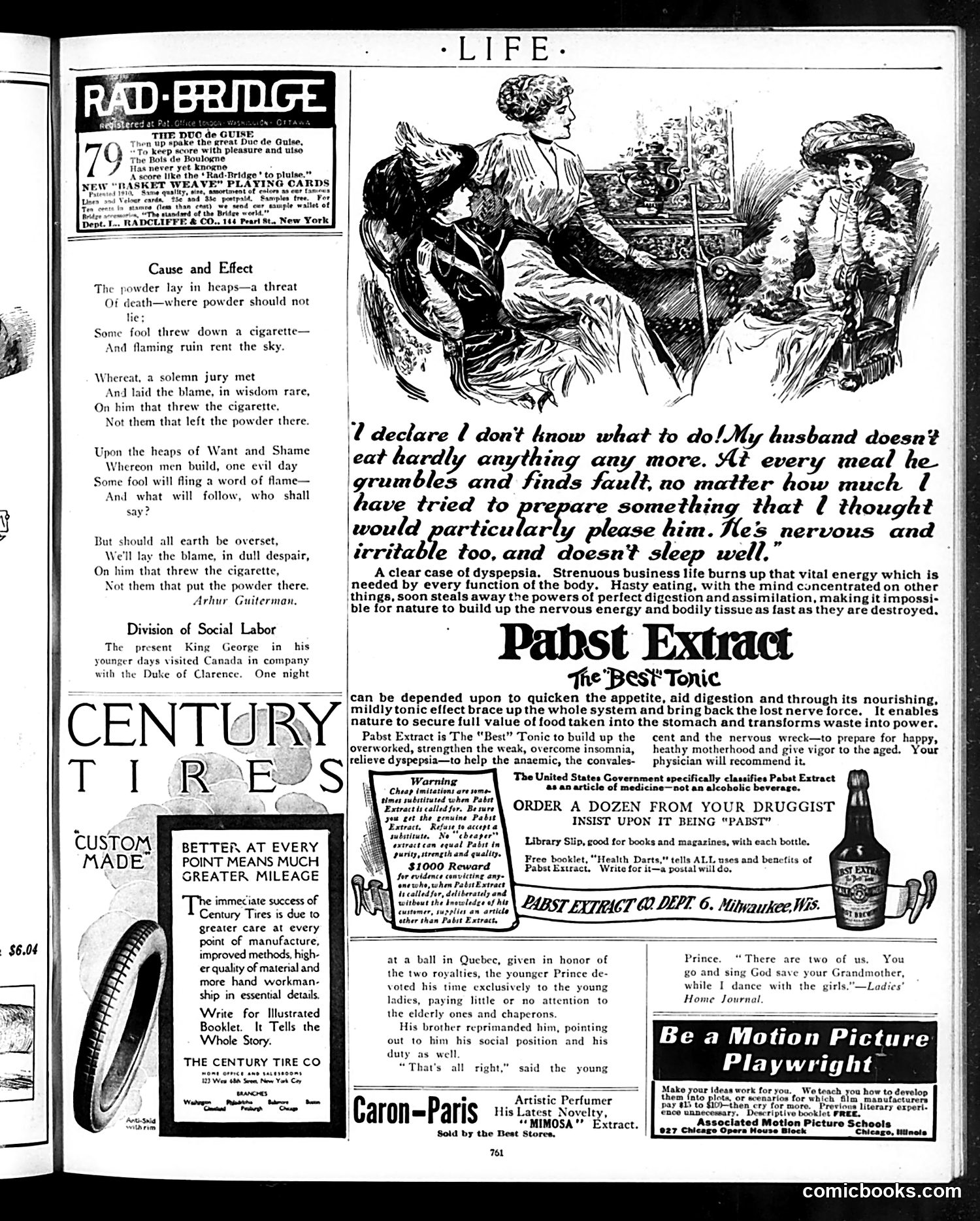
This page contains several distinct commentaries on early 20th-century society: **"Cause and Effect" (Arthur Guiterman poem):** A satirical critique of misplaced blame. Using a powder explosion caused by a carelessly discarded cigarette as metaphor, Guiterman argues that society blames the immediate wrongdoer while ignoring systemic injustices ("heaps of Want and Shame") that create dangerous conditions. The poem warns that suppressing underlying social problems will eventually lead to catastrophe—yet authorities will still blame the spark, not the powder. **"Division of Social Labor" anecdote:** A brief story mocking royal etiquette and generational attitudes. A young prince ignores elderly ladies at a formal ball, prioritizing dancing with younger women. When rebuked about his social duty, he dismissively suggests the elderly entertain themselves ("sing God save your Grandmother"), revealing aristocratic indifference to proper decorum. The remaining content consists primarily of period advertisements (Pabst Extract tonic, Century Tires, motion picture schools).
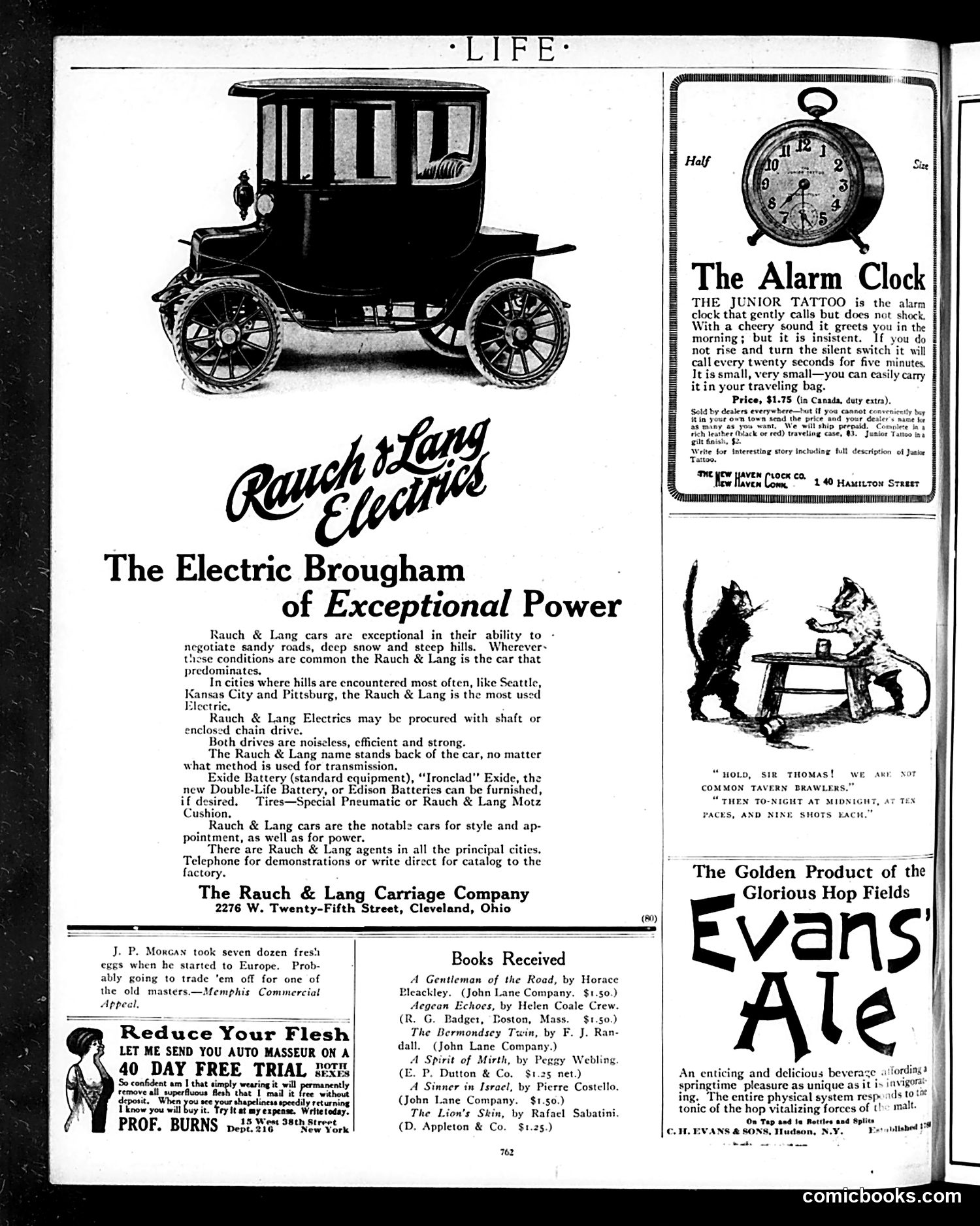
This page is primarily **advertising with minimal editorial content**. The main satirical element appears in a small cartoon captioned "Hold, Sir Thomas! We are not common tavern brawlers," which depicts two figures in what appears to be a mock-serious confrontation—likely a light joke about genteel behavior versus rowdy conduct, though the specific reference is unclear without more context. The bulk of the page consists of period advertisements: - **Rauch & Lang Electrics**: Promotes electric automobiles (then a practical alternative to gas cars), emphasizing their ability to handle challenging terrain and hills - **Junior Tattoo alarm clock**: A genteel, portable alarm device - **Evans' Ale**: Beer advertisement - **Prof. Burns' auto massager**: A dubious health device promising flesh reduction in 40 days The "Books Received" section lists contemporary literary publications from publishers like John Lane Company and others. The advertisements reflect early 1900s consumer goods and concerns—electric vehicles as modern technology, health/beauty devices, and leisure products.
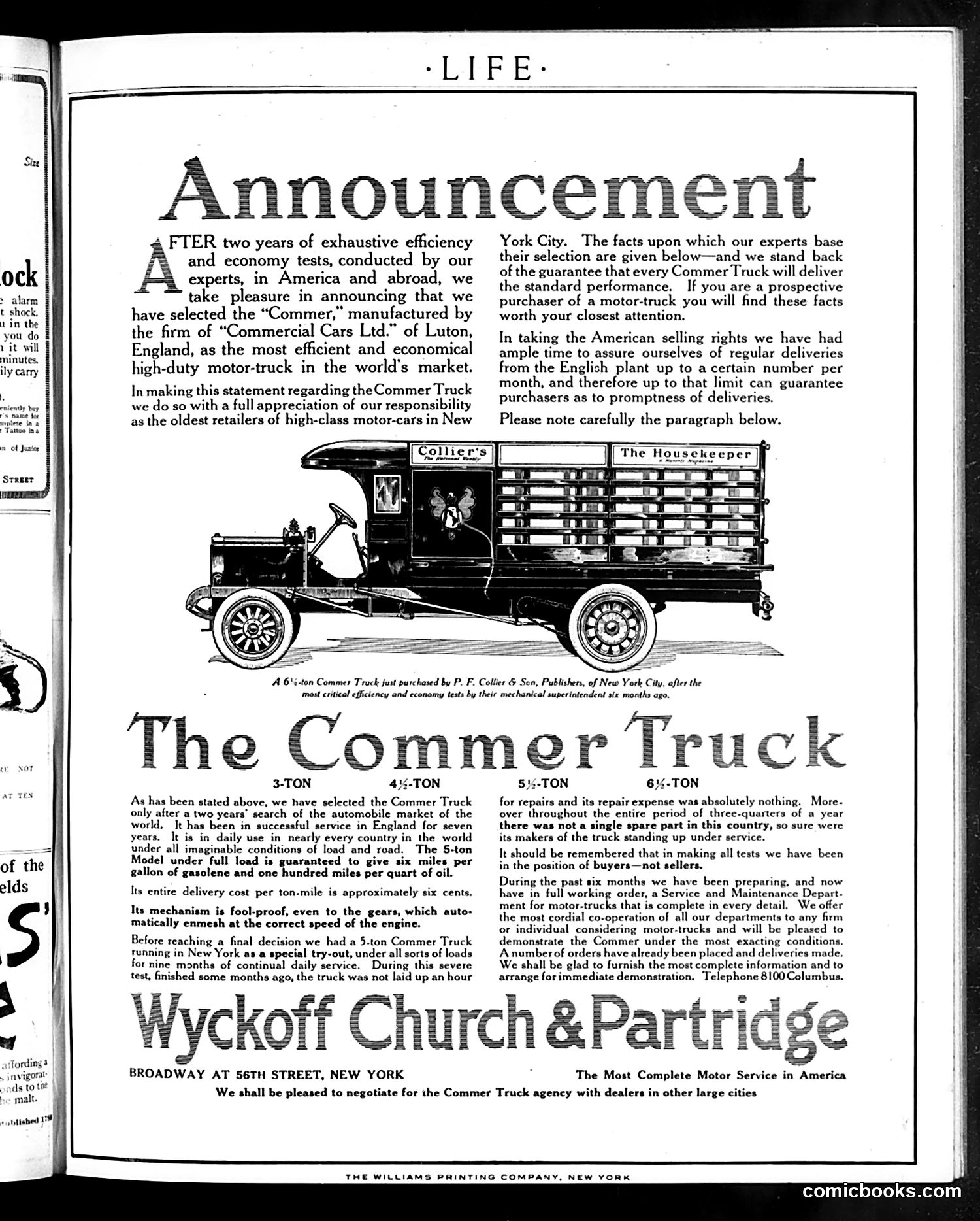
This is **not a cartoon or satire**—it's a straightforward advertisement disguised as editorial content in *Life* magazine. The page announces that Wyckoff Church & Partridge, a New York auto retailer, has selected the British-made Commer truck as "the most efficient and economical high-duty motor-truck in the world's market" after two years of testing. The pitch emphasizes durability: a test truck ran nine months in New York with zero repair costs and no downtime. The ad includes an illustration of a Commer truck carrying freight for Collier's and *The Housekeeper* publications. **For modern readers:** This represents early automotive advertising strategy—using claimed scientific testing and testimonials to build credibility. The ad's placement in a satirical magazine (rather than labeled as advertising) reflects less-regulated 1910s-era advertising practices, where the line between editorial and commercial content was blurry. The focus on efficiency metrics reflects contemporaneous fascination with industrial standardization and Taylorism.
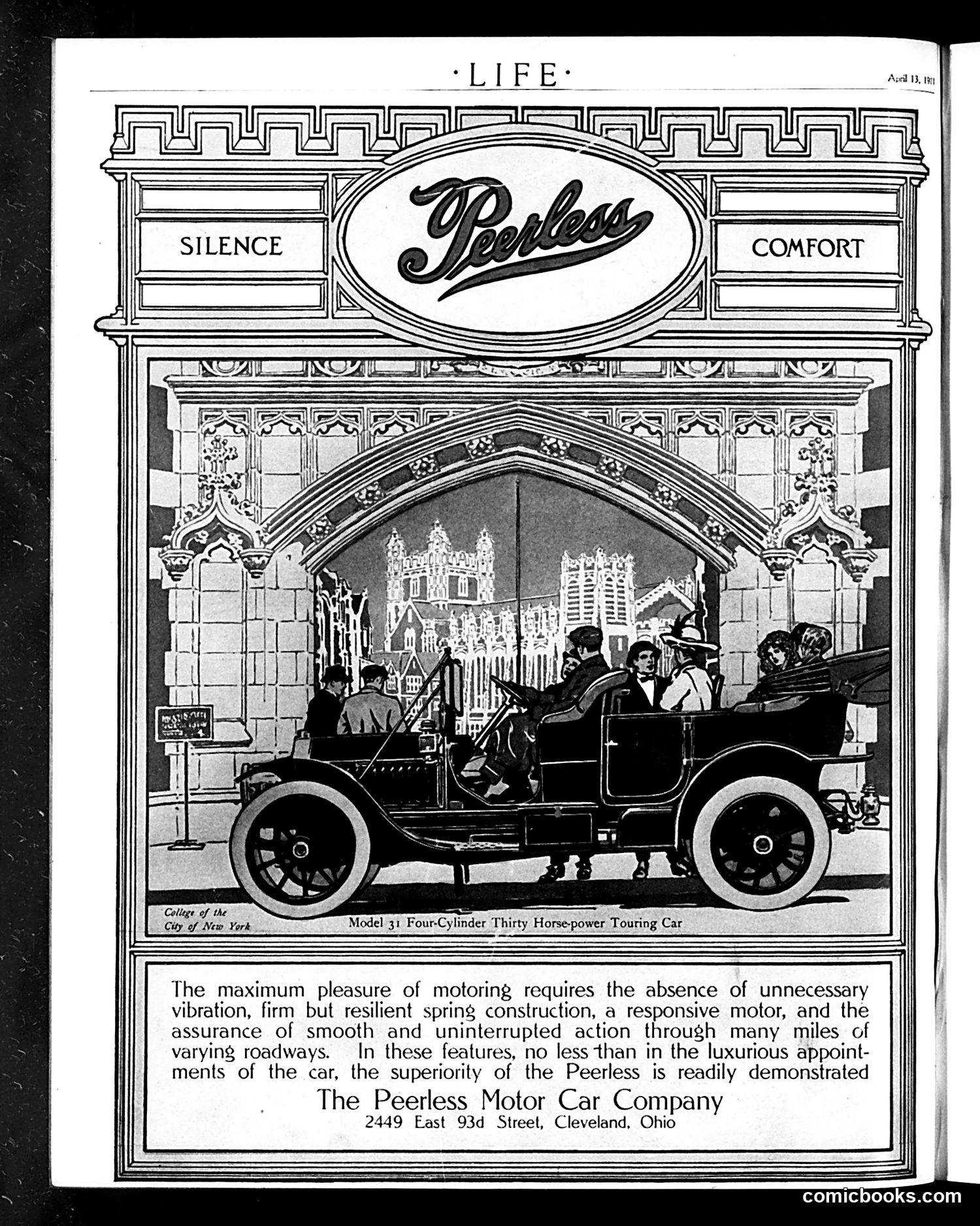
This page is **primarily an advertisement**, not satirical content. It's a Peerless Motor Car Company ad from Life magazine (dated April 13, 1911, based on the header). The illustration shows a touring car parked beneath an ornate Gothic archway resembling a cathedral entrance, with the Manhattan skyline visible behind it. Well-dressed passengers sit in the vehicle. The visual joke is subtle: by framing the automobile within grand architectural styling and positioning it like a religious structure, the ad suggests the car itself is a cathedral-worthy achievement—something to be revered. The text emphasizes engineering refinements (spring construction, motor responsiveness, smooth operation). The header labels "SILENCE" and "COMFORT" reinforce the luxury pitch. This represents early automotive advertising's appeal to affluent buyers through both technical claims and aspirational imagery, positioning the motorcar as a status symbol worthy of fine art presentation.