
Life, 1911-04-13 · page 17 of 44
Life — April 13, 1911 — page 17: what you’re looking at
What you’re looking at
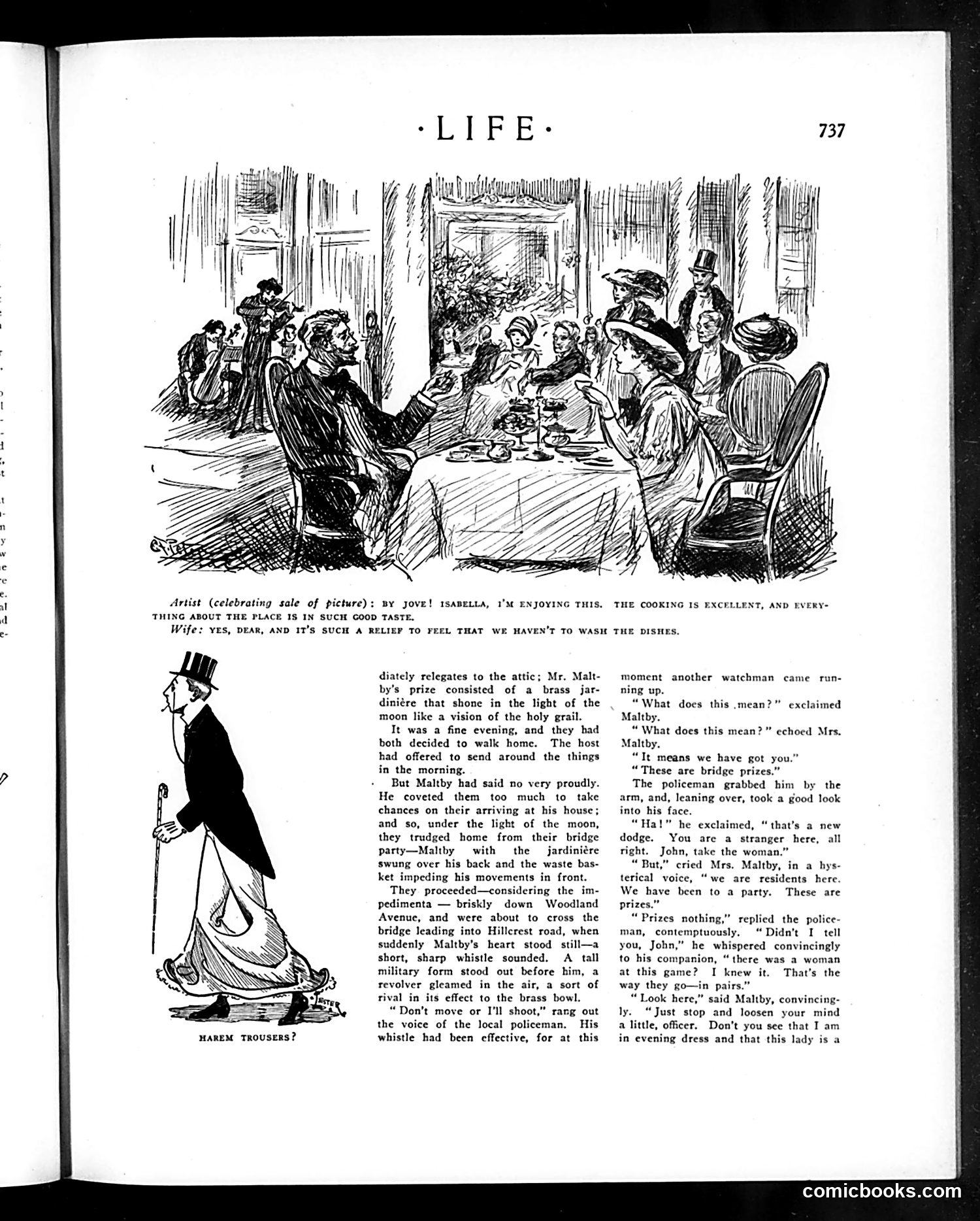
This page contains two satirical pieces about gender roles and social propriety in early 20th-century America. **Top cartoon:** An artist celebrates selling a painting to a wealthy couple. His wife jokes that the best part is not having to wash the dishes—satirizing how domestic labor fell entirely to wives regardless of household finances. **Bottom story:** A married couple leaving a bridge party is arrested by police while carrying home their prize (a brass jardiniére and waste basket). The officers assume they're criminals because a man and woman are out together at night carrying items—a "new dodge" or theft method. The story mocks both the obtuse police and period assumptions about proper behavior: respectable married couples shouldn't be seen carrying household goods through streets at night, and the suspicious pairing of a man and woman suggests illicit activity. The title "Harem Trousers?" (partially visible) appears unrelated or refers to another item on the page. The satire targets rigid Victorian/Edwardian social conventions and the absurdity of policing respectability.
📄 Transcribed text from this page (OCR, searchable)
Machine-transcribed from the original scan — historical spelling and the odd misread are preserved.
Artist (celebrating sale of picture): By Jove! 1sABELLA, 1'x ENJOYING THIS. = ABOUT THE PLACE 1S IN SUCH GOOD TASTE. Wife: YES, DEAR, AND IT'S SUCH A RELIEF TO FEEL THAT WE HAVEN'T TO WASH THE DISHES. MAREM TROUSERS? diately relegates to the attic; Mr. Malt- prize consisted of a brass jar- diniére that shone in the light of the moon like a vision of the holy grail. It was a fine evening, and they had both decided to walk home. The host had offered to send around the things in the morning. But Maltby had said no very proudly. He coveted them too much to take chances on their arriving at his house; and so, under the light of the moon, they trudged home from their bridge party—Maltby with the jardiniére swung over his back and the waste bas- ket impeding his movements in front. They proceeded—considering the im- pedimenta — briskly down Woodland Avenue, and were about to cross the bridge leading into Hillcrest road, when suddenly Maltby’s heart stood still—a short, sharp whistle sounded. A tall military form stood out before him, a revolver gleamed in the air, a sort of rival in its effect to the brass bowl. “Don’t move or I'll shoot,” rang out the voice of the local policeman, His whistle had been effective, for at this THE COOKING IS EXCELLENT, AND EVERY= moment another watchman came run- ning up. “What does this .mean?” exclaimed Maltby. “ What does this mean?” echoed Mrs. Maltby. “Tt means we have got you.” “These are bridge prizes. The policeman grabbed him by the arm, and, leaning over, took a good look into his face. “Hal” he exclaimed, “that’s a new dodge. You are a stranger here, all right. John, take the woman.” “ But,” cried Mrs. Maltby, in a hys- terical voice, “we are residents here. We have been to a party. These are prizes. “Prizes nothing,” replied the police- man, contemptuously, “Didn't I tell you, John,” he whispered convincingly to his companion, “there was a woman at this game? I knew it. That's the way they go—in pairs.” “Look here,” said Maltby, convincing- ly, “Just stop and loosen your mind a little, officer, Don't you see that I am in evening dress and that this lady is a comicbooks.com