
Life, 1911-04-13 · page 24 of 44
Life — April 13, 1911 — page 24: what you’re looking at
What you’re looking at
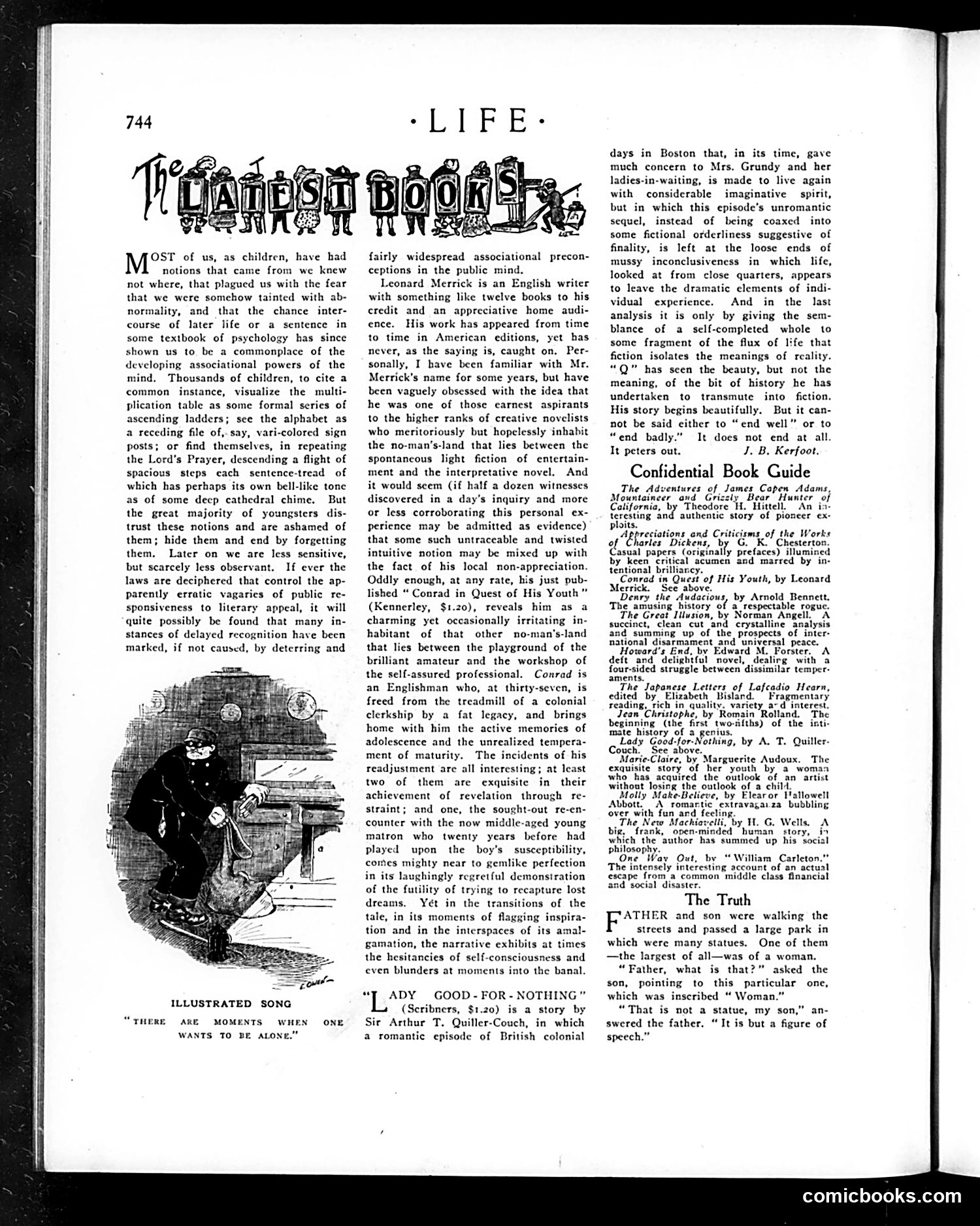
This page from *Life* magazine (a satirical publication, not the photo magazine) contains a critical essay on literature rather than political cartoons. The author discusses Leonard Merrick's novel *Conrad in Quest of His Youth*, noting that despite Merrick's substantial output (twelve books), his work hasn't achieved popular success in America—possibly due to preconceived notions about where his work fits literarily. The accompanying illustration shows a contemplative figure, accompanying a section titled "Illustrated Song: 'There Are Moments When One Wants to Be Alone.'" This appears to be a humorous visual commentary on solitude and introspection. The page also reviews other contemporary books by authors like Sir Arthur Quiller-Couch. Rather than political satire, this represents *Life's* cultural criticism function—using wit to analyze literature and reading habits of the educated American public.
📄 Transcribed text from this page (OCR, searchable)
Machine-transcribed from the original scan — historical spelling and the odd misread are preserved.
OST of us, as children, have bad notions that came from we knew not where, that plagued us with the fear that we were somehow tainted with ab- normality, and that the chance inter- course of later life or a sentence in some textbook of psychology has since shown us to be a commonplace of the developing associational powers of the mind. Thousands of children, to cite a common instance, visualize the multi- plication table as some formal series of ascending ladders; see the alphabet as a receding file of, say, vari-colored sign posts; or find themselves, in repeating the Lord’s Prayer, descending a flight of spacious steps cach sentence-tread of which has perhaps its own bell-like tone as of some decp cathedral chime. But the great majority of youngsters dis- trust these notions and are ashamed of them; hide them and end by forgetting them. Later on we are less sensitive, but scarcely less observant. If ever the laws are deciphered that control the ap- parently erratic vagaries of public re- sponsiveness to literary appeal, it will quite possibly be found that many in- stances of delayed recognition have been marked, if not caused, by deterring and ILLUSTRATED SONG “THERE ARE MOMENTS WHEN WANTS TO BE ALONE.’ ONE fairly widespread associational precon- ceptions in the public mind. Leonard Merrick is an English writer with something like twelve books to his credit and an appreciative home audi- ence. His work has appeared from time to time in American editions, yet has never, as the saying is, caught on, Per- sonally, I have been familiar with Mr. Merrick’s name for some years, but have been vaguely obsessed with the idea that he was one of those carnest aspirants to the higher ranks of creative novelists who meritoriously but hopelessly inhabit the no-man’s-land that lies between the spontancous light fiction of entertain- ment and the interpretative novel. And it would scem (if half a dozen witnesses discovered in a day's inquiry and more or less corroborating this personal ex- perience may be admitted as evidence) that some such untraceable and twisted intuitive notion may be mixed up with the fact of his local non-appreciation. Oddly enough, at any rate, his just pub- lished “ Conrad in Quest of His Youth” (Kennerley, $1.20), reveals him as a charming yet occasionally irritating in- habitant of that other no-man’s-land that lies between the playground of the brilliant amateur and the workshop of the self-assured professional. Conrad is an Englishman who, at thirty-seven, is freed from the treadmill of a colonial clerkship by a fat legacy, and brings home with him the active memories of adolescence and the unrealized tempcera- ment of maturity. The incidents of his readjustment are all interesting; at least two of them are exquisite in their achievement of revelation through re- straint; and one, the sought-out re-en- counter with the now middle-aged young matron who twenty years before had played upon the boy's susceptibility, comes mighty near to gemlike perfection in its laughingly regretful demonstration of the futility of trying to recapture lost dreams. Yét in the transitions of the tale, in its moments of flagging inspira- tion and in the interspaces of its amal- gamation, the narrative exhibits at times the hesitancies of self-consciousness and even blunders at moments into the banal, “] ADY GOOD-FOR- NOTHING” (Scribners, $1.20) is a story by Sir Arthur T. Quiller-Couch, in which a romantic episode of British colonial days in Boston that, in its time, gave much concern to Mrs. Grundy and her ladies-in-waiting, is made to live again with considerable imaginative spirit, but in which this episode’s unromantic sequel, instead of being coaxed into some fictional orderliness suggestive of finality, is left at the loose ends of mussy inconclusiveness in which life, looked at from close quarters, appears to leave the dramatic clements of indi- vidual experience. And in the last analysis it is only by giving the sem- blance of a self-completed whole to some fragment of the flux of life that fiction isolates the meanings of reality. “Q" has scen the beauty, but not the meaning, of the bit of history he has undertaken to transmute into fiction. His story begins beautifully. But it can- not be said cither to “end well” or to “end badly.” It does not end at all. Tt peters out. J. B. Kerfoot. Confidential Book Guide The Adventures of James Capen Adams, Mountaineer ond Gi Bear Hunter of California, by Theodore H. Hittell. An in- teresting an ploits. A spreciations and Criticisms of the Works of Charles Dickens, by G. K. Chesterton. Casual pape: (originally prefaces) illumined by keen critical acumen and marred by in- tentional brilliancy. Conrad in Quest of His Youth, by Leonard Merrick. See above. Denry the Audacious, by Arnold Bennett. The amusing ‘history of a respectable rogue. The Great Illusion, by Norman Angell. A succinct, clean cut and crystalline analysis and summing up of the prospects of inter- national disarmament and universal peace. Howard's End, by Edward M. Forster. A deft and delightful novel, dealirg with a four-sided struggle between ‘dissimilar temper- aments. The Japanese Letters of Lafcadio Hearn, edited by Elizabeth Bisland. Fragmentary reading, rich in quality. variety a~d interest. Jean Christophe, by Romain Rolland. The beginning (the first two-nfths) of the inti- mate history of a genius. Ledy Good-for-Nothing, by A. T. Quiller- Couch: See above. Marie-Claire, by Marguerite Audoux. The exquisite story of her youth by a woman who has acquired the outlook of an artist without losing the outlook of a child. Molly Make-Believe, by Elearor Hallowell Abbott. A romartic extravagaiza bubbling over with fun ard feeling. The New Machiavelli, by H. G. Wells, A big, frank, open-minded human story, i which the author has summed up his social philosophy. One Way Out, by “ William Carleton,” “he tensely interesting account of an actual escape from a common middle class financial and social disaster. The Truth ATHER and son were walking the Streets and passed a large park in which were many statues. One of them —the largest of all—was of a woman. what is that?” asked the to this particular one, s inscribed “ Woman.” “That is not a statue, my son,” an- swered the father. “It is but a figure of authentic story of pioneer ex- comicbooks.com