
Life, 1911-04-13 · page 16 of 44
Life — April 13, 1911 — page 16: what you’re looking at
What you’re looking at
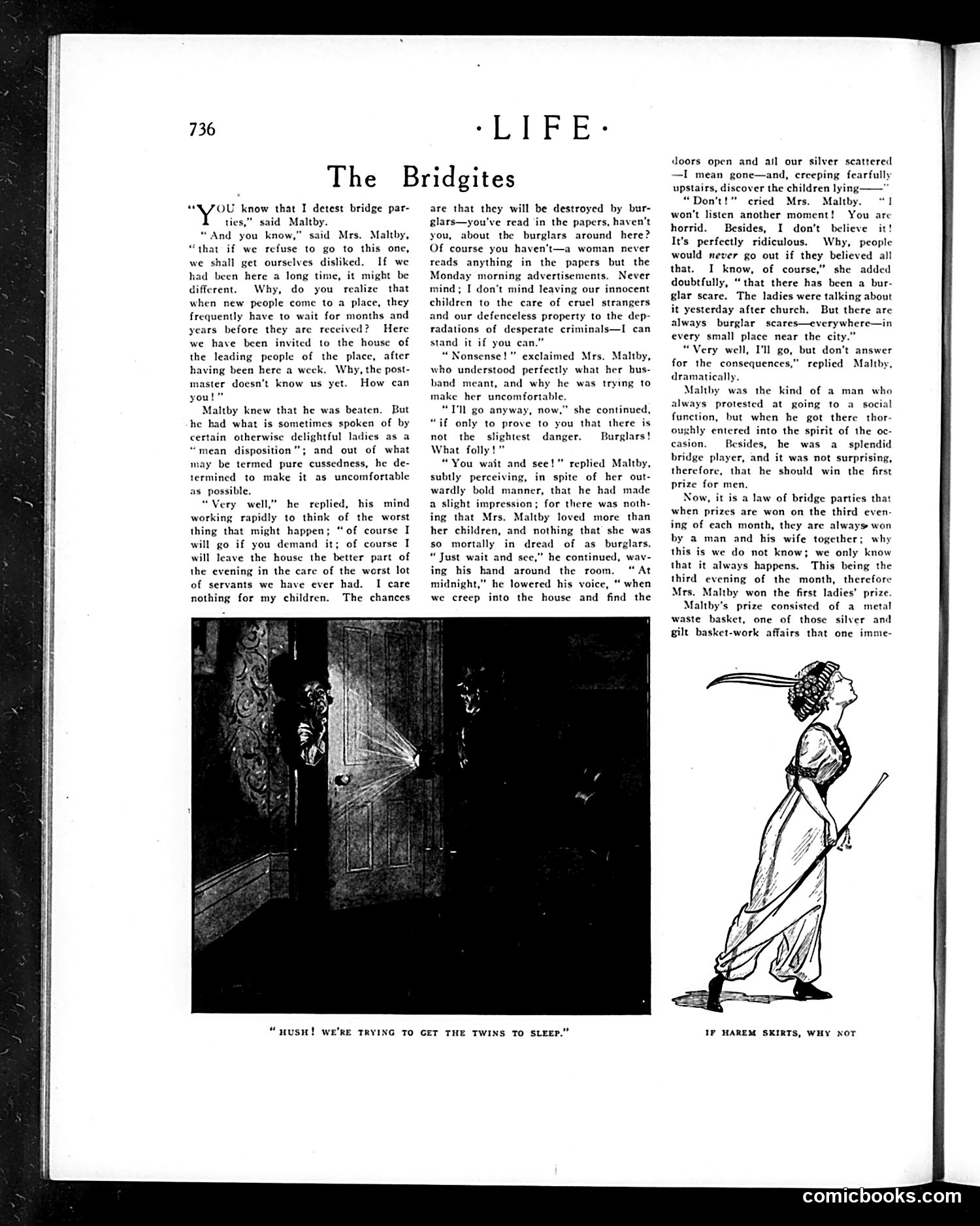
This is a domestic comedy story mocking early 20th-century social anxieties about fitting into new communities. Mr. Maltby protests attending a bridge party (a popular card game social event), reluctantly citing fears of burglars and servant neglect. His wife counters that refusing invitations from "the leading people" risks social ostracism—newcomers must prove themselves worthy. The satire targets both characters: Maltby's theatrical complaints and his wife's social desperation. The accompanying illustrations show the dramatic scene and a woman in elegant dress. The story reveals Maltby eventually attends and wins the bridge tournament prize alongside his wife—suggesting that social conformity, though tedious, has its rewards. The piece satirizes the rigid social hierarchies and anxieties of small-town American life, where acceptance requires careful social performance.
📄 Transcribed text from this page (OCR, searchable)
Machine-transcribed from the original scan — historical spelling and the odd misread are preserved.
The “YOU know that I detest bridge par- ties,” said Maltby. nd you know,” said Mrs. Maltby, “that if we refuse to go to this one, we shall get ourselves disliked. If we had been here a long time, it might be different. Why, do you realize that when new people come to a place, they frequently have to years before they are received? ait for months and Here we have been invited to the house of the leading people of the place, after having been here a week. Why, the post- master doesn’t know us yet. How can you!” Maltby knew that he was beaten. But he had what is sometimes spoken of by certain otherwise delightful ladies as a sposition”; and out of what may be termed pure cussedness, he de- termined to make it as uncomfortable as possible, “Very well,” he replied, his mind working rapidly to think of the worst thing that might happen; “of course I will go if you demand it; of course I will leave the house the better part of the evening in the care of the worst lot of servants we have ever had. I care nothing for my children. The chances -LIFE- Bridgites are that they will be destroyed by bur- glars—you've read in the papers, haven't you, about the burglars around here? Of course you haven't—a woman never reads anything in the papers but the Monday morning advertisements. Never mind; I don’t mind leaving our innocent children to the care of cruel strangers and our defenceless property to the dep- radations of desperate criminals—I can stand it if you can.” onsense!" exclaimed Mrs, Maltby, who understood perfectly what her bus- band meant, and why he was trying to ake her uncomfortable. I'll go anyway, now,” she continued, f only to prove to you that there is not the slightest. danger. Burglars! What folly!” “You wait and see!” replied Maltby, subtly perceiving, in spite of her out- wardly bold manner, that he had made a slight impression; for there was noth- ing that Mrs, Maltby loved more than her children, and nothing that she was so mortally in dread of as burglars. “ Just wait and sce,” he continued, wav ing his hand around the room. “At midnight,” he lowered his voice, “ when we creep into the house and find the “wus! WE'RE TRYING TO GET THE TWINS TO SLEEP.” doors open and ail our silver scattered —I mean gone—and, erceping fearfully upstairs, discover the children lying “Don't!” cried Mrs. Maltby. won't listen another moment! You are horrid. Besides, I don’t believe it! It’s perfectly ridiculous. Why, people would never go out if they believed all that. I know, of course,” she added doubtfully, “that there has been a bur- glar scare. The ladies were talking about it yesterday after church. But there are always burglar scares—everywhere—in every small place near the city.” “Very well, I'll go, but don’t answer for the consequences,” replied Maltby, dramatically. Maltby was the kind of a man who always protested at going to a social function, but when he got there thor- oughly entered into the spirit of the oc- casion. Besides, he was a splendid bridge player, and it was not surprising, therefore, that he should win the first prize for men, Now, it is a law of bridge parties that when prizes are won on the third even- ing of each month, they are always won by a man and his wife together; why this is we do not know; we only know that it always happens. This being the third evening of the month, therefore Mrs. Maltby won the first ladies’ prize. Maltby’s prize consisted of a metal waste basket, one of those silver and gilt basket-work affairs that one imme- IF HAREM SKIRTS, WHY NOT comicbooks.com