
Life, 1911-04-13 · page 20 of 44
Life — April 13, 1911 — page 20: what you’re looking at
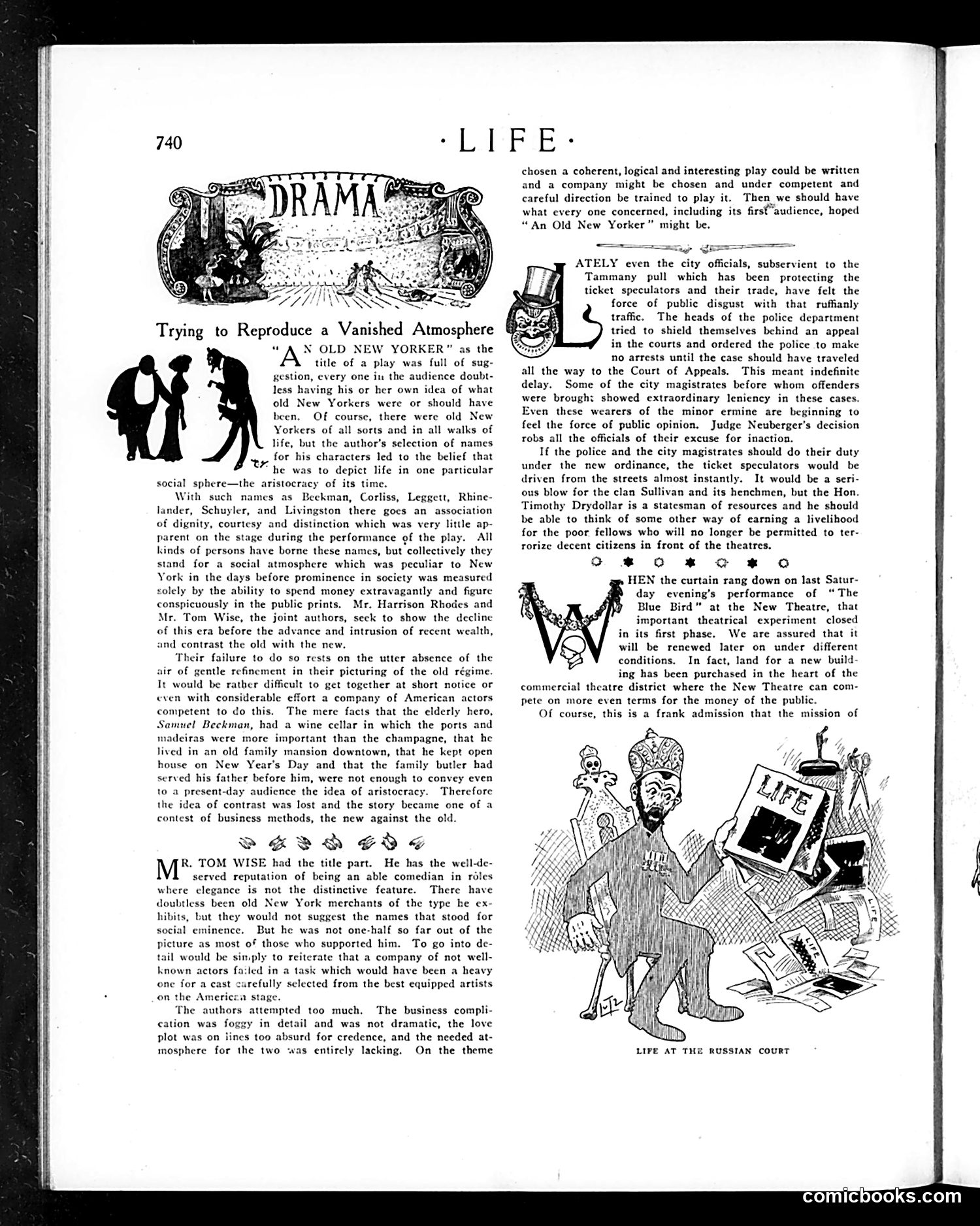
A restored page from Life, 1911-04-13. Page through the whole issue in the reader above.
📄 Transcribed text from this page (OCR, searchable)
Machine-transcribed from the original scan — historical spelling and the odd misread are preserved.
ay We I ler Trying to Reproduce a Vanished Atmosphere “4 N OLD NEW YORKER” as the title of a play was full of sug- gestion, every one in the audience doubt- less having his or her own idea of what old New Yorkers were or should have been. Of course, there were old New Yorkers of all sorts and in all walks of life, but the author's selection of names ‘ty {0F his characters led to the belief that “he was to depict life in one particular social sphere—the aristocracy of its time. With such names as Beekman, Corliss, Leggett, Rhine- lander, Schuyler, and Livingston there gocs an association of dignity, courtesy and distinction which was very little ap- parent on the stage during the performance of the play. All kinds of persons have borne these names, but collectively they stand for a social atmosphere which was peculiar to New York in the days before prominence in society was measured solely by the ability to spend money extravagantly and figure conspicuously in the public prints. Mr. Harrison Rhodes and Mr. Tom Wise, the joint authors, seck to show the decline of this era before the advance and intrusion of recent wealth, and contrast the old with the new, Their failure to do so rests on the utter absence of the air of gentle refincment in their picturing of the old régime. It would be rather difficult to get together at short notice or even with considerable effort a company of American actors competent to do this. The mere facts that the elderly hero, Samuel Beckman, had a wine cellar in which the ports and madeiras were more important than the champagne, that he lived in an old family mansion downtown, that he kept open house on New Year's Day and that the family butler had served his father before him, were not enough to convey even to a present-day audience the idea of aristocracy. Therefore the idea of contrast was lost and the story became one of a contest of business methods, the new against the old. SARA EGdIE R. TOM WISE had the title part. He has the well-de- served reputation of being an able comedian in roles where elegance is not the distinctive feature. There have doubtless been old New York merchants of the type ke ex hibits, but they would not suggest the names that stood for social eminence. But he was not one-half so far out of the picture as most of those who supported him. To go into de- tail would be sin.ply to reiterate that a company of not well- known actors fa:led in a task which would have been a heavy one for a cast carefully selected from the best equipped artists on the Ameri stage. The authors attempted too much. The business compli- cation was fo; in detail and was not dramatic, the love plot was on lines too absurd for credence, and the needed at- mosphere for the two was entirely lacking. On the theme chosen a coherent, logical and interesting play could be written and a company might be chosen and under competent and careful direction be trained to play it. Then we should have what every one concerned, including its first audience, hoped “An Old New Yorker” might be. even the city officials, subservient to the Tammany pull which has been protecting the ticket speculators and their trade, have felt the force of public disgust with that ruffianly traffic. The heads of the police department tried to shield themselves behind an appeal in the courts and ordered the police to make no arrests until the case should have traveled all the way to the Court of Appeals. This meant indefinite delay. Some of the city magistrates before whom offenders were brought showed extraordinary leniency in these cases. Even these wearers of the minor ermine are beginning to feel the force of public opinion. Judge Neuberger’s decision robs all the officials of their excuse for inaction. If the police and the city magistrates should do their duty under the new ordinance, the ticket speculators would be driven from the streets almost instantly. It would be a seri- ous blow for the clan Sullivan and its henchmen, but the Hon. Timothy Drydollar is a statesman of resources and he should be able to think of some other way of carning a livelihood for the poor fellows who will no longer be permitted to ter- rorize decent citizens in front of the theatres. o *€ OO * G&G € 8 HEN the curtain rang down on last Satur- day evening’s performance of “The Blue Bird” at the New Theatre, that important theatrical experiment closed in its first phase. We are assured that it will be renewed later on under different conditions, In fact, land for a new build- ing has been purchased in the heart of the commercial theatre district where the New Theatre can com- pete on more even terms for the money of the public. Of course, this is a frank admission that the mission of MEX? LIPE AT THE RUSSIAN COURT comicbooks.com