
Life, 1911-04-13 · page 26 of 44
Life — April 13, 1911 — page 26: what you’re looking at
What you’re looking at
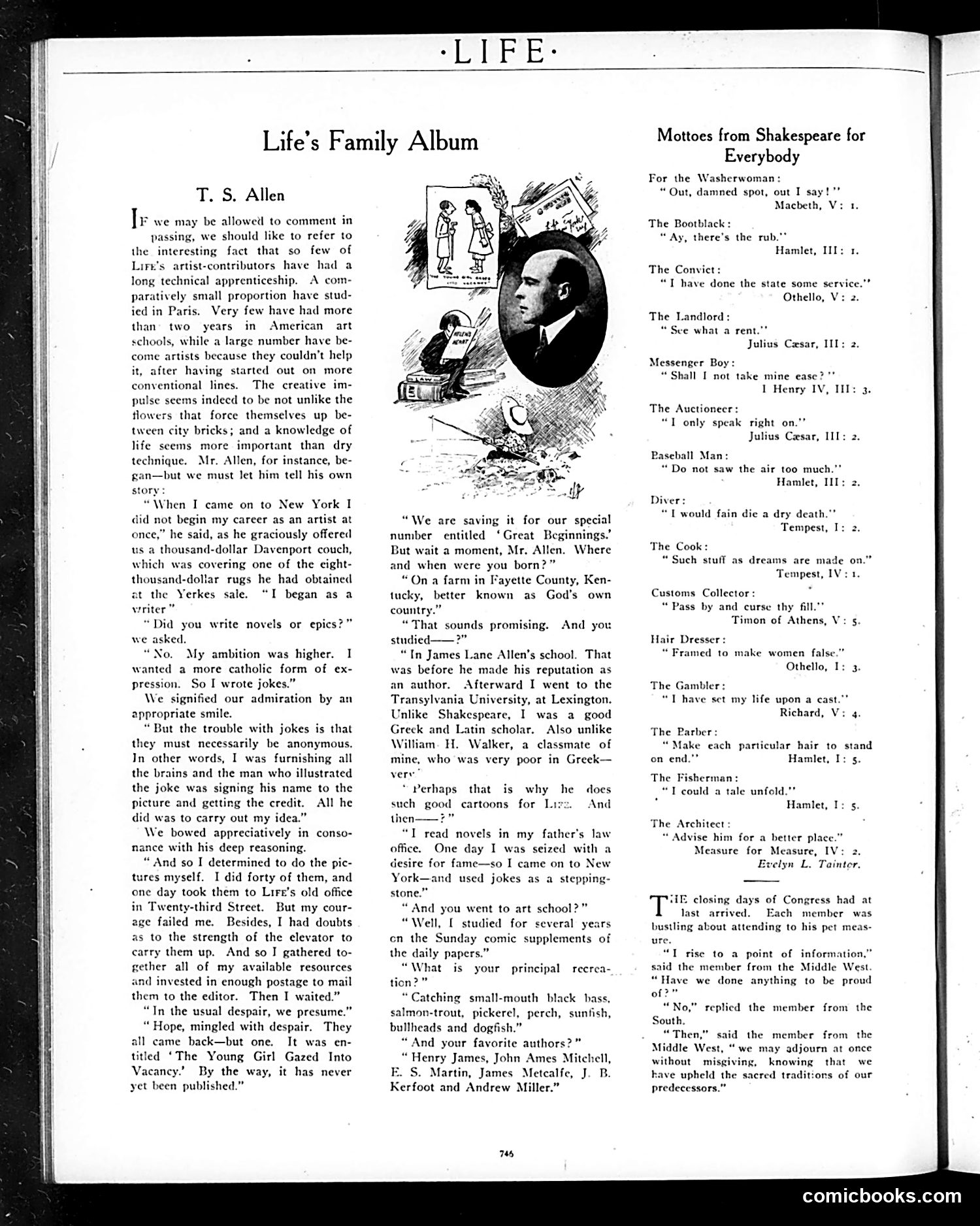
This page contains a humorous interview with T.S. Allen, a Life magazine artist-contributor, presented as "Life's Family Album." ## The Satire The joke centers on Allen's self-aggrandizing account of his career. He claims he wrote jokes for cartoonists but the illustrators received credit—a transparent exaggeration designed to inflate his own importance. The interviewer's repeated "appreciative" bows mock Allen's grandiosity. ## Key Comedic Elements - Allen describes his modest beginnings (Kentucky farm, self-taught artist) while surrounded by expensive possessions (thousand-dollar couch, Yerkes sale rugs)—highlighting pretension - He credits his success to mailing unsolicited cartoons, one of which Life allegedly never published - The right column offers Shakespeare quotes matched to common workers ("For the Washerwoman," "The Bootblack"), a separate satirical feature mocking how high culture gets applied to lowly professions The overall effect gently ridicules artistic vanity and the gap between humble origins and assumed sophistication—typical of Life's satirical humor targeting the American middle class.
📄 Transcribed text from this page (OCR, searchable)
Machine-transcribed from the original scan — historical spelling and the odd misread are preserved.
ble eg Life’s Family Album T. S. Allen I > we may be allowetl to comment in passing, we should like to refer to the interesting fact that so few of Lire’s artist-contributors have had a long technical apprenticeship. A com- paratively small proportion have stud- ied in Paris. Very few have had more than’ two years in American art schools, while a large number have be- come artists because they couldn’t help it, after having started out on more conventional lines. The creative im- pulse seems indecd to be not unlike the flowers that force themselves up be- tween city bricks; and a knowledge of life seems more important than dry technique. Mr. Allen, for instance, be- gan—but we must let him tell his own stor, “When I came on to New York I did not begin my career as an artist at once,” he said, as he graciously offered us a thousand-dollar Davenport couch, which was covering one of the cight- thousand-dollar rugs he had obtained at the Yerkes sale. “I began as a writer” “Did you write novels or epics?” we asked. “No. My ambition was higher. 1 wanted a more catholic form of ex- pression. So I wrote jokes.” We signified our admiration by an appropriate smile. “But the trouble with jokes is that they must necessarily be anonymous, In other words, I was furnishing all the brains and the man who illustrated. the joke was signing his name to the picture and getting the credit. All he did was to carry out my ide: We bowed appreciatively in conso- nance with his deep reasoning. “And so I determined to do the pic- tures myself. I did forty of them, and one day took them to Lire’s old office in Twenty-third Street. But my cour- age failed me. Besides, I had doubts as to the strength of the elevator to carry them up. And so I gathered to- gether all of my available resources and invested in enough postage to mail them to the editor. Then I waited.” “Tn the usual despair, we presume.” “ Hope, mingled with despair. They all came back—but one. It was en- titled ‘The Young Girl Gazed Into Vacancy.’ By the way, it has never yet been published.” “We are saving it for our special number entitled ‘Great Beginnings.’ But wait a moment, Mr, Allen. Where and when were you born?” On a farm in Fayette County, Ken- lucky, better known as God’s own country.” “That sounds promising. And you studied ——? “Tn James Lane Allen’s school. That was before he made his reputation as an author. Afterward I went to the Transylvania University, at Lexington. Unlike Shakespeare, I was a good Greck and Latin scholar. Also unlike William. H. Walker, a classmate of mine, who was very poor in Greek— verv" “perhaps that is why he does such good cartoons for Lizz. And tien——? “T read novels in my father’s law office. One day I was seized with a desire for fame—so I came on to New York—and used jokes as a stepping- stone. “And you went to art school?” “Well, [ studied for several years cn the Sunday comic supplements of the daily papers.” “What is your principal reerea- tion?” “Catching small-mouth black bass, salmon-trout, pickerel, perch, sunfish, bullheads and dogfish “And your favorite authors?” “Henry James, John Ames Mitchell, E. S. Martin, James Metcalfe, J. B. Kerfoot and Andrew Miller.” Mottoes from Shakespeare for Everybody For the Washerwoman: “Out, damned spot, out I say!” Macbeth, V The Bootblack : “Ay, there’s the rub.” Hamlet, II: 1. The Convict: “T have done the state some service.” Othello, V: 2. The Landlord: “ See what a rent.” Julius Cxsar, III: 2. Messenger Boy: “Shall I not take mine ease?’ I Henry IV, HI: The Auctioneer: “TL only speak right on.’ Julius Cesar, II: Paseball Man: “Do not saw the air too much.” Hamlet, IIT: Diver: “would fain die a dry death.” Tempest, I The Cook: “Such stuff as dreams are made on.” Tempest, IV: 1. Customs Collector: “Pass by and curse thy fill."" Timon of Athens Dresser : Framed to make women false Othello, I: 3. The Gambler: “T have set my life upon a cast Richard, The Parber: fake each particular hair to stand on end.” Hamlet, I: 5. The Fisherman: “T could a tale unfold.’ Hamlet, I: s. The Architect: “ Advise him for a better place.” Measure for Measure, IV: 2. n L. Tainter, T E closing days of Congress had at last arrived. Each member was bustling about attending to his pet meas- ure. “TL rise to a point of information,” d the member from the Middle West Have we done anything to be proud of? “No,” replicd the member from the South. “Then,” said the member from the Middle West, “we may adjourn at once without misgiving, know that we have upheld the sacred traditions of our predecessors.” comicbooks.com