
Life, 1911-04-13 · page 21 of 44
Life — April 13, 1911 — page 21: what you’re looking at
What you’re looking at
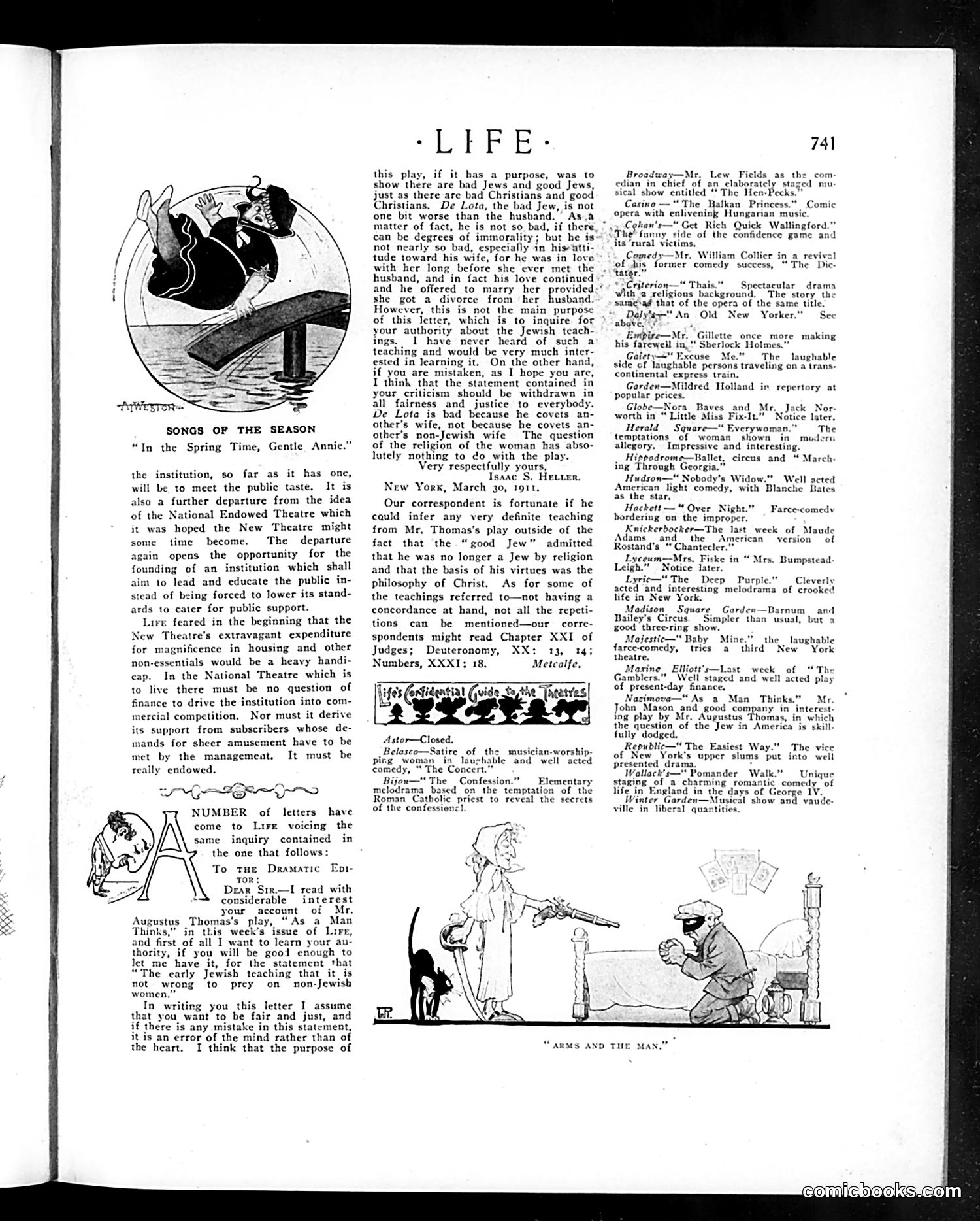
This page primarily features a **letter-to-editor debate** about Augustus Thomas's play "As a Man Thinks." A reader (Isaac S. Heller) challenges *Life*'s dramatic critic for claiming the play endorsed Jewish teachings permitting exploitation of non-Jewish women. Heller argues the play simply contrasts moral and immoral individuals regardless of religion, and demands the critic retract what he calls a misrepresentation. *Life*'s editor responds defensively, citing biblical passages (Judges, Deuteronomy, Numbers) as sources for such teachings—implying anti-Semitic views were indeed embedded in the play's themes. **The satire**: This exchange exposes how contemporary theater reinforced ethnic stereotypes. The editor's citation of scripture to justify anti-Jewish tropes represents *Life*'s willingness to legitimize bigoted characterizations under the guise of dramatic criticism. The controversy reveals early 20th-century tensions around Jewish representation and religious prejudice in American popular culture. The page also includes theater reviews and a cartoon titled "Arms and the Man" (visible at bottom).
📄 Transcribed text from this page (OCR, searchable)
Machine-transcribed from the original scan — historical spelling and the odd misread are preserved.
SONGS OF THE SEASON “In the Spring Time, Gentle Annie.” the institution, so far as it has one, will be to meet the public taste, It is also a further departure from the idea of the National Endowed Theatre which it was hoped the New Theatre might some time become. The departure again opens the opportunity for the founding of an institution which shall aim to lead and educate the public in- stead of being forced to lower its stand- ards to cater for public support. Lire feared in the beginning that the New Theatre's extravagant expenditure for magnificence in housing and other non-essentials would be a heavy handi- cap. In the National Theatre which is to live there must be no question of finance to drive the institution into com- mercial competition. Nor must it derive its support from subscribers whose de- mands for sheer amusement have to be met by the managemeat. It must be really endowed. aOR \ NUMBER of letters have come to Lire voicing the same inquiry contained in the one that follows: To tHe Dramatic oR: Dear Sir—I read with *% considerable interest your account of Mr. Augustus Thomas's play, “As a Man Thinks,” in this week’s issue of Lire, and first of all I want to learn your au- thority, if you will be good enough to let me have it, for the statement that “The early Jewish teaching that it is not wrong ‘to prey on non-Jewish women.” In writing you this letter I assume that you want to be fair and just, and if there is any mistake in this statement, it is an error of the mind rather than of the heart. I think that the purpose of [\ Eo1- -LIPE * this play, if it has a purpose, was to show there are bad Jews and good Jews, just as there are bad Christians and good Christians. De Lota, the bad Jew, is not one bit worse than the husband.” Asa matter of fact, he is not s can be degrees of immorality; but he is not nearly so bad, especially in his-atti- tude toward his wife, for he was in love with her long before she ever met the . husband, and in fact his love continued and he ‘offered to marry her provided she got a divorce from her husband. However, this is not the main purpose of this letter, which is to inquire for your authority about the Jewish teach- ings. I have never heard of such a teaching and would be very much inter- ested in learning it. On the other hand, if you are mistaken, as I hope you are, I think that the statement contained in your criticism should be withdrawn in all fairness and justice to everybody. De Lota is bad because he covets an- other's wife, not because he covets an- other's non-Jewish wife The question of the religion of the woman has abso- lutely nothing to do with the play. Very respectfully yours, Isaac S. Hettrr. ew York, March 30, 1911. Our correspondent is fortunate if he could infer any very definite teaching from Mr. Thomas's play outside of the fact that the “good Jew admitted that he was no longer a Jew by religion and that the basis of his virtues was the philosophy of Christ. As for some of the teachings referred to—not having a concordance at hand, not all the repeti- tions can be mentioned—our corre- spondents might read Chapter XXI of Judges; Deuteronomy, XX: 13, 14; Numbers, XXXI: 18. Metcalfe. vide tothe “Tntatves| Astor—Closed. Belasco—Satire of the musician-worship- ping woman in laughable and well acted comedy, “ The Concert. Bijou—" The | Confession. Elementary melodrama based on the temptation of the Roman Catholic priest to reveal the secrets of the confessions], bad, if there, * 741 Broadway—Mr. Lew. Fields as the com: edian in chief of an elaborately staged mu- sical show entitled ** The Hen-Peck: Casino —“ The Ralkan Princess.” Comic opera with enlivening Hungarian music. saCohan's—" Get Rich Quick Wallingford.” iThe fanny. side of the confidence game and its ‘rural victims, Comedy—Mr. William Collier in a revive! of shis former comedy success, “The Dic- tater. * \Criterion—“ Thais.” ith “a religious background. same-aé that of the opera o! Daly'tx-" An Old New above, \¢ 2 _Empize—Mr. | Gillette once more making his farewell in, Sherlock Holmes." _ Gaiety" Excuse Me." The laughable side cf laughable persons traveling on a trans- continental express train, Garden—Mildred Holland ir repertory at popular prices. Globe—Noza Bayes and Mr. Jack Nor- worth in “Little Miss Fix-It.” Notice later. Herald Square—" Everywoman.” The temptations of woman shown moder allegory. Impressive and interestin _ Hippodrome—Ballet, circus and ing Through Georgia.” Hudson—" Nobody's Widow.” Well acted American light comedy, with Blanche Dates as the star, Hackett —“ Over Night.” bordering on the improper. Knickerbocker—The last _weck of Maude Adams and the American version of Rostand’s “ Chantecler.” Lyceum—Mrs. Fiske in “ Mrs, Bumpstead- Leigh.” Notice later. Lyric—“' The Deep Purple.” — Cleverly acted and interesting melodrama of crooked life in New York. Medison Square Garden—Barnum and Bailey's Circus Simpler than usual, " good three-ring show. Majestic—" Baby farce-comedy, tries a theatre. Maxine, Elliott's—Last week of “Th Gamblers.” Well staged and well acted play of present-day finance, Nazimova— As a Man Thinks.” Mr. John Mason and good company in interest ing play by Mr. Augustus Thomas, in which the question of the Jew in America is skill- fully dodged. Republic—" The Easiest Way.” The vice of New York’s upper slums put into well presented drama, : Wallack’s—" Pomander Walk.” — Unique staging of a charming romantic comedy of life in England in the days of George IV. Winter Garden—Musical show and vaude- ville in liberal quantities. Spectacular drama ‘The story the the same title, Yorke: Sec March- Farce-comedv Mine.” the laughable third New York “ARMS AND TILE 3fan,”