
A complete issue · 41 pages · 1910
Life — December 29, 1910
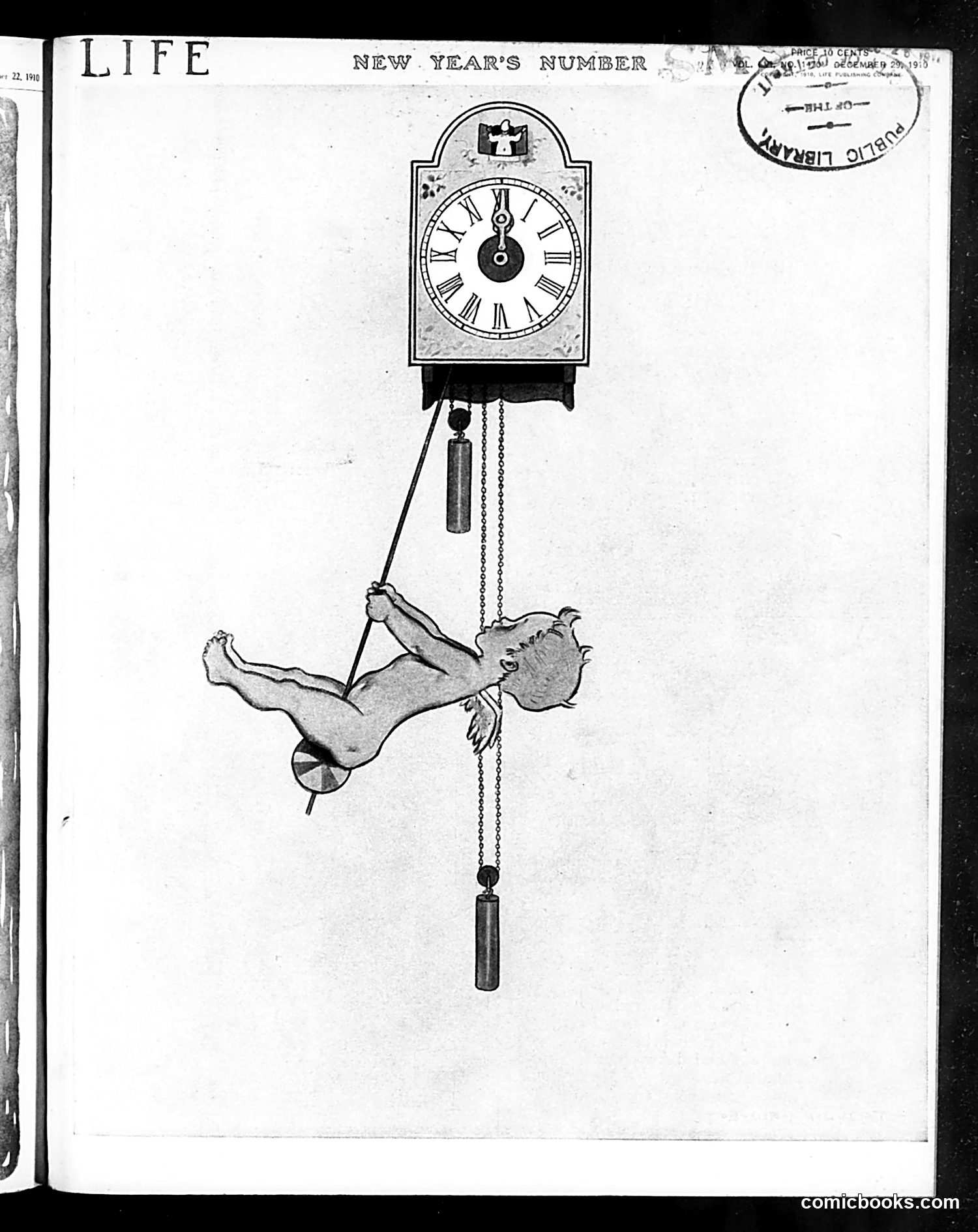
This is *Life* magazine's New Year's issue cover featuring a cuckoo clock—a classic visual metaphor for time and new beginnings. A cherubic putto (baby figure) is suspended from the clock's chain mechanism, appearing to operate or be operated by the timepiece itself. The satire likely suggests that the coming year (appears to be around 1918 based on the visible date) will be controlled by or dependent upon timing and fate—a common New Year's anxiety. The cherub, typically symbolizing innocence or hope, is humorously portrayed as merely a mechanical component of time's inexorable march rather than as an agent of free will. The image plays on contemporary anxieties about human agency versus mechanical, predetermined forces shaping the future.
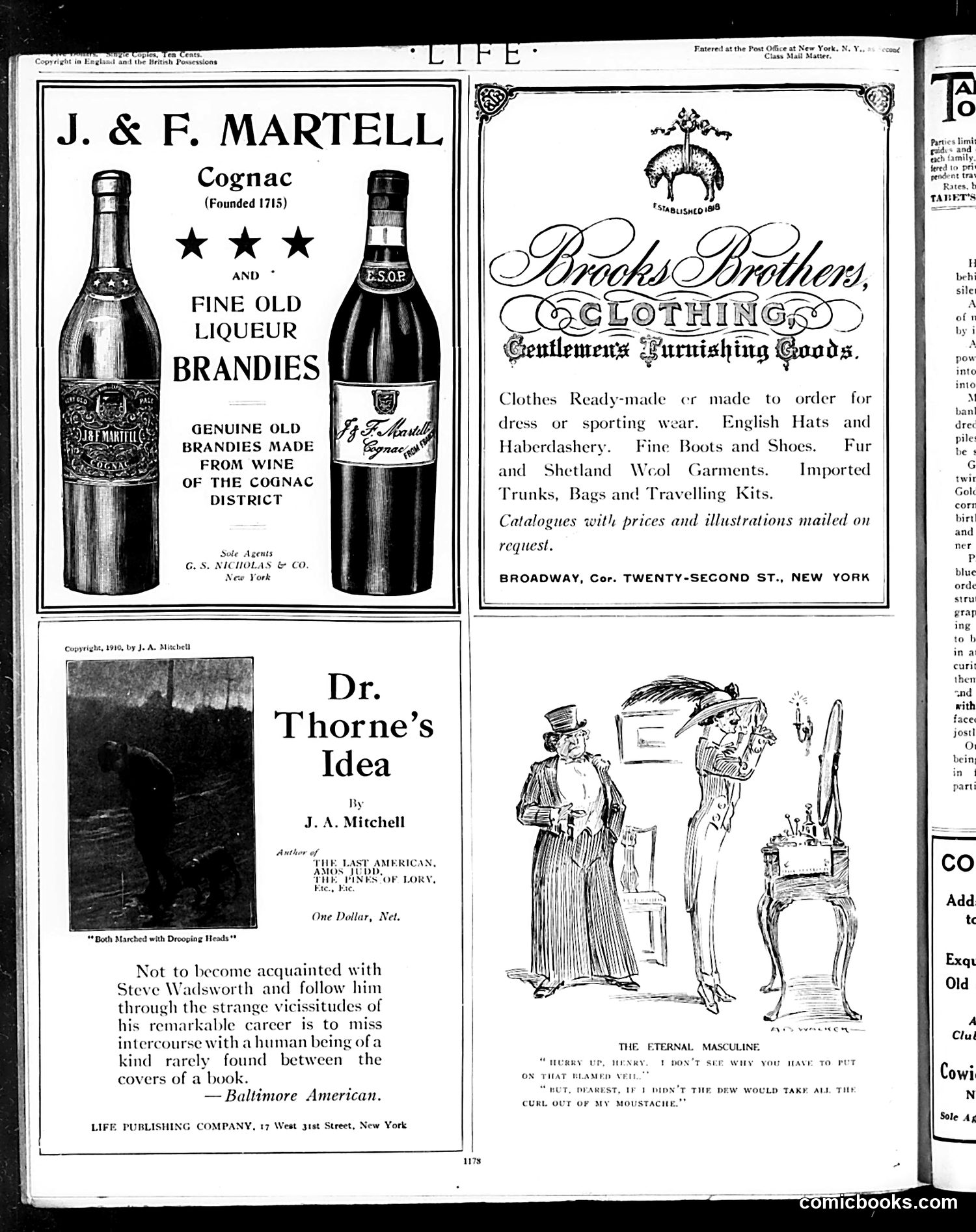
This page is primarily **advertising**, not political commentary. The upper advertisements promote J. & F. Martell Cognac brandy and Brooks Brothers clothing. The lower portion advertises "Dr. Thorne's Idea," a novel by J.A. Mitchell costing one dollar, published by Life Publishing Company. The only cartoon content appears to be a small illustration accompanying the book advertisement, captioned "The Eternal Masculine," showing two figures in what appears to be a humorous domestic scene about masculinity and grooming habits (mentioning a mustache curl). The Baltimore American quote promotes the novel as offering "strange vicissitudes" of intercourse between a unique character type rarely found in literature. This is primarily a book promotion rather than social satire.
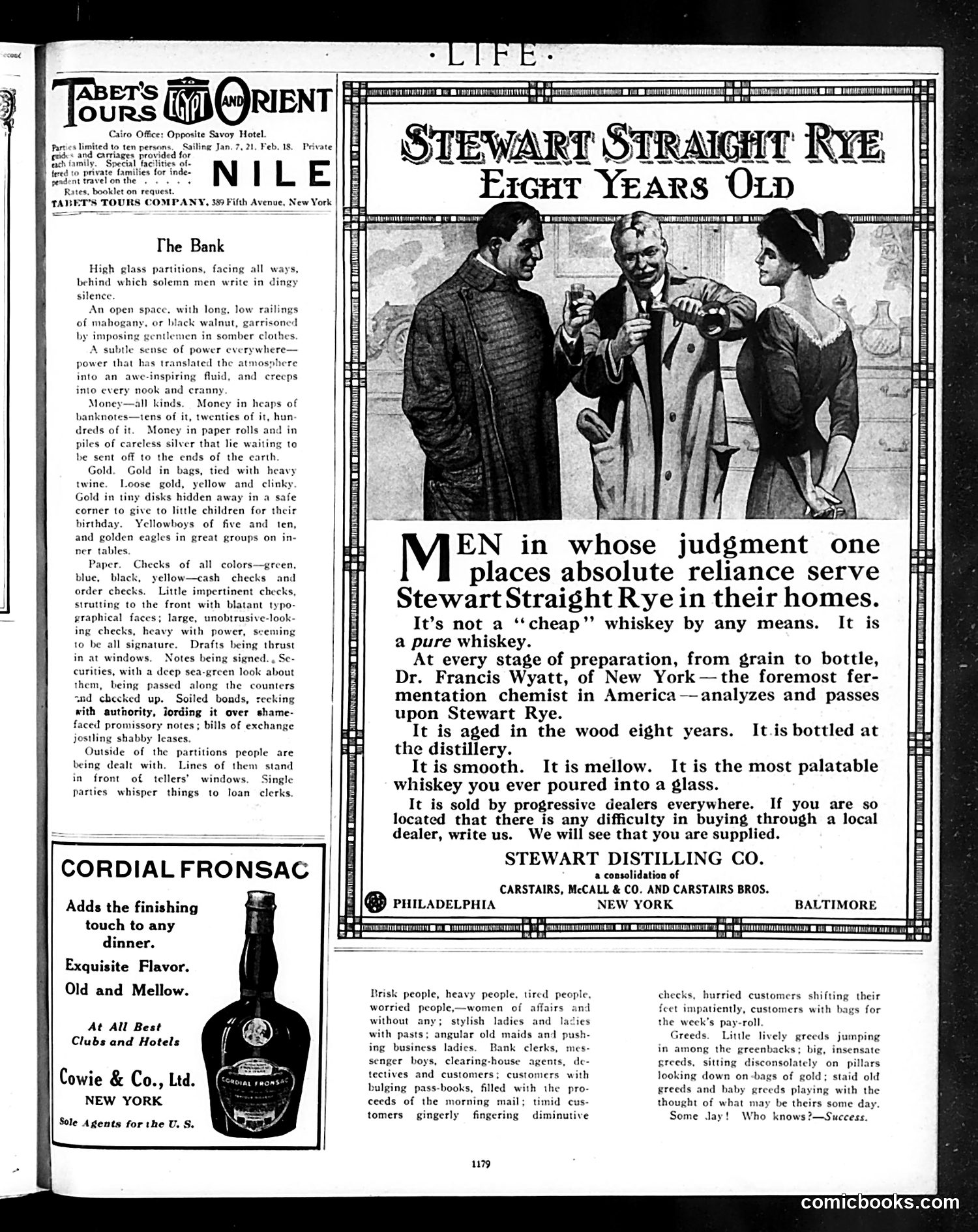
This page is primarily **advertising content**, not satire or political commentary. The dominant feature is a large advertisement for Stewart Straight Rye whiskey (eight years old), showing three well-dressed figures in what appears to be a social setting. The accompanying smaller ad promotes Cordial Fronsac liqueur by Cowie & Co., Ltd. On the left, "The Bank" appears to be descriptive prose about banking operations—not a cartoon. It reads as editorial or feature content describing the physical layout and atmosphere of a bank, including details about money, checks, and financial instruments. There is **no identifiable political cartoon or satire** on this page. The content reflects early 20th-century American magazine advertising and reflects the pre-Prohibition era's open promotion of alcohol.
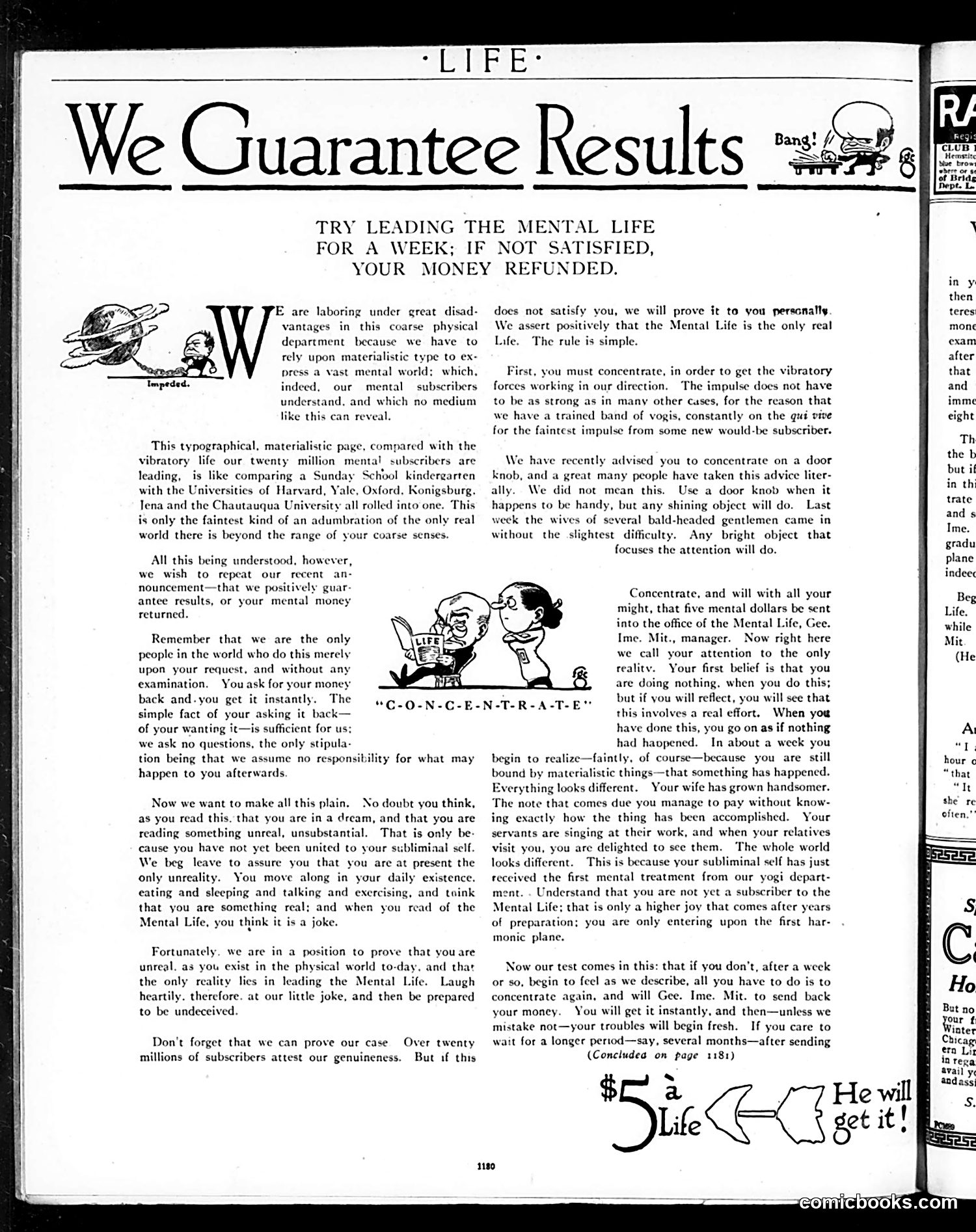
This page is primarily **advertisement disguised as editorial content** for "Mental Life," a mail-order self-help product costing $5. The satirical cartoon shows two figures labeled "C-O-N-C-E-N-T-R-A-T-E," appearing to be straining mentally. The satire targets the booming early-20th-century mail-order spiritualism and self-improvement racket. Life magazine mocks the absurd promise: concentrate on a doorknob for a week, and if unsatisfied, get your money back. The text ironically acknowledges readers may think they're dreaming while reading this obvious con. The joke is that Life is publishing a blatant scam ad while openly admitting its fraudulence—simultaneously mocking both the product and the gullible audiences purchasing such schemes. The "$5 a Life" tagline plays on the desperation of buyers seeking quick personal transformation.
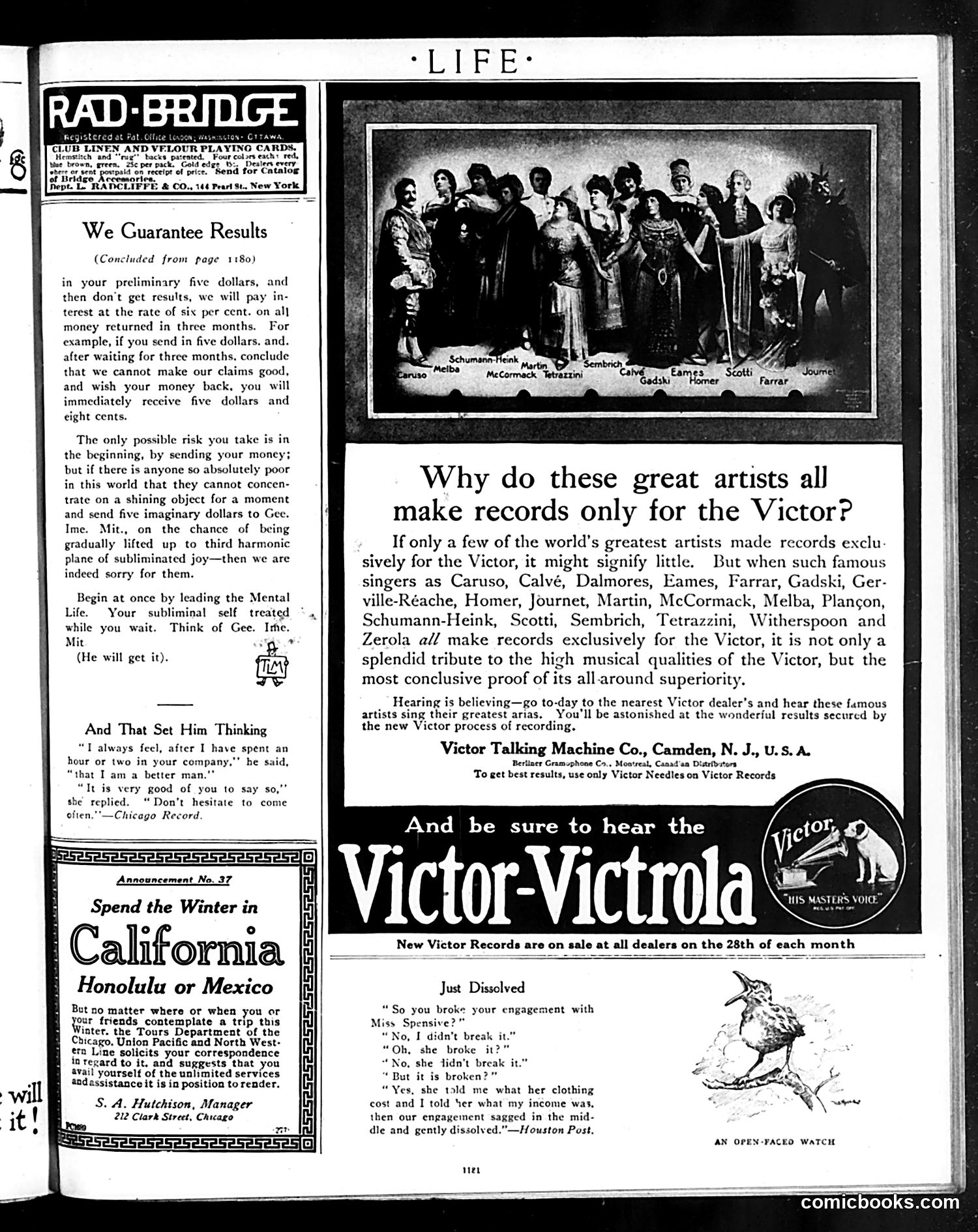
This page is primarily **advertising**, not satire or political commentary. The main content is a **Victor Victrola advertisement** featuring a photograph of famous opera singers and classical musicians of the era (names visible include Caruso, Calvé, McCormack, Scotti, and others). The ad's central argument is that these "great artists" exclusively recording for Victor proves the brand's superior recording quality. Below is a small humorous sketch titled "Just Dissolved" depicting a broken engagement—a light domestic joke about a woman breaking her engagement because her fiancé disclosed his modest income. The left side contains travel and investment advertisements unrelated to the main content. This page represents typical early 20th-century magazine advertising and light humor rather than political or social satire.
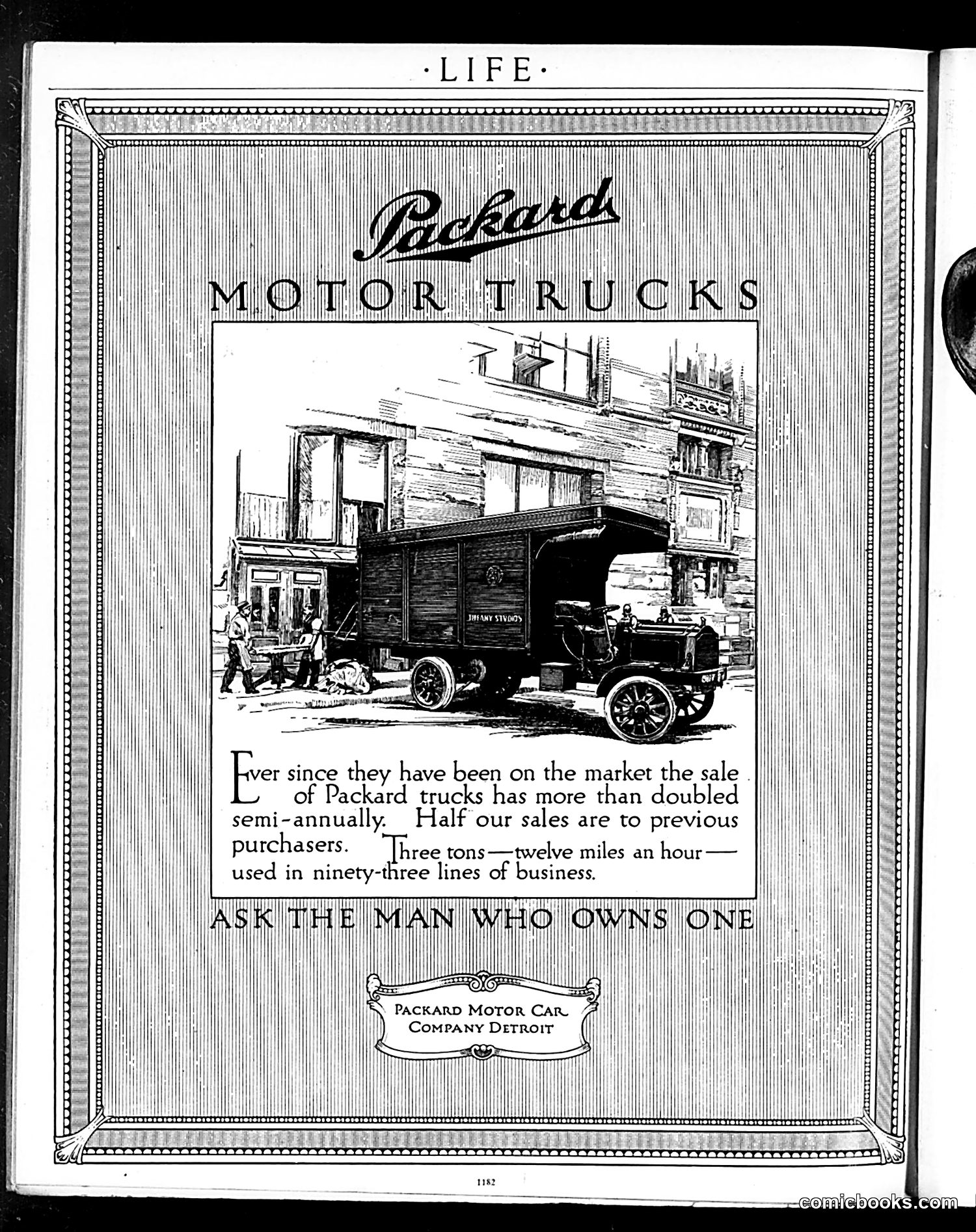
This is **not satirical content** — it's a **straightforward advertisement** for Packard Motor Trucks, appearing in Life magazine. There are no political cartoons or caricatures to analyze. The ad emphasizes commercial success: Packard truck sales have "more than doubled semi-annually," with half of sales going to repeat customers. It highlights a specific model's capabilities: a three-ton truck achieving twelve miles per hour, used across ninety-three different business lines. The illustration shows a delivery truck outside a commercial building with workers loading cargo, depicting practical, everyday commercial use. The closing line "Ask the Man Who Owns One" was a classic advertising slogan of the era, appealing to customer testimonials rather than satire.
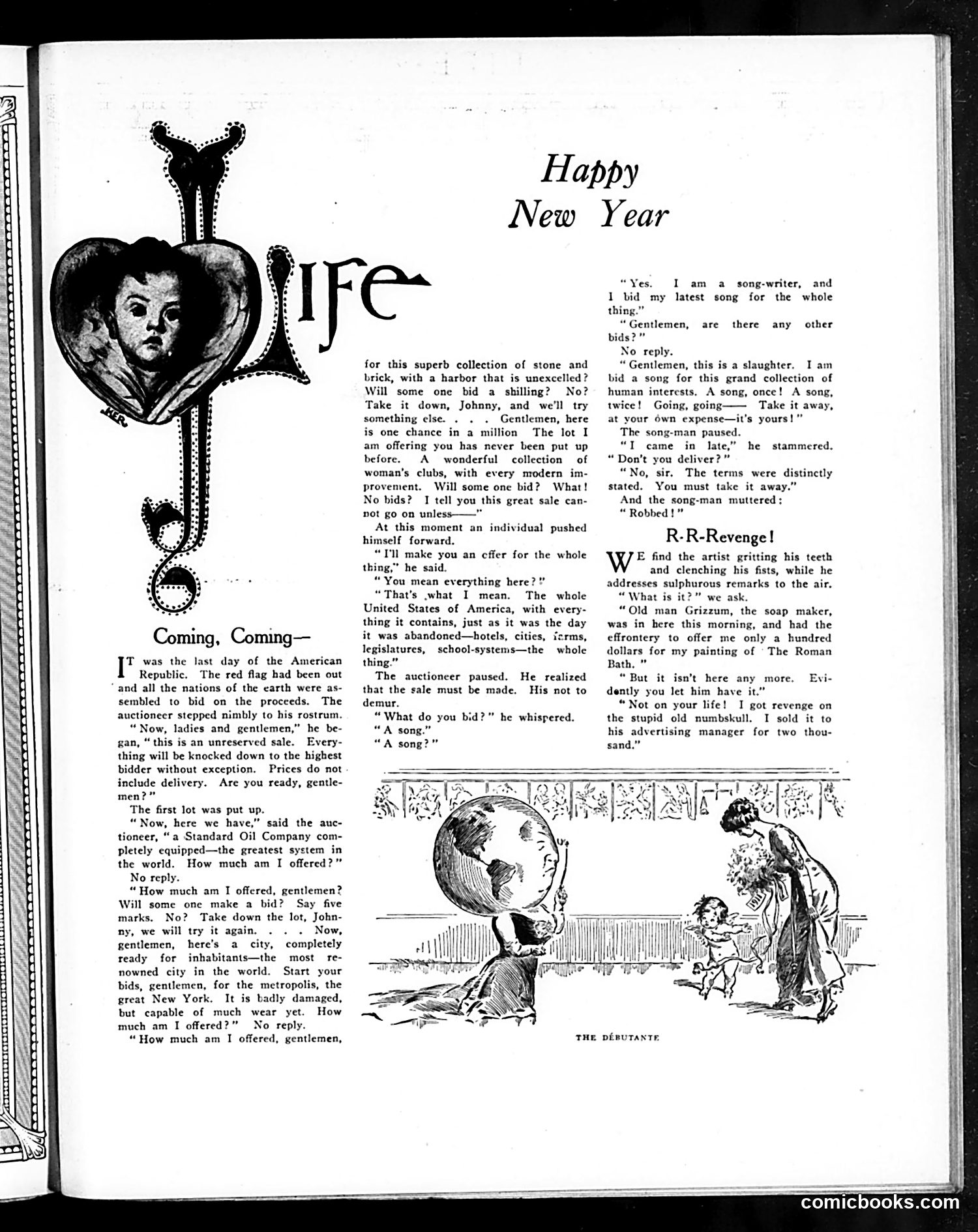
This page satirizes the final days of the American Republic through an auction scenario. An auctioneer attempts to sell off the entire United States—"the whole thing"—to the highest bidder, offering everything from "hotels, cities, farms, legislatures, school-systems" to New York City specifically. The satire mocks the idea that America could be bought and sold like property. A song-writer bids on "the whole collection of human interests," suggesting artistic and cultural value were being commodified. The accompanying cartoon "R-R-Revenge!" depicts a debutante getting revenge on an old businessman (soap maker) by selling his Roman Bath advertisement to his rival for money, illustrating how personal vendettas could emerge in a commercialized society. The overall message critiques American materialism and the reduction of national ideals to mere transactions.
This page contains editorial commentary on two main political issues circa 1912: **Judicial Appointments**: The text criticizes President Taft's Supreme Court appointments, suggesting his judgment about selecting judges is poor—despite appointing competent individuals, his overall record as President would be "one grand, sweet song" only if he hadn't made judicial choices. **Senate Elections**: The article discusses the difficulty of selecting Democratic Senators in Ohio and New Jersey, expressing concern about machine bosses and "respectable nonentities" being nominated. It praises New Jersey's Hon. James Smith as a thoughtful choice. **Stamped Envelopes**: A separate item promotes legislation for stamped envelopes with return-request printing, positioning this as consumer-friendly and economical. The cartoons (small illustrations visible) appear decorative rather than substantively satirical.
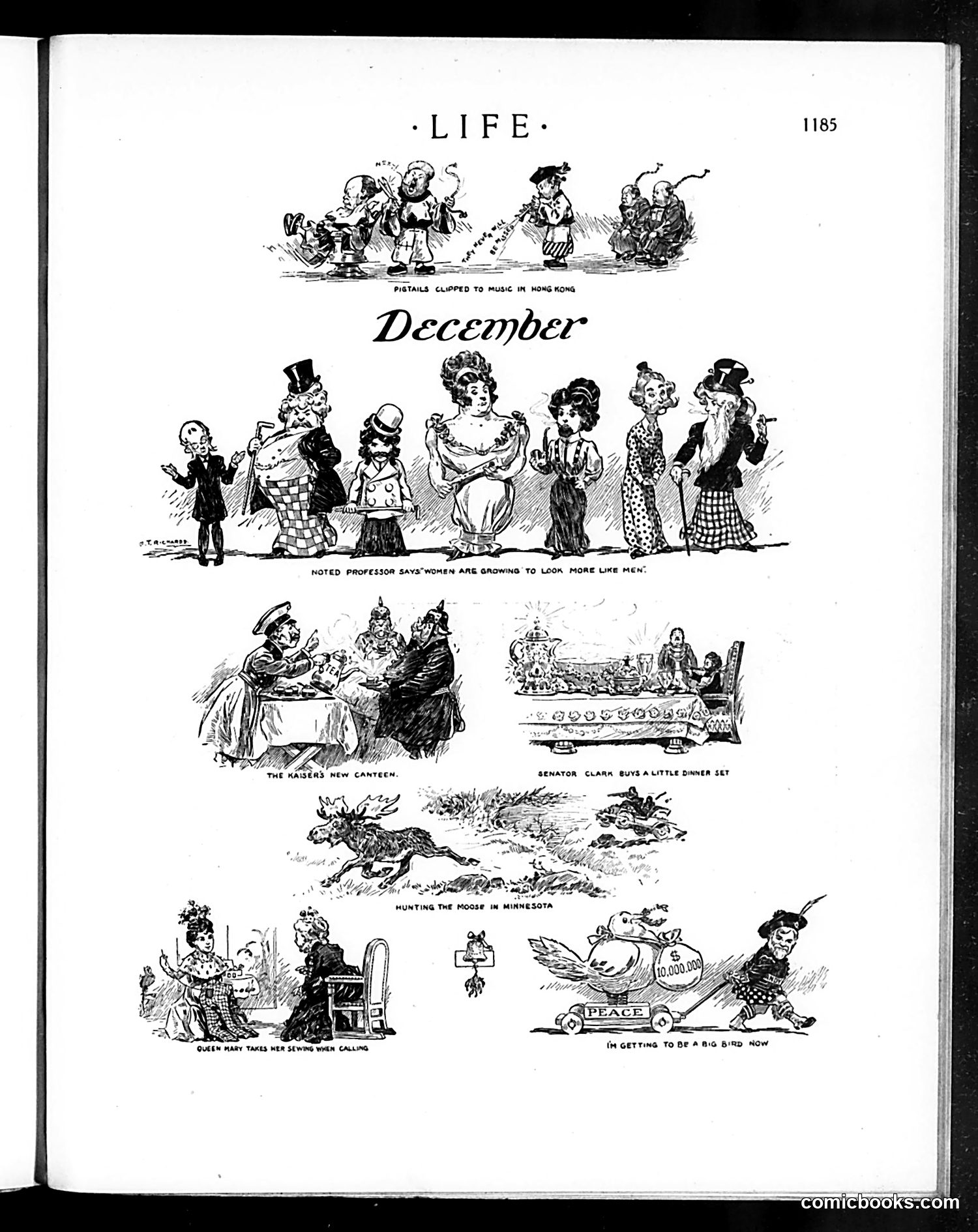
This December page presents six separate satirical cartoons on social and political topics: 1. **"Pistols Clopped to Music in Hong Kong"** (top): Appears to mock colonial military conduct in Hong Kong. 2. **"Women Growing to Look More Like Men"**: A professor's observation illustrated by seven women in various fashionable outfits, satirizing changing women's fashion and appearance norms. 3. **"The Kaisers New Canteen"** and **"Senator Clark Buys a Little Dinner Set"**: Likely political satire regarding wealthy figures and consumption. 4. **"Hunting the Moose in Minnesota"**: Unclear reference, possibly mocking a notable hunt. 5. **"Queen Mary Takes Her Sewing When Calling"** and **"I'm Getting to Be a Big Bird Now"**: Appear to mock upper-class social customs and pretension. The page exemplifies *Life*'s characteristic blend of social commentary and visual humor targeting contemporary American society and politics.
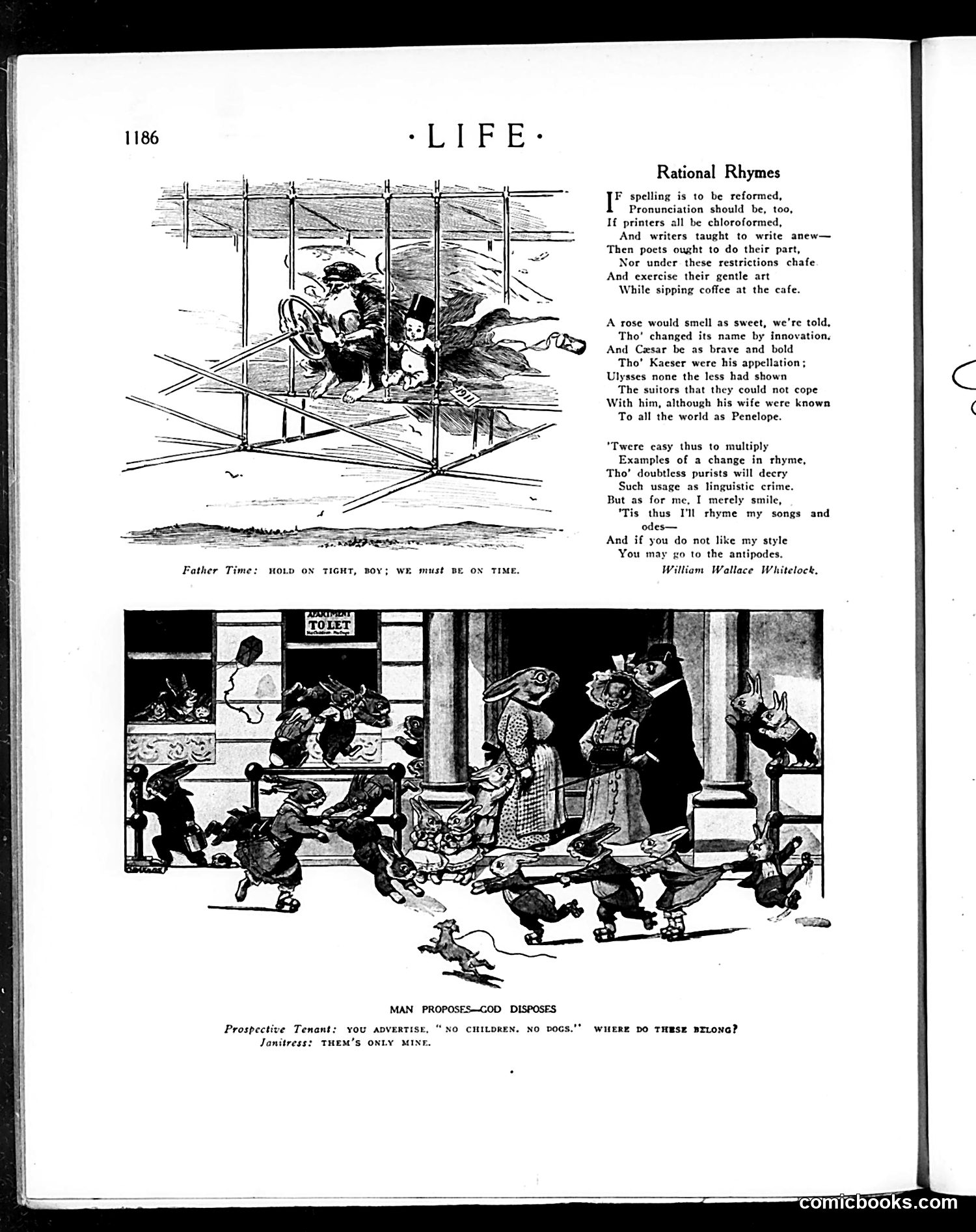
This page contains two satirical cartoons with accompanying poetry by William Wallace Whitelock. **Top cartoon** ("Father Time"): Shows figures in a streetcar or vehicle marked "ON TIME," satirizing punctuality and modern scheduling pressures. **Bottom cartoon** ("Man Proposes—God Disposes"): Depicts a chaotic domestic scene with multiple children and animals in what appears to be a landlord-tenant dispute. A prospective tenant advertises "no children, no dogs," while the janitor responds "them's only mine"—the joke being that the landlord's own unruly household contradicts the tenant's requirements. Both pieces mock social pretensions and the gap between ideal order and messy reality—recurring themes in early 20th-century American satire.
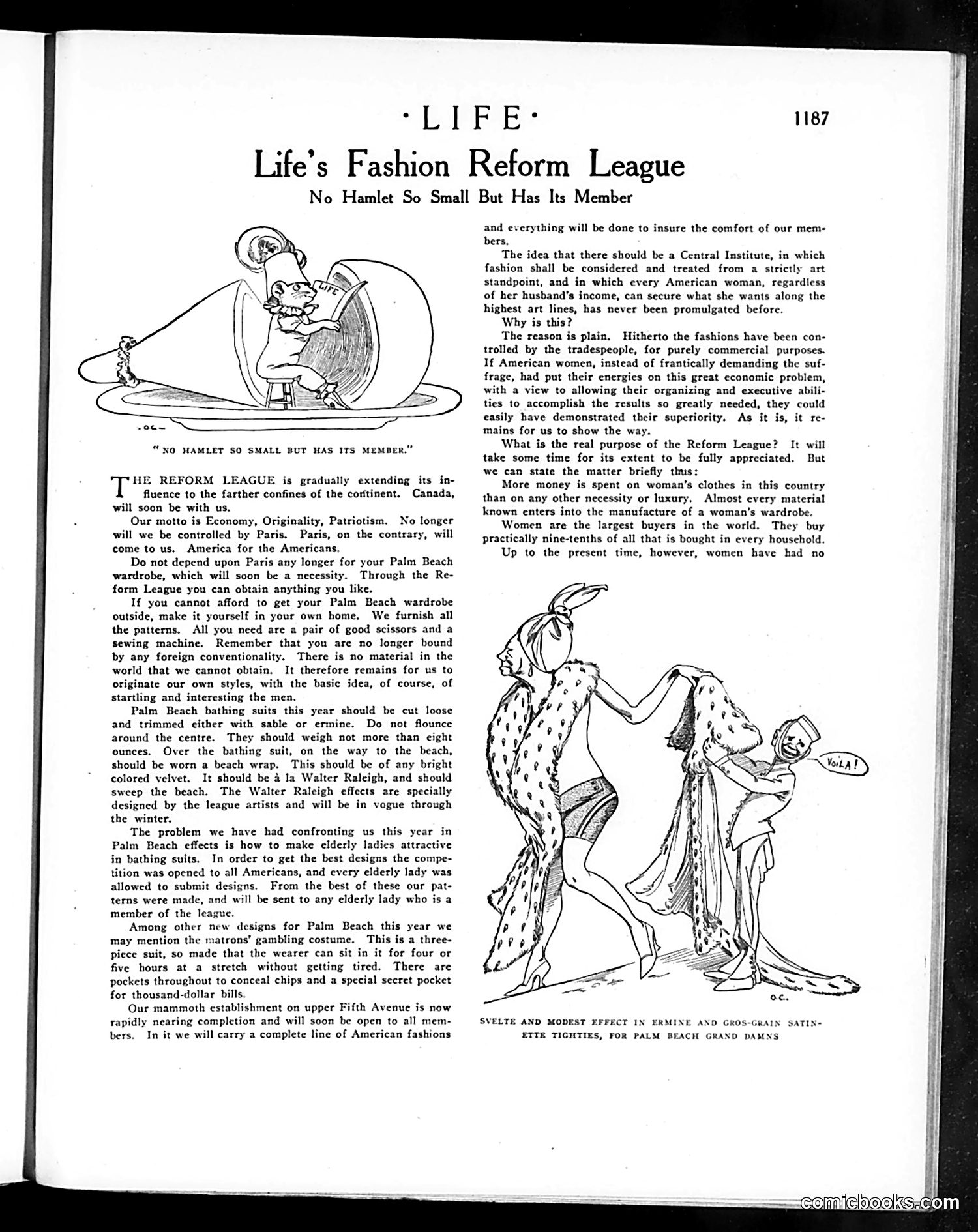
This satirical article mocks a women's fashion reform movement advocating for practical, American-designed clothing instead of European fashions. The cartoon at top shows a tiny figure inside an enormous hamper or basket—a visual joke about the "smallest" league member. The text sarcastically champions American fashion independence, claiming women should make their own clothes rather than depend on Paris. It proposes specific reforms: loose-fitting Palm Beach bathing suits weighing under eight ounces, and practical elderly ladies' designs. The lower illustration depicts women in exaggerated, unflattering beach attire—the "svelte and modest effect" mentioned in the caption—satirizing how the proposed reforms would actually look. The humor lies in presenting these restrictive, unstylish garments as progressive solutions to fashion excess.
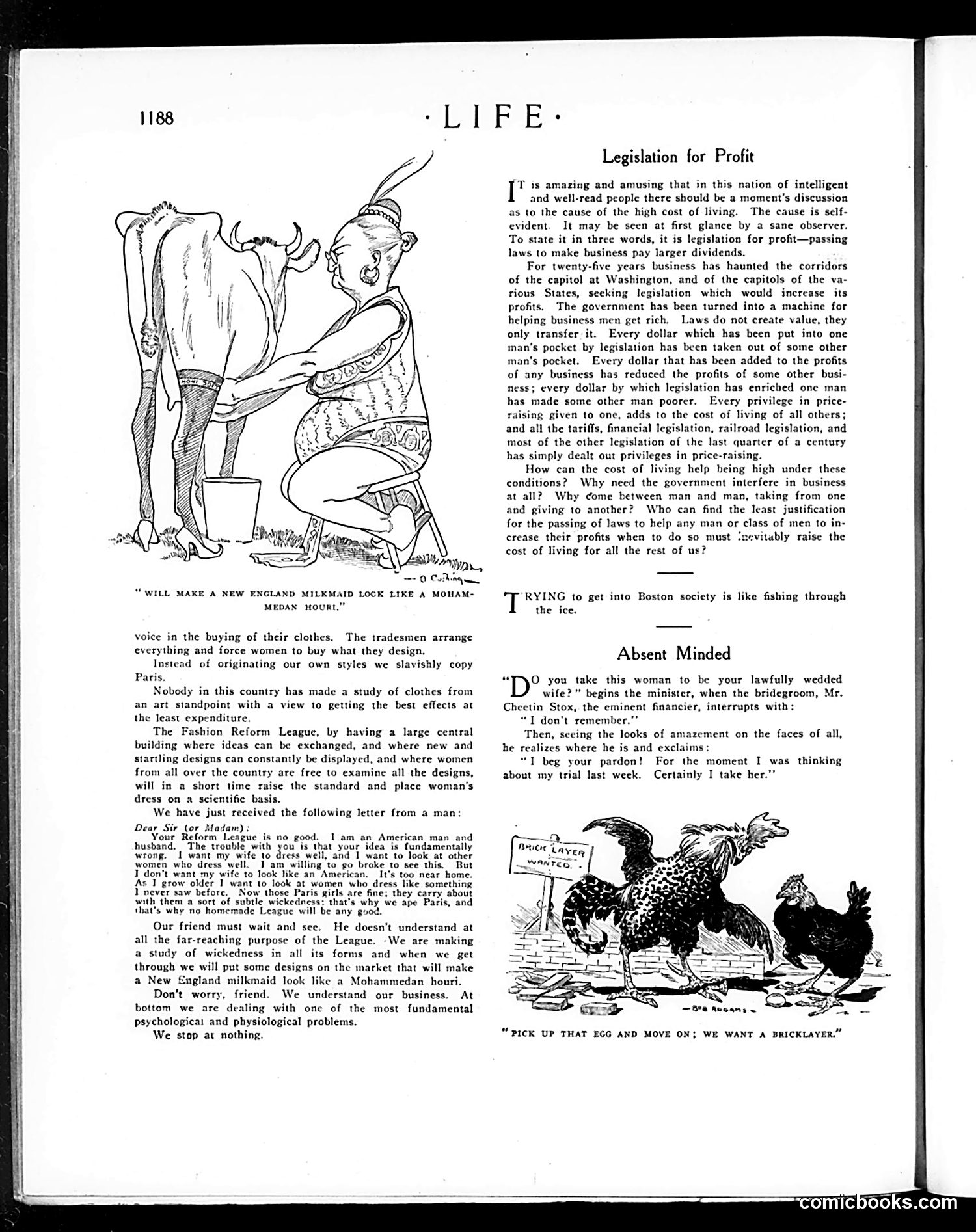
**Top Cartoon:** "Will Make a New England Milkmaid Look Like a Mohammedan Houri" This satirizes fashion trends and the Fashion Reform League's efforts to standardize women's dress. The figure on the left appears to be a traditional New England milkmaid; the caricatured figure on the right (with exaggerated features suggesting Middle Eastern aesthetics) represents an over-stylized, fashionable woman. The joke critiques how extreme fashion reform might make modest women look exotic or foreign—implying that standardizing dress could paradoxically make American women appear "un-American." **Bottom Cartoon:** "Pick Up That Egg and Move On; We Want a Bricklayer" Shows a rooster with a sign reading "Block Layer" standing over an egg, with a figure ordering it away. This plays on the double meaning of "block layer"—a construction worker versus a chicken laying blocks/eggs—mocking occupational terminology or labor shortages of the era.
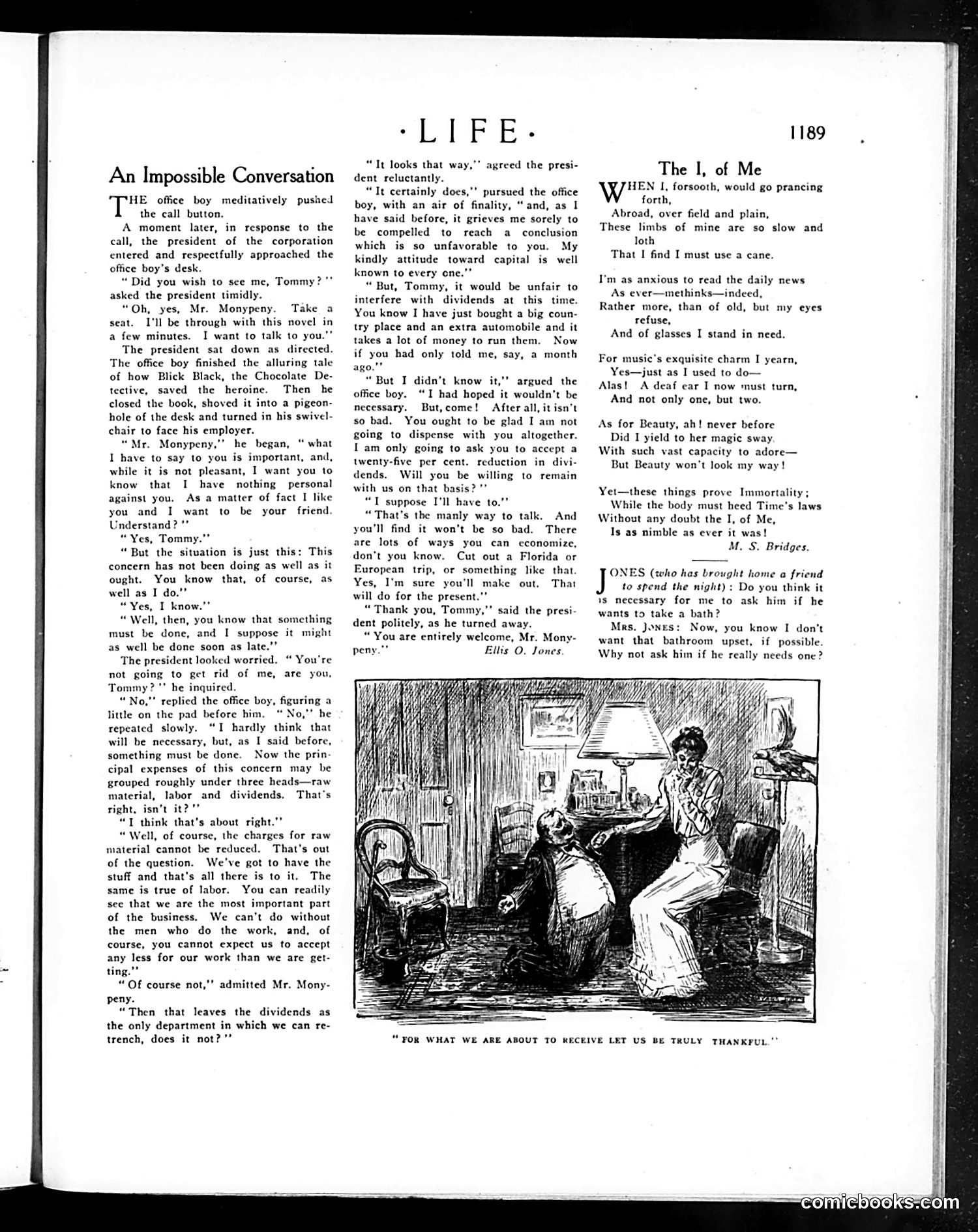
This page contains two distinct pieces: **"An Impossible Conversation"** is a satirical dialogue between an office boy and a company president about dividend cuts. The president argues the company must reduce dividends to cover labor and material costs, suggesting workers should accept pay cuts instead. The satire targets corporate greed—the president seeks to protect shareholder profits while shifting financial burdens onto workers. **"The I, of Me"** is a poem about physical decline and aging, touching on themes of mortality and dependency (needing a cane). **The illustration** (bottom) depicts an interior domestic scene with the caption "For What We Are About to Receive Let Us Be Truly Thankful," likely satirizing gratitude during economic hardship or scarcity—possibly Depression-era commentary on making do with less.
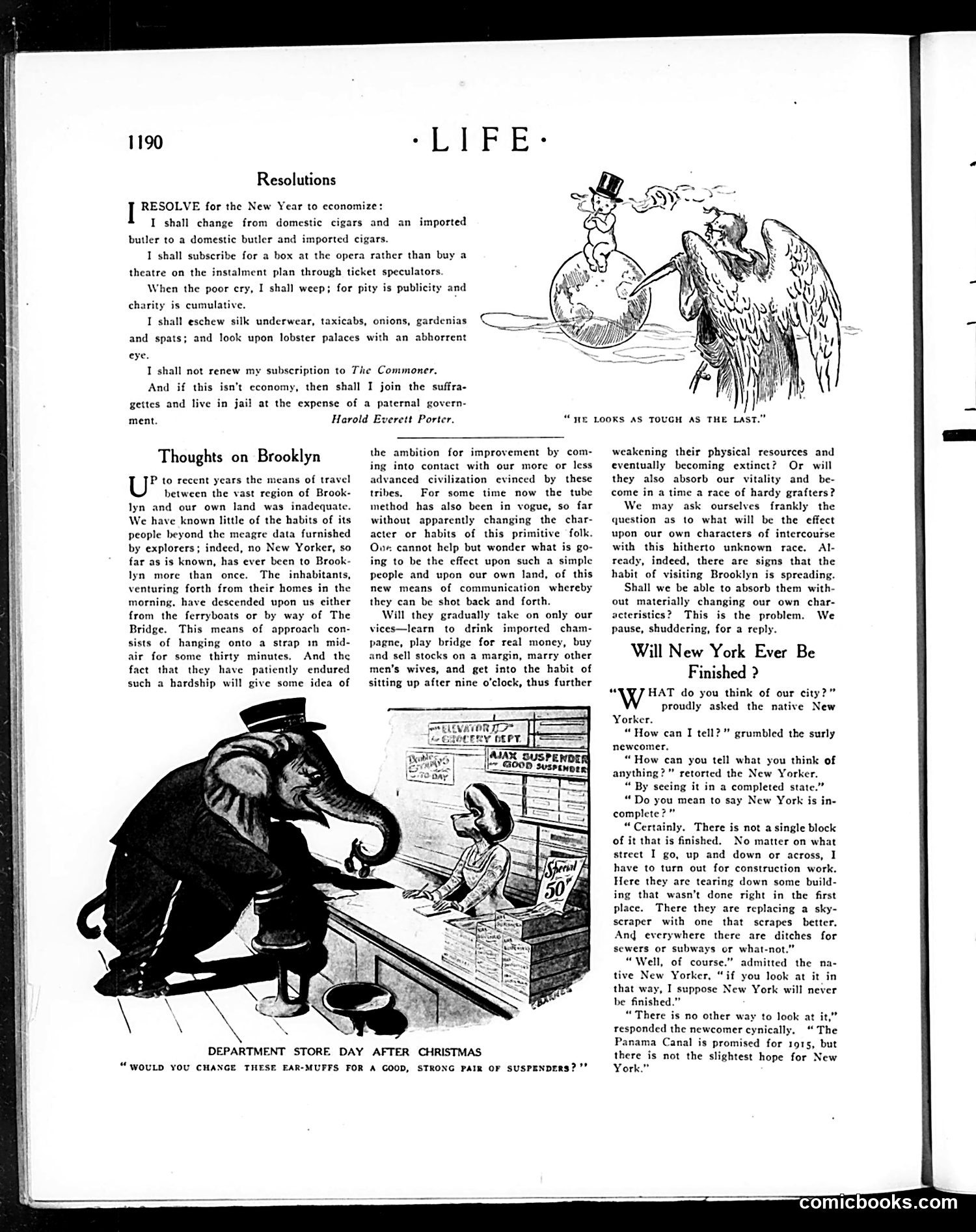
This satirical page contains three distinct pieces mocking early 1900s American upper-class pretensions and urban development: **"Resolutions"** (by Harold Everett Porter): A wealthy person's "economy" resolutions that reveal absurd class contradictions—switching from domestic cigars to imported ones, or domestic butler to imported butler. The joke satirizes how the rich's "economizing" merely shifts between luxury goods. The final jab at suffragettes and jail suggests mocking those advocating women's rights. **"Thoughts on Brooklyn"**: Condescending commentary treating Brooklyn as an exotic, "primitive" region whose inhabitants must be civilized by contact with Manhattan. It's satirical xenophobia within one city—mocking New Yorkers' snobbish dismissal of outer boroughs and their fears that Brooklyn residents will either corrupt Manhattan or become corrupted by it. **"Will New York Ever Be Finished?"**: A joke about NYC's constant construction and demolition. The newcomer observes buildings constantly torn down and rebuilt, questioning whether the city will ever be "complete." The native New Yorker admits it likely never will be—satirizing New York's perpetual chaos and obsessive self-improvement.
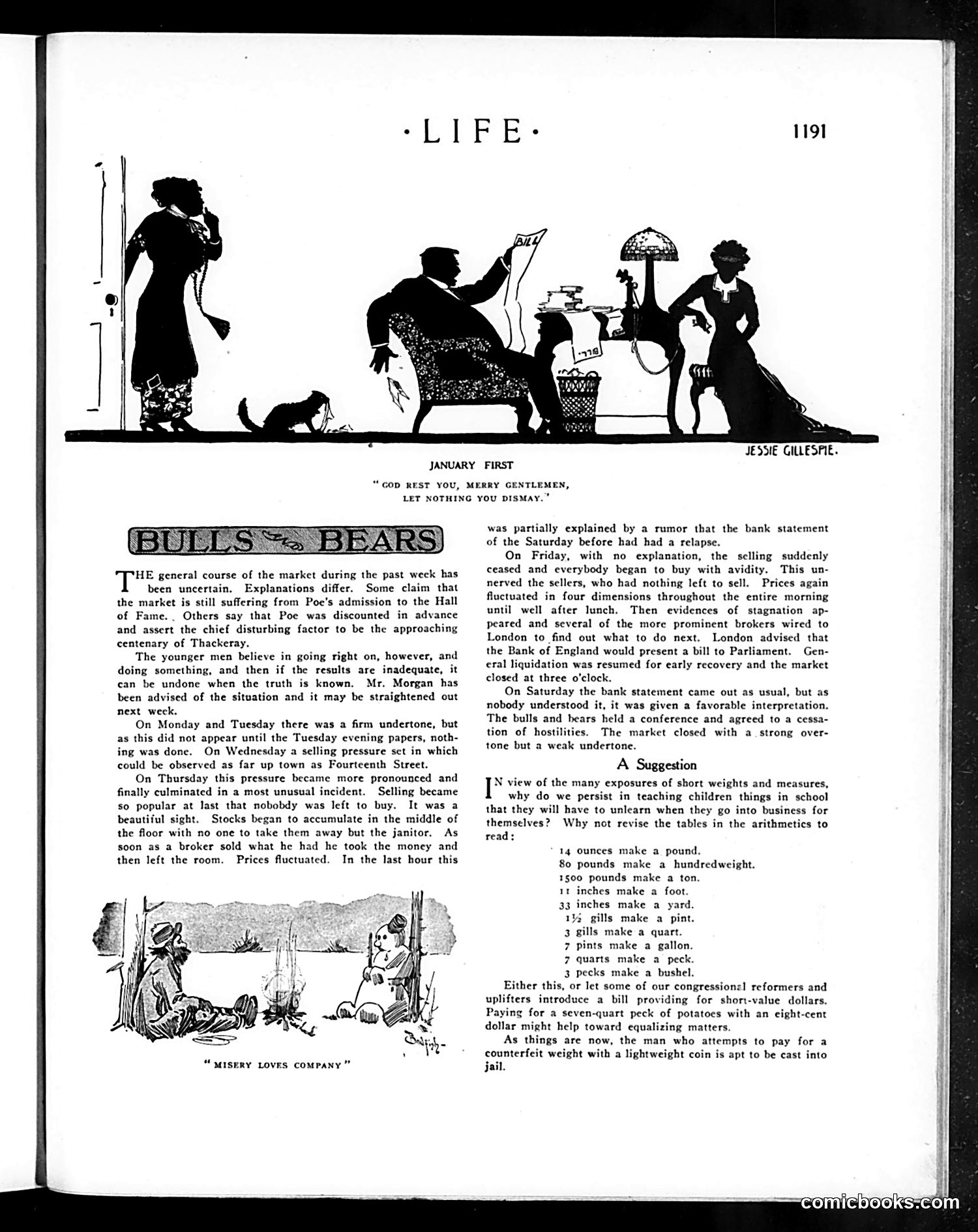
This *Life* magazine page satirizes early 1900s stock market volatility and commercial dishonesty. The "Bulls & Bears" section mocks the chaotic, irrational behavior of financial traders—prices fluctuating wildly based on rumors, banker telegrams to London, and collective panic rather than logic. The humor lies in describing absurd outcomes: brokers abandoning stocks with no buyers, prices shifting in "four dimensions," and mysterious bank statements given "favorable interpretation" nobody understands. "A Suggestion" extends the satire to everyday commerce, noting that children learn honest weights and measures in school but encounter systematic short-weighting in actual business (short-changing customers). The proposal—officially teach false measurements, or alternatively legalize short-value currency—exposes the hypocrisy: current law punishes ordinary citizens for counterfeiting while merchants routinely cheat. The satire suggests commercial dishonesty is so normalized that legalizing it might be logical.
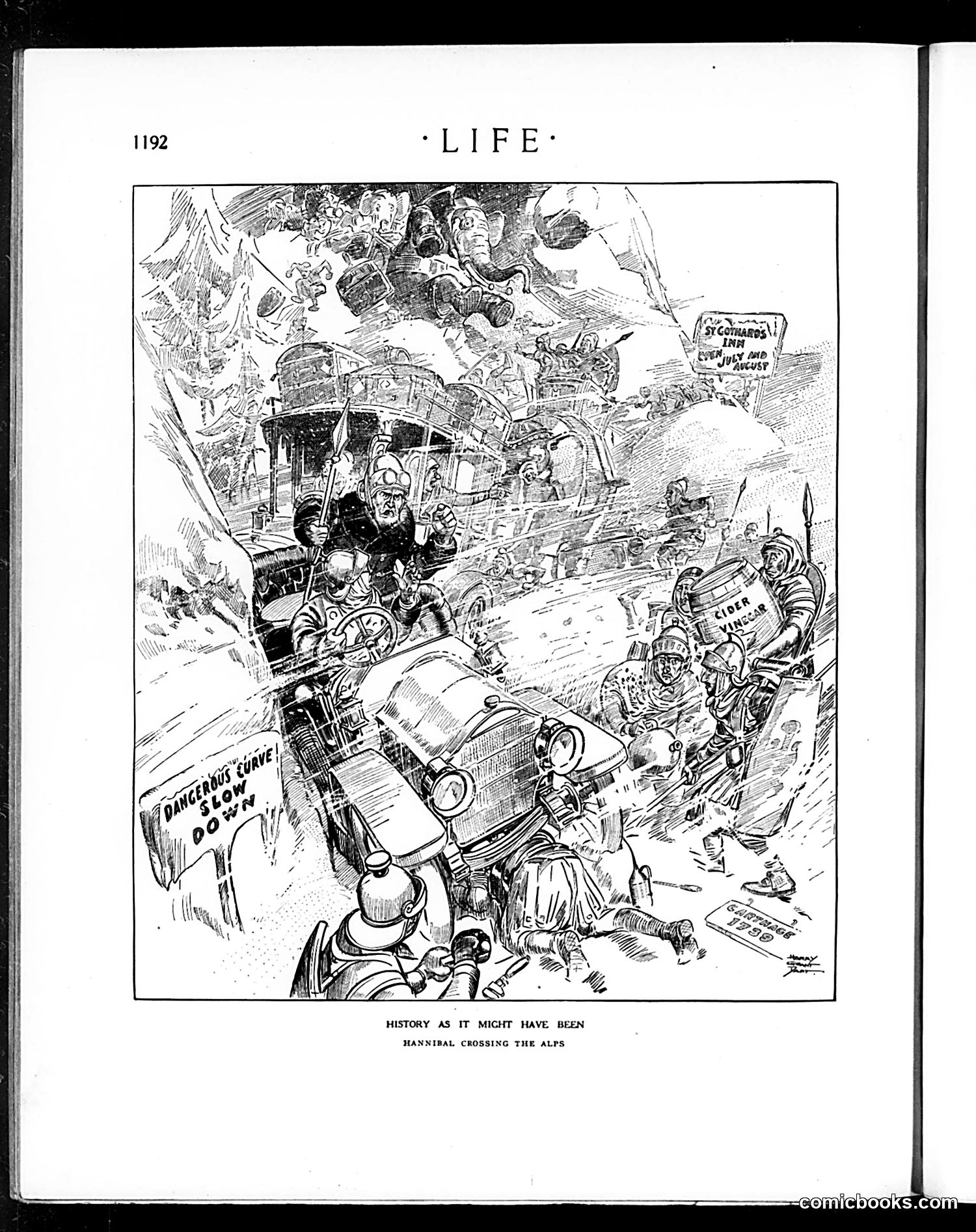
This cartoon satirizes modern automobile culture by reimagining the famous historical moment when Hannibal crossed the Alps with his army and elephants during the Second Punic War (218 BCE). Instead of ancient soldiers and war elephants, the image shows early automobiles, motorcycles, and modern tourists navigating a mountain pass, complete with warning signs like "Dangerous Curve" and "Do Slow." The satire appears to comment on how automobile travel was transforming leisure and adventure—what once required military conquest and elephants now involved motor vehicles and casual tourists. Signs visible suggest typical roadway warnings. The title "History As It Might Have Been" frames this as humorous alternative history, mocking both the grandiosity of ancient conquest and the mundane reality of modern motoring.
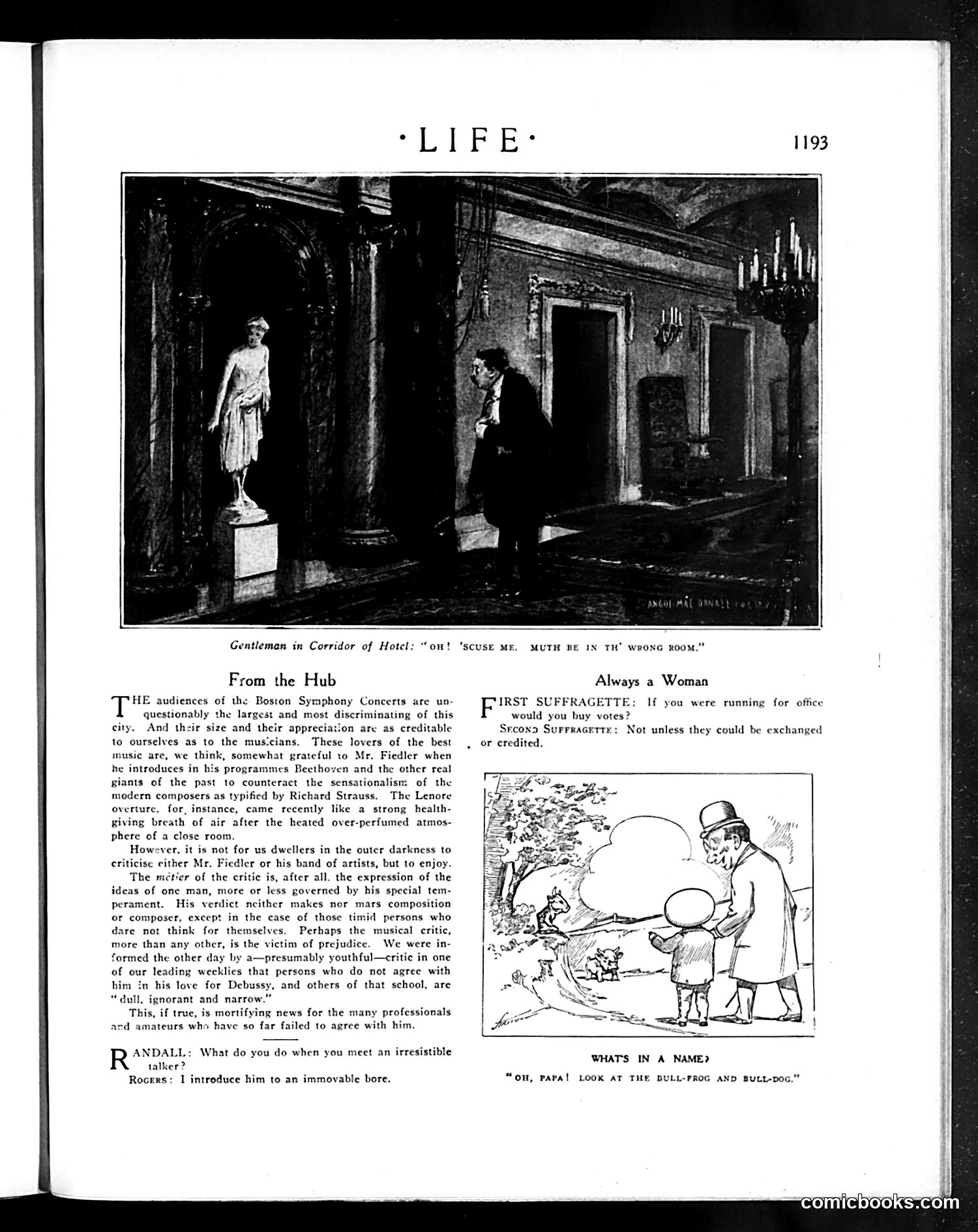
This page contains three distinct satirical pieces: **1. Hotel Corridor Scene (top):** A gentleman apologizes for interrupting, saying he must find the restroom. The humor relies on polite social awkwardness—the mundane bathroom need clashing with formal hotel etiquette. **2. "From the Hub" (left column):** A defense of Boston Symphony audiences and conductor Fiedler against musical critics. The piece mocks a young critic who dismisses those disliking Debussy as "dull, ignorant and narrow." The satire targets pretentious modernist music criticism of the era, suggesting critics' opinions shouldn't dictate public taste. **3. Two Short Jokes (right):** - *Randall and Rogers:* Meeting an unstoppable talker requires introducing him to an immovable bore—a classic paradox joke. - *Suffragette Exchange:* Two female suffragists discuss vote-buying in elections. The humor reflects early-20th-century women's suffrage activism and suggests women voters might apply commercial logic ("exchange or credit") to voting—satirizing both political corruption and emerging female political participation.
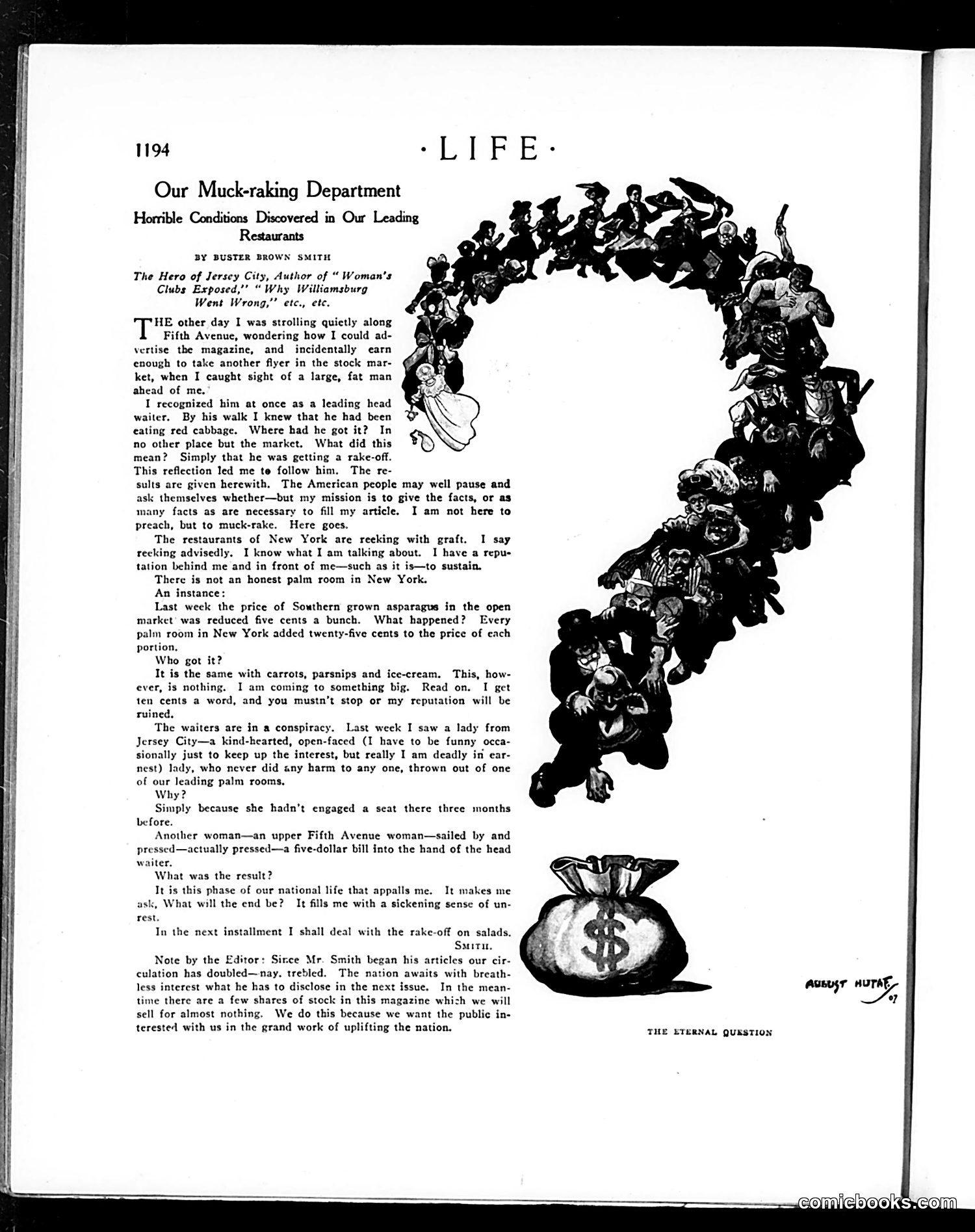
This satirical piece mocks the "muck-raking" journalism trend popular in early 20th-century America. The author, credited as "Buster Brown Smith," parodies investigative reporters who exposed corruption by claiming to have discovered restaurant graft—minor price-gouging schemes. The satire works on multiple levels: Smith's "evidence" (a waiter eating cabbage, slight food markups) is trivial compared to actual corruption. The editor's note further ridicules the premise by admitting circulation has "trebled" and attempting to sell magazine stock, suggesting the sensationalism drives profit rather than genuine reform. The cartoon titled "The Eternal Question" (showing a money bag) reinforces this critique. Life magazine itself is satirized as cynically exploiting public concern about graft for commercial gain—the very corruption it claims to expose. This reflects Life's satirical mission: mocking both corrupt institutions *and* the self-serving nature of the media claiming to reform them.
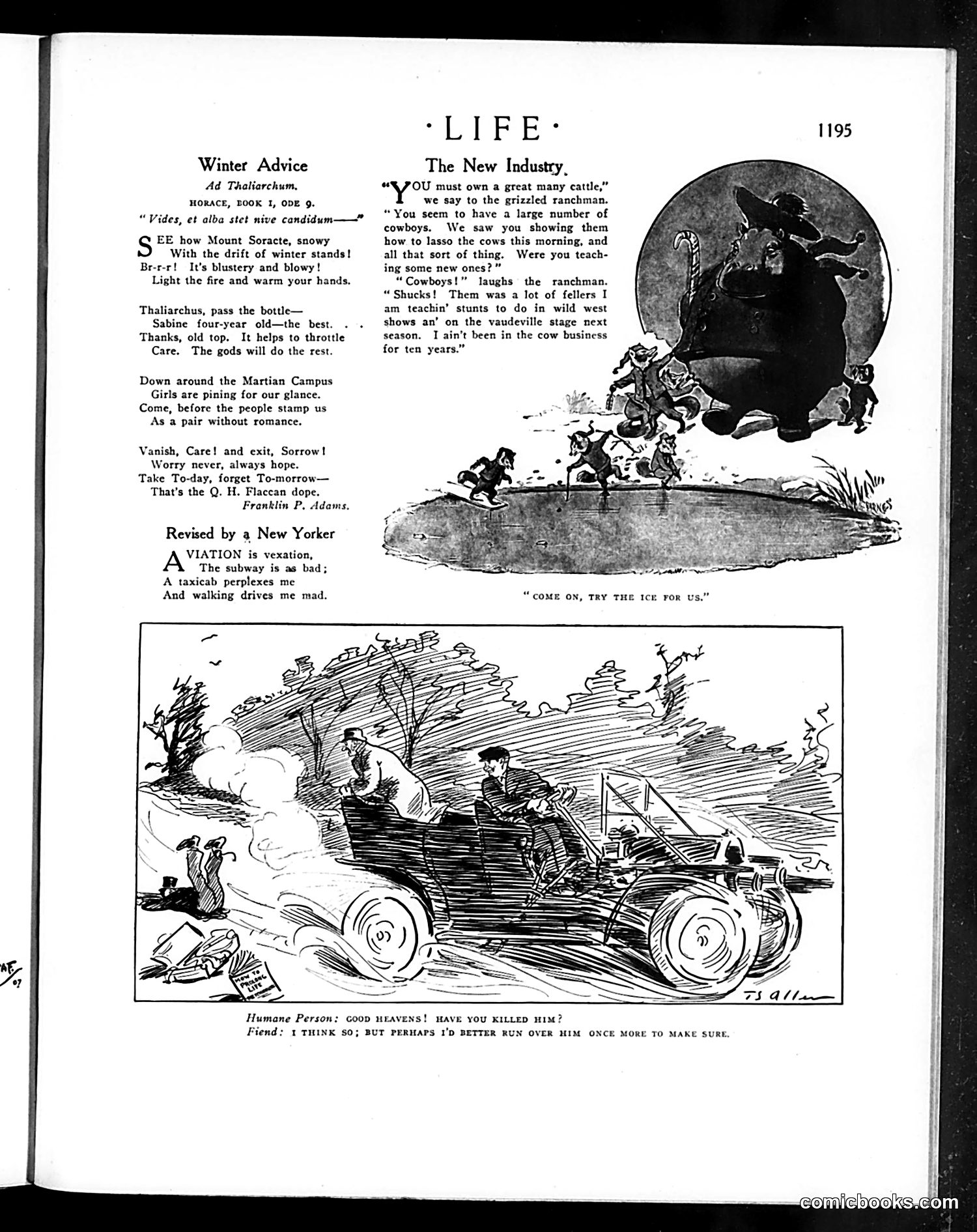
This *Life* magazine page contains several distinct satirical pieces: **"Winter Advice"**: A classical poetry piece (adapted from Horace) humorously counseling readers to enjoy wine, warmth, and romance rather than worry—typical *Life* magazine sophistication aimed at educated readers. **"Revised by a New Yorker"**: Mocks urban transportation complaints (subways, taxis, walking), suggesting modern city life creates constant frustration. **"The New Industry"**: The main cartoon satirizes the shift from authentic ranching to entertainment. A ranchman reveals he's abandoned cattle ranching to train performers for Wild West vaudeville shows—a commentary on how the romanticized "Old West" had become commercialized theater rather than actual occupation. This reflects early 20th-century anxiety about authenticity versus manufactured spectacle. **Bottom Cartoon**: Dark humor about a "humane person" and a "fiend" regarding roadkill, suggesting casual indifference to violence. The page reflects *Life*'s typical blend of literary sophistication, urban satire, and commentary on American cultural shifts.
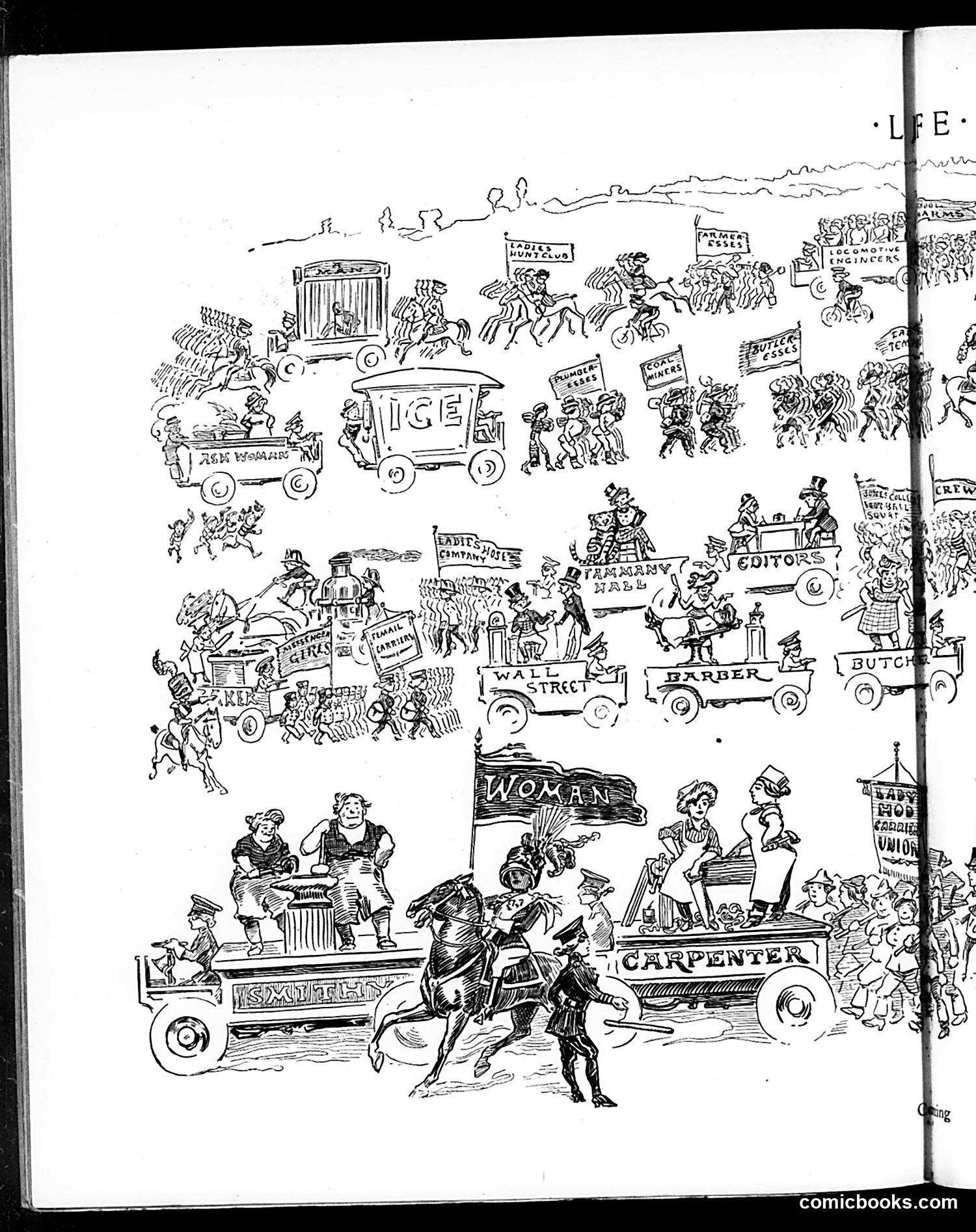
This appears to be a satirical illustration of a labor parade or procession, likely from the early 20th century. Various trade groups and professions are depicted as parade floats and marching contingents—including "Ice," "Wall Street," "Barber," "Carpenter," and others—alongside women's suffrage imagery (the prominent "Woman" banner and flag). The centerpiece features a woman on horseback, possibly representing labor activism or women's rights. The satirical point seems to critique either the diversity and chaos of competing labor interests, or perhaps mock women's inclusion in such demonstrations. The chaotic, densely-packed composition—with crowds, floats, and competing messages—suggests the cartoonist's skepticism about unified labor movements or progressive causes of the era.
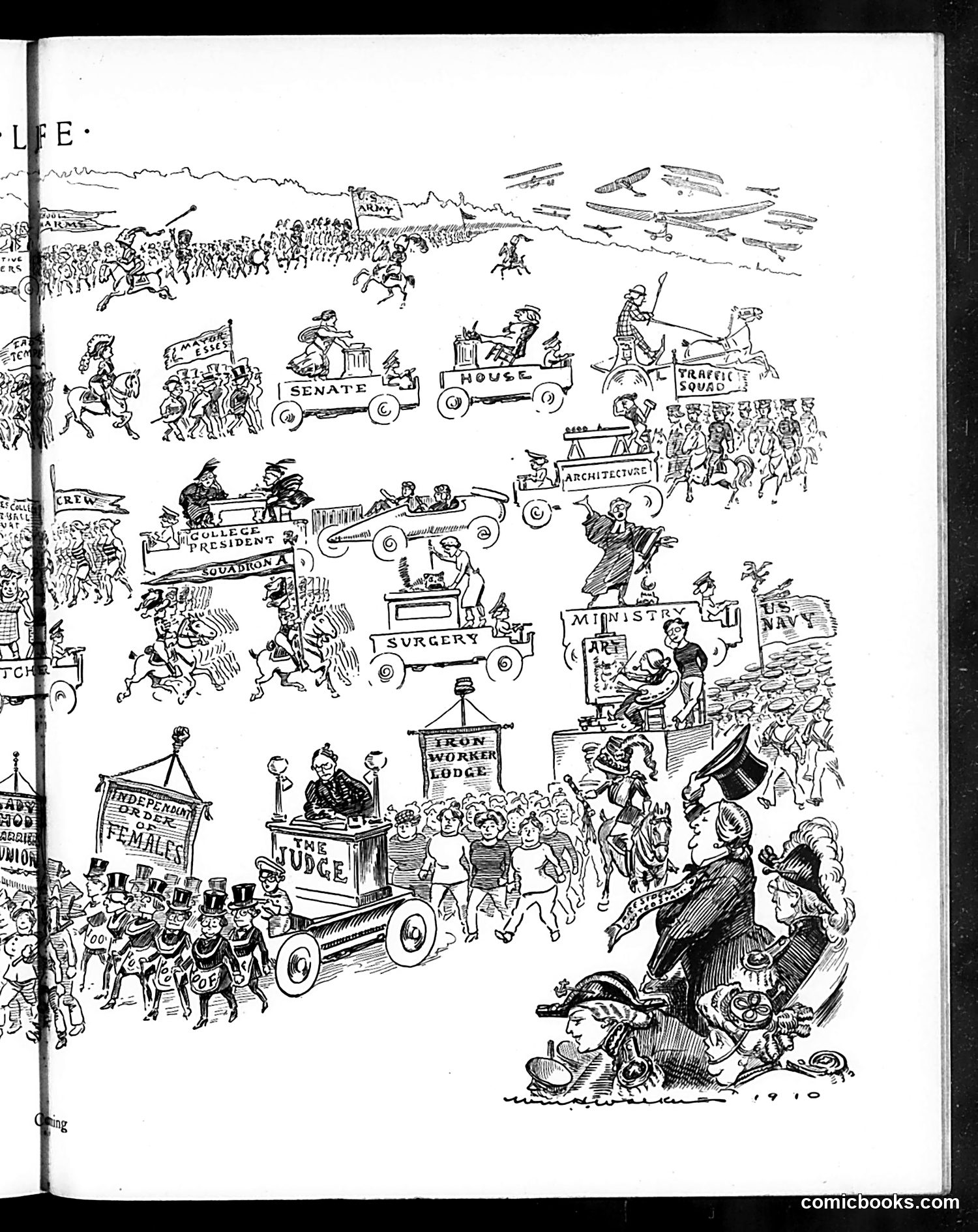
This is a satirical parade cartoon depicting various American institutions and professions as float participants. Visible labels include "Senate," "House," "Architecture," "Surgery," "Traffic Squad," "Ministry," "Navy," "College President," "Squadron," "Iron Worker's Lodge," "Judge," and "Independence" (with "Females" noted). The satire appears to mock the pomposity and self-importance of American government, professional, and civic organizations by depicting them in an exaggerated parade formation. Notably, the "Independence for Females" float suggests commentary on women's suffrage—a major political issue of the early 1910s era (the date appears to be 1910). The cartoon satirizes institutional pretension while highlighting contemporary debates about women's rights and political representation.
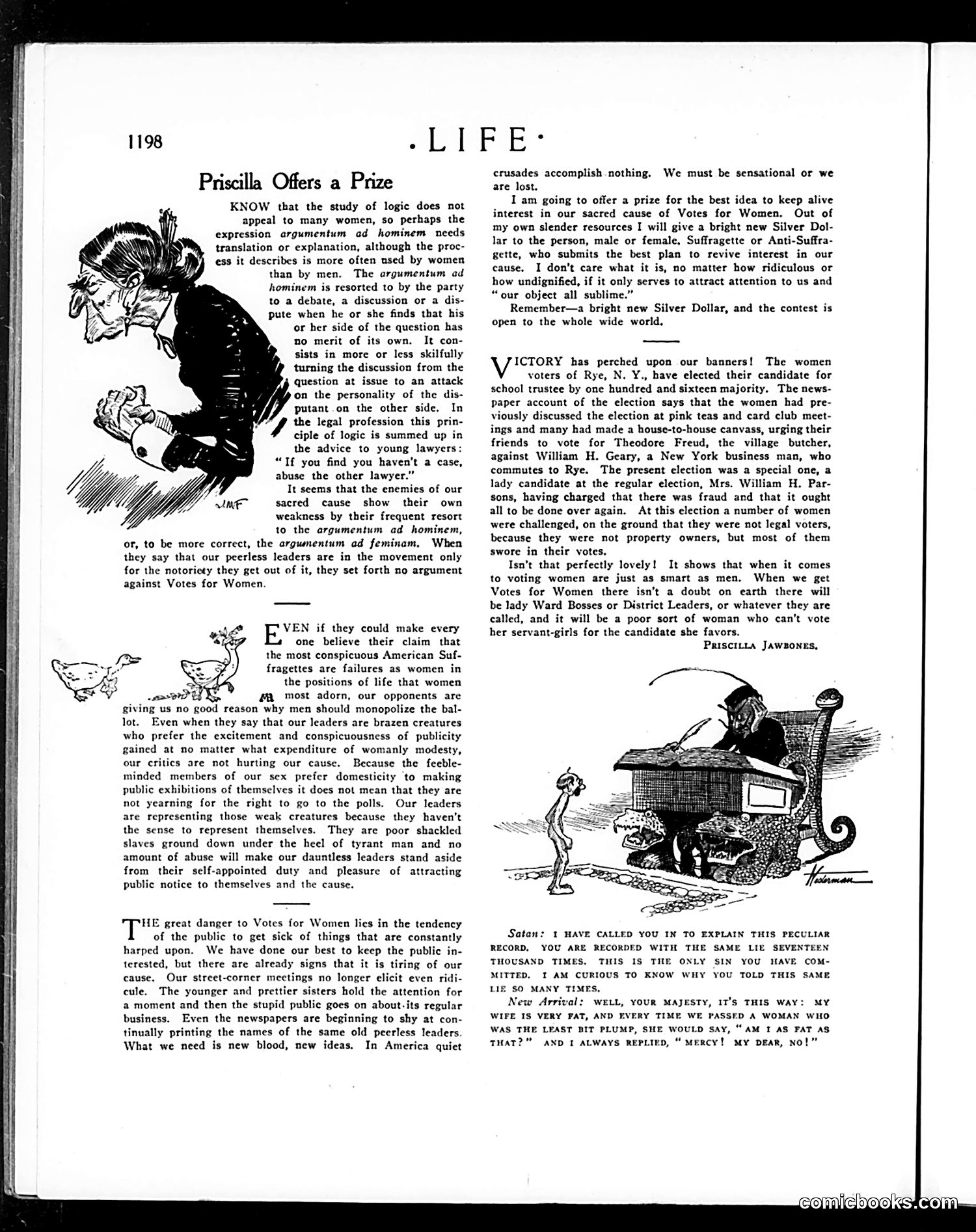
This page from Life magazine satirizes the women's suffrage movement through Priscilla Jaywones's commentary. The article attacks suffragists using the logical fallacy of *argumentum ad feminam*—attacking the character of female leaders rather than engaging substantive arguments for voting rights. Jaywones mocks suffragists as attention-seekers motivated by notoriety rather than principle, while simultaneously acknowledging their opponents use only personal attacks, proving suffragists have the stronger case. She then pivots, expressing concern that public interest in suffrage is waning, and offers a silver dollar prize for ideas to make the cause more "sensational." The accompanying cartoons (illustrating argumentum ad hominem through whimsical figures) visually reinforce the logical argument. The bottom cartoon shows a Sultan dismissing women voters based on their appearance rather than merit—ironically demonstrating the very ad hominem attacks Jaywones describes. The piece is fundamentally satirical: while appearing to support suffrage, it ridicules how both opponents and advocates prioritize spectacle over substance.
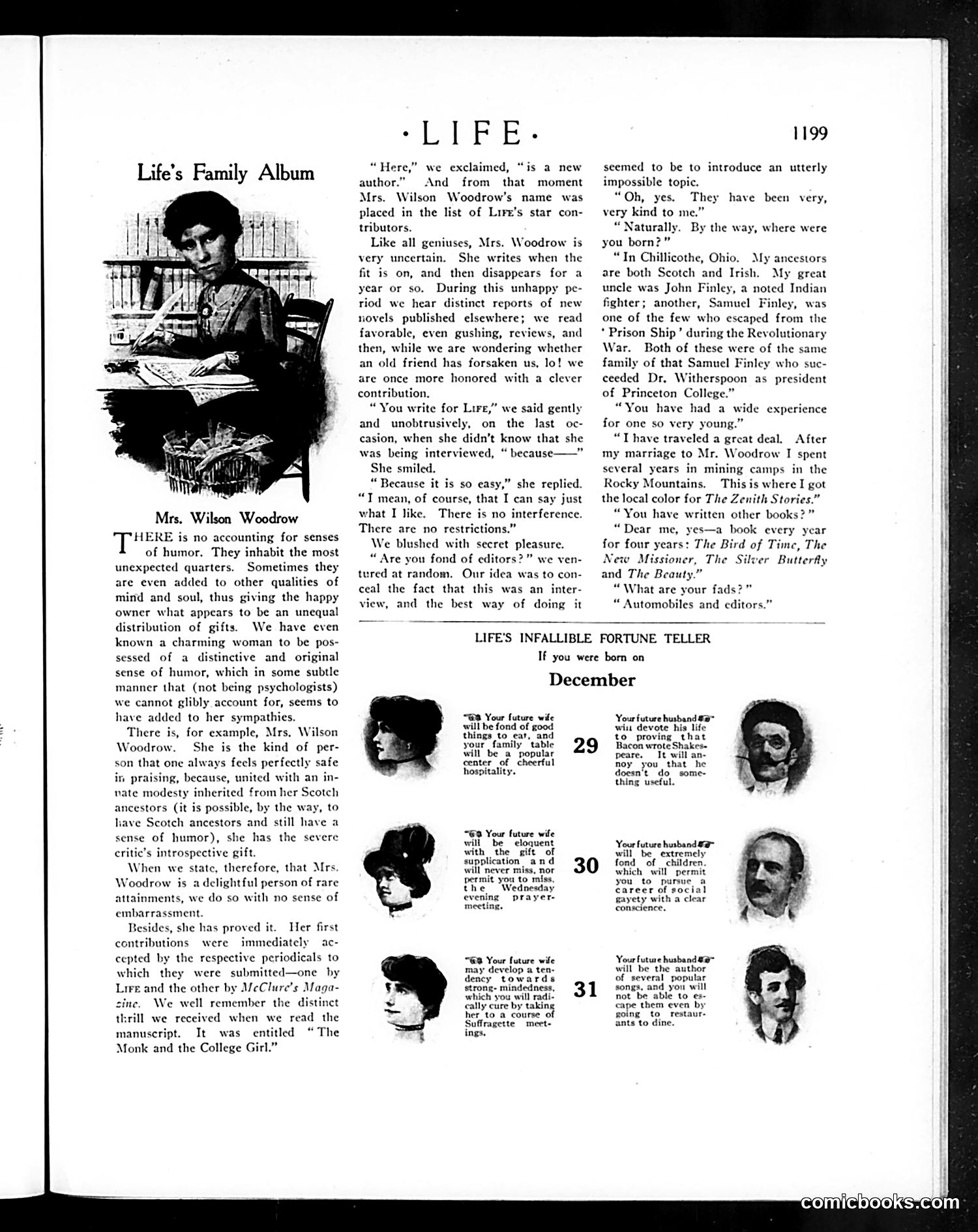
This page features a profile of **Mrs. Wilson Woodrow**, a magazine contributor to *Life* and *McClure's Magazine*. The piece humorously praises her as a talented writer with a distinctive sense of humor—a quality the editors claim is mysteriously rare among women. The biographical interview reveals she's descended from notable Revolutionary War figures and has lived in mining camps in the Rocky Mountains, experiences that informed her published novels (*The Bird of Time*, *The New Missioner*, *The Silver Butterfly*, *The Beauty*). The tone is gently satirical about her modest, productive temperament and her claim that she writes for *Life* "because it is so easy"—no editorial interference. The lower section, "Life's Infallible Fortune Teller," is an unrelated feature offering humorous predictions for people born in December, using period-appropriate stereotypes about wives and fate. The overall content celebrates literary contributions while gently mocking both the subject's modesty and magazine culture itself.
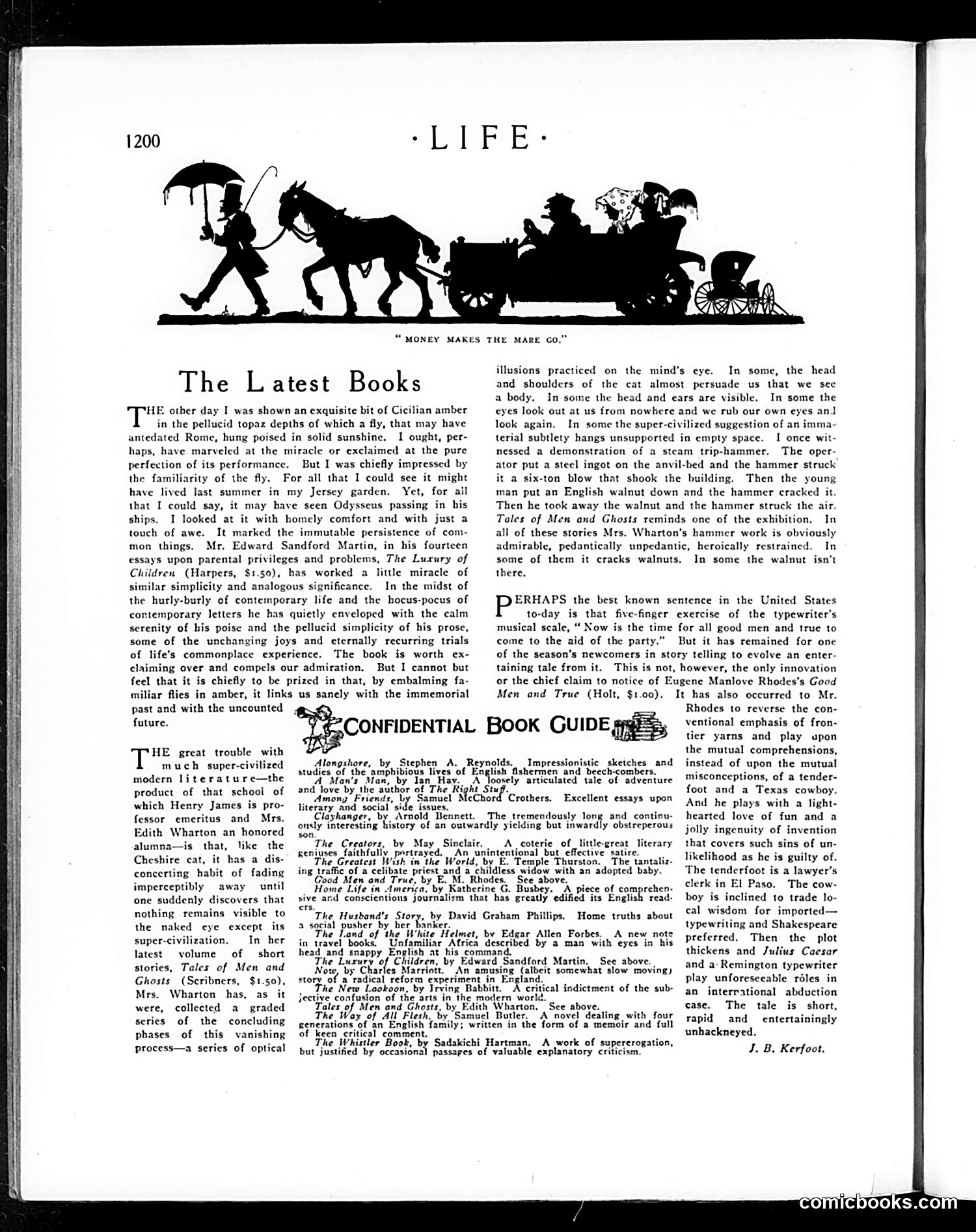
This page contains a book review section titled "The Latest Books" with a satirical silhouette cartoon at the top captioned "Money Makes the Mare Go" — depicting a man with an umbrella leading a horse pulling a cart of passengers, a visual pun on the proverb suggesting financial motivation. The reviews critique contemporary literature, particularly targeting Henry James and Edith Wharton's overly intellectual, abstract style. The critic compares Wharton's stories to optical illusions that fade away until "nothing remains visible to the naked eye except its super-civilization" — mocking how their work becomes so refined and abstract it loses substance and connection to real life. The reviews praise simpler, more grounded works: Martin's essays on parenthood and Rhodes's frontier stories that engage with authentic human experience rather than literary pretension. The satire suggests that early 20th-century "high literature" had become disconnected from ordinary life—a common complaint about modernist writers.
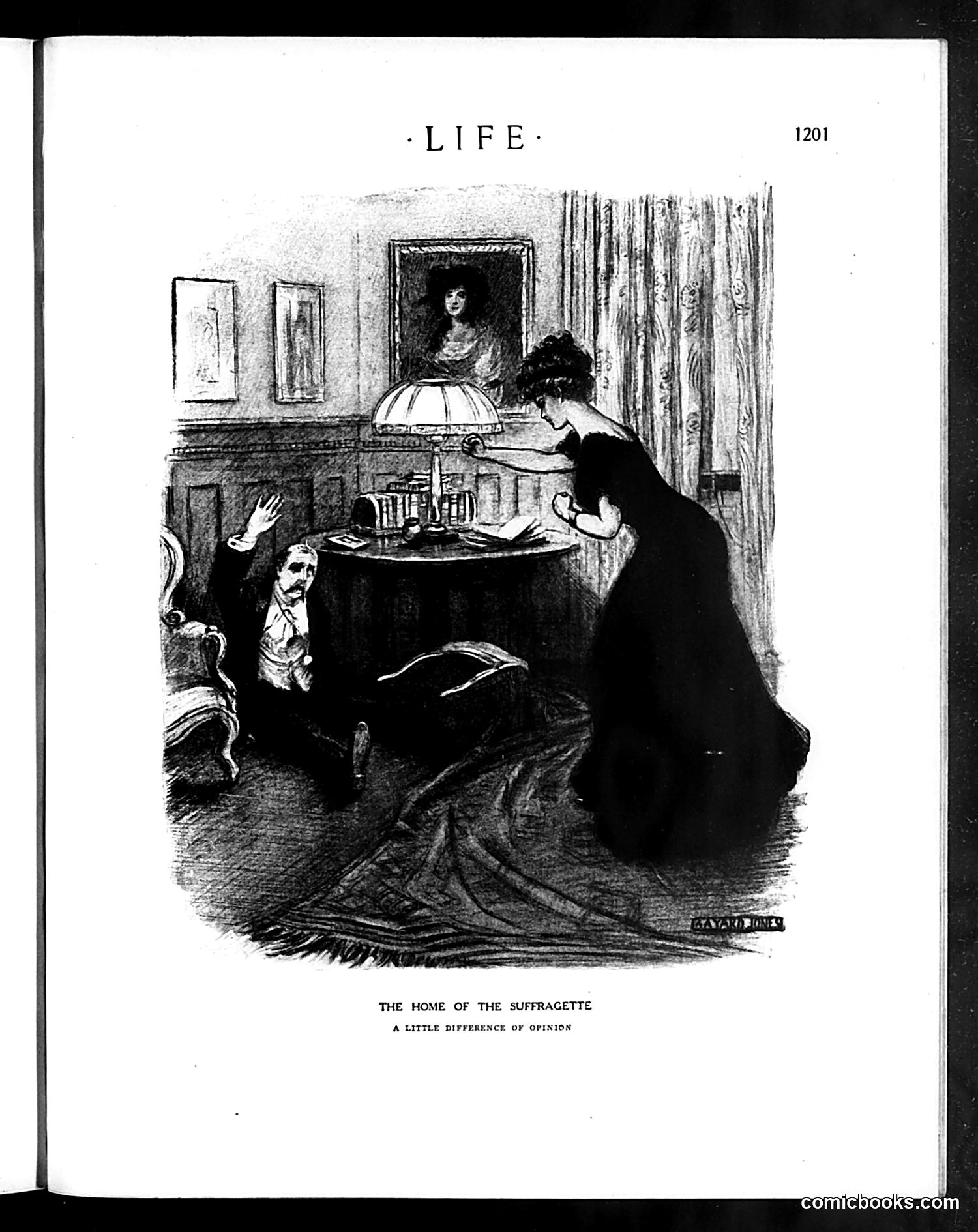
This satirical cartoon from *Life* magazine depicts domestic conflict over women's suffrage. The illustration shows a man seated in a chair with his arm raised in apparent exasperation, while a woman in dark clothing stands nearby gesturing toward a table. A portrait of another woman hangs on the wall above. The caption "The Home of the Suffragette: A Little Difference of Opinion" suggests marital discord centered on the suffrage issue. The cartoon satirizes pro-suffrage women by implying their political activism creates household tension and conflict with husbands or male family members who oppose women's voting rights. This reflects *Life* magazine's anti-suffrage editorial stance during the early 20th century, using domestic humor to ridicule the suffragette movement.
This page satirizes the women's suffrage movement through mock-Shakespearean verse and a humorous contest. The main piece, "Better Not!" parodies Hamlet's soliloquy, asking whether men should marry suffragettes—those demanding voting rights. The satire portrays suffragettes as domineering, opinionated, and threatening to male authority. Life then announces a real $300 prize contest asking readers to submit reasons why men shouldn't marry suffragettes. The published "reasons" mock suffragists as unfeminine, overly ambitious ("incubator" instead of mother), and threatening to men's domestic comfort and chivalry. This reflects pre-1920 anti-suffrage sentiment: the piece treats women's political participation as absurd and emasculating. The cartoon woman at top appears dismissive or argumentative toward the man, reinforcing the stereotype. The satire assumes readers share anxiety about women gaining political power and abandoning traditional domestic roles.
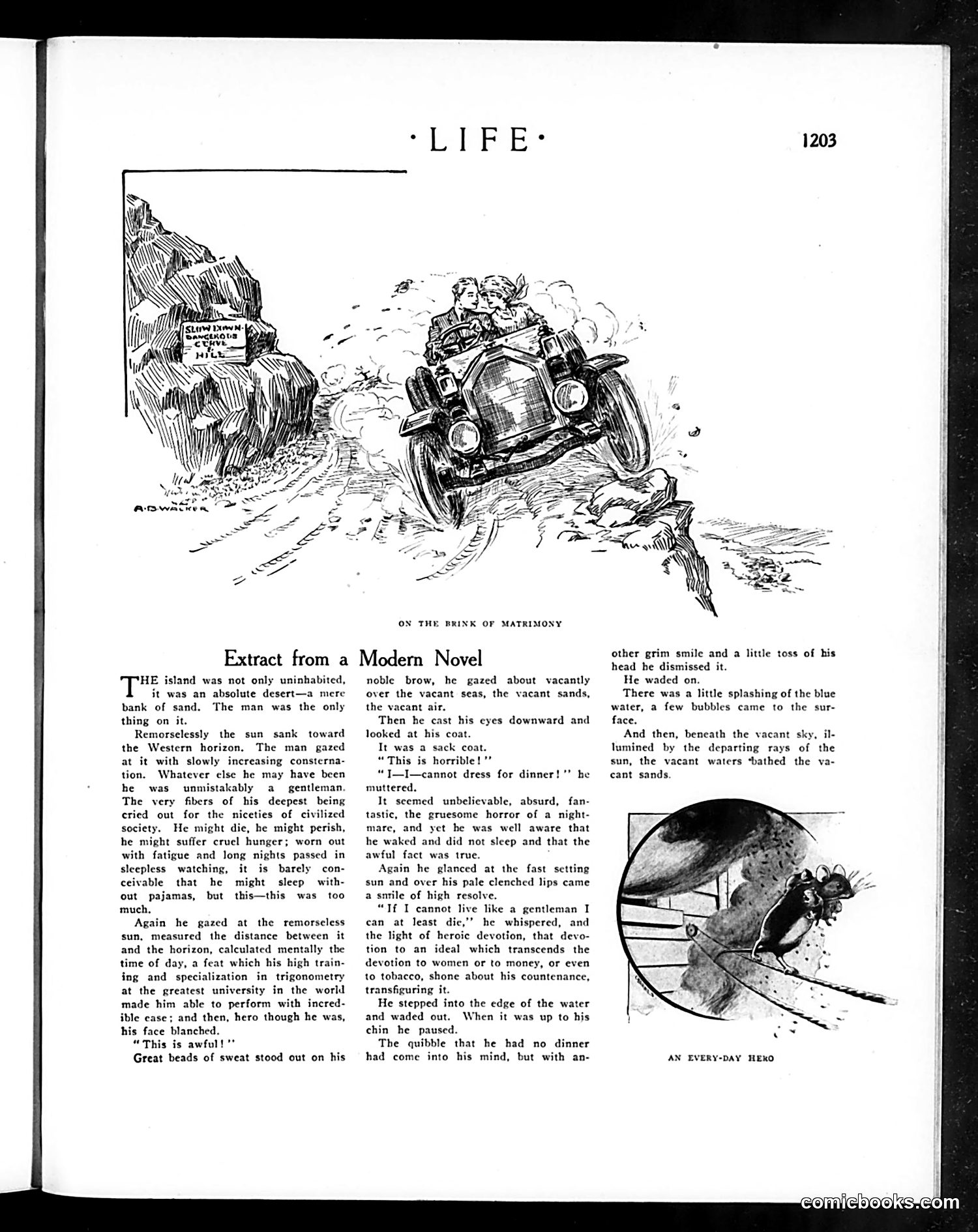
This satirical piece mocks upper-class masculine vanity and rigidity. A gentleman stranded alone on a desert island faces existential crisis—not from hunger or danger, but because he lacks proper dinner attire (a sack coat instead of formal wear). His crisis of conscience over appearing undressed for dinner supersedes survival instincts. The satire targets early 20th-century aristocratic obsession with social conventions and etiquette. The title "On the Brink of Matrimony" suggests this anxious, convention-bound character type represents the kind of man entering marriage. The "Every-Day Hero" caption ironically presents his suicide—choosing death over social impropriety—as noble rather than absurd. Life magazine here ridicules the absurd priorities of wealthy men who prioritize appearance and propriety over practical reality.
This page contains **no political cartoons**, despite the header "Sparks From Old Anvils." Instead, it presents three humorous essays typical of Life's satirical commentary. **"Civility"** opens with a Chinese proverb contrasting practical human interaction with abstract theology—priests respond to greetings; gods don't. **"Patience as a Fine Art"** satirizes American labor practices by praising plumbers who work "by the hour" rather than "by the job." The author jokes that hourly workers have no incentive to hurry, making them philosophically patient—they profit equally from delay. This mocks both inefficient labor practices and American commercial culture obsessed with productivity. **"The Yankees and Paper Money"** ridicules early American currency production, suggesting any Yankee with a printing press could manufacture money from worthless materials. It references historical monetary chaos (likely pre-Civil War or Reconstruction era), when unregulated currency creation was rampant. The essays use gentle irony to critique American materialism, labor inefficiency, and financial recklessness.
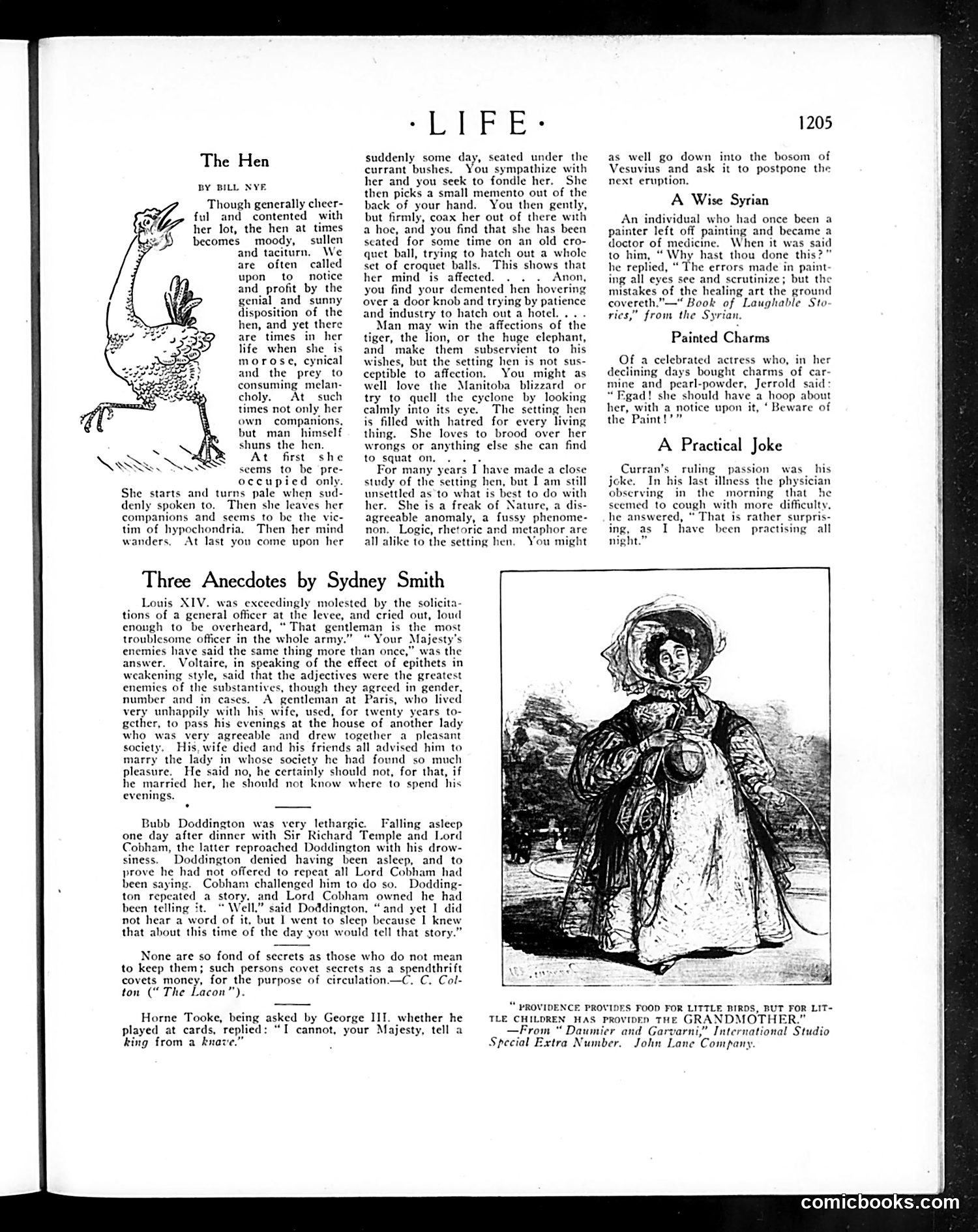
This page contains humor essays typical of Life's satirical style. **"The Hen"** by Bill Nye is a mock-serious treatise on hens' psychology, particularly "setting hens" (brooding females). Nye humorously catalogs their neurotic behaviors—sitting on croquet balls trying to hatch them, attempting to incubate doorknobs—characterizing them as fundamentally irrational and hostile creatures immune to human affection or logic. The satire mocks both pseudo-scientific animal observation and sentimental domesticity. **"Three Anecdotes by Sydney Smith"** presents brief historical anecdotes about 18th-century figures (Louis XIV, Voltaire, Horne Tooke) dealing with social pretension and wit—humor based on classical allusion rather than contemporary reference. The remaining pieces—**"A Wise Syrian,"** **"Painted Charms,"** and **"A Practical Joke"**—are brief moral or witty tales drawn from literary sources, typical of Life's mix of satire, aphorism, and genteel humor for educated readers. The illustration appears unrelated to the text.
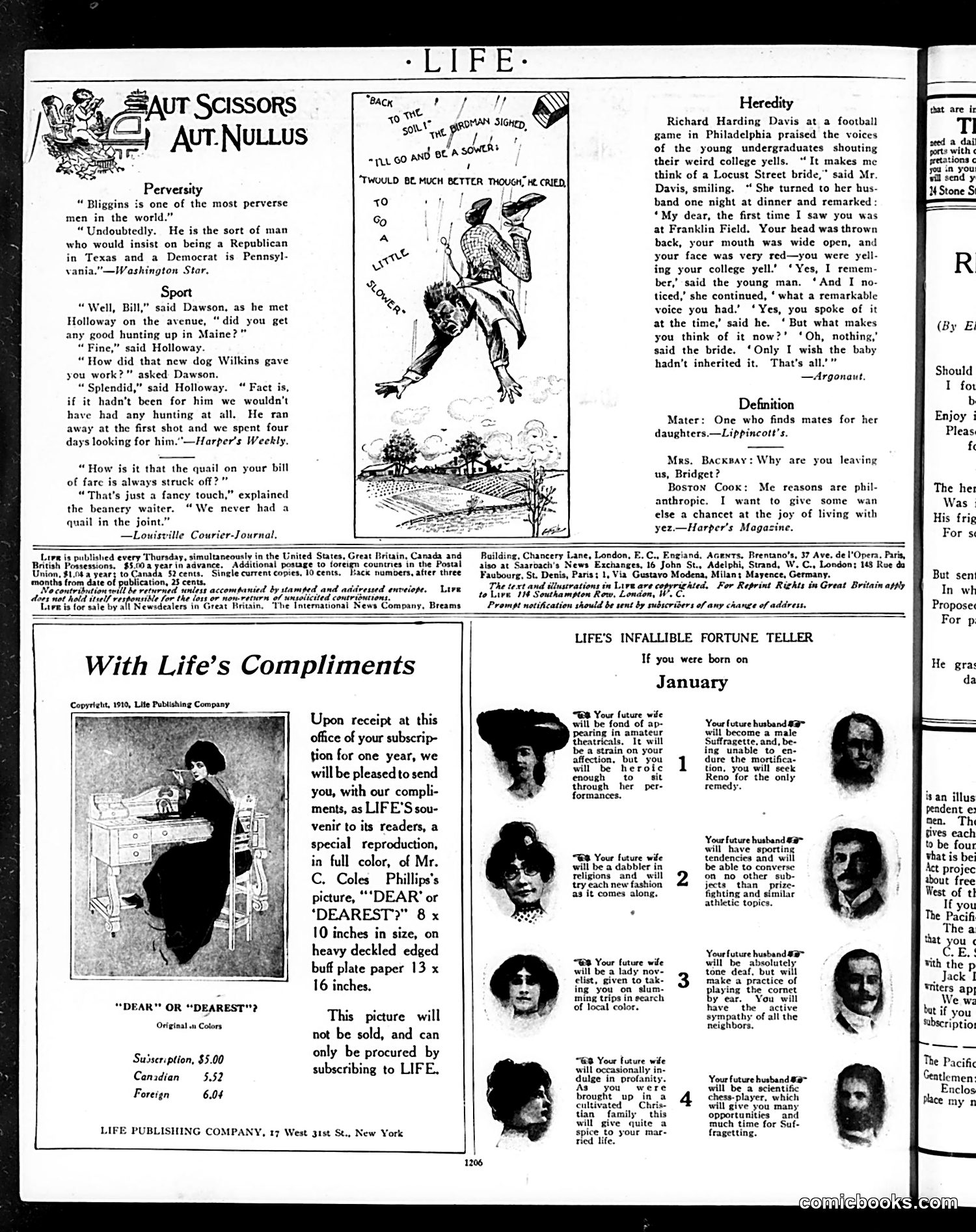
This page contains several humor columns and an advertisement disguised as a gift offer. **The Cartoons/Humor Sections:** The top features "Aut Scissors Aut Nullus" — brief satirical jokes about social behavior. These include jabs at political inconsistency (Republicans in Texas, Democrats in Pennsylvania), incompetent hunting dogs, restaurant pretense, and inherited traits. The "Heredity" section mocks how a woman married to a loud college athlete wishes their baby hadn't inherited his booming voice. **The Central Illustration:** A figure appears to be tumbling or falling — likely illustrating one of the brief jokes, though the specific reference is unclear from the text alone. **The Advertisement:** The bottom section presents "Life's Infallible Fortune Teller" — supposedly predicting the futures of people born in January. It's actually marketing a subscription offer: subscribe to Life magazine for one year and receive a reproduction of C. Coles Phillips's painting "Dear" or "Dearest." This was common early-20th-century advertising strategy. Overall, this is a typical Life magazine page mixing satirical humor with commercial promotion.
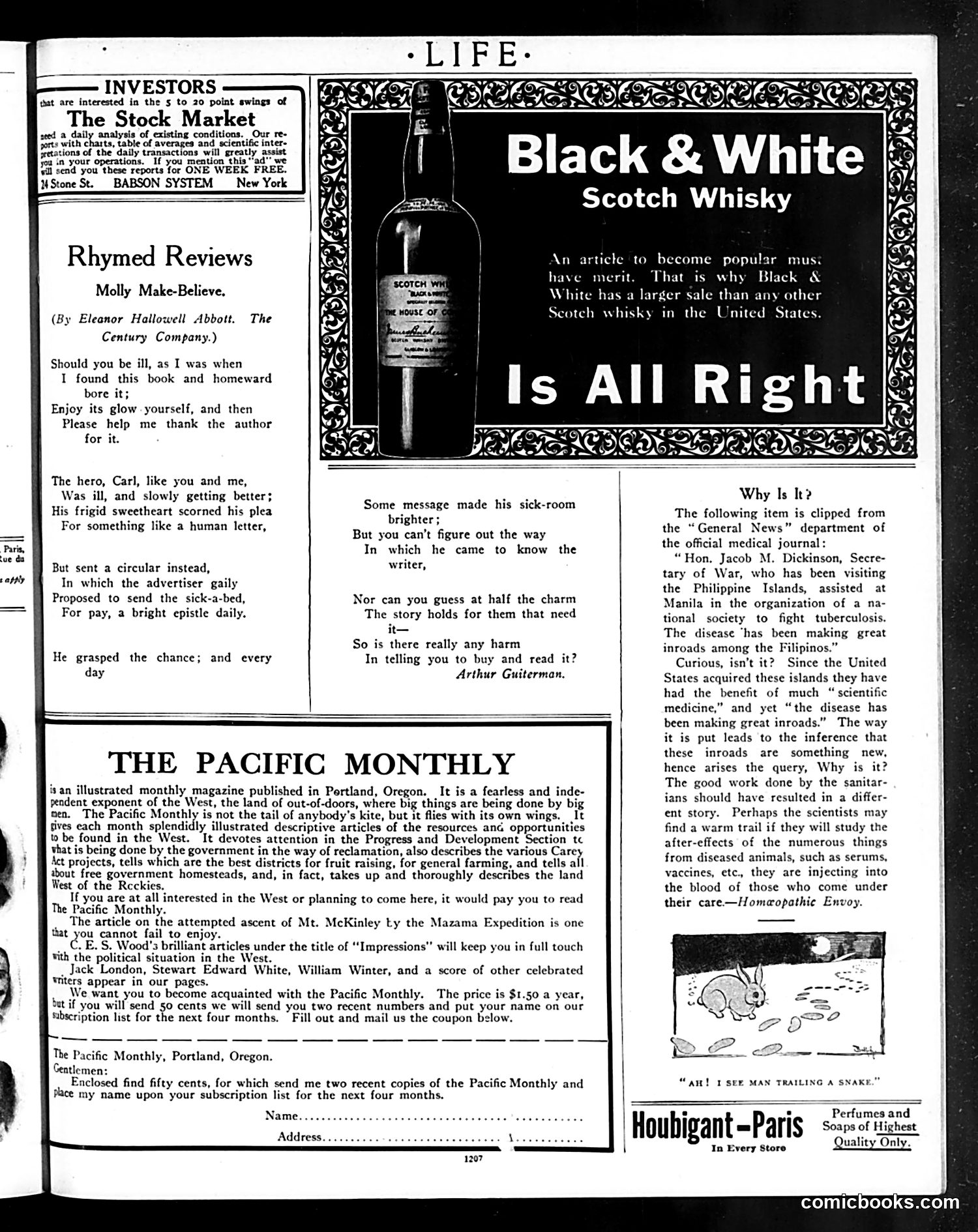
This page contains **primarily advertisements and promotional content** rather than political satire or comics requiring historical interpretation. The main elements are: 1. **"Rhymed Reviews"** — a light verse commentary on a novel called *Molly Make-Believe* by Eleanor Hallowell Abbott. The humorous point: a bedridden man receives advertising circulars instead of personal letters from his sweetheart, yet the story somehow charms readers anyway. The poem gently mocks both the romantic disappointment and asks whether reading such a tale causes harm. 2. **Black & White Scotch Whisky advertisement** — a straightforward product ad claiming superiority in the U.S. market. 3. **The Pacific Monthly** — a lengthy magazine subscription pitch describing it as an independent Western publication featuring nature writing and development articles. 4. **"Why Is It?"** — a brief medical note questioning why tuberculosis spreads in the Philippines despite American "scientific medicine," suggesting either irony about colonial medicine's limits or genuine confusion. The page is primarily **commercial content** with minimal satire, reflecting Life's mixed editorial-advertising model of the era.
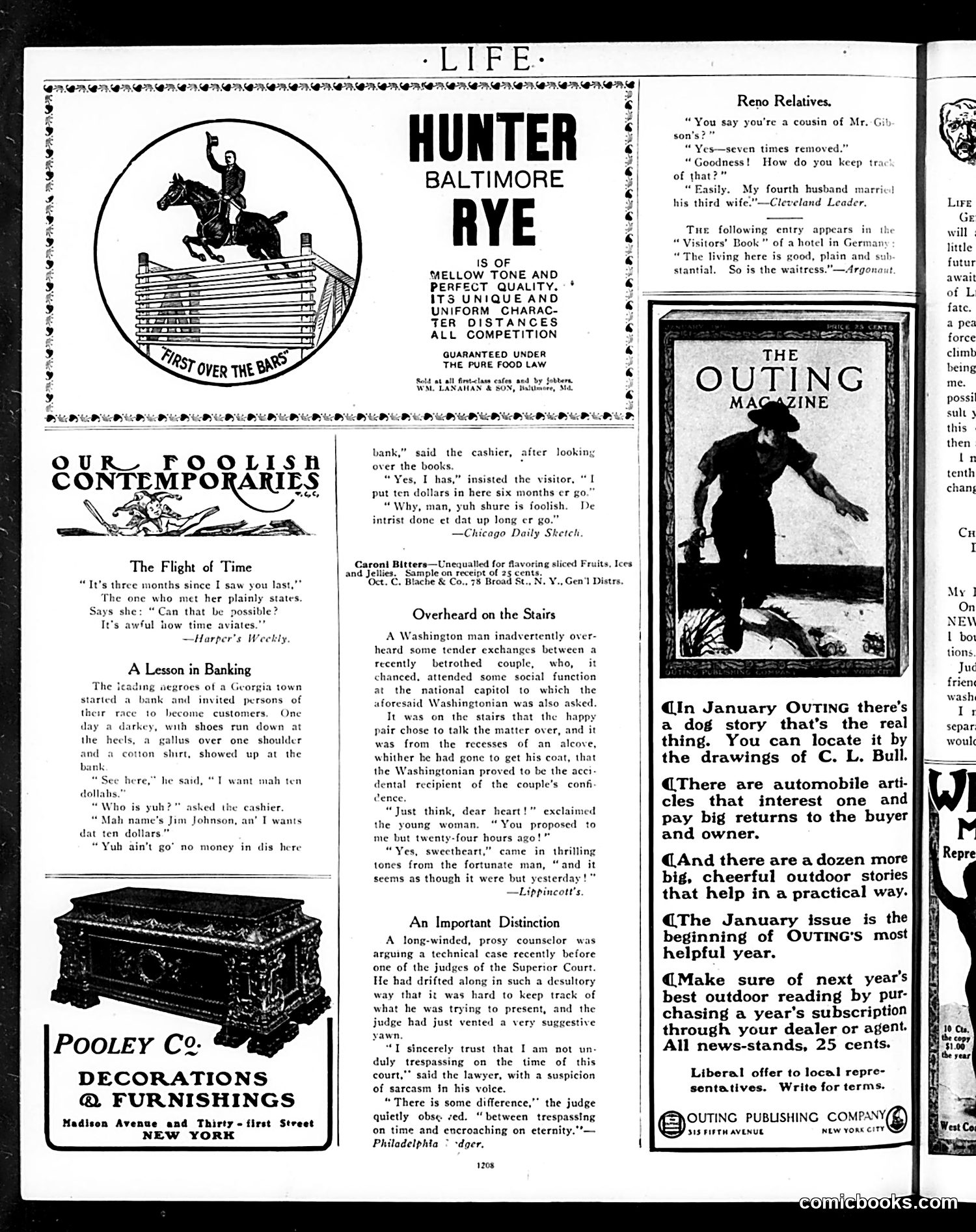
This Life magazine page is primarily **advertising and humorous anecdotes** rather than political cartoons. The main content consists of brief joke columns under "Our Foolish Contemporaries," featuring reprinted humor from other sources. These include period jokes about: - **Banking and race**: A deliberately unflattering dialect story about Black depositors in Georgia, reflecting early 1900s racist stereotypes common in mainstream publications - **Marriage and time**: Conventional romantic humor about courtship - **Lawyers**: A joke about a verbose attorney's tedious courtroom manner The advertisements include Hunter Baltimore Rye whiskey and Pooley Company furnishings. **The satire here is mild and social** rather than political—poking fun at human foibles (forgetfulness, long-windedness, banking confusion) using exaggerated characters. By modern standards, the racial dialect humor is offensive and emblematic of how casually dehumanizing stereotypes appeared in "respectable" publications of that era. The page reflects Life's format as a general-interest humor magazine mixing advertisements with light comic content.
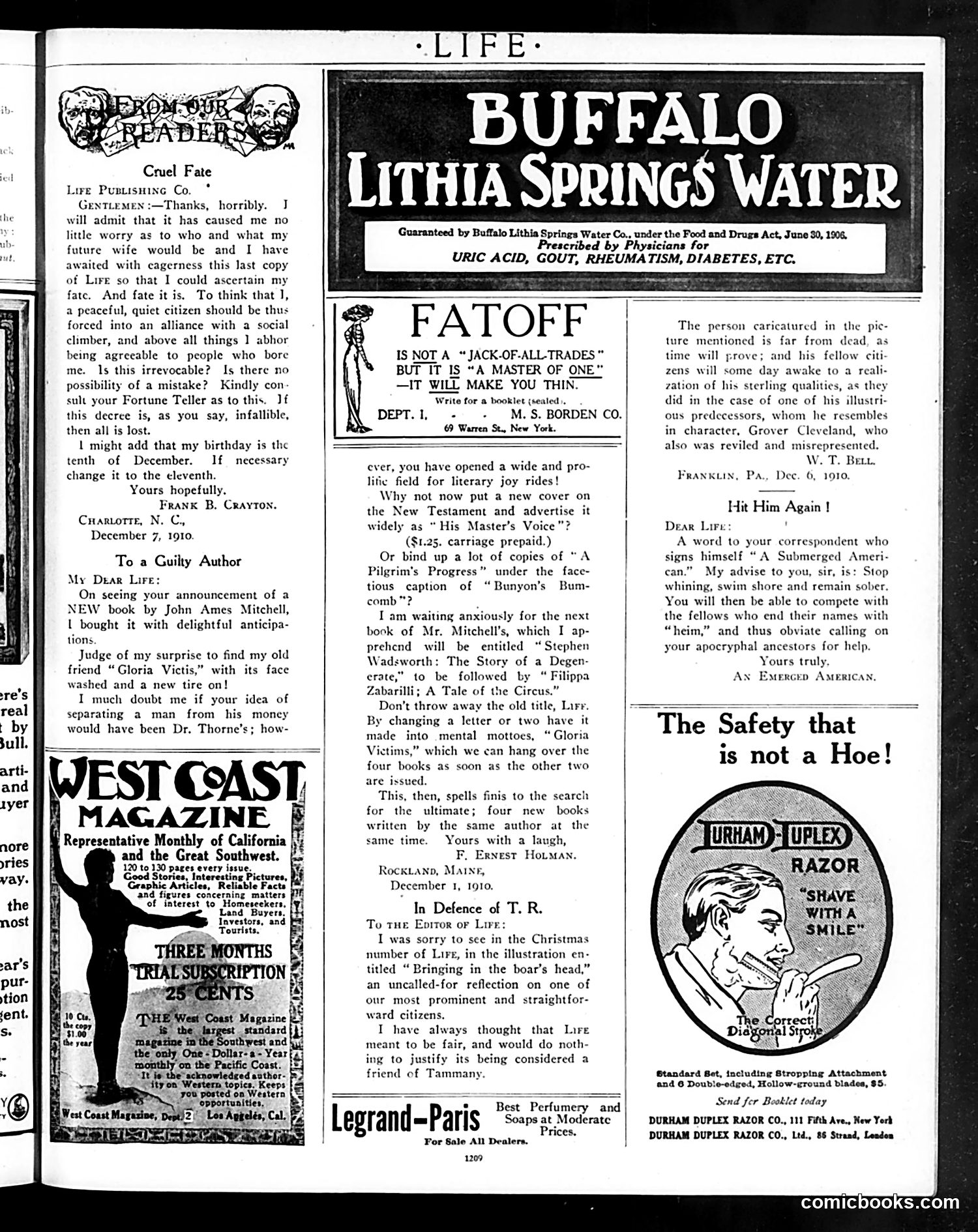
This page consists primarily of **reader letters to the editor**, not political cartoons. The content reflects early 1900s concerns: **Notable letters:** - A reader claims Life's fortune-telling feature predicted his future wife—a "social climber" he finds disagreeable, expressing mock distress at his "fate" - A humorous letter mocking author John Ames Mitchell for recycling an old book with a new cover, sarcastically suggesting he rebrand religious texts with misleading titles - **"In Defence of T.R."**: A reader defends Theodore Roosevelt against a recent Life illustration ("Bringing in the boar's head") that apparently mocked him. The writer argues Roosevelt deserves respect like Grover Cleveland did. **Advertisements include:** - Buffalo Lithia Springs Water (mineral water treatment for gout, rheumatism, diabetes) - "Fatoff" weight-loss product - West Coast Magazine subscription - Durham Duplex Razor The Roosevelt letter suggests Life's editorial stance occasionally drew criticism for perceived unfairness to public figures, even prominent ones.
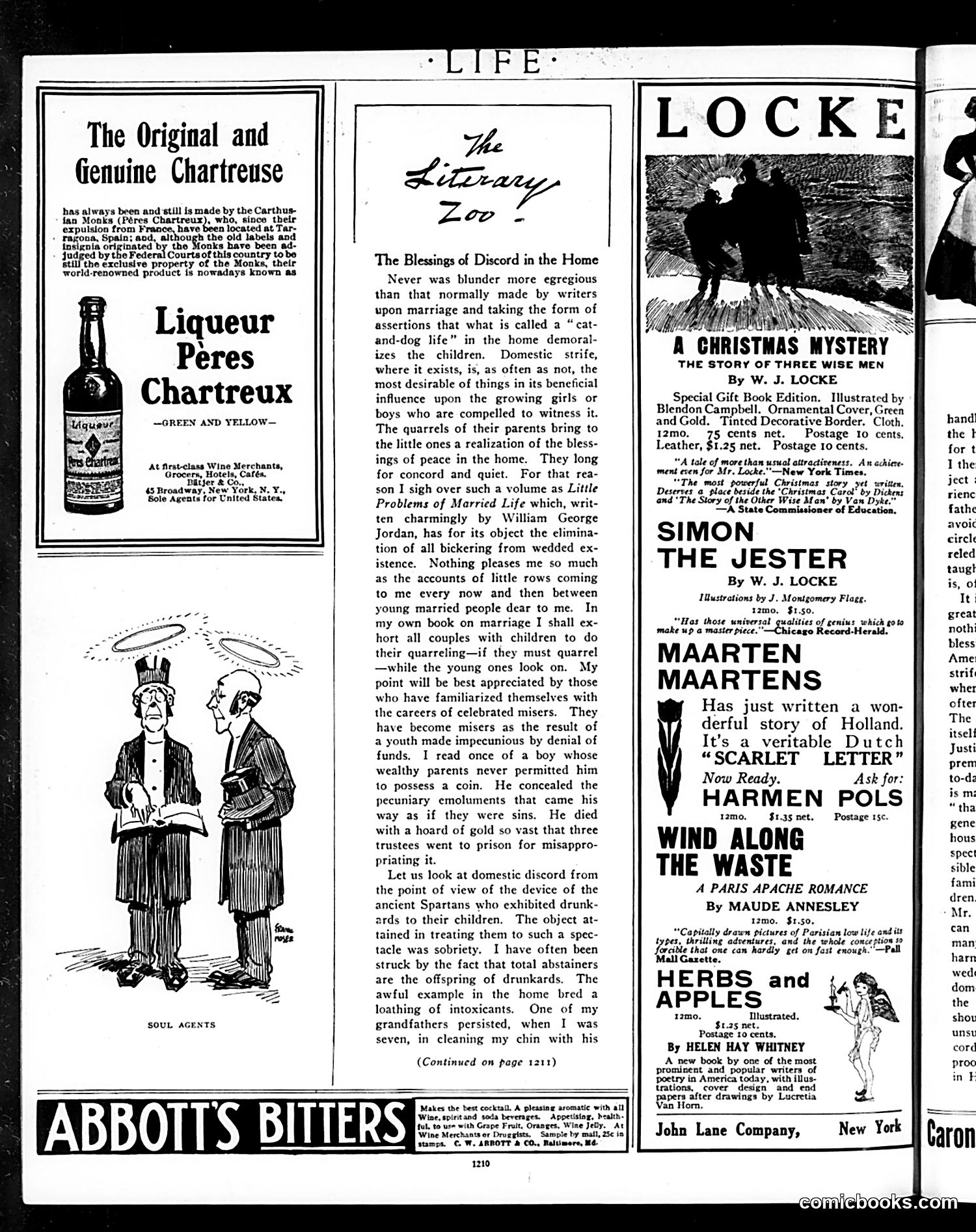
This cartoon satirizes clergy members—depicted as two rotund, jowly figures in religious vestments with halos. The label "Soul Agents" is the joke: it mocks priests or ministers as literal salesmen peddling spiritual salvation like a commercial product. The satire reflects early 20th-century American skepticism toward organized religion and its perceived commercialization. The figures' exaggerated features suggest gluttony and worldliness, contradicting spiritual ideals. Their halo-wearing is ironic—they're presented as self-proclaimed saints while behaving as cynical merchants. The surrounding page content—particularly the editorial championing domestic discord as character-building—reinforces the magazine's contrarian, debunking tone toward conventional wisdom and institutions, including the church.
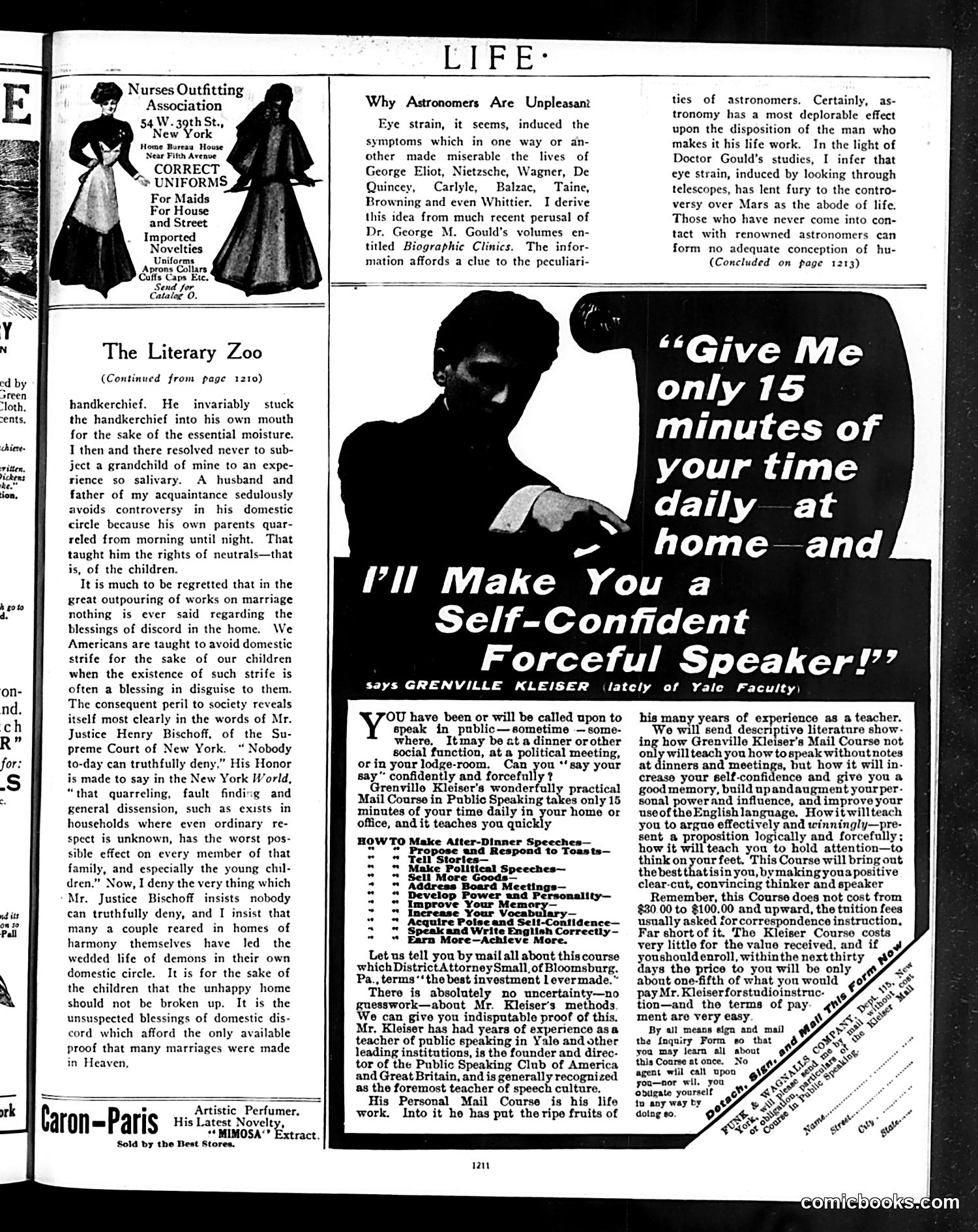
This page contains three distinct elements: **"Why Astronomers Are Unpleasant"** — A humorous essay claiming that eye strain from telescope use explains why famous astronomers (and literary figures like George Eliot and Nietzsche) were reportedly difficult personalities. The author cites Dr. George M. Gould's "Biographic Clinics," suggesting that optical strain correlates with bad temperament—a pseudo-scientific joke. **"The Literary Zoo"** — A continuation of an essay arguing against the popular American belief that domestic harmony benefits children. The author controversially claims that parental quarreling isn't harmful, citing a New York judge's opposing view. **Advertisements** — Including a nursing uniform service and the main ad: Grenville Kleiser's mail-order public speaking course (15 minutes daily at home). Kleiser, identified as "lately of Yale Faculty," promises to make readers confident speakers. This appears genuine advertising rather than satire. The page is primarily editorial content with advertising, not political commentary.
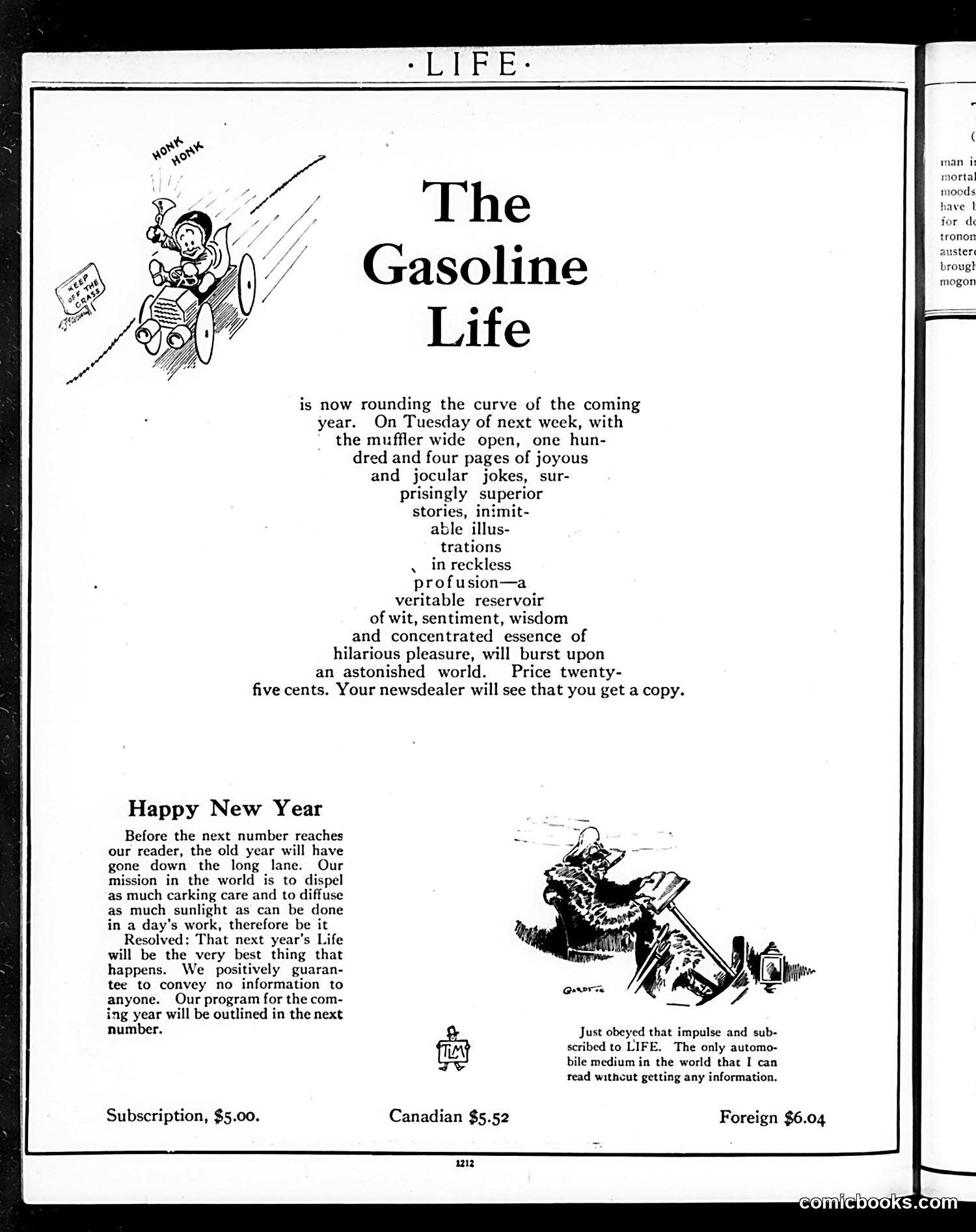
This is a **title/promotional page** for an upcoming special issue of *Life* magazine, not a political cartoon. The page advertises a forthcoming 104-page issue devoted to automobile and motoring humor. The cartoon at top-left shows a driver in an early motorcar, labeled "HONK HONK," depicting the newfound automobile culture. The bottom illustration shows a figure reading while driving, reinforcing the joke in the text below: *Life* claims to be "the only automobile medium in the world that I can read without getting any information"—satirizing the magazine's self-described purpose as pure entertainment and humor with no serious content. The **New Year's resolution** declares *Life*'s mission is "to dispel carking care" and provide "hilarious pleasure" while "convey[ing] no information to anyone." This is tongue-in-cheek boasting about being frivolous and comedic rather than informative—typical of *Life*'s brand as a humor publication in the early automobile era.
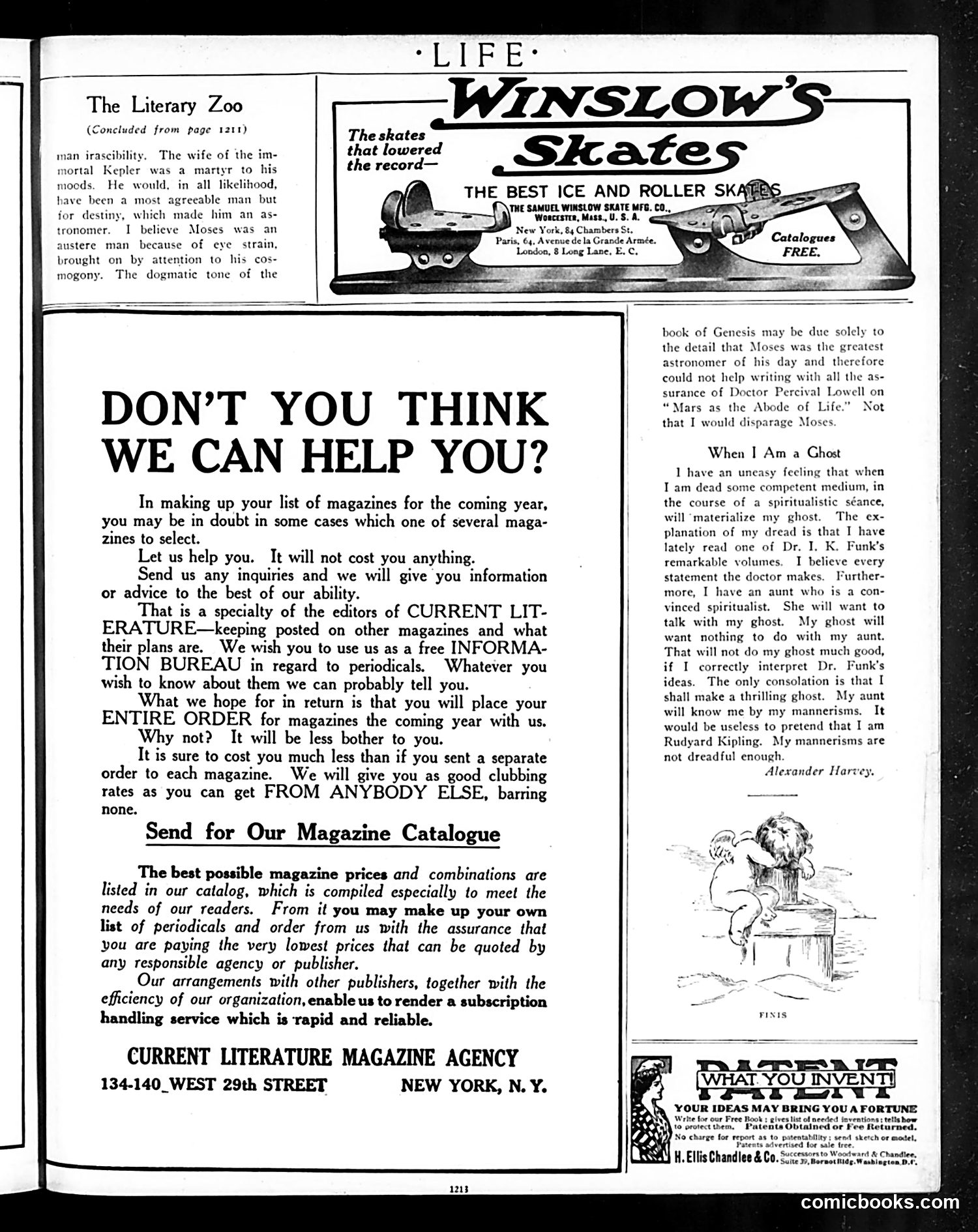
This is primarily a **advertising and editorial page** from *Life* magazine, not a political cartoon. The page contains: 1. **"The Literary Zoo"** (top left): A humorous essay concluding a previous piece, making comedic observations about historical figures. It jokes that Johannes Kepler's grumpiness stemmed from eye strain caused by astronomy, and Moses's authoritative tone came from similar causes. This is satirical pop psychology—lightweight humor about famous men. 2. **Winslow's Skates advertisement** (top right): A straightforward product ad for ice and roller skates. 3. **Current Literature Magazine Agency advertisement** (main content): The bulk of the page is a subscription service pitch encouraging readers to consolidate magazine orders through their agency rather than ordering individually. It emphasizes convenience and cost savings. 4. **"When I Am a Ghost"** essay (right): A humorous piece by Alexander Harvey about spiritualism and séances—contemporary social commentary on the spiritualist craze of the era. The page is predominantly **commercial/promotional** rather than satirical commentary.
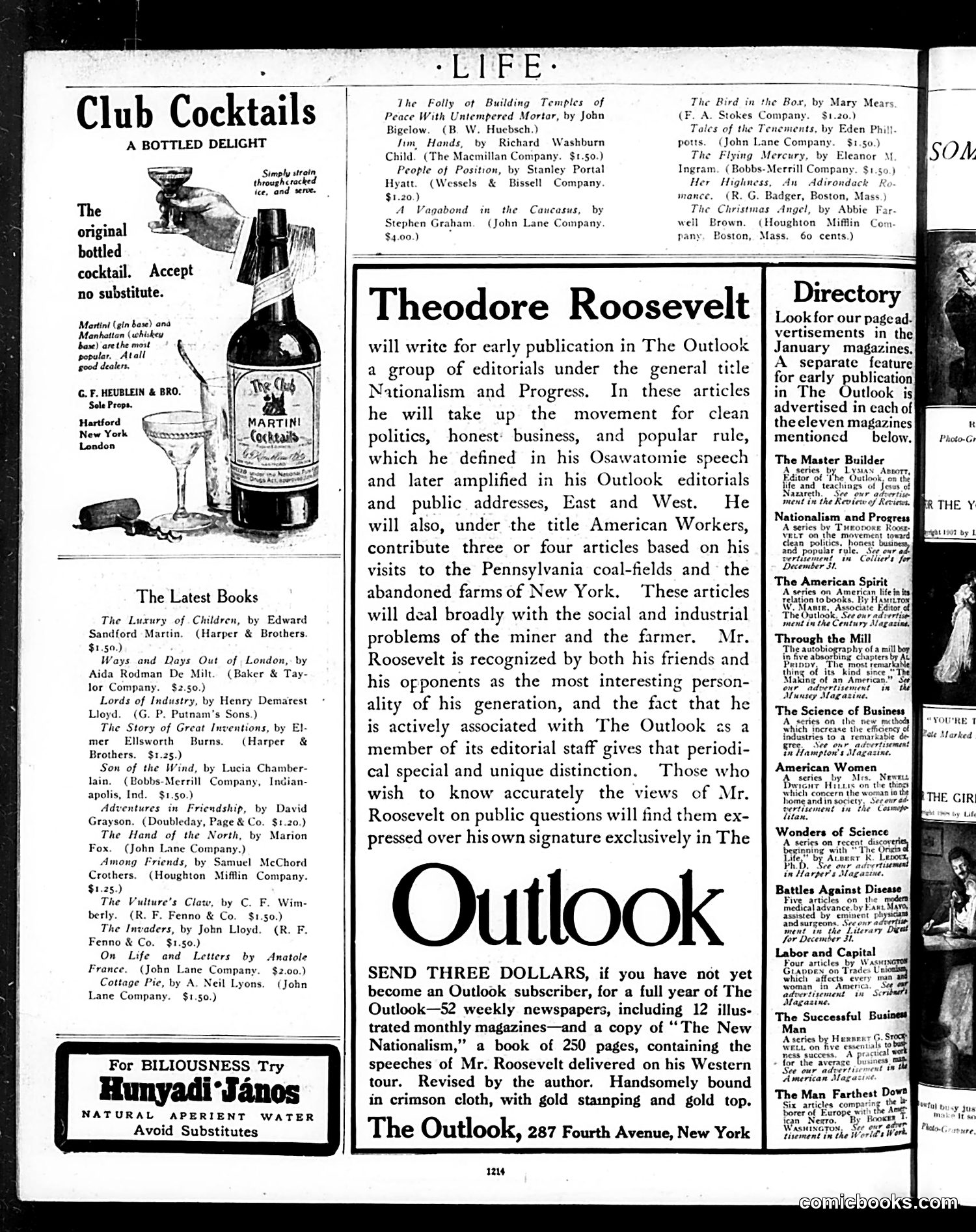
This is primarily an **advertising and announcements page** from Life magazine, not a satirical cartoon page. The dominant content announces that **Theodore Roosevelt** will contribute editorial articles to *The Outlook* magazine on "Nationalism and Progress," focusing on clean politics, honest business, and workers' issues based on his visits to coal-fields and farms. The text emphasizes Roosevelt's stature as "the most interesting personality of his generation." The page also advertises Roosevelt's book *"The New Nationalism"* containing his Western tour speeches, available to new *Outlook* subscribers for three dollars. Surrounding this are standard magazine advertisements for Club Cocktails (pre-mixed drinks), book listings, and Hunyadi János mineral water. There is no political satire visible—the page functions as a celebrity endorsement and subscription promotion, leveraging Roosevelt's post-presidency prominence to boost the magazine's readership and establish editorial credibility.
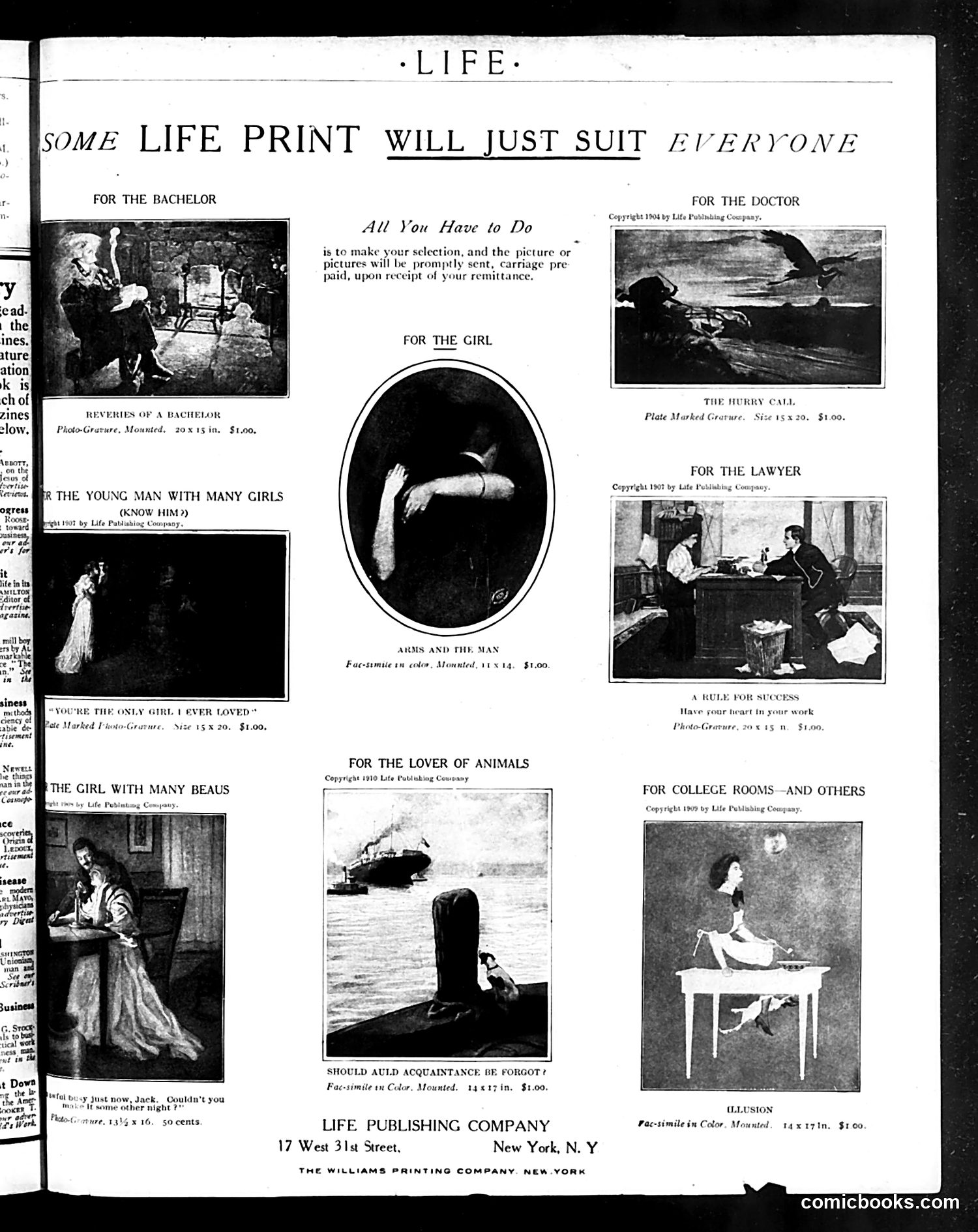
This is primarily a **mail-order print catalog** rather than satirical content. Life Publishing Company advertises affordable art prints ($0.50–$1.00) organized by audience type: bachelors, doctors, lawyers, girls, and college students. The prints reflect early 1900s social stereotypes and romantic ideals. Titles like "Reveries of a Bachelor," "The Young Man with Many Girls (Know Him?)," and "Arms and the Man" suggest sentimental or mildly risqué themes appealing to young adults. "The Girl with Many Beaus" plays on marriage-market anxieties common to the era. The satire is **implicit rather than explicit**: Life gently mocks predictable romantic fantasies and social types by packaging them as marketable commodities. The format itself—cataloging prints by demographic—suggests that people's emotional lives follow formulaic patterns Life's audience would recognize and laugh at.
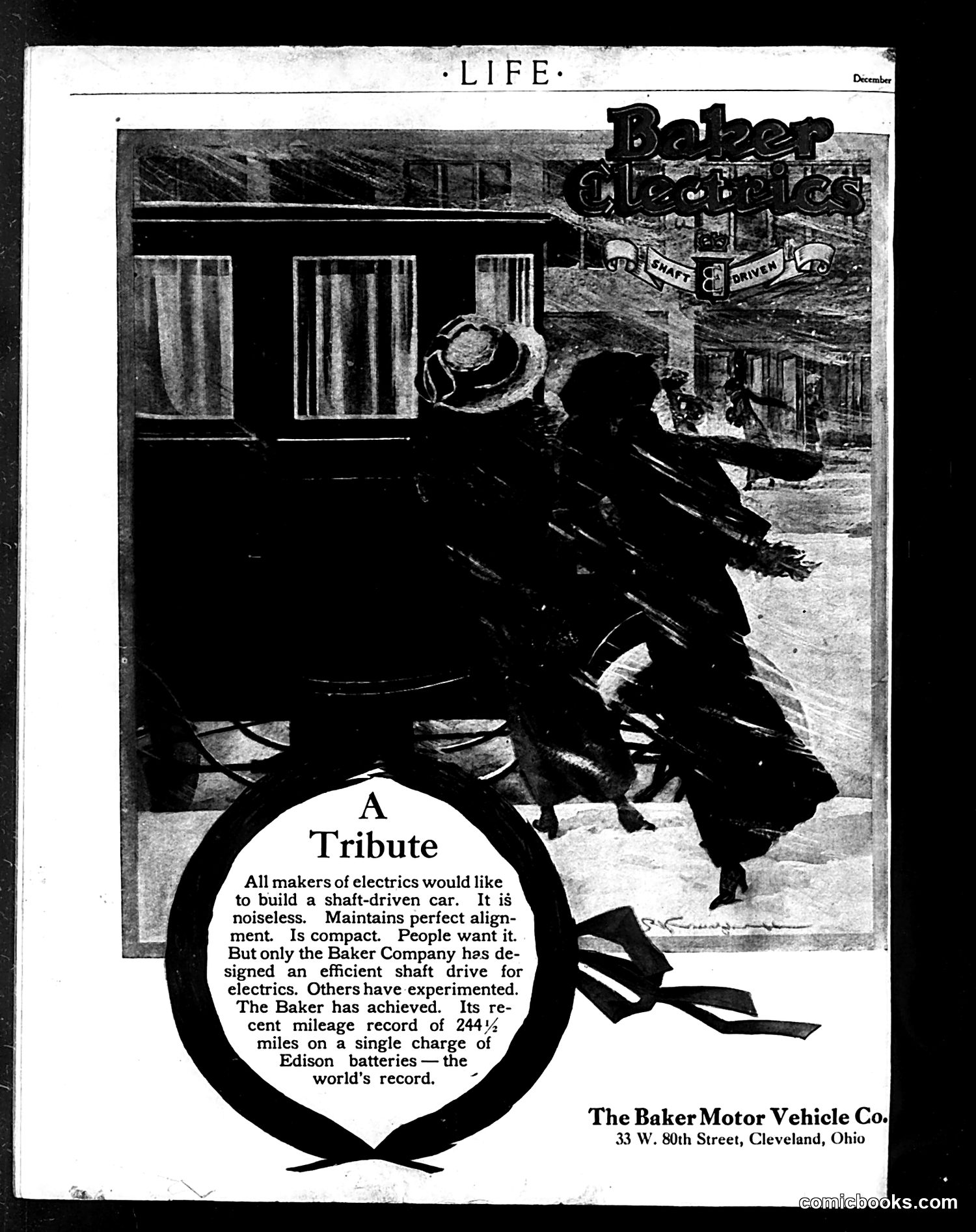
This is a **product advertisement**, not a political cartoon. The page promotes the Baker Motor Vehicle Company's electric car, specifically highlighting its shaft-drive technology and battery efficiency. The image shows silhouetted figures (a man and woman) near an electric vehicle, dressed in early 1900s attire. The "Tribute" text claims Baker uniquely achieved an efficient shaft-drive system for electric cars—something competitors attempted but failed to accomplish. It boasts a record 244½-mile range on Edison batteries. **Context for modern readers**: This reflects the era (likely 1910s) when electric vehicles competed seriously with gasoline cars. Electric cars were considered quiet, reliable, and desirable for urban use. Baker's advertisement positions them as the technological leader by claiming superior engineering and performance metrics—a marketing strategy identical to today's competing automakers.

I can see this is a very dark, heavily degraded image from what appears to be a Life magazine page (based on the "comicbooks.com" watermark). However, the image quality is too poor for me to reliably make out any cartoon details, text, figures, or caricatures with confidence. The page appears to be primarily black with some faint grayscale variations and possible line work, but I cannot distinguish specific political figures, identify references, or explain satirical content without being able to see the actual illustrations or read the accompanying text clearly. To provide an accurate historical analysis as requested, I would need a higher-quality or clearer version of this page.