
Life, 1910-12-29 · page 28 of 41
Life — December 29, 1910 — page 28: what you’re looking at
What you’re looking at
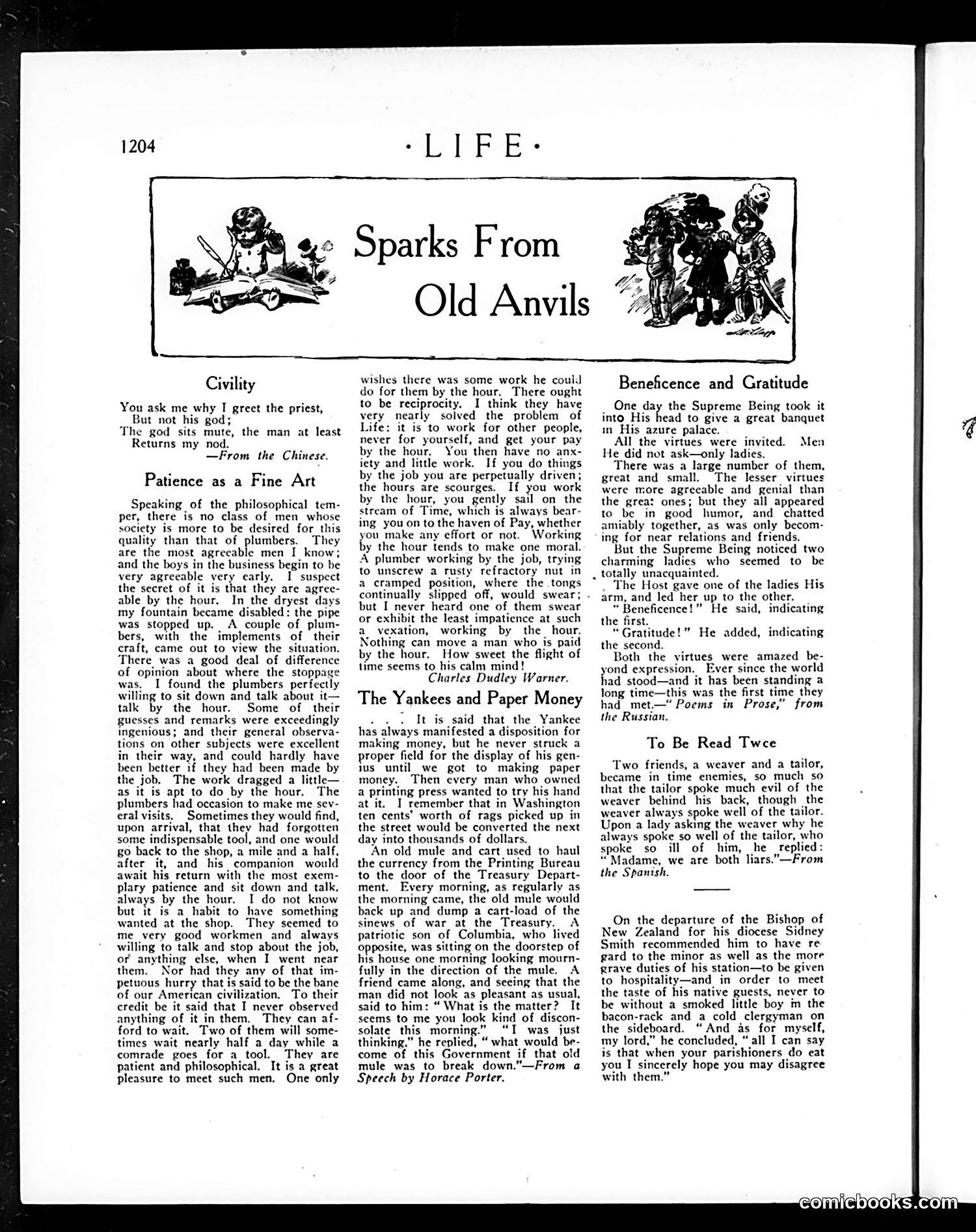
This page contains **no political cartoons**, despite the header "Sparks From Old Anvils." Instead, it presents three humorous essays typical of Life's satirical commentary. **"Civility"** opens with a Chinese proverb contrasting practical human interaction with abstract theology—priests respond to greetings; gods don't. **"Patience as a Fine Art"** satirizes American labor practices by praising plumbers who work "by the hour" rather than "by the job." The author jokes that hourly workers have no incentive to hurry, making them philosophically patient—they profit equally from delay. This mocks both inefficient labor practices and American commercial culture obsessed with productivity. **"The Yankees and Paper Money"** ridicules early American currency production, suggesting any Yankee with a printing press could manufacture money from worthless materials. It references historical monetary chaos (likely pre-Civil War or Reconstruction era), when unregulated currency creation was rampant. The essays use gentle irony to critique American materialism, labor inefficiency, and financial recklessness.
📄 Transcribed text from this page (OCR, searchable)
Machine-transcribed from the original scan — historical spelling and the odd misread are preserved.
“PE * Civility You ask me why I greet the priest, But not his god; The god sits mute, the man at least Returns my nod. . —From the Chinese. Patience as a Fine Art Speaking of the philosophical tem- per, there is no class of men whose society is more to be desired for this quality than that of plumbers. They are the most agrecable men I_ know; and the boys in the business begin to be very agreeable very early, I suspect the secret of it is that they are agree- able by the hour. In the dryest days my fountain became disabled: the pipe was stopped up. A couple of plum- bers, with the implements of their craft, came out to view the situation. There was a good deal of difference of opinion about where the stoppage was, I found the plumbers perfectly willing to sit down and talk about it— talk by the hour. Some of their guesses and remarks were exceedingly ingenious; and their general observa- tions on other subjects were excellent in their way, and could hardly have been better if they had been made by the job. The work dragged a little— as it is apt to do by the hour. The plumbers had occasion to make me sev- eral visits. Sometimes they would find, upon arrival, that they had forgotten some indispensable tool, and one would go back to the shop, a mile and a half, after it, and his companion would await his return with the most exem- plary patience and sit down and talk, always by the hour. I do not know but it is a habit to have something wanted at the shop. They seemed to me very good workmen and always willing to talk and stop about the job, or anything else, when I went near them. Nor had they any of that im- petuous hurry that is said to be the bane of our American civilization. To their credit be it said that I never observed anything of it in them. They can af- ford to wait. Two of them will some- times wait nearly half a day while a comrade goes for a tool. They are patient and philosophical. It is a great pleasure to meet such men. One only Sparks From Old Anvils wishes there was some work he could do for them by the hour. There ought to be reciprocity. I think they have very nearly solved the problem of Life: it is to work for other people, never for yourself, and get your pay by the hour, You then have no anx- iety and little work. If you do things by the job you are perpetually driven; the hours are scourges. If you work by the hour, you gently sail on the stream of Time, which is always bear- ing you on to the haven of Pay, whether ou make any effort or not. Working by the hour tends to make one moral. A plumber working by the job, trying to unscrew a rusty refractory nut in a cramped position, where the tongs continually slipped off, would swear; but I never heard one of them swear or exhibit the least impatience at such a_ vexation, working by the hour. Nothing can move a man who is paid the hour. How sweet the flight of time seems to his calm mind! Charles Dudley Warner. The Yankees and Paper Money . . . It is said that the Yankee has always manifested a disposition for making money, but he never struck a proper field for the display of his gen- ius until we got to making paper money. Then every man who owned a printing press wanted to try his hand at it. I remember that in Washington ten cents’ worth of rags picked up in the street would be converted the next day into thousands of dollars. An old mule and cart used to haul the currency from the Printing Bureau to the door of the Treasury Depart- ment. Every morning, as regularly as the morning came, the old mule would back up and dump a cart-load of the sinews of war at the Treasury. A patriotic son of Columbia, who lived opposite, was sitting on the doorstep of his house one morning looking mourn- fully in the direction of the mule. A friend came along, and seeing that the man did not look as pleasant as usual, said to him: “ What is the matter? It seems to me you look kind of discon- solate this morning.” “I was just thinking.” he replied, “ what, would be- come of this Government if that old mule was to break down.”—From a Speech by Horace Porter. Beneficence and Gratitude One day the Supreme Being took it into His head to give a great banquet in His azure palace. All the virtues were invited. He did not ask—only ladies. There was a large number of them, great and small. The lesser virtues were more agreeable and genial than the great ones; but they all appeared to be in good humor, and chatted amiably together, as was only becom- ing for near relations and friends. But the Supreme Being noticed two charming ladies who seemed to be Men . totally unacquainted. The Host gave one of the ladies His arm, and led her up to the other. “ Beneficence!” He said, indicating the first. . “Gratitude!” He added, indicating the second. Both the yirtues were amazed be- yond expression. Ever since the world had stood—and it has been standing a long time—this was the first time they had met.— Poems in Prose,” from the Russian. To Be Read Twce Two friends, a weaver and a tailor, became in time enemies, so much so that the tailor spoke much evil of the weaver behind his back, though the weaver always spoke well of the tailor. Upon a lady asking the weaver w always spoke so well of the tailor, v spoke so ill of him, he replied: “Madame, we are both liars.”—From the Spanish. On the departure of the Bishop of New Zealand for his diocese Sidney Smith recommended him to have re gard to the minor as well as the more grave duties of his station—to be given to hospitality—and in order to meet the taste of his native guests, never to be without a smoked little boy m the bacon-rack and a cold clergyman on the sideboard. “And as for myself, my lord,” he concluded, “all I can say is that when your parishioners do eat you I sincerely hope you may disagree with them.”