
Life, 1910-12-29 · page 12 of 41
Life — December 29, 1910 — page 12: what you’re looking at
What you’re looking at
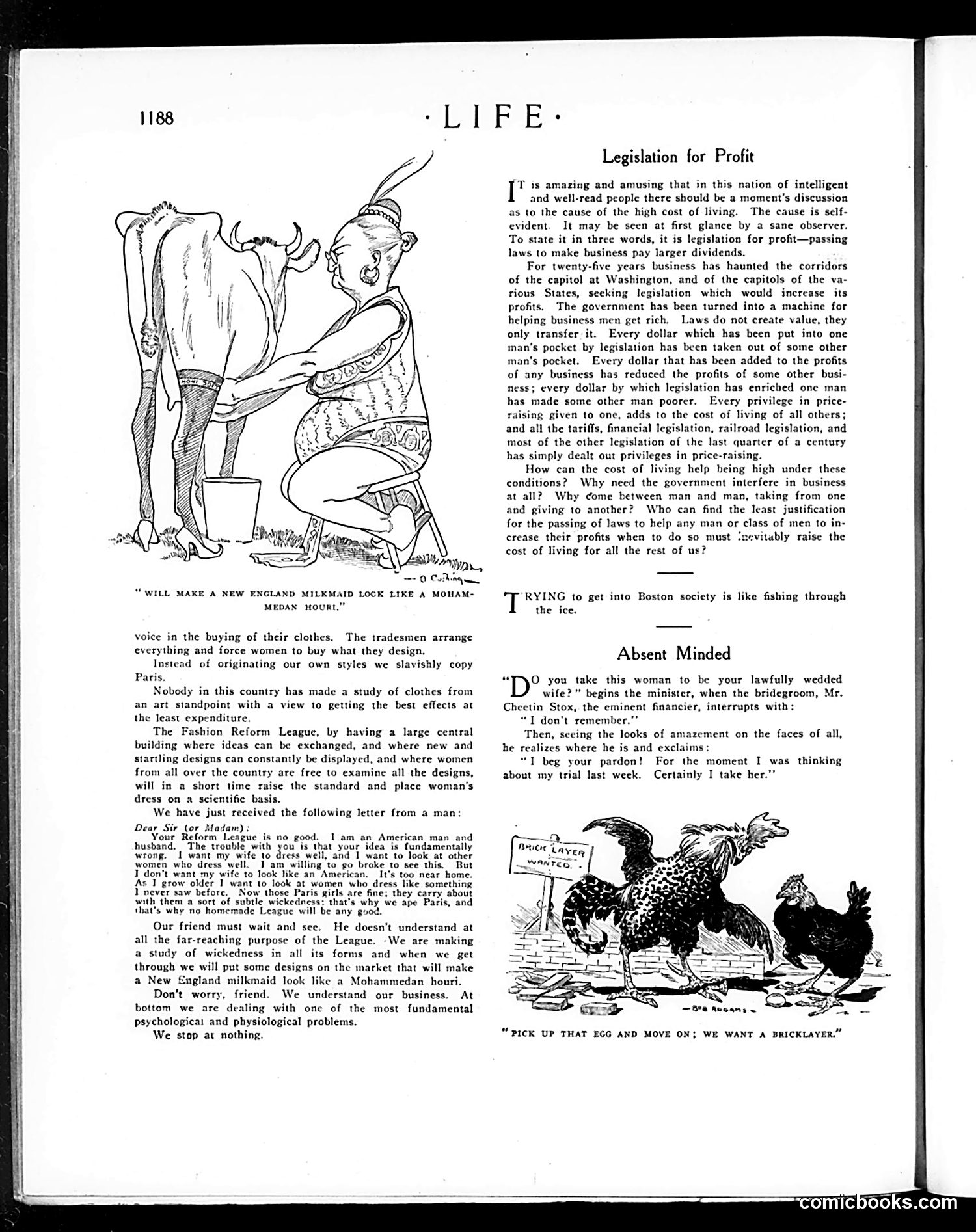
**Top Cartoon:** "Will Make a New England Milkmaid Look Like a Mohammedan Houri" This satirizes fashion trends and the Fashion Reform League's efforts to standardize women's dress. The figure on the left appears to be a traditional New England milkmaid; the caricatured figure on the right (with exaggerated features suggesting Middle Eastern aesthetics) represents an over-stylized, fashionable woman. The joke critiques how extreme fashion reform might make modest women look exotic or foreign—implying that standardizing dress could paradoxically make American women appear "un-American." **Bottom Cartoon:** "Pick Up That Egg and Move On; We Want a Bricklayer" Shows a rooster with a sign reading "Block Layer" standing over an egg, with a figure ordering it away. This plays on the double meaning of "block layer"—a construction worker versus a chicken laying blocks/eggs—mocking occupational terminology or labor shortages of the era.
📄 Transcribed text from this page (OCR, searchable)
Machine-transcribed from the original scan — historical spelling and the odd misread are preserved.
a eel ea “WILL MAKE A NEW ENGLAND MILKMAID LOCK LIKE A MOHAM- MEDAN HouRt,”” voice in the buying of their clothes. The tradesmen arrange everything and force women to buy what they design. Instead of originating our own styles we slavishly copy Paris. Nobody in this country has made a study of clothes from an art standpoint with a view to getting the best effects at the least expenditure, The Fashion Reform League, by having a large central building where ideas can be exchanged, and where new and startling designs can constantly be displayed, and where women from all over the country are free to examine all the designs, will in a short time raise the standard and place woman's dress on a scientific basis. We have just received the following letter from a man: Dear Sir (or Madam): Your Reform League is no good. 1 am an American man and husband. The trouble with you is that your idea is fundamentally wrong. I want my wife to dress well, and I want to look at other women who dress well. I am willing to go broke to see this But I don't want my wife to look like an American. It's too near home. As 1 grow older I want to look at women who dress like something I never saw before. Now those Paris girls are fine; they carry about with them a sort of subtle wickedness: that’s why we ape Paris, and that's why no homemade League will be any guod. Our friend must wait and see. He doesn’t understand at all the far-reaching purpose of the League. -We are making a study of wickedness in all its forms and when we get through we will put some designs on the market that will make a New England milkmaid look like a Mohammedan houri. Don’t worry, friend. We understand our business. At bottom we are dealing with one of the most fundamental psychological and physiological problems. We stop at nothing. Legislation for Profit T 1s amazing and amusing that in this nation of intelligent I and well-read people there should be a moment's discussion as to the cause of the high cost of living. The cause is self- evident. It may be seen at first glance by a sane observer. To state it in three words, it is legislation for profit—passing laws to make business pay larger dividends. For twenty-five years business has haunted the corridors of the capitol at Washington, and of the capitols of the va- rious States, seeking legislation which would increase its profits. The government has been turned into a machine for helping business men get rich. Laws do not create value, they only transfer it. Every dollar which has been put into one man’s pocket by legislation has been taken out of some other man's pocket. Every dollar that has been added to the profits of any business has reduced the profits of some other busi- ness; every dollar by which legislation has enriched one man has made some other man poorer. Every privilege in price- raising given to one, adds to the cost of living of all others; and all the tariffs, financial legislation, railroad legislation, and most of the other legislation of the last quarter of a century has simply dealt out privileges in price-raising. How can the cost of living help being high under these conditions? Why need the government interfere in business at all? Why ¢ome between man and man, taking from one and giving to another? Who can find the least justification for the passing of laws to help any man or class of men to in- crease their profits when to do so must tably raise the cost of living for all the rest of us? RYING to get into Boston society is like fishing through the ice. Absent Minded 1“: O you take this woman to be your lawfully wedded wife?" begins the minister, when the bridegroom, Mr. Cheetin Stox, the eminent financier, interrupts with: “I don't remember.”* Then, seeing the looks of amazement on the faces of all, he realizes where he is and exclaims: “T beg your pardon! For the moment I was thinking about my trial last week. Certainly I take her.” “PICK UP THAT EGG AND MOVE ON; WE WANT A BRICKLAYER.” “comicbooks.com