
Life, 1910-12-29 · page 29 of 41
Life — December 29, 1910 — page 29: what you’re looking at
What you’re looking at
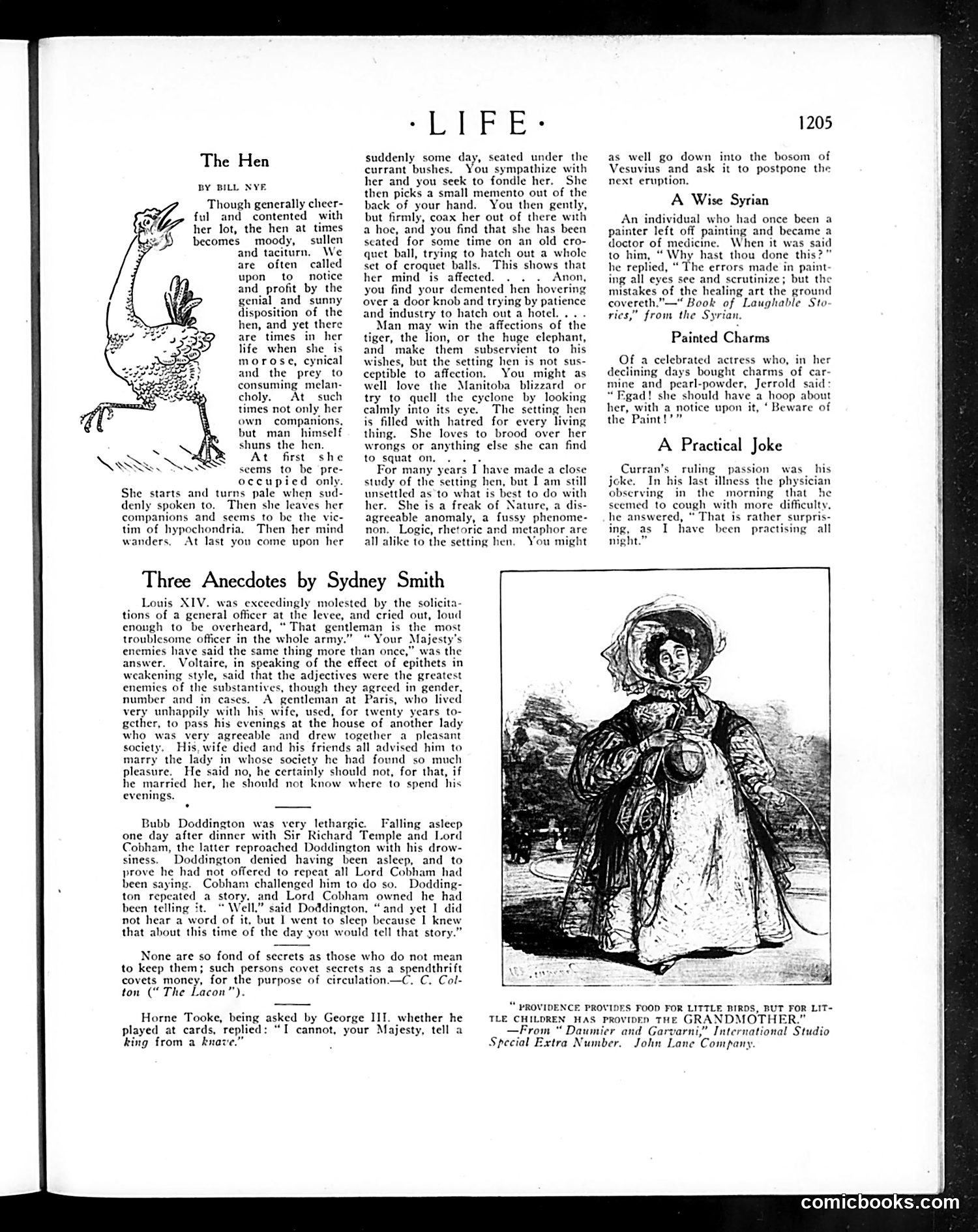
This page contains humor essays typical of Life's satirical style. **"The Hen"** by Bill Nye is a mock-serious treatise on hens' psychology, particularly "setting hens" (brooding females). Nye humorously catalogs their neurotic behaviors—sitting on croquet balls trying to hatch them, attempting to incubate doorknobs—characterizing them as fundamentally irrational and hostile creatures immune to human affection or logic. The satire mocks both pseudo-scientific animal observation and sentimental domesticity. **"Three Anecdotes by Sydney Smith"** presents brief historical anecdotes about 18th-century figures (Louis XIV, Voltaire, Horne Tooke) dealing with social pretension and wit—humor based on classical allusion rather than contemporary reference. The remaining pieces—**"A Wise Syrian,"** **"Painted Charms,"** and **"A Practical Joke"**—are brief moral or witty tales drawn from literary sources, typical of Life's mix of satire, aphorism, and genteel humor for educated readers. The illustration appears unrelated to the text.
📄 Transcribed text from this page (OCR, searchable)
Machine-transcribed from the original scan — historical spelling and the odd misread are preserved.
The Hen BY BILL NYE Though generally cheer- ful and contented with her lot, the hen at times becomes moody, _ sullen and taciturn, We are often called upon to notice and profit by the genial and sunny disposition of the hen, and yet there are times in her life when she is morose, cynical and the prey to consuming melan- choly, At such times not only her own companions, but man himself < % shuns the hen. m At first’ she NS 8 ONS cams to be pre- occupied only. She starts and turns pale when sud- denly spoken to, Then she leaves her companions and seems to be the v tim of hypochondria. Then her mind wanders. At last you come upon her Three Anecdotes by Sydney Smith Louis XIV. was answer. enemies of the substantive number and in cases. exceedingly molested by the solicita- tions of a general officer at the levee, and cried out, loud enongh to be overheard, “ That gentleman is the most troublesome officer in the whole army.” enemies have said the same thing more than once Voltaire, in speaking of the effect of epithets in weakening style, said that the adjectives were the greatest though they agreed in gender, gentleman at Paris, =e REE suddenly some day, seated under the currant bushes. You sympathize with her and you seek to fondle her. She then picks a small memento out of the back of your hand. You then gently, but firmly, coax her out of there with a hoe, and you find that she has been seated for some time on an old cro- quet ball, trying to hatch out a whole set of croquet balls. This shows that her mind is affected. . . Anon, you find your demented hen hovering over a door knob and trying by patience and industry to hatch out a hotel... . Man may win the affections of the tiger, the lion, or the huge elephant, and make them subservient to his wishes, but the setting hen is not sus- ceptible to affection, You might as well love the Manitoba blizzard or try to quell the cyclone by looking calmly into its eye. The setting hen is filled with hatred for every living thing. She loves to brood over her wrongs or anything else she can find to uat on, . we r many years I have made a close study of the setting hen, but I am still unsettled as to what is best to do with her. She is a freak of Nature, a dis- agreeable anomaly, a fussy phenome- non. Logic, rhetoric and metaphor are all alike to the setting hen. You might 1205 as well go down into the bosom of Vesuvius and ask it to postpone the next eruption. A Wise Syrian An individual who had once been a painter left off painting and became a doctor of medicine. When it said to him, “ Why hast thou done this?” he replied, “ The errors made in paint ing all eyes see and scrutinize; but the mistakes of the healing art the ground covereth,”—" Book of Laughable Sto. ries,” from the Syrian. Painted Charms Of a celebrated actress who, in her declining days bought charms of car- mine and pearl-powder, Jerrold said: *Egad! she should have a hoop about her, with a notice upon it, ‘Beware of the’ Paint!’” A Practical Joke Curran’s ruling passion was_ his joke. In his last illness the physician observing in the morning that he seemed to cough with more difficulty. he answered, “ That is rather surpris- ing, as I have been practising all night.” “Your Majesty's was the who lived very unhappily with his wife, used, for twenty years to- gether, to pass his evenings at the house of another lady who was very agreeable and drew together a pleasant society, His, wife died and his friends all advised him to marry the lady in whose society he had found so much pleasure. He said no, he certainly should not, for that, he married her, he should not know where to spend his evening: Bubb Doddington was very lethargic. Falling asleep one day after dinner with Sir Richard Temple and Lord Cobham, the latter reproached Doddington with his drow- siness. Doddington denied having been asleep, and to prove he had not offered to repeat all Lord Cobham had Cobham challenged him to do so. Dodding- nd Lord Cobham owned he had been telling it. said Doddington, “and yet I did not hear a word of it, but 1 went to sleep because | knew that about this time of the day you would tell that story.” None are so fond of secrets as those who do not mean to keep them; such persons covet secrets as a spendthrift covets money, for the purpose of circulation—C. C. Col- ton (“ The Lacon”). E PROVIDES FOOD FOR LITTLE DIRDS, BUT FOR LIT- Has provipen THE GRANDMOTHER.” —From “ Daumier and Garvarni,” International Studio Special Extra Number. John Lane Company. Horne Tooke, being asked by George III. whether he played at cards, replied: “I cannot, your Majesty, tell a king from a knave.” comicbooks.com