
Life, 1910-12-29 · page 14 of 41
Life — December 29, 1910 — page 14: what you’re looking at
What you’re looking at
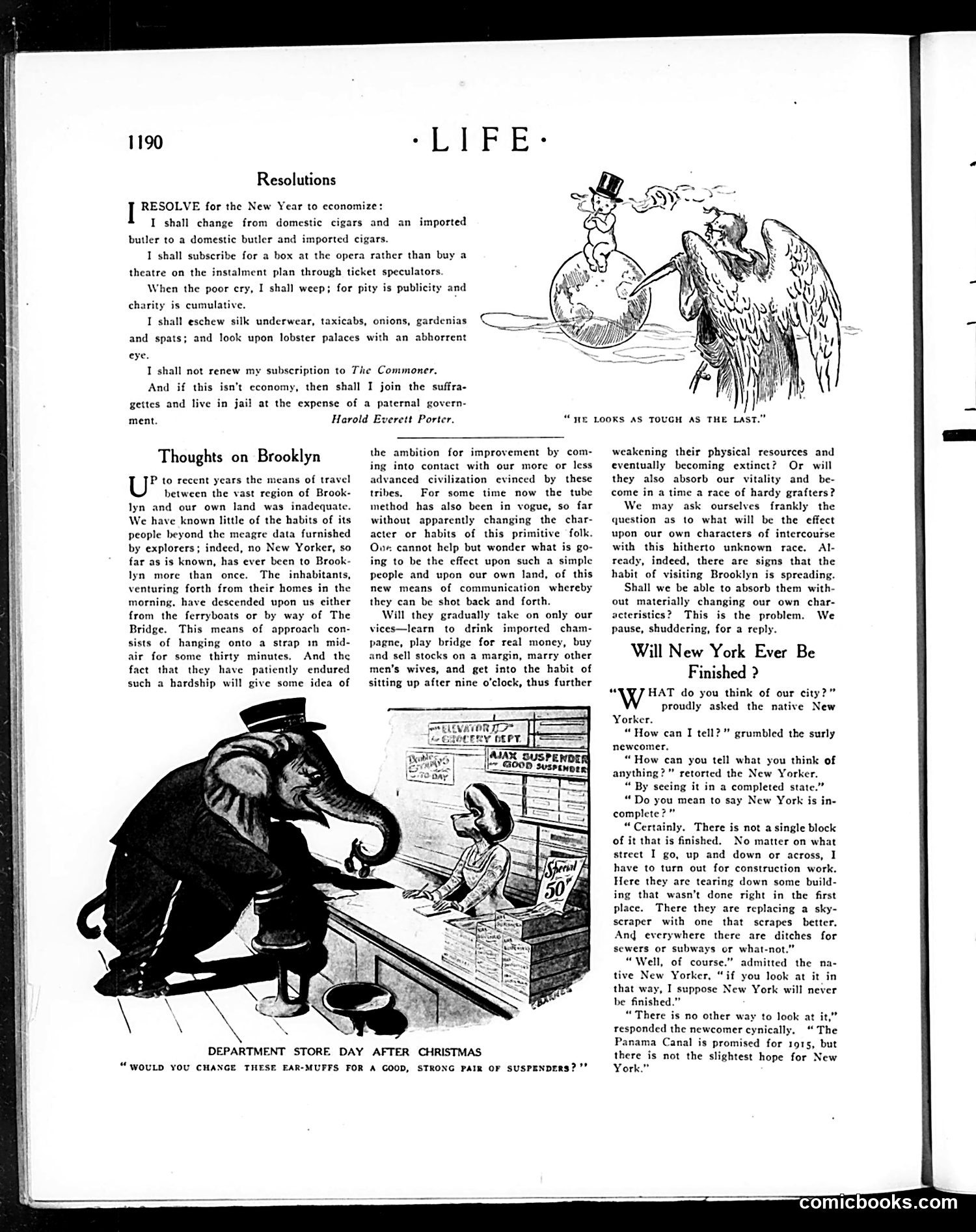
This satirical page contains three distinct pieces mocking early 1900s American upper-class pretensions and urban development: **"Resolutions"** (by Harold Everett Porter): A wealthy person's "economy" resolutions that reveal absurd class contradictions—switching from domestic cigars to imported ones, or domestic butler to imported butler. The joke satirizes how the rich's "economizing" merely shifts between luxury goods. The final jab at suffragettes and jail suggests mocking those advocating women's rights. **"Thoughts on Brooklyn"**: Condescending commentary treating Brooklyn as an exotic, "primitive" region whose inhabitants must be civilized by contact with Manhattan. It's satirical xenophobia within one city—mocking New Yorkers' snobbish dismissal of outer boroughs and their fears that Brooklyn residents will either corrupt Manhattan or become corrupted by it. **"Will New York Ever Be Finished?"**: A joke about NYC's constant construction and demolition. The newcomer observes buildings constantly torn down and rebuilt, questioning whether the city will ever be "complete." The native New Yorker admits it likely never will be—satirizing New York's perpetual chaos and obsessive self-improvement.
📄 Transcribed text from this page (OCR, searchable)
Machine-transcribed from the original scan — historical spelling and the odd misread are preserved.
1190 Resolutions “ETE Ee * RESOLVE for the New Year to economize: I shall change from domestic cigars and an imported butler to a domestic butler and imported cigars. I shall subscribe for a box at the opera rather than buy a theatre on the instalment plan through ticket speculators. When the poor cry, I shall weep; for pity is publicity and charity is cumulative. I shall eschew silk underwear, taxicabs, onions, gardenias and spats; and look upon lobster palaces with an abhorrent eye. I shall not renew my subscription to The Commoner. And if this isn’t economy, then shall I join the suffra- gettes and live in jail at the expense of a paternal govern- ment. Thoughts on Brooklyn P to recent years the means of travel between the vast region of Brook- lyn and our own land was inadequate. We have known little of the habits of its people beyond the meagre data furnished by explorers; indeed, no New Yorker, so far as is known, has ever been to Brook- lyn more than once. The inhabitants, venturing forth from their homes in the morning. have descended upon us cither from the ferryboats or by way of The Bridge. This means of approach con- sists of hanging onto a strap im mid- air for some thirty minutes. And the fact that they have patiently endured such a hardship will give some idea of Harold Everett Porter. the ambition for improvement by com- ing into contact with our more or less advanced civilization evinced by these tribes. For some time now the tube method has also been in vogue, so far without apparently changing the char- acter or habits of this primitive folk. One cannot help but wonder what is go- ing to be the effect upon such a simple people and upon our own land, of this new means of communication whereby they can be shot back and forth. Will they gradually take on only our vices—learn to drink imported cham- pagne, play bridge for real money, buy and sell stocks on a margin, marry other men’s wives, and get into the habit of sitting up after nine o'clock, thus further DEPARTMENT STORE DAY AFTER CHRISTMAS “WOULD YOU CHANGE THESE EAR-MUFFS FOR A GOOD, STRONG PAIR OF SUSPENDERS? ’? “WE LOOKS AS TOUGH AS THE LAST.” weakening their physical resources and eventually becoming extinct? Or will they also absorb our vitality and be- come in a time a race of hardy grafters? We may ask ourselves frankly the question as to what will be the effect upon our own characters of intercourse with this hitherto unknown race. Al- ready, indeed, there are signs that the habit of visiting Brooklyn is spreading. Shall we be able to absorb them with- out materially changing our own char- acteristics? This is the problem. We pause, shuddering, for a reply. Will New York Ever Be Finished > HAT do you think of our city?” proudly asked the native New Yorker. “How can I tell?” grumbled the surly newcomer. “How can you tell what you think of anything?" retorted the New Yorke: “ By seeing it in a completed stat “Do you mean to say New York is in- complete?” “Certainly. There is not a single block of it that is finished. No matter on what strect I go, up and down or across, I have to turn out for construction work. Here they are tearing down some build- ing that wasn’t done right in the first place. There they are replacing a sky- scraper with one that scrapes better. And everywhere there are ditches for sewers or subways or what-not.” “Well, of course.” admitted the na- Yorker, “if you look at it in y, I suppose New York will never be finished.’ “There is no other way to look . responded the newcomer cynically, “ The Panama Canal is promised for 1915, but there is not the slightest hope for New Yor! comicbooks.com