
Life, 1910-12-29 · page 27 of 41
Life — December 29, 1910 — page 27: what you’re looking at
What you’re looking at
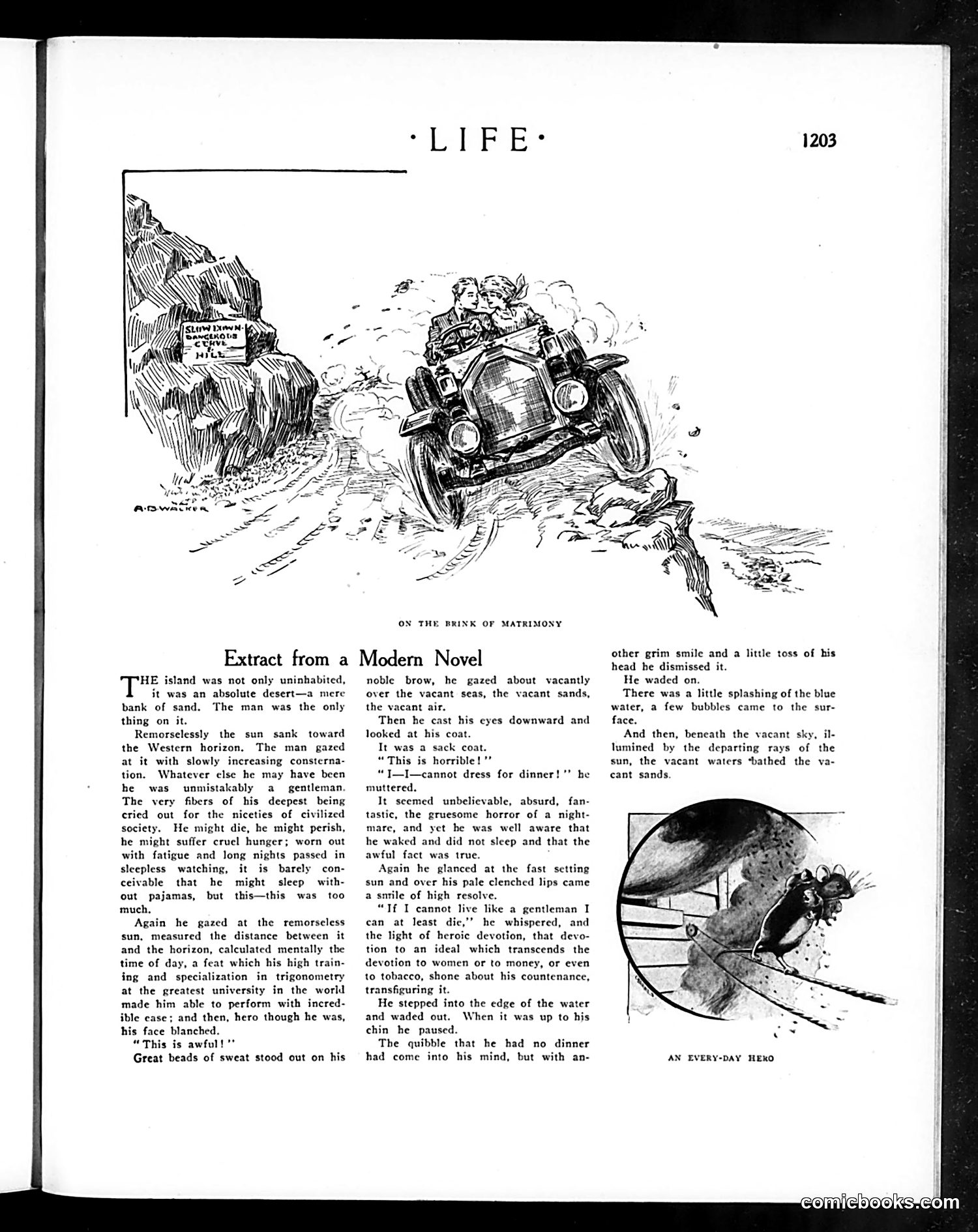
This satirical piece mocks upper-class masculine vanity and rigidity. A gentleman stranded alone on a desert island faces existential crisis—not from hunger or danger, but because he lacks proper dinner attire (a sack coat instead of formal wear). His crisis of conscience over appearing undressed for dinner supersedes survival instincts. The satire targets early 20th-century aristocratic obsession with social conventions and etiquette. The title "On the Brink of Matrimony" suggests this anxious, convention-bound character type represents the kind of man entering marriage. The "Every-Day Hero" caption ironically presents his suicide—choosing death over social impropriety—as noble rather than absurd. Life magazine here ridicules the absurd priorities of wealthy men who prioritize appearance and propriety over practical reality.
📄 Transcribed text from this page (OCR, searchable)
Machine-transcribed from the original scan — historical spelling and the odd misread are preserved.
ON THE BRINK OF MATRIMONY Extract from a Modern Novel HE island was not only uninhabited, it was an absolute desert—a mere bank of sand. The man was the only thing on it. Remorselessly the sun sank toward the Western horizon. The man gazed at it with slowly increasing consterna- tion. Whatever clse he may have been he was unmistakably a gentleman. The very fibers of his deepest being cried out for the niceties of civilized society. He might die, he might perish, he might suffer crucl hunger; worn out with fatigue and long nights passed in sleepless watching, it is barely con- ceivable that he might sleep with- out pajamas, but this—this was too much, Again he gazed at the remorseless sun, measured the distance between it and the horizon, calculated mentally the time of day, a feat which his high train- ing and specialization in trigonometry at the greatest university in the world made him able to perform with incred- ible case; and then, hero though he was, his face blanched. “This is awful!’ Great beads of sweat stood out on his noble brow, he gazed about vacantly over the vacant seas, the vacant sands, the vacant air. Then he cast his eyes downward and looked at his coat. It was a sack coat. “This is horrible!" “J—I—cannot dress for dinner!" he muttered. It seemed unbelievable, absurd, fan- tastic, the gruesome horror of a night- mare, and yet he was well aware that he waked and did not sleep and that the awful fact was true. Again he glanced at the fast setting sun and over his pale clenched lips came a smile of high resolve. “Tf I cannot live like a gentleman I can at least dic,’’ he whispered, and the light of heroic devotion, that devo- tion to an ideal which transcends the devotion to women or to money, or even to tobacco, shone about his countenance, transfiguring it. He stepped into the edge of the water and waded out. When it was up to his chin he paused. The quibble that he had no dinner had come into his mind, but with an- other grim smile and a little toss of his head he dismissed it. He waded on. There was a little splashing of the blue water, a few bubbles came to the sur- face. And then, beneath the vacant sky, il- lumined by the departing rays of the sun, the vacant waters ‘bathed the va- cant sands. AN EVERY-DAY HEKO