
Life, 1910-12-29 · page 13 of 41
Life — December 29, 1910 — page 13: what you’re looking at
What you’re looking at
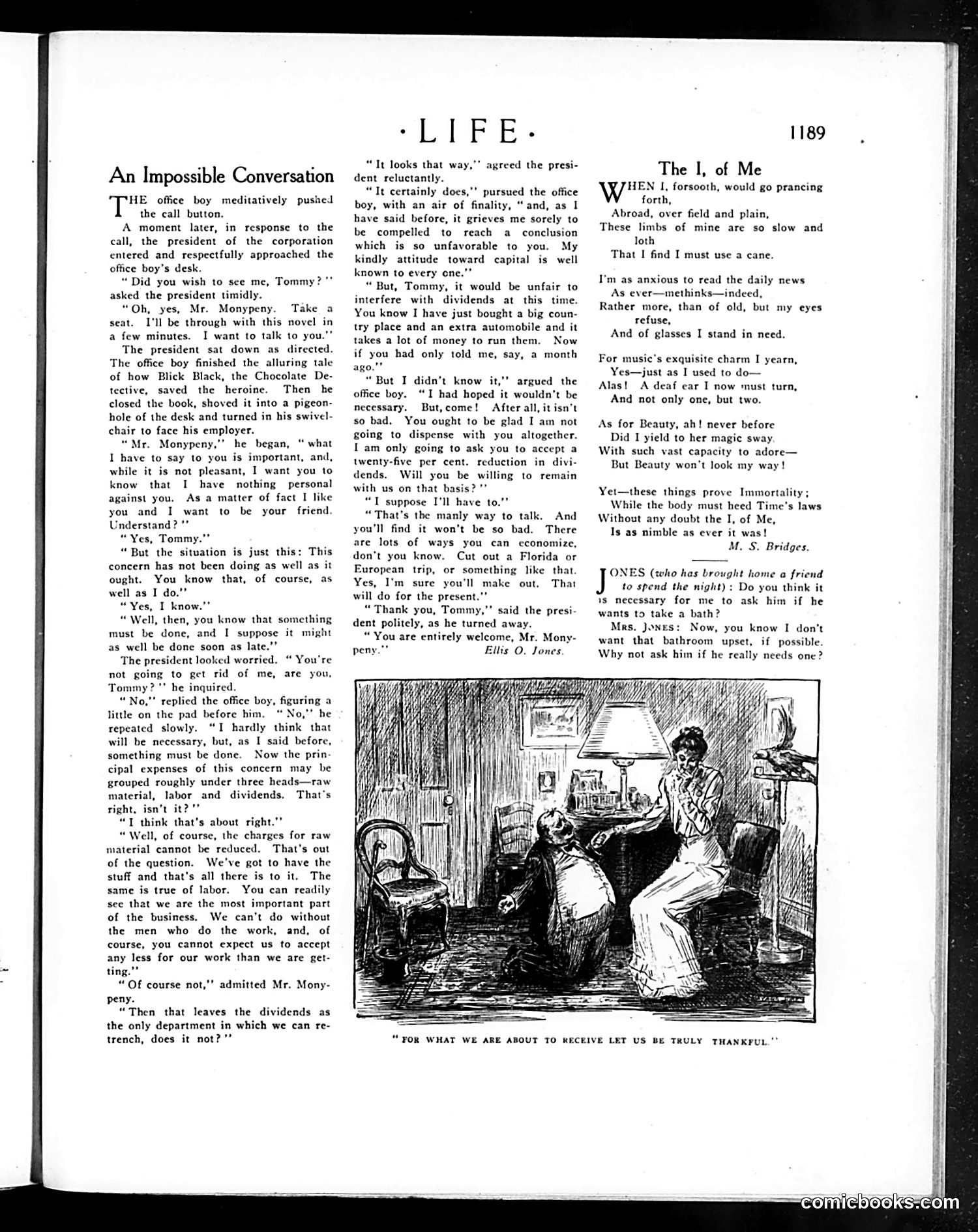
This page contains two distinct pieces: **"An Impossible Conversation"** is a satirical dialogue between an office boy and a company president about dividend cuts. The president argues the company must reduce dividends to cover labor and material costs, suggesting workers should accept pay cuts instead. The satire targets corporate greed—the president seeks to protect shareholder profits while shifting financial burdens onto workers. **"The I, of Me"** is a poem about physical decline and aging, touching on themes of mortality and dependency (needing a cane). **The illustration** (bottom) depicts an interior domestic scene with the caption "For What We Are About to Receive Let Us Be Truly Thankful," likely satirizing gratitude during economic hardship or scarcity—possibly Depression-era commentary on making do with less.
📄 Transcribed text from this page (OCR, searchable)
Machine-transcribed from the original scan — historical spelling and the odd misread are preserved.
An Impossible Conversation HE office boy meditatively pushed the call button. A moment later, in response to the call, the president of the corporation entered and respectfully approached the office boy’s desk. “Did you wish to see me, Tommy?" asked the president timidly. “Oh, yes, Mr. Monypeny. Take a seat. I'll be through with this novel in a few minutes. I want to talk to you.”” The president sat down as directed. The office boy finished the alluring tale of how Blick Black, the Chocolate De- tective, saved the heroine. Then he closed the book, shoved it into a pigeon- hole of the desk and turned in his swivel- chair to face his employer. “Mr. Monypeny,’’ he began, “ what I have to say to you is important, and, while it is not pleasant, I want you to know that I have nothing personal against you. Asa matter of fact I like you and I want to be your friend Understand? '" “Yes, Tommy “But the situation is just this: This concern has not been doing as well as it ought. You know that, of course, as well as I do.’" “Yes, I know.” “Well, then, you know that something must be done, and I suppose it might as well be done soon as late."’ The president looked worried. “ You're not going to get rid of me, are you, Tommy?" he inquired. “No,” replied the office boy, figuring a little on the pad before him. No,"" he repeated slowly, “I hardly think that will be necessary, but, as I said before, something must be done. Now the prin cipal expenses of this concern may be grouped roughly under three heads—raw material, labor and dividends. That's right, isn’t it?’’ “T think that’s about right.’” “Well, of course, the charges for raw material cannot be reduced. That's out of the question. We've got to have the stuff and that’s all there is to it. The same is true of labor. You can readily see that we are the most important part of the business. We can’t do without the men who do the work, and, of course, you cannot expect us to accept any less for our work than we are get- ting.”” “ OF course not, peny. “Then that leaves the dividends as the only department in which we can re- trench, does it not?'’ admitted Mr. Mony- ‘LIFE- “Tt looks that way,’” dent reluctantly. “Tt certainly does,"’ pursued the office boy, with an air of finality, “and, as I have said before, it grieves me sorely to be compelled to reach a conclusion which is so unfavorable to you. My kindly attitude toward capital is well known to every one.’’ “But, Tommy, it would be unfair to interfere with dividends at this time. You know I have just bought a big coun- try place and an extra automobile and it takes a lot of money to run them. Now if you had only told me, say, a month ago."" “ But I didn’t know it,’’ argued the office boy. “I had hoped it wouldn't be necessary. But,come! After all, it isn’t so bad. You ought to be glad I am not going to dispense with you altogether. I am only going to ask you to accept a twenty-five per cent. reduction in divi- dends. Will you be willing to remain with us on that basis? ’’ “T suppose I'll have to."’ “That's the manly way to talk. And you'll find it won't be so bad. There are lots of ways you can economize, don’t you know. Cut out a Florida or European trip, or something like that Yes, I'm sure you'll make out. That will do for the present." “Thank you, Tommy,” said the presi dent politely, as he turned away. “You are entirely welcome, Mr. Mony- Ellis O. Jones. agreed the presi- 1189 The I, of Me Wee I, forsooth, would go prancing forth, Abroad, over field and plain, These limbs of mine are so slow and loth That I find I must use a cane. I'm as anxious to read the daily news As ever—methinks—indeed, Rather more, than of old, but my eyes refuse, And of glasses I stand in need. For music's exquisite charm I yearn, Yes—just as I used to do— Alas! A deaf ear I now must turn, And not only one, but two. As for Beauty, ah! never before Did I yield to her magic sway. With such vast capacity to adore— But Beauty won't look my way! Yet—these things prove Immortality; While the body must heed Time's laws Without any doubt the I, of Me, Is as nimble as ever it was! M. S. Bridges. ONES (who has brought home a friend J to spend the night): Do you think it is necessary for me to ask him if he wants to take a bath? Mrs. Jo Now, you know I don't want that bathroom upset, if possible. Why not ask him if he really needs one? “FOR WHAT WE ARE ABOUT TO RECEIVE LET US BE TRULY THANKFUL."