
Life, 1910-12-29 · page 24 of 41
Life — December 29, 1910 — page 24: what you’re looking at
What you’re looking at
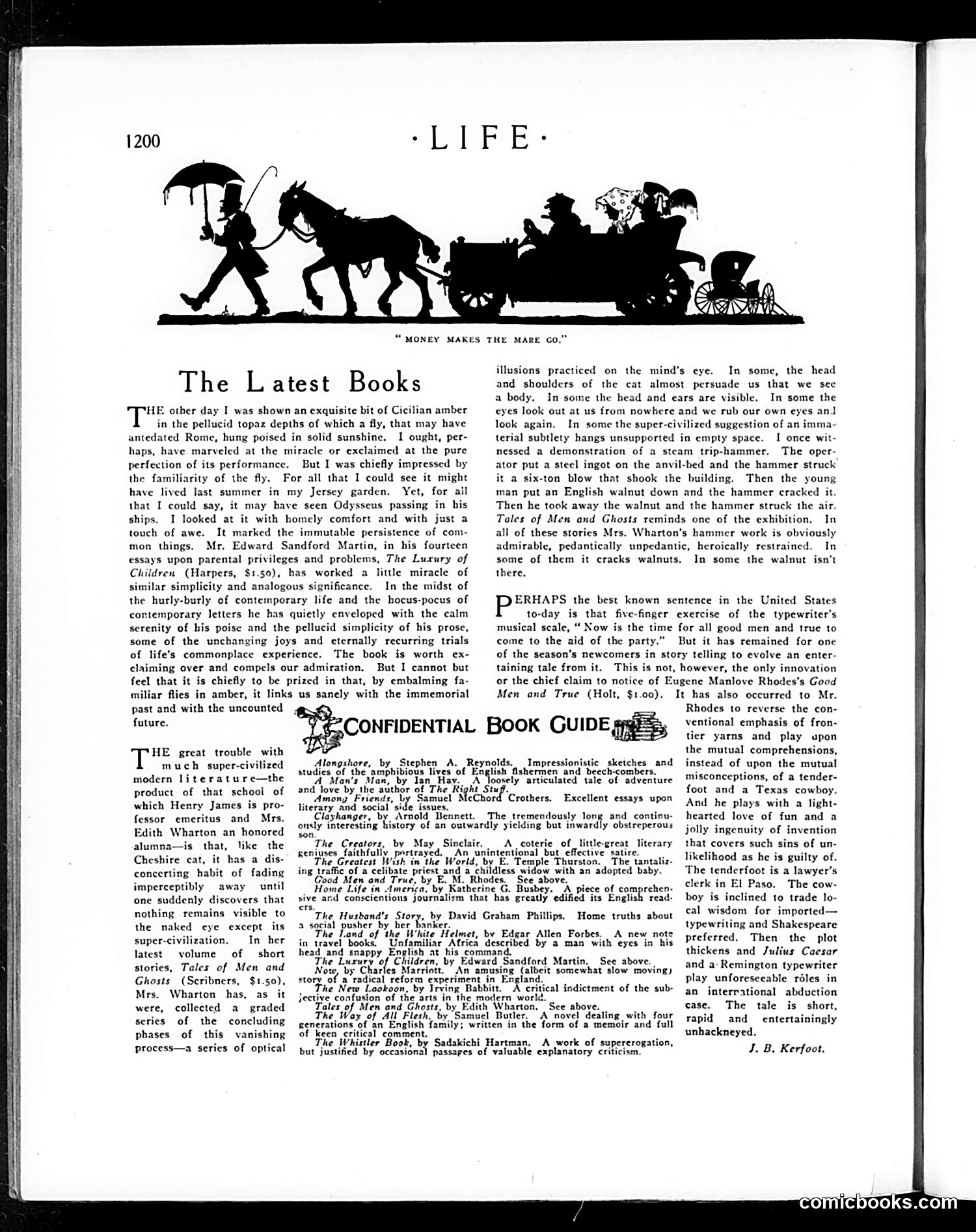
This page contains a book review section titled "The Latest Books" with a satirical silhouette cartoon at the top captioned "Money Makes the Mare Go" — depicting a man with an umbrella leading a horse pulling a cart of passengers, a visual pun on the proverb suggesting financial motivation. The reviews critique contemporary literature, particularly targeting Henry James and Edith Wharton's overly intellectual, abstract style. The critic compares Wharton's stories to optical illusions that fade away until "nothing remains visible to the naked eye except its super-civilization" — mocking how their work becomes so refined and abstract it loses substance and connection to real life. The reviews praise simpler, more grounded works: Martin's essays on parenthood and Rhodes's frontier stories that engage with authentic human experience rather than literary pretension. The satire suggests that early 20th-century "high literature" had become disconnected from ordinary life—a common complaint about modernist writers.
📄 Transcribed text from this page (OCR, searchable)
Machine-transcribed from the original scan — historical spelling and the odd misread are preserved.
“MONEY MAKES THE MARE Go.” The Latest Books T other day I was shown an exquisite bit of Cicilian amber in the pellucid topaz depths of which a fly, that may have antedated Rome, hung poised in solid sunshine. I ought, per- haps, have marveled at the miracle or exclaimed at the pure perfection of its performance. But I was chiefly impressed by the familiarity of the fly. For all that I could see it might have lived last summer in my Jersey garden. Yet, for ail that I could say, it may have seen Odysseus passing in his ships. I looked at it with homely comfort and with just a touch of awe. It marked the immutable persistence of com- mon things. Mr. Edward Sandford Martin, in his fourteen essays upon parental privileges and problems, The Lurury of Children (Harpers, $1.50), has worked a little miracle of similar simplicity and analogo’ significance. In the midst of the hurly-burly of contemporary life and the hocus-pocus of contemporary letters he has quietly enveloped with the calm serenity of his poise and the pellucid simplicity of his prose, some of the unchanging joys and eternally recurring trials of life's commonplace experience. The book is worth ex- claiming over and compels our admiration. But I cannot but feel that it is chiefly to be prized in that, by embalming fa- miliar flies in amber, it links us sanely with the immemorial past and with the uncounted future. illusions practiced on the mind's eye. In some, the head and shoulders of the cat almost persuade us that we sec a body. In some the head and ears are visible. In some the eyes look out at us from nowhere and we rub our own eyes and look again. In some the super-civilized suggestion of an imma- terial subtlety hangs unsupported in empty space. I once wit- nessed a demonstration of a steam trip-hammer. The oper- ator put a steel ingot on the anvil-bed and the hammer struck it a six-ton blow that shook the building. Then the young man put an English walnut down and the hammer cracked it Then he took away the walnut and the hammer struck the air. Tales of Men and Ghosts reminds one of the exhibition. In all of these stories Mrs. Wharton's hammer work is obviously admirable, pedantically unpedantic, heroically restrained. In some of them it cracks walnuts. In some the walnut isn't there. ERHAPS the best known sentence in the United States to-day is that five-finger exercise of the typewriter’s musical scale, “ Now is the time for all good men and true to come to the aid of the party.” But it has remained for one of the season's newcomers in story telling to evolve an enter- taining tale from it. This is not, however, the only innovation or the chief claim to notice of Eugene Manlove Rhodes's Good Men and True (Holt, $1.00). It has also occurred to Mr. HE great trouble with much super-civilized modern literature—the product of that school of which Henry James is pro- fessor emeritus and Mrs. ith Wharton an honored alumna—is that, like the Cheshire cat, it has a dis- concerting habit of fading imperceptibly away until one suddenly discovers that nothing remains visible to the naked cye except its super-civilization. In her latest. volume of — short stories, Tales of Men and Ghosts (Scribners, $1.50), Mrs. Wharton has, as it were, collected a graded series of the concluding phases of this vanishing Process—a series of optical q Rhodes to reverse the con- “ERCONFIDENTIAL Book GUIDE gts, ventional emphasis of fron- tier yarns and play upon Alongshore, by Stephen A. Reynolds. Impressionistic sketches and studies of the amphibious lives of English fishermen and beech-combers. ‘A Man's Man, by Ian Hay. A loosely articulated tale of adventure and love by the author of The Right Stuf. Amony Friends, by Samuel McChord Crothers. Excellent essays upon literary and social side issues. Clayhanger, by Arnold Bennett. The tremendously long and continu: onsly interesting history of an outwardly yielding but inwardly obstreperous son, The Creators, by May Sinclai A coterie of little-great literary geniuses faithfully portrayed. An unintentional but effective satire. The Greatest Wish in the World, by E. Temple Thurston. The tantaliz~ ing traffic of a celibate priest and a childless widow with an adopted baby. Good Men and True, by E. M. Rhodes. See above. Home Life in America, by Katherine G, Busbey. A. piece of comprehen- sive and conscientions journalism that has greatly edified its English read- crs. The Husband's Story, by David Graham Phillips. Home truths about a social pusher by her banker. The Iand of the White Helmet, bv Edgar Allen Forbes. A new note in travel books. Unfamiliar Africa described by a man with eyes in his head and snappy English at his command. The Luxury of Children, by Edward Sandford Martin, See above. Now, by Charles Marriott. An amusing (albeit somewhat slow moving) story of a radical reform experiment in England. | The New Laokoon, by Irving Babbitt. A critical indictment of the sub- jective confusion of the arts in the modern world. Tales of Men and Ghosts, by Edith Wharton. See above. The Way of All Flesh, by Samuel Butler. A novel dealing with four generations of an English family; written in the form of a memoir and full of keen critical comment, The Whistler Book, by Sadakichi Hartman, A work of supererogation, but justified by occasional passages of valuable explanatory criticism. the mutual comprehensions, instead of upon the mutual misconceptions, of a tender- foot and a Texas cowboy. And he plays with a light- hearted love of fun and a jolly ingenuity of invention that covers such sins of un- likelihood as he is guilty of. The tenderfoot is a lawyer’s clerk in El Paso. The cow- boy is inclined to trade lo- cal wisdom for imported— typewriting and Shakespeare preferred. Then the plot thickens and Julius Caesar and a- Remington typewriter play unforeseeable réles in an interrational abduction case. The tale is short, rapid and entertainingly unhackneyed. J. B, Kerfoot. cComicbooks.com