
Life, 1910-12-29 · page 15 of 41
Life — December 29, 1910 — page 15: what you’re looking at
What you’re looking at
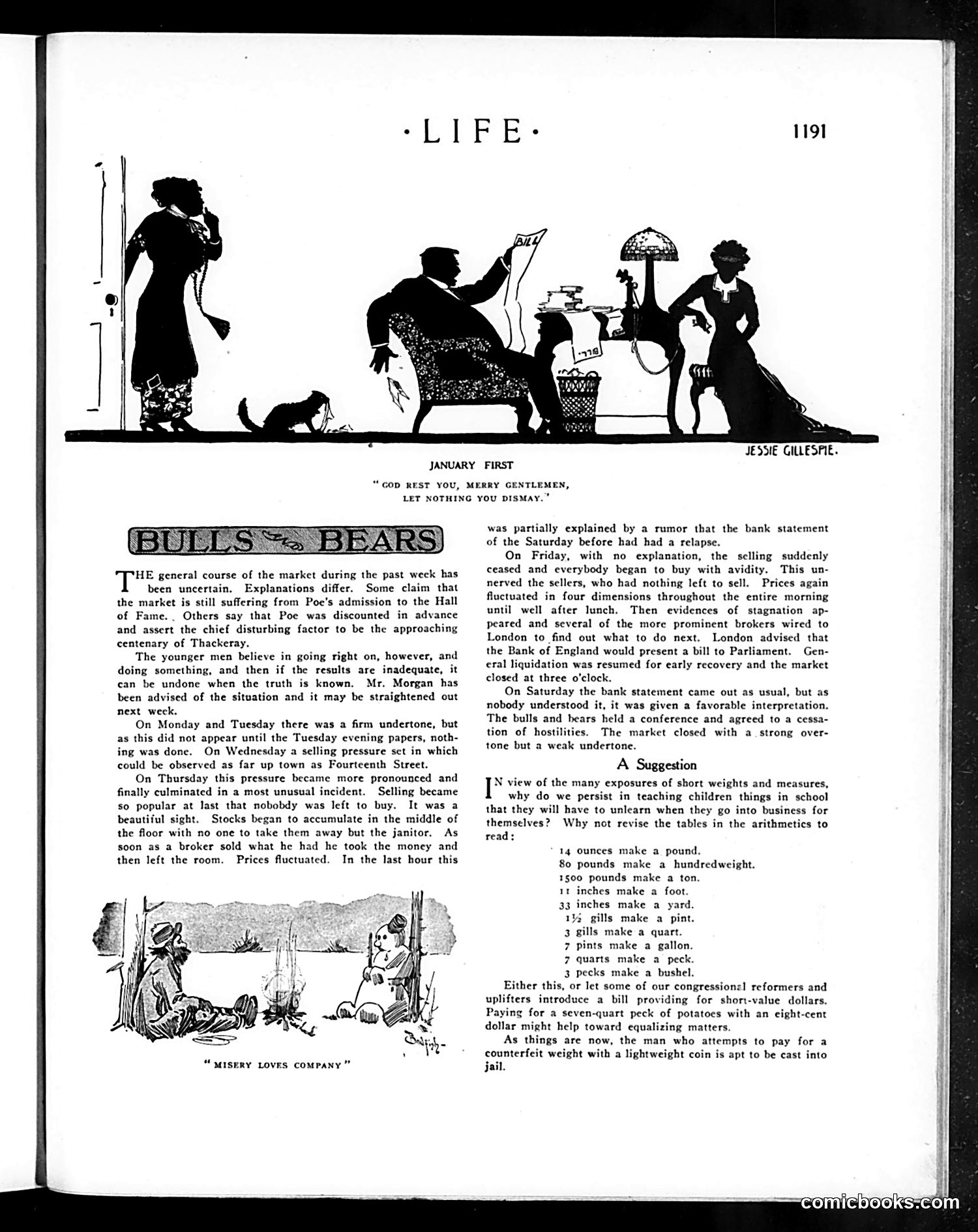
This *Life* magazine page satirizes early 1900s stock market volatility and commercial dishonesty. The "Bulls & Bears" section mocks the chaotic, irrational behavior of financial traders—prices fluctuating wildly based on rumors, banker telegrams to London, and collective panic rather than logic. The humor lies in describing absurd outcomes: brokers abandoning stocks with no buyers, prices shifting in "four dimensions," and mysterious bank statements given "favorable interpretation" nobody understands. "A Suggestion" extends the satire to everyday commerce, noting that children learn honest weights and measures in school but encounter systematic short-weighting in actual business (short-changing customers). The proposal—officially teach false measurements, or alternatively legalize short-value currency—exposes the hypocrisy: current law punishes ordinary citizens for counterfeiting while merchants routinely cheat. The satire suggests commercial dishonesty is so normalized that legalizing it might be logical.
📄 Transcribed text from this page (OCR, searchable)
Machine-transcribed from the original scan — historical spelling and the odd misread are preserved.
JESSIE GILLESPIE. JANUARY FIRST “GOD REST YOU, MERRY GENTLEMEN, LET NOTHING You DISMAY.” HE general course of the market during the past week has been uncertain. Explanations differ. Some claim that the market is still suffering from Poe's admission to the Hall of Fame.. Others say that Poe was discounted in advance and assert the chief disturbing factor to be the approaching centenary of Thackeray. The younger men believe in going right on, however, and doing something, and then if the results are inadequate, it can be undone when the truth is known, Mr. Morgan has been advised of the situation and it may be straightened out next week. On Monday and Tuesday there was a firm undertone, but as this did not appear until the Tuesday evening papers, noth- ing was done. On Wednesday a selling pressure set in which could be observed as far up town as Fourteenth Street. On Thursday this pressure became more pronounced and finally culminated in a most unusual incident. Selling became so popular at last that nobobdy was left to buy. It was a beautiful sight. Stocks began to accumulate in the middle of the floor with no one to take them away but the janitor. As soon as a broker sold what he had he took the money and then left the room. Prices fluctuated. In the last hour this “MISERY LOVES COMPANY” was partially explained by a rumor that the bank statement of the Saturday before had had a relapse. On Friday, with no explanation, the selling suddenly ceased and everybody began to buy with avidity. This un- nerved the sellers, who had nothing left to sell. Prices again fluctuated in four dimensions throughout the entire morning until well after lunch. Then evidences of stagnation ap- peared and several of the more prominent brokers wired to London to find out what to do next, London advised that the Bank of England would present a bill to Parliament. Gen- eral liquidation was resumed for early recovery and the market closed at three o'clock. On Saturday the bank statement came out as usual, but as nobody understood it, it was given a favorable interpretation. The bulls and hears held a conference and agreed to a cessa- tion of hostilities. The market closed with a strong over- tone but a weak undertone. A Suggestion I view of the many exposures of short weights and measures, why do we persist in teaching children things in school that they will have to unlearn when they go into business for themselves? read: Why not revise the tables in the arithmetics to 14 ounces make a pound. 80 pounds make a hundredweight. 1500 pounds make a ton. 11 inches make a foot. 33 inches make a yard. 1% gills make a pint. 3 gills make a quart. 7 pints make a gallon. 7 quarts make a peck. 3 pecks make a bushel. Either this, or let some of our congressionz! reformers and uplifters introduce a bill providing for short-value dollars. Paying for a seven-quart peck of potatoes with an eight-cent dollar might help toward equalizing matters. As things are now, the man who attempts to pay for a counterfeit weight with a lightweight coin is apt to be cast into jail.