
A complete issue · 48 pages · 1910
Life — July 7, 1910
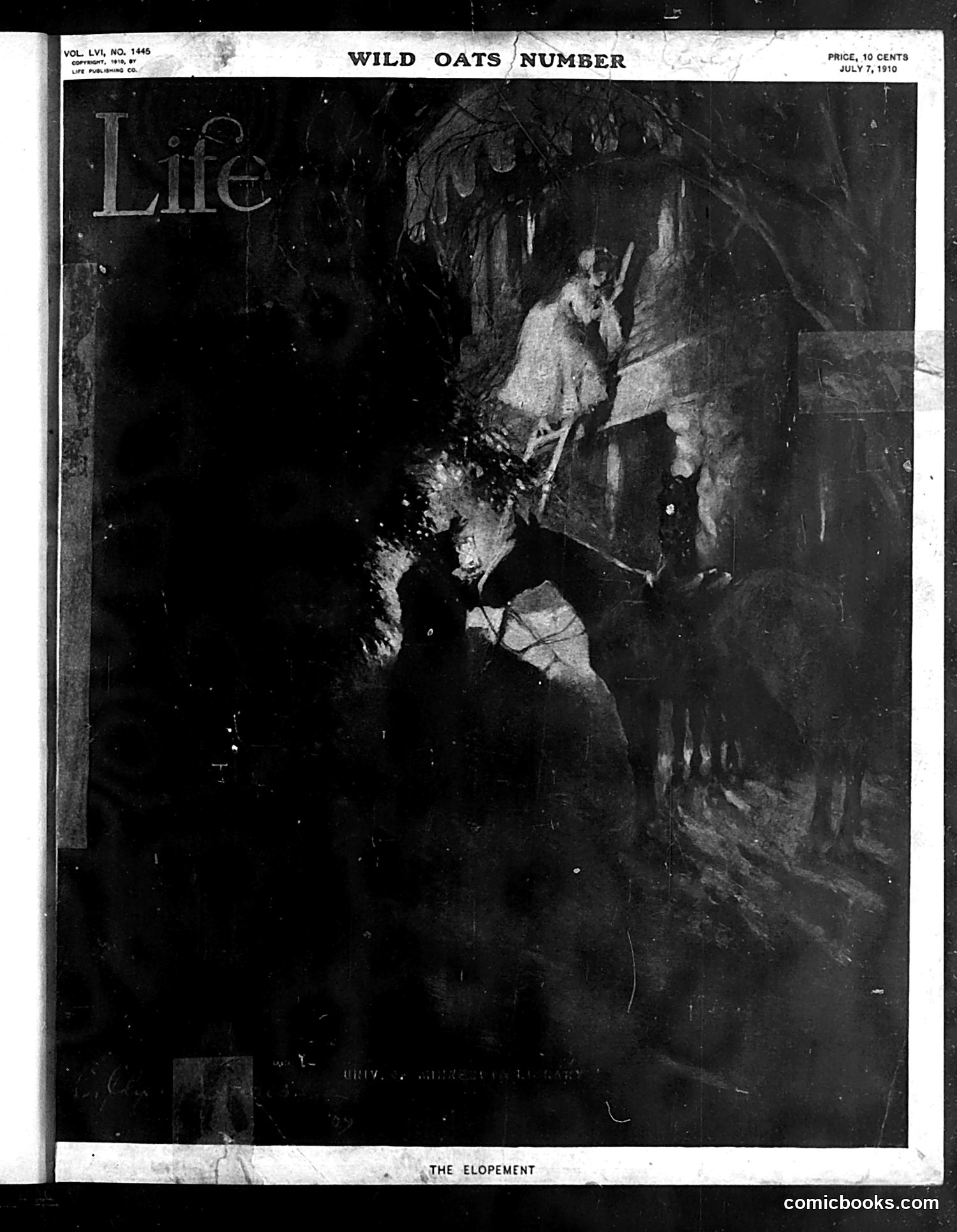
This is a dramatic scene titled "The Elopement" from Life magazine's "Wild Oats" humor section (July 1, 1910). The image shows what appears to be a staged theatrical or satirical scene depicting a romantic escape—likely a couple fleeing together, with figures in period costume within a darkened interior space. Without additional caption text visible, the specific satirical target remains unclear. However, given the theatrical staging and Life magazine's focus on social commentary, this likely mocks contemporary attitudes about courtship, scandal, or class dynamics. The melodramatic composition suggests satire of romantic conventions or possibly a commentary on real social figures of the era. The exact reference requires additional context beyond what's legible here.
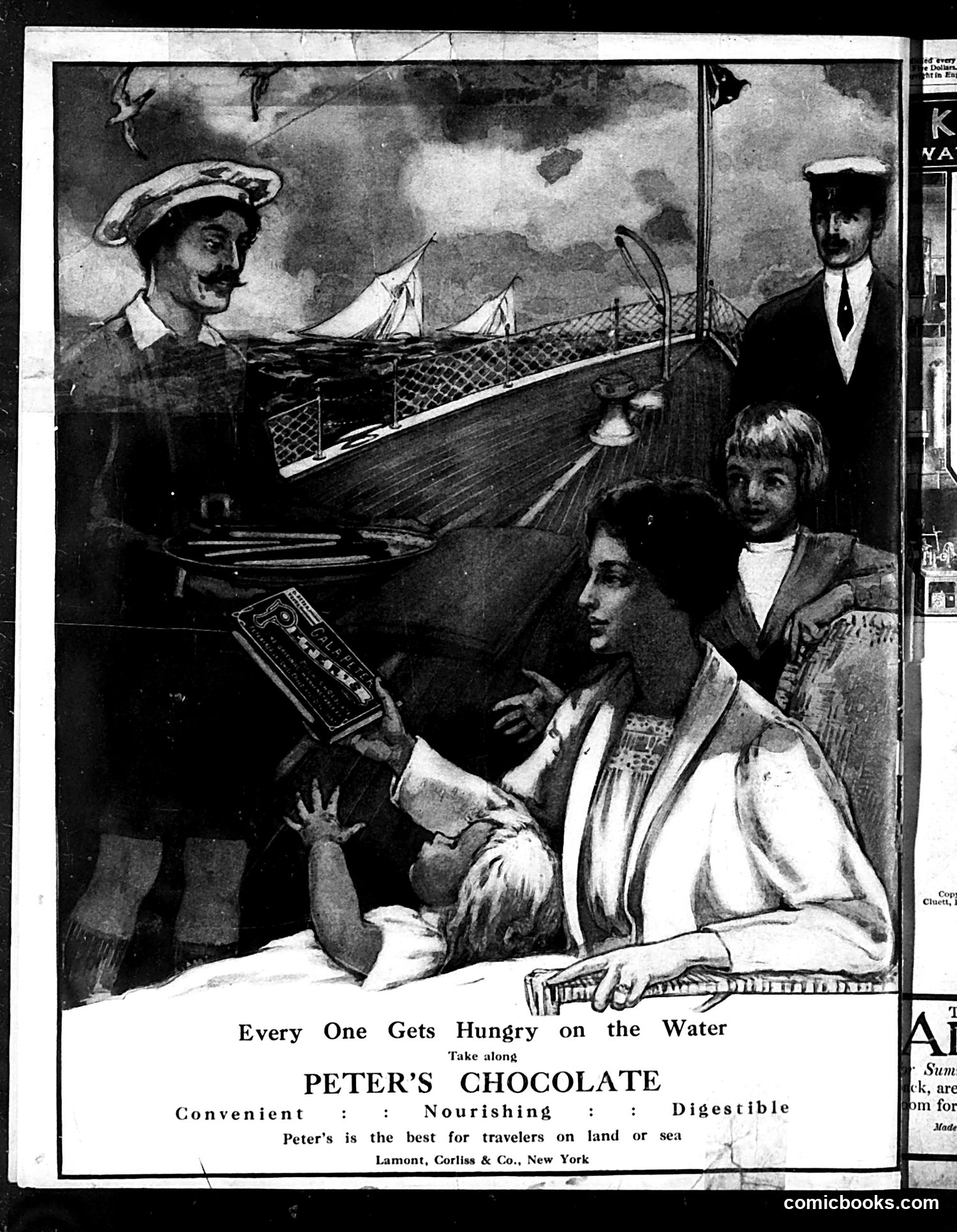
This page is primarily an **advertisement**, not political satire. It depicts a chocolate company's marketing campaign. The ad shows what appears to be a ship's deck scene with sailors or travelers and passengers. The caption "Every One Gets Hungry on the Water" promotes Peter's Chocolate as a convenient travel food. The tagline emphasizes it is "Nourishing" and "Digestible" for "travellers on land or sea." The figures are generic characters (sailors, well-dressed gentlemen, a woman, a child) meant to represent typical travelers of the era. This is straightforward commercial advertising using the appeal of maritime travel—likely popular in the early 1900s when ocean voyages were common for tourism and immigration. There is no discernible political commentary or satirical intent on this page.
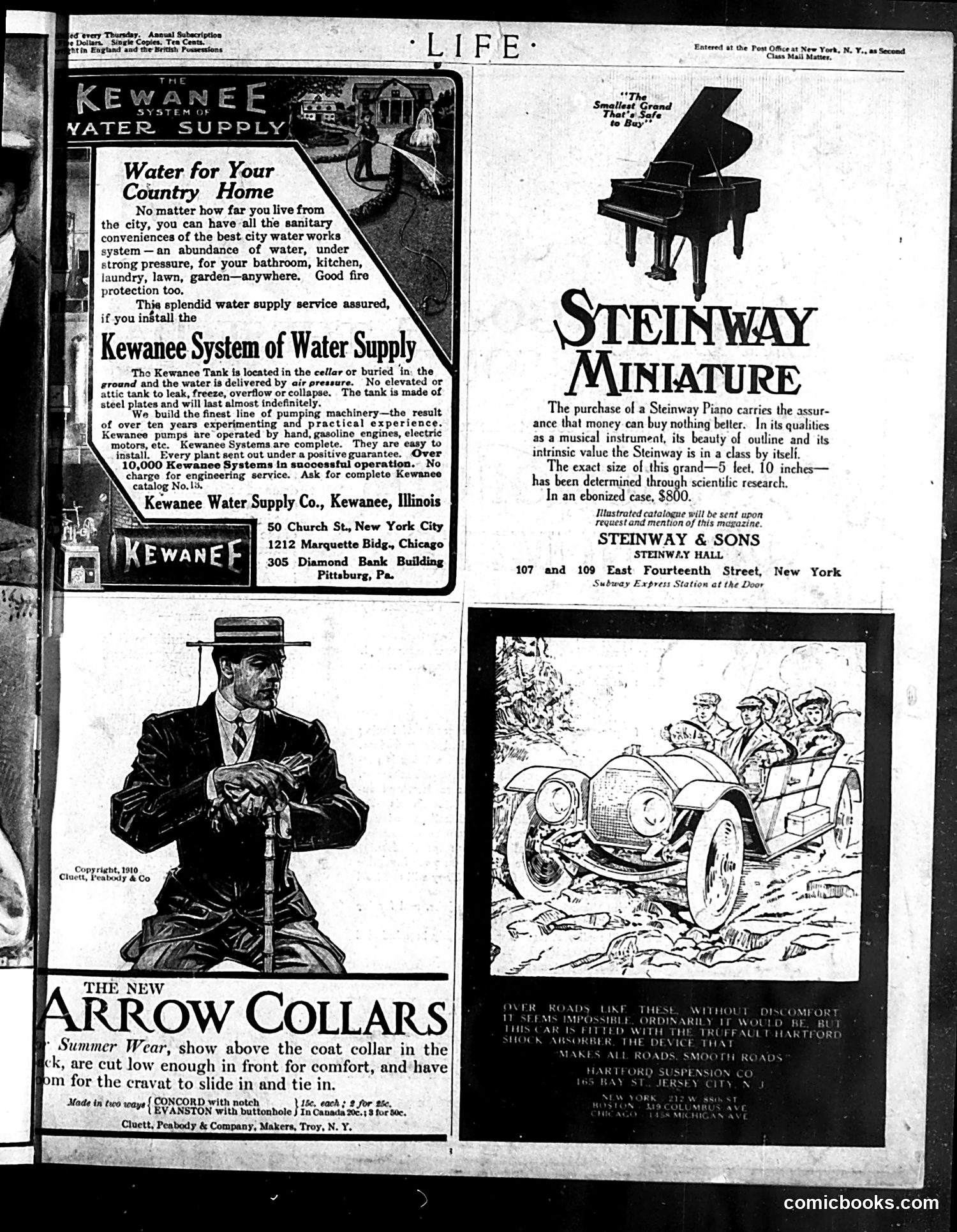
This page is primarily **advertising** from early 20th century Life magazine, not satirical content. It contains four advertisements: 1. **Kewanee Water Supply System** — promotes home water systems for rural/country properties 2. **Steinway Miniature Piano** — advertises a smaller piano model, emphasizing quality and scientific design 3. **Arrow Collars** — shows a man demonstrating the new low-cut summer collar design for comfort 4. **Hartford Suspension** — an automotive ad featuring a racing car, highlighting shock absorption technology for smooth rides The page reflects period consumer culture: rural modernization, luxury goods, men's fashion, and early automotive innovation. No political satire or caricature appears present — this is straightforward commercial advertising typical of Life's revenue model during this era.
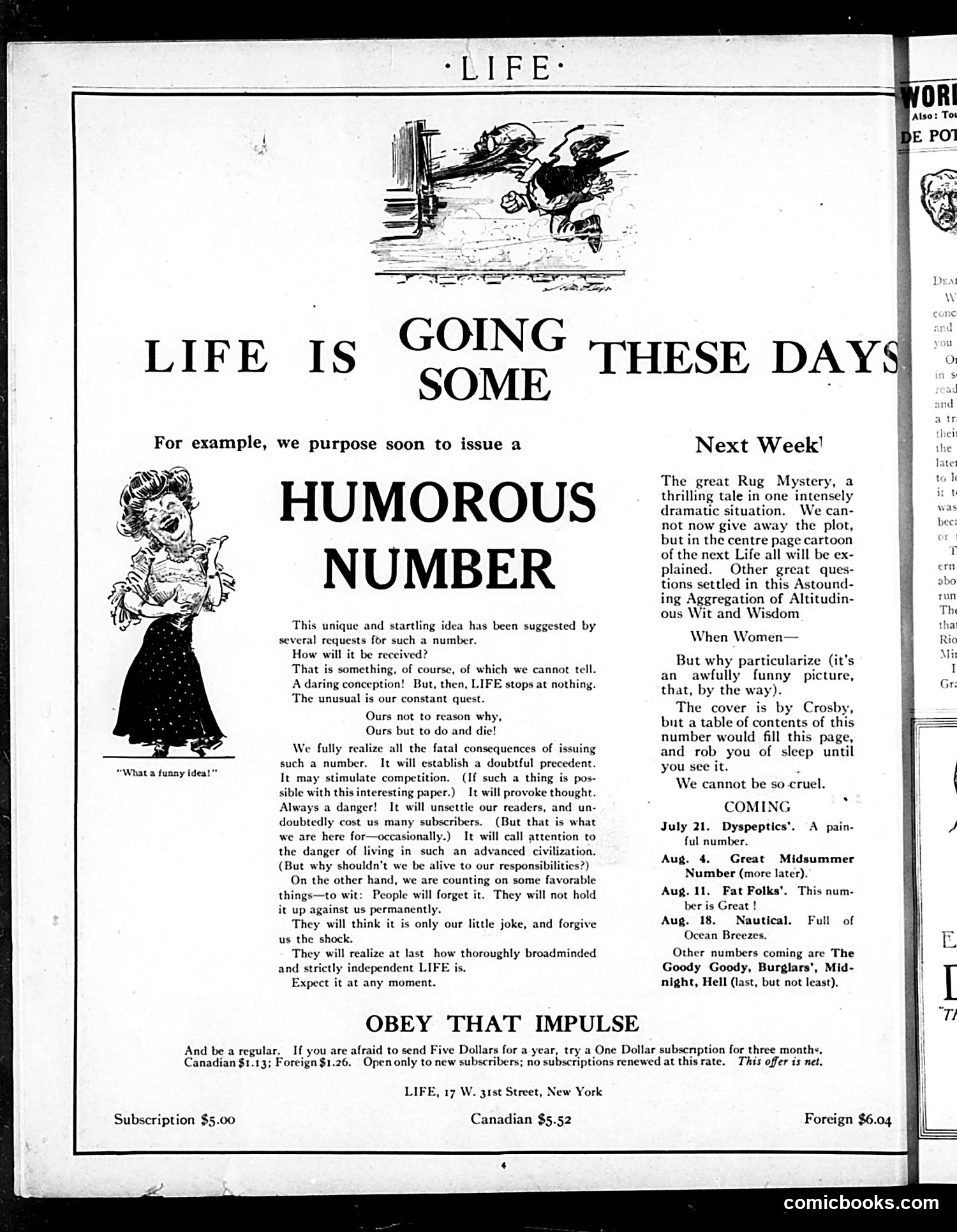
This is primarily a **house advertisement** for *Life* magazine itself, not political commentary. The page announces an upcoming "Humorous Number" issue, promoting it as an innovative and daring publication venture. The cartoon at top shows a figure being chased or fleeing—likely generic comedic illustration rather than specific satire. The illustration of a woman labeled "What a funny idea!" appears to be stock humor art. The text emphasizes *Life*'s self-image as bold and intellectually adventurous ("It will unsettle our readers, and undoubtedly cost us many subscribers"), appealing to readers who appreciate sophisticated wit. The page lists upcoming special issues and urges subscription. **This is advertising content, not political satire**—promoting the magazine's brand as witty, risk-taking, and culturally important.
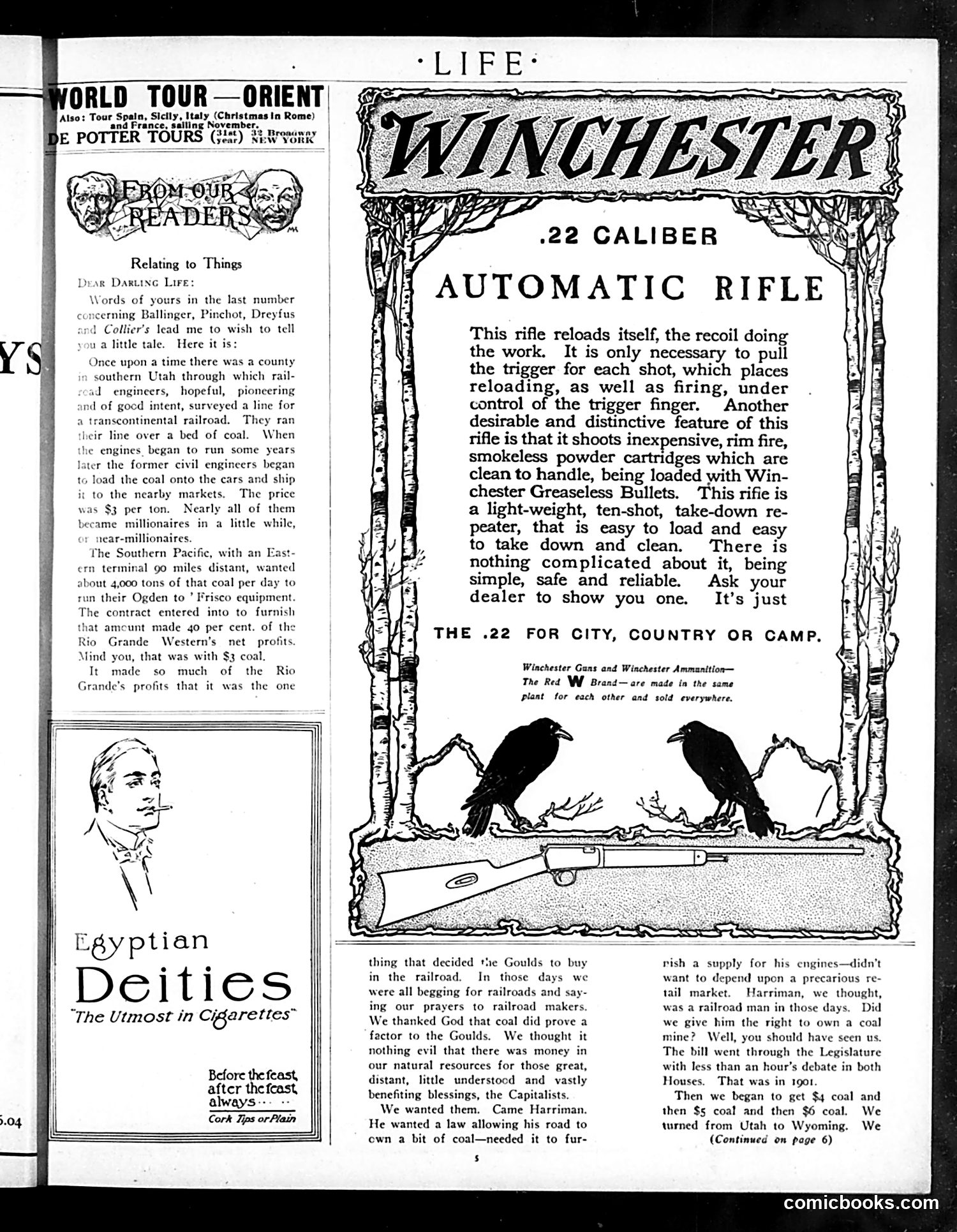
This page is primarily **advertising, not satire or editorial content**. The right side features a Winchester .22 caliber automatic rifle advertisement, using decorative art-nouveau framing with birds perched on branches above the rifle. The text emphasizes the weapon's simplicity and reliability for "city, country or camp" use. The left side contains two distinct sections: a "From Our Readers" column discussing railroad economics and the Goulds (a wealthy industrialist family), and an advertisement for "Egyptian Deities" cigarettes below. Neither element appears to be political satire. The reader column discusses 19th-century railroad history factually, while the cigarette ad simply uses Egyptian imagery as a branding device. This is a typical early 20th-century magazine page mixing reader correspondence, product advertisements, and commercial messaging.
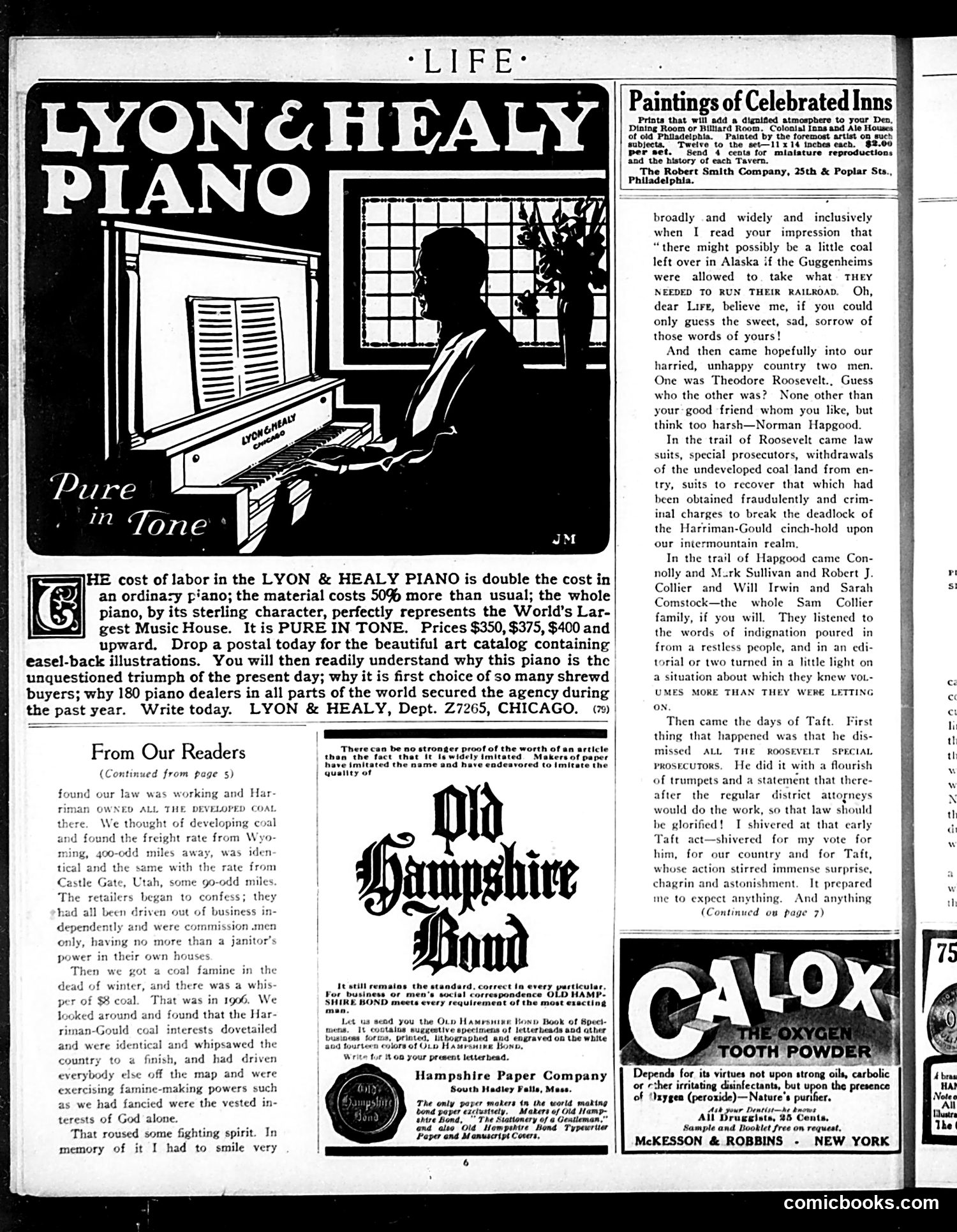
This page is primarily **advertising and reader letters**, not political satire. The main advertisement features **Lyon & Healy Piano**, emphasizing superior craftsmanship ("Pure in Tone"). The accompanying silhouette shows a man at the piano with a gridded window behind him—a stylized composition typical of 1920s commercial art. Below, "From Our Readers" contains a letter discussing coal mining and freight rates in Wyoming, apparently a response to earlier Life content. The writer describes labor disputes and economic hardship. Additional advertisements include the **Old Hampshire Bond** paper company and **Calox Tooth Powder**. The content reflects early 20th-century American commercial and industrial concerns rather than political commentary. Without additional context about what prompted the reader's letter, specific historical references remain unclear.
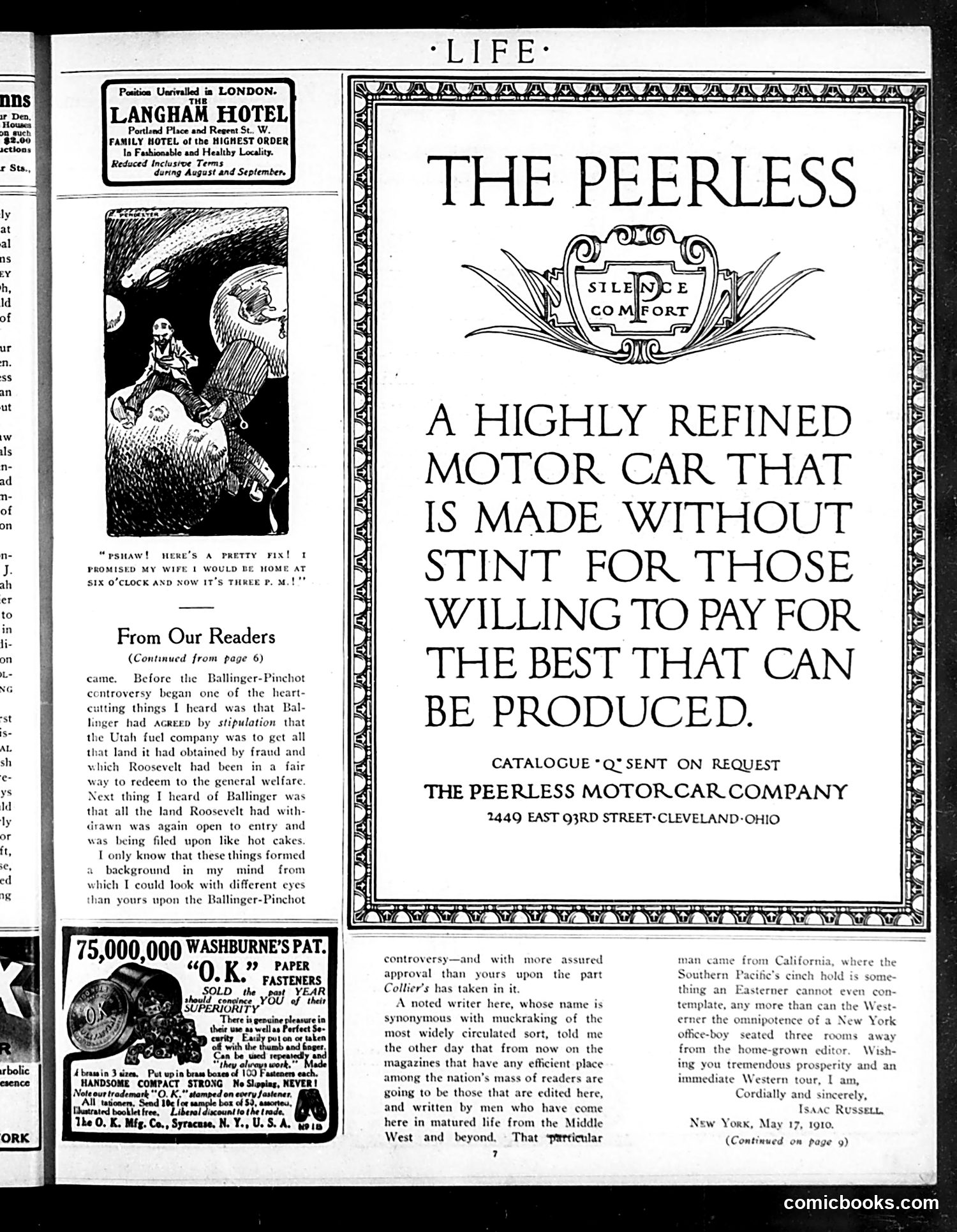
This page is primarily **advertising and editorial content** rather than political satire. The main elements are: **Left side:** A cartoon captioned "PSHAW! HERE'S A PRETTY FIX! I PROMISED MY WIFE I WOULD BE HOME AT SIX O'CLOCK AND NOW IT'S THREE P.M.!" The image shows a man appearing distressed, likely illustrating car trouble or travel delays—a common early-automobile-era frustration. **Center/Right:** A full-page advertisement for the **Peerless Motor Car Company** (Cleveland, Ohio), marketing their luxury automobile as refined and expensive but worth the cost to discerning buyers. **Bottom:** Advertisement for Washburne's "O.K." paper fasteners. The cartoon humorously plays on contemporary anxiety about automobile reliability and punctuality—concerns advertisers tried to address through luxury branding.
This page is primarily **advertising content**, not satire or political commentary. It promotes "Life's Mental Vibration Bureau"—an apparently pseudo-scientific mail-order service offering "mental" subscription benefits. The text claims nearly eight million subscribers and promises that mental effort (rather than physical action) can achieve desired outcomes. Subscribers pay $45 annually and supposedly receive benefits through "mental impulses." **For modern readers:** This appears to be early 20th-century **pseudoscientific marketing**—similar to today's wellness scams. The "mental" language likely references New Thought or similar belief systems popular then. The repeated testimonial letters are classic marketing tactics designed to build credibility for what reads as an obvious fraud. The satire, if any exists, is likely *Life magazine itself* mocking such schemes through exaggerated promotion.
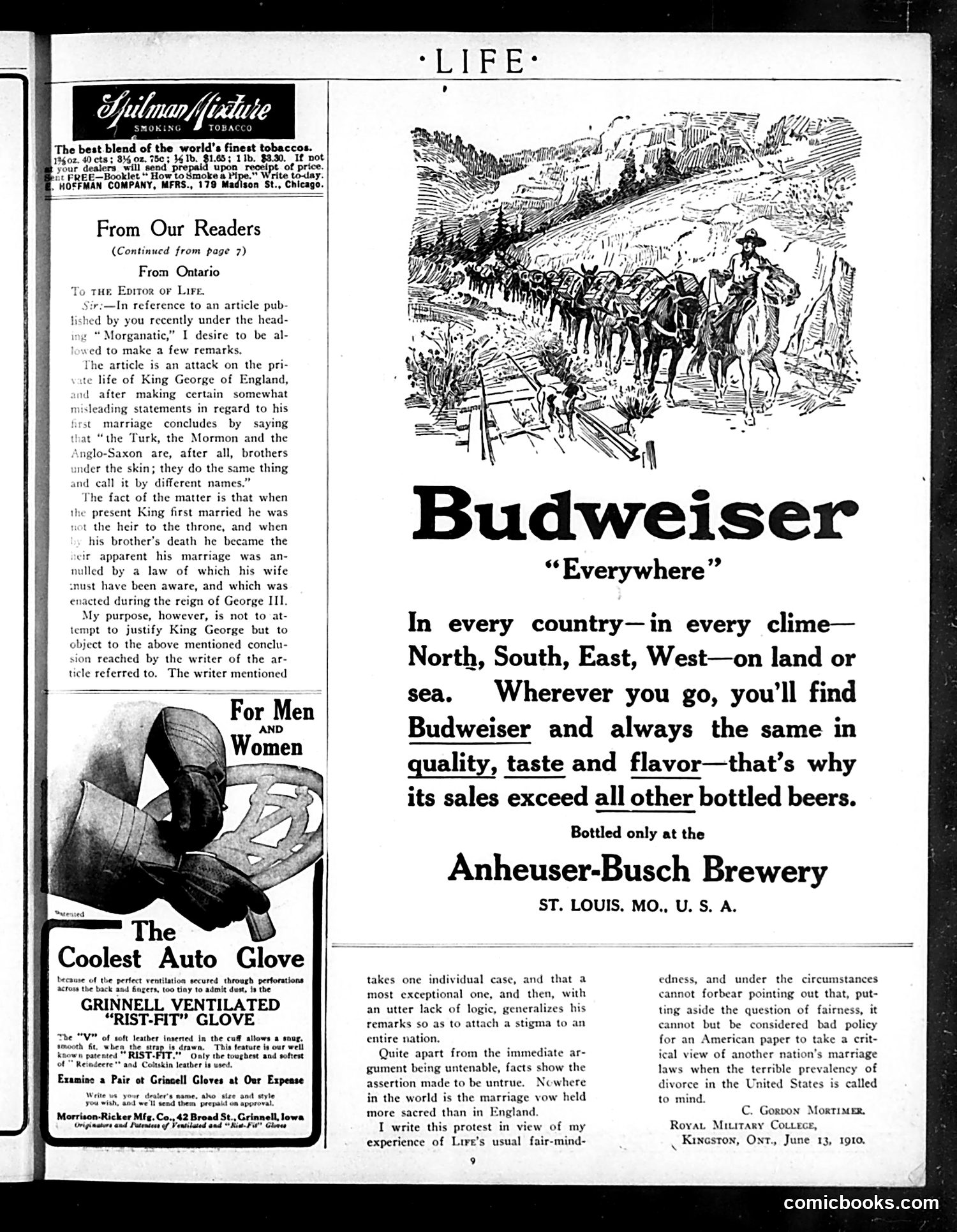
This is primarily an **advertising and letters page** from Life magazine, circa 1910 (based on the Royal Military College letter dated June 13, 1910). The main content includes: 1. **Budweiser advertisement** - A large ad for Anheuser-Busch beer emphasizing worldwide availability and consistent quality 2. **Reader letters** - Including one from Ontario critiquing a previous Life article about King George of England's marriage 3. **Product advertisements** - Including "The Coolest Auto Glove" and other merchandise **No political cartoons appear on this page.** The content is largely commercial, with letters to the editor discussing a historical article about English royal succession rather than current satire. This is a typical early 20th-century magazine page mixing advertising, reader correspondence, and product promotions.
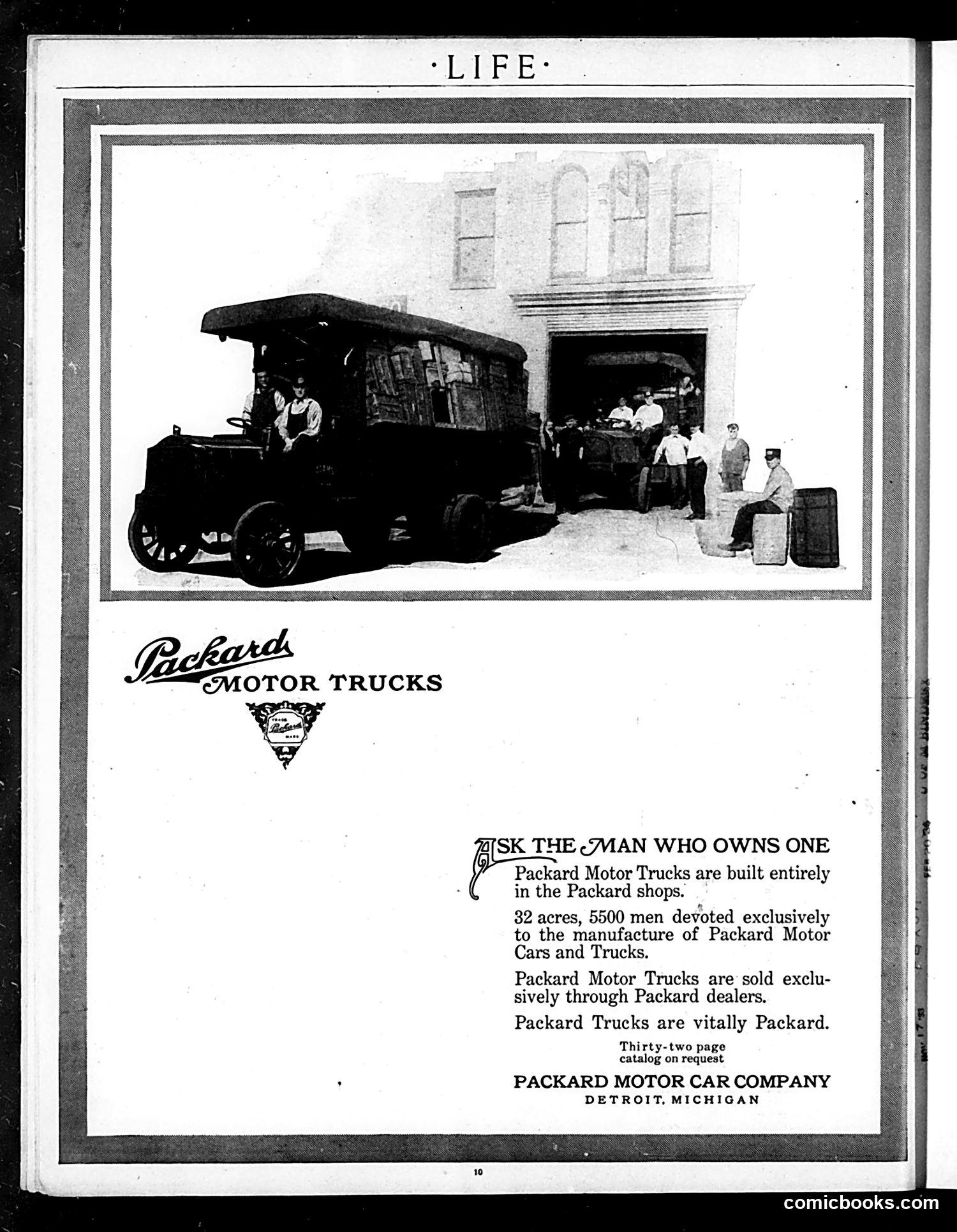
This is primarily **advertising content**, not satire or commentary. It's a Packard Motor Car Company advertisement from *Life* magazine featuring a motor truck. The image shows a delivery truck from the early automotive era (likely 1910s-1920s based on vehicle design) loading cargo at what appears to be a warehouse or factory building. The ad emphasizes Packard's manufacturing scale: 32 acres of factory space and 5,500 employees devoted exclusively to vehicle production. The marketing pitch appeals to business owners by stressing that Packard trucks are "vitally Packard"—meaning fully integrated products made entirely in-house rather than assembled from outside parts. This was a significant selling point during an era when automotive manufacturing practices varied considerably. There is no political satire or caricature on this page.
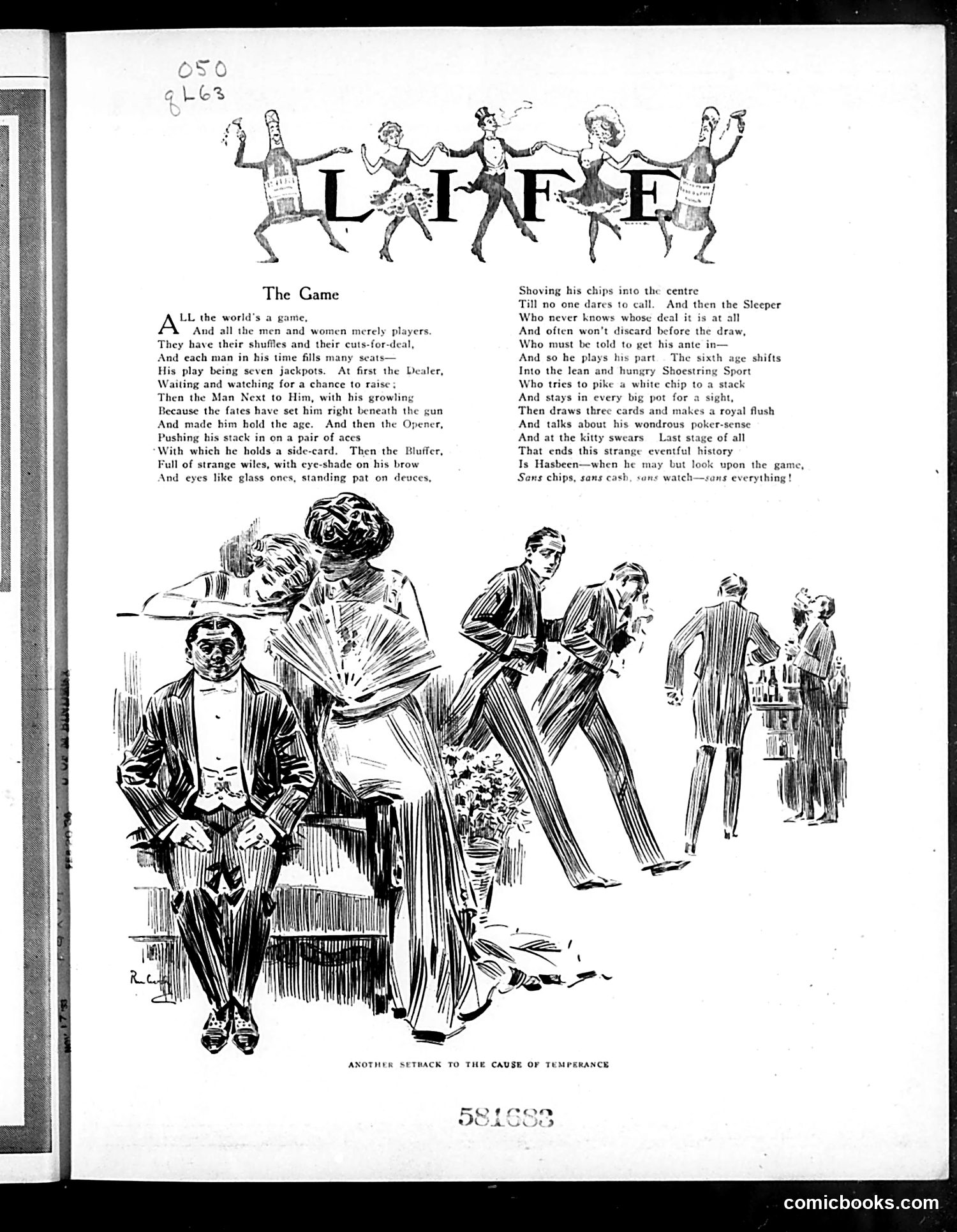
This satirical piece critiques high-society gambling and its moral consequences. The header illustration shows figures dancing around the word "LIFE," suggesting frivolous entertainment. The poem describes poker game participants with unflattering stereotypes—"the Dealer," "the Man Next to Him," "the Opener," "the Bluffer"—each representing recognizable social types engaged in card games. The illustration below shows a well-dressed man (likely a wealthy gambler) sitting while others around him appear distressed or involved in the aftermath of gambling losses. The caption reads "ANOTHER SETBACK TO THE CAUSE OF TEMPERANCE," indicating this satirizes not just gambling but the broader moral corruption of upper-class leisure. The piece mocks how respectable society members engaged in vice while publicly supporting temperance movements—highlighting perceived hypocrisy of the era.
This page contains editorial commentary rather than political cartoons. The text discusses railroad regulation and trust reform under President Taft's administration. A small illustration shows five owl-like figures, appearing to represent corporate interests or "trusts" being scrutinized. The main argument advocates for the Carnegie Foundation to extend pensions to state university professors and legislators, positioning this as enlightened philanthropy benefiting education. The piece criticizes ongoing legal battles over trust regulation, suggesting the Supreme Court's indecision creates business uncertainty. The editors argue that established figures like Aldrich, Payne, and Dalzell should receive pension support for their legislative service. The satire targets both governmental inaction on trusts and the selective nature of philanthropic beneficence favoring the powerful.
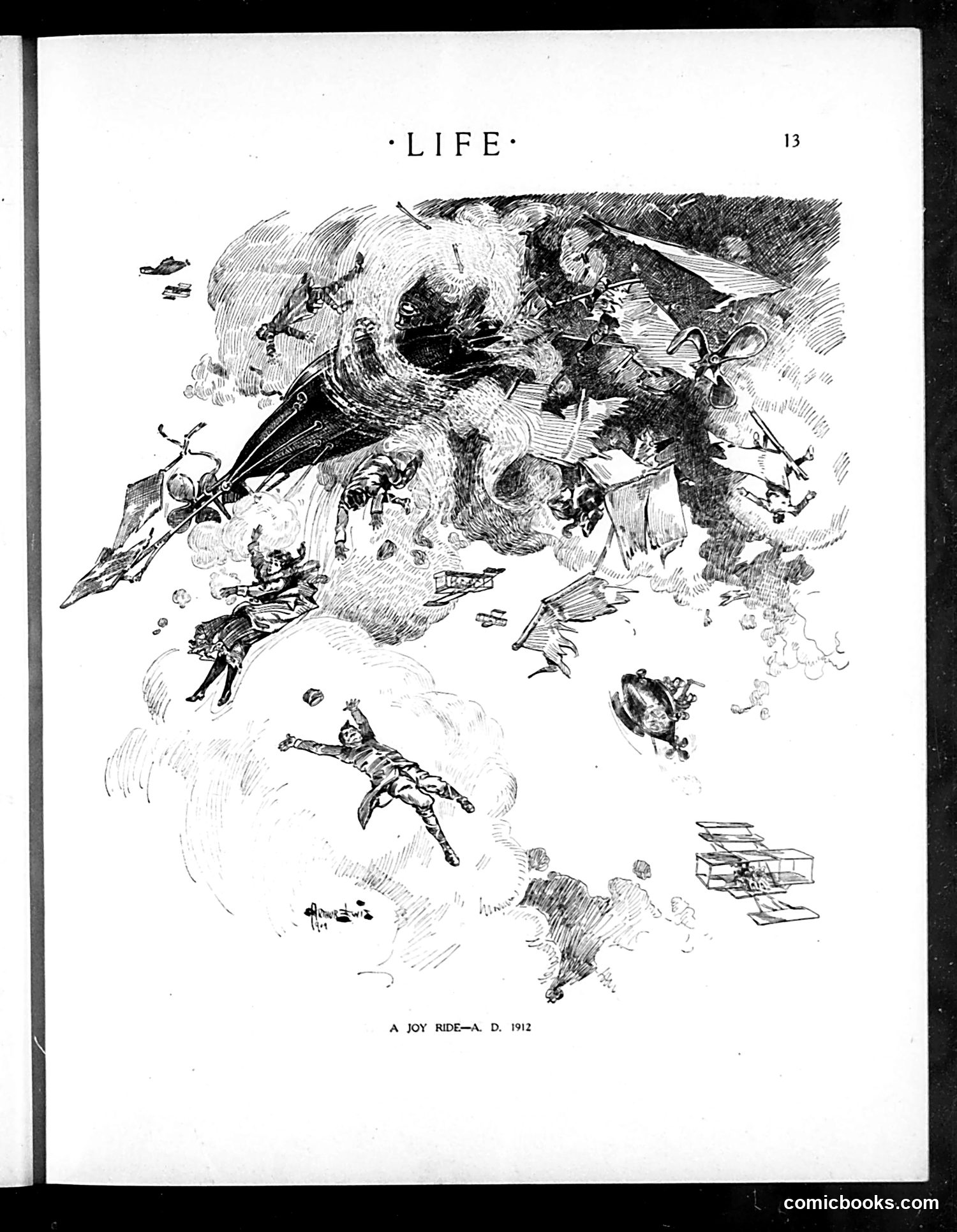
This satirical illustration depicts a chaotic aerial scene titled "A Joy Ride," dated 1912. The image shows multiple figures in what appears to be early aircraft or flying contraptions tumbling through clouds in disarray. The cartoon likely satirizes the novelty and danger of early aviation, which was still experimental and unreliable in 1912. The term "joy ride" suggests reckless pleasure-seeking, while the chaotic composition—with figures and debris scattering—mocks both the unpredictable nature of primitive aircraft and the foolishness of those who would risk their lives in them for entertainment. Without clearer identification of specific figures, the broader point appears to be social commentary on the aviation craze of the era and human hubris in pursuing dangerous technological pursuits.
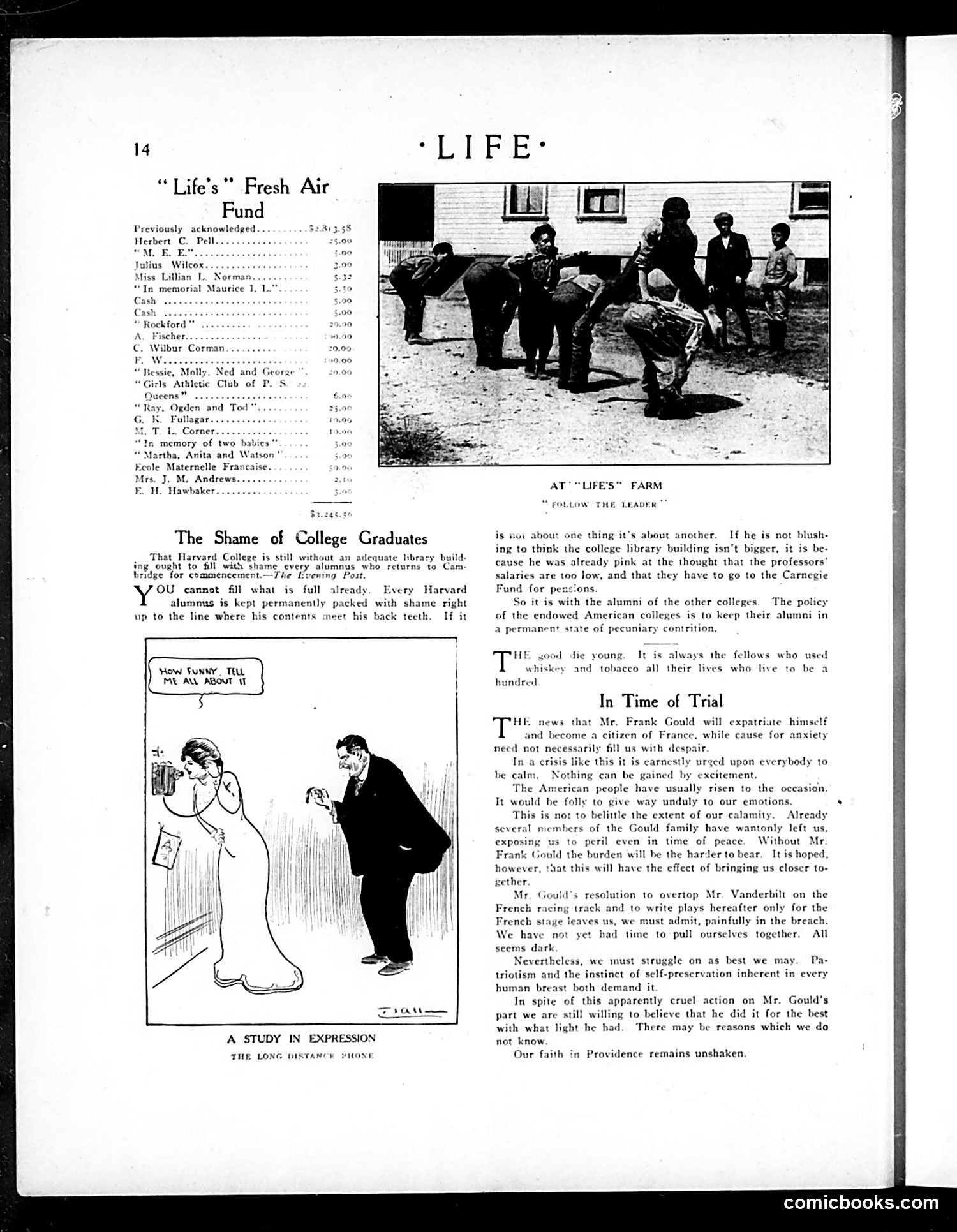
**The Main Cartoon ("A Study in Expression"):** Shows a woman on a telephone complaining to someone, with the caption "HOW FUNKY. TELL ME ABOUT IT." This satirizes the tendency of people—particularly college graduates and alumni—to use the phone to air complaints and grievances. It's mocking social gossip culture. **The Frank Gould Article:** Satirizes wealthy heir Frank Gould's announced plan to expatriate to France and become a French citizen. The magazine treats this mock-seriously as a national crisis, sarcastically suggesting Americans must "struggle on" and maintain "faith in Providence" during this trial. The satire lies in the absurd over-dramatization: a rich man leaving the country is presented as a patriotic catastrophe requiring national resilience. **Context:** Both pieces mock contemporary upper-class society—their petty complaints and self-importance—suggesting that wealthy Americans' personal dramas deserve far less gravity than they command in social discourse.
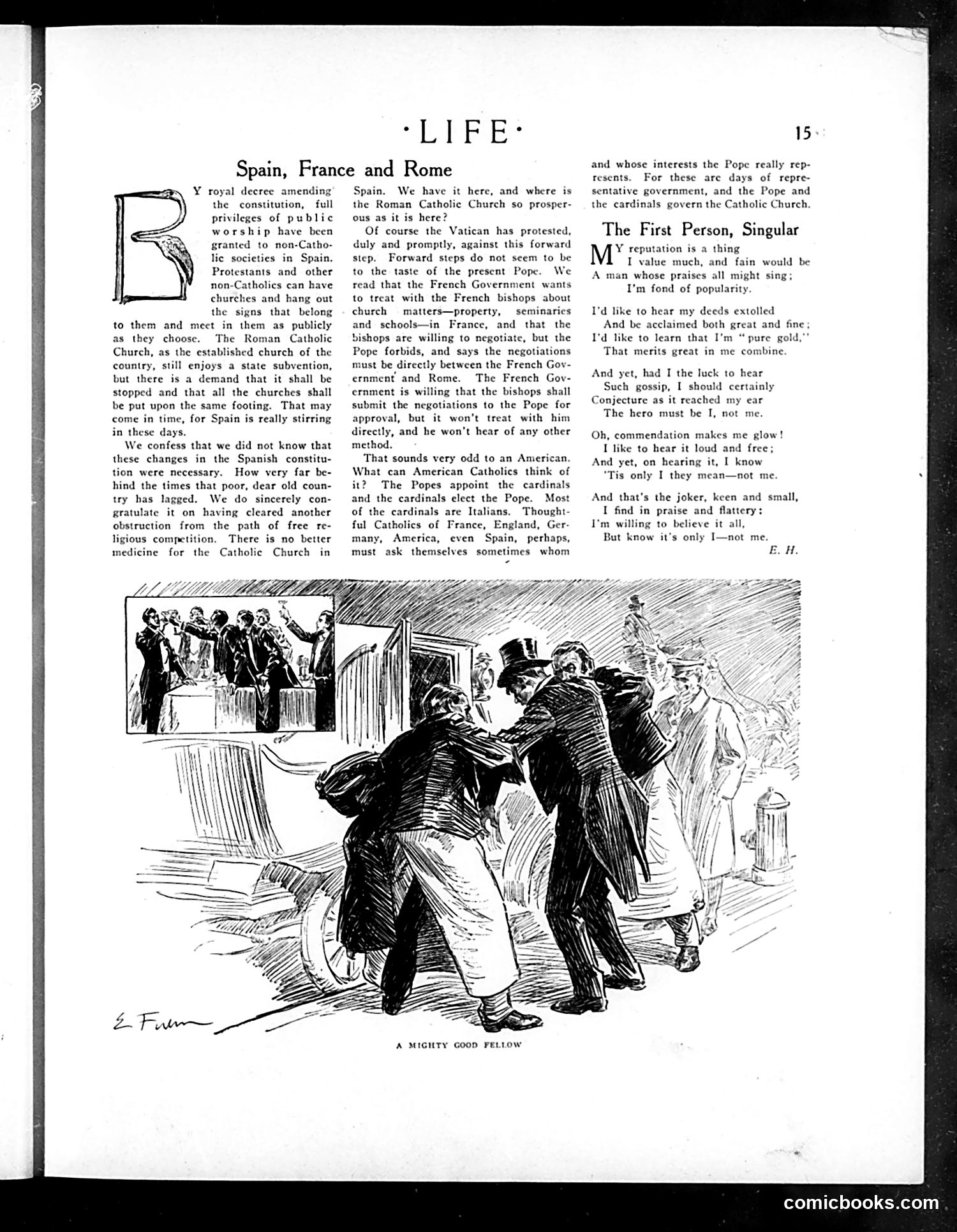
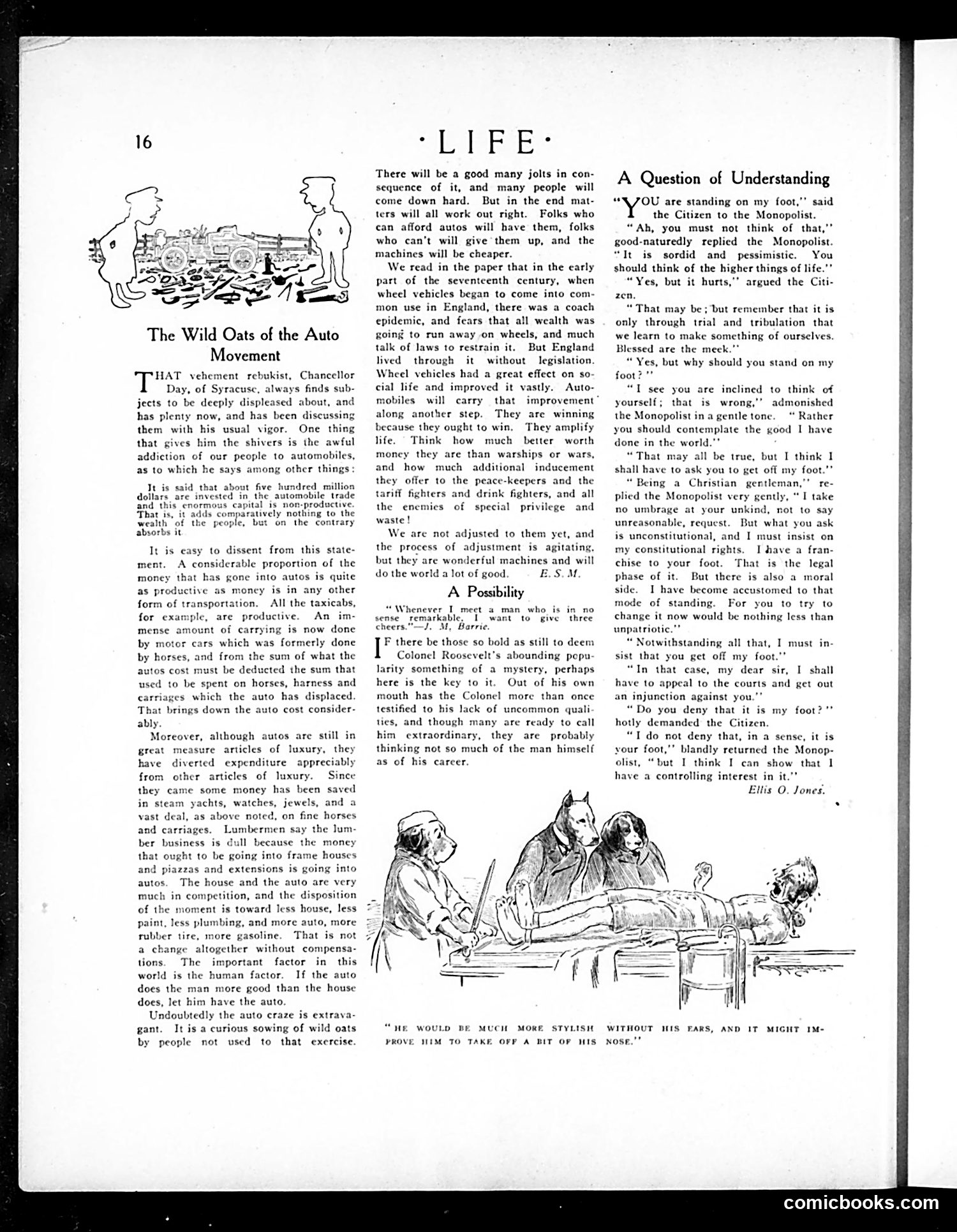
This page from *Life* magazine presents two distinct pieces of social commentary on early automobiles. **"The Wild Oats of the Auto Movement"** argues against Chancellor Day of Syracuse, who claimed cars represent wasteful spending. The author contends automobiles are productively equivalent to replaced horse-drawn carriages and function like transportation in general. The piece uses historical analogy—comparing auto "craze" to England's 17th-century coach epidemic—to argue society will naturally adjust. The satire's title suggests cars represent youthful excess that will ultimately prove beneficial. **"A Question of Understanding"** depicts a dialogue (likely involving Theodore Roosevelt, based on the Barrie quote about "uncommon qualities" and Roosevelt's famous populism) between a Citizen and Mongolian about standing on one's foot. The cartoon's caption suggests someone would be "more stylish" without ears—a crude joke about physical appearance. Both pieces reflect early-1900s anxiety about automotive technology as disruptive luxury while predicting eventual social acceptance.
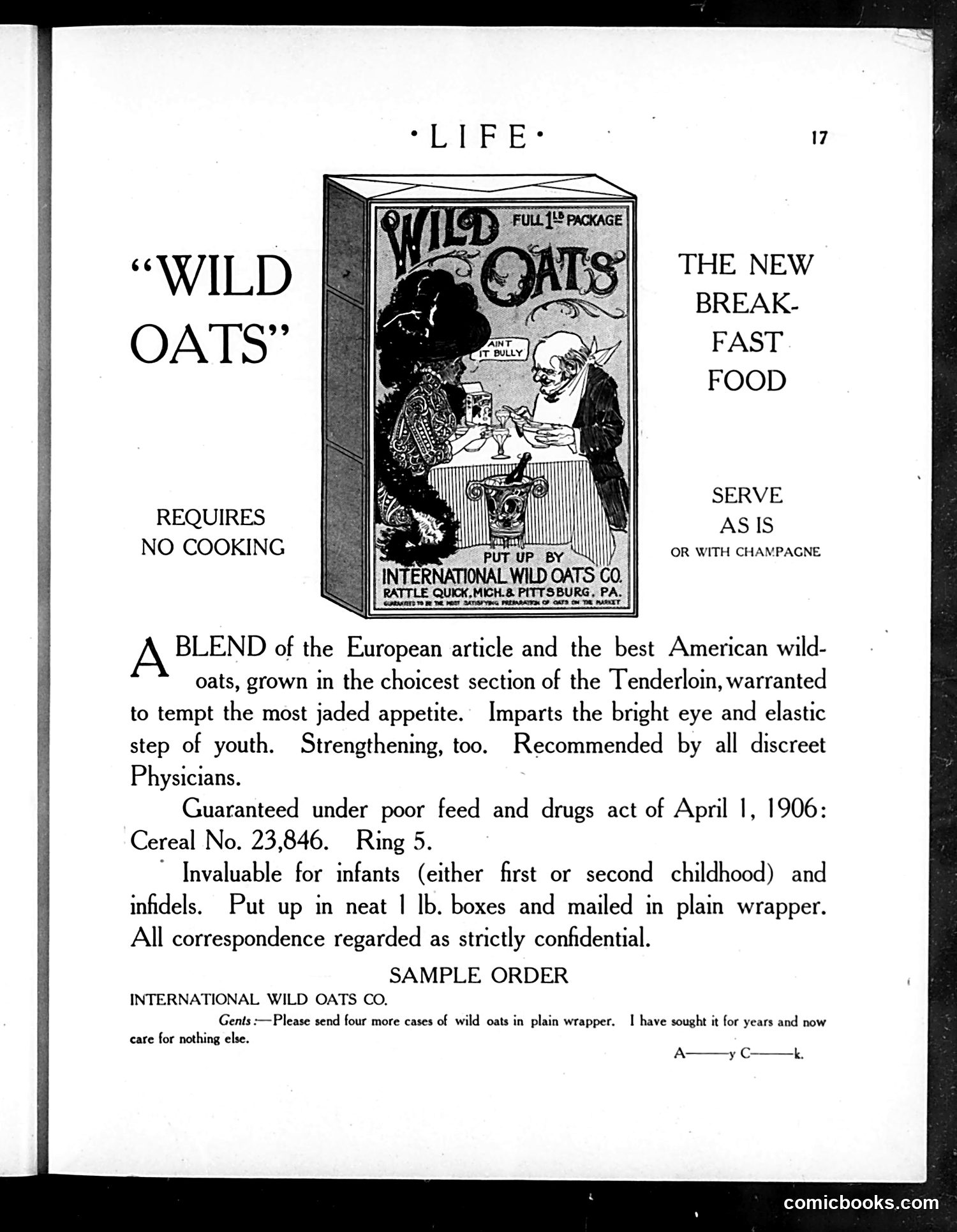
This is a satirical fake advertisement mocking both breakfast cereal marketing and social hypocrisy of the early 1900s. The joke hinges on double meaning: "wild oats" (a plant) versus the idiom "sowing wild oats" (youthful excess/debauchery). The ad sarcastically claims the product is grown in the "Tenderloin"—a notorious red-light district—and recommends it for "infants" and "infidels," with promises of "bright eye and elastic step of youth." References to "discreet Physicians," "plain wrapper" mailing, and "strictly confidential" correspondence all mimic dubious patent medicine advertising of the era. The cartoon shows two figures (likely a woman and older man) examining the box, suggesting illicit activity masked by breakfast-food respectability. The satire targets both the false morality of the period and the deceptive advertising practices that pervaded early 1900s media, particularly around patent medicines and dubious remedies.
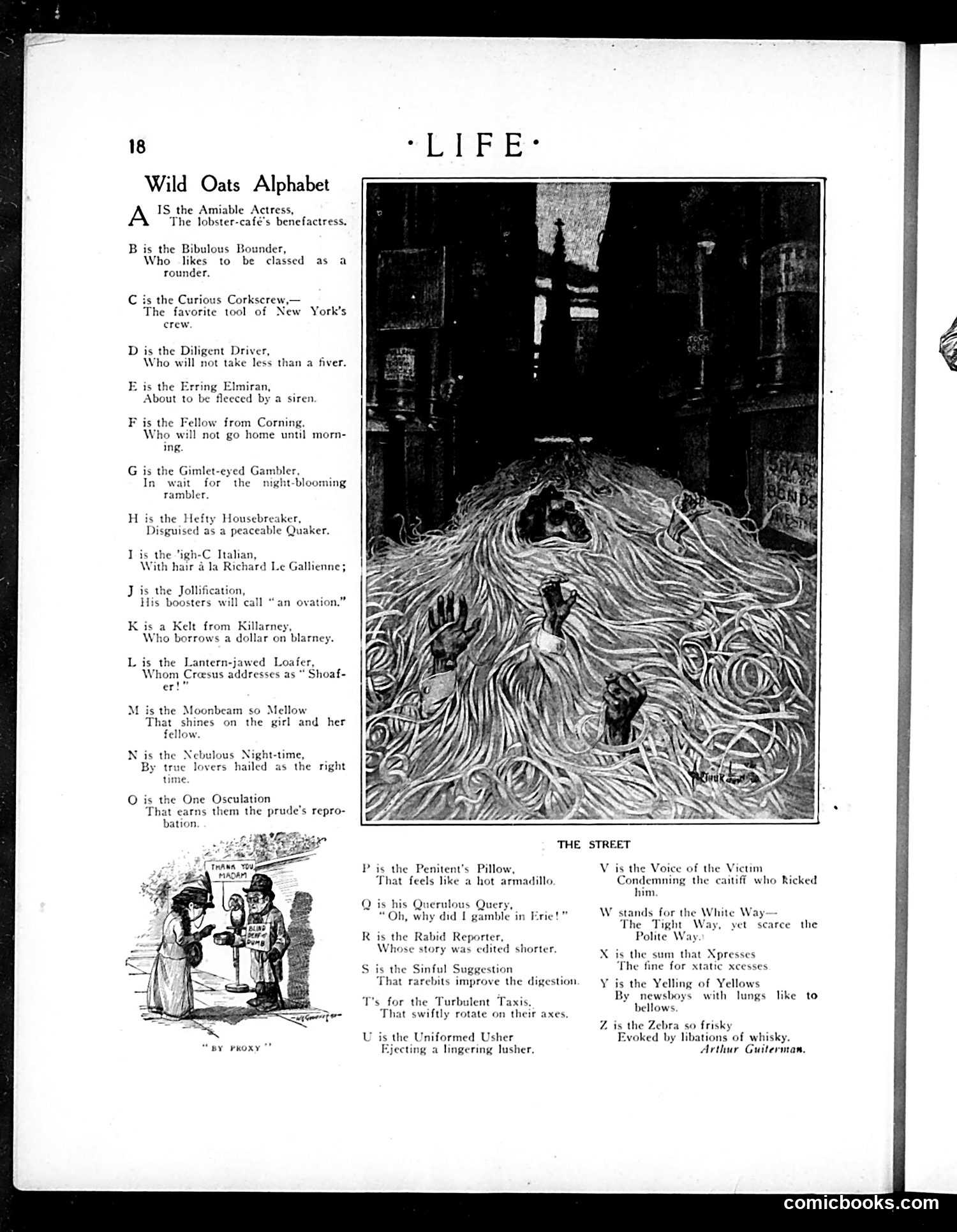
This is a humorous alphabetical guide to urban archetypes and social vices in turn-of-the-century New York. Each letter represents a character type or phenomenon the editor wants to mock: **Key figures include:** gamblers preying on women ("Gimlet-eyed Gambler"), criminals ("Hefty Housebreaker"), taxi drivers overcharging ("Turbulent Taxis"), and working girls being exploited ("night-blooming rambler"). **Social references:** "The White Way" (Broadway's bright lights), "Erie" stock gambling, "rarebits" (Welsh rarebit—food blamed for indigestion and moral looseness), and whisky-induced hallucinations. **The satire's point:** Life ridicules New York's entertainment district as morally corrupt—populated by con artists, prostitutes, drunks, and predators. The tone is cynical but playful, treating urban vice as inevitable human folly rather than serious crime. The accompanying small illustration labeled "By Proxy" remains unclear without additional context.
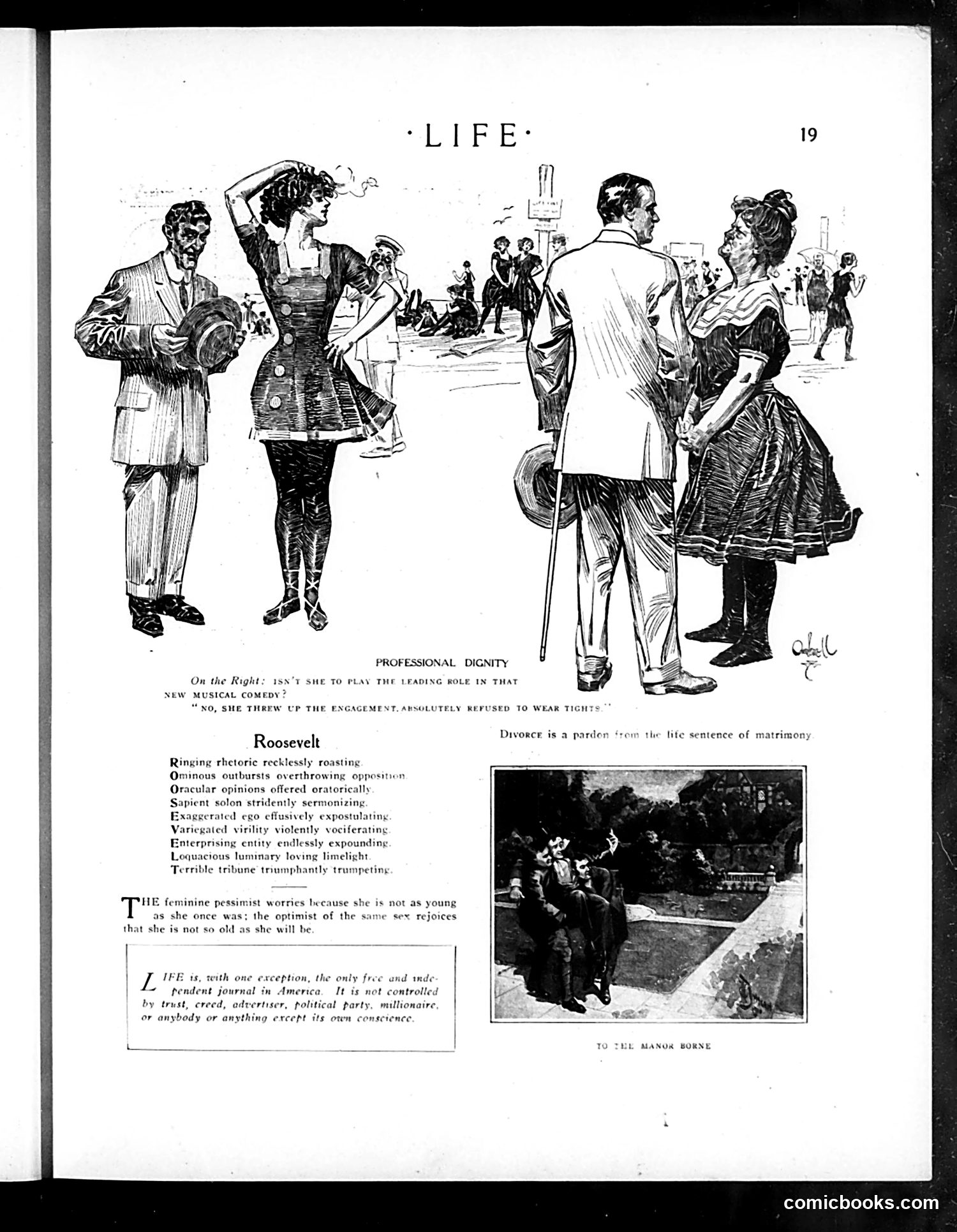
**Upper Cartoon ("Professional Dignity"):** Depicts a theatrical dispute. A woman refuses a leading role in a new musical comedy, specifically rejecting the requirement to wear tights—apparently viewing this as undignified or improper for a serious actress. The joke satirizes the tension between professional ambition and social propriety regarding women's costumes on stage. **"Roosevelt" Section:** An acrostic poem mocking Theodore Roosevelt's oratorical style through alliteration. Terms like "ringing rhetoric," "ominous outbursts," and "terrible tribune" suggest satirical criticism of his bombastic public speaking and aggressive political posturing—common contemporary critique of his presidency. **Bottom Section:** A philosophical quip contrasting feminine pessimism (aging) with optimism. The accompanying photograph and caption about divorce as "pardon from the life sentence of matrimony" reflects period cynicism about marriage. **Context:** This appears typical of Life's early 20th-century satirical content, mixing theatrical humor, political critique of Roosevelt-era politics, and commentary on gender/social conventions.
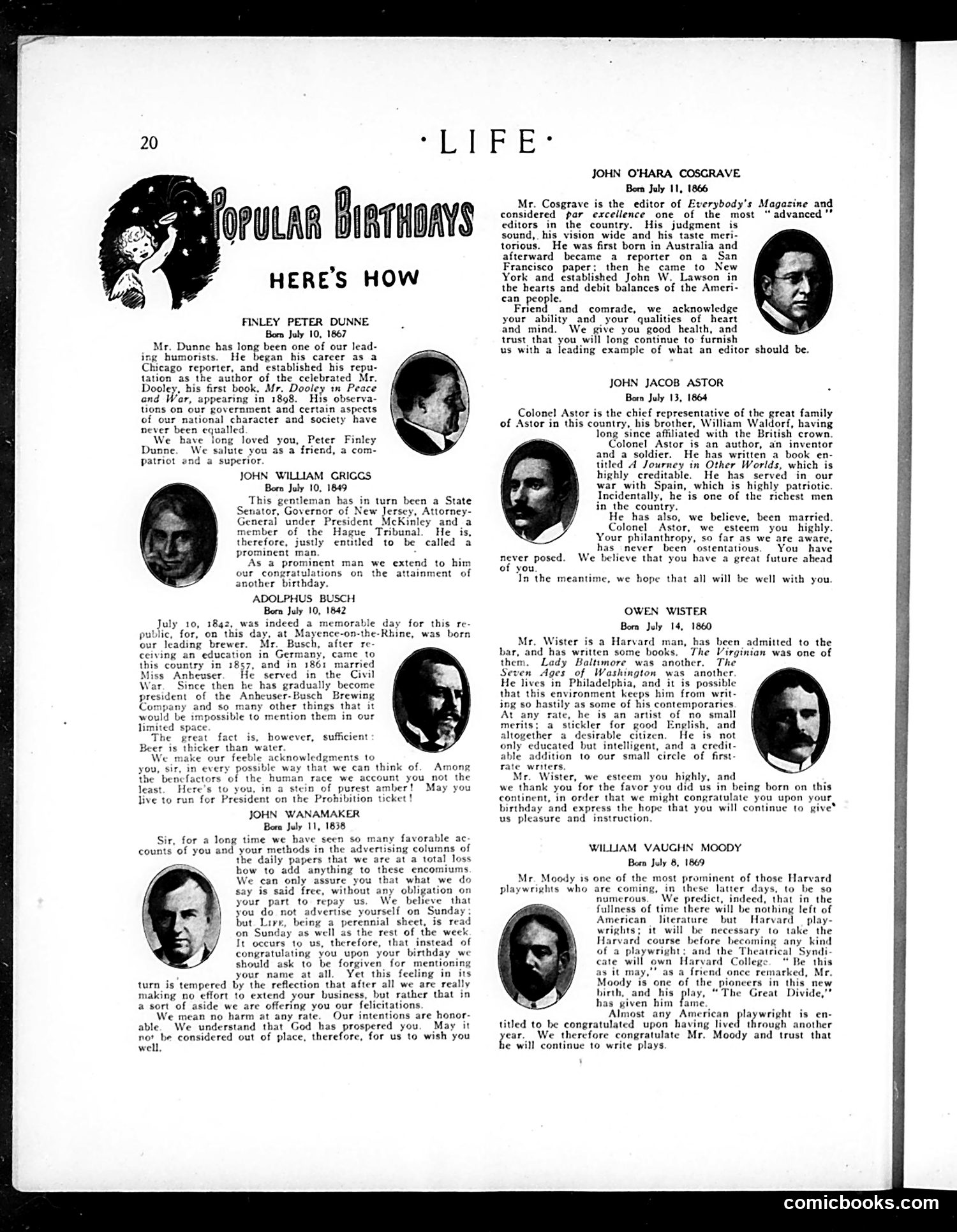
This is a "Popular Birthdays" column from *Life* magazine celebrating notable Americans born in July. Rather than political satire, it's a humorous celebration of prominent figures. The page includes ribbing birthday wishes to: - **Finley Peter Dunne** (humorist and creator of Mr. Dooley) - **John William Griggs** (politician and judge) - **Adolphus Busch** (German-American brewery founder), where the joke is "Beer is thicker than water" and they jokingly wish him to run on the Prohibition ticket - **John Wanamaker** (retail magnate and advertiser), gently mocking his self-promotion - **John O'Hara Cosgrave** (magazine editor) - **John Jacob Astor** (wealthy industrialist) The humor relies on gentle roasting of each figure's reputation—Busch the brewer, Wanamaker the advertising man, Cosgrave the "advanced" editor—rather than sharp political commentary. It's celebratory celebrity gossip dressed as wit.
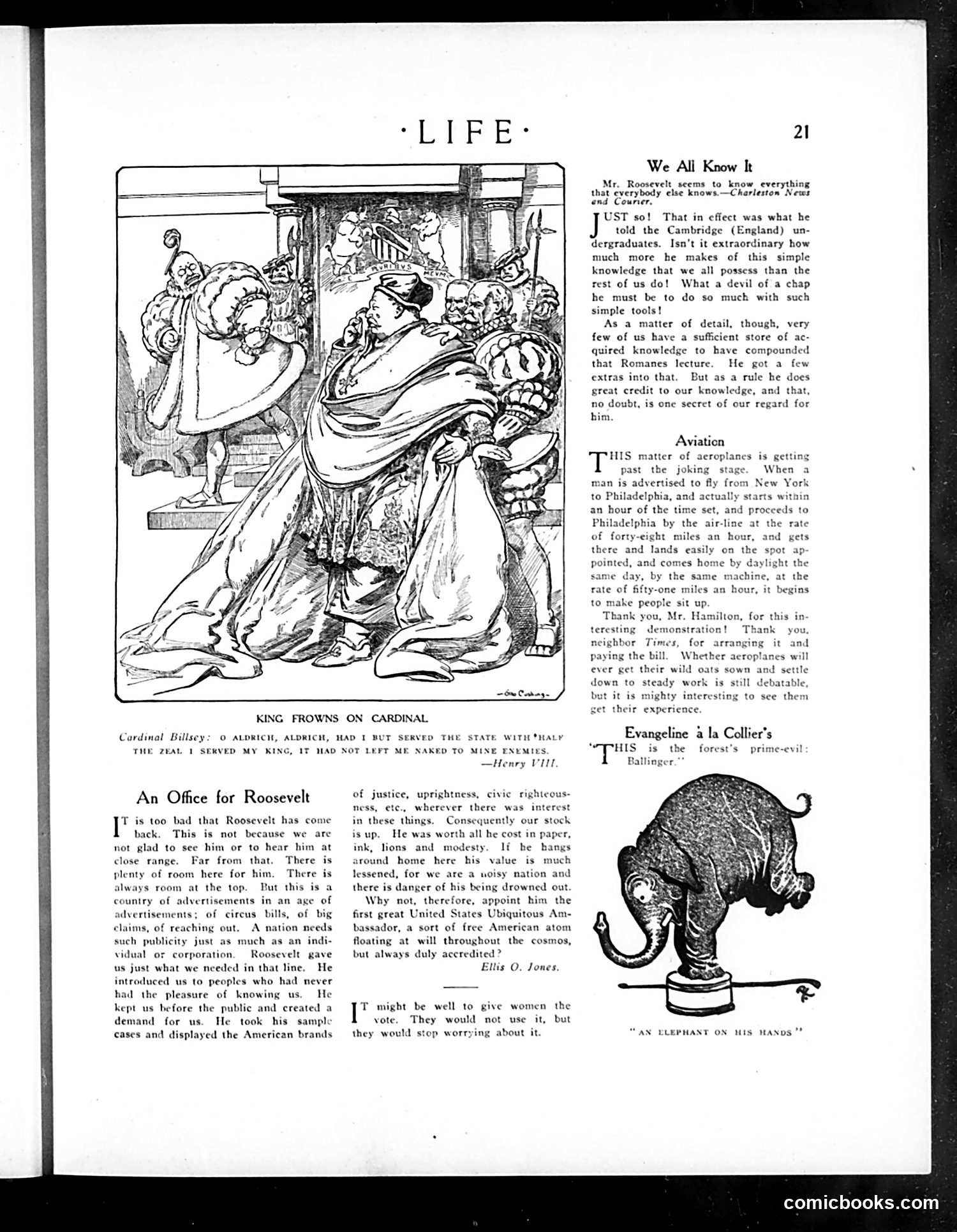
**Main Cartoon: "King Frowns on Cardinal"** The large illustration depicts a historical scene from Henry VIII's reign. The caption quotes Henry VIII complaining that Cardinal Wolsey served the state but "left me naked to mine enemies"—referencing the real historical tension between the king and his powerful cardinal. The satire appears to comment on powerful advisors who become liabilities when they lose favor. **Articles Discussed:** 1. **"An Office for Roosevelt"**: Satirizes Theodore Roosevelt's high public profile. The writer argues Roosevelt's value came from promoting American interests abroad; now that he's returned home, he should be appointed "Ubiquitous Ambassador" to continue this publicity work, as his constant presence domestically risks diminishing his impact. 2. **"We All Know It"**: Mocks Roosevelt's tendency to present common knowledge as profound wisdom, referencing his Cambridge lecture. 3. **Aviation & other brief pieces**: Comment on nascent airplane technology and women's suffrage. The page reflects early-1900s American attitudes toward celebrity politicians and technological progress.
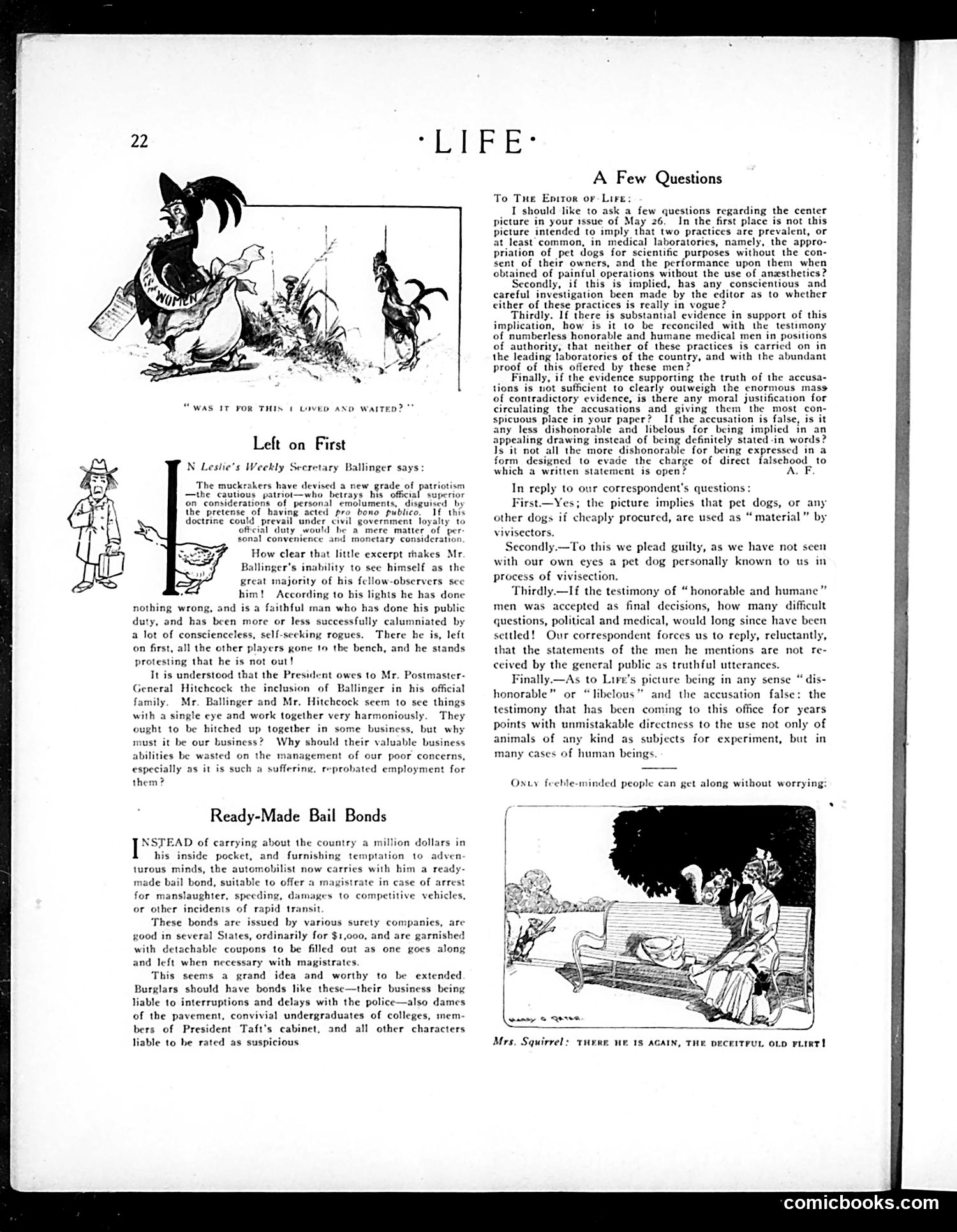
This page satirizes the Ballinger-Pinchot controversy, a major Progressive Era scandal. **Richard Ballinger**, Secretary of the Interior under President Taft, faced accusations of corruption regarding conservation issues. The cartoon shows Ballinger "left on first"—a baseball metaphor meaning abandoned and defenseless—while his colleagues have fled. The text mocks Ballinger's self-righteousness; he claims to have acted honorably ("pro bono publico") while being abandoned by the administration. The satire suggests his superiors (including Postmaster-General Hitchcock) have distanced themselves. The **"Ready-Made Bail Bonds"** section sarcastically proposes criminals carry pre-printed bail bonds, then extends the joke by suggesting government officials—"members of President Taft's cabinet"—should similarly carry bonds, implying they're corruption-prone. The reader letter addresses vivisection concerns in medical labs, unrelated to the political content but contemporary Progressive-era reform anxiety.
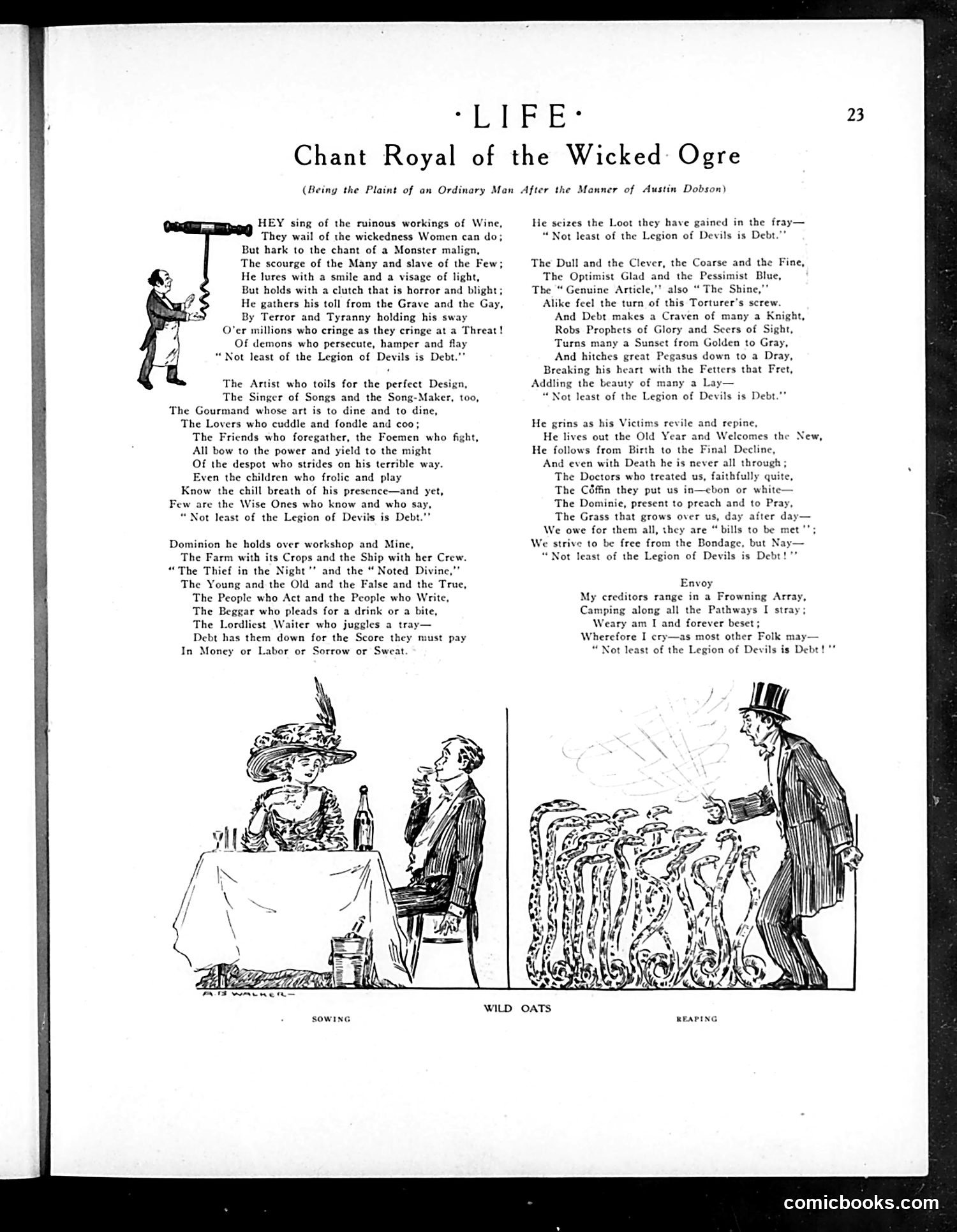
This page presents a poetic satire on **Debt as an all-consuming evil** affecting every social class. Written in the style of Austin Dobson (a Victorian poet), the lengthy poem personifies Debt as a demonic "Monster" and "Ogre" that tyrannizes rich and poor alike—artists, lovers, workers, priests, even the dead. The accompanying illustrations use the motif "Wild Oats" (a period phrase for youthful excess and irresponsibility). The left cartoon shows "Sowing"—a young couple dining lavishly. The right shows "Reaping"—an older man facing creditors, literally harvesting consequences. **The satire's point:** Financial irresponsibility and debt inevitably catch up with everyone, regardless of status or morality. It's a morality tale warning against living beyond one's means, casting debt not as mere economic hardship but as a supernatural curse. The tone is darkly comic—simultaneously mocking the pretentiousness of both debtors and creditors while acknowledging debt's universal grip on society.
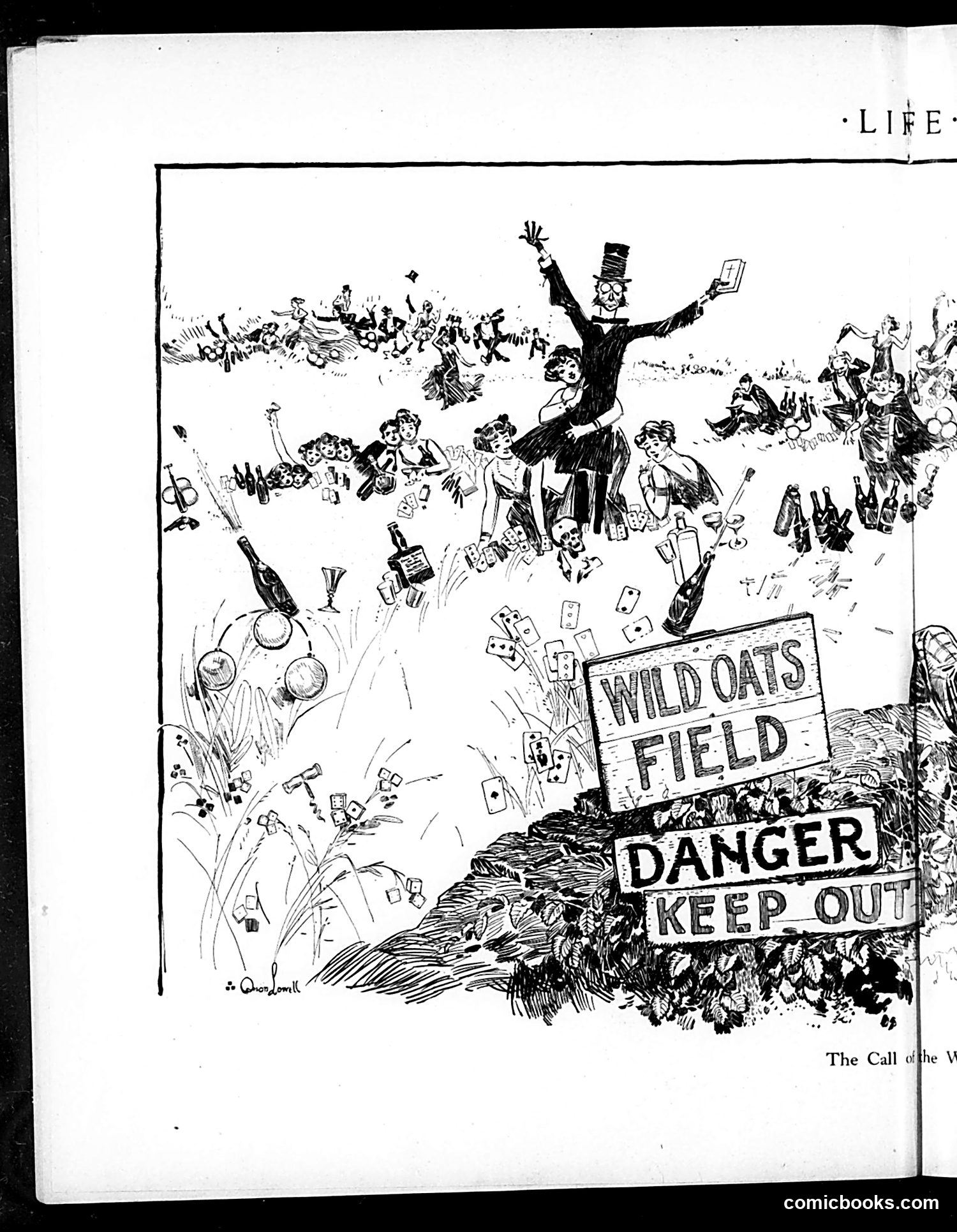
This satirical cartoon depicts a well-dressed gentleman in top hat and formal attire, positioned precariously atop a bottle amid a chaotic "Wild Oats Field" marked "Danger—Keep Out." He's surrounded by celebrating revelers engaged in wild partying—drinking, gambling (visible playing cards scattered), and general debauchery. The image satirizes the phrase "sowing wild oats," a euphemism for youthful indiscretion and irresponsible behavior. The cartoon warns that such hedonistic pursuits are dangerous and unstable (note his precarious perch). The well-dressed figure suggests this vice tempts even supposedly respectable society members, mocking the hypocrisy of those who indulge despite social pretense.
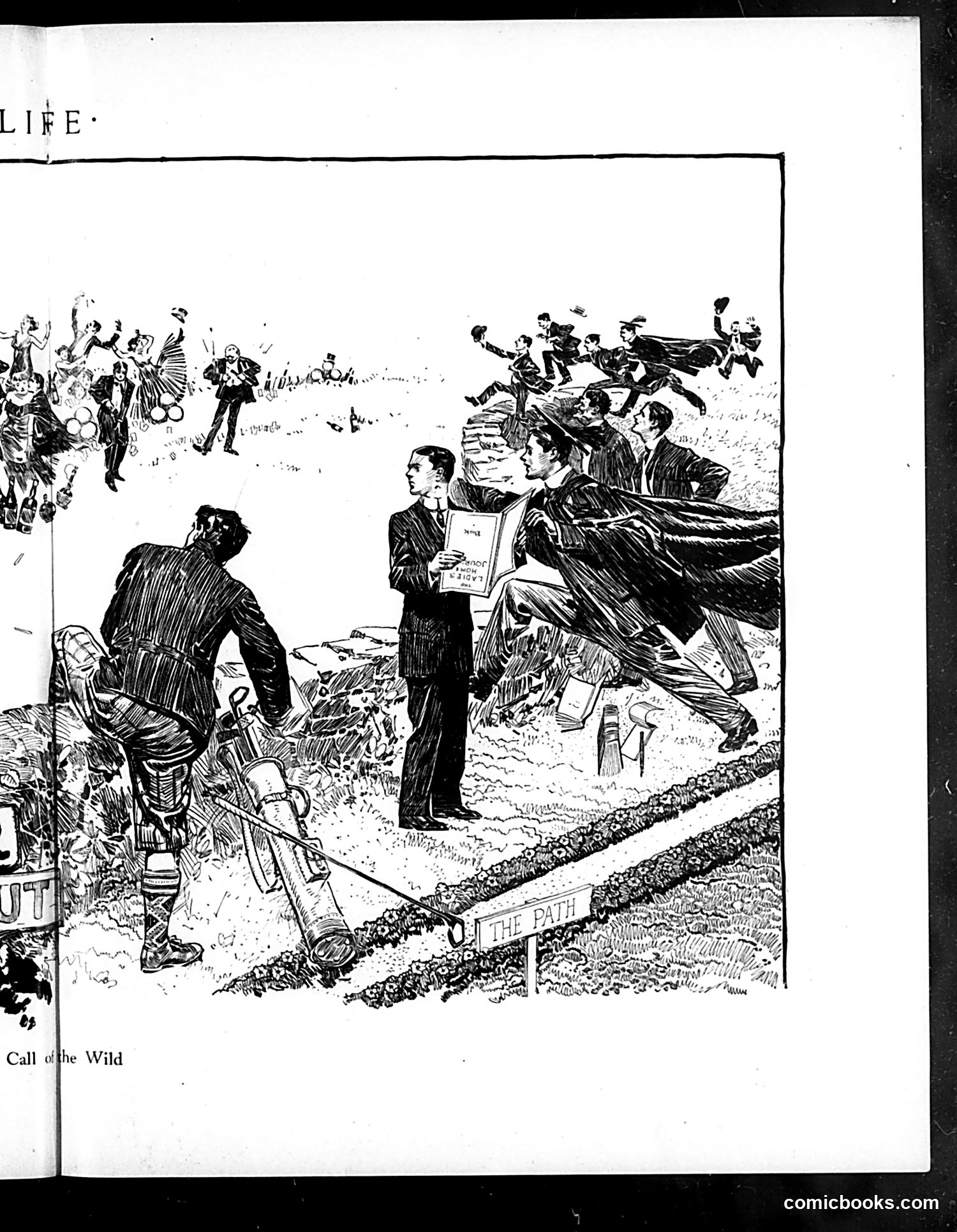
This cartoon satirizes the contrast between civilized society and wild nature. The central figure—a well-dressed businessman holding what appears to be a document or map—stands at a crossroads marked "THE PATH." To his left, refined Victorian figures engage in proper social conduct. To his right, wild, chaotic figures cavort in unrestrained behavior, suggesting temptation toward recklessness. The satire likely critiques either the allure of escapism from civilized responsibilities, or the tension between societal expectations and human impulses toward freedom and abandon. The businessman's position at the literal crossroads visualizes this moral choice between propriety and wildness—a common early-20th-century Life magazine theme exploring anxieties about social order versus individual desire.
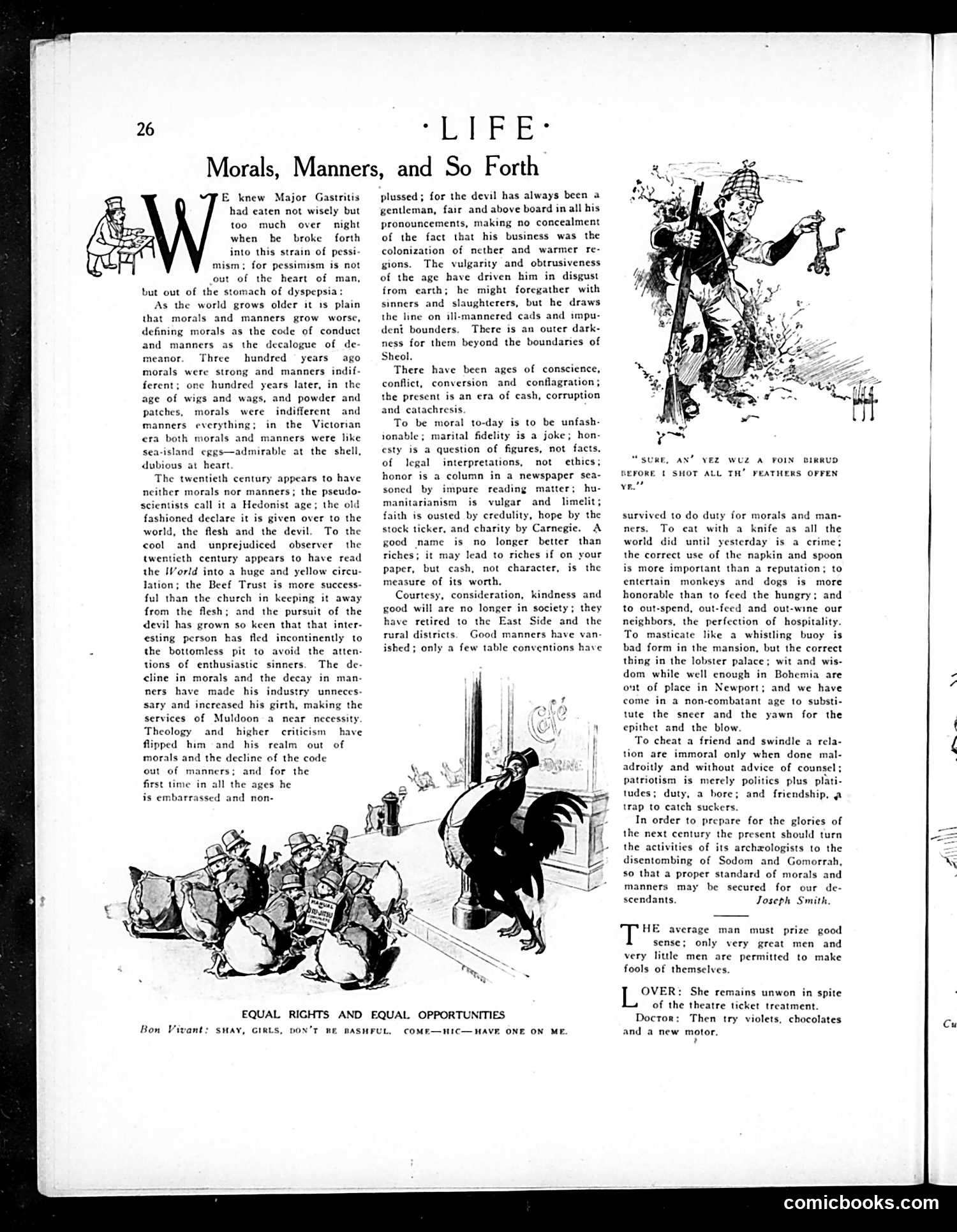
This *Life* magazine page satirizes early 20th-century American social decline through multiple angles. The main article, framed by a dyspeptic "Major Gastritis," argues that modern society (the "Hedonist age") has abandoned both morals and manners—a sharp reversal from previous centuries. The author laments that honor, honesty, and charity have been replaced by cash, corruption, and materialism. The cartoons reinforce this critique: one depicts the Devil himself fleeing earth, disgusted by modern rudeness and vulgarity—a darkly comic inversion suggesting society has become *worse* than evil itself. A second cartoon shows working-class figures, possibly mocking "equal rights and equal opportunities" rhetoric while illustrating class-based social divisions. The overall message: rapid modernization and capitalism have corroded traditional moral and social codes, leaving only shallow materialism and bad manners behind.
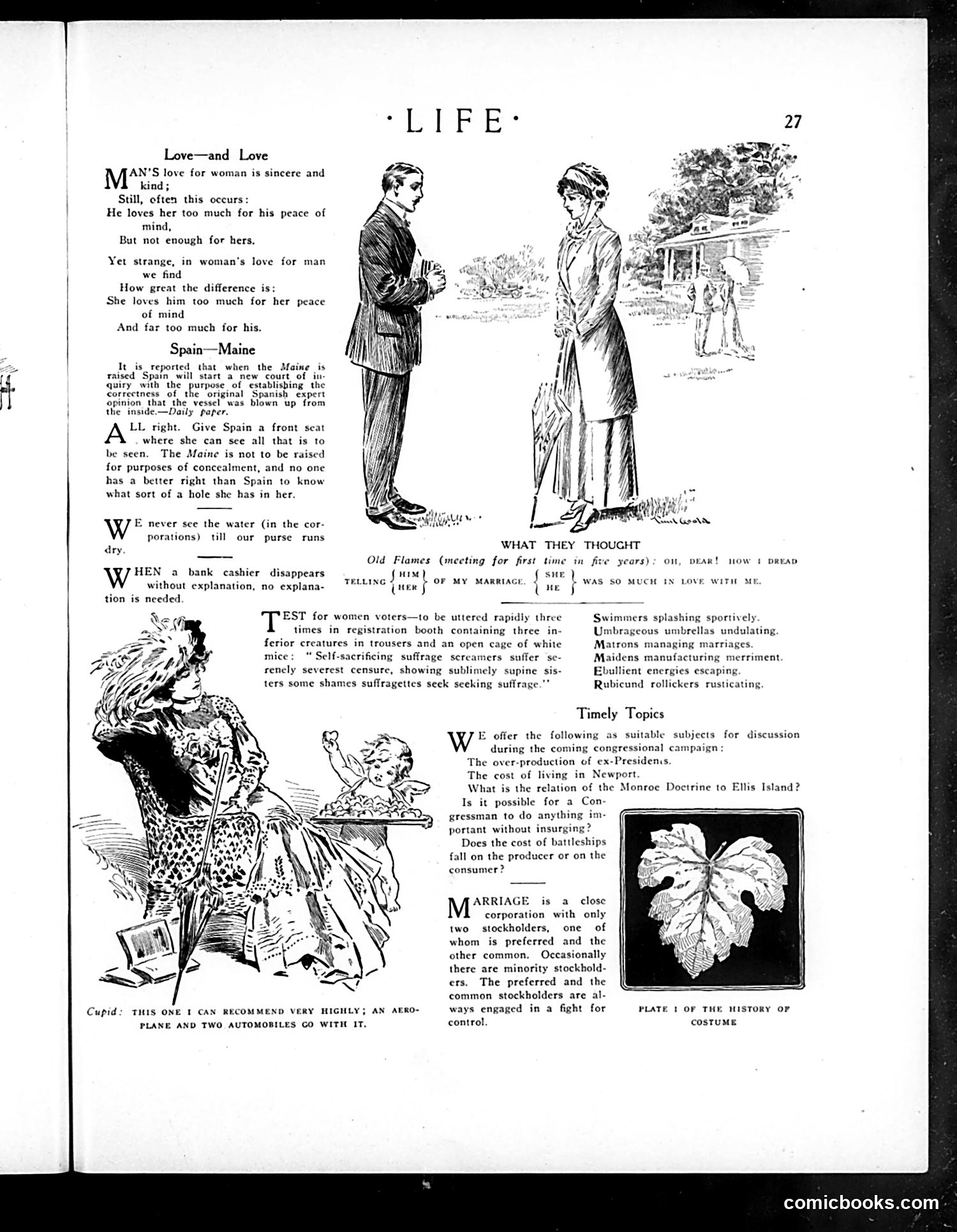
This page contains several distinct satirical pieces typical of Life's early 20th-century commentary: **"Love—and Love"** contrasts men's and women's romantic attachments, suggesting men love women insufficiently for women's happiness, while women love men excessively for their own peace of mind—a commentary on relationship imbalance. **"Spain—Maine"** references the USS Maine explosion (1898), which sparked the Spanish-American War. Spain had claimed the ship exploded internally. The satire sarcastically invites Spain to inspect the wreckage, implying Spain bears responsibility and therefore has "no better right than Spain to know what sort of a hole she has in her." **Lower sections** include humorous observations about bank embezzlement, suffrage activism ("Self-sacrificing suffrage screamers"), and marriage as corporate stockholding disputes. **The Cupid cartoon** shows a woman boasting about her marriage success to an old flame, with satirical commentary on women voters and female activists. The page overall reflects early-1900s American attitudes toward gender relations, political events, and contemporary social debates.
This page contains book reviews rather than political cartoons. The "Latest Books" header features a decorative illustration of people surrounded by books, but the content is primarily critical commentary on three novels. The reviews discuss: 1. **Governor Morris's "The Voice in the Rice"** — praised as an imaginative adventure story set in a South Carolina swamp among descendants of pre-Revolutionary aristocratic planters. 2. **Ashton Hilliers's "The Master Girl"** — a prehistoric romance based on a cave-bear bone carving from La Madeleine, France, with an undercurrent about gender conflict ("sex-struggle"). 3. **Charles Edward Russell's "Why I Am a Socialist"** — a work on economic evolution and socialism. The page also advertises a "Confidential Book Guide" listing additional titles. This is a typical early-20th-century literary criticism page, not satire or political cartooning.
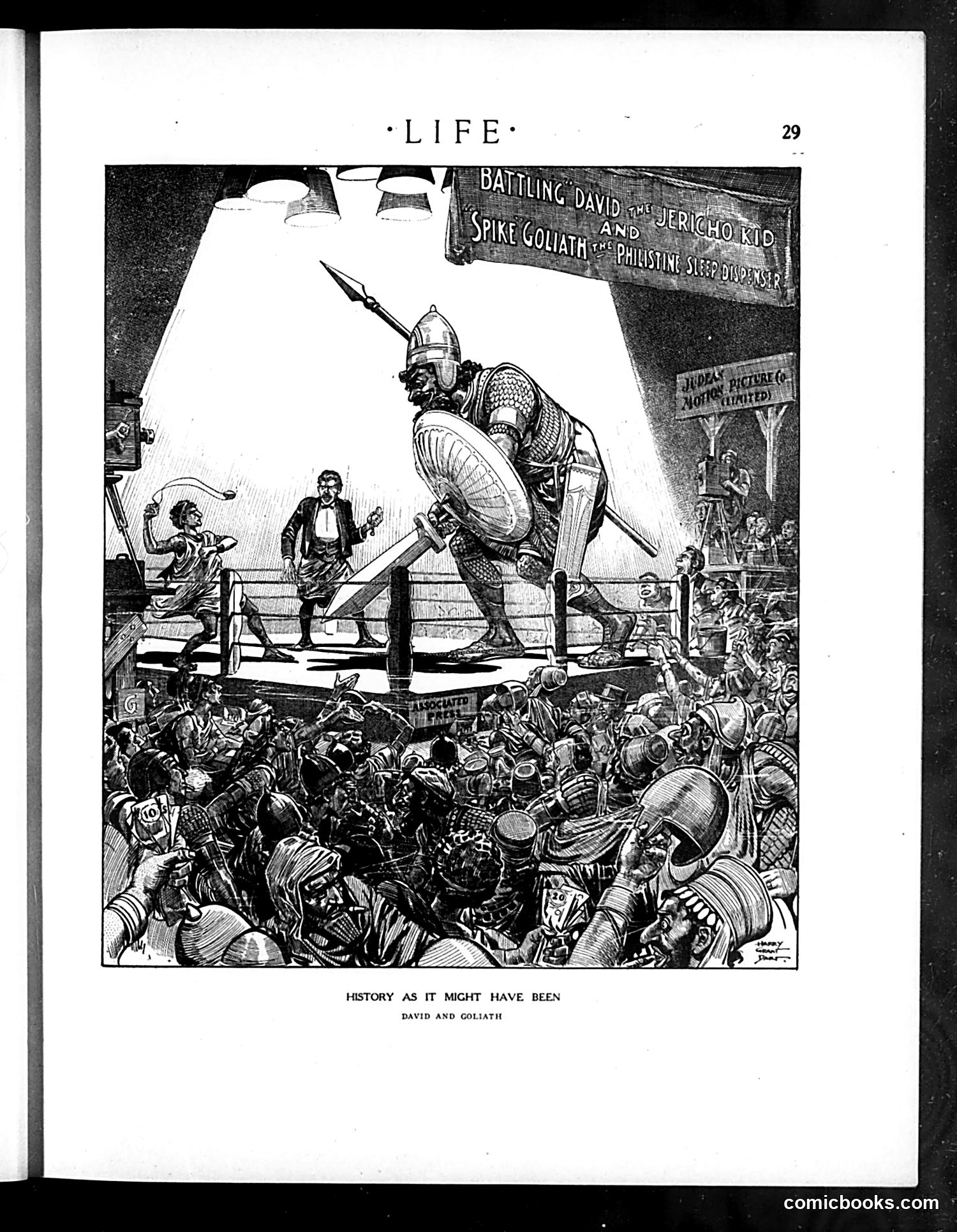
This is a satirical illustration reimagining the biblical David and Goliath story as a modern theatrical production. The image shows Goliath as an enormous armored giant on a stage, while David and other figures appear below. The signage visible references movie titles including "Battling David," "The Jericho Kid," and "Spike Goliath," suggesting this depicts classic cinema or stage productions. The satire appears to mock how popular entertainment adapts historical or biblical narratives into melodramatic spectacles. The crowded audience and theatrical staging transform a biblical parable into commercial entertainment. The "history as it might have been" caption suggests Life magazine is critiquing how media sensationalizes and theatricalizes serious narratives for entertainment profit.
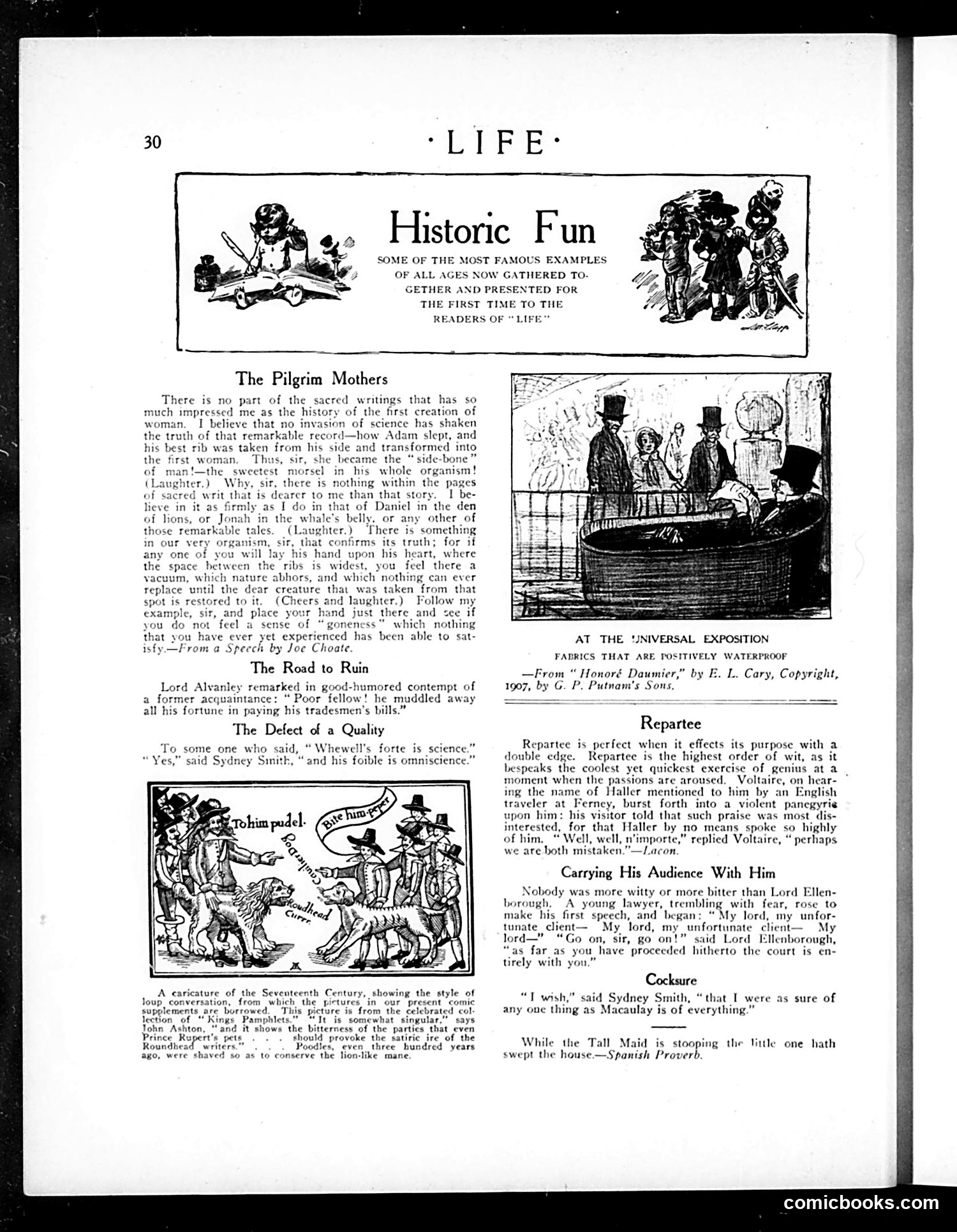
This page presents anecdotes and historical quotes intended as humor for *Life* magazine readers. The content includes: **"The Pilgrim Mothers"**: A lengthy speech by Joe Choate sentimentalizing Adam's creation of woman, treating it as scientifically validated—a jab at both romantic idealization and selective invocation of religious "science." **Period Anecdotes**: Brief witty remarks attributed to historical figures (Lord Alvanley, Sydney Smith, Voltaire, Lord Ellenborough) demonstrating clever repartee. For instance, Smith's quip about Macaulay's overconfidence, or Ellenborough's backhanded compliment to a nervous young lawyer. **Historical Cartoon**: A 17th-century satirical engraving showing contemporary conversation style—presented as the ancestor of modern comic supplements. **Context**: The page celebrates verbal wit and historical humor as refined entertainment. The satire targets pretension, overconfidence, and self-deception through sharp, quotable remarks rather than visual comedy.
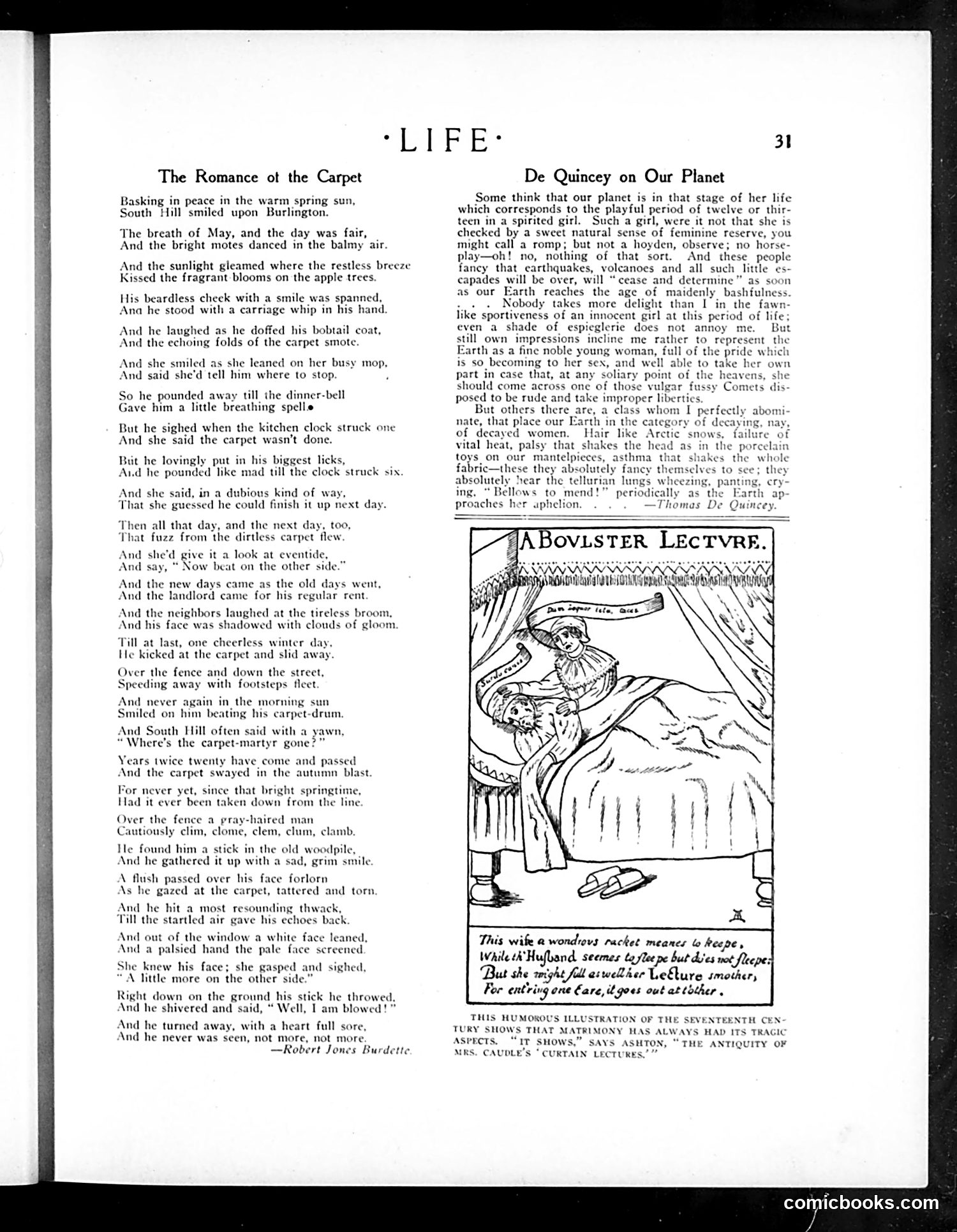
This page contains two distinct pieces: **"The Romance of the Carpet"** (left): A sentimental narrative poem by Robert Jones Burdette about a man hired to beat a carpet clean on a spring day. The job spirals into an endless, Sisyphean task—he returns repeatedly as the woman keeps directing him to beat the other side. Years pass. Decades later, now gray-haired, he returns and discovers the carpet still hanging, never taken down. The poignant twist: she recognizes him from the window, still issuing the same orders. He leaves defeated. The satire appears to mock the futility of domestic labor and perhaps the absurd expectations placed on workers by households. **"A Bowlster Lecture"** (right): An illustration captioned with dialogue about a wife's "wondrous rocket meaness" and a husband's hopes, suggesting marital discord played for humor. The caption credits it as a 17th-century image illustrating matrimony's "tragic aspects." Both pieces use humor to address themes of marital strain and domestic life—common satirical targets in early 20th-century American magazines.
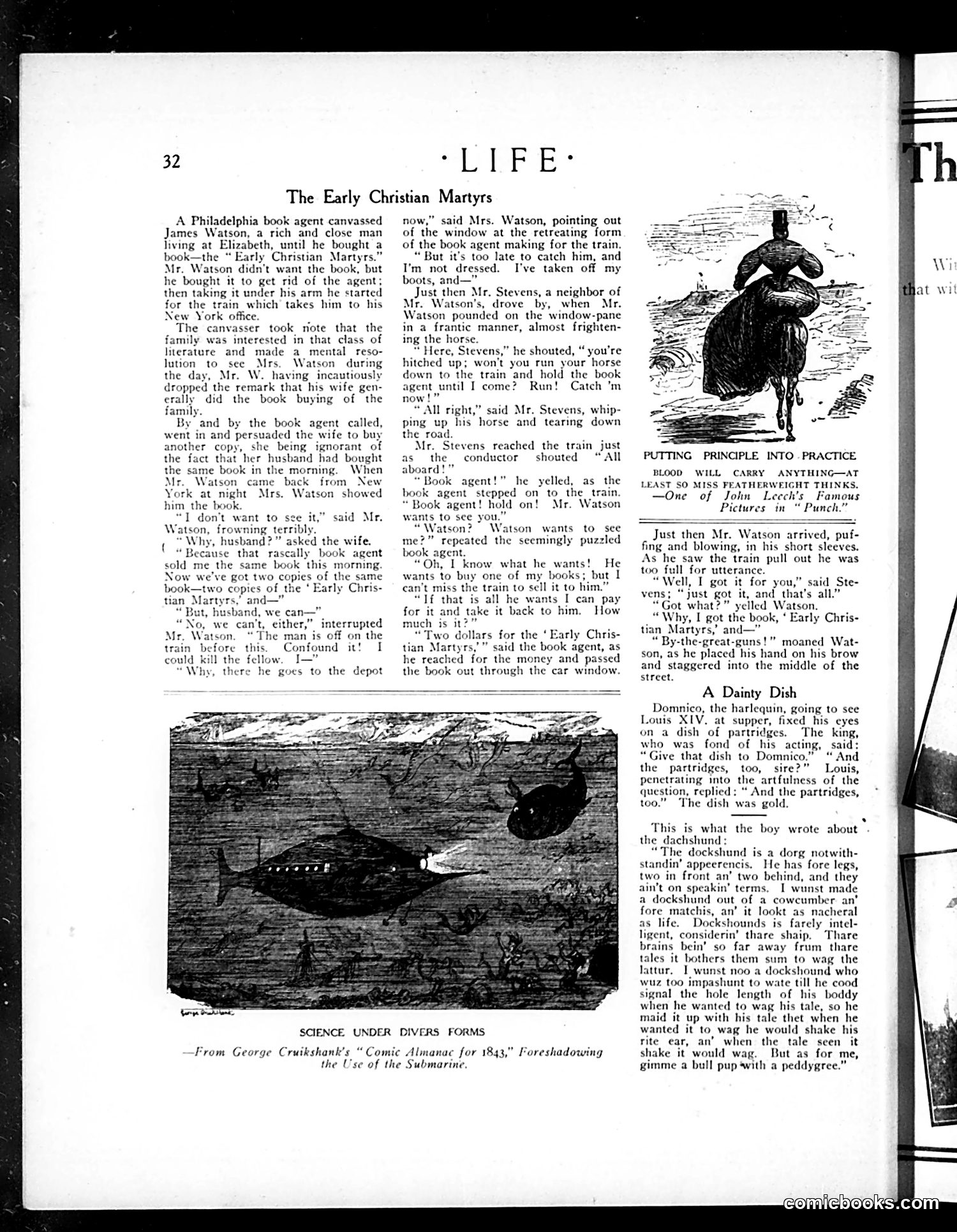
This humor piece satirizes the pushy door-to-door book sales tactics of the era. A Philadelphia book agent sells James Watson an unwanted copy of "The Early Christian Martyrs." Later, the agent deceives Watson's wife into buying the *same book*, unaware her husband already purchased it. When Watson discovers the duplication, he's enraged—not at the waste, but at being bamboozled twice by the same agent. His fury escalates absurdly: he chases the agent to the train station, even recruiting a neighbor to intercept him. The final irony: the neighbor succeeds in catching the agent, who casually sells Watson a *third copy* for two dollars before boarding the train. The satire mocks both aggressive salesmanship and the gullibility of wealthy but stingy customers like Watson, whose desperation to punish the agent leads him into the very trap he sought to avoid. It's a period piece capturing early commercial consumer anxiety.
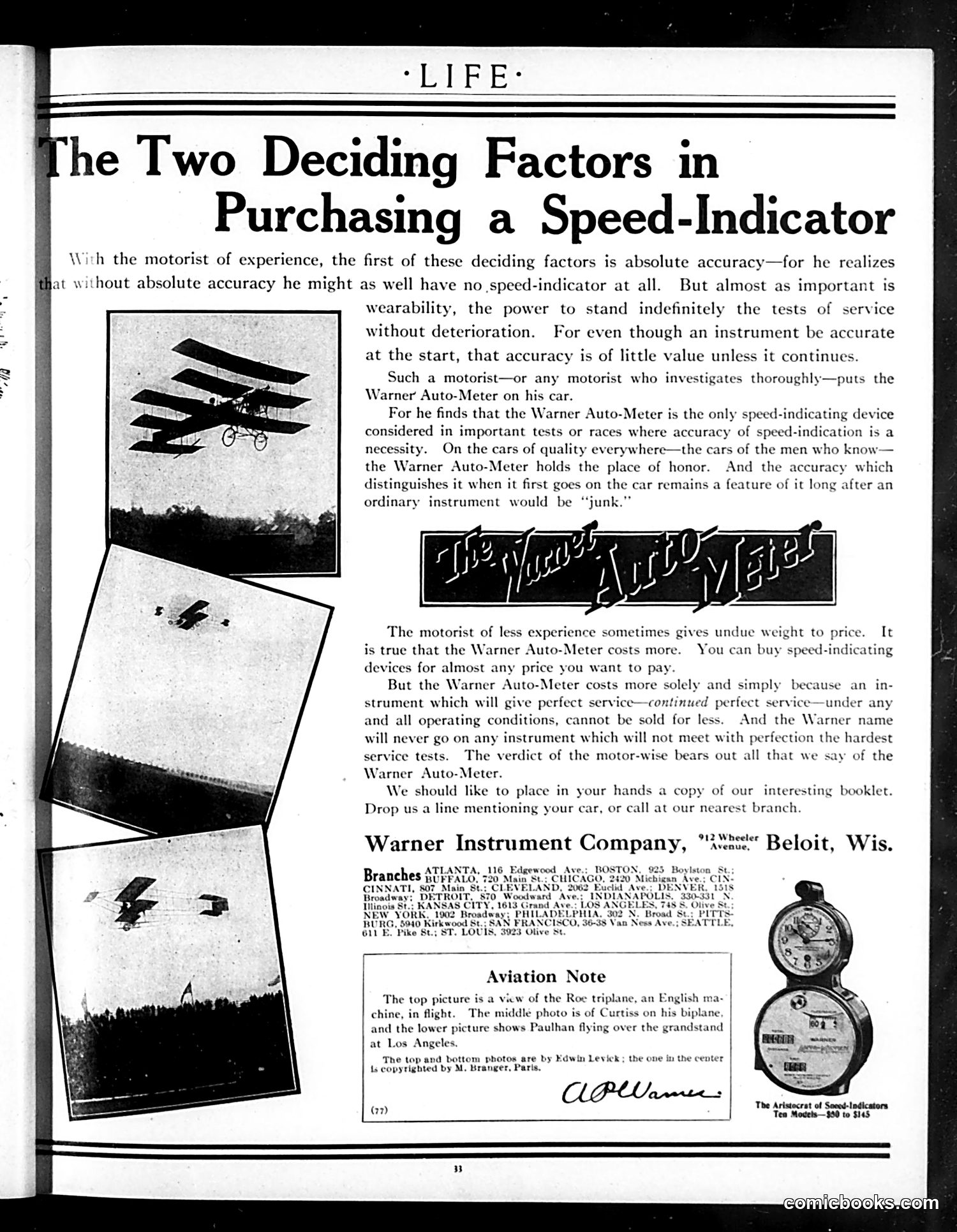
This is primarily **advertising, not satire or political commentary**. The page is a Warner Auto-Meter speed-indicator advertisement from an early 1900s Life magazine issue. The text argues that motorists should value two qualities in speedometers: absolute accuracy and durability ("wearability"). It acknowledges Warner's product costs more than competitors but claims this reflects superior engineering—the instrument maintains accuracy over time while cheaper alternatives become "junk." The **three aviation photographs** in the left margin are unrelated editorial content: early aircraft (a Roe triplane, Curtiss biplane, and Paulhan flying machine) with photo credits to Edwin Levick and M. Branger. **The point**: This is straightforward product promotion positioning Warner as the premium, reliable choice for serious motorists—those "who know." There is no satirical commentary or political content; it's a standard early-automotive-era advertisement appealing to quality-conscious consumers.
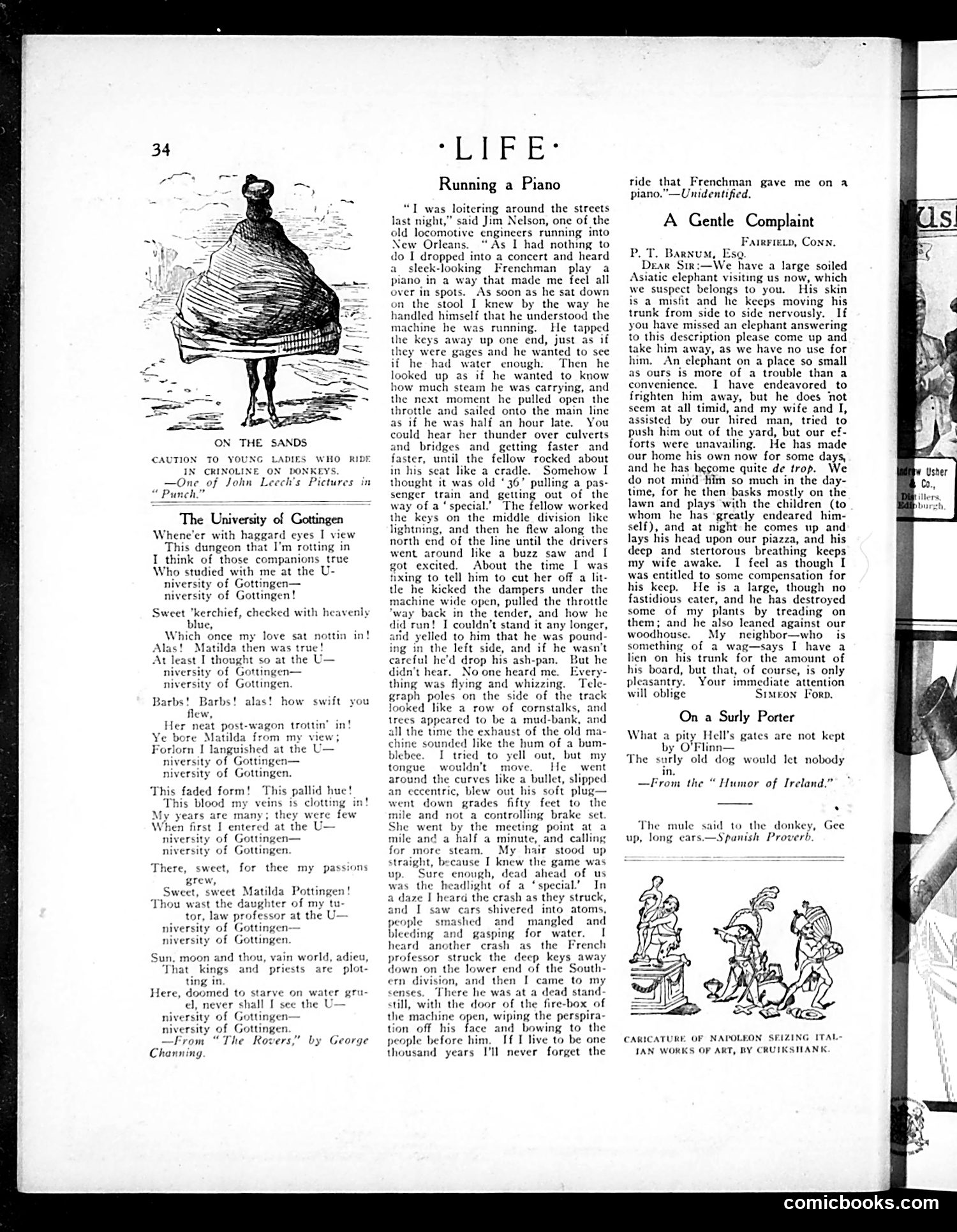
## "On the Sands" (Leech cartoon) A Victorian-era cautionary illustration depicting a young woman riding a donkey on a beach, with the animal appearing to buck or misbehave. This is John Leech's social satire warning young ladies about the dangers of riding donkeys—likely commenting on impropriety or physical risk associated with uncontrolled animals and unchaperoned activities. ## "The University of Gottingen" (poem) A sentimental romantic poem about a languishing prisoner recalling his lost love, Matilda Pottingen, whom he met at the University of Gottingen. The repetitive structure satirizes overwrought Romantic-era sentimentality and melodramatic heartbreak literature—mocking the clichéd conventions of lovelorn ballads through absurdist repetition and exaggeration. ## "Running a Piano" A humorous monologue where an engineer describes a concert pianist's performance using locomotive metaphors (throttle, dampers, steam, curves)—treating the piano like a train engine. The satire mocks both the engineer's limited vocabulary and perhaps affected musical criticism pretending expertise in unfamiliar domains.
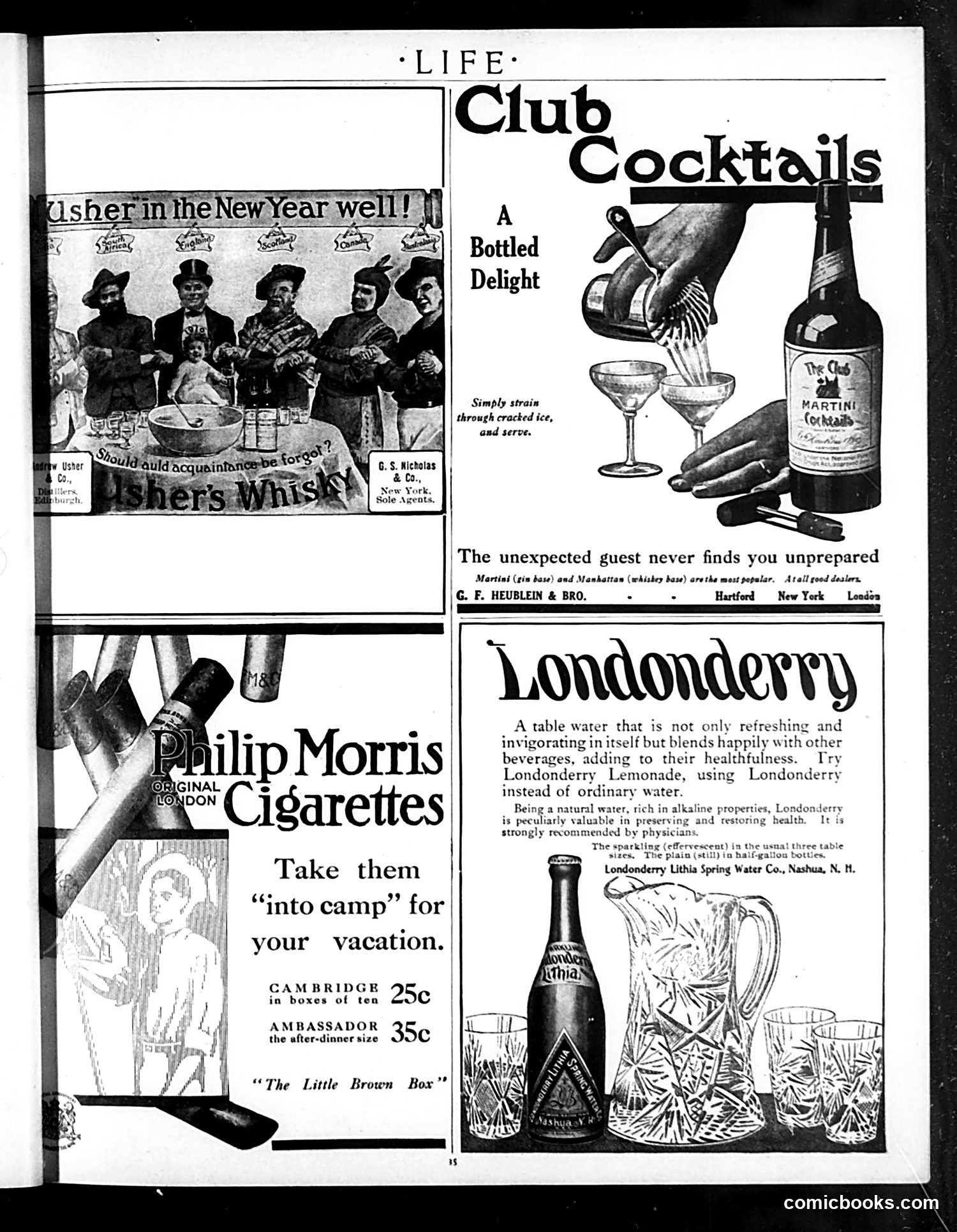
This page comprises **four separate advertisements** rather than satirical cartoons, reflecting early 20th-century marketing approaches. **Upper left:** Usher's Whisky ad depicts five men in formal attire toasting the New Year, suggesting whisky as essential for social occasions and entertaining guests. **Upper right:** Club Cocktails advertisement promotes pre-made martinis and manhattans as convenient solutions for unexpected entertaining—reflecting the cocktail culture boom of the Prohibition era (when homemade mixed drinks became popular). **Lower left:** Philip Morris cigarettes marketed as portable vacation items, priced affordably (25-35 cents). **Lower right:** Londonderry Lithia Spring Water claims health benefits, marketed as a mixer and standalone beverage with supposed medicinal properties—typical of pre-FDA regulation era health claims. All advertisements target middle/upper-class leisure and social entertaining, with subtle gender assumptions about hospitality obligations. None contains obvious political satire.
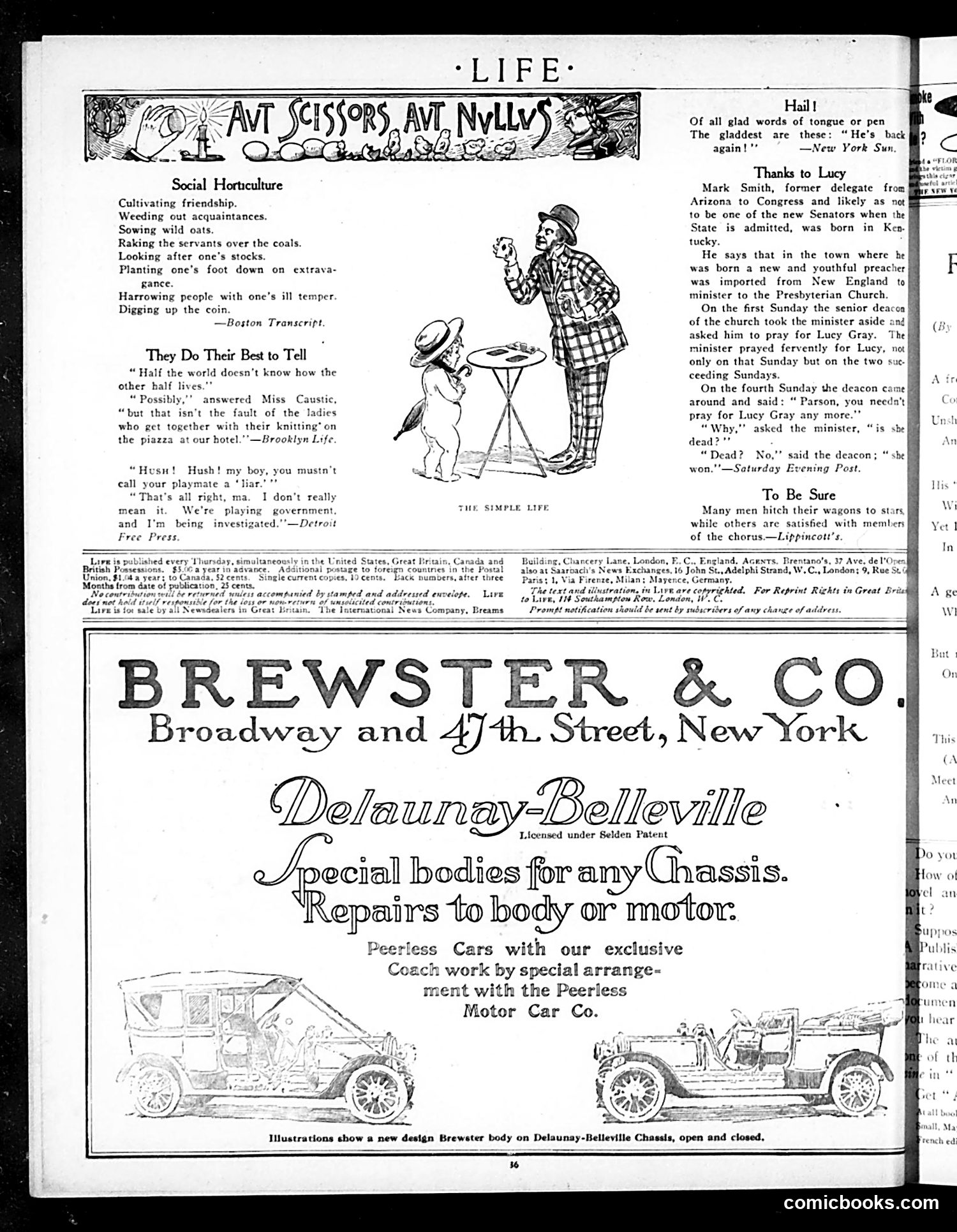
This page mixes humor with advertising. The main satirical content includes: **"Social Horticulture"** uses gardening metaphors to mock upper-class social management—"weeding out acquaintances," "raking servants over coals," "harrowing people with ill temper." It's gentle satire on how the wealthy treat social relationships and household staff. **"They Do Their Best to Tell"** jokes about gossip among society ladies at hotels, suggesting they spread rumors and information despite claims that "half the world doesn't know how the other half lives." **Small humorous vignettes** about government ("playing government"), prayer effectiveness, and ambition round out the satirical content. The bulk of the page is a **Brewster & Co. automobile advertisement** for Delaunay-Belleville chassis with custom coach bodies—clearly targeting wealthy readers of Life magazine. The historical context: this appears early 1900s, reflecting Life's role as a magazine for educated, affluent audiences mixing light social satire with luxury goods marketing.
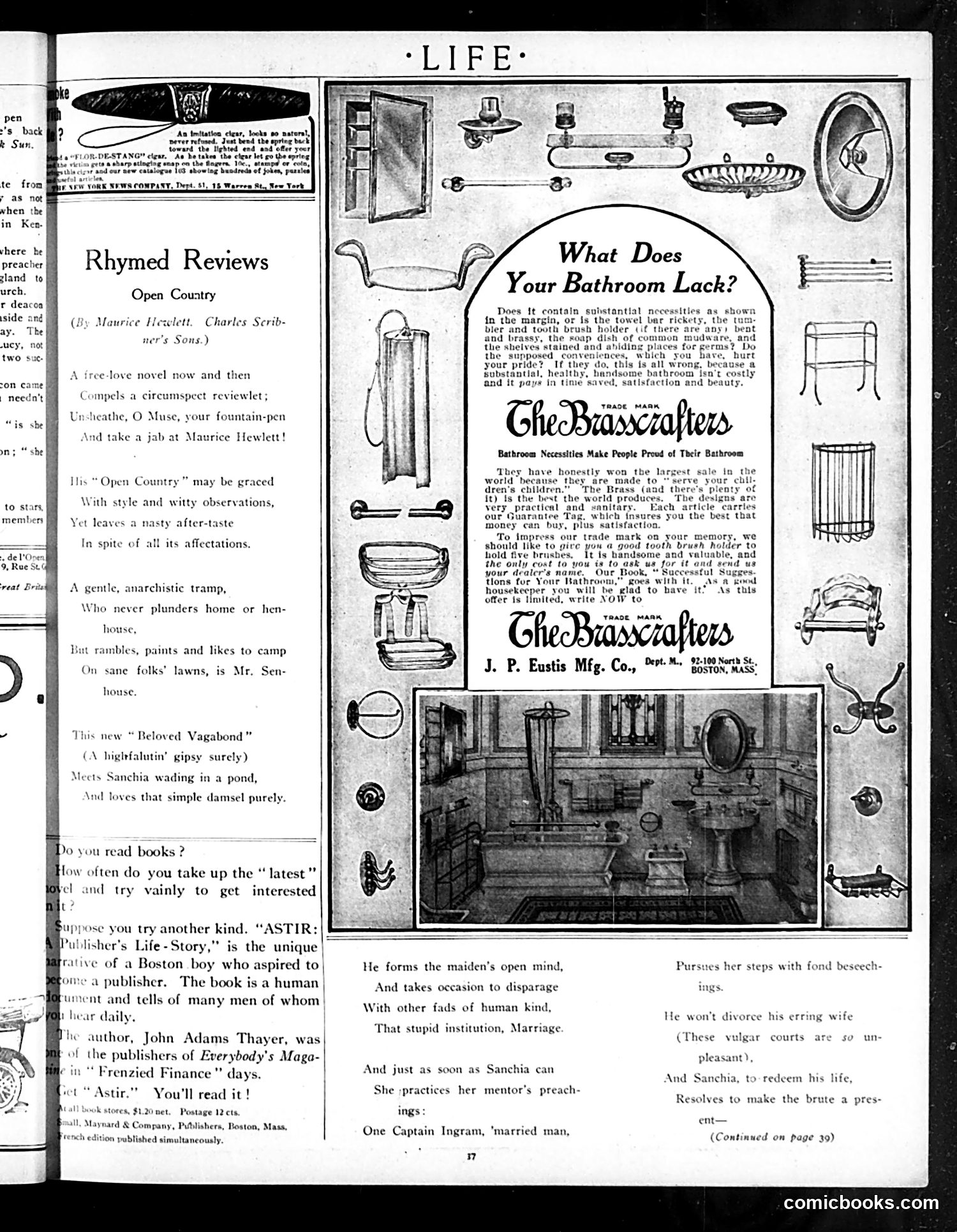
This is primarily an **advertisement page** for "Chebrasscrafter" bathroom fixtures, disguised within a literary magazine. The ad uses illustrated bathroom items (soap dishes, towel bars, mirror, fixtures) surrounding a photo of an elegant bathroom to promote their products as status symbols—suggesting a well-appointed bathroom reflects good taste and pride. The left side contains a "Rhymed Reviews" section reviewing books, including a novel called "Open Country" and a biography titled "ASTIR" about a Boston publisher. The reviews are written in verse, a common feature in *Life* magazine's satirical style. Below is what appears to be the beginning of a serialized story or poem about characters named Sanchia, Captain Ingram, and others, with lines about marriage and redemption. The page reflects early 20th-century attitudes: bathroom fixtures as markers of respectability, and literary culture presented for educated, affluent readers.
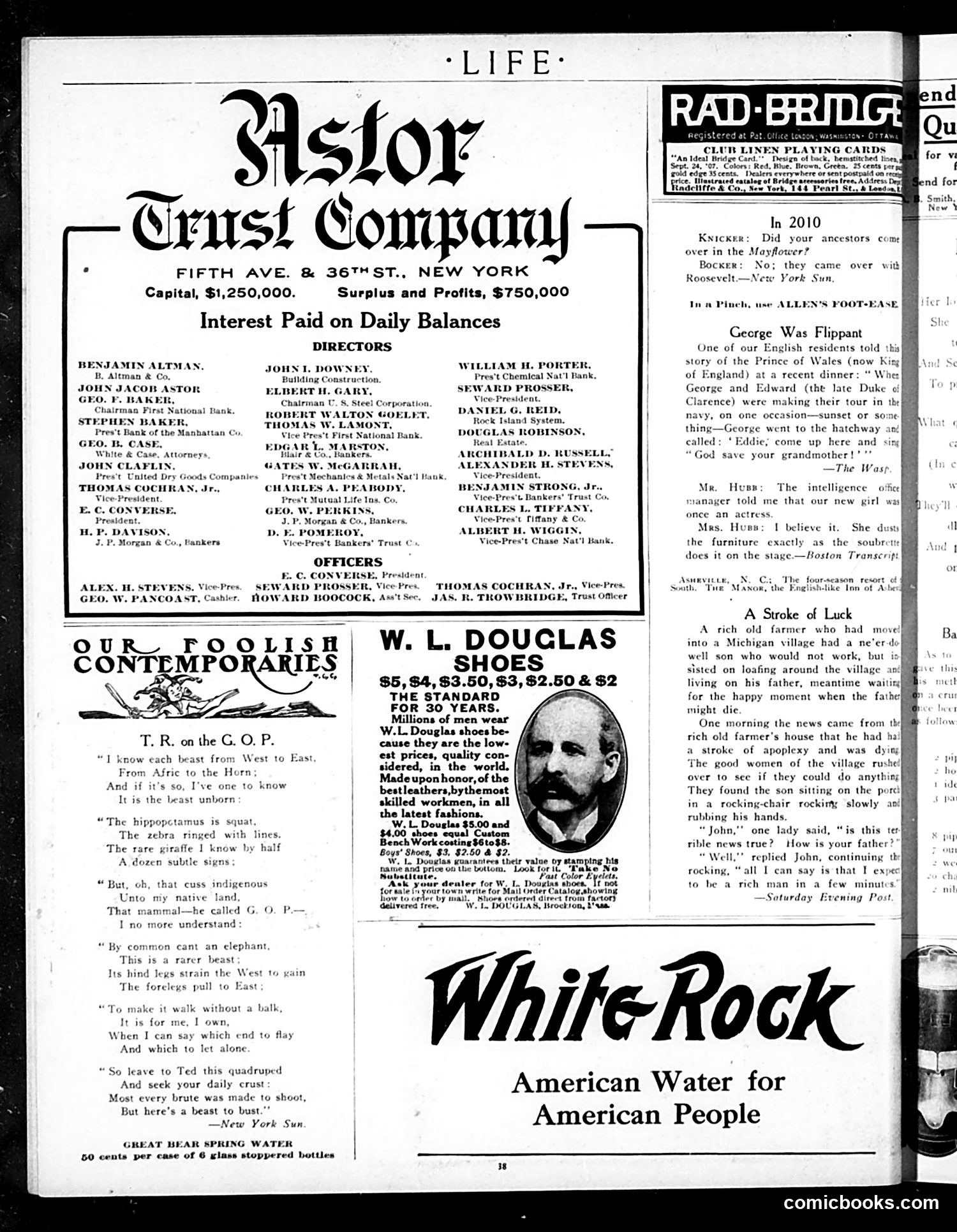
This page is primarily **advertising and corporate announcements**, not political satire. The main content includes: 1. **Astor Trust Company** advertisement listing New York's wealthy elite as directors—names like John Jacob Astor, railroad magnates, and banking executives. 2. **W.L. Douglas Shoes** ad featuring a poem "T.R. on the G.O.P." The verses about animals (hippopotamus, zebra, giraffe) appear to be whimsical wordplay unrelated to Theodore Roosevelt, despite the title's reference to him. 3. **Several humor columns** including a brief anecdote about a Michigan farmer's lazy son hoping to inherit money, and snippets about bridge players and theater actresses. 4. **White Rock water** advertisement. The page reflects early 1900s Life content: mixing high-society financial institutions with consumer goods advertising and light comedic vignettes—primarily appealing to wealthy, educated readers rather than offering sharp political commentary.
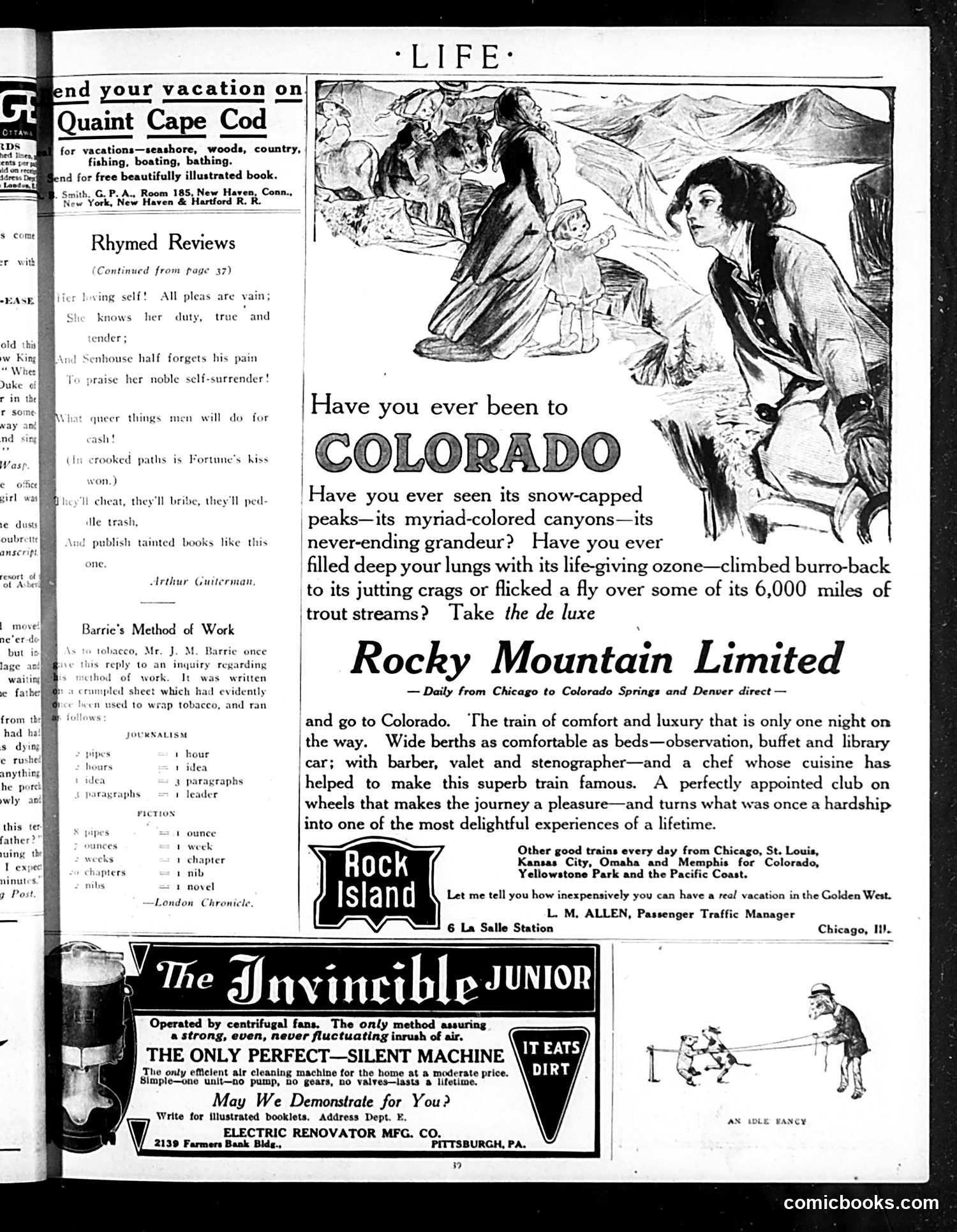
This page is primarily **advertisements and filler content**, not political satire. The main elements are: **Colorado Tourism Ad**: The largest feature promotes the "Rocky Mountain Limited" train, using romantic imagery of mountain scenery and a woman tourist. The ad emphasizes luxury travel ("comfort and de luxe") and natural attractions (snow-capped peaks, canyons, trout streams). This is straightforward promotional content aimed at wealthy Americans seeking vacations. **Literary Content**: The page includes "Rhymed Reviews" (poetry criticism by Arthur Guiterman) and a brief note about author J.M. Barrie's writing methods—typical Life magazine cultural commentary. **Product Ads**: Two appliance advertisements appear: "The Invincible Junior" (an air-cleaning machine) and a vacuum renovator. **Small Cartoon**: A tiny illustration labeled "An Idle Fancy" appears at bottom right, though it's too small to interpret clearly. The page reflects early 20th-century magazine layout: mixing editorial content with ads to subsidize publication costs.
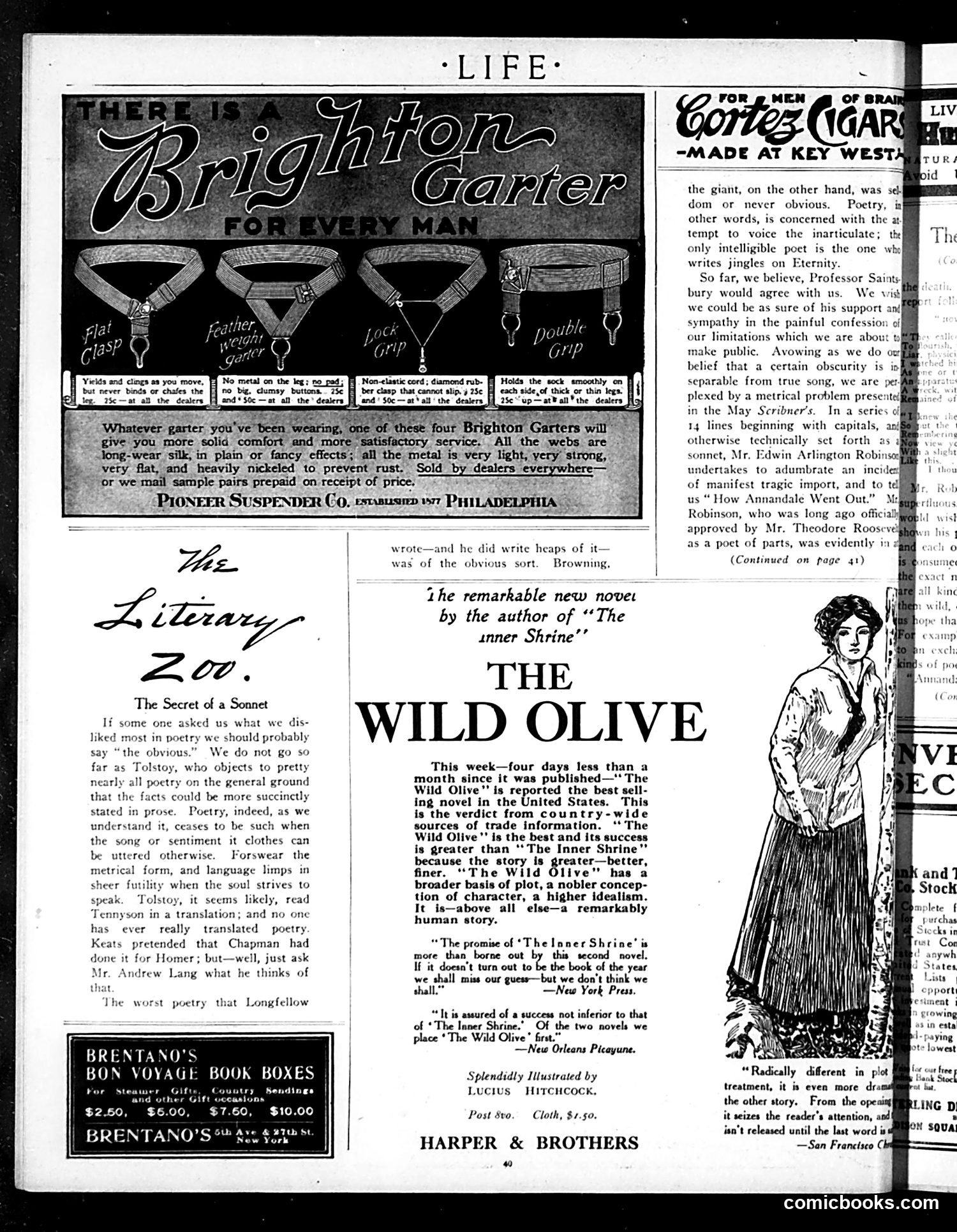
This page is primarily **literary and advertising content**, not political satire. The top features a **Brighton Garter advertisement** for men's suspenders, showing four styles (Flat Clasp, Feather Weight, Lace Grip, Double Grip) with technical descriptions—standard product marketing of the era. The main editorial content is "The Literary Zoo," discussing poetry and sonnets, referencing **Tolstoy, Browning, Keats, Chapman, and Longfellow**—literary criticism about whether obvious versus obscure poetry works better. The centerpiece advertises **"The Wild Olive,"** a novel by the author of "The Inner Shrine," reporting it's the best-selling novel in America. Publishers highlight its superiority over the previous work through favorable reviews. Lower sections include ads for **Brentano's book boxes** and **Harper & Brothers** publishing. There is **no political cartoon or satire** on this page—it's a typical early 20th-century magazine blend of literature discussion and period advertising.
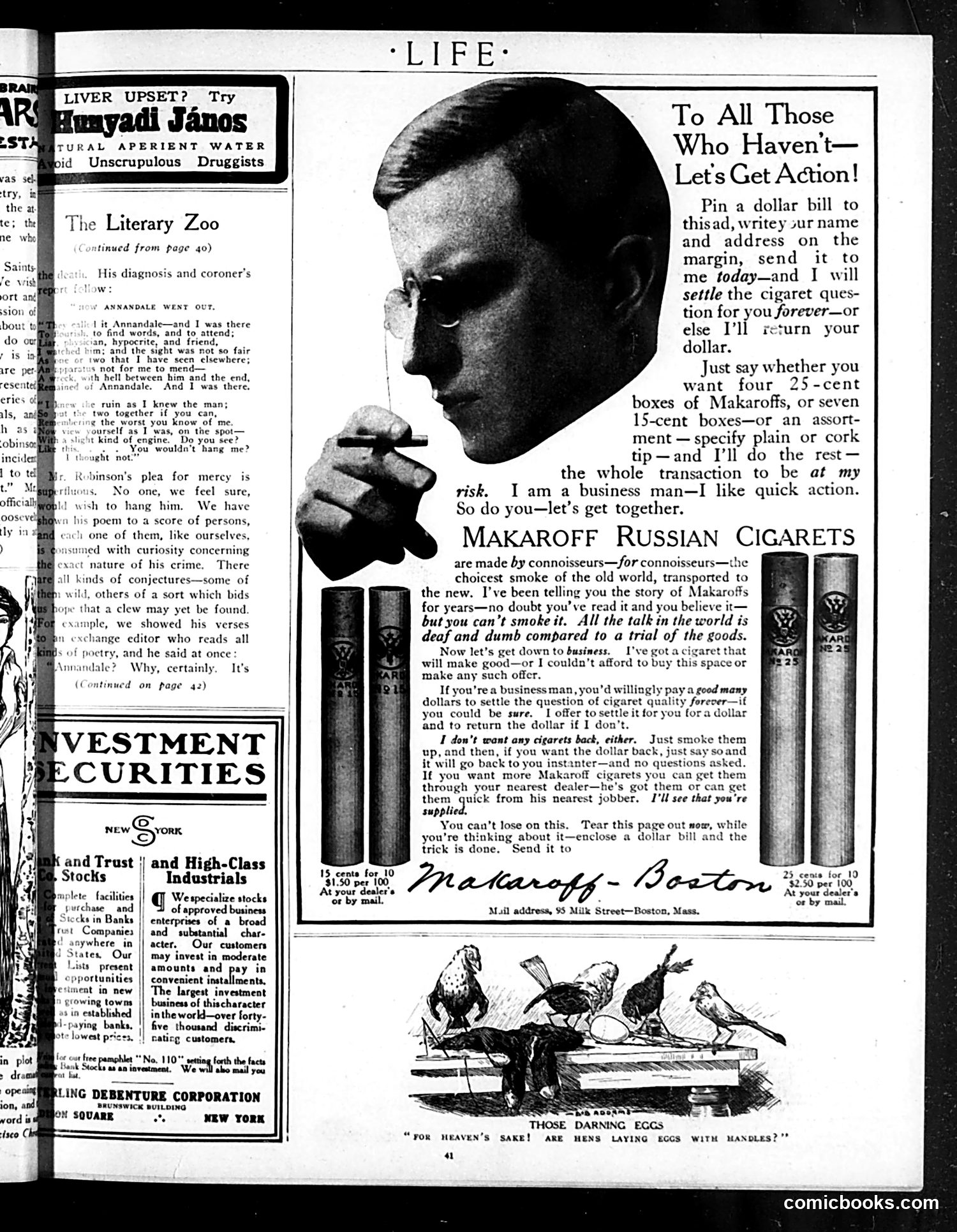
This page contains primarily **advertisements and literary content**, not political cartoons. The main feature is a **Makaroff Russian Cigarets advertisement**—a full-page pitch using a business-appeal angle. The copywriter addresses readers as fellow businessmen, offering to settle a "question of cigaret quality forever" by sending a dollar bill. If unsatisfied after smoking, they promise to return it. The ad emphasizes speed and action ("I like quick action") and claims the cigarets are "made by connoisseurs—for connoisseurs." Also visible: "The Literary Zoo" continues a literary discussion (from page 40) about a character named Annandale; investment securities ads appear on the left margin. At the bottom is a small cartoon captioned "Those Darning Eggs" showing birds near a bench—a mild visual joke, likely playing on the double meaning of "laying eggs" (failing or producing). The page reflects early 20th-century advertising style and consumer culture rather than political satire.
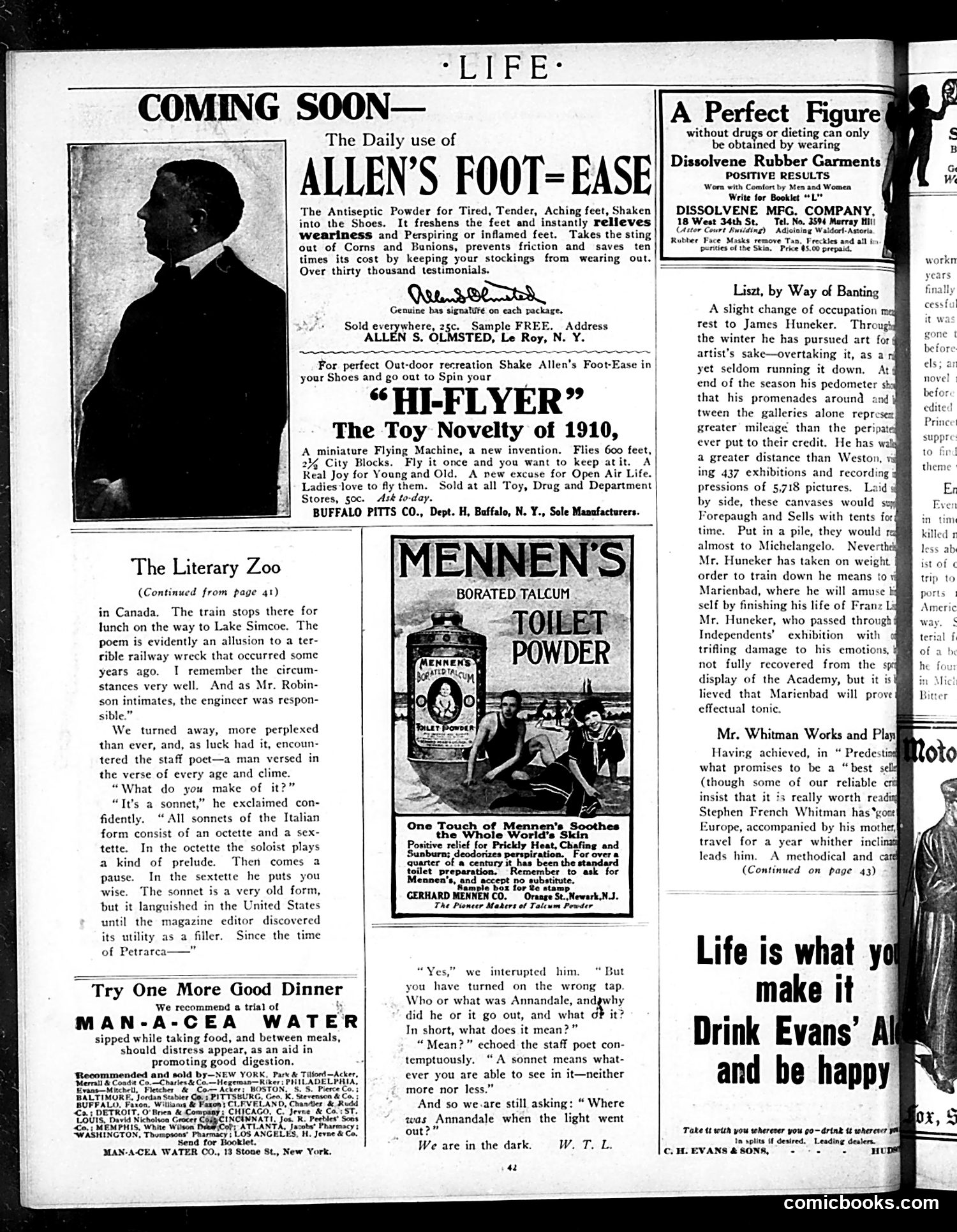
This page is primarily **advertising**, typical of early-20th-century magazines. The content includes: **Main Advertisements:** - **Allen's Foot-Ease**: An antiseptic powder for foot problems, promising relief from corns, bunions, and perspiration - **Hi-Flyer**: A toy novelty flying machine from 1910—a miniature aircraft that "flies 600 feet" - **Mennen's Borated Talcum Powder**: Toilet powder for skin care - **Man-a-cea Water**: A patent medicine **Editorial Content:** A column titled "The Literary Zoo" discusses a train-wreck poem, featuring dialogue about Italian sonnets and their structure. Another section, "Liszt, by Way of Banting," profiles art critic James Huneker's winter travels and his pedometer measurements of gallery visits. **Historical Context:** The advertisements reflect 1910 consumer culture—patent medicines and novelty toys were heavily marketed in magazines. "Banting" (mentioned regarding Huneker) refers to dieting, named after William Banting, a 19th-century dieting advocate. The page shows no political satire; it's a standard magazine issue mixing literary discussion with commercial promotions.
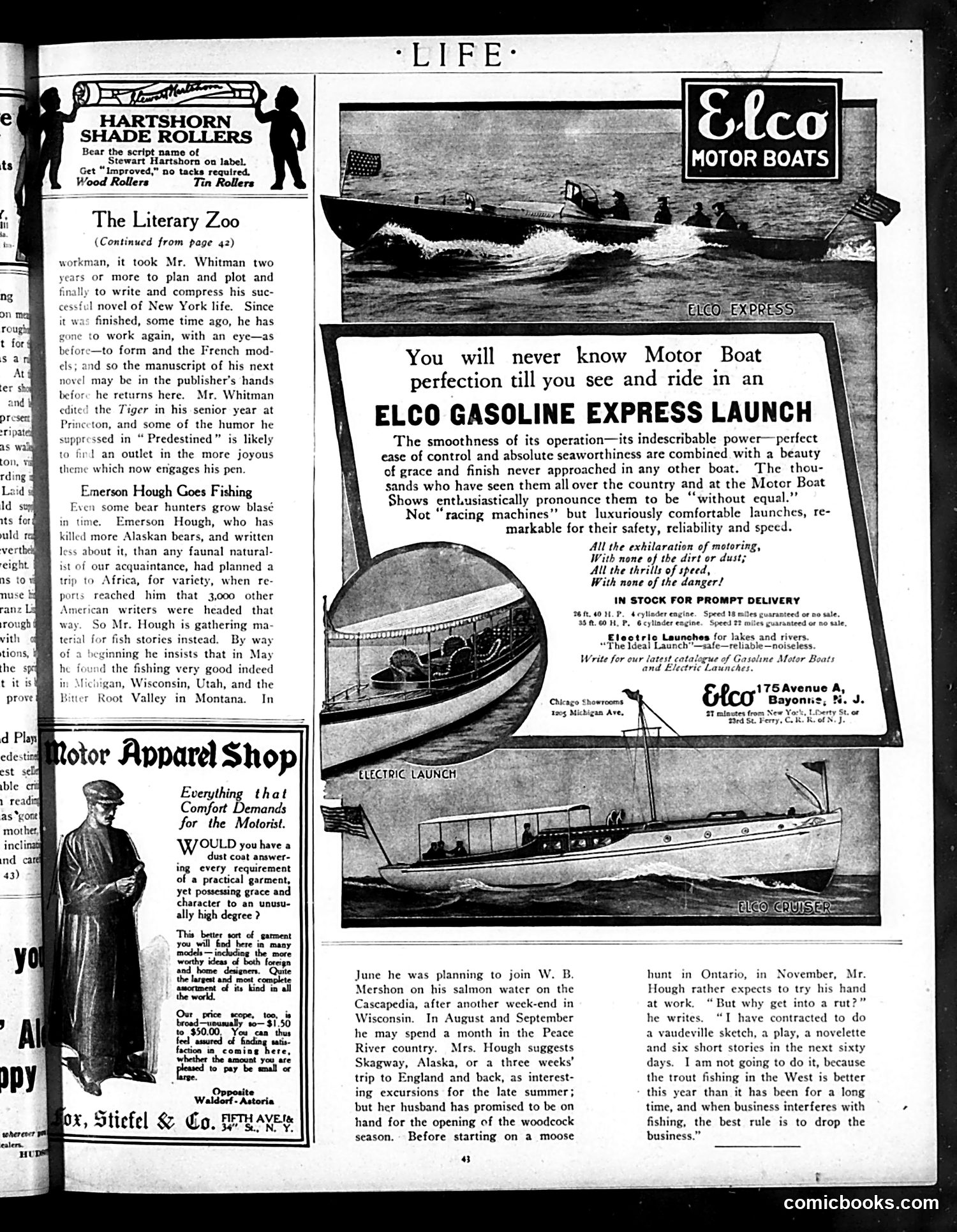
This page is primarily **advertising and literary content**, not political satire. The main feature is a large **Elco Motor Boats advertisement** showcasing their "Gasoline Express Launch," emphasizing luxury, safety, and smooth operation—targeting wealthy leisure consumers. The ad promises comfort without the dirt of racing machines. Below is a continuation of "The Literary Zoo," a profile column about American writers. It discusses novelist Whitman's meticulous writing process and humorist **Emerson Hough**, a prolific author known for hunting and fishing stories. The text notes Hough ironically abandoned an Africa trip because 3,000 other American writers were going there, instead gathering fishing material. The passage humorously captures Hough's priorities: he commits to theatrical and writing projects but admits he'll skip them for trout fishing in the West—satirizing the creative writer's perpetual conflict between professional obligations and personal passions. The **Motor Apparel Shop** ad (left) sells practical motorist clothing.
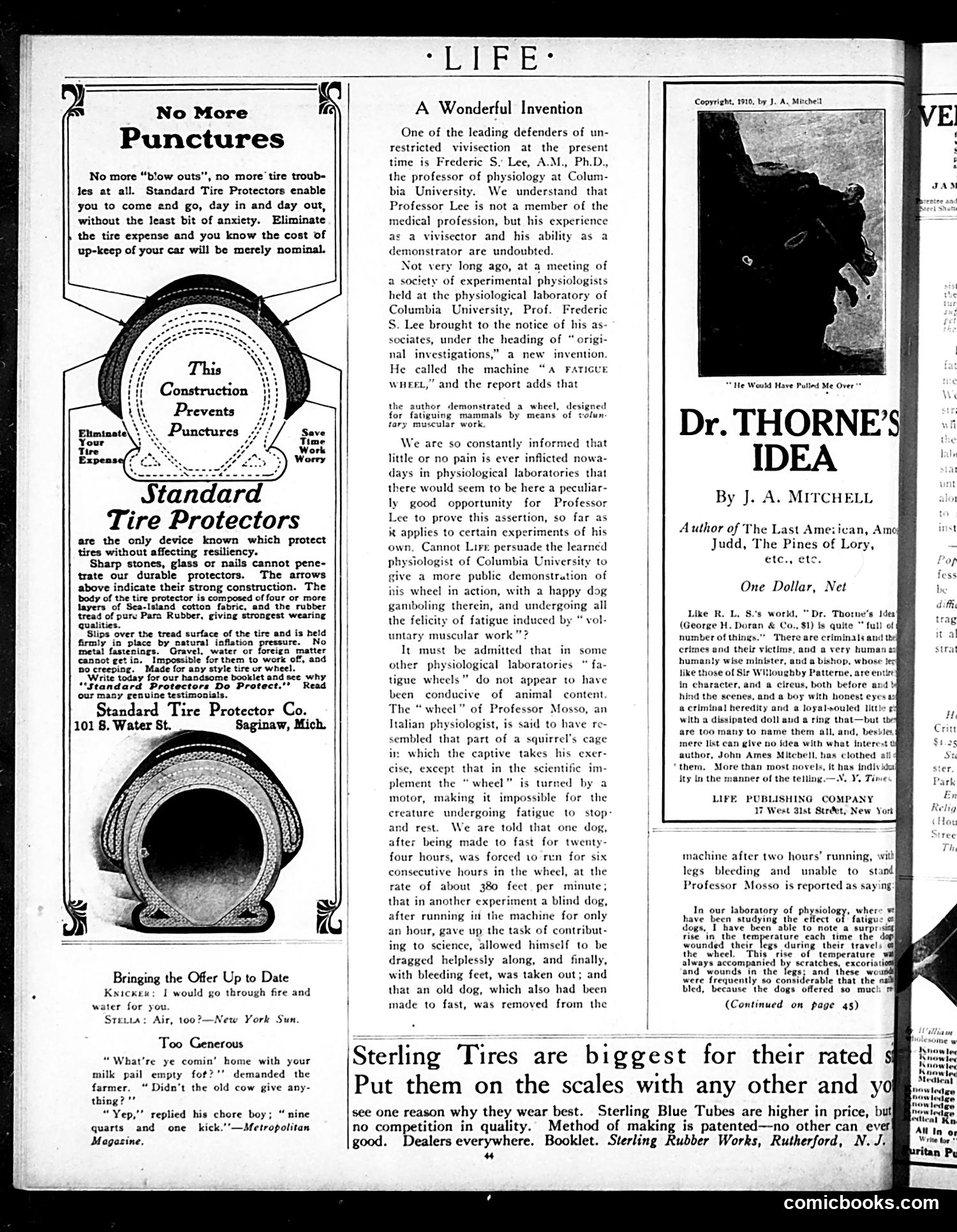
This article attacks Professor Frederic S. Lee of Columbia University for developing a "fatigue wheel"—a device that forces animals to run continuously until exhaustion to study muscular fatigue. The author sarcastically praises Lee's invention while describing cruel experiments: dogs forced to run 380 feet per minute for six consecutive hours, a blind dog collapsing after one hour. The satire targets the contradiction in Lee's position: he publicly claims vivisection (animal experimentation) causes little pain, yet his wheel deliberately inflicts fatigue and suffering. The piece challenges Lee to publicly demonstrate the device on a healthy dog to prove it's humane. This reflects early 20th-century animal welfare activism criticizing scientific experimentation's ethical costs. The sarcastic tone—calling torture an "invention" and "felicity"—exposes what the author sees as self-serving rationalization by the scientific establishment.
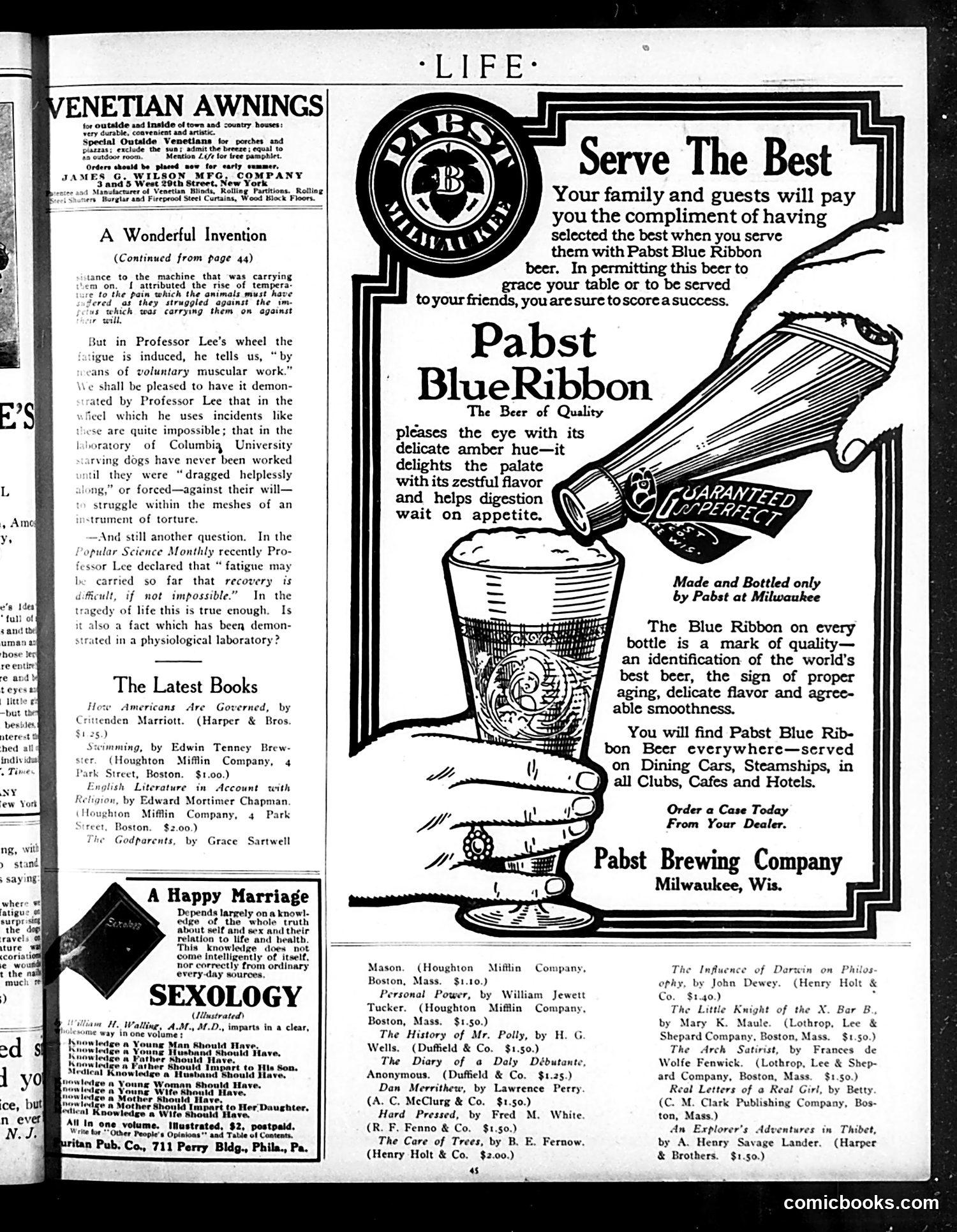
This page is primarily **advertising**, not political satire. The dominant content is a Pabst Blue Ribbon beer advertisement featuring a large illustration of a beer glass with a bottle. The ad's message is straightforward: serving Pabst Blue Ribbon signals good taste and hospitality to guests. The "mark of quality" language emphasizes the beer's superiority and widespread availability "on Dining Cars, Steamships, in all Clubs, Cafes and Hotels." The left side contains unrelated editorial content—a book review section and an advertisement for a "Sexology" guide book. There is no political cartoon or satire visible. **Context for moderns**: This reflects the pre-Prohibition era (before 1920) when beer advertising was commonplace in mainstream magazines. The aspirational framing—serving the "best" to impress guests—was typical marketing strategy of the period.
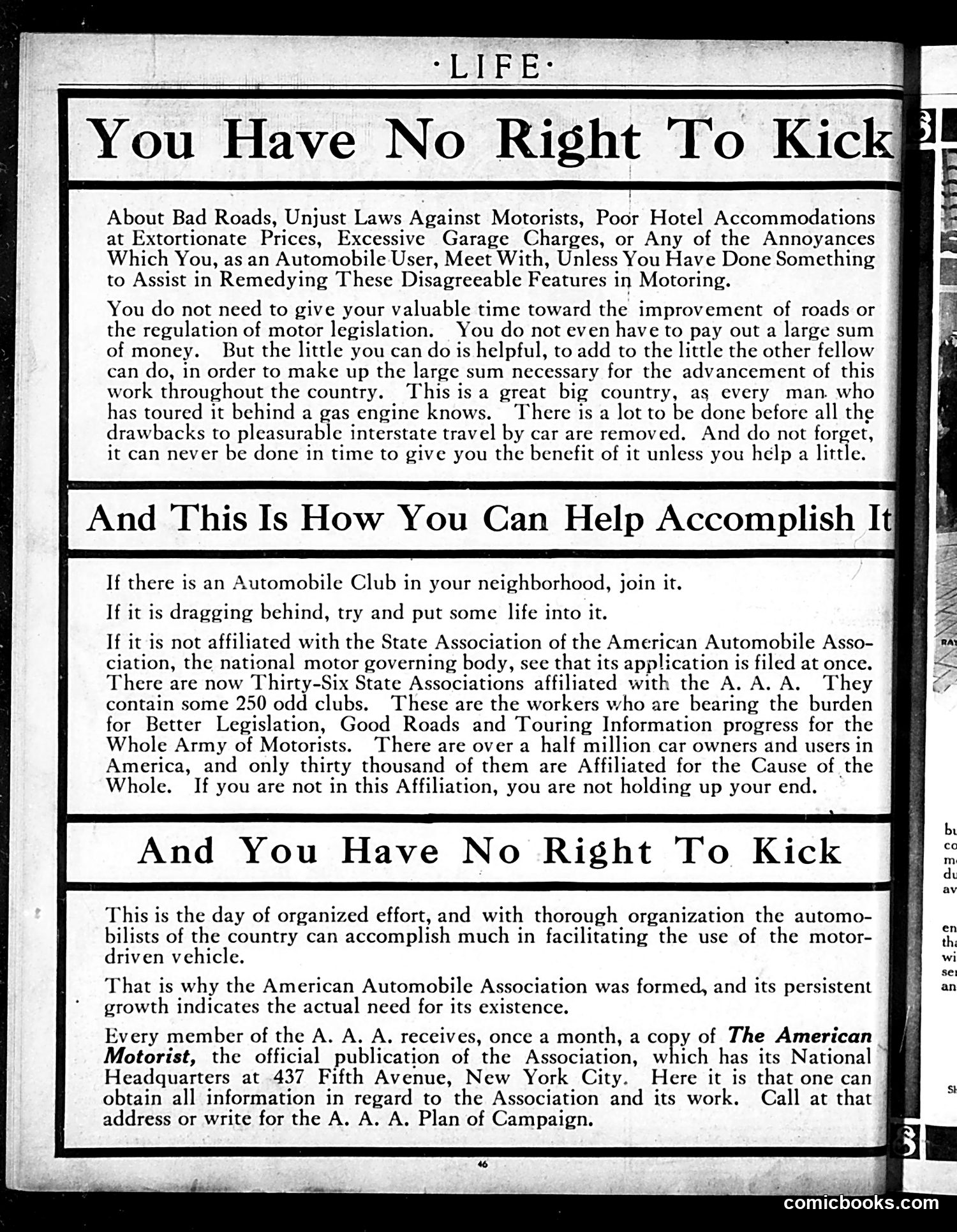
This is **not a cartoon but a persuasive advertisement/editorial** from *Life* magazine promoting membership in the American Automobile Association (A.A.A.). The piece uses guilt-based rhetoric to pressure motorists into joining the organization. Its central argument: you cannot legitimately complain about poor roads, unfair motor laws, expensive hotels, or garage overcharges **unless you actively support the A.A.A.'s reform efforts**. The piece appeals to motorists' self-interest while reframing participation as a collective duty—even small individual contributions, when combined, fund major infrastructure and legislative improvements across this "great big country." The A.A.A. is positioned as the sole legitimate representative of motorists' interests, with 36 affiliated state associations and 250 clubs. The copy criticizes low membership (only 30,000 of 500,000+ car owners) and directly solicits readers to join, visit their Fifth Avenue headquarters, or request their publication *The American Motorist*. **It's essentially a membership drive disguised as moral argument.**
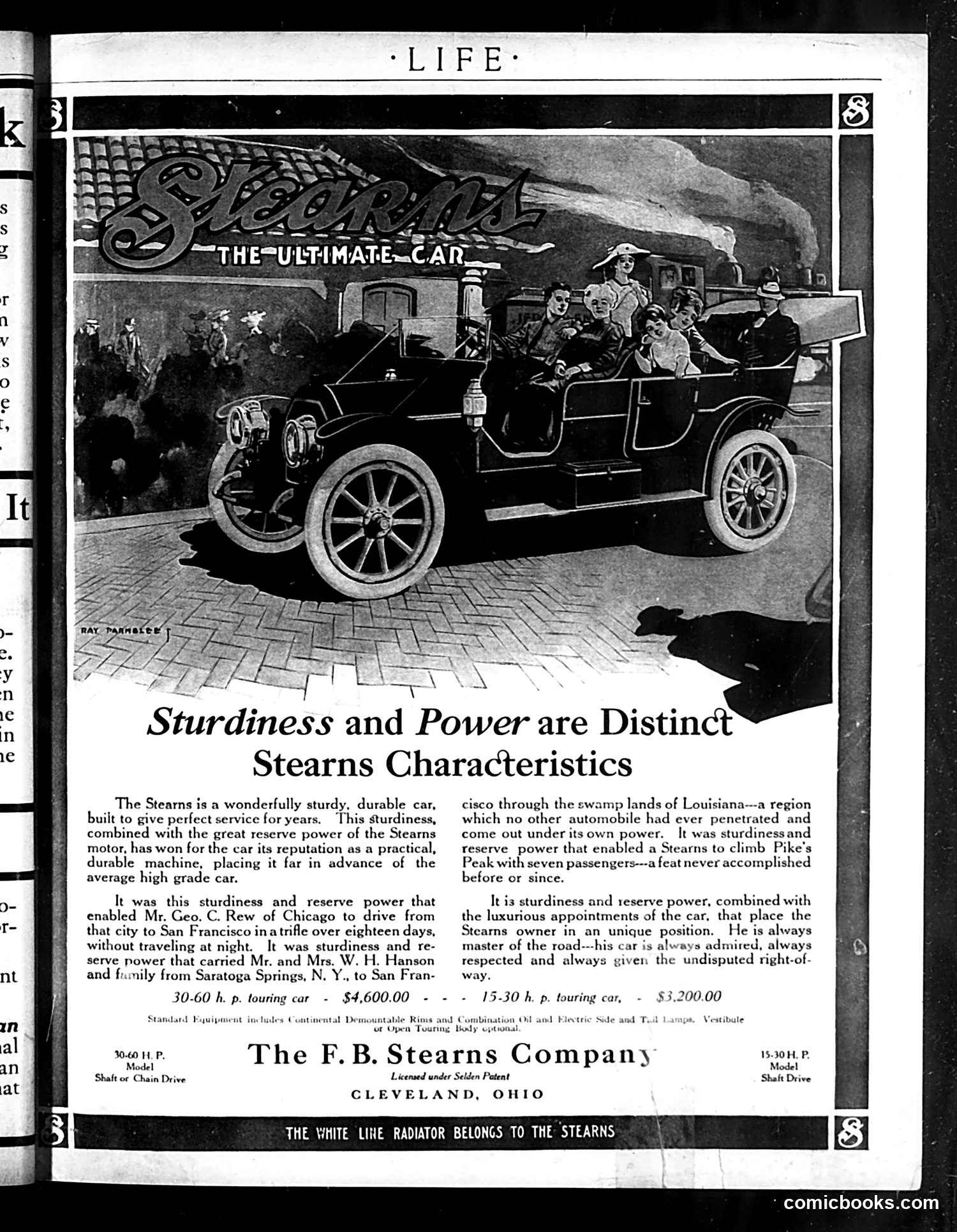
This is primarily **automobile advertising**, not political satire or a cartoon. It's a full-page ad for the F.B. Stearns Company (Cleveland, Ohio) promoting their automobiles. The page features a photograph of a Stearns car filled with well-dressed passengers, emphasizing the vehicle's luxury and capacity. The advertising copy highlights two selling points: "Sturdiness and Power." The text supports these claims through specific anecdotes: a Chicago driver's 18-day trip to San Francisco, a couple's journey through Louisiana swamps, and a climb up Pike's Peak with seven passengers—feats the ad claims no competitor had accomplished. The message targets affluent buyers, positioning Stearns ownership as conferring social status and respect on the road ("always admired, always respected"). Two models are advertised with prices ($4,600 and $3,200), both substantial sums for the era. This reflects early-20th-century automotive marketing strategy: reliability, luxury, and social prestige.
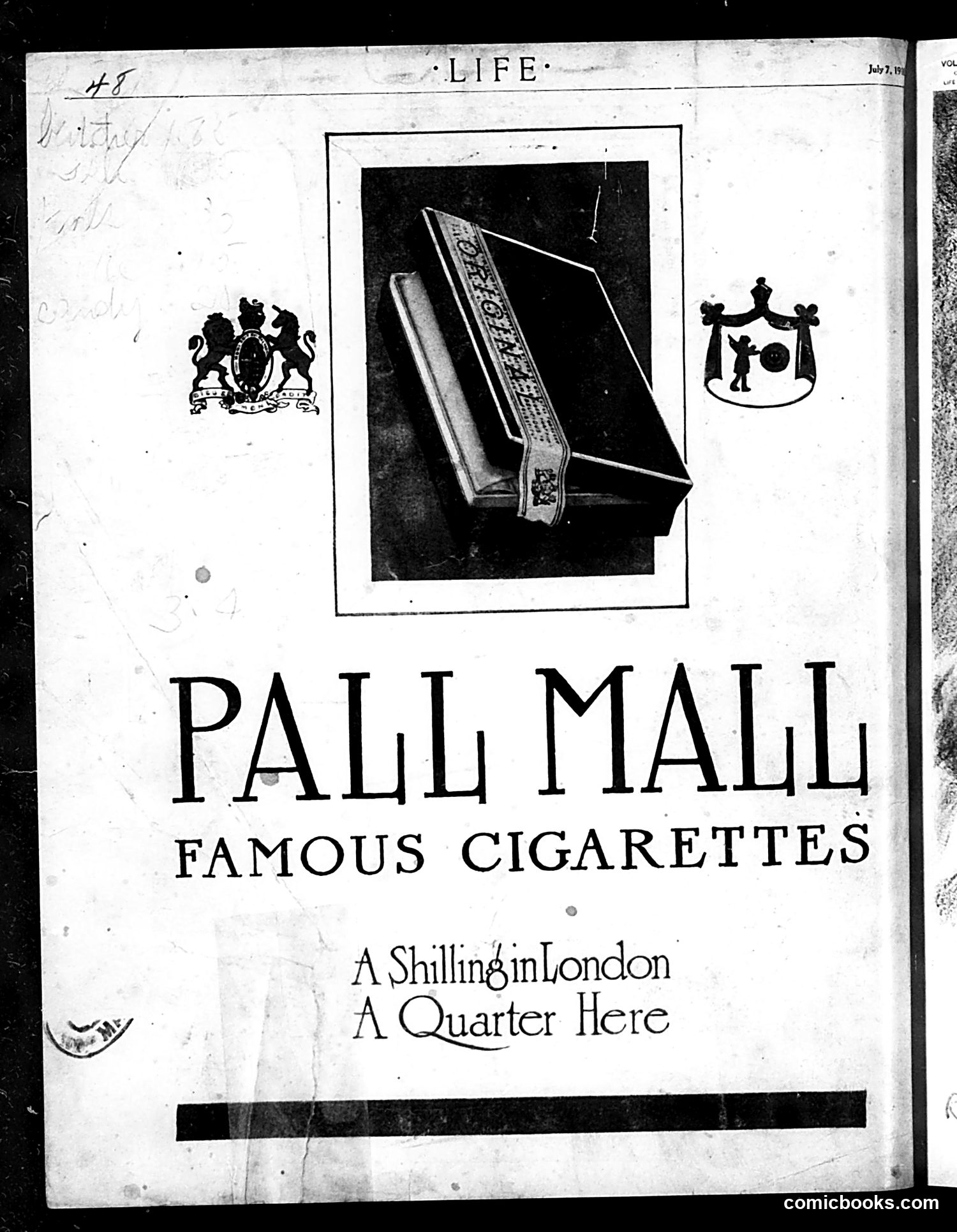
This is primarily a **cigarette advertisement** for Pall Mall brand, not a political cartoon or satirical content. The page appears from *Life* magazine and features a product image of an open cigarette package with decorative ribbon/trim visible. The ad's messaging is straightforward commercial copy: it emphasizes the product's international prestige by comparing London and American pricing ("A Shilling in London / A Quarter Here"), suggesting Pall Mall cigarettes are a quality import or luxury good. The heraldic crests flanking the product image reinforce this positioning as a sophisticated, refined product. There is no satire or political commentary present—this is purely advertising content from the era when tobacco products were routinely advertised in mainstream publications.