
Life, 1910-07-07 · page 31 of 48
Life — July 7, 1910 — page 31: what you’re looking at
What you’re looking at
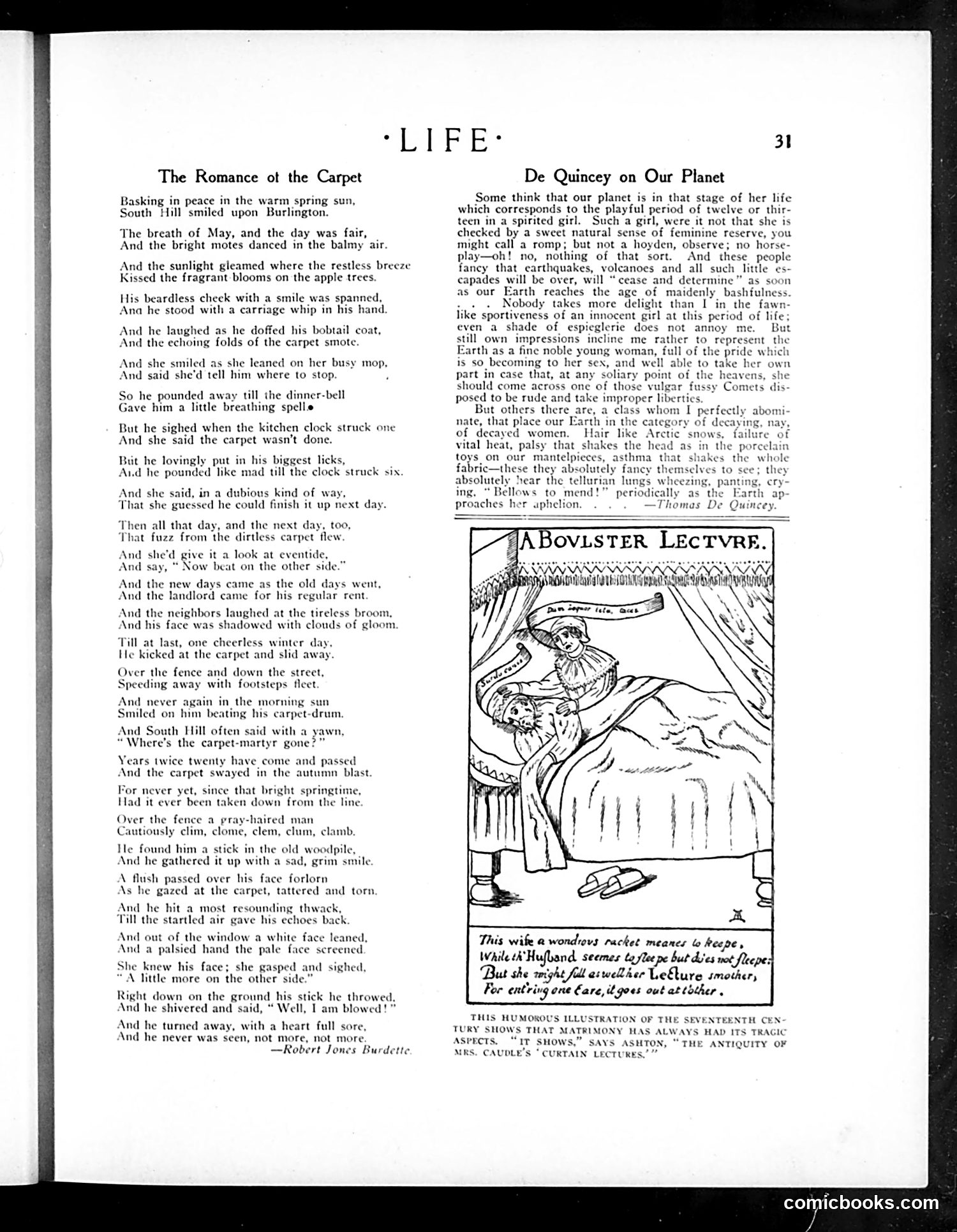
This page contains two distinct pieces: **"The Romance of the Carpet"** (left): A sentimental narrative poem by Robert Jones Burdette about a man hired to beat a carpet clean on a spring day. The job spirals into an endless, Sisyphean task—he returns repeatedly as the woman keeps directing him to beat the other side. Years pass. Decades later, now gray-haired, he returns and discovers the carpet still hanging, never taken down. The poignant twist: she recognizes him from the window, still issuing the same orders. He leaves defeated. The satire appears to mock the futility of domestic labor and perhaps the absurd expectations placed on workers by households. **"A Bowlster Lecture"** (right): An illustration captioned with dialogue about a wife's "wondrous rocket meaness" and a husband's hopes, suggesting marital discord played for humor. The caption credits it as a 17th-century image illustrating matrimony's "tragic aspects." Both pieces use humor to address themes of marital strain and domestic life—common satirical targets in early 20th-century American magazines.
📄 Transcribed text from this page (OCR, searchable)
Machine-transcribed from the original scan — historical spelling and the odd misread are preserved.
LIPE: 31 The Romance ot the Carpet Basking in peace in the warm spring sun, South Hill smiled upon Burlington. The breath of May, and the day was fair, | And the bright motes danced in the balmy air. And the sunlight gleamed where the restless breeze Kissed the fragrant blooms on the apple trees. His beardless cheek with a smile was spanned, Ana he stood with a carriage whip in his hand. And he laughed as he doffed his bobtail coat, And the echoing folds of the carpet smote. And she smiled as she leaned on her busy mop, And said she'd tell him where to stop. So he pounded away till the dinner-bell Gave him a little breathing spelle But he sighed when the kitchen clock struck one And she said the carpet wasn’t done. Brit he lovingly put in his biggest licks, Aud he pounded like mad till the clock struck six. And she said, in a dubious kind of way, That she guessed he could finish it up next day. Then all that day, and the next day, too, That fuzz from the dirtless carpet flew And she'd give it a look at eventide, ‘And say, Now beat on the other side And the new days came as the old days went, And the landlord came for his regular rent. And the neighbors laughed at the tireless broom, And his face was shadowed with clouds of gloom. Till at last, one cheerless winter day, He kicked at the carpet and slid aw Over the fence and down the street, Speeding away with footsteps fleet And never again in the morning sun Smiled on him beating his carpet-drum, And South Hill often said with a yawn, “Where's the carpet-martyr gone?” Years twice twenty have come and passed And the carpet swayed in the autumn blast. For never yet, since that bright springtime, Had it ever been taken down from the line. Over the fence a gray-haired man Cautiously clim, clome, clem, clum, clamb, Ie found him a stick in the old woodpile, And he gathered it up with a sad, grim smile \ flush passed over his face forlorn As he gazed at the carpet, tattered and torn. And he hit a most resounding thwack, Till the startled air gave his echoes back. And out of the window a white face leaned And a palsied hand the pale face screened. She knew his face; she gasped and sighed, “A little more on the other side. Right down on the ground his stick he throwed, And he shivered and said, “ Well, I am blowed!”" And he turned away, with a heart full sore, And he never was seen, not more, not more. —Robert Jones Burdette. De Quincey on Our Planet Some think that our planet is in that stage of her life which corresponds to the playful period of twelve or thir- teen in a spirited girl. Such a girl, were it not that she is checked by a sweet natural sense of feminine reserve, you might call a romp; but not a hoyden, observe; no horse- play—oh! no, nothing of that sort. And these people fancy that carthquakes, volcanoes and all such little es- capades will be over, will “cease and determine” as soon as our Earth reaches the age of maidenly_bashfulness. Nobody takes more delight than I in the faw like sportiveness of an innocent girl at this period of life even a shade of espieglerie does not annoy me. But still own impressions incline me rather to represent the rth as a fine noble young woman, full of the pride hh is so becoming to her sex, and well able to take her own part in case that, at any soliary point of the heavens, she should come across one of those vulgar fussy Comets dis- posed to be rude and take improper liberties. But others there are, a class whom I perfectly abomi- nate, that place our Earth in the category of decaying, nay, of decayed women. Hair like Arctic snows, failure of vital heat, palsy that shakes the head as in the porcelain toys on our mantelpiece asthma that shakes the whole fabric—these they absolutely fancy themselves to see absolutely hear the tellurian lungs wheezing, p: ing, “Bellows to mend!” periodically as th Broaches h T aphelion . —Thomas De This wike a wondrovs racket meancs lo heepe, WailetX'Hufband seemes ta flee pe but di'es not fleepes But she amght fill es wellher Lehlats smother, For extring one €are, it goes out attother, THIS HUMOROUS ILLUSTRATION OF THE SEVENTEENTH CEN TURY SHOWS THAT MATRIMONY HAS ALWAYS HAD ITS TRAGIC ASPECTS, “IT S S$,” SAYS ASHTON, “THE ANTIQUITY OF MRS. CAUDLE'S ‘CURTAIN LECTURES, comicbooks.com yi