
Life, 1910-07-07 · page 12 of 48
Life — July 7, 1910 — page 12: what you’re looking at
What you’re looking at
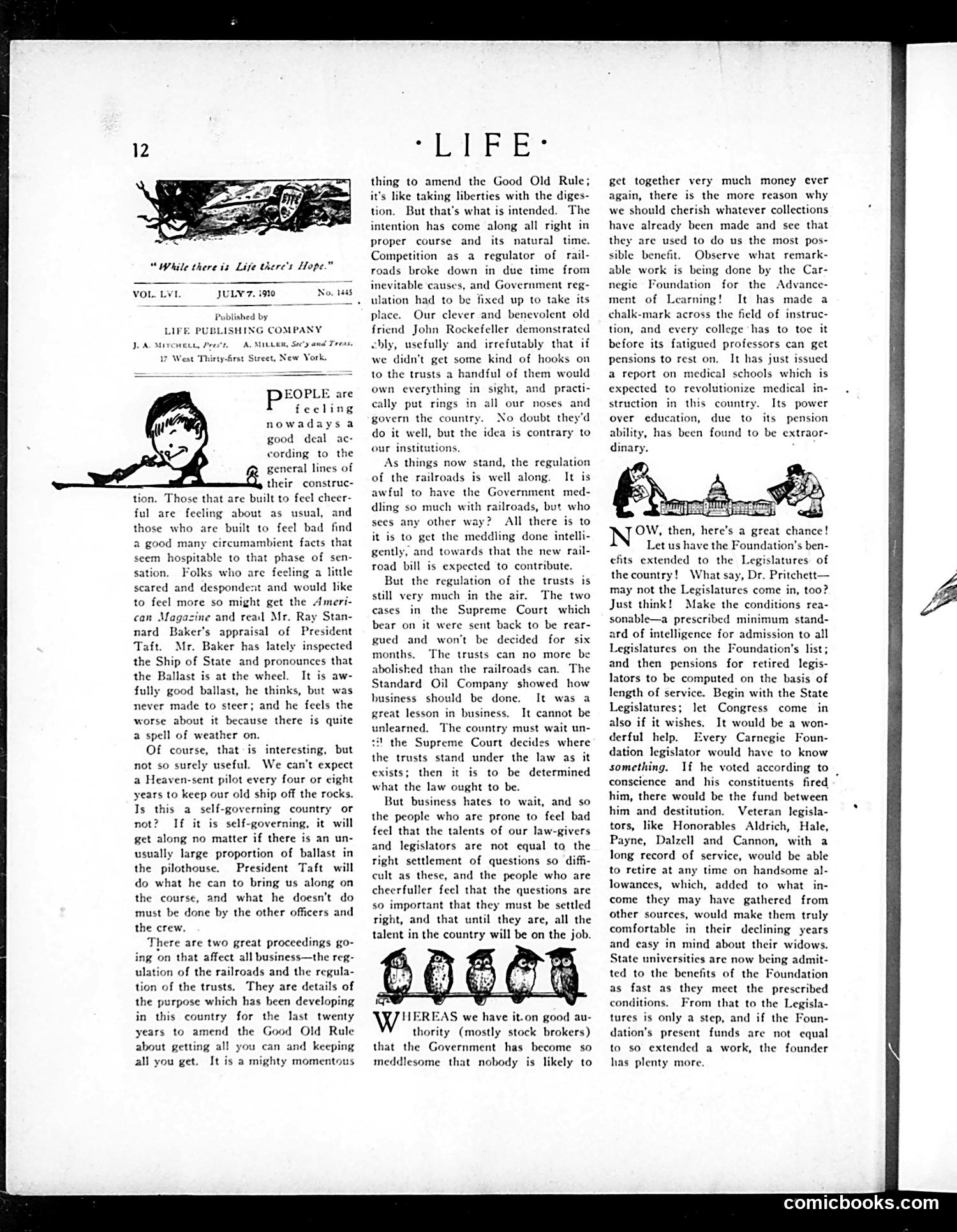
This page contains editorial commentary rather than political cartoons. The text discusses railroad regulation and trust reform under President Taft's administration. A small illustration shows five owl-like figures, appearing to represent corporate interests or "trusts" being scrutinized. The main argument advocates for the Carnegie Foundation to extend pensions to state university professors and legislators, positioning this as enlightened philanthropy benefiting education. The piece criticizes ongoing legal battles over trust regulation, suggesting the Supreme Court's indecision creates business uncertainty. The editors argue that established figures like Aldrich, Payne, and Dalzell should receive pension support for their legislative service. The satire targets both governmental inaction on trusts and the selective nature of philanthropic beneficence favoring the powerful.
📄 Transcribed text from this page (OCR, searchable)
Machine-transcribed from the original scan — historical spelling and the odd misread are preserved.
“While there is Life there's Hope.” VOL. LVI. JULY7. i910 Maas Published by LIFE PUBLISHING COMPANY JA Mircwett, Pratt A, MILLER, Sec'y and Treas, West Thirty-first Street, New York. EOPLE are fecling nowadays a good deal cording to the general lines of their construc- tion. Those that are built to feel cheer- ful are feeling about as usual, and those who are built to feel bad find a good many circumambient facts that seem hospitable to that phase of sen- sation. Folks who are feeling a little scared and despondent and would like to feel more so might get the Ameri- can Magazine and real Mr. Ray Stan- nard Baker’s appraisal of President Taft. Mr. Baker has lately inspected the Ship of State and pronounces that the Ballast is at the wheel. It is aw- fully good ballast, he thinks, but was never made to steer; and he feels the worse about it because there is quite a spell of weather on. Of course, that-is interesting, but not so surely useful. We can’t expect a Heaven-sent pilot every four or eight years to keep our old ship off the rocks. Is this a self-governing country or not? If it is self-governing, it will get along no matter if there is an un- usually large proportion of ballast in the pilothouse. President Taft will do what he can to bring us along on the course, and what he doesn’t do must be done by the other officers and the crew. There are two great proceedings go- ing on that affect all business—the reg- ulation of the railroads and the regula- tion of the trusts. They are details of the purpose which has been developing in this country for the last twenty years to amend the Good Old Rule about getting all you can and keeping all you get. It is a mighty momentous A IARAES: thing to amend the Good Old Rule; it’s like taking liberties with the dige tion, But that’s what is intended. The intention has come along all right in proper course and its natural time. Competition as a regulator of rail- roads broke down in due time from inevitable causes, and Government reg- ulation had to be fixed up to take its place. Our clever and benevolent old friend John Rockefeller demonstrated chly, usefully and irrefutably that if we didn’t get some kind of hooks on to the trusts a handful of them would own everything in sight, and. practi- cally put rings in all our noses and govern the country. No doubt they'd do it well, but the idea is contrary to our institutions. As things now stand, the regulation of the railroads is well along. It is awful to have the Government med- dling so much with railroads, but who sees any other way? All there is to it is to get the meddling done intelli- gently, and towards that the new rail- road bill is expected to contribute. But the regulation of the trusts is still very much in the air. The two cases in the Supreme Court which bear on it were sent back to be rear- gued and won't be decided for six months. The trusts can no more be abolisked than the railroads can. The Standard Oil Company showed how business should be done. It was a great lesson in business. It cannot be unlearned. The country must wait un- =! the Supreme Court decides where the trusts stand under the law as it exists; then it is to be determined t the law ought to be. But business hates to wait, and so the people who are prone to feel bad feel that the talents of our law-givers and legislators are not equal to the right settlement of questions so diffi- cult as these, and the people who are cheerfuller feel that the questions are so important that they must be settled right, and that until they are, all the talent in the country will be on the job. S we have it-on good au- thority (mostly stock brokers) that the Government has become so meddlesome that nobody is likely to get together very much money ever again, there is the more reason why we should cherish whatever collections have already been made and see that they are used to do us the most pos- sible benefit. Observe what remark- able work is being done by the Car- negic Foundation for the Advance- ment of Learning! It has made a chalk-mark across the field of instruc- tion, and every college has to toe it before its fatigued professors can get pensions to rest on. It has just issued a report on medical schools which is expected to revolutionize medical i struction in this country. Its power over education, due to its pension has been found to be extraor- OW, then, here’s a great chance! Let us have the Foundation’s ben- efits extended to the Legislatures of the country! What say, Dr. Pritchett— may not the Legislatures come in, too? Just think! Make the conditions rea- sonable—a prescribed minimum stand- ard of intelligence for admission to all Legislatures on the Foundation’s list; and then pensions for retired legis- lators to be computed on the basis of length of service. Begin with the State Legislatures; let Congress come in also if it wishes. It would be a won- derful help. Every Carnegie Foun- dation legislator would have to know something. If he voted according to conscience and his constituents fired him, there would be the fund between him and destitution. Veteran legisla- tors, like Honorables Aldrich, Hale, Payne, Dalzell and Cannon, with a long record of service, would be able to retire at any time on handsome al- lowances, which, added to what in- come they may have gathered from other sources, would make them truly comfortable in their declining years and casy in mind about their widows. State universities are now being admit- ted to the benefits of the Foundation as fast as they meet the prescribed conditions. From that to the Legisla- tures is only a step, and if the Foun- dation’s present funds are not equal to so extended a work, the founder has plenty more. comicbooks.com