
Life, 1910-07-07 · page 16 of 48
Life — July 7, 1910 — page 16: what you’re looking at
What you’re looking at
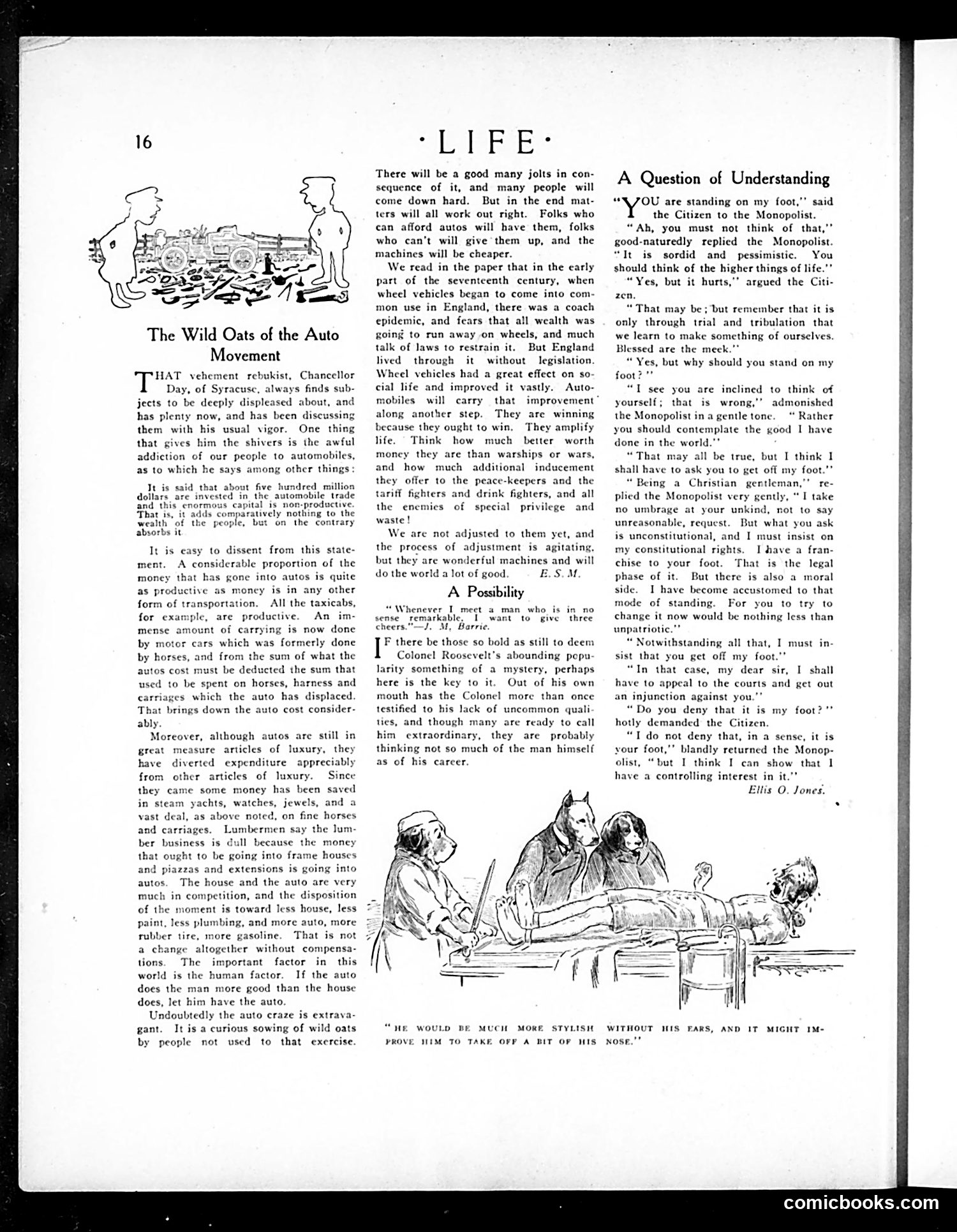
This page from *Life* magazine presents two distinct pieces of social commentary on early automobiles. **"The Wild Oats of the Auto Movement"** argues against Chancellor Day of Syracuse, who claimed cars represent wasteful spending. The author contends automobiles are productively equivalent to replaced horse-drawn carriages and function like transportation in general. The piece uses historical analogy—comparing auto "craze" to England's 17th-century coach epidemic—to argue society will naturally adjust. The satire's title suggests cars represent youthful excess that will ultimately prove beneficial. **"A Question of Understanding"** depicts a dialogue (likely involving Theodore Roosevelt, based on the Barrie quote about "uncommon qualities" and Roosevelt's famous populism) between a Citizen and Mongolian about standing on one's foot. The cartoon's caption suggests someone would be "more stylish" without ears—a crude joke about physical appearance. Both pieces reflect early-1900s anxiety about automotive technology as disruptive luxury while predicting eventual social acceptance.
📄 Transcribed text from this page (OCR, searchable)
Machine-transcribed from the original scan — historical spelling and the odd misread are preserved.
The Wild Oats of the Auto Movement HAT vehement rebukist, Chancellor Day, of Syracuse, always finds sub- jects to be deeply displeased about, and has plenty now, and has been discussing them with his usual vigor. One thing that gives him the shivers is the awful addiction of our people to automobiles, as to which he says among other things: It is said that about five hundred million dollars are invested in the automobile trade and this enormous capital is non-productive. That is, it adds comparatiy ly nothing to the wealth of the people, but on the contrary absorbs it It is easy to dissent from this state- ment. money as productive A considerable proportion of the that has gone into autos is quite as money is in any other form of transportation, All the taxicabs, for example, are productive. An im- mense amount of carrying is now done by motor cars which was formerly done by horses, and from the sum of what the autos cost must be deducted the sum that used to be spent on horses, harness and carriages which the auto has displaced That brings down the auto cost consider- ably. Moreover, although autos are still in great measure articles of luxury, they have diverted expenditure appreciably from other articles of luxury. Since they came some money has been saved in steam yachts, watches, jewels, and a vast deal, as above noted, on fine horses and carriages. Lumbermen say the lum- ber business is dull because the moncy that ought to be going into frame houses and piazzas and extensions is going into The house and the auto are very much in competition, and the disposition of the moment is toward less house, less paint, less plumbing, and more auto, more rubber tire, more gasoline. That is not a change altogether without compensa- tions. The important factor in this world is the human factor. If the auto does the man more good than the house does, let him have the auto. Undoubtedly the auto craze is extrava- gant. It is a curious sowing of wild oats by people not used to that exercise autos. “al lsBeE? There will be a good many jolts in con- sequence of it, and many people will come down hard. But in the end mat- ters will all work out right. Folks who can afford autos will have them, folks who can't will give them up, and the machines will be cheaper. We read in the paper that in the early part of the seventeenth century, when wheel vehicles began to come into com- mon use in England, there was a coach epidemic, and fears that all wealth was going to run away on wheels, and much talk of laws to restrain it. But England lived through it without legislation. Wheel vehicles had a great effect on so- cial life and improved it vastly. Auto- will carry that along another step. They are winning because they ought to win, They amplify life. Think how much better worth money they are than warships or wars, and how much additional inducement they offer to the peace-keepers and the tariff fighters and drink fighters, and all the en special privilege and waste! We are not adjusted to them yet, and the process of adjustment is agitating, but they are wonderful machines and will do the world a lot of good. B.S. M. mobiles ies of “Whenever T meet a man wh sense remarkable, I want to give cheers."—J. M, Barrie. three F there be those so bold as still to deem Colonel Roosevelt’s abounding popu- larity something of a mystery, perhaps here is the key to it. Out of his own mouth has the Colonel more than once testified to his lack of uncommon quali ties, and though many are ready to call him extraordinary, they are probably thinking not so much of the man himself as of his carcer. improvement’ A Question of Understanding “XY/OU are standing on my foot," said the Citizen to the Monopolist. “Ab, you must not think of that,”’ good-naturedly replied the Monopolist. “It is sordid and pessimistic. You should think of the higher things of life “Yes, but it hurts," argued the Citi- zen. “That may be; but remember that it is only through trial and tribulation that we learn to make something of ourselves. Blessed are the meck.”” “Yes, but why should you stand on my foot?" “I see you are inclined to think of yourself; that is wrong,’’ admonished the Monopolist in a gentle tone.“ Rather you should contemplate the good I have done in the world.”* “That may all be true, but I think I shall have to ask you to get off my foot.” “Being a Christian gentleman,’ re- plied the Monopolist very gently, “I take no umbrage at your unkind, not to say unreasonable, request. But what you ask is unconstitutional, and I must insist on my constitutional rights. I have a fran- chise to your foot. That is the legal phase of it. But there is also a moral jc. I have become accustomed to that mode of standing. For you to try to change it now would be nothing less than unpatriotic.” “ Notwithstanding all that, I must in- t that you get off my foot.” “In that case, my dear sir, I shall have to appeal to the courts and get out an injunction against you.”’ “Do you deny that it is my foot?" hotly demanded the Citizen “T do not deny that, in a sense, it is your foot," blandly returned the Monop- olist, “but I think I can show that 1 have a controlling interest in it.” Ellis O. Jones. ME WOULD BE MORE STYLISH PROVE IM TO TAKE OFF A BIT OF HIS mucH WITHOUT MIS FARS, AND NOSE. IT MIGHT IM- comicbooks.com