
Life, 1910-07-07 · page 26 of 48
Life — July 7, 1910 — page 26: what you’re looking at
What you’re looking at
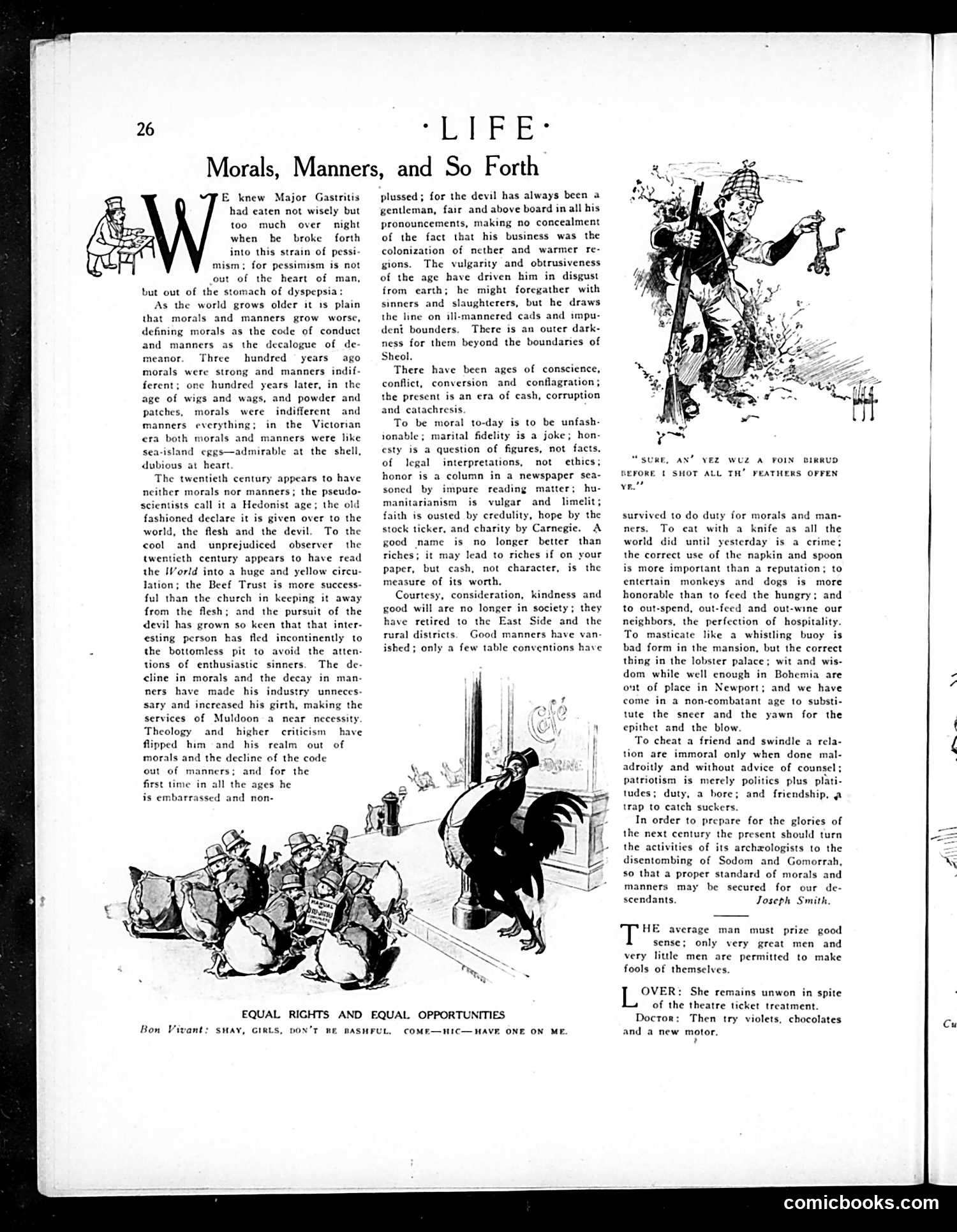
This *Life* magazine page satirizes early 20th-century American social decline through multiple angles. The main article, framed by a dyspeptic "Major Gastritis," argues that modern society (the "Hedonist age") has abandoned both morals and manners—a sharp reversal from previous centuries. The author laments that honor, honesty, and charity have been replaced by cash, corruption, and materialism. The cartoons reinforce this critique: one depicts the Devil himself fleeing earth, disgusted by modern rudeness and vulgarity—a darkly comic inversion suggesting society has become *worse* than evil itself. A second cartoon shows working-class figures, possibly mocking "equal rights and equal opportunities" rhetoric while illustrating class-based social divisions. The overall message: rapid modernization and capitalism have corroded traditional moral and social codes, leaving only shallow materialism and bad manners behind.
📄 Transcribed text from this page (OCR, searchable)
Machine-transcribed from the original scan — historical spelling and the odd misread are preserved.
E knew Major Gastritis had eaten not wisely but too much over night when be broke forth into this strain of pessi mism ; for pessimism is not out of the heart of man, but out of the stomach of dyspepsia: As the world grows older it 1s plain that morals and manners grow worse, defining morals as the code of conduct and manners as the decalogue of de meanor. Three hundred years ago morals were strong and manners indif- ferent; one hundred years later, in the age of wigs and wags, and powder and patches, morals were indifferent and manners everything; in the Victorian era both morals and manners were like sea-island eggs—admirable at the shell, dubious at heart The twentieth century appears to have neither morals nor manners; the pseudo- scientists call it a Hedonist age; the old fashioned declare it is given over to the world, the flesh and the devil. To the cool and unprejudiced observer the twentieth century appears to have read the World into a huge and yellow circu- lation; the Beef Trust is more success- ful than the church in keeping it away from the flesh; and the pursuit of the devil has grown so keen that that inter- esting person has fled incontinently to the bottomless pit to avoid the atten- tions of enthusiastic sinners. The de- cline in morals and the decay in man- ners have made his industry unneces- sary and increased his girth, making the services of Muldoon a near necessi Theology and higher criticism have flipped him and his realm out of morals and the decline of the code out of manners; and for the first time in all the ages he is embarrassed and non- EQUAL RIGHTS AND EQUAL OPPORTU? Bon Vivant: sway, GIRLS, DON’T RE DASHFUL. “AEE Morals, Manners, and So Forth plussed; for the devil has always been a gentleman, fair and above board in all his pronouncements, making no concealment of the fact that his business was the colonization of nether and warmer te- gions. The vulgarity and obtrusiveness of the age have driven him in disgust from earth; he might foregather with sinners and slaughterers, but he draws the line on ill-mannered cads and impu- dent bounders. There is an outer dark- ness for them beyond the boundaries of Sheol. There have been ages of conscience, conflict, conversion and conflagration; the present is an era of cash, corruption and catachresis To be moral to-day is to be unfash- ionable; marital fidelity is a joke; hon- esty is a question of figures, not facts, of legal interpretations, not ethics; honor is a column in a newspaper sea- soned by impure reading matter; hu- manitarianism is vulgar and limelit; faith is ousted by credulity, hope by the ‘ock ticker, and charity by Carnegie. A good name is no longer better than riches; it may lead to riches if on your paper, but cash, not character, is the measure of its worth. Courtesy, consideration, kindness and good will are no longer in society; they have retired to the East Side and the rural districts. Good manners have van- ished; only a few table conventions have COME—MNIC—MAVE ONE ON ME. “SURE, AN’ YEZ WUZ A POIN BIRRUD REFORE { SMOT ALL TH’ FEATHERS OFFEN ve? survived to do duty for morals and man- ners, To eat with a knife as all the world did until yesterday is a crime; the correct use of the napkin and spoon is more important than a reputation; to entertain monkeys and dogs is more honorable than to feed the hungry; and to out-spend, out-feed and out-wine our neighbors, the perfection of hospitality. To masticate like a whistling buoy is bad form in the mansion, but the correct thing in the lobster palace; wit and wis- dom while well enough in Bohemia are out of place in Newport; and we have come in a non-combatant age to substi- tute the sneer and the yawn for the epithet and the blow. To cheat a friend and swindle a rela- tion are immoral only when done mal- adroitly and without advice of counsel; patriotism is merely politics plus plati- tudes; duty, a bore; and friendship, a trap to catch suckers. In order to prepare for the glories of the next century the present should turn the activities of its archzologists to the disentombing of Sodom and Gomorrah, so that a proper standard of morals and manners may be secured for our de- scendants. Joseph Smith. HE average man must prize good sense; only very great men and very little men are permitted to make fools of themselves. LovER: She remains unwon in spite of the theatre ticket treatment. Doctor: Then try violets, chocolates and a new motor. comicbooks.com QQ