
Life, 1910-07-07 · page 28 of 48
Life — July 7, 1910 — page 28: what you’re looking at
What you’re looking at
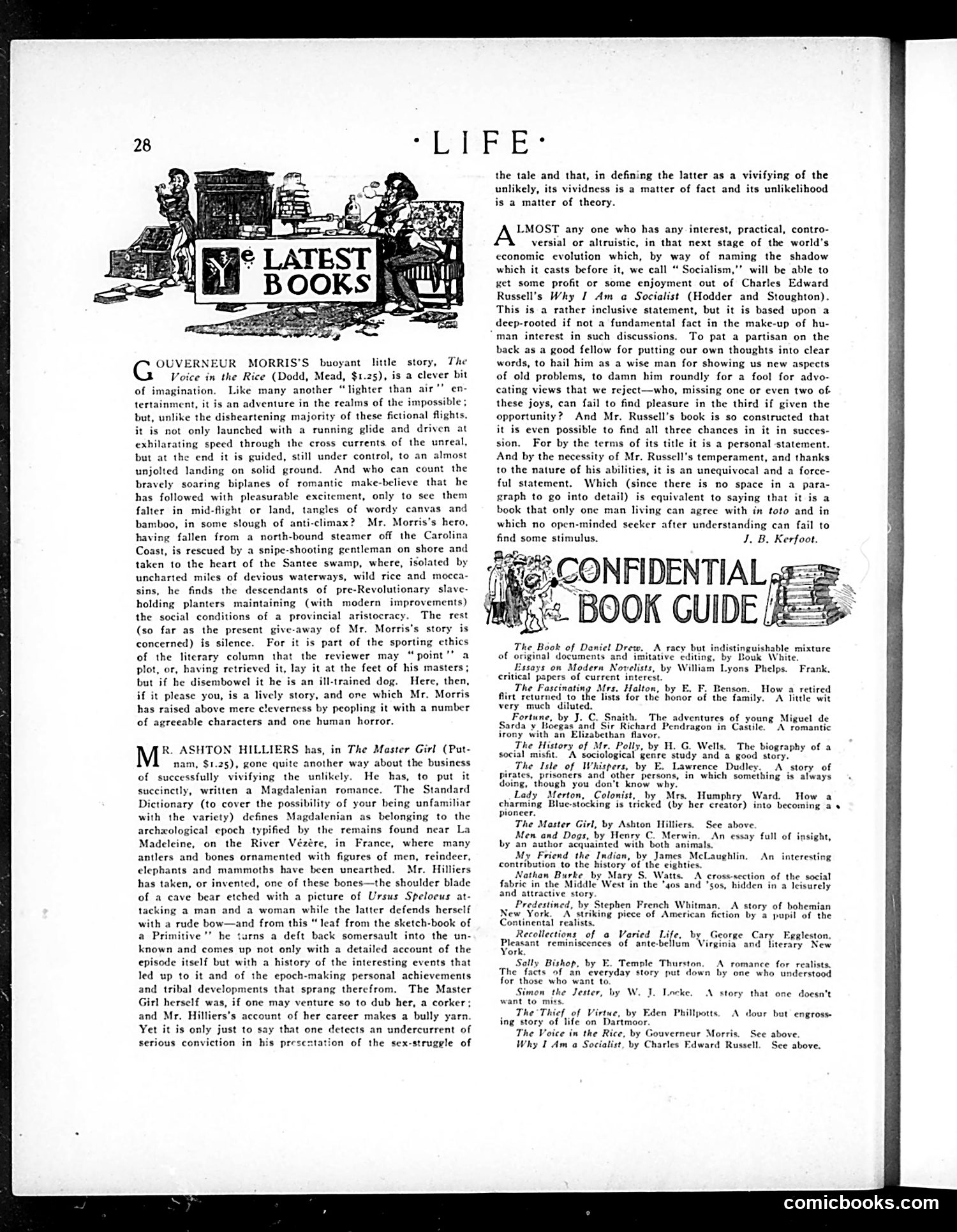
This page contains book reviews rather than political cartoons. The "Latest Books" header features a decorative illustration of people surrounded by books, but the content is primarily critical commentary on three novels. The reviews discuss: 1. **Governor Morris's "The Voice in the Rice"** — praised as an imaginative adventure story set in a South Carolina swamp among descendants of pre-Revolutionary aristocratic planters. 2. **Ashton Hilliers's "The Master Girl"** — a prehistoric romance based on a cave-bear bone carving from La Madeleine, France, with an undercurrent about gender conflict ("sex-struggle"). 3. **Charles Edward Russell's "Why I Am a Socialist"** — a work on economic evolution and socialism. The page also advertises a "Confidential Book Guide" listing additional titles. This is a typical early-20th-century literary criticism page, not satire or political cartooning.
📄 Transcribed text from this page (OCR, searchable)
Machine-transcribed from the original scan — historical spelling and the odd misread are preserved.
Ge sll cl slat OUVERNEUR MORRIS'S buoyant little story, The Voice in the Rice (Dodd, Mead, $1.25), is a clever bit of imagination. Like many another “lighter than air’? en- tertainment, it is an adventure in the realms of the impossible; but, unlike the disheartening majority of these fictional flights. it is not only launched with a running glide and driven at exhilarating speed through the cross currents of the unreal, but at the end it is guided, still under control, to an almost unjolted landing on solid ground. And who can count the bravely soaring biplanes of romantic make-believe that he has followed with pleasurable excitement, only to sce them falter in mid-flight or land, tangles of wordy canvas and bamboo, in some slough of anti-climax? Mr. Morris's hero, having fallen from north-bound steamer off the Carolina Coast, is rescued by a snipe-shooting gentleman on shore and taken to the heart of the Santee swamp, where, isolated by uncharted miles of devious waterways, wild rice and mocca- he finds the descendants of pre-Revolutionary slave- holding planters maintaining (with modern improvements) the social conditions of a provincial aristocracy. The rest (so far as the present give-away of Mr. Morris's story is concerned) is silence. For it is part of the sporting ethics of the literary column that the reviewer may “ point’? a plot, or, having retrieved it, lay it at the feet of his masters ; but if he disembowel it he is an ill-trained dog. Here, then, if it please you, is a lively story, and one which Mr. Morris has raised above mere cleverness by peopling it with a number of agreeable characters and one human horror. M* ASHTON HILLIERS has, in The Master Girl (Put- nam, $1.25), gone quite another way about the business of successfully vivifying the unlikely. He has, to put it succinctly, written a Magdalenian romance. The Standard Dictionary (to cover the possibility of your being unfamiliar with the variety) defines Magdalenian as belonging to the archxological epoch typified by the remains found near La Madeleine, on the River Vézére, in France, where many antlers and bones ornamented with figures of men, reindeer, elephants and mammoths have been unearthed. Mr. Hilliers has taken, or invented, one of these bones—the shoulder blade of a cave bear etched with a ture of Ursus Speloeus at- tacking a man and a woman while the latter defends herself with a rude bow—and from this “leaf from the sketch-book of a Primitive’ he turns a deft back somersault into the un- known and comes up not only with a detailed account of the episode itself but with a history of the interesting events that led up to it and of the epoch-making personal achievements and tribal developments that sprang therefrom. The Master Girl herself was, if one may venture so to dub her, a corker; and Mr. Hilliers’s account of her career makes a bully yarn. Yet it is only just to say that one detects an undercurrent of serious conviction in his presentation of the sex-struggle of the tale and that, in defining the latter as a vivifying of the unlikely, its vividness is a matter of fact and its unlikelihood is a matter of theory. A LMOST any one who has any interest, practical, contro- versial or altruistic, in that next stage of the world’s economic evolution which, by way of naming the shadow which it casts before it, we call “ Socialism,"’ will be able to get some profit or some enjoyment out of Charles Edward Russell's Why J Am a@ Socialist (Hodder and Stoughton). This is a rather inclusive statement, but it is based upon a deep-rooted if not a fundamental fact in the make-up of hu- man interest in such discussions. To pat a partisan on the back as a good fellow for putting our own thoughts into clear words, to hail him as a wise man for showing us new aspects of old problems, to damn him roundly for a fool for advo- cating views that we reject—who, missing one or even two of these joys, can fail to find pleasure in the third if given the opportunity? And Mr. Russell’s book is so constructed that it is even possible to find all three chances in it in succes- sion. For by the ternis of its title it is a personal statement. And by the necessity of Mr. Russell's temperament, and thanks to the nature of his abilities, it is an unequivocal and a force- ful statement. Which (since there is no space in a para graph to go into detail) is equivalent to saying that it is a book that only one man living can agree with in toto and in which no open-minded seeker after understanding can fail to find some stimulus. J. B. Kerfoot. éONFIDENTIAL << BOOK GUIDE The Book of Daniel Drew. A racy but indistinguishable mixture of original documents and imitative editing, by Bouk White. _ Essays on Modern Novelists, by William Lyons Phelps. critical papers of current interest. The Fascinating Mrs. Halton, by E. F. Benson. How a retired flirt returned to the lists for the honor of the family. A little wit very much diluted. Fortune, by J. C. Snaith. The adventures of young Miguel de Sarda y Moegas and Sir Richard Pendragon in Castile. A romantic irony with an Elizabethan flavor. The History of Mr. Polly, by H. G. Wells. The biography of a social misfit. A sociological genre study and a good story. The Isle of Whispers, by E. Lawrence Dudley. A story of pirates, prisoners and other persons, in which something is always doing, though you don’t know why. Lady Merton, Colonist, by Mrs. Humphry Ward. How a charming Blue-stocking is tricked (by her creator) into becoming a pioneer. The Master Girl, by Ashton Hilliers. See above. Men and Dogs, by Henry C. Merwin, An essay full of insight, by an author acquainted with both animals. My Friend the Indian, by James McLauel contribution to the history of the eighties Nathan Burke by Mary S. Watts. A cross-section of the social fabric in the Middle West in the "4os and "sos, hidden in a leisurely and attractive story ._ Predestined, by Stephen French Whitman. A story of bohemian New York. A’ striking piece of American fiction by a pupil of the Continental realists. Recollections of @ Varied Life, by, George Cary Eggleston. Pleasant reminiscences of ante-bellim Virginia and hterary New ork. _, Sally Bishop, by E. Temple Thurston. A romance for realists. The facts of an everyday story put down by one who understood for those who want to. Simon the Jester, by W. J. Locke want to miss. The Thief of Virtue, by Eden Phillpotts ing story of life on Dartmoor. The Voice in the Rice, by Gouverneur Morris. See above. Why I Am a Socialist, by Charles Edward Russell. Sce above. rere | Frank, An interesting A story that one doesn’t A dour but engross comicbooks.com