
Life, 1910-07-07 · page 5 of 48
Life — July 7, 1910 — page 5: what you’re looking at
What you’re looking at
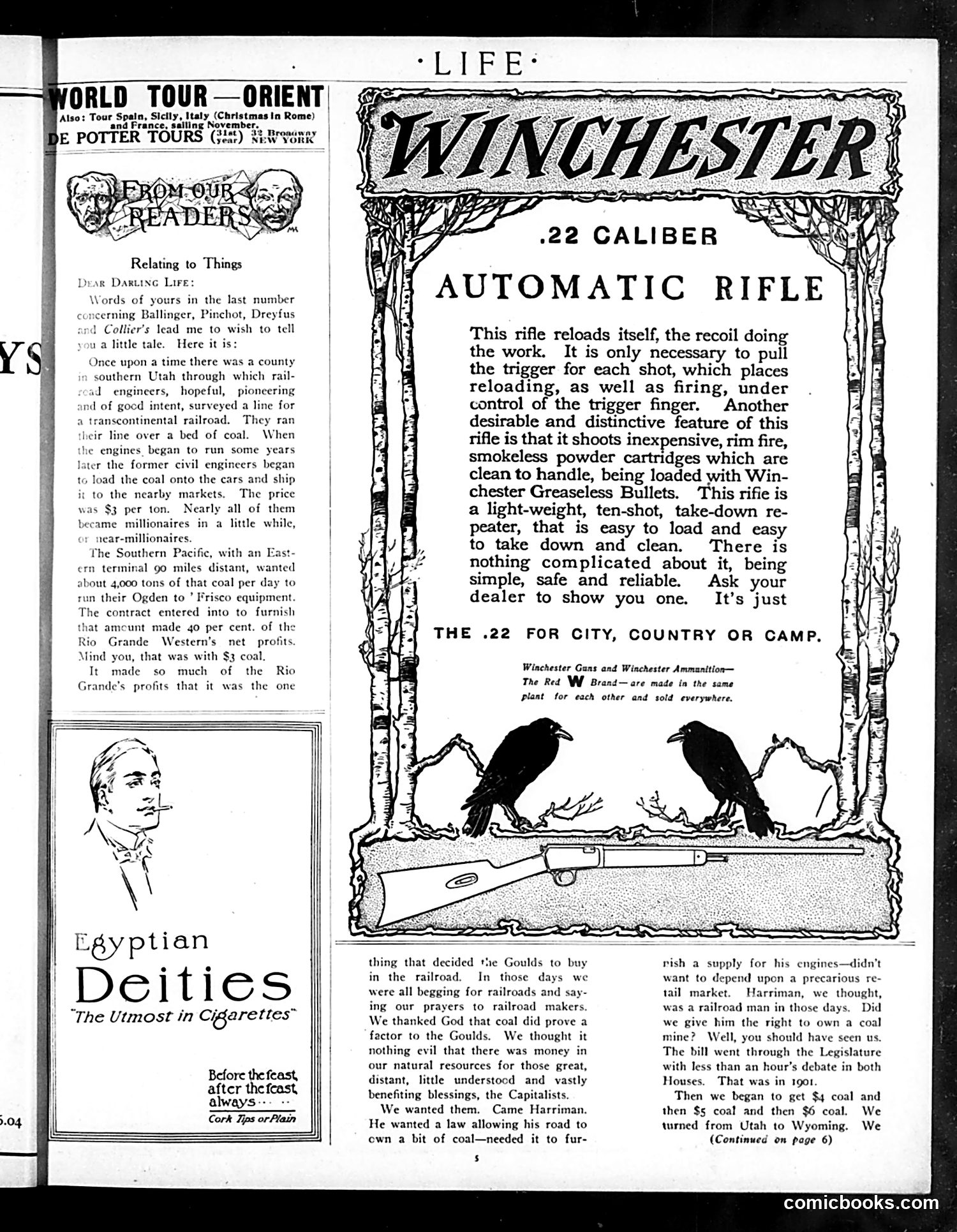
This page is primarily **advertising, not satire or editorial content**. The right side features a Winchester .22 caliber automatic rifle advertisement, using decorative art-nouveau framing with birds perched on branches above the rifle. The text emphasizes the weapon's simplicity and reliability for "city, country or camp" use. The left side contains two distinct sections: a "From Our Readers" column discussing railroad economics and the Goulds (a wealthy industrialist family), and an advertisement for "Egyptian Deities" cigarettes below. Neither element appears to be political satire. The reader column discusses 19th-century railroad history factually, while the cigarette ad simply uses Egyptian imagery as a branding device. This is a typical early 20th-century magazine page mixing reader correspondence, product advertisements, and commercial messaging.
📄 Transcribed text from this page (OCR, searchable)
Machine-transcribed from the original scan — historical spelling and the odd misread are preserved.
ORLD TOUR —ORIENT) Also: Tour Spain, Sicily, Italy (Christmas in Rome) and France, sailing November. TOURS Gi! Relating to Things ag Dartinc Lire: ords of yours in the last number ning Ballinger, Pinchot, Dreyfus and Collier's lead me to wish to tell you a little tale. Here it is: Once upon a time there was a county 9 southern Utah through which rail- ad engineers, hopeful, pioneering 1 of gocd intent, surveyed a line for a nscontinental railroad. They ran heir line over a bed of coal. When the engines. began to run some years later the former civil engineers began to load the coal onto the cars and ship it to the nearby market The price was $3 per ton. Nearly all of them became millionaires in a little while, near-millionaires. The Southern Pacific, with an East- ern terminal 90 miles distant, wanted about 4,000 tons of that coal per day to run their Ogden to ’ Frisco equipment. The contract entered into to furnish that amount made 4o per cent. of the Rio Grande Western's net profits. Mind you, that was with $3 coal, It made so much of the Rio Grande’s profits that it was the one This rifle reloads itself, the recoil doing the work. It is only necessary to pull the trigger for each shot, which places reloading, as well as firing, under control of the trigger finger. Another desirable and distinctive feature of this rifle is that it shoots inexpensive, rim fire, smokeless powder cartridges which are clean to handle, being loaded with Win- chester Greaseless Bullets. This rifie is a light-weight, ten-shot, take-down re- peater, that is easy to load and easy to take down and clean. There is nothing complicated about it, being Egyptian Deities “The Utmost in Cigarettes” Before thefeast, after thefeast always::: - Cork Tips or Plain simple, safe and reliable. Ask your dealer to show you one. It’s just THE .22 FOR CITY, COUNTRY OR CAMP. Winchester Guns and Winchester Ammanition— The Red Wi Brand—are made in the same plant for each other and sold everywhere. thing that decided the Goulds to buy in the railroad. In those days we were all begging for railroads and say- ing our prayers to railroad makers. We thanked God that coal did prove a factor to the Goulds. We thought it nothing evil that there was money in our natural resources for those great, distant, little understocd and vastly benefiting blessings, the Capitalists. We wanted them. Came Harriman. He wanted a law allowing his road to own a bit of coal—needed it to fur- s rish a supply for his engines—didn't want to depend upon a precarious re- tail market. Harriman, we thought, was a railroad man in those days. Did we give him the right to own a coal mine? Well, you should have seen us. The bill went through the Legislature with less than an hour’s debate in both Houses. That was in 1901. Then we began to get $4 coal and then $s coal and then $6 coal. We turned from Utah to Wyoming. We (Continued on page 6) comicbooks.com