
Life, 1910-07-07 · page 32 of 48
Life — July 7, 1910 — page 32: what you’re looking at
What you’re looking at
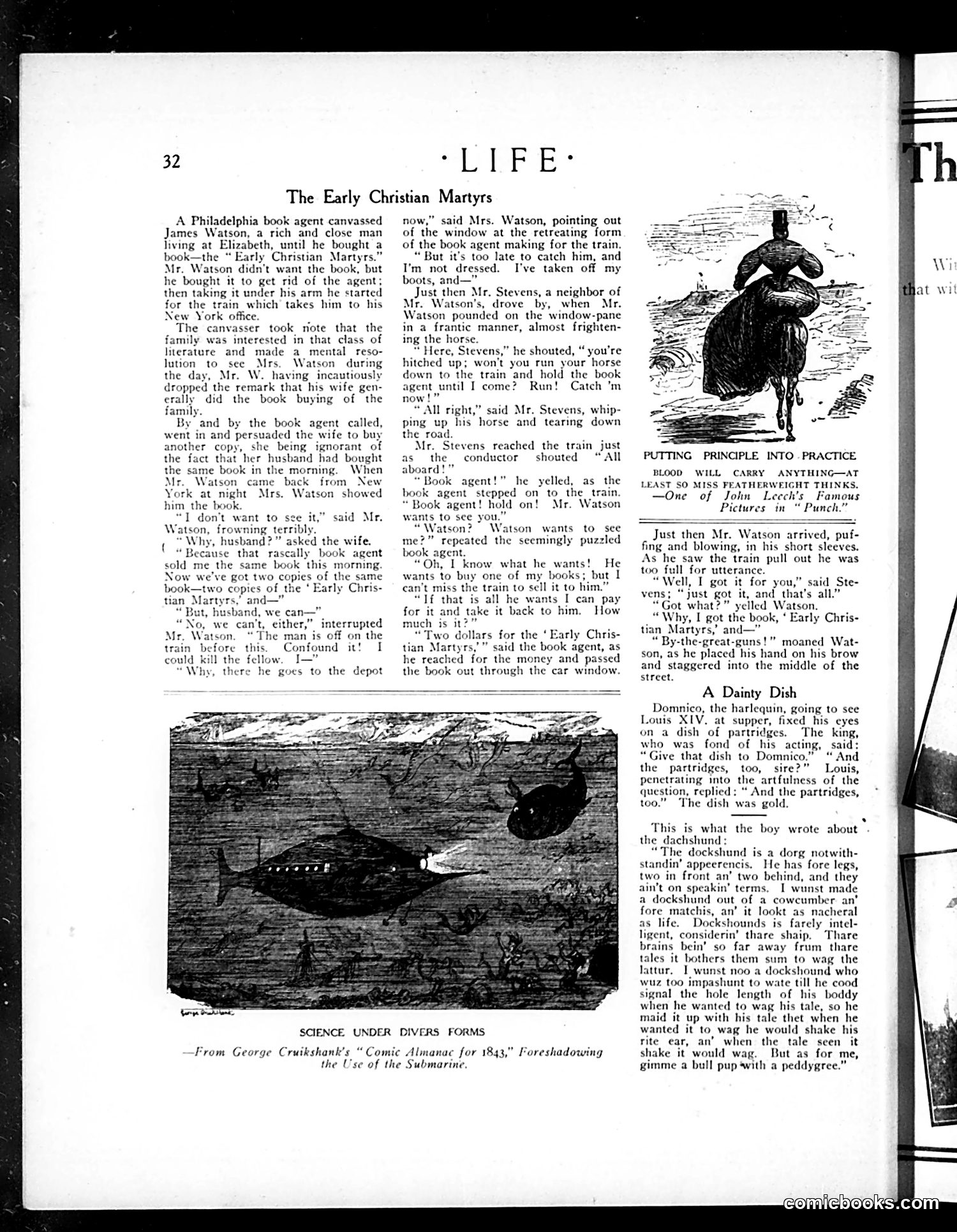
This humor piece satirizes the pushy door-to-door book sales tactics of the era. A Philadelphia book agent sells James Watson an unwanted copy of "The Early Christian Martyrs." Later, the agent deceives Watson's wife into buying the *same book*, unaware her husband already purchased it. When Watson discovers the duplication, he's enraged—not at the waste, but at being bamboozled twice by the same agent. His fury escalates absurdly: he chases the agent to the train station, even recruiting a neighbor to intercept him. The final irony: the neighbor succeeds in catching the agent, who casually sells Watson a *third copy* for two dollars before boarding the train. The satire mocks both aggressive salesmanship and the gullibility of wealthy but stingy customers like Watson, whose desperation to punish the agent leads him into the very trap he sought to avoid. It's a period piece capturing early commercial consumer anxiety.
📄 Transcribed text from this page (OCR, searchable)
Machine-transcribed from the original scan — historical spelling and the odd misread are preserved.
32 “LP iE * The Early Christian Martyrs A Philadelphia book agent canvassed James Watson, a rich and close man living at Elizabeth, until he bought a book—the rly Christian Martyrs.” Mr. Watson didn’t want the book, but he bought it to get rid of the agent; then taking it under his arm he started for the train which takes him to his New York office. The canvasser took note that the family was interested in that class of literature and made a mental reso- lution to see Mrs. Watson during the day, Mr. W. having incautiously dropped the remark that his wife gen- erally did the book buying of the family. By and by the book agent called, went in and persuaded the wife to buy another copy, she being ignorant of the fact that her husband had bought the same book in the morning. When Mr. Watson came back from New York at night Mrs. Watson showed him the book. “I don’t want to see it,” said Mr. Watson, frowning terribly. { “Why, husband?” asked the wife. “Because that rascally book agent sold me the same book this morning. Now we've got two copies of the same book—two copies of the ‘ Early Chris- tian Martyrs,’ and—” “But, husband, we can—' we can't, either,” interrupted The man is off on the train before this. Confound it! I could kill the fellow. I—” “Why, there he goes to the depot Mr. Watson now,” said Mrs. Watson, pointing out of the window at the retreating form of the book agent making for the train, “ But it’s too late to catch him, and I'm not dressed. I've taken off my boots, and—” Just then Mr. Stevens, a neighbor of Mr. Watson's, drove by, when Mr. Watson pounded on the window-pane in a frantic manner, almost frighten- ing the horse. “ Here, Stevens,” he shouted, “ you're hitched up; won't you run your horse down to the train and hold the book agent until I come? Run! Catch 'm now!” All right,” said Mr. Stevens, whip- ping up his horse and tearing down the road. Mr. Stevens reached the train just as the conductor shouted “All aboard! “Book agent!" he yelled, as the book agent stepped on to the train. “Book agent! hold on! Mr. Watson wants to sce you.” “Watson? Watson wants to sce me?” repeated the seemingly puzzled book agent. “Oh, | know what he wants! He wants to buy one of my books; but I can't miss the train to sell it to him.” “If that is all he wants I can pay for it and take it back to him. How much is it?” Two dollars for the ‘Early Chris- tian Martyrs,” said the book agent, as he reached for the money and passed the book out through the car window. SCIENCE UNDER DIVERS FORMS From George Cruikshank’s “Comic Almanac for 1843,” Foreshadowing the Use of the Submarine. PUTTING PRINCIPLE INTO PRACTICE BLOOD Ww) CARRY ANYTHING—. LEAST SO MI: EATHERWEIGHT T. —One of John Leech's mous Pictures in“ Punch.” Just then Mr. Watson arrived, puf- fing and blowing, in his short sleeves. As he saw the train pull out he was too full for utterance. “Well, I got it for you,” vens; “just got it, and that’ t what?” yelled Watson. “Why, I got the book, ‘ Early Chris- tian Martyrs,’ and—” “ By-the-great-guns!" moaned Wat- son, as he placed his hand on his brow and staggered into the middle of the street. A Dainty Dish Domnico, the harlequin, going to see Louis XIV. at supper, fixed his eyes on a dish of partrid, The king, who was fond of his acting, sai “Give that dish to Domnico.” “ And the partridges, too, sire?” Louis, penetrating into the artfulness of the question, replied: “ And the partridges, too.” The dish was gold, aid Ste- all.” This is what the boy wrote about the dachshund ; The dockshund is a dorg notwith- standin’ appeerencis. He has fore legs, two in front an’ two behind, and they ain’t on speakin’ terms. I wunst made a dockshund out of a cowcumber an’ fore matchis, an’ it lookt as nacheral as life. Dockshounds is farely intel- ligent, considerin’ thare shaip. Thare brains bein’ so far away frum thare tales it bothers them sum to wag the Jattur, I wunst noo a dockshound who wuz too impashunt to wate till he cood signal the hole length of his boddy when he wanted to wag his tale, so he maid it up with his tale thet when he wanted it to wag he would shake his rite ear, an’ when the tale seen it shake it would wag. But as for me, gimme a bull pup with a peddygree.”