
A complete issue · 36 pages · 1910
Life — January 27, 1910
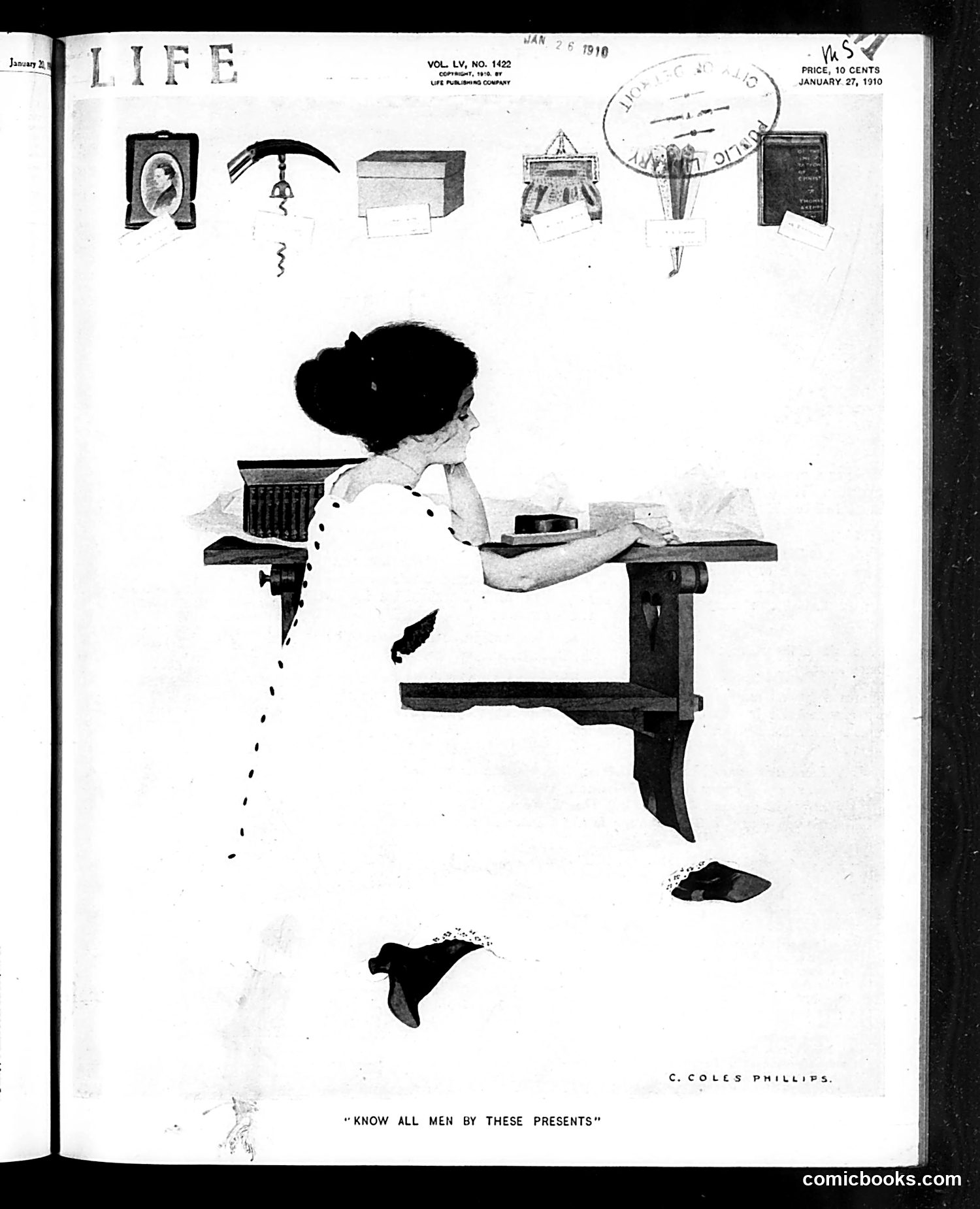
This satirical illustration by C. Coles Phillips depicts a woman at a desk with various objects scattered around—appearing to represent gifts or "presents." The caption reads "Know All Men By These Presents," a legal phrase typically used in official documents. The satire appears to target gift-giving customs, possibly related to courtship or marriage. The woman's posture—relaxed and examining items—suggests she's evaluating suitors' offerings. The scattered objects likely represent different types of men or their characteristics, playing on the double meaning of "presents" (gifts versus male suitors). This reflects early 1900s social commentary about women's choices in marriage and dating practices, presented through Phillips's characteristic elegant illustration style.
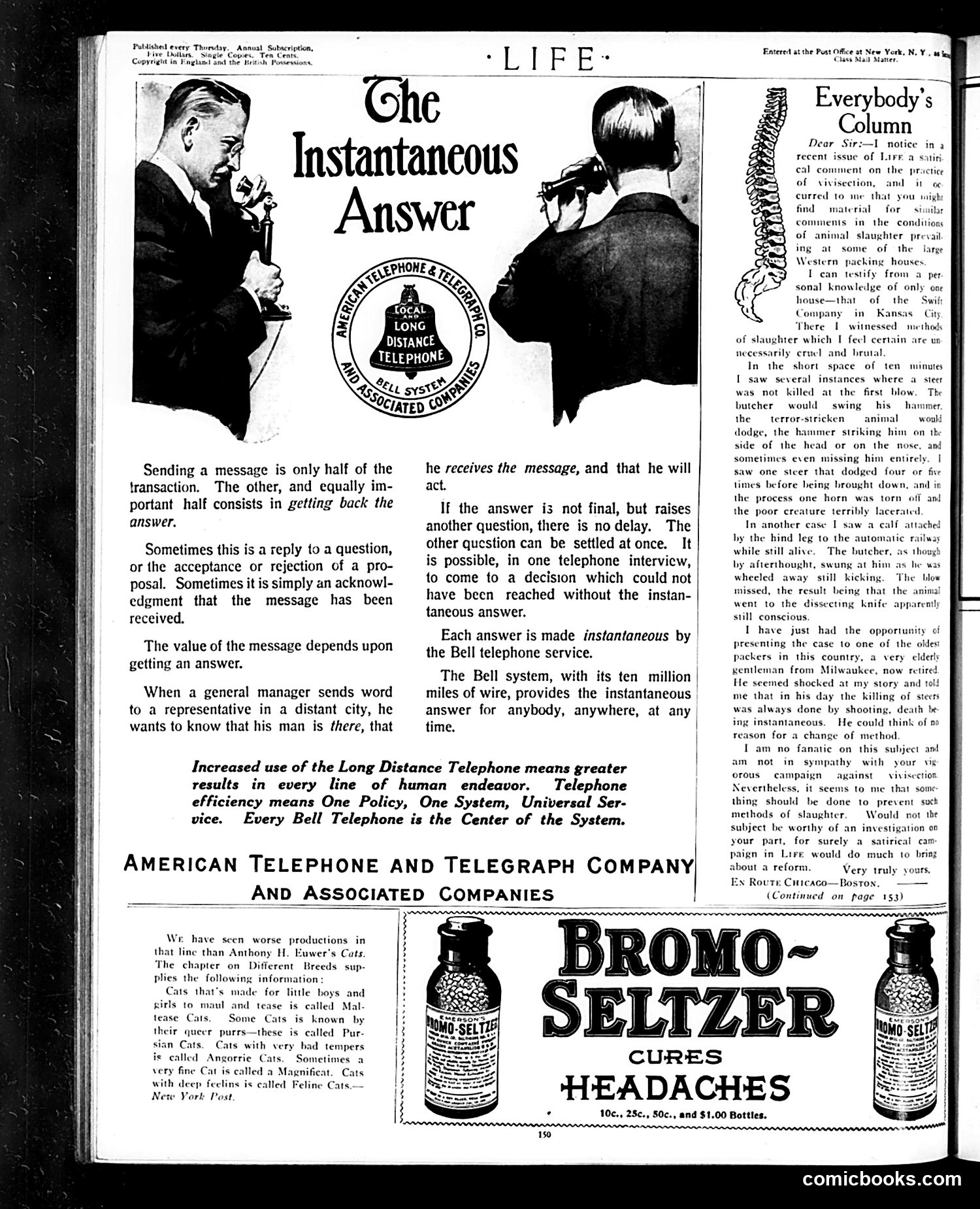
This page is primarily a **corporate advertisement** for American Telephone and Telegraph Company (AT&T), not satire. The illustration shows two businessmen using long-distance telephone service—one sending a message, the other receiving it. The advertisement's central point is that "getting back the answer" is equally important as sending the initial message. It argues that AT&T's telephone network enables instantaneous two-way communication across distances, allowing managers to conduct business efficiently without delay. The accompanying text emphasizes the Bell system's reliability and reach (ten million miles of wire). A secondary element is a consumer product ad for Bromo-Seltzer headache remedy. This represents early 20th-century corporate messaging promoting telephone adoption as essential business infrastructure.
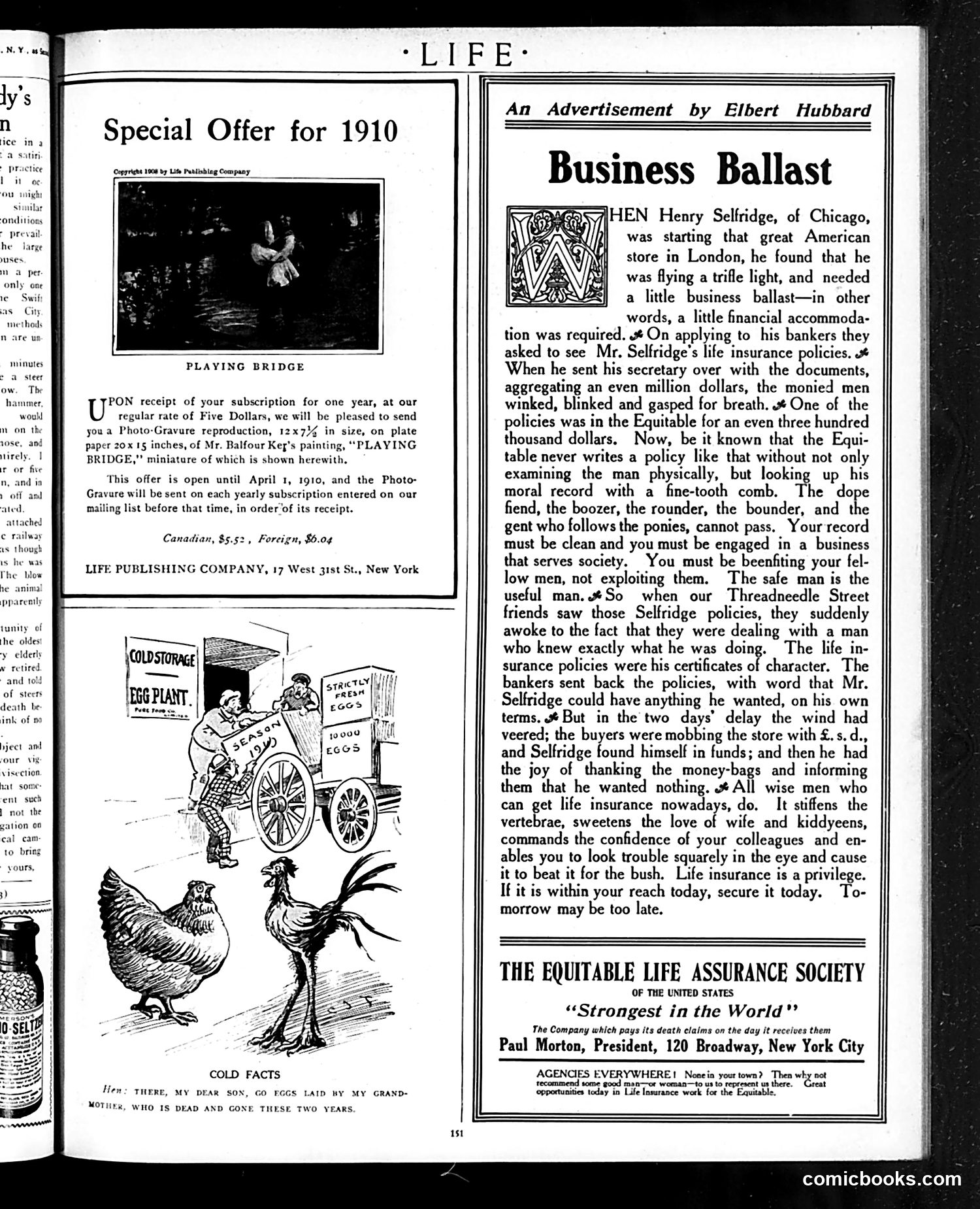
This page contains two separate items: **Left side:** A subscription offer for a photo-gravure reproduction of a painting titled "Playing Bridge," accompanied by a cartoon titled "Cold Facts" featuring poultry and a cart labeled with egg storage references. The cartoon appears to be a visual pun about eggs and practical matters, though the specific satirical point is unclear from the image alone. **Right side:** An advertisement for life insurance by the Equitable Life Assurance Society, featuring a narrative about Henry Selfridge (the famous Chicago department store founder) securing business financing. The ad argues that life insurance provides financial security and moral respectability for businessmen—a pitch emphasizing insurance as essential to professional credibility and family welfare. Both items reflect early-1900s commercial messaging and attitudes toward business and financial security.
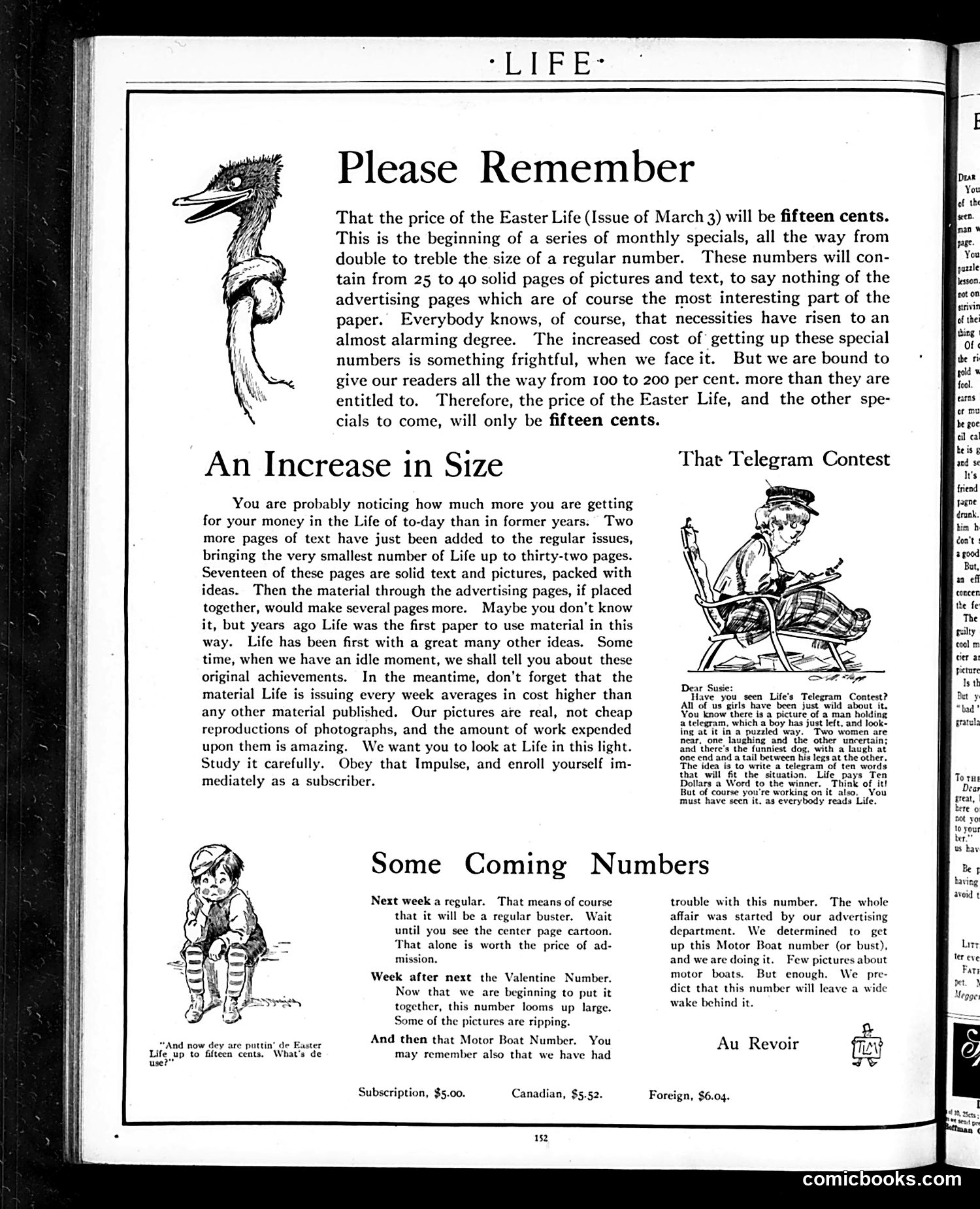
This page contains **publisher announcements rather than political satire**. The main content promotes upcoming special issues and subscription details for *Life* magazine, circa early 20th century. Key elements: - **"Please Remember"**: Announces the Easter Life issue (March 3) will cost fifteen cents—part of a monthly special series offering 25-40 pages, double to triple regular size - **"An Increase in Size"**: Explains *Life* now contains more pages than before, featuring original pictures rather than cheap reproductions - **Cartoon illustrations**: A simple line drawing of a child and an ostrich serve as decorative elements - **"That Telegram Contest"**: References a reader puzzle or competition The page focuses on circulation and product promotion rather than satirical commentary on current events or politics.
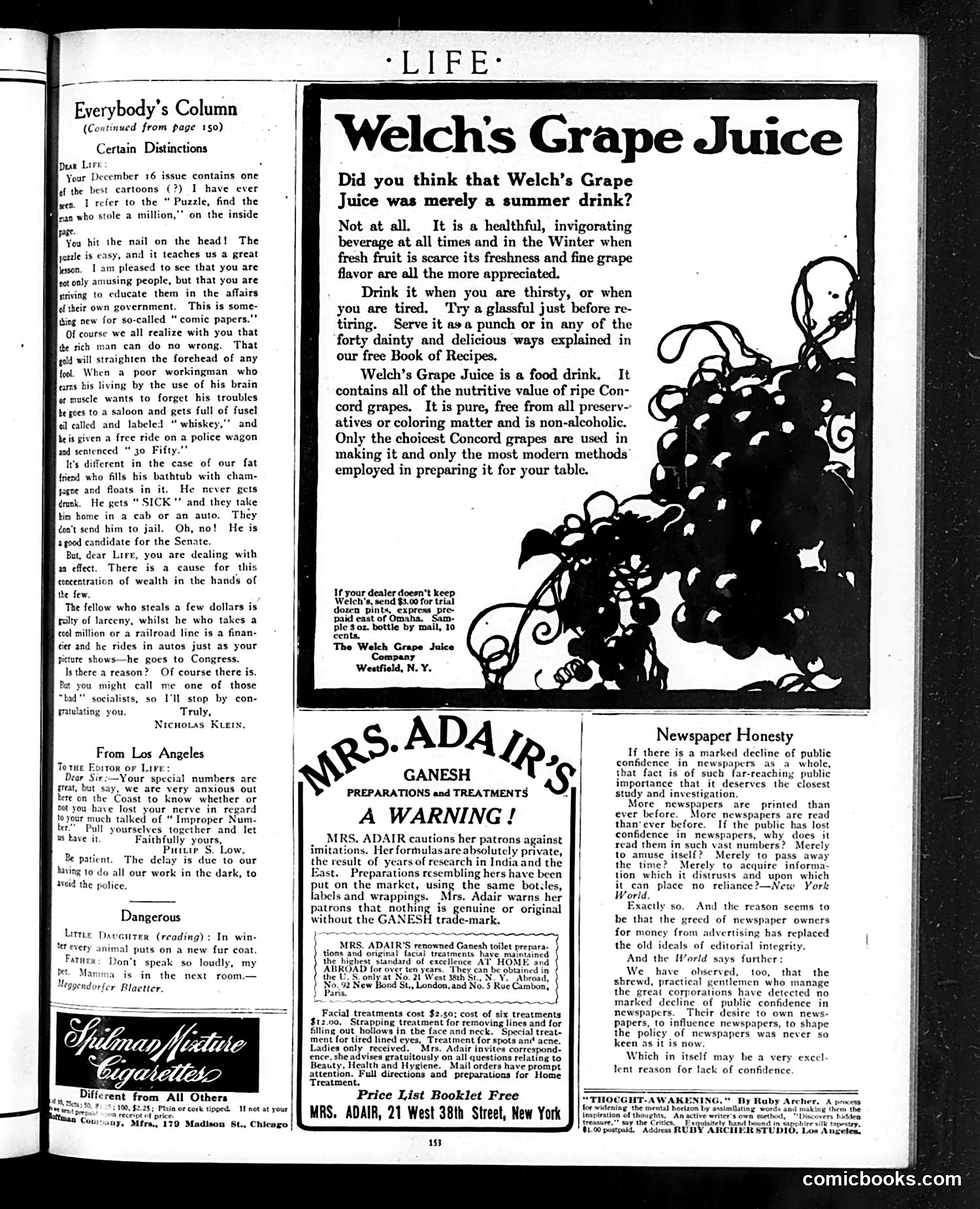
This page is primarily **advertising and editorial content** rather than political satire. The dominant feature is a **Welch's Grape Juice advertisement** with an illustrated bunch of grapes. The ad promotes grape juice as a year-round healthful beverage, not merely a summer drink, emphasizing its nutritive value and purity. The left column contains **"Everybody's Column,"** reader letters addressing various topics: a puzzle contest, Senate elections, and wealth distribution—standard editorial fare. Additional advertisements appear for **Mrs. Adair's beauty treatments** and **Spilman Mixture cigarettes**. There's a brief piece on **"Newspaper Honesty"** discussing public confidence in journalism. Overall, this is a typical early 20th-century magazine page mixing light reader commentary with commercial advertising, lacking significant political cartoon content or satire.
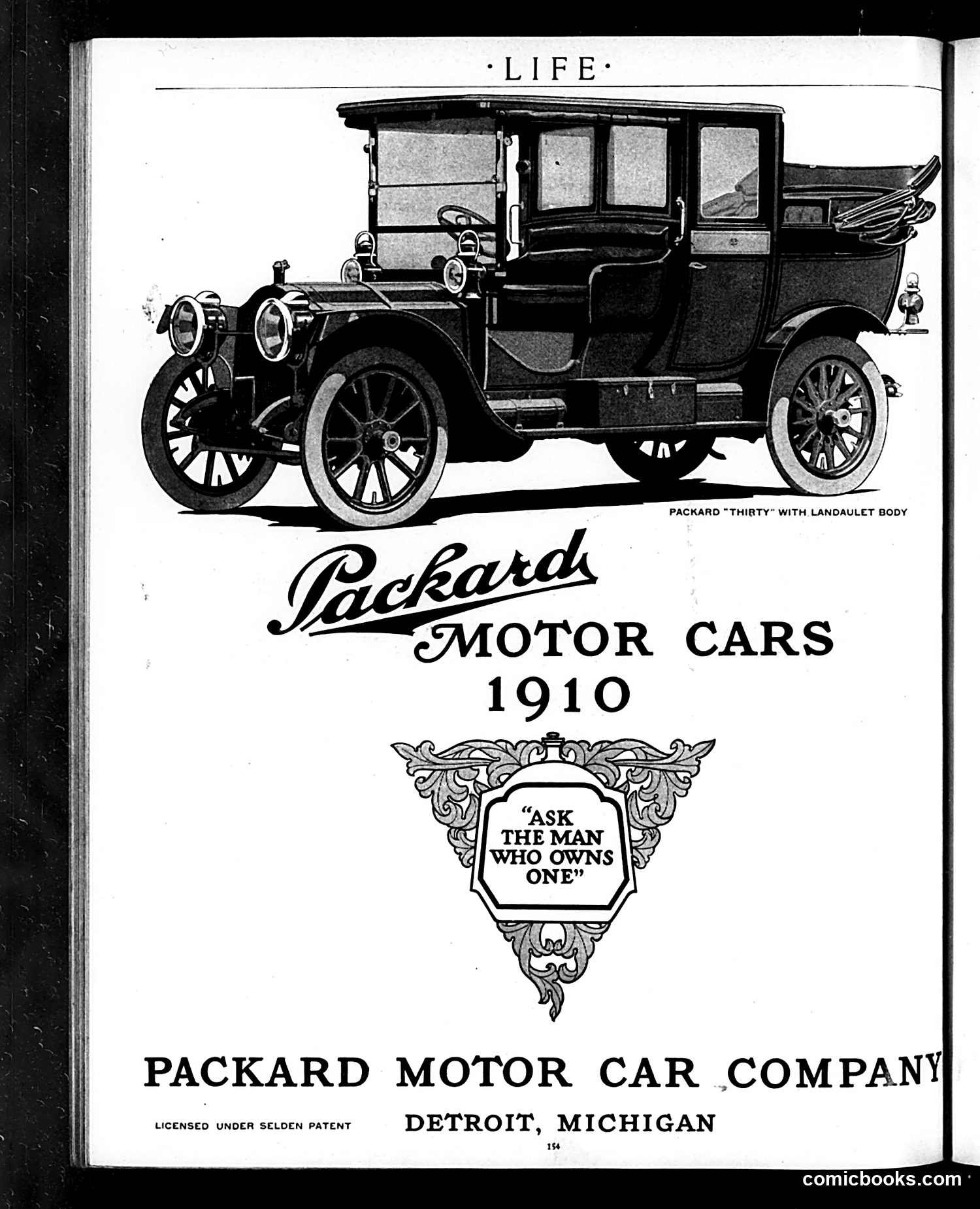
This page is primarily **advertising, not satire or political commentary**. It features a 1910 Packard "Thirty" automobile with a Landaulet body—a luxury car marketed by the Packard Motor Car Company of Detroit, Michigan. The ad's tagline, "Ask the Man Who Owns One," was Packard's famous slogan emphasizing customer satisfaction and peer recommendation. The ornate heraldic emblem reinforces the car's luxury positioning. There is **no political cartoon or satirical content** visible on this page. It's a straightforward product advertisement from Life magazine's early 20th-century issues, when the publication included substantial advertising alongside editorial content. The focus is entirely on promoting Packard automobiles to affluent readers.
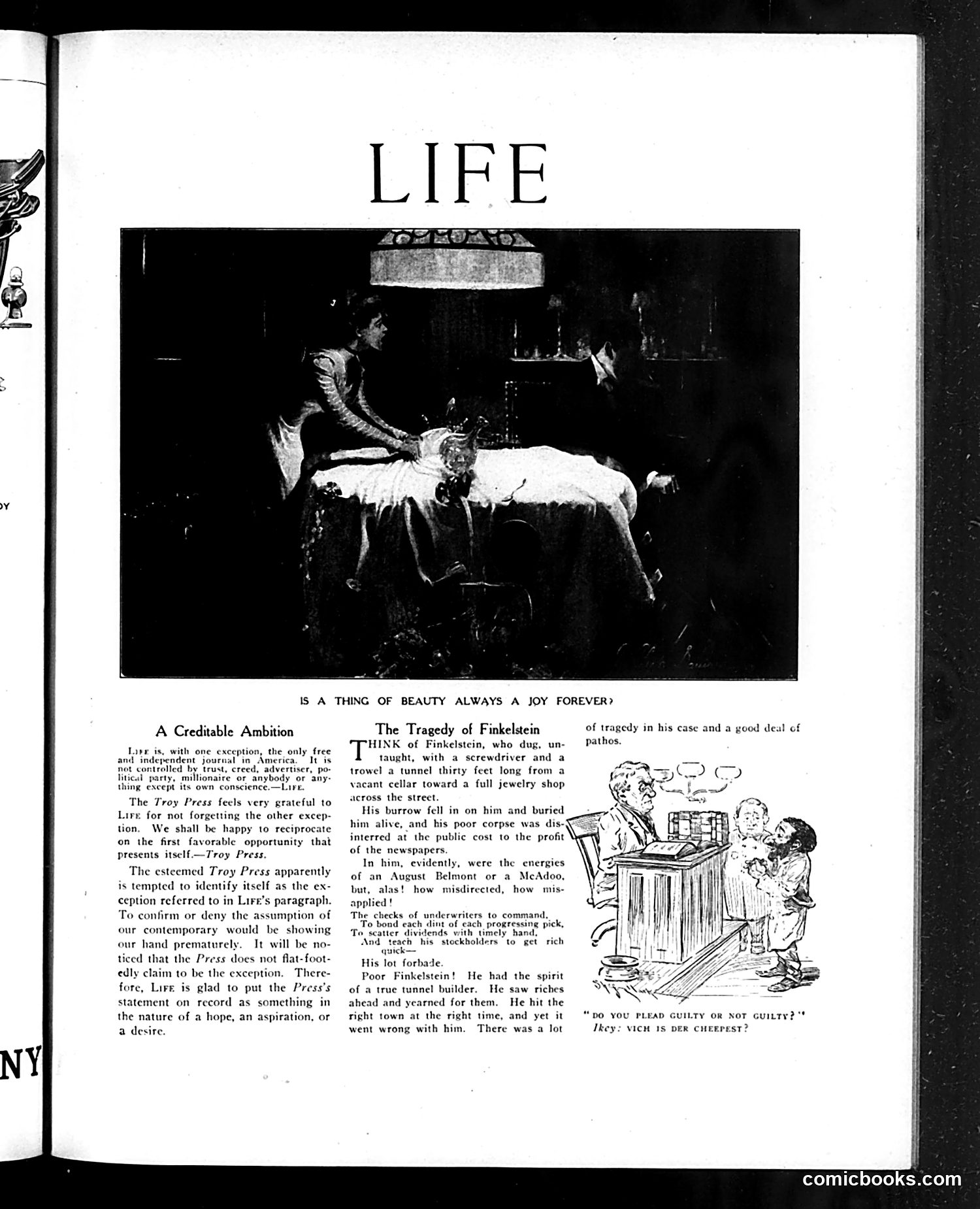
This page contains two satirical pieces about ambition and failure in American business. **"A Credible Ambition"** mocks the *Troy Press* newspaper's claim to ethical independence, suggesting it actually compromises principles for profit—a common critique of press integrity. **"The Tragedy of Finkelstein"** presents a darker cautionary tale: a man named Finkelstein attempts to tunnel from a cellar to a jewelry shop across the street, planning theft to get rich. He's discovered, dies in the attempt, and his body is sold to newspapers for profit. The accompanying cartoon shows authorities or creditors literally profiting from his corpse. The satire highlights how desperation drives people to crime, and how even tragedy becomes commodified by institutions seeking financial gain—a critique of American capitalism's ruthlessness toward the desperate poor.
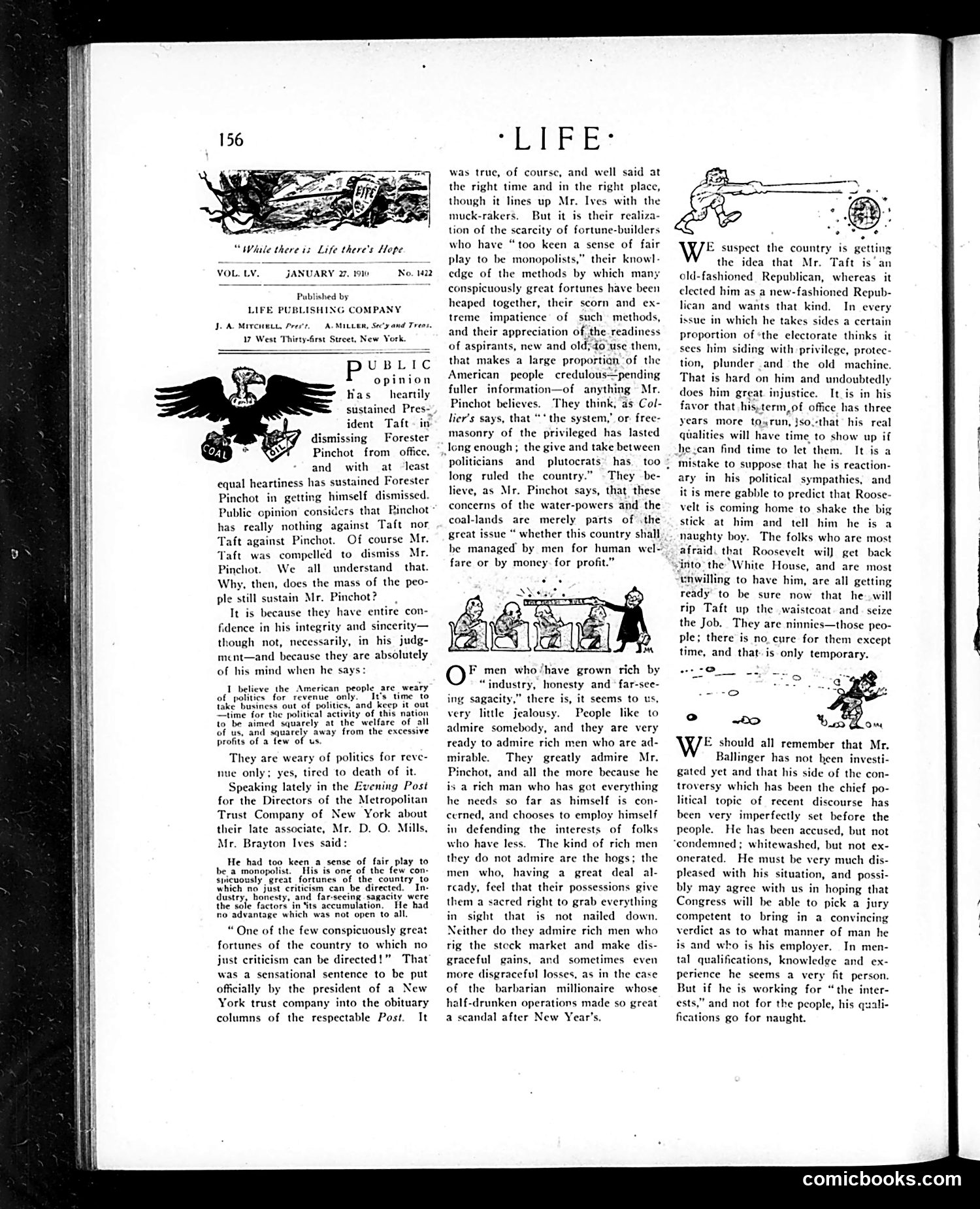
This page contains political commentary criticizing President Theodore Roosevelt's approach to trust-busting and regulation. The text discusses public opinion's weariness with Roosevelt's anti-monopoly campaign, suggesting Americans want less political interference in business. The article defends wealthy industrialists like Mr. Pinchot against criticism, arguing that rich men who built fortunes deserve admiration rather than suspicion. It argues Roosevelt's aggressive trust-busting is unnecessary and that the public is tired of his interventionist policies. The small illustrations appear to be decorative vignettes typical of Life magazine's satirical style, though specific subjects are difficult to identify clearly in this reproduction. The overall message critiques Roosevelt's progressive regulatory agenda as overzealous and unpopular with ordinary citizens seeking stable business conditions.
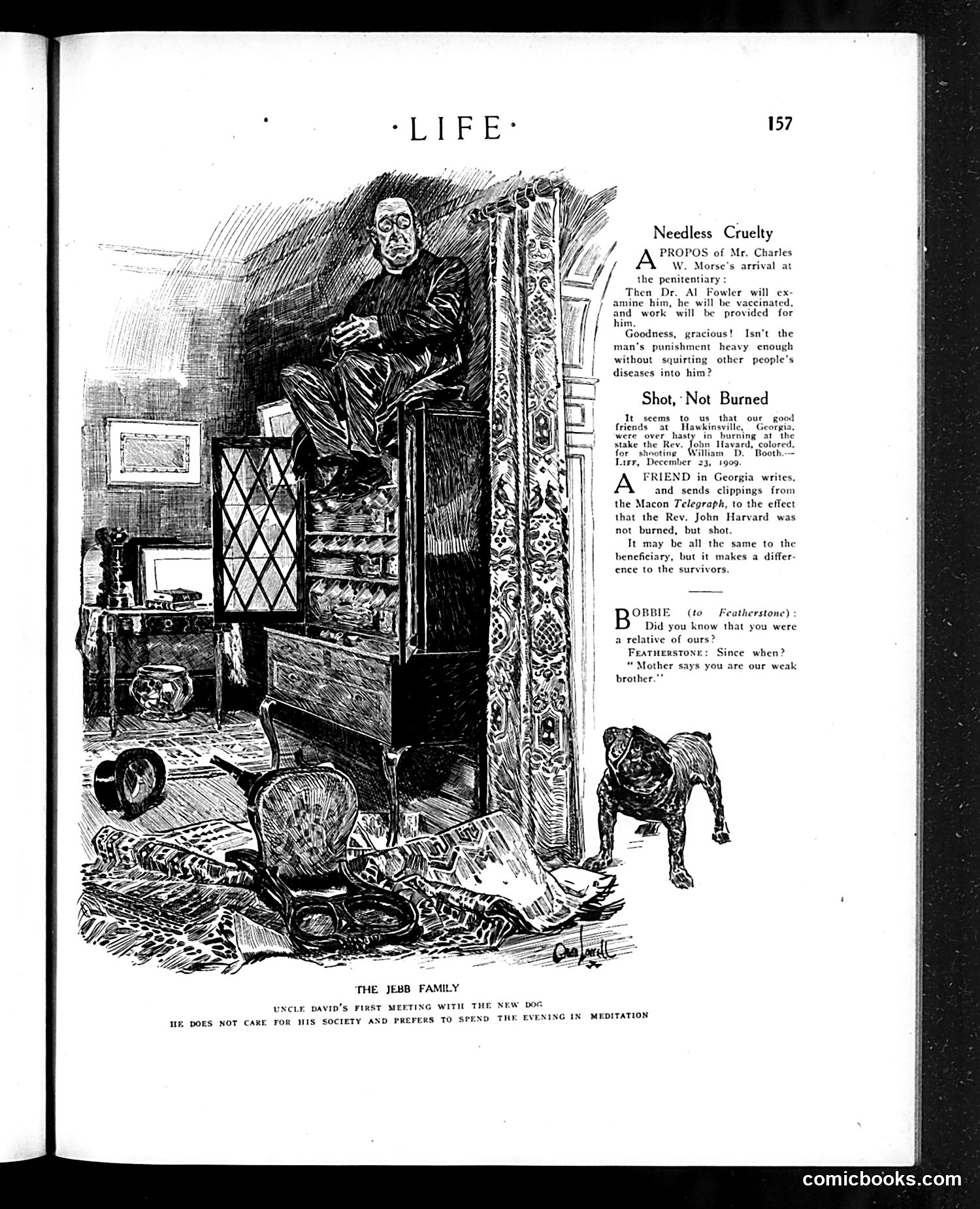
This page contains three satirical items: 1. **"Needless Cruelty"** - Mocks a proposal by Charles W. Morse regarding vaccination procedures. The satire questions whether Dr. Al Baker's examination and work on vaccinated subjects constitutes cruel punishment without proper medical justification. 2. **"Shot, Not Burned"** - References a Georgia incident where friends of William D. Booth were "hasty in burning" someone. A Georgia correspondent notes the distinction between shooting and burning, suggesting the former is preferable—dark satire about frontier justice. 3. **"Bobbie" (Featherstone dialogue)** - A brief comedic exchange where Bobbie reveals Featherstone is a relative, with the punchline that Featherstone's mother calls him "the weak brother." The main illustration shows "Uncle David's first meeting with the new dog," depicting a gentleman in meditation while his dog investigates his surroundings.
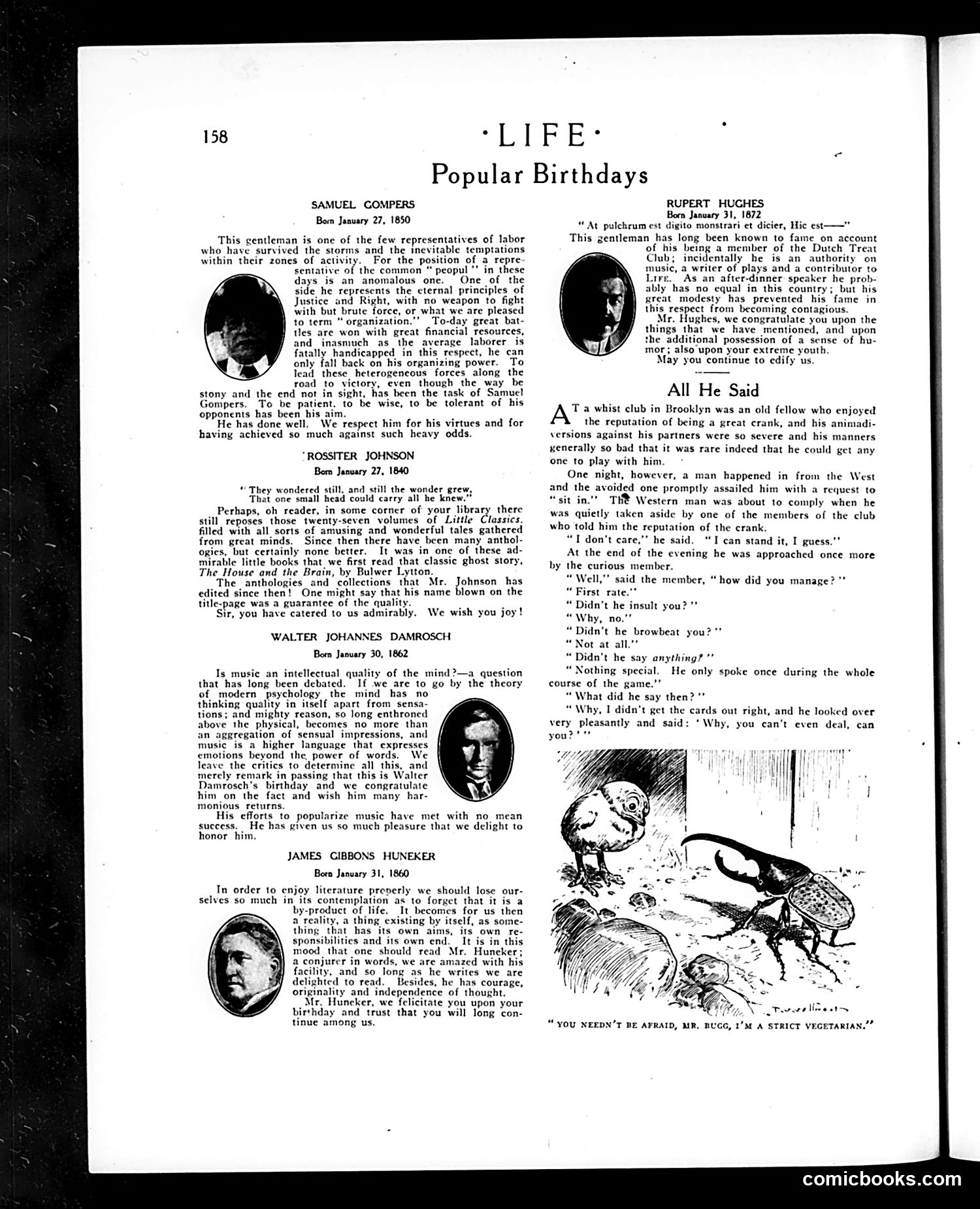
This page celebrates notable birthdays and includes a humorous cartoon titled "All He Said." The cartoon depicts a confrontation between two men over a card game, with one man (labeled "Mr. Rugg") claiming to be "a strict vegetarian." The joke appears to satirize social pretension and dietary fads popular among the wealthy in the early 1900s. The vegetarian's claim seems absurd given the physical altercation—his commitment to non-violence as a vegetarian is undermined by his apparent willingness to fight. The cartoon mocks those who adopt fashionable health or ethical positions while failing to live consistently by them, a common target of Life magazine's satirical humor.
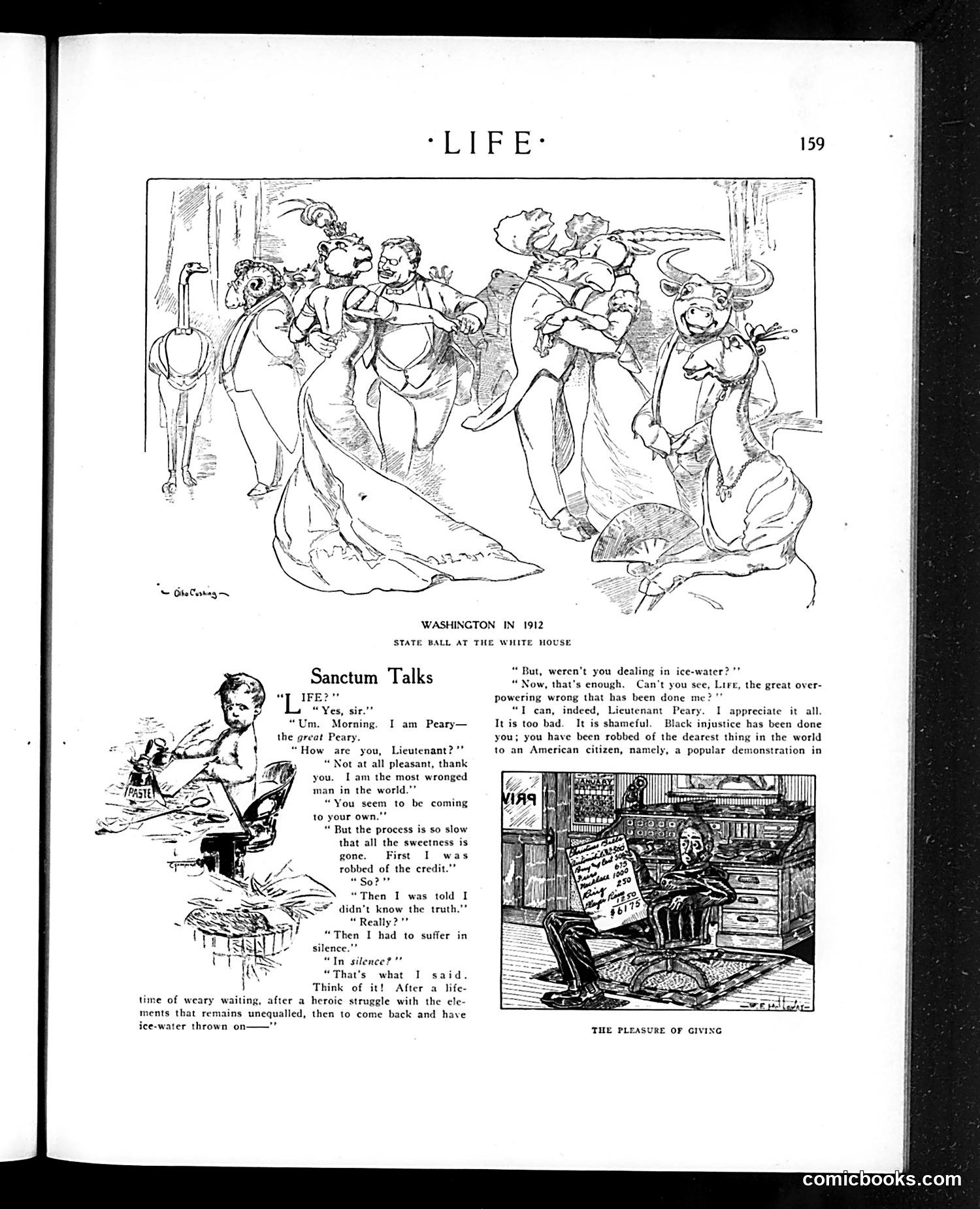
This page contains two distinct pieces of satire from 1912: **Top cartoon** ("Washington in 1912: State Ball at the White House"): Depicts a formal White House ball with figures in evening dress. The scene appears to satirize high-society Washington politics during the 1912 election year, likely mocking the pretense and social posturing of the political elite. **"Sanctum Talks" dialogue**: A conversation between "Limpet" (appears to be a junior figure) and "Lieutenant Peary" (likely explorer Robert Peary, recently famous for Arctic expeditions). Peary complains about being robbed of credit for his achievement and having "ice-water thrown on" his accomplishment—a metaphor for public indifference to his heroic struggles. **"The Pleasure of Giving" cartoon** (bottom right): Shows a man surrounded by empty pockets and drawers, satirizing the difficulties of charitable giving during economic hardship.
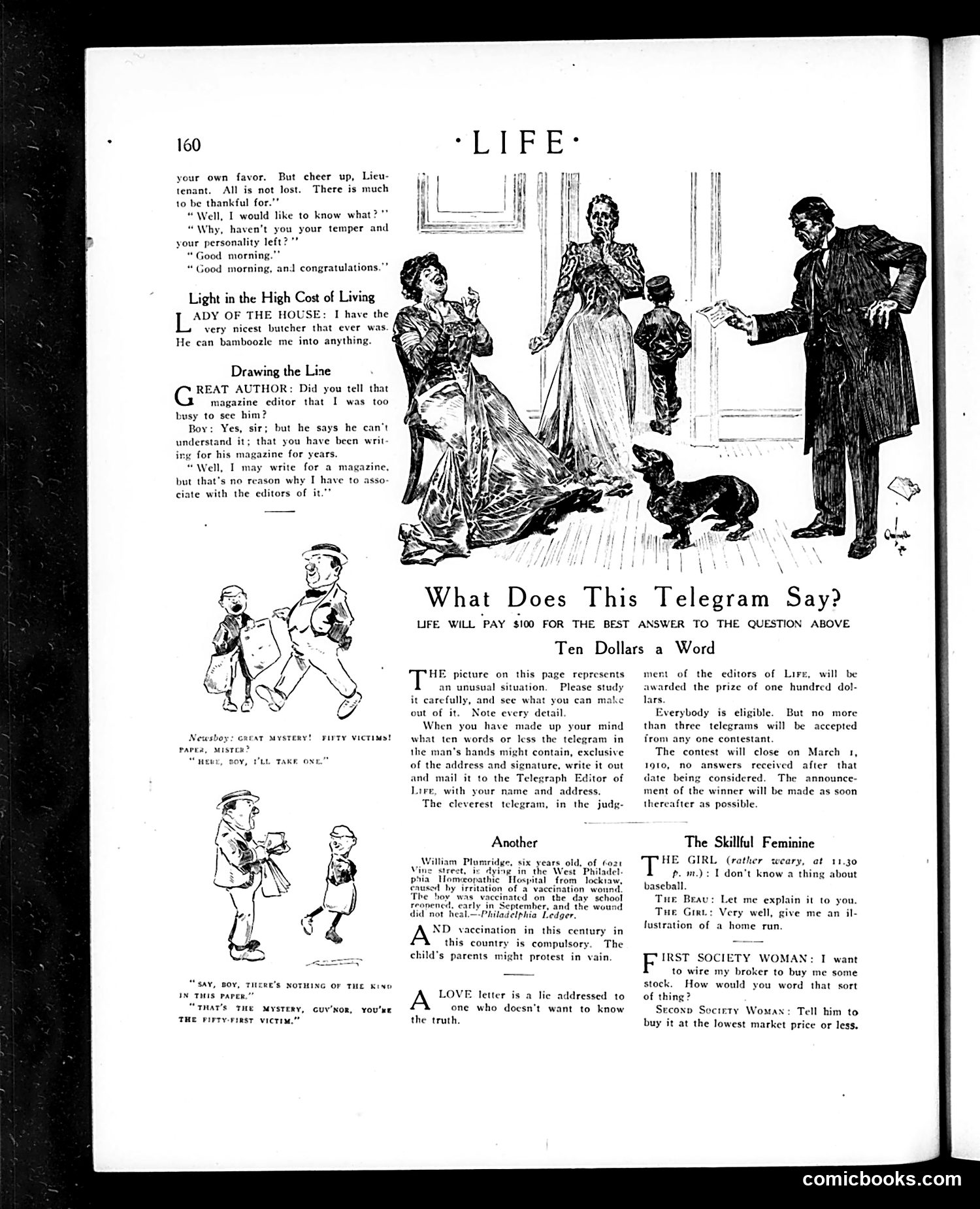
This page from *Life* magazine contains several satirical vignettes and a contest. The main cartoon depicts a domestic scene where a well-dressed man appears to be dismissing or scolding a woman in elaborate dress while children and a small dog are present—likely satirizing marital dynamics or domestic authority. Below are smaller comics showing men with children, captioned with humorous dialogue about mystery and "fifty victims," satirizing popular detective fiction tropes of the era. The page features a "$100 contest" asking readers to decipher a telegram shown in the central illustration, paying "$10 a word" for the best answer—a typical early 20th-century reader-engagement device. Additional brief satirical dialogues mock contemporary social types: magazine editors, vaccination debates, love letters, society women, and stock trading—reflecting common early 1900s anxieties and social pretensions.
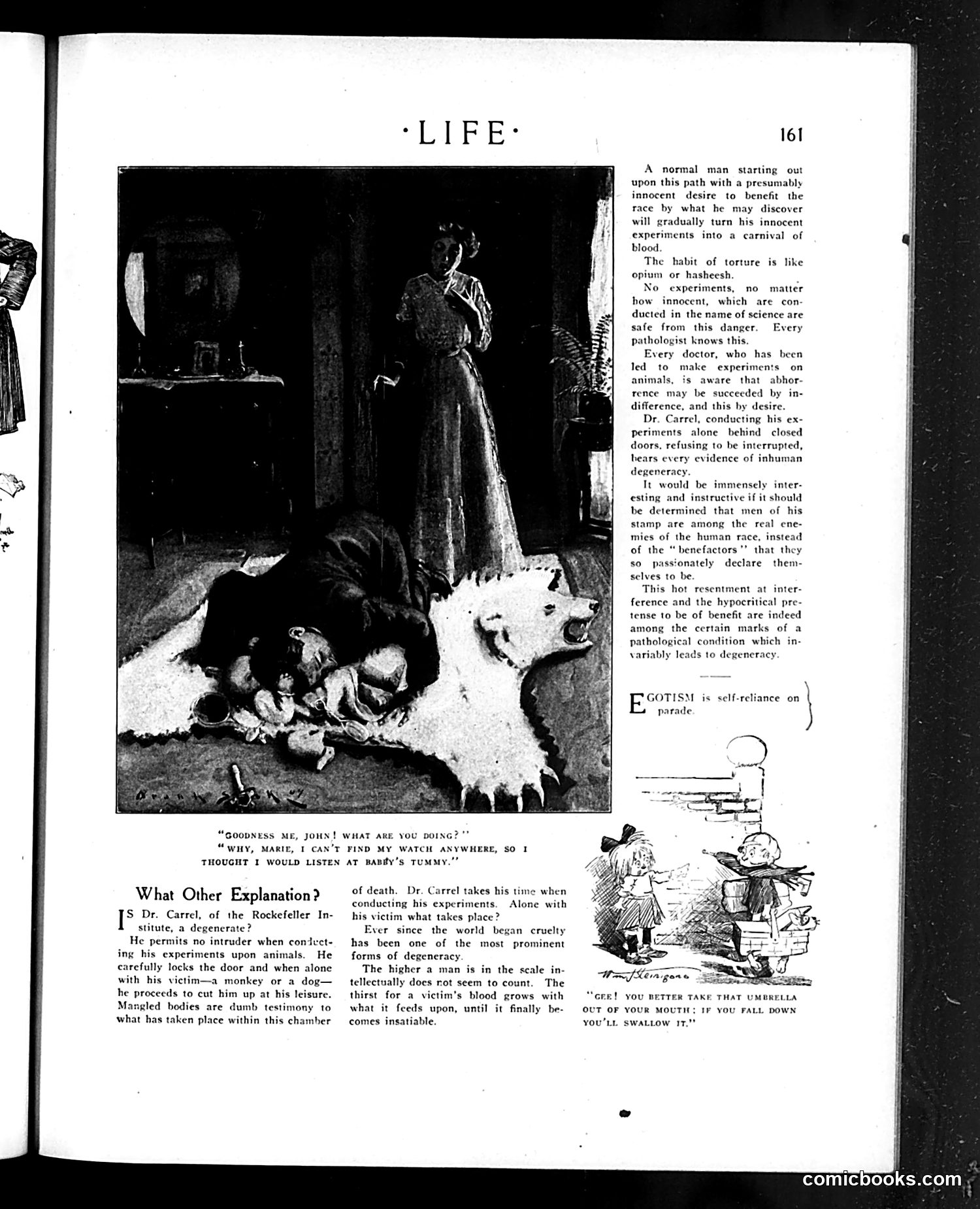
This page critiques Dr. Carrel (likely Alexis Carrel, a famous early-20th-century surgeon), who conducted animal experiments behind closed laboratory doors. The main illustration shows a woman discovering a monkey or dog being vivisected in a chamber—a moment of horrified realization. The satire attacks the moral hypocrisy of conducting cruel experiments "in the name of science" while claiming to benefit humanity. The text argues that such cruelty represents degeneracy rather than progress, and that men conducting these experiments are actually enemies of the human race, not benefactors. The bottom cartoon appears unrelated—a humorous domestic scene about a lost watch. The overall message: scientific advancement doesn't justify hidden brutality.
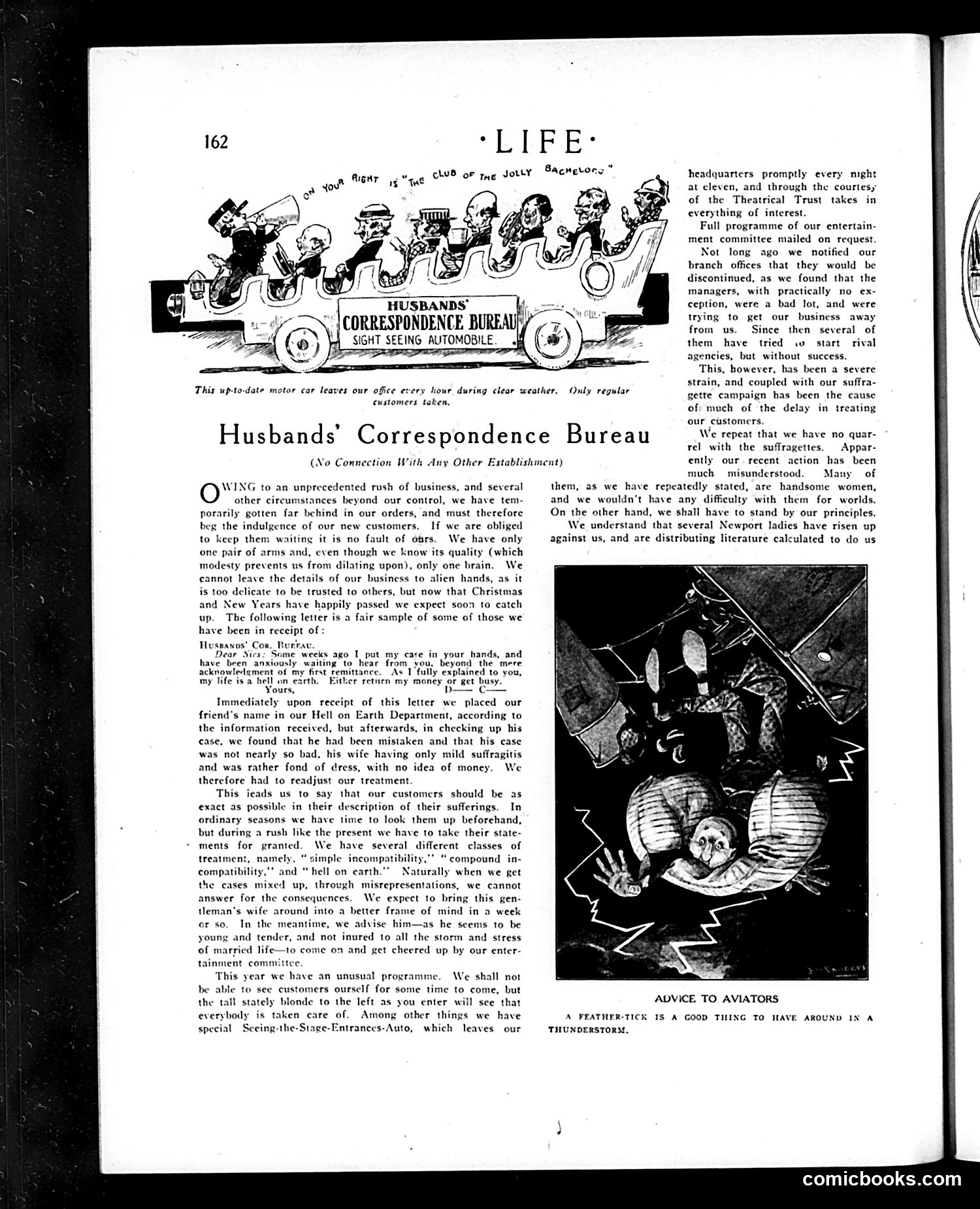
This page satirizes marital unhappiness as a commercial enterprise. The fictional "Husbands' Correspondence Bureau" purports to treat men suffering from domestic strife, categorizing complaints into classes like "simple incompatibility" and "hell on earth." The satire targets: 1. **Marriage as business transaction**: The bureau operates like a legitimate company with departments, customer service delays, and treatment classifications. 2. **Women's suffrage movement**: The text dismisses suffragettes while claiming no quarrel with them—a backhanded insult common to anti-suffrage rhetoric of the era. 3. **Marital discord**: A sample letter from an unhappy customer complains his wife has "mild suffragitis" (the text's invented term mocking suffragettes) and loves shopping. The cartoon vehicle illustration depicts the "Sight Seeing Automobile"—likely referencing theatrical entertainment as marital relief. The joke: Life magazine presents matrimonial misery as both epidemic and commercializable, mocking both unhappy husbands and the women's rights movement simultaneously.
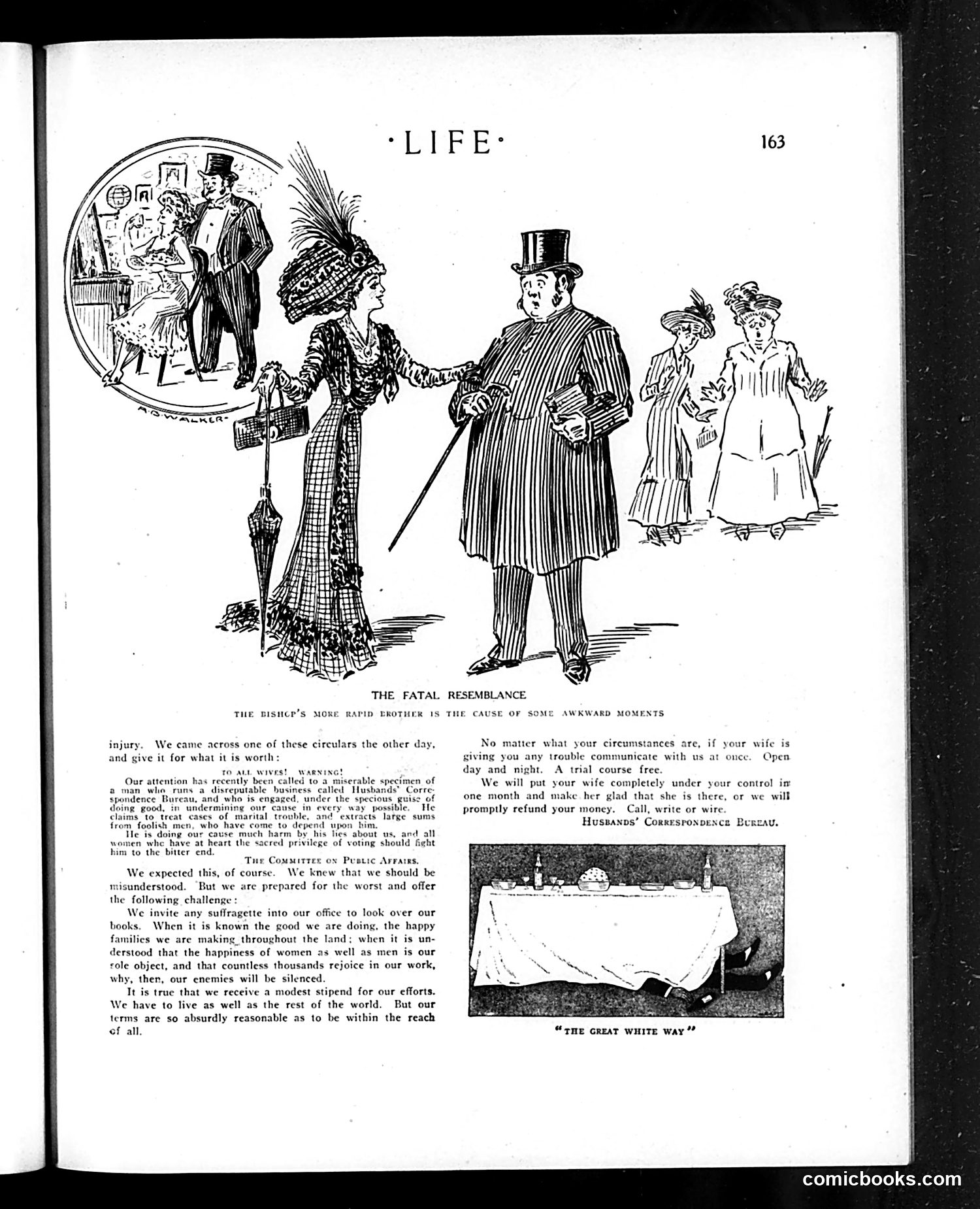
This page satirizes a fraudulent "Husbands' Correspondence Bureau"—a fake matrimonial service that claims to "put your wife completely under your control" for a fee, exploiting marital discord. The cartoon's joke: a woman mistakes the Bureau's rapid-talking brother for the Bureau operator himself, creating awkward moments of confusion. The visual shows elegantly dressed figures; the "fatal resemblance" creates comedic misidentification. The text mocks both the Bureau's predatory business model (extracting money from "foolish men") and its defensive response to women's suffrage activists. A "Committee on Public Affairs" warning attacks the Bureau for undermining women's rights, while the Bureau's owner brazenly defends his operation as morally justified. The satire targets early-1900s gender anxiety: men's fears about marital control, women's emerging political power through suffrage, and exploitative businesses preying on relationship insecurity. The "Great White Way" image below remains unclear without additional context.
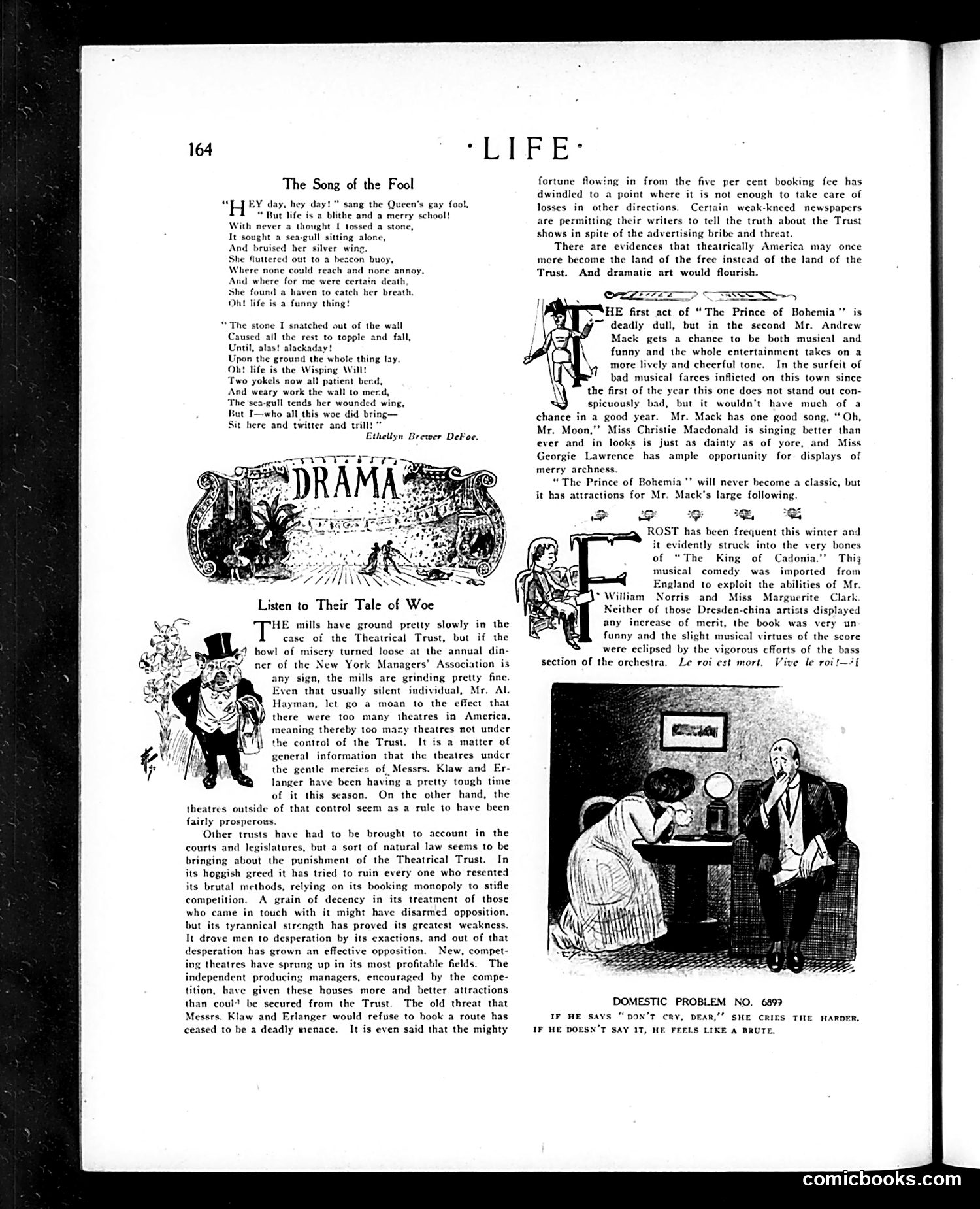
This page contains theatrical criticism and social commentary typical of Life's satirical approach. **"The Song of the Fool"** is a narrative poem about consequences—a fool thoughtlessly throws a stone, causing a seagull injury and a wall to collapse, yet faces no repercussions while others suffer. The satire likely comments on how the powerful escape accountability for their destructive actions. **"Listen to Their Tale of Woe"** attacks the **Theatrical Trust** (Klaw and Erlanger's monopoly controlling American theater booking). Life celebrates their decline: independent theaters are now thriving, competing houses offer better entertainment, and the Trust's "booking monopoly" stranglehold is weakening. The article suggests that tyranny inevitably breeds opposition and its own defeat—a vindication of free-market competition over monopolistic control. The theater reviews below discuss specific productions, maintaining Life's focus on entertainment criticism intertwined with broader social commentary about monopolistic power and justice.
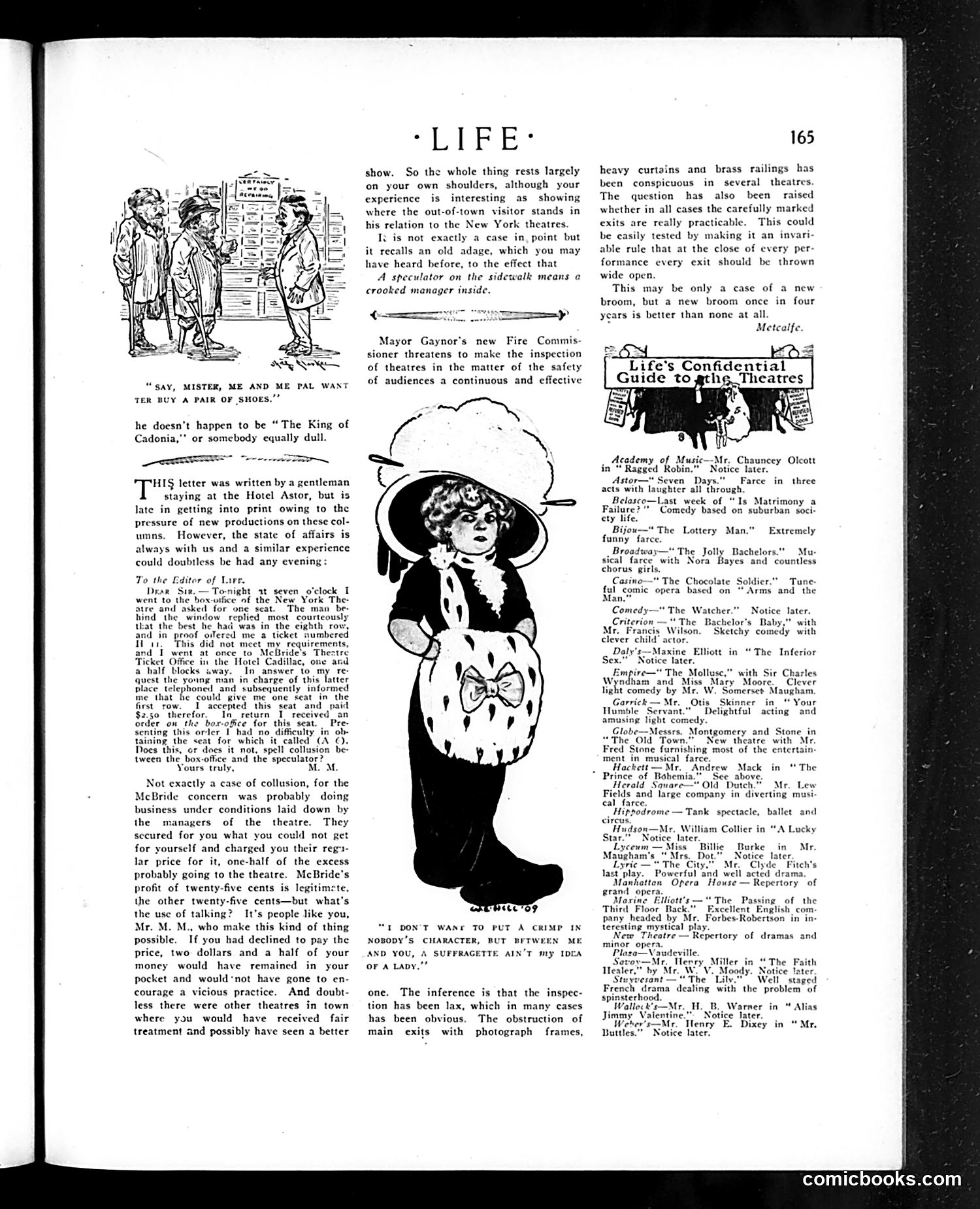
This page contains **theater-related complaints and satire** from early 20th-century New York. The main cartoon shows two working-class men asking a shoe salesman for footwear—a visual joke accompanying a letter criticizing ticket scalping. A hotel guest paid $2.50 through a middleman (McBride's ticket office) for a seat that cost $2.00 at the box office, effectively subsidizing the scalper's 50-cent markup. The editor's response blames consumers for enabling this "vicious practice" rather than the theater managers—arguing that refusing to overpay would eliminate scalping incentives. A second cartoon features a man dismissing suffragettes as "not my idea of a lady"—reflecting anti-women's-suffrage sentiment common in the era. The page also notes Mayor Gaynor's Fire Commissioner promised better theater safety inspections, referencing poor emergency exit conditions (blocked by curtains and frames)—a serious concern after theater fire disasters of that period.
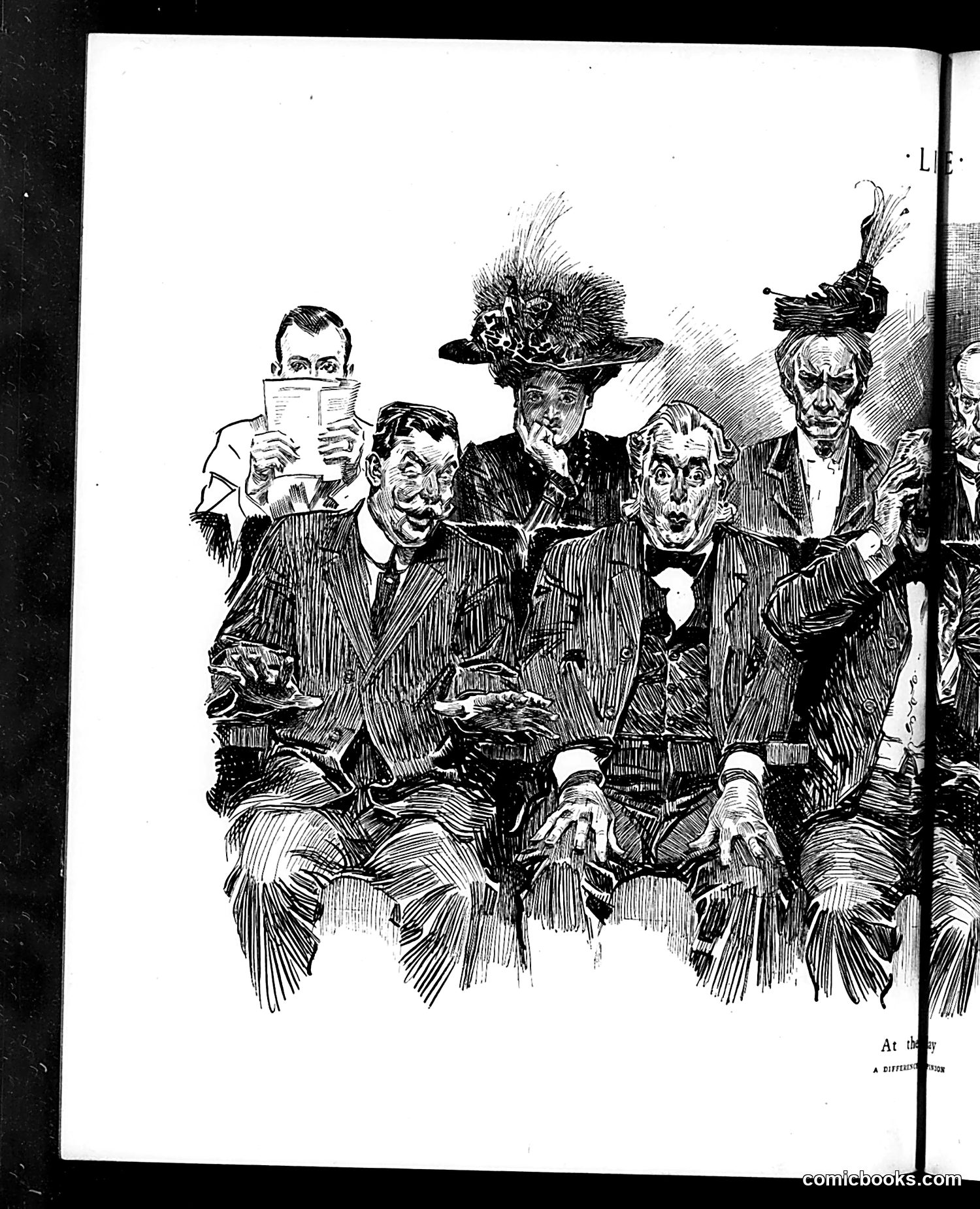
This black-and-white satirical illustration depicts a group of men in formal attire (suits and hats) seated together. The figures display exaggerated, unflattering facial features typical of late 19th or early 20th-century caricature style. One man holds a newspaper, while others gesture expressively. The standing figures in back wear elaborate hats with feathers or plumes. The cartoon appears to satirize a specific group of politicians, businessmen, or public figures of its era, though the OCR text provides minimal context—only "At the" and what appears to be a partial caption fragment. Without the complete caption or date, I cannot definitively identify which specific individuals or events are being mocked, though the style suggests commentary on contemporary social or political figures.
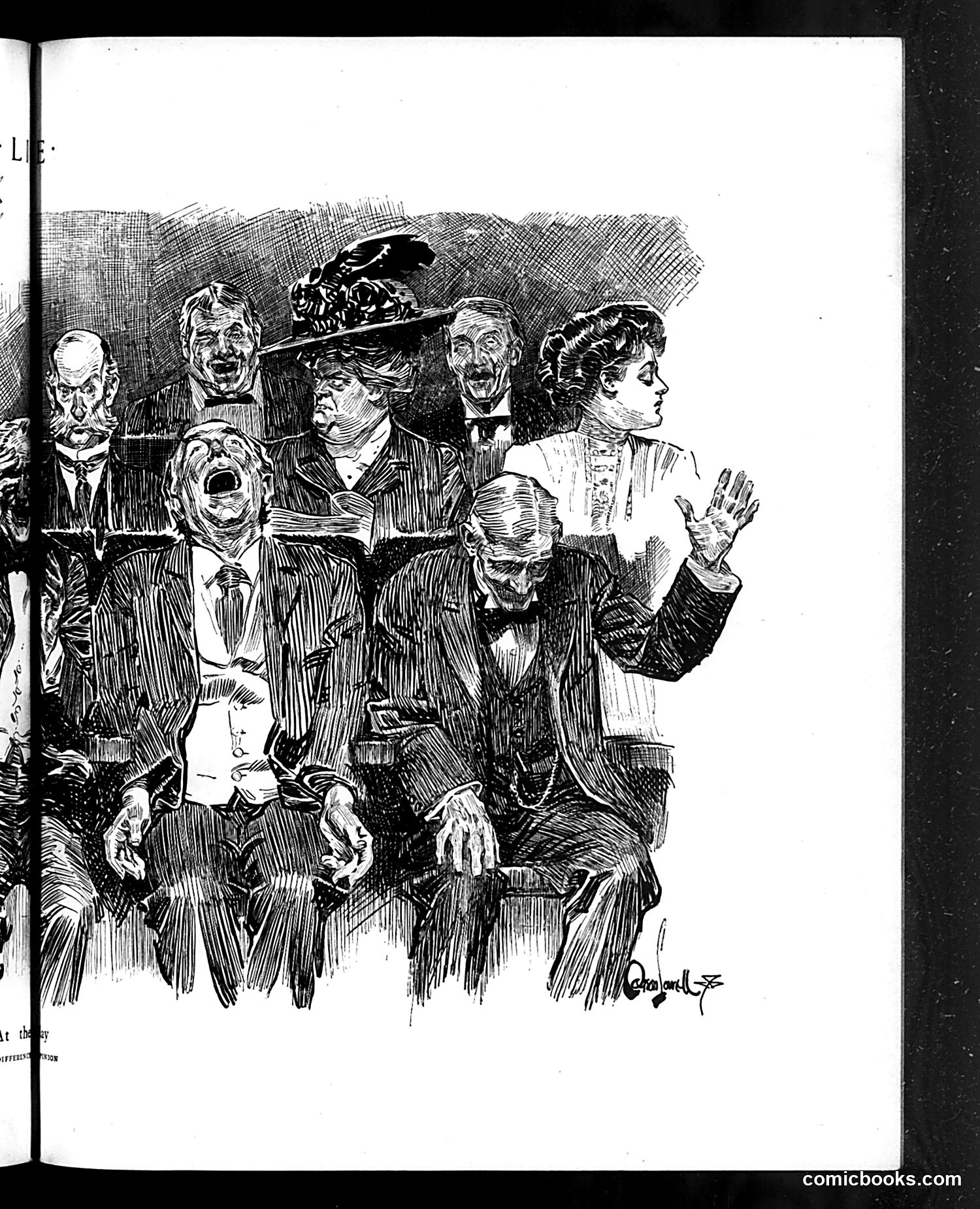
This appears to be a satirical illustration from *Life* magazine depicting a group of formally dressed men and one woman in what seems to be a social or theatrical setting. The figures display exaggerated expressions—some laughing uproariously, others with theatrical grimaces—suggesting mockery of pretentious social behavior or performance. The woman on the right, dressed differently from the men, appears isolated or set apart from the group, possibly satirizing her position in an exclusive male social space. Without visible text identifying the specific figures or event being mocked, I cannot definitively state which political or social situation this cartoon references. The illustration's style and formal dress suggest early-to-mid 20th century satire, but the exact subject remains unclear from the image alone.
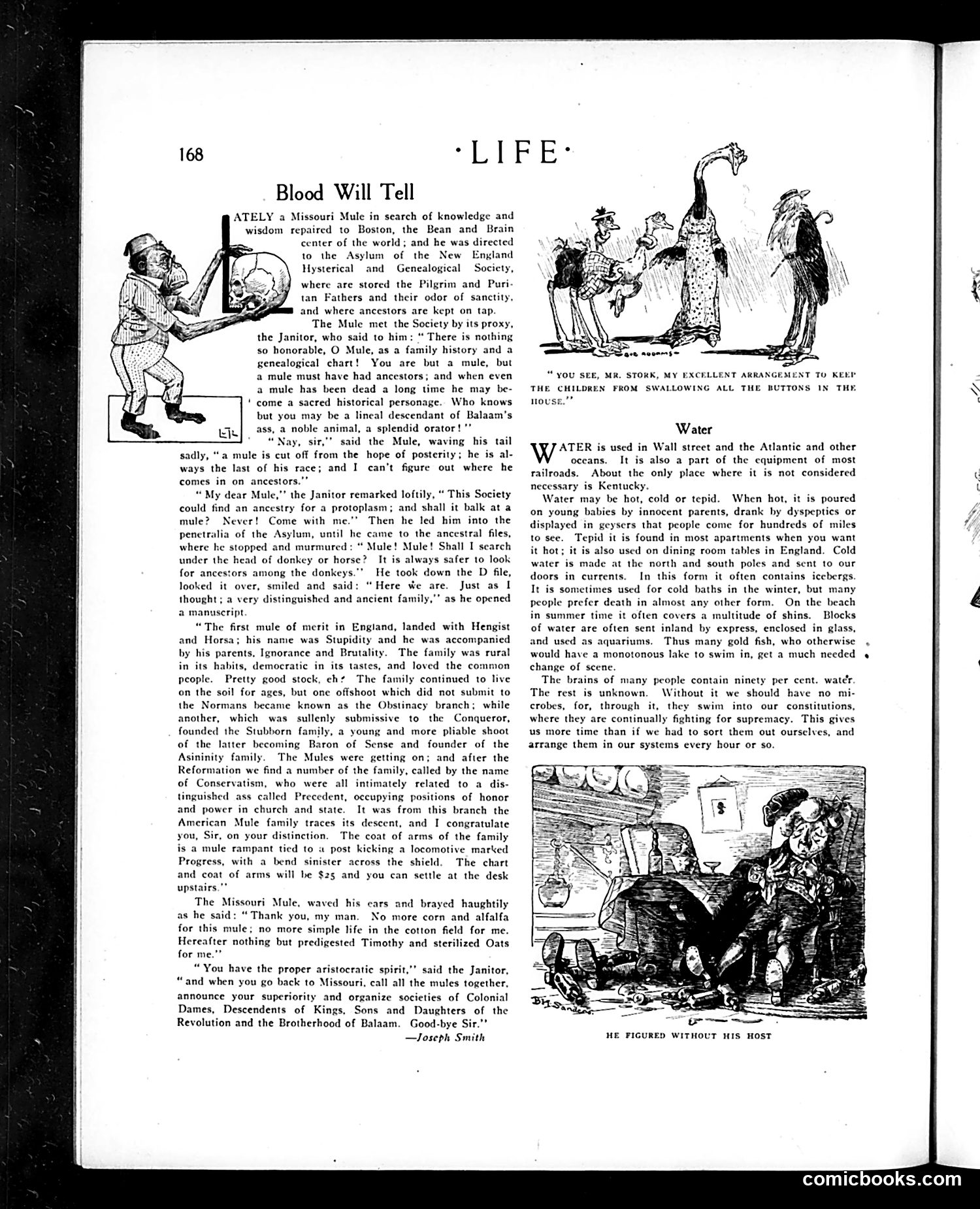
This satirical story mocks the American obsession with aristocratic ancestry and genealogical societies (particularly Boston's "New England Hysterical and Genealogical Society"). A Missouri mule visits seeking a prestigious family history. A janitor fabricates an elaborate pedigree tracing the mule's lineage back to "Balaam's ass," complete with ancestors named "Stupidity," "Ignorance," and "Brutality." The joke targets Americans, especially those descended from English settlers, who paid for fake genealogical charts to claim noble heritage. By giving a mule a distinguished family tree, the author ridicules how these genealogy services would validate *any* client's supposed superiority. The mule's transformed pretension—now refusing simple oats for "predigested Timothy"—satirizes how false ancestry breeds snobbish behavior. Attributed to Joseph Smith, this piece critiques the absurdity of American genealogical pretension and class aspiration.
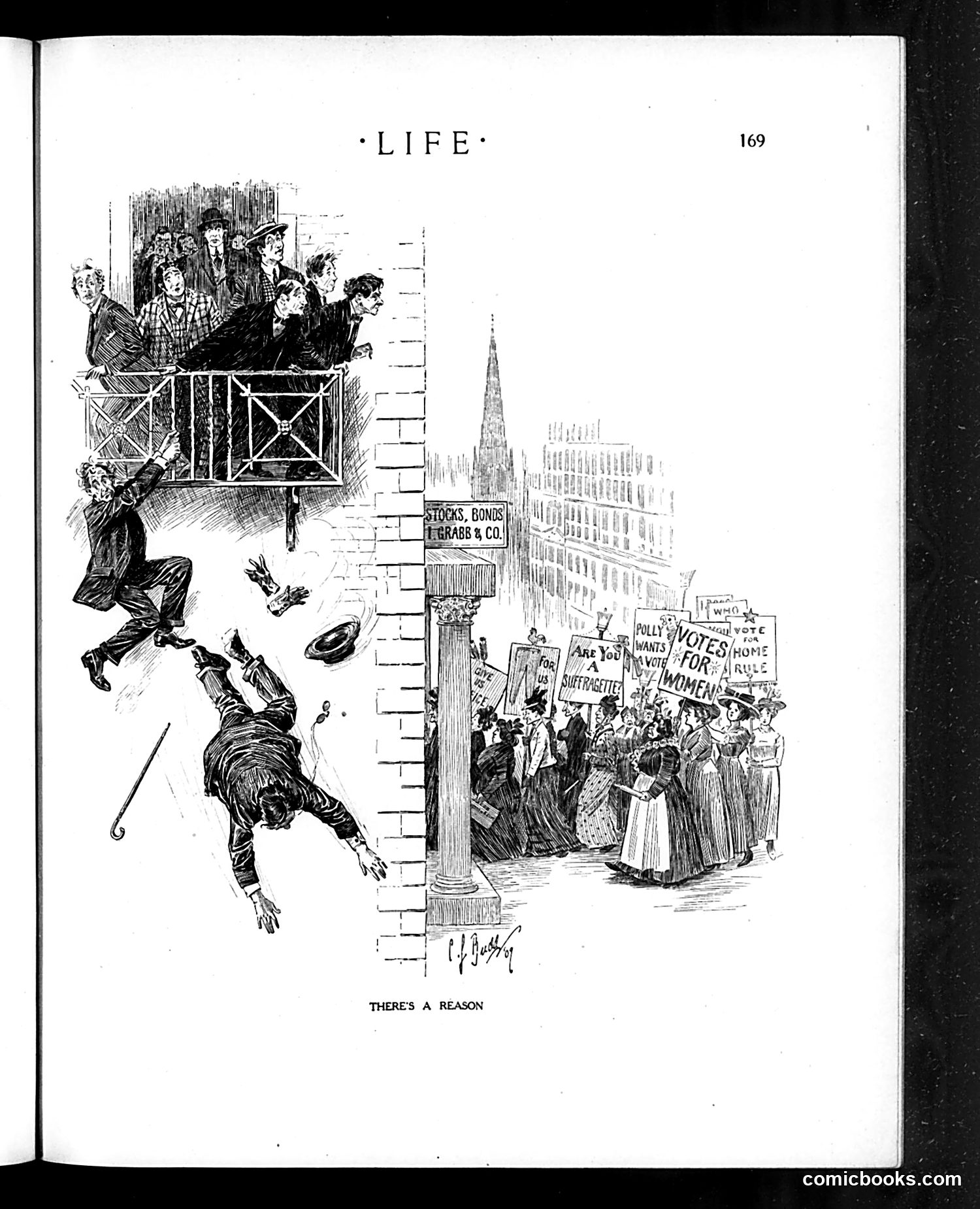
This Life magazine cartoon satirizes the contrast between wealthy financial interests and women's suffrage activism. On the left, men in a building (likely a stock exchange, given the "Stocks, Bonds" sign and "Grabb & Co." reference) throw objects downward at suffragettes below. On the right, women hold protest signs reading "Votes for Women," "Polly Wants," and "Are You Suffragettes." The cartoon's title "There's a Reason" suggests financial/business elites actively oppose women's voting rights—depicted literally as violent resistance. This reflects early 20th-century opposition to suffrage from business interests who feared women voters might support labor protections or wealth redistribution. The satire criticizes both the hostile establishment and, implicitly, the persistence required for suffragists to achieve their goals.
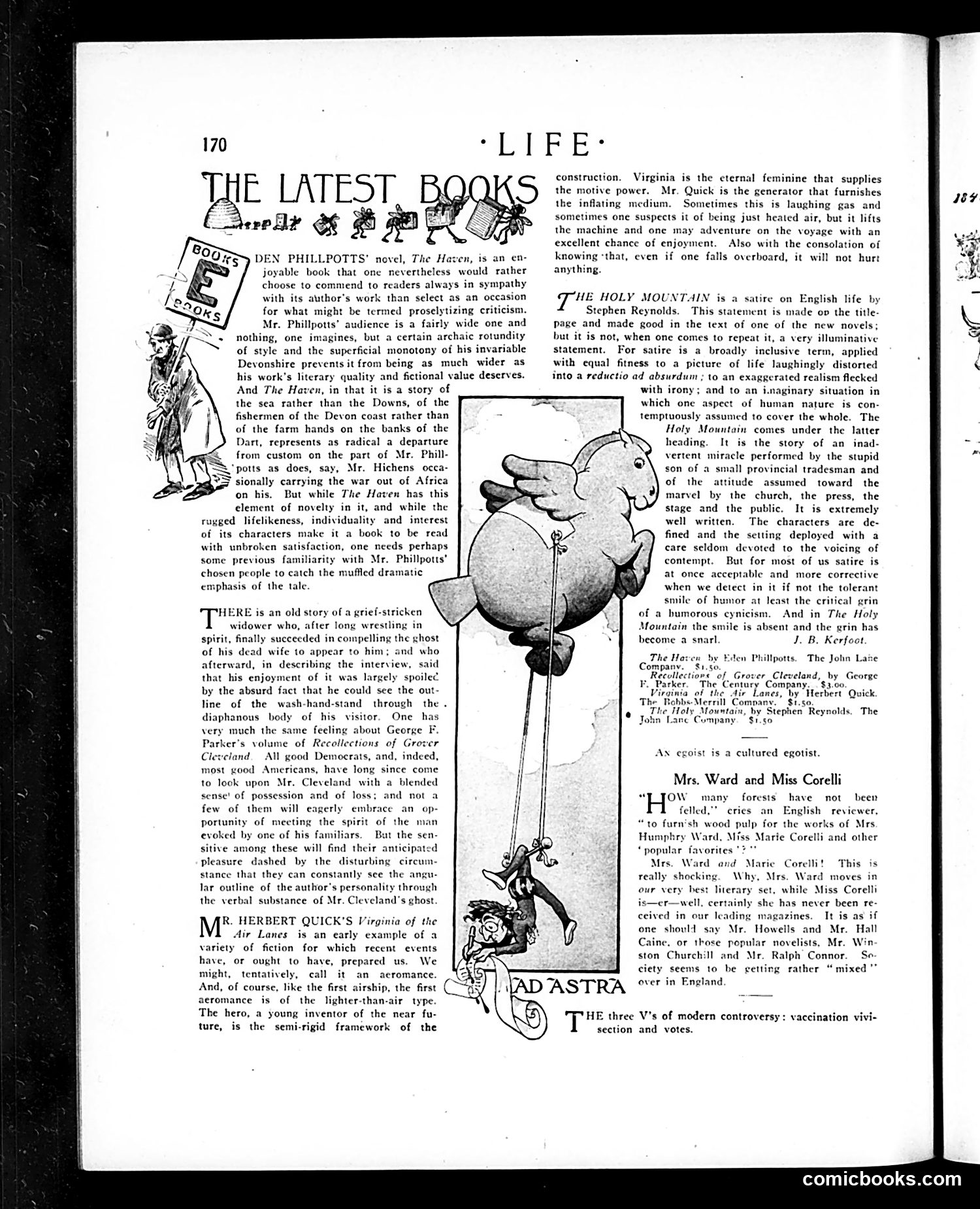
This page features literary reviews of contemporary novels, accompanied by an illustration labeled "AD ASTRA" depicting a figure in a hot air balloon. **Key Content:** The reviews discuss Den Phillpotts' *The Haven* (a sea story departing from his typical Devonshire settings), George Parker's *Recollections of Grover Cleveland* (criticized for the author's personality overshadowing the subject), and R. Herbert Quick's *Virginia of the Air Lanes* (described as an "aeromance"—an early aviation romance where the female character Virginia provides the emotional "motive power"). **The Cartoon:** The "AD ASTRA" illustration satirizes Quick's novel by literally depicting the concept: a woman in a balloon basket carries a man aloft, humorously visualizing the female character as the driving force. The Latin title means "toward the stars," reinforcing the aspirational aviation theme and the reviewer's playful tone about this emerging fiction genre.
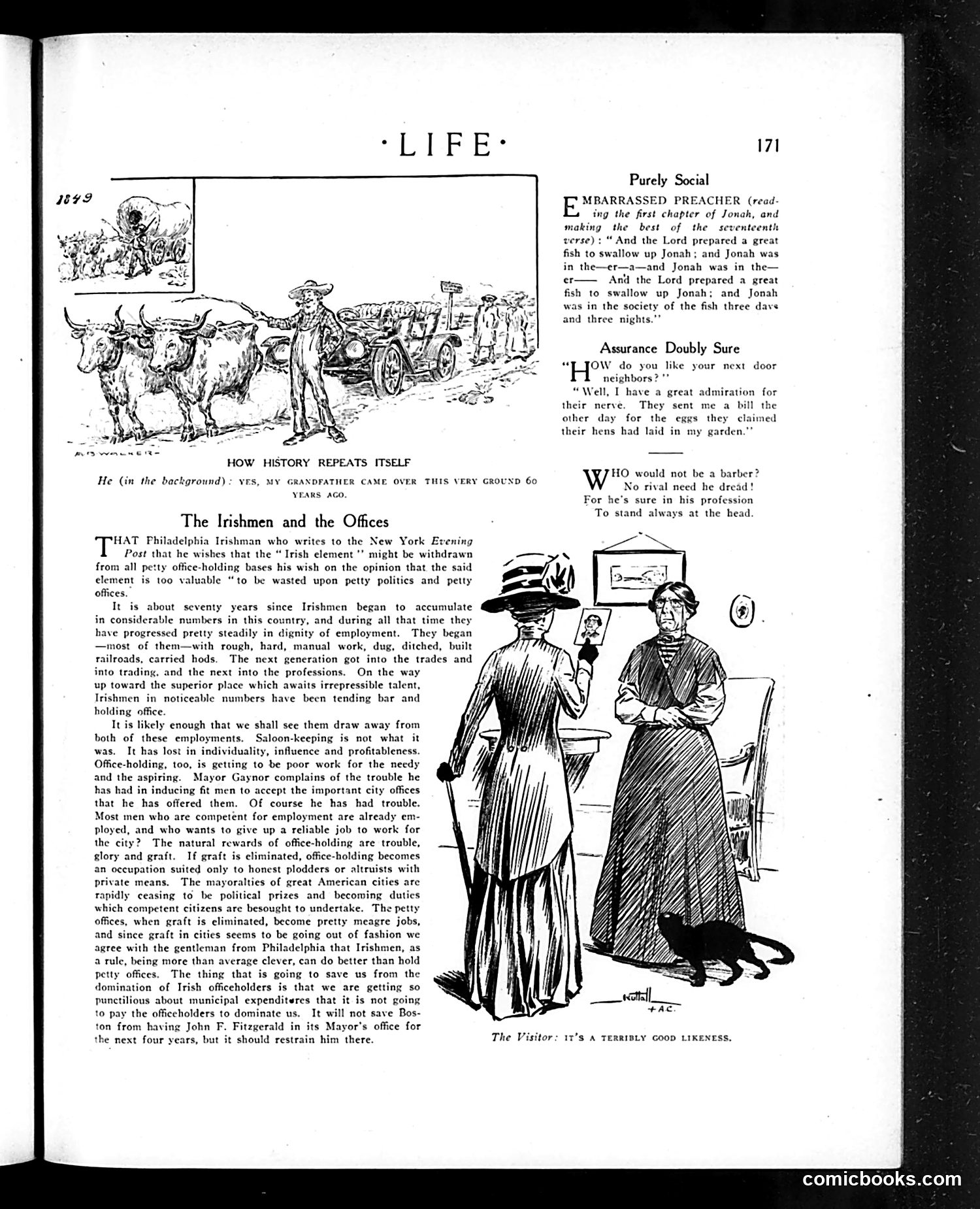
This page contains multiple satirical pieces typical of early 1900s American humor: **"The Irishmen and the Offices"** is the main article, responding to a Philadelphia Irishman's letter urging withdrawal of Irish people from petty office-holding. The author argues Irish immigrants have progressed from manual labor to trades and professions over seventy years, and will naturally abandon low-status work like bartending and minor offices as better opportunities emerge. He notes Mayor Gaynor struggles filling city positions—suggesting office-holding is becoming unattractive without graft opportunities. **The smaller jokes** mock social situations: an embarrassed preacher repeatedly stumbling over the Book of Jonah passage; neighbors billing someone for eggs their hens laid in his garden; and a barber's secure profession. **"How History Repeats Itself"** shows a man noting his grandfather worked the same ground sixty years prior—satirizing cyclical patterns or immigrant labor. The overall theme critiques urban politics, Irish-American assimilation, and municipal corruption while celebrating immigrant upward mobility.
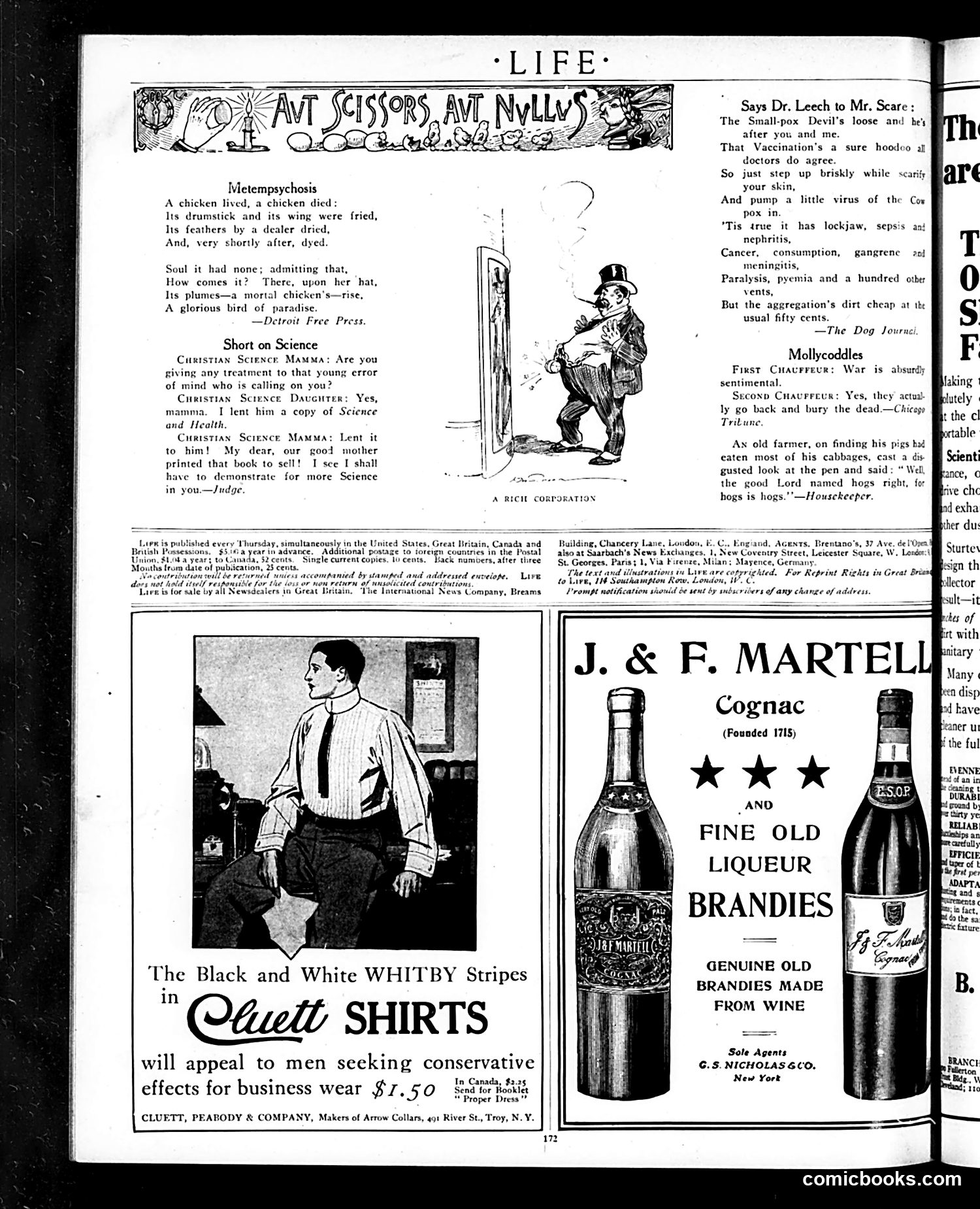
This page contains **multiple short satirical pieces and advertisements** rather than a single cartoon. The main satirical content includes: 1. **"Metempsychosis"** — A poem mocking the fashion of wearing feathered hats. It traces a chicken from dinner plate to fashion accessory, sarcastically noting that despite the chicken having "no soul," its feathers become a "glorious bird of paradise" on a woman's hat. This critiques the wasteful use of animal products in women's fashion. 2. **"Short on Science"** — A dialogue mocking Christian Science, suggesting its practitioners lend out religious texts rather than providing actual treatment. 3. **"The Dog Journal" section** — Contains a satirical piece about vaccination skeptics, where a doctor sarcastically lists serious diseases (lockjaw, cancer, meningitis, paralysis) as vaccination side effects while claiming it's "cheap at fifty cents." This defends vaccination against contemporary anti-vaccine sentiment. 4. **"Mollycoddles"** — A brief joke about war sentiment. The page also features period **advertisements for Cluett shirts and Martel brandy**.
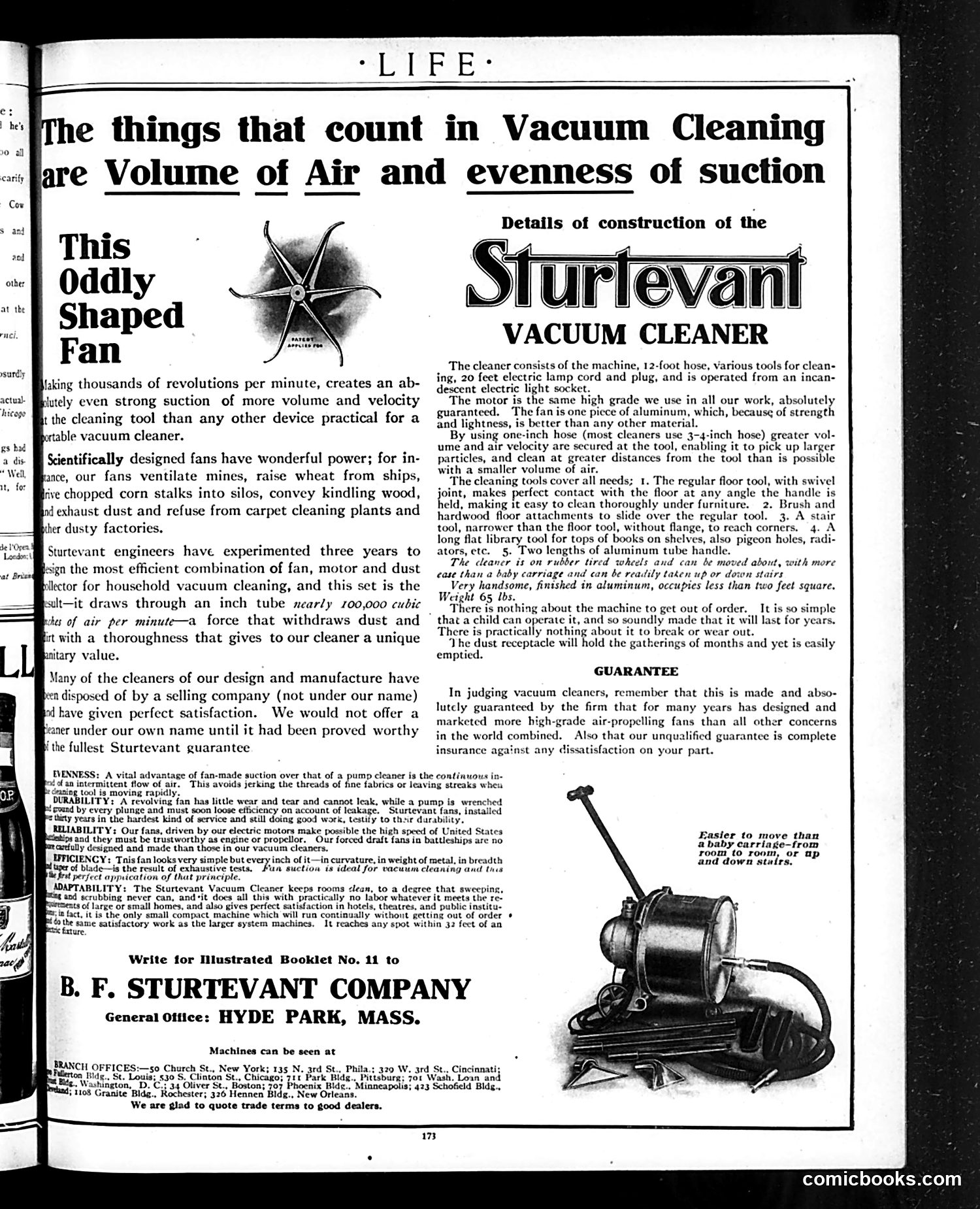
This is primarily **a full-page advertisement**, not political satire. The page promotes the Sturtevant Vacuum Cleaner, a household appliance from the B.F. Sturtevant Company (based in Hyde Park, Massachusetts). The "oddly shaped fan" illustration at top left shows the machine's technical innovation—its distinctive fan design that creates continuous suction, claimed superior to pump-based competitors. The lower illustration depicts the cleaner as "easier to move than a baby carriage," emphasizing its portability. The advertisement emphasizes engineering credentials: Sturtevant engineers designed fans for industrial use (mines, grain handling, factories) before adapting the technology for homes. Key selling points include the one-inch hose delivering strong suction, specialized cleaning tools for different surfaces, and durability—"simple" enough for a child to operate, lasting for years. This reflects early 20th-century marketing strategy: establishing industrial credibility to sell consumer products.
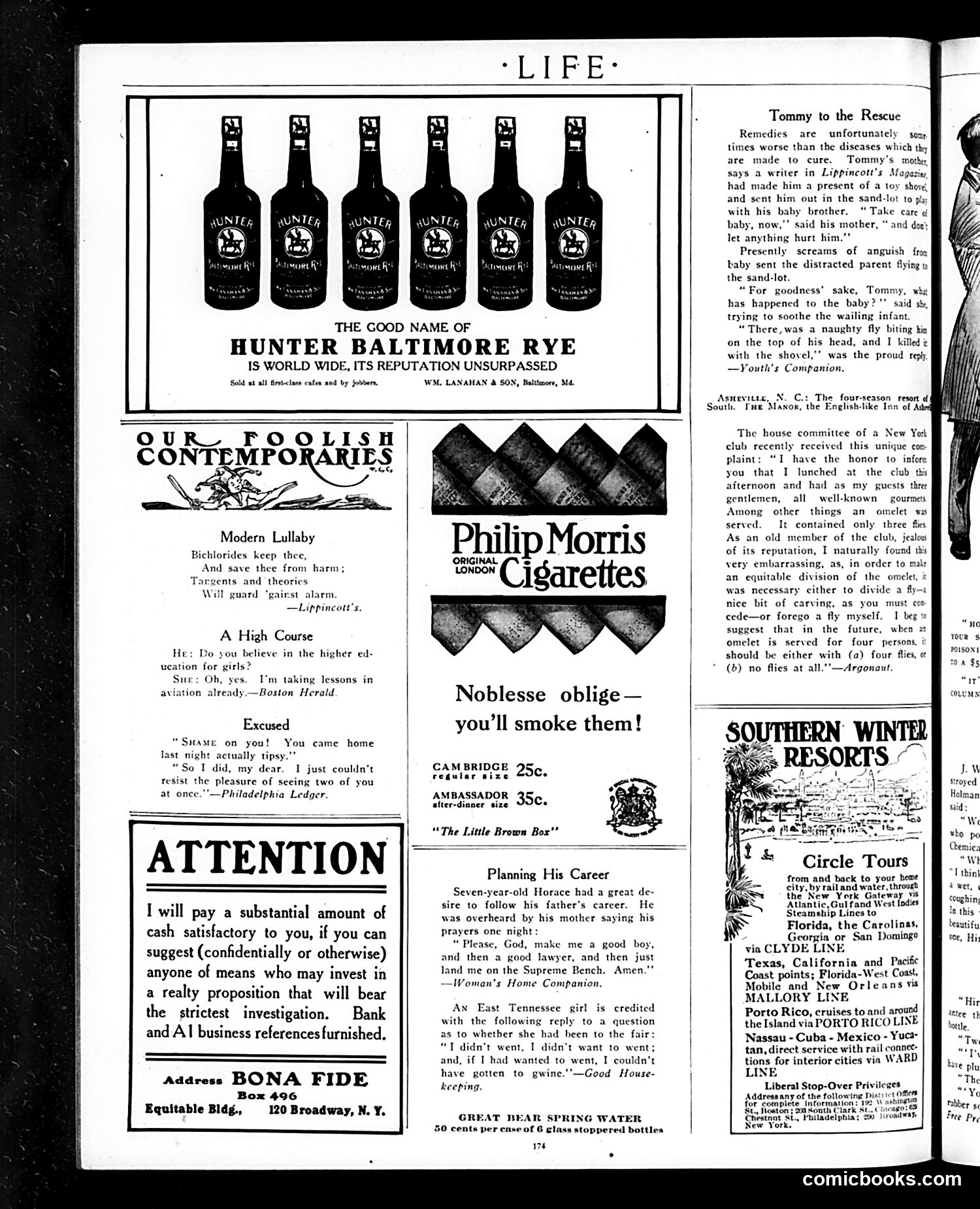
This page from *Life* magazine is primarily **advertisements and humorous anecdotes** rather than political cartoons. The **satire** appears in short jokes mocking contemporary social attitudes: - **"Modern Lullaby"**: Darkly jokes about treating infant illnesses with dangerous chemicals (bichlorides), reflecting early 20th-century medicine's reliance on toxic remedies. - **"Tommy to the Rescue"**: A child story satirizing overzealous parenting—a mother warns her son not to hurt his baby brother, so Tommy kills a fly biting the baby *with a shovel*, showing absurd literal-mindedness. - **"Planning His Career"**: Satirizes ambitious social climbing through a child's prayer requesting God make him "a good lawyer, and then just land me on the Supreme Bench"—mocking materialistic aspiration. - **Omelet complaint**: Absurdly pedantic club member complains an omelet had only three flies for four people, requiring impossible division of a fly. The advertisements (whiskey, cigarettes, travel) occupy significant space. Overall, the humor targets pretension, dangerous medical practices, and upper-class absurdity.
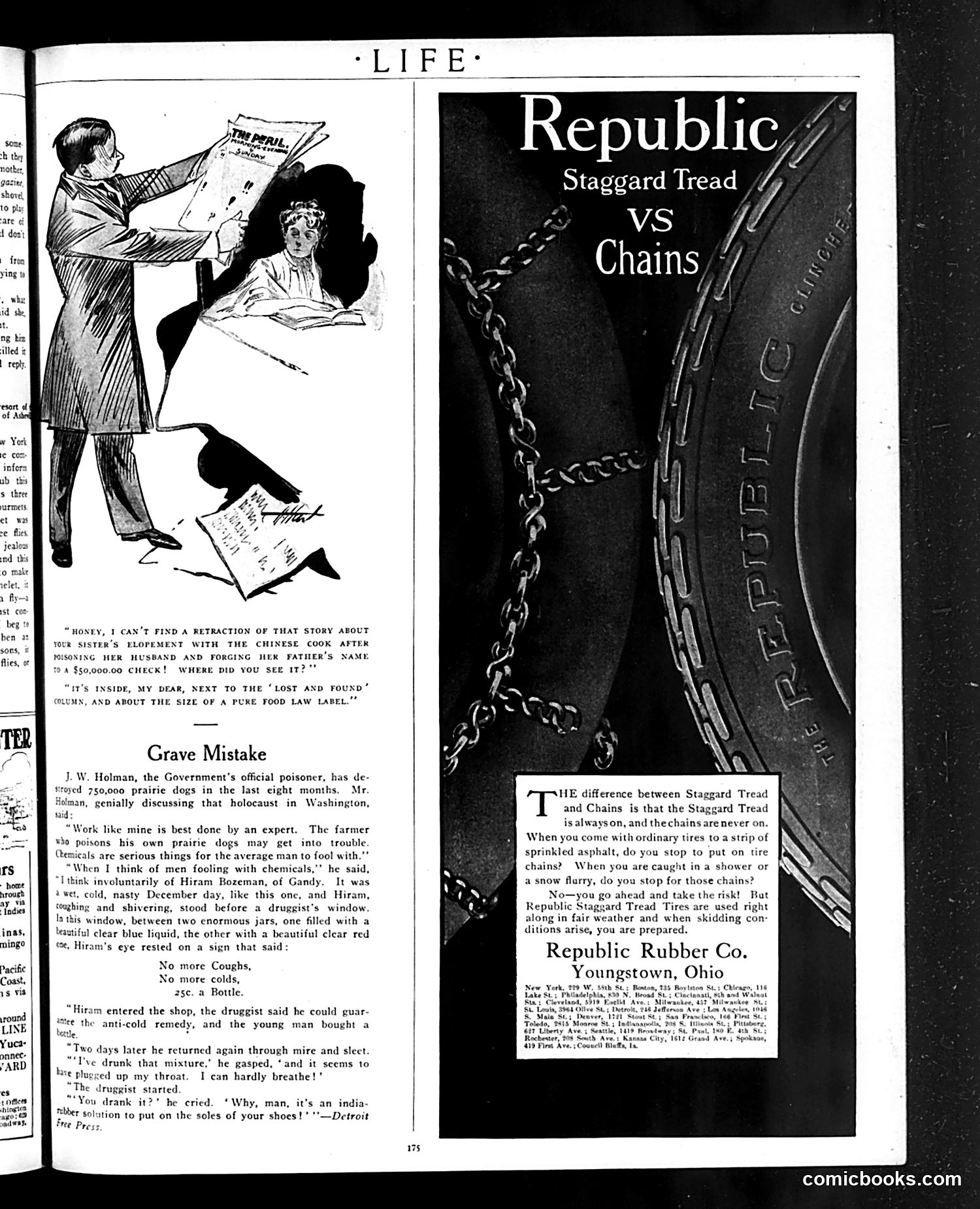
**Left Cartoon:** A satirical sketch about journalistic standards. A husband asks his wife where she saw a scandalous retraction about her sister's elopement and crime. She replies it was "inside, next to the lost and found ads, about the size of a pure food law label"—meaning the retraction was so tiny it was barely visible. The joke mocks newspapers for burying retractions of major stories in obscure corners, and sarcastically compares this practice to deceptive food labeling. **"Grave Mistake" Story:** A humorous anecdote about Hiram Bozeman, who drinks what he thinks is cough medicine but is actually a shoe sole treatment. The piece satirizes J.W. Holman, the government's "official poisoner" of prairie dogs, by questioning whether untrained people should handle chemicals—the ironic punchline being that even professional druggists' products can be dangerously mislabeled or misused. **Right Advertisement:** A Republic Rubber Co. tire ad contrasting their "Staggard Tread" (always-on tread) with chains (temporary). Standard advertising copy emphasizing constant reliability versus occasional protection.
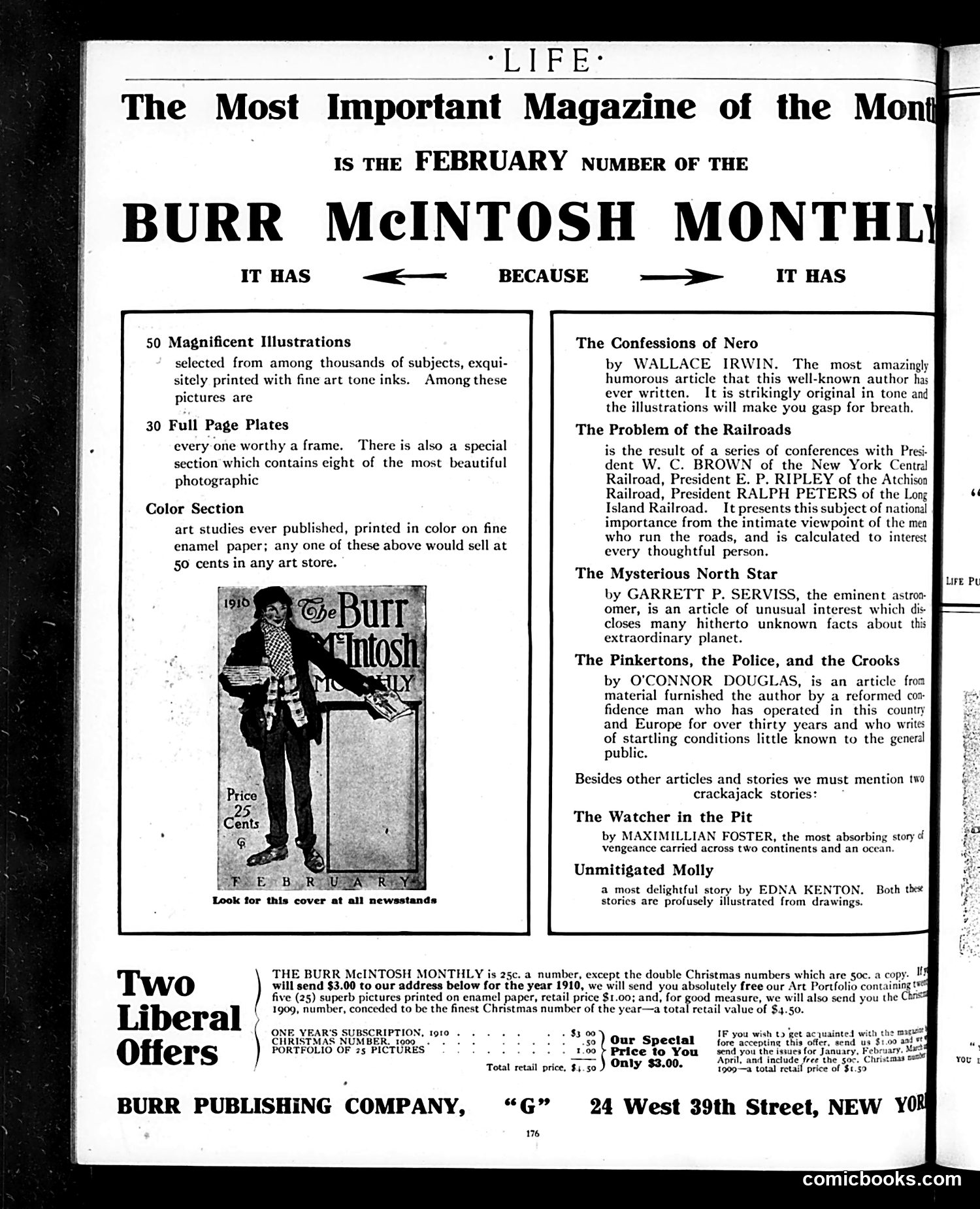
This is primarily a **magazine advertisement** for the February 1910 issue of *Burr McIntosh Monthly*, a high-end illustrated publication. The page contains no political cartoons or satire requiring historical context. The advertisement promotes the magazine's content through lists of articles and illustrations. Notable features include: - **"The Confessions of Nero"** by Wallace Irwin—a humorous piece treating the Roman emperor as a contemporary character - **"The Problem of the Railroads"**—featuring interviews with actual railroad presidents (W.C. Brown, E.P. Ripley, Ralph Peters), addressing contemporary concerns about railroad monopolies and regulation - **"The Mysterious North Star"** by astronomer Garrett P. Serviss—claiming to reveal unknown facts about a celestial body - Crime-themed stories featuring Pinkertons detectives and reformed confidence men The magazine emphasizes lavish production values (50 illustrations, color plates, full-page art) to justify its premium pricing. This reflects the era's market for illustrated magazines targeting educated, affluent readers.
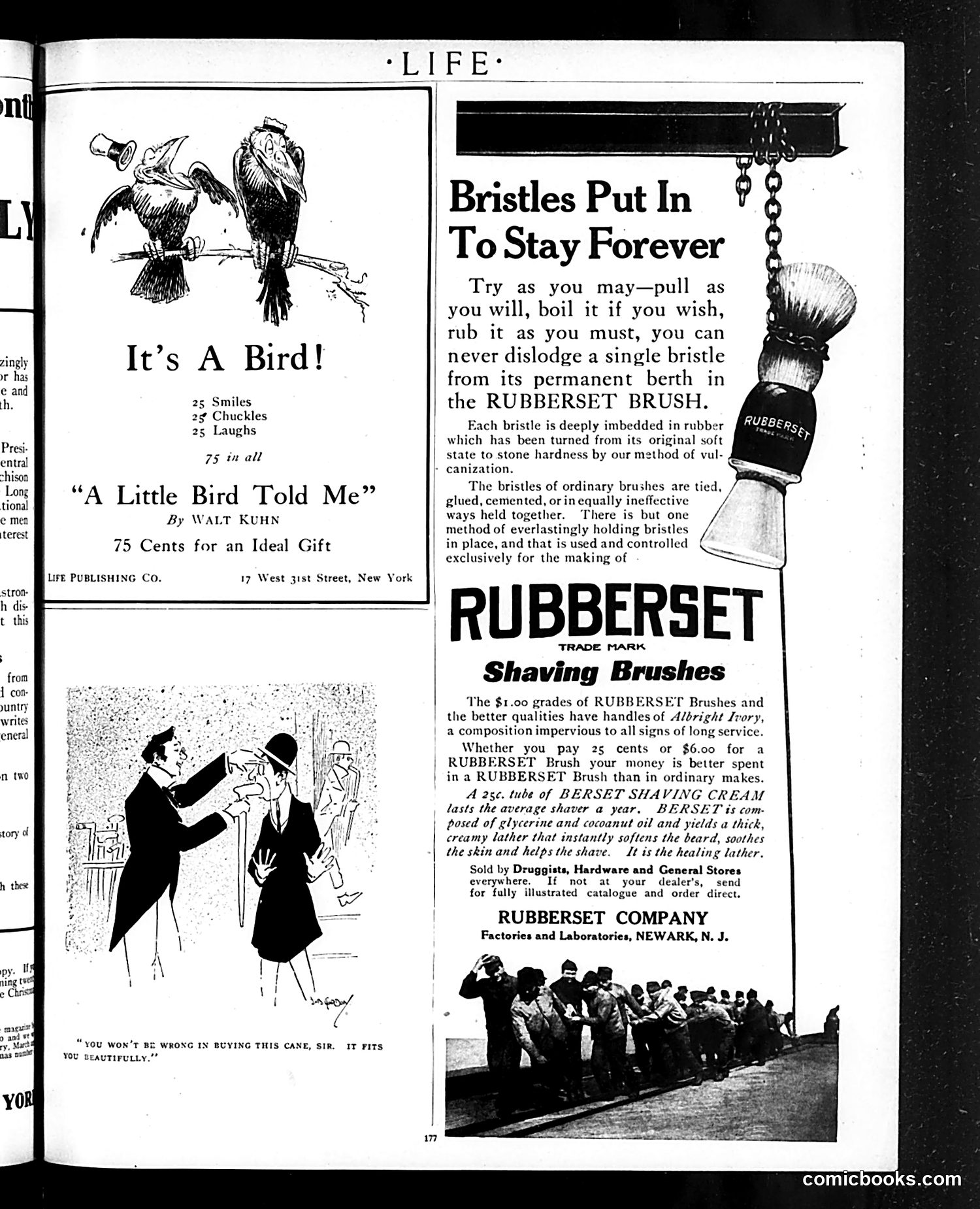
This page mixes editorial content with advertising, typical of Life magazine's format. **Left side:** Contains a book advertisement ("A Little Bird Told Me" by Walt Kuhn, 75 cents) and a cartoon showing a salesman telling a customer a cane "fits you beautifully"—a gentle joke about salesmen overselling mediocre products through flattery. The humor relies on the customer's obvious skepticism and the salesman's transparent insincerity. **Right side:** Dominates with a full advertisement for Rubberset shaving brushes, emphasizing that their bristles are permanently embedded in vulcanized rubber and won't fall out—contrasting with "ordinary brushes" where bristles are tied or glued. The ad promises durability and value across price points (25 cents to $6). The page reflects early 20th-century consumer culture: satirizing salesmanship while simultaneously showcasing aggressive product advertising claiming technological superiority. The cane cartoon and brush ad together humorously frame the tension between skeptical consumers and persuasive marketing.
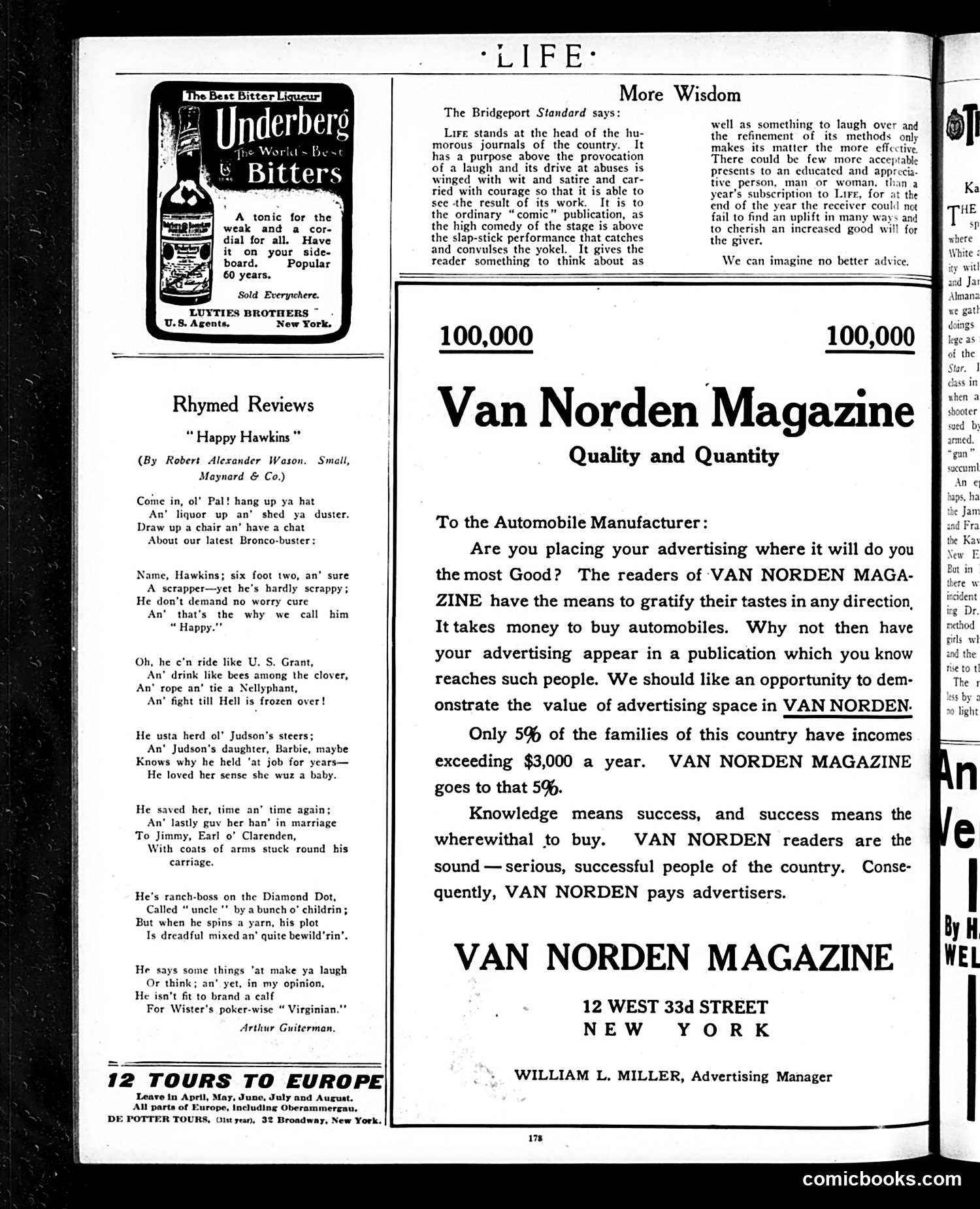
This page is primarily **advertising and editorial content** rather than political satire. It contains: **Left column:** An advertisement for Underberg Bitters (a digestive liqueur) and a humorous poem review of "Happy Hawkins" by Robert Alexander Wason—a Western novel. The poem, written by Arthur Guiterman, humorously summarizes the cowboy protagonist's exploits and romance, critiquing the character as inferior to Owen Wister's "The Virginian." **Right column:** Editorials praising Life's satirical mission (noting its superiority to ordinary comic publications) and a substantial advertisement for Van Norden Magazine, targeting automobile manufacturers by emphasizing that its readers represent the wealthy 5% of American families with incomes exceeding $3,000 annually—the demographic most likely to purchase automobiles. The page reflects early 20th-century magazine culture: literary reviews in verse, patent medicines, and class-targeted advertising directed at affluent readers.
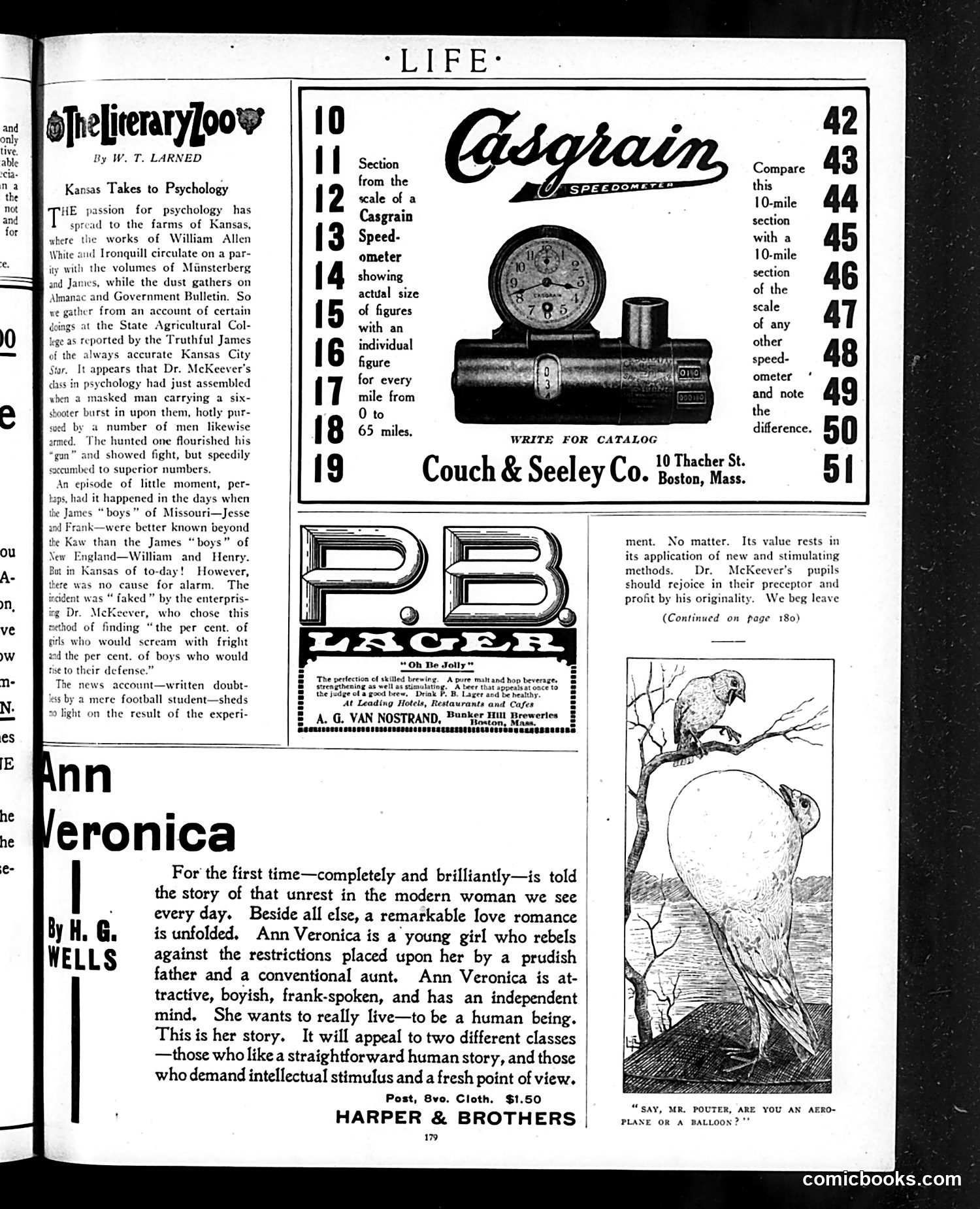
This page combines editorial content with advertisements and book promotions, typical of early 20th-century Life magazine. **Main Editorial Content:** "The Literary Zoo" column by W.T. Larned discusses Kansas's embrace of psychology, referencing William Allen White and citing an anecdote about Dr. McKeever's psychology experiment. A masked man bursts into a gathering, pursued by armed men—McKeever uses this staged scenario to observe whether girls scream in fright or boys rush to their defense. The piece satirizes both the methodology (faking a robbery to test gender responses) and Kansas's adoption of "modern" psychology as a trend. **Advertisements:** Feature a Casgrain speedometer and P.B. (likely a beverage) promotion. **Book Promotion:** H.G. Wells' *Ann Veronica*, about a young woman rebelling against paternal/patriarchal restrictions—relevant to contemporary debates about women's independence. **Cartoon:** The bottom illustration appears unrelated—showing a figure asking "Say, Mr. Pouter, are you an aeroplane or a balloon?"—likely a joke about hot air or pomposity, though context is unclear from this page alone.
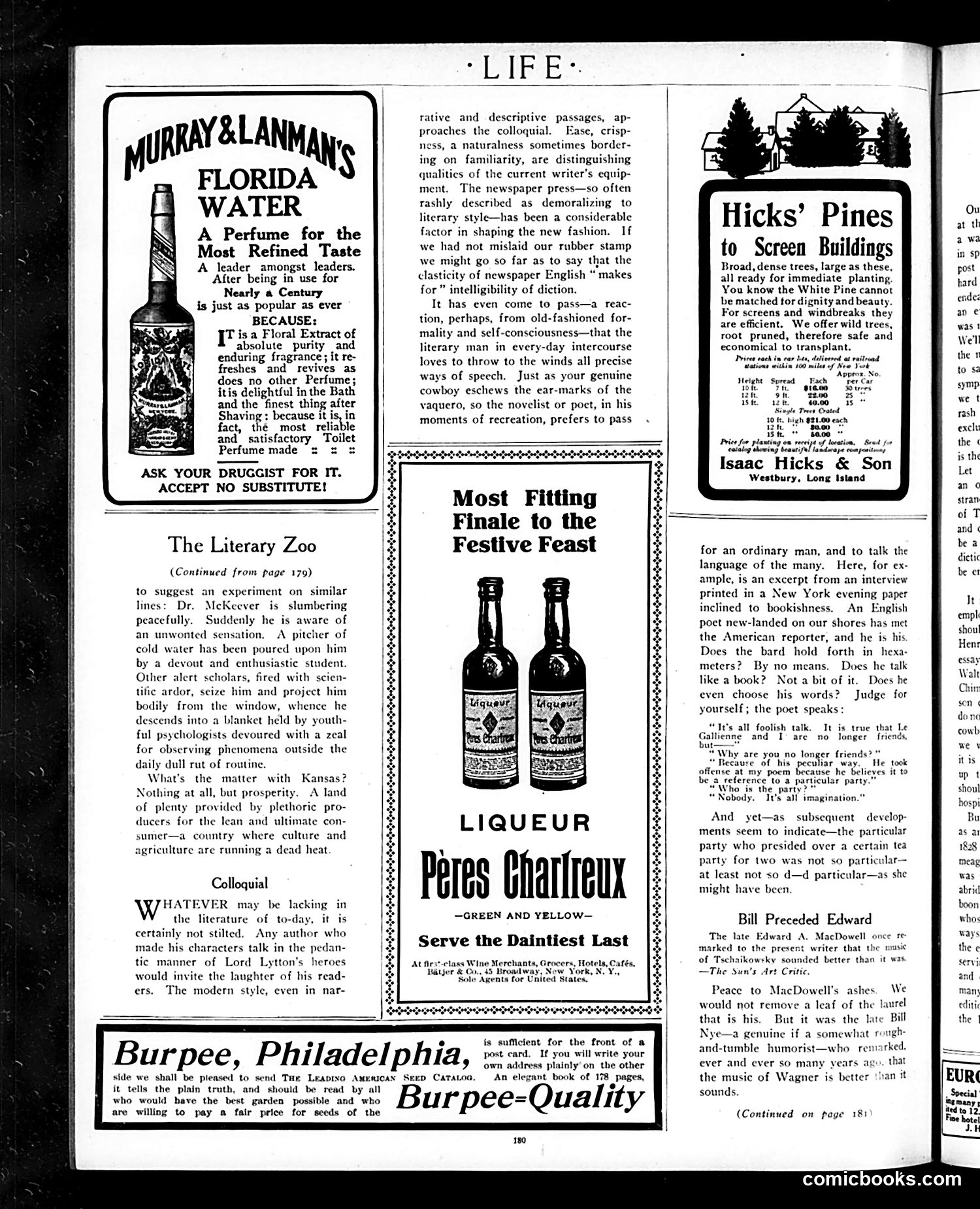
This page is primarily **advertising**, with limited editorial cartoon content. The main articles discuss modern literary style—noting that contemporary writers increasingly use colloquial, accessible language rather than formal Victorian prose. The piece observes that newspaper writing has influenced this trend toward "intelligibility of diction." The notable editorial content is a brief anecdote titled "The Literary Zoo," describing Dr. McKeever being dumped from a window by enthusiastic students—a satirical jab at academic excess, though the context is incomplete on this page. The **advertisements** are period-specific: Murray & Lanman's Florida Water perfume, Liqueur Péres Chafreux, Hicks' Pine trees, Burpee seeds, and other luxury goods. These reflect early 20th-century consumer culture targeting refined, educated readers. No identifiable political figures or major social satire appears on this page. It represents Life magazine's mixed format of light social commentary and upscale advertising.
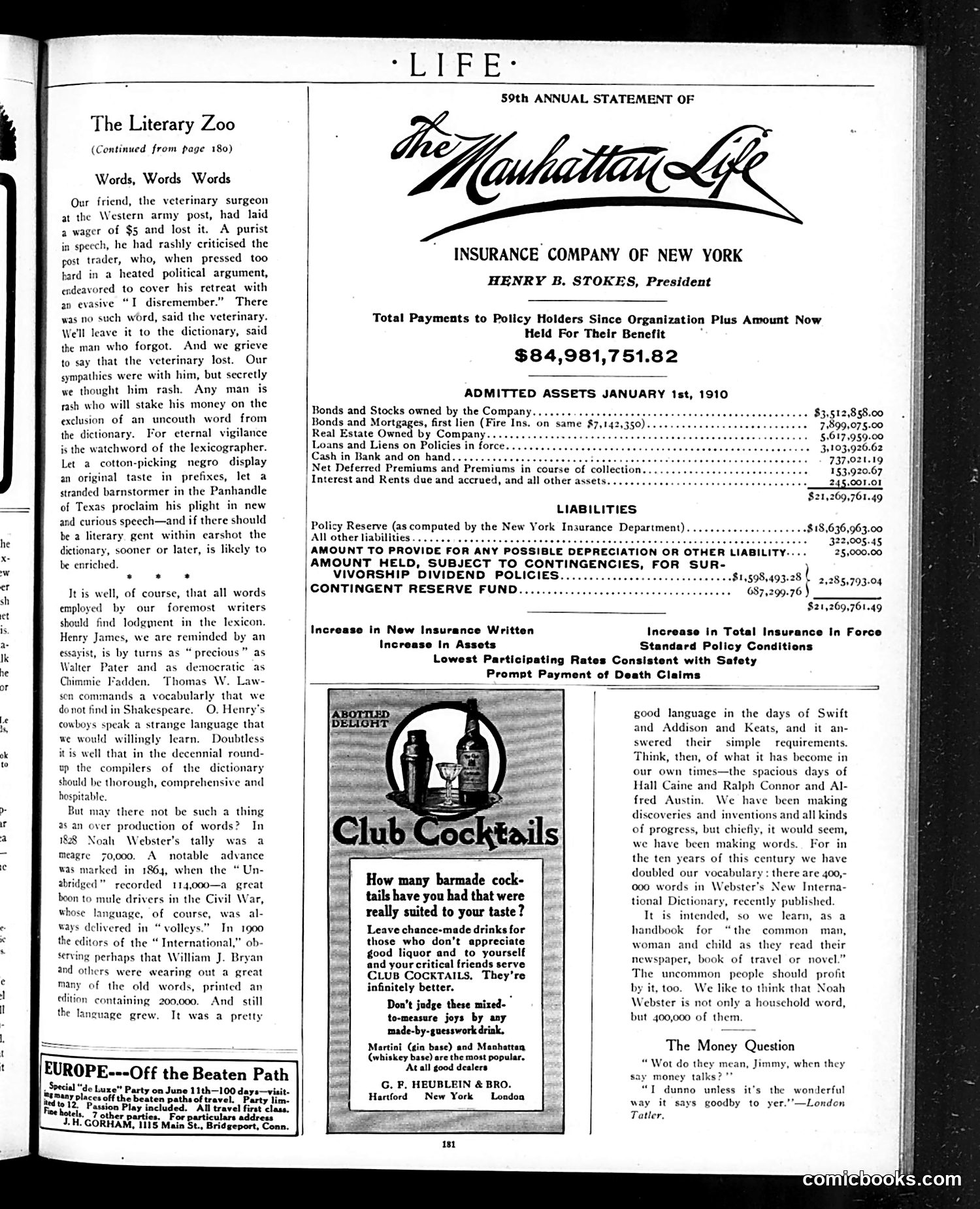
This essay satirizes linguistic excess and dictionary expansion. The author argues that while comprehensive dictionaries are valuable, there's danger in over-producing words. He notes Noah Webster's 1828 dictionary contained 70,000 words; by 1864 it had grown to 114,000; and by 1910 (the article's date) vocabulary had doubled to 400,000 words. The piece mocks writers who contribute unnecessarily obscure or invented language—referencing Henry James as alternately "precious" and democratic, Thomas W. Lawson's extensive vocabulary, and O. Henry's cowboys speaking "strange language." The opening anecdote about a veterinary surgeon losing a wager over whether "disremember" exists illustrates the problem: dictionaries inevitably validate whatever words circulate, encouraging linguistic chaos rather than preserving linguistic standards. The satire targets modern American culture's verbal inflation.
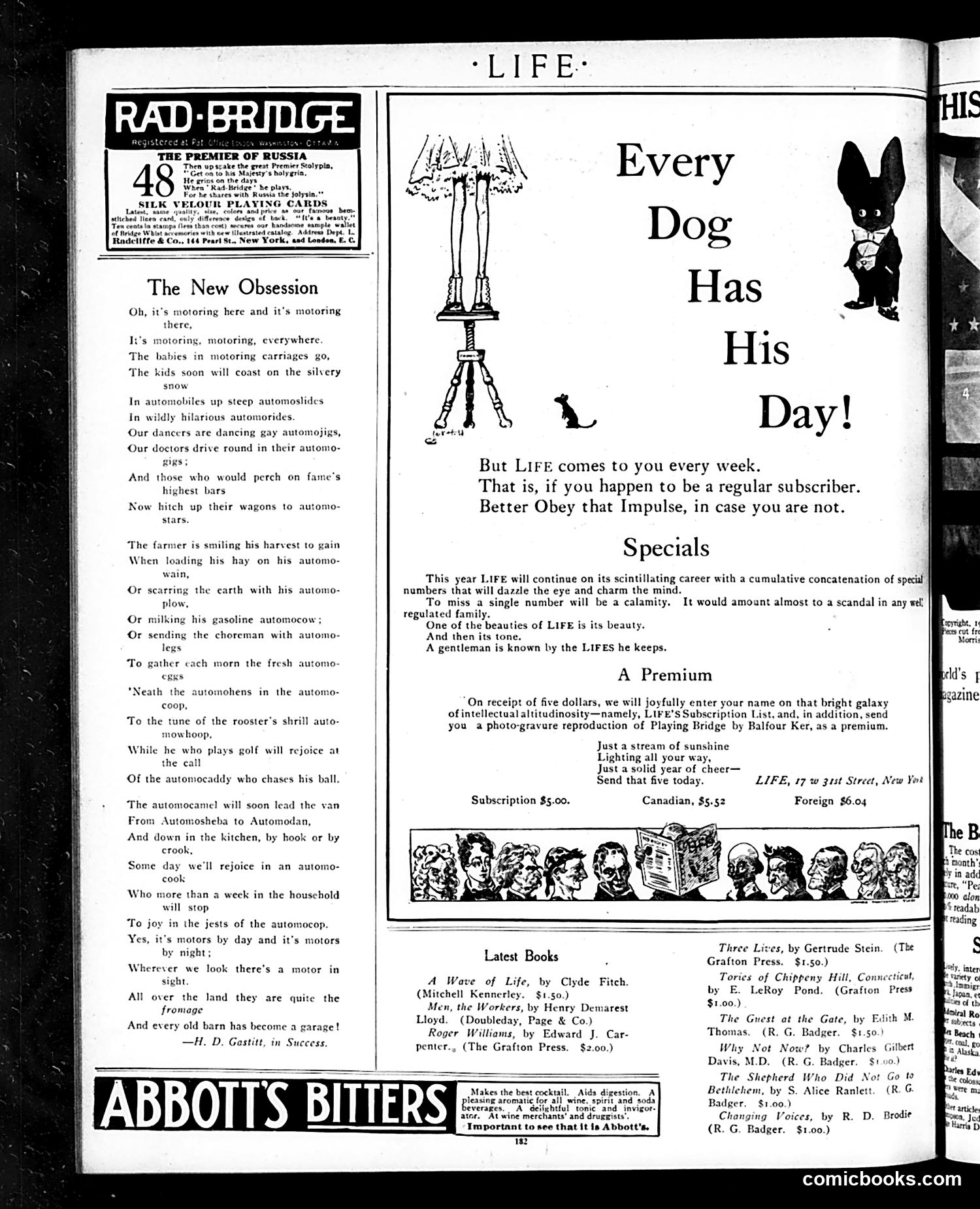
This page satirizes the early 1900s American craze for automobiles. The poem "The New Obsession" by H.D. Gestitt mocks how completely motor vehicles have infiltrated daily life—farmers use "automocows," doctors drive "automobiles," and even golf caddies are now "automocaddies." The satire works by stacking absurd automobile-prefixed neologisms to show how obsessively society has embraced motoring: "automorides," "automojigs," "automo-legs," "automo-eggs," "automohoop." The punchline—"every old barn has become a garage"—captures how this new technology is reshaping American infrastructure and values. This reflects genuine early-1900s anxiety about rapid technological change displacing traditional rural life. The poem's exaggeration was likely relatable to readers experiencing genuine disruption from automobiles appearing in their communities.
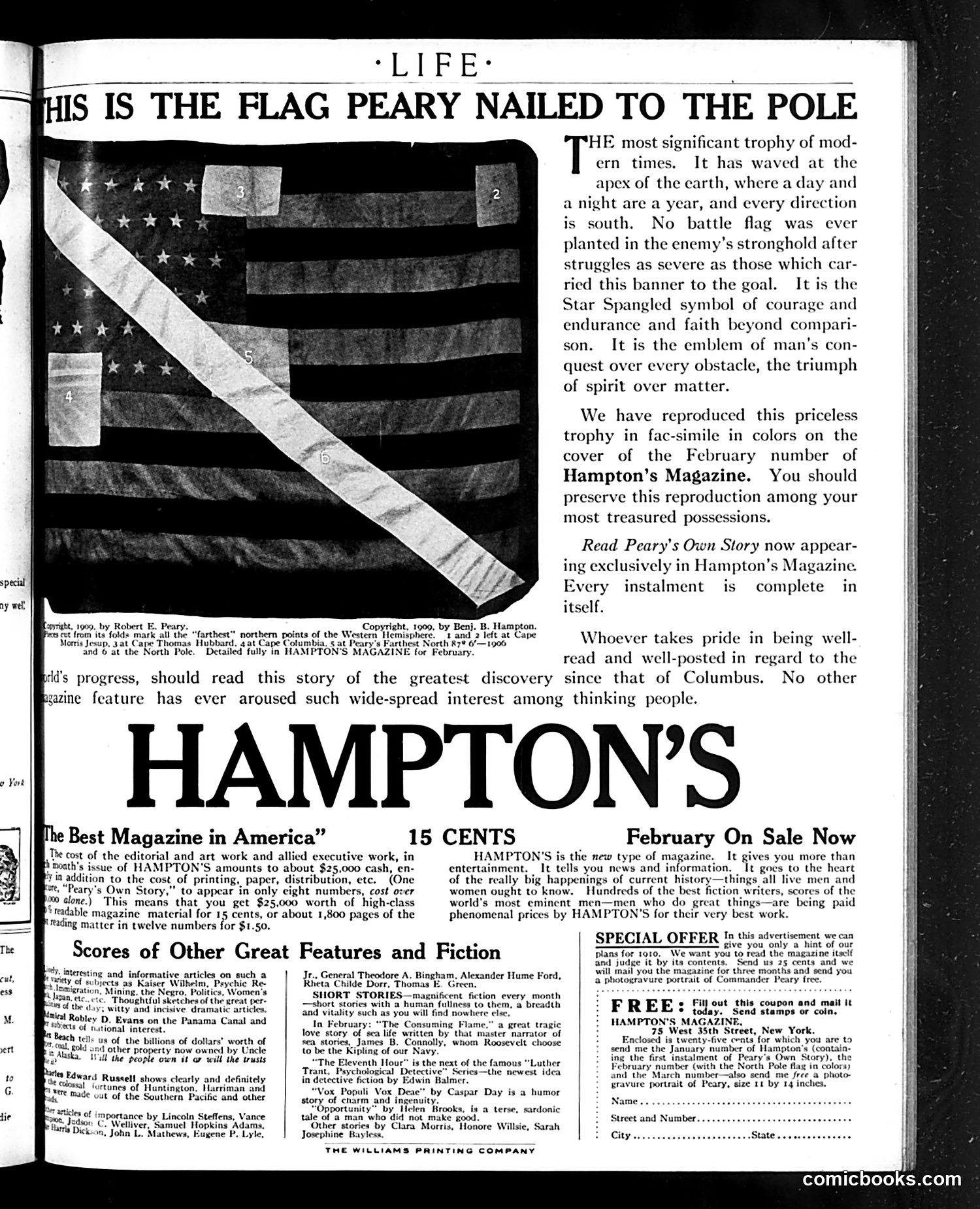
This is primarily **advertising**, not satire or political commentary. Life magazine is promoting Hampton's Magazine's February issue, which features explorer Robert Peary's account of reaching the North Pole (1909). The image shows the American flag that Peary planted at the pole, with numbered marks indicating previous "farthest north" expedition points. The accompanying text celebrates this as "the most significant trophy of modern times" and "the greatest discovery since that of Columbus." The appeal is straightforwardly patriotic and sensationalist: Hampton's is selling subscriptions by offering exclusive access to Peary's first-person narrative, positioning it as essential reading for educated Americans. There's no satire here—rather, genuine contemporary excitement about polar exploration as a symbol of American achievement and human triumph over nature. The text emphasizes the magazine's quality editorial work and diverse feature content to justify its 15-cent price.

This is a **Pall Mall cigarettes advertisement**, not political satire. The page features the brand's heraldic logo—a lion, unicorn, and crowned shield with the Latin motto "Dieu et Mon Droit" (God and My Right, the British royal motto). The ad emphasizes the product's British prestige and luxury through this royal imagery. The pricing comparison is its main message: Pall Mall cigarettes cost "A Shilling in London / A Quarter Here," likely aimed at American readers to highlight the brand's international reputation and suggest good value in the U.S. market. This is typical early 20th-century advertising strategy: using British royal associations to convey quality and sophistication to American consumers.