
Life, 1910-01-27 · page 10 of 36
Life — January 27, 1910 — page 10: what you’re looking at
What you’re looking at
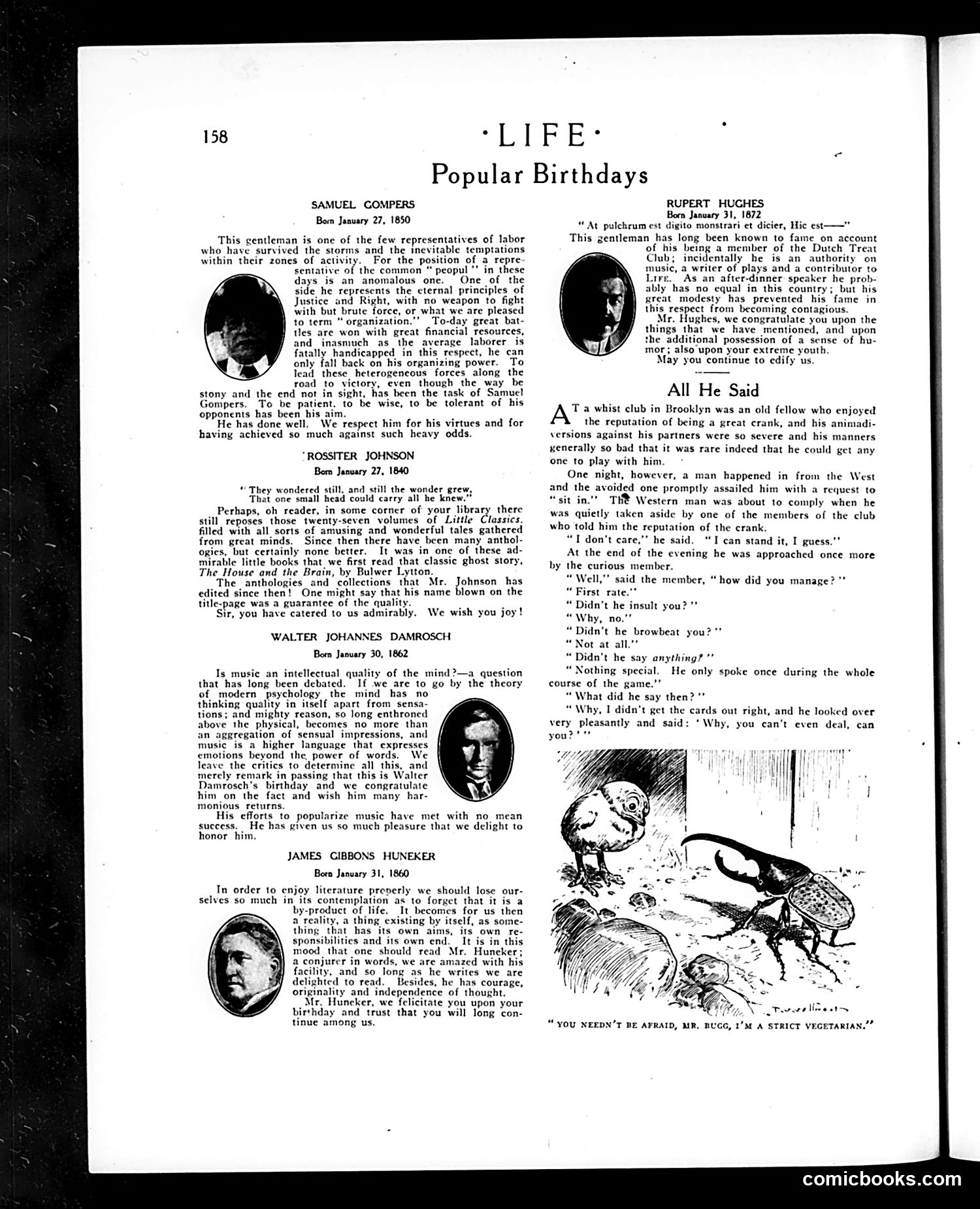
This page celebrates notable birthdays and includes a humorous cartoon titled "All He Said." The cartoon depicts a confrontation between two men over a card game, with one man (labeled "Mr. Rugg") claiming to be "a strict vegetarian." The joke appears to satirize social pretension and dietary fads popular among the wealthy in the early 1900s. The vegetarian's claim seems absurd given the physical altercation—his commitment to non-violence as a vegetarian is undermined by his apparent willingness to fight. The cartoon mocks those who adopt fashionable health or ethical positions while failing to live consistently by them, a common target of Life magazine's satirical humor.
📄 Transcribed text from this page (OCR, searchable)
Machine-transcribed from the original scan — historical spelling and the odd misread are preserved.
LBB Popular Birthdays SAMUEL COMPERS Born January 27, 1850 This gentleman is one of the few representatives of labor who have survived the storms and the inevitable temptations within their zones of activity. For the position of a repre sentative of the common “ peopul ”? in these days is an anomalous one. One of the side he represents the eternal principles of Justice and Right, with no weapon to fight with but brute force, or what we are pleased to term “organization.”” To-day great bat- tles are won with great financial resources, and inasmuch as the average laborer is fatally handicapped in this respect, he can only fall back on his organizing power. To Tead these. heterogeneous forces along the road to victory, even though the way be stony and the end not in sight, has been the task of Samuel Gompers. To be patient. to be wise, to be tolerant of his opponents has been his aim. . He has done well. We respect him for his virtues and for having achieved so much against such heavy odds. “ROSSITER JOHNSON Bom January 27, 1840 “ They wondered still, and still the wonder grew, That one small head could carry all he knew.” Perhaps, oh reader, in some corner of your library there still reposes those twenty-seven volumes of Little Classics. filled with all sorts of amusing and wonderful tales gathered from great minds. Since then there have been many anthol- ogics, but certainly none better. It was in one of these ad- mirable little books that we first read that classic ghost story, The House and the Brain, by Bulwer Lytton. The anthologies and’ collections that Mr. Johnson has edited since then! One might say that his name blown on the title-page was a guarantee of the quality. . ; Sir, you have catered to us admirably. We wish you joy! WALTER JOHANNES DAMROSCH Born January 30, 1862 Is musie an intellectual quality of the mind?—a question that has long been debated. If we are to go by the theory of modern psychology the mind has no thinking quality in itself apart from sensa- tions; and mighty reason, so long enthroned above the physical, becomes no more than an aggregation of sensual impressions, and music is a higher language that expresses emotions beyond the power of words. We leave the critics to determine all this, and merely remark in passing that this is Walter Damrosch’s birthday and we congratulate him on the fact and wish him many har- monious returns. His efforts to popularize music have met with no mean success. He has given us so much pleasure that we delight to honor him. JAMES CIBBONS HUNEKER Bora January 31, 1860 In order to enjoy literature properly we should lose our- selves so much in its contemplation as to forget that it is a by-product of life. It becomes for us then a reality, a thing existing by itself, as some- thing that has its own aims, its own re- sponsibilities and its own end. It is in this mood that one should read Mr. Huneker; a conjurer in words, we are amazed with his facility, and so long as he writes we are delighted to read. Besides, he has courage, originality and independence of thought. Mr. Huneker, we felicitate you upon your birthday and trust that you will long con- tinue among us. RUPERT HUGHES Born Janvary 31, 1872 “At pulchrum est digito monstrari et dicier, Hic est——" This gentleman has long been known to fame on account of his being a member of the Dutch Treat Club; incidentally he is an authority on music, a writer of plays and a contributor to Lire.’ As an after-dinner speaker he prob- ably has no equal in this country; but his great modesty has prevented his fame in this respect from becoming contagious. Mr. Hughes, we congratulate you upon the things that we have mentioned, and upon the additional possession of a sense of hu- mor; also upon your extreme youth. May you continue to edify us. All He Said A’ a whist club in Brooklyn was an old fellow who enjoyed the reputation of being a great crank, and his animadi- versions against his partners were so severe and his manners generally so bad that it was rare indeed that he could get any one to play with him. One night, however, a man happened in from the West and the avoided one promptly assailed him with a request to “sit in” THE Western man was about to comply when he was quietly taken aside by one of the members of the club who told him the reputation of the crank. “Tdon’t care,"" he said. “I can stand it, I guess.”" At the end of the evening he was approached once more by the curious member. “Well,”” said the member, “how did you manage? "* “ First rate. “Didn't he insult you? ”* “Why, no."” “Didn't he browbeat you?" “Not at all.” “Didn't he say anything? ”” “Nothing special. He only spoke once during the whole course of the game. “What did he say then?" “Why, I didn't get the cards out right, and he looked over very pleasantly and said: ‘Why, you can’t even deal, can Tecra linet “YOU NEEDN'T BE AFRAID, MR, BUGG, I’M A STRICT VEGETARIAN.” comicbooks.com