
Life, 1910-01-27 · page 16 of 36
Life — January 27, 1910 — page 16: what you’re looking at
What you’re looking at
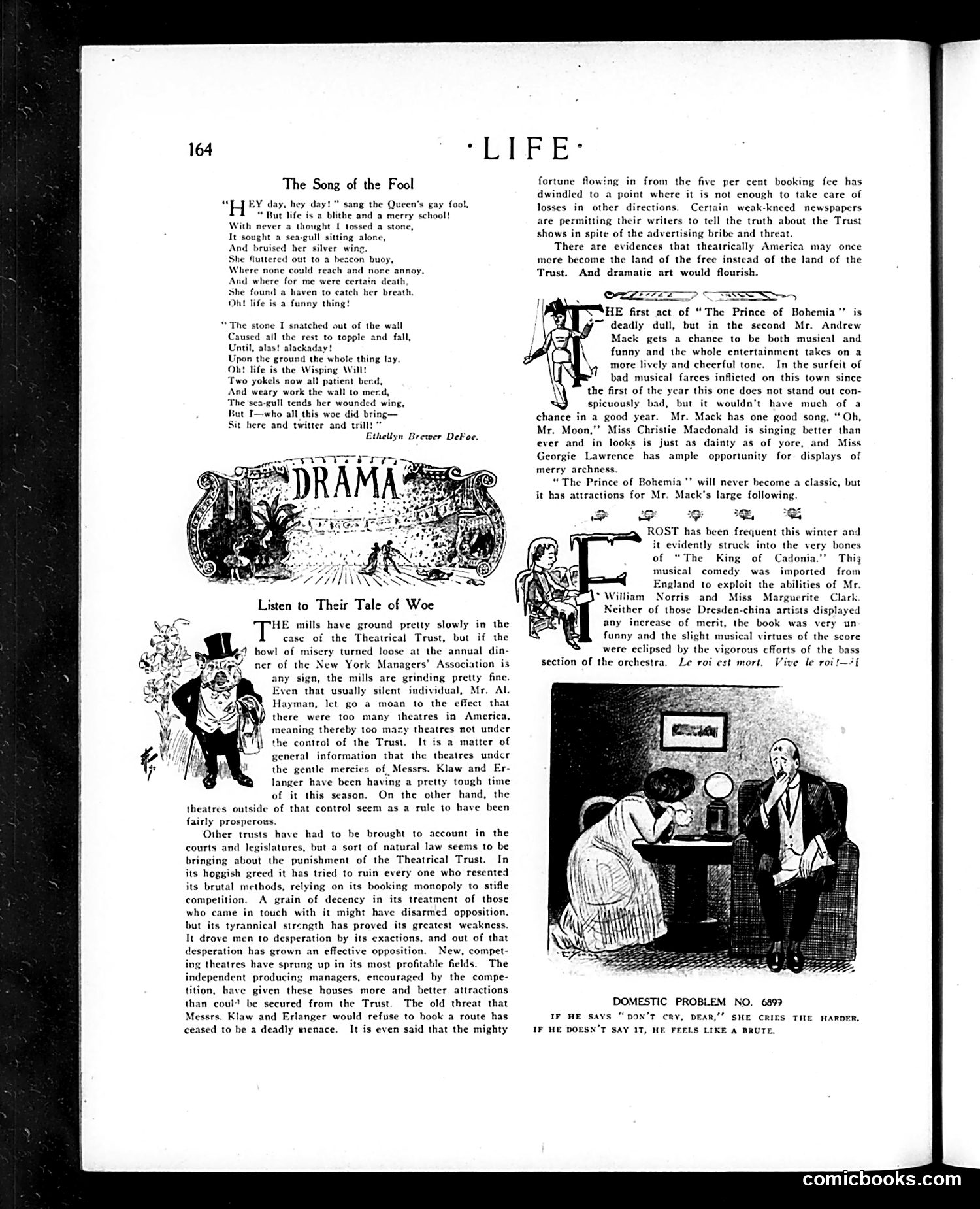
This page contains theatrical criticism and social commentary typical of Life's satirical approach. **"The Song of the Fool"** is a narrative poem about consequences—a fool thoughtlessly throws a stone, causing a seagull injury and a wall to collapse, yet faces no repercussions while others suffer. The satire likely comments on how the powerful escape accountability for their destructive actions. **"Listen to Their Tale of Woe"** attacks the **Theatrical Trust** (Klaw and Erlanger's monopoly controlling American theater booking). Life celebrates their decline: independent theaters are now thriving, competing houses offer better entertainment, and the Trust's "booking monopoly" stranglehold is weakening. The article suggests that tyranny inevitably breeds opposition and its own defeat—a vindication of free-market competition over monopolistic control. The theater reviews below discuss specific productions, maintaining Life's focus on entertainment criticism intertwined with broader social commentary about monopolistic power and justice.
📄 Transcribed text from this page (OCR, searchable)
Machine-transcribed from the original scan — historical spelling and the odd misread are preserved.
*LIPE* The Song of the Fool “HEY day, hey dayt ” sang the Queen's gay fool, “ But life is a blithe and a merry school! With never a thought I tossed a stone, It sought a sea-gull sitting alone, Ai bruised her silver wing. She fluttered out to a hezcon buoy, Where none could reach and nore annoy, nd where for me were certain death dhe found a haven to catch her breath. Oh! life is a funny thing! "The stone I snatched out of the wall Caused all the rest to topple and fall, Until, alas! alackaday! Upon the ground the whole Oh! life is the Wisping Will! ‘Two yokcls now all patient berd, And weary work the wall to merd, ‘The sca-gull tends her wounded wing, Rut T—who all this woe did bring— Sit here and twitter and trill! Ethellyn Brewer Dek oc. ing lay, Listen to Their Tale of Woe HE mills have ground pretty slowly in the case of the Theatrical Trust, but if the howl! of misery turned loose at the annual din- ner of the New York Managers’ Association is any sign, the mills are grinding pretty fine. ven that usually silent individual, Mr. Al. Hayman, let go a moan to the effect that meaning thereby too mary theatres not under the control of the Trust. It is a matter of general information that the theatres undcr the gentle mercies of Messrs. Klaw and Er- langer have been having a pretty tough time of it this season. On the other hand, the theatres outside of that control seem as a rule to have been fairly prosperous. Other trusts have had to be brought to account in the courts and legislatures, but a sort of natural law seems to be bringing about the punishment of the Theatrical Trust. In its hoggish greed it has tried to ruin every one who resented its brutal methods, relying on its booking monopoly to stifle competition. A grain of decency in its treatment of those who came in touch with it might have disarmed opposition. but its tyrannical strength has proved its greatest weakness. It drove men to desperation by its exactions, and out of that desperation has grown an effective opposition. New, compet- ing theatres have sprung up in its most profitable fields. The independent producing managers, encouraged by the compe- tition, have given these houses more and better attractions than coul? be secured from the Trust. The old threat that Messrs. Klaw and Erlanger would refuse to book a route has ceased to be a deadly menace. It is even said that the mighty fortune flowing in from the five per cent booking fee has dwindled to a point where it is not cnough to take care of losses in other directions. Certain weak-kneed newspapers are permitting their writers to tell the truth about the Trust shows in spite of the advertising bribe and threat. There are evidences that theatrically America may once more become the land of the free instead of the land of the Trust. And dramatic art would flourish. —S HE first act of “The Prince of Bohemia’? is deadly dull, but in the second Mr. Andrew Mack gets a chance to be both musical and funny and the whole entertainment takes on a more lively and cheerful tone. In the surfeit of bad musical farces inflicted on this town since the first of the year this one does not stand out con- spicuously bad, but it wouldn't have much of a chance in a good year. Mr. Mack has one good song, “Oh, Mr. Moon,"” Miss Christie Macdonald is singing better than ever and in looks is just as dainty as of yore, and Miss Georgie Lawrence has ample opportunity for displays of merry archness. “The Prince of Bohemia "’ will never become a classic, but it has attractions for Mr. Mack's large following. ROST has been frequent this winter and it evidently struck into the very bones of “The King of Cadonia."? Thi3 musical comedy was imported from England to exploit the abilities of Mr. Norris and Miss Marguerite Clark ther of those Dresden-china artists displayed any increase of merit, the book was very un funny and the slight musical virtues of the score were eclipsed by the vigorous efforts of the bass section of the orchestra. Le roi est mort. Vive le roi!—*f DOMESTIC PROBLEM NO. 6899 IF HE SAYS “DON’T CRY, DEAR’? SHE CRIES TITE HARDER. IF HE DOESN'T SAY 1T, HE PEELS LIKE A BRUTE. comicbooks.com