
Life, 1910-01-27 · page 17 of 36
Life — January 27, 1910 — page 17: what you’re looking at
What you’re looking at
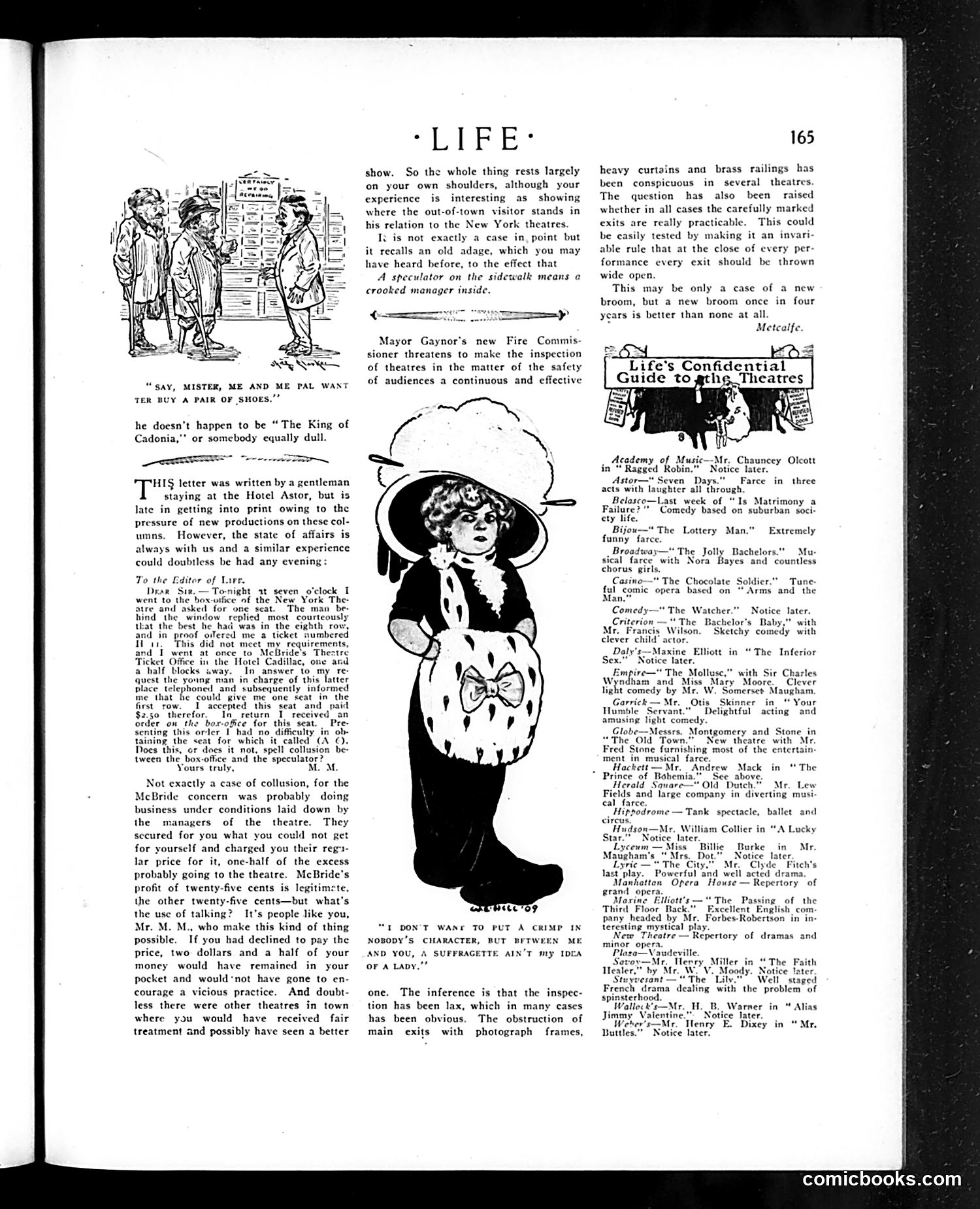
This page contains **theater-related complaints and satire** from early 20th-century New York. The main cartoon shows two working-class men asking a shoe salesman for footwear—a visual joke accompanying a letter criticizing ticket scalping. A hotel guest paid $2.50 through a middleman (McBride's ticket office) for a seat that cost $2.00 at the box office, effectively subsidizing the scalper's 50-cent markup. The editor's response blames consumers for enabling this "vicious practice" rather than the theater managers—arguing that refusing to overpay would eliminate scalping incentives. A second cartoon features a man dismissing suffragettes as "not my idea of a lady"—reflecting anti-women's-suffrage sentiment common in the era. The page also notes Mayor Gaynor's Fire Commissioner promised better theater safety inspections, referencing poor emergency exit conditions (blocked by curtains and frames)—a serious concern after theater fire disasters of that period.
📄 Transcribed text from this page (OCR, searchable)
Machine-transcribed from the original scan — historical spelling and the odd misread are preserved.
“Say, MISTER, ME AND ME PAL WANT TER BUY A PAIR OF SHOES.’” he doesn’t happen to be “The King of Cadonia,"’ or somebody equally dull. ee TH letter was written by a gentleman staying at the Hotel Astor, but is late in getting into print owing to the pressure of new productions on these col- umns, However, the state of affairs is always with us and a similar experience could doubtless be had any evening: Tee eece TO To the Editor of Larr. Drax Sir. — To-night at seven o'clock I went to the box-oifice of the Ni York Th atre and asked for one seat. The man be- hind the window replied. most courteously tkat the best he had was in the eighth row, in proof oifered me a ticket numbered This did not meet my requirements, and I went at once to McBride's Theztre Ticket Office in the Hotel Cadillac, one and a half blocks away. In answer to my re- quest the young man in charge of this latter place telephoned and subsequently informed me that fe could give me one seat in the st row. accepted this seat and paid 2.50 therefor. In_ return I received an order on the box-ofice for this seat. Pre- senting this orler I had no_ difficulty ob- taining the seat for which it called (A ©). Does this, or does it not, spell collusion be- tween the box-office and the ayecularer?, Yours truly, M. M. Not exactly a case of collusion, for the McBride concern was probably doing business under conditions laid down by the managers of the theatre. They sccured for you what you could not get for yourself and charged you their regs lar price for it, one-half of the excess probably going to the theatre. McBride's profit of twenty-five cents is legitim the other twenty-five cents—but what's the use of talking? It’s people like you, Mr. M. M., who make this kind of thing possible. If you had declined to pay the price, two dollars and a half of your money would have remained in your pocket and would-not have gone to cn- courage a vicious practice. And doubt- less there were other theatres in town where you would have received fair treatment and possibly have seen a better LIFE So the whole thing rests largely on your own shoulders, although your experience is interesting as showing where the out-of-town visitor stands in his relation to the New York theatres. Iz is not exactly a case in, point but it recalls an old adage, which you may have heard before, to the effect that A speculator on the sidewalk means @ crooked manager inside. show. —=== Mayor Gaynor’s new Fire Commis- sioner threatens to make the inspection of theatres in the matter of the safety of audiences a continuous and effective rs 1 DON’T WANE TO PUT A CRIMP IN NOBODY’S CHARACTER, BUT BFTWEEN ME AND YOU, A SUFFRAGETTE AIN'T my IDEA OF A Laby, one. The inference is that the inspec- tion has been lax, which in many cases has been obvious. The obstruction of main exits with photograph frames, 165 heavy curtains ana brass railings has been conspicuous in several theatres. The question has also been raised whether in all cases the carefully marked exits are really practicable. This could be casily tested by making it an invari- able rule that at the close of every per- formance every exit should be thrown wide open This may be only a case of broom, but a new broom once years is better than none at all . Metcalfe. a new in four , Academy of Music in’ Ragged Robin.” ice later. Astor—" Seven Days.” Farce in acts with laughter all through, Belasco—Last week of “Is Matrimony a Failure?" Comedy based on suburban soci- ety life. Bijou— funny fares Broadway—" The Jolly Bachelors." Mu- sical farce with Nora Bayes and countless chorus girls. Casino The Chocolate Soldier.” Tune- ful comic opera based on “Arms and the Man.” Comedy—" The Watcher. Criterion The Mr. Francis Wilson. clever child’ actor. “s—Maxine Elliott in otice later. mpire—"* The Mollysc,” ham and Miss Mary Chauncey Olcott three The Lottery Man.” Extremely Notice later. Bachelor's Baby,” with Sketchy comedy with “The Inferior with Sir Charles Moore. Clever Tight comedy by Mr. W. Somerset Maugham Garrick — Mr. Otis Skinner in “ Your Humble Servant." Delightful acting and amusing light comedy. Globe—Messrs. Montgomery and Stone in “The Old Town.” New theatre with Mr. Fred Stone furnishing most of the entertain’ ment in musical farce, Hackett —Mr, Andrew Mack in Prince of Bohemia.” See above, Herald Souare—" Old Dutch.” Mr. Le Fields and large company in diverting mu cal farce. Hippodrome — Tank spectacle, ballet and circus Mr. William Collier in “A Lucky Hudson "Notice later. fis Billie Burke in Mr. “Mrs. Dot.” Notice later The City.” 3 de Fitch's last play Powerful and well acted drama Manhatten Opera House — Repertory of grand opera. Marine Elliott's — Third Floor Back.” pany headed by Mr. teresting mystical play. New Theatre — Repertory of dramas and minor oper Plaza—Vaudeville Merry The Passing of the Excellent English com: ‘orbes-Robertson in in- Miller in “The Faith Notice later Well staged French drama dealing with the problem of spinsterhood. Wallock’'s—Mr. H. B. Warner in Jimmy ‘Vaientine.” "Notice later. Weber's Henry E. Dixey in Buttles.” Notice later. Alias “Mr. comicbooks.com