
Life, 1910-01-27 · page 8 of 36
Life — January 27, 1910 — page 8: what you’re looking at
What you’re looking at
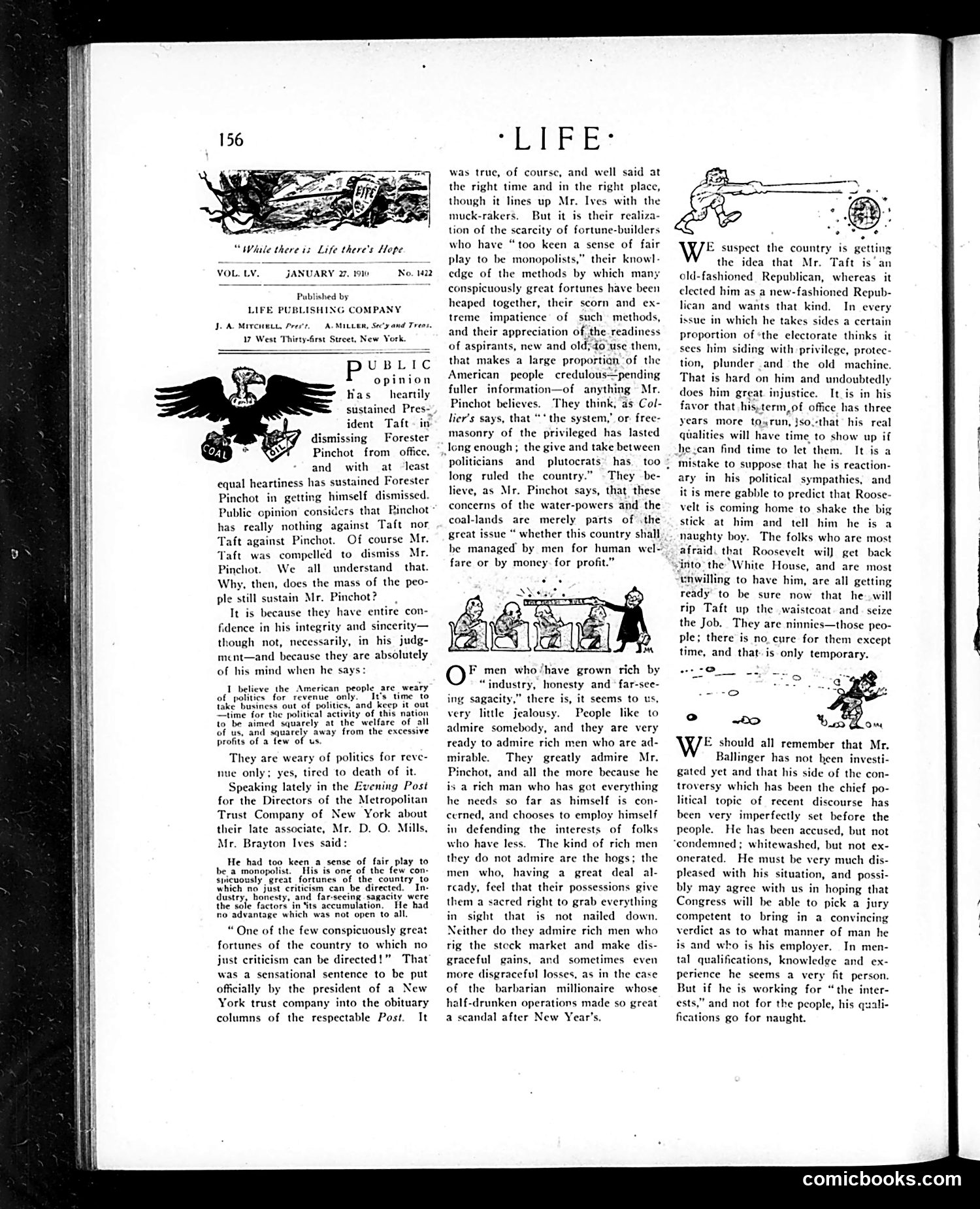
This page contains political commentary criticizing President Theodore Roosevelt's approach to trust-busting and regulation. The text discusses public opinion's weariness with Roosevelt's anti-monopoly campaign, suggesting Americans want less political interference in business. The article defends wealthy industrialists like Mr. Pinchot against criticism, arguing that rich men who built fortunes deserve admiration rather than suspicion. It argues Roosevelt's aggressive trust-busting is unnecessary and that the public is tired of his interventionist policies. The small illustrations appear to be decorative vignettes typical of Life magazine's satirical style, though specific subjects are difficult to identify clearly in this reproduction. The overall message critiques Roosevelt's progressive regulatory agenda as overzealous and unpopular with ordinary citizens seeking stable business conditions.
📄 Transcribed text from this page (OCR, searchable)
Machine-transcribed from the original scan — historical spelling and the odd misread are preserved.
“Whale there is Life there's Hope VOL. LY. No. u22 Published by LIFE PUBLISHING COMPANY JA. Mrvcieny, Press, W West Thirty-first Street, New York. A. MILLER, Sec'y and Treas. UBLIC opinion Nas __ heartily sustained Pres- ident Taft. in 7 dismissing Forester Pinchot from office, and with at least equal heartiness has sustained Forester Pinchot in getting himself dismissed. Public opinion considers that Pinchot has really nothing against Taft nor Taft against Pinchot. Of course Mr. aft was compelled to dismiss Mr. Pinchot. We all understand that. Why, then, does the mass of the peo- ple still sustain Mr. Pinchot? It is because they have entire con- fidence in his integrity and sincerity: though not, necessarily, in his judg- ment—and because they are absolutely of his mind when he says: I believe the American people are weary of pol or revenue only. It's time to take bi out of politics, and keep it out —time for the political activity of this nation to be aimed squarely at the welfare of all fof us, and squarely away from the excessive profits of a few of us. They are weary of politics for reve- nue only; yes, tired to death of it. Speaking lately in the Evening Post for the Directors of the Metropolitan Trust Company of New York about their late associate, Mr. D. O. Mills, Mr. Brayton Ives said: He had too keen a sense of fair play to be a monopolist. His is one of the few con- spicuously great fortunes of the country to which no just criticism can be directed. In dustey, honesty, and far-seeing sagacity were lat the sole factors’ in ‘its accumulation. He had no advantage which was not open to all. “One of the few conspicuously great fortunes of the country to which no just criticism can be directed!” That was a sensational sentence to be put officially by the president of a New York trust company into the obituary columns of the respectable Post. It gf Pell cles was truce, of course, and well said at the right time and in the right place, though it lines up Mr. Ives with the muck-rakers. But it is their realiza- tion of the scarcity of fortune-builders. who have “too keen a sense of fair play to be monopolists,” their _knowl- edge of the methods by which many conspicuously great fortunes have been heaped together, their scorn and ex- treme impatience of such methods, and their appreciation of the readiness of aspirants, new and old;docuse them, that makes a large proportion of the American people credulous—pending fuller information—of anything Mr. Pinchot believes. They think, as Col- lier’s says, that “‘ the system,’ or free- masonry of the privileged has lasted long enough; the give and take between politicians and plutocrats’ has. too long ruled the country.” They be- lieve, as Mr. Pinchot says, that these concerns of the water-powers and the coal-lands are merely parts of .the great issue “ whether this country shall be managed by men for human wel- fare or by moncy. for profit.” 7 men who/have grown rich by “industry, honesty and‘ far-see- ing sagacity,” there is, it seems to us, very little jealousy. People like to admire somebody, and they are very ready to admire rich men who are ad- mirable. They greatly admire Mr. Pinchot, and all the more because he is a rich man who has got everything he needs so far as himself is con- cerned, and chooses to employ himself in defending the interests of folks who have less. The kind of rich men they do not admire are the hogs; the men who, having a great deal al- ready, feel that their possessions give them a sacred right to grab everything in sight that is not nailed down. Neither do they admire rich men who rig the steck market and make dis- graceful gains, and sometimes even more disgraceful losses, as in the case of the barbarian millionaire whose half-drunken operations made so great a scandal after New Year's. suspect the country is getting the idea that Mr. Taft is’ an old-fashioned Republican, whereas it clected him as a new-fashioned Repub- lican and wants that kind. In every issue in which he takes sides a certain proportion of ‘the electorate thinks it sees him siding with privilege, protec- tion, plunder and the old machine. That is hard on him and undoubted! does him great injustice. It is in his favor that his,term,of office has three years more toxrun, jso.-that his real qualities will have time to show up if he can find time to let them. It is a mistake to suppose that he is reaction- ary in his political sympathies, and is mere gabble to predict that Roose- velt is coming home to shake the big stick at him and tell him he is a naughty boy. The folks who are most afraid. that Roosevelt wil) get back ‘into the ‘White House, and are most unwilling to have him, are all getting ready to be sure now that he will rip Taft up the waistcoat and. seize the Job. They are ninnies—those peo- ple; there is no. cure for them except time, and that. is only temporary. we OL WE should all remember that Mr. Ballinger has not heen investi- gated yet and that his side of the con- troversy which has been the chief po- litical topic of recent discourse has been very imperfectly set before the people. He has been accused, but not “condemned ; whitewashed, but not ex- onerated. He must be very much dis- pleased with his situation, and possi- bly may agree with us in hoping that Congress will be able to pick a jury competent to bring in a convincing verdict as to what manner of man he is and who is his employer. In men- tal qualifications, knowledge and ex- perience he seems a very fit person. But if he is working for “the inter- ests,” and not for the people, his qzuali- fications go for naught. comicbooks.com