
Life, 1910-01-27 · page 22 of 36
Life — January 27, 1910 — page 22: what you’re looking at
What you’re looking at
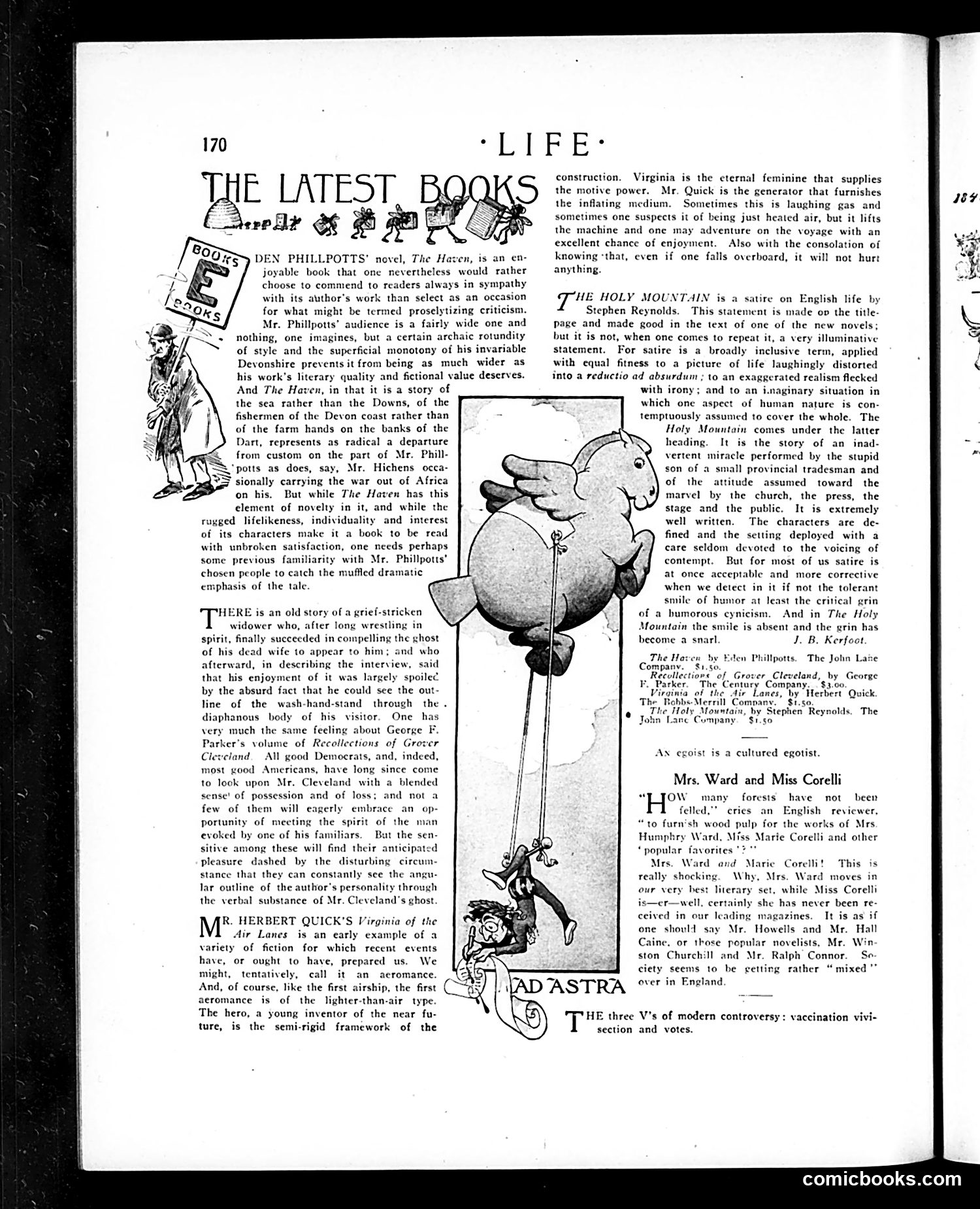
This page features literary reviews of contemporary novels, accompanied by an illustration labeled "AD ASTRA" depicting a figure in a hot air balloon. **Key Content:** The reviews discuss Den Phillpotts' *The Haven* (a sea story departing from his typical Devonshire settings), George Parker's *Recollections of Grover Cleveland* (criticized for the author's personality overshadowing the subject), and R. Herbert Quick's *Virginia of the Air Lanes* (described as an "aeromance"—an early aviation romance where the female character Virginia provides the emotional "motive power"). **The Cartoon:** The "AD ASTRA" illustration satirizes Quick's novel by literally depicting the concept: a woman in a balloon basket carries a man aloft, humorously visualizing the female character as the driving force. The Latin title means "toward the stars," reinforcing the aspirational aviation theme and the reviewer's playful tone about this emerging fiction genre.
📄 Transcribed text from this page (OCR, searchable)
Machine-transcribed from the original scan — historical spelling and the odd misread are preserved.
170 “LIFE: THE LATEST ats) steve LY & x E Ea DEN PHILLPOTTS’ novel, The Haven, is an en- joyable book that one nevertheless would rather choose to commend to readers always in sympathy with its author's work than select as an occasion for what might be termed proselytizing criticism. Mr. Phillpotts’ audience is a fairly wide one and nothing, one imagines, but a certain archaic rotundity of style and the superficial monotony of his invariable Devonshire prevents it from being as much wider as his work's literary quality and fictional value deserves. And The Haven, in that it is a story of the sea rather than the Downs, of the fishermen of the Devon coast rather than of the farm hands on the banks of the Dart, represents as radical a departure from custom on the part of Mr. Phill- “pots as does, say, Mr. Hichens occa- sionally carrying the war out of Africa on his. But while The Haven has this element of novelty in it, and while the rugged lifelikeness, individuality and interest of its characters make it a book to be read with unbroken satisfaction, one needs perhaps some previous familiarity with Mr. Phillpotis’ chosen people to catch the muffled dramatic emphasis of the tale. HERE is an old story of a grief-stricken widower who, ter long wrestling in spirit, finally succeeded in compelling the ghost of his dead wife to appear to him; and who afterward, in describing the interview, said that his enjoyment of it was largely spoilec by the absurd fact that he could see the out- line of the wash-hand-stand through the diaphanous body of his visitor. One has very much the same feeling about George I Parker's volume of Recollections of Grover Cleveland. All good Democrats, and, indeed, most good Americans, have long since come to look upon Mr. Cleveland with a blended sense! of possession and of loss; and not a few of them will eagerly embrace an op- portunity of meeting the spirit of the man evoked by one of his familiars. But the sen- sitive among these will find their anticipated pleasure dashed by the disturbing circum- stance that they can constantly see the angu- lar outline of the author's personality through the verbal substance of Mr. Cleveland's ghost R. HERBERT QUICK’S Virginia of the Air Lanes is an early example of a variety of fiction for which recent events have, or ought to have, prepared us. We might, tentatively, call it an aeromance. And, of course, like the first airship, the first aeromance is of the lighter-than-air type The hero, a young inventor of the near fu- ture, is the semi-rigid framework of the construction. Virginia is the eternal feminine that supplies the motive power. Mr. Quick is the generator that furnishes the inflating medium. Sometimes this is laughing gas and sometimes one suspects it of being just heated air, but it lifts the machine and one may adventure on the voyage with an excellent chance of enjoyment. Also with the consolation of knowing ‘that, even if one falls overboard, it will not hurt anything. ‘HE HOLY MOUNTAIN is a satire on English life by Stephen Reynolds. This statement is made op the title- Page and made good in the text of one of the new novels; but it is not, when one comes to repeat it, a very illuminative statement. For satire is a broadly inclusive term, applied with equal fitness to a picture of life laughingly distorted into a reductio ad absurdum ; to an exaggerated realism flecked with irony; and to an isnaginary situation in which one aspect of human nature is con- temptuously assumed to cover the whole. The Holy Mountain comes under the latter heading. It is the story of an inad- vertent miracle performed by the stupid son of a small provincial tradesman and of the attitude assumed toward the marvel by the church, the press, the stage and the public. It is extremely well written. The characters are de- fined and the setting deployed with a care seldom devoted to the voicing of contempt. But for most of us satire is at once acceptable and more corrective when we detect in it if not the tolerant smile of humor at least the critical grin of a humorous cynicism. And in The Holy Mountain the smile is absent and the grin has J.B. Kerfoot The Hi y Eden Phillpotts. The John Lake Company. $1.30. Recollections of Grover Cleveland, by George I’. Parker. The Century Company. $3.00. Virginia of the Air Lanes, by Herbert Quick. Robbs:- Merrill Company $1.50. ‘he Holy Mountain, by Stephen Reynolds. The Lane Company. $1.50 become a snarl As egoist is a cultured egotist. Mrs. Ward and Miss Corelli * OW many forests have not been felled,”’ cries an English reviewer, “to furn'sh wood pulp for the works of Mrs. Humphry Ward, Miss Marie Corelli and other ‘popular favorites * Mrs. Ward and Marie Corellit This is really shocking. Why, Mrs. Ward moves in our very best literary set, while Miss Corelli is—er—well, certainly she has never been re- ceived in our leading magazines. It is as if one should say Mr. Howells and Mr. Hall Caine, or those popular novelists, Mr. Win. ston Churchill and Mr. Ralph Connor. So- ciety seems to be cetting rather “mixed” over in England HE three V's of modern controversy: vaccination vivi- section and votes. comicbooks.com