
Life, 1910-01-27 · page 32 of 36
Life — January 27, 1910 — page 32: what you’re looking at
What you’re looking at
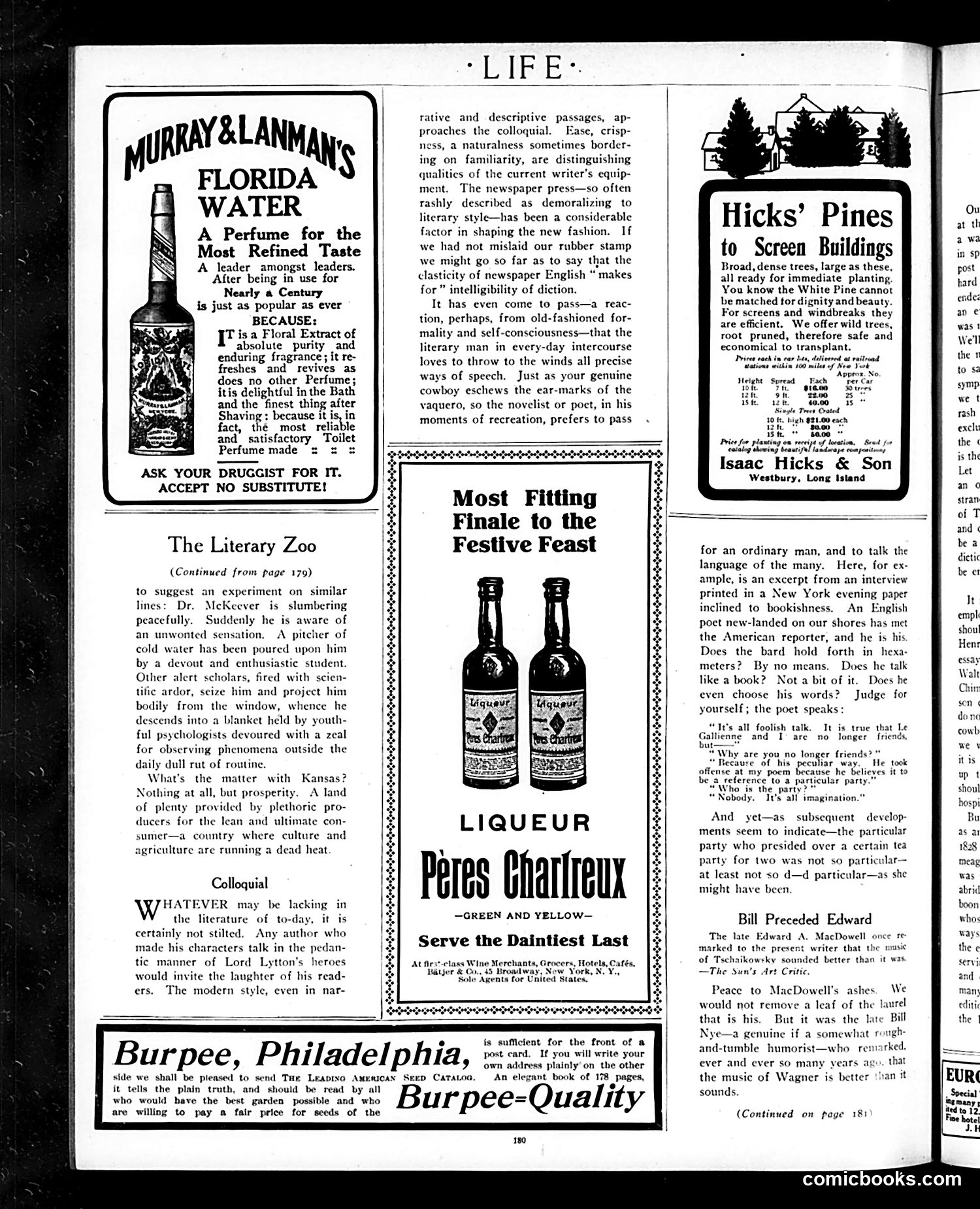
This page is primarily **advertising**, with limited editorial cartoon content. The main articles discuss modern literary style—noting that contemporary writers increasingly use colloquial, accessible language rather than formal Victorian prose. The piece observes that newspaper writing has influenced this trend toward "intelligibility of diction." The notable editorial content is a brief anecdote titled "The Literary Zoo," describing Dr. McKeever being dumped from a window by enthusiastic students—a satirical jab at academic excess, though the context is incomplete on this page. The **advertisements** are period-specific: Murray & Lanman's Florida Water perfume, Liqueur Péres Chafreux, Hicks' Pine trees, Burpee seeds, and other luxury goods. These reflect early 20th-century consumer culture targeting refined, educated readers. No identifiable political figures or major social satire appears on this page. It represents Life magazine's mixed format of light social commentary and upscale advertising.
📄 Transcribed text from this page (OCR, searchable)
Machine-transcribed from the original scan — historical spelling and the odd misread are preserved.
‘LIFE: rative and descriptive passages, ap- proaches the colloquial. Ease, crisp- s, a naturalness sometimes border- ing on familiarity, are distinguishing FLORID. A. qualities of the current writer's equip- ment. The newspaper press—so often W. ATER rashly described as demoralizing to literary style—has been a considerable A Perfume for the factor in shaping the new fashion. If Most Refined Taste we had not mislaid our rubber stamp ‘A leader amongst leaders. we might go so far as to say that the After being in use for | clasticity of newspaper English “ makes Nearly a Century for” intelligibility of diction. is just as popular as ever It has even come to pass—a reac- BECAUSE: tion, perhaps, from old-fashioned for- [7 isa Floral Extract of mality and self-consciousness—that the absolute purity and literary man in every-day intercourse does no other Perfume; ways of speech. Just as your genuine itis delightful in the Bath cowboy eschews the ear-marks of the and the finest thing after vaquero, so the novelist or poet, in his pak because ft ls td moments of recreation, prefers to pass and satisfactory Toilet Perfume made “3 = 3 1K YOUR DRUGGIST FOR IT. ACCEPT NO SUBSTITUTE! Most Fitting Finale to the The Literary Zoo Festive Feast (Continued from page 179) to suggest an experiment on similar lines: Dr. McKeever is slumbering peacefully. Si nly he is aware of an unwonted sensation. A pitcher of cold water has been poured upon him by a devout and enthusiastic student. Other alert scholars, fired with scien- tific ardor, seize him and project him bodily from the window, whence he descends into a blanket held by youth- ful psychologists devoured with a zeal for observing phenomena outside the daily dull rut of routine. What's the matter with Kansas? Nothing at all, but prosperity. A land of plenty provided by plethoric pro- ducers for the lean and ultimate con- LIQUEUR sumer—a country where culture and riculture are running a dead heat cb Peres Ghalren HATEVER may be lacking in the literature of to-day, it is “GREEN AND YELLOW- certainly not stilted. Any author who made his characters talk in the pedan- | Serve the Daintiest Last tic manner of Lord Lytton’s heroes «3 Wine Merchants, Grocers, Hotels, would invite the laughter of his read- Maier York Sy ers. The modern style, even in nar- Hicks’ Pines to Screen Buildings Broad, dense trees, large as these, all ready for immediate planting You know the White Pine cannot be matched tor dignity and beauty. For screens and windbreaks they are efficient. We offer wild trees, root pruned, therefore safe and economical to transplant. Height Spread bk Tne Ri Price for planting om eee hig hewiag boar Isaac Hicks & Son Westbury, Long Istand B P ° 1. J e is suMcient for the front of a h d h post card, If you will write your urpee, 1 a e Dp 1a, own address plainly’ on the other side we shall be pleased to send THe Lrabixc Americay Seep Catatoa, An elegant book of 178 pages, it tells the plain truth, and should be read by all b} who would have the best garden possible and who ur pee= UALL VY are willing to pay a fair price for seeds of the for an ordinary man, and to talk the language of the many. Here, for ex- ample, is an excerpt from an interview printed in a New York evening paper inclined to bookishness. An English poet new-landed on our shores has met the American reporter, and he is his. Does the bard hold forth in hexa- meters? By no means. Does he talk like a book? Not a bit of it. Does he even choose his words? Judge for yourself; the poet speaks: “I's all foolish talk. It is true that Le ienne and I are no longer friends, Why are you no longer friends?” Recaure of his peculiar way. He took offense at my poem because he believes it to be a reference to a part party.” “Who is the party?” “Nobody. It’s all imagination.” And yet—as_ subsequent develop ments seem to indicate—the particular party who presided over a certain tea party for two was not so particular— at least not so d—d particular—as she might have been. Bill Preceded Edward The late Edward A. MacDowell once fe marked to the present writer that the music of Tschaikowsky sounded better than it was —The Sun's Art Critic. Peace to MacDowell’s ashes. We would not remove a leaf of the laurel that is his. But it was the late Bill Nye—a genuine if a somewhat rough: and-tumble humorist—who remarked. ever and ever so many years ago. that the music of Wagner is better {han it sounds. (Continued on page 181 Ou at th awa in sp post hard endes ane was | We'll the 1 to 83 symp we t rash exclu the ¢ is the an 0 cowb we \ it is up t shoul many editic the | comicbooks.com