
A complete issue · 36 pages · 1910
Life — January 20, 1910
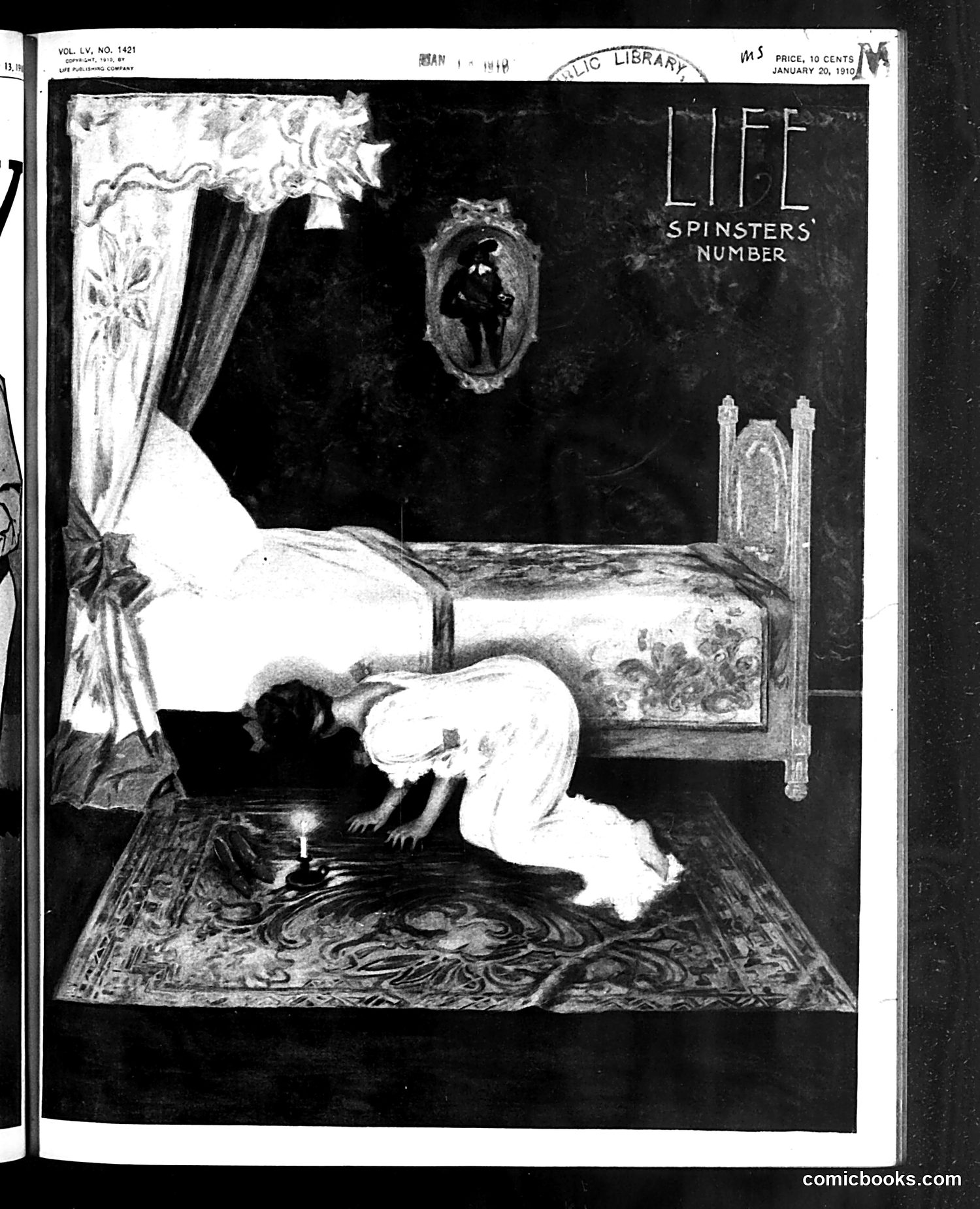
This is the cover of Life magazine's "Spinsters' Number" from January 20, 1912 (price 10 cents). The illustration depicts a supernatural scene: a woman in a nightgown kneels beside a bed, gazing upward at a ghostly male face appearing in an ornate mirror or portrait frame above. A candle burns on the floor. The satire plays on the popular Victorian spiritualism trend—séances and communication with the dead were fashionable among unmarried women of the era. The cartoon mocks unmarried women ("spinsters") as desperate enough to conjure ghostly suitors through supernatural means, since they couldn't attract living partners. It's a comedic jab at both spinsterhood and the era's spiritualist craze, positioning lonely single women as gullible believers seeking romantic companionship from beyond the grave.
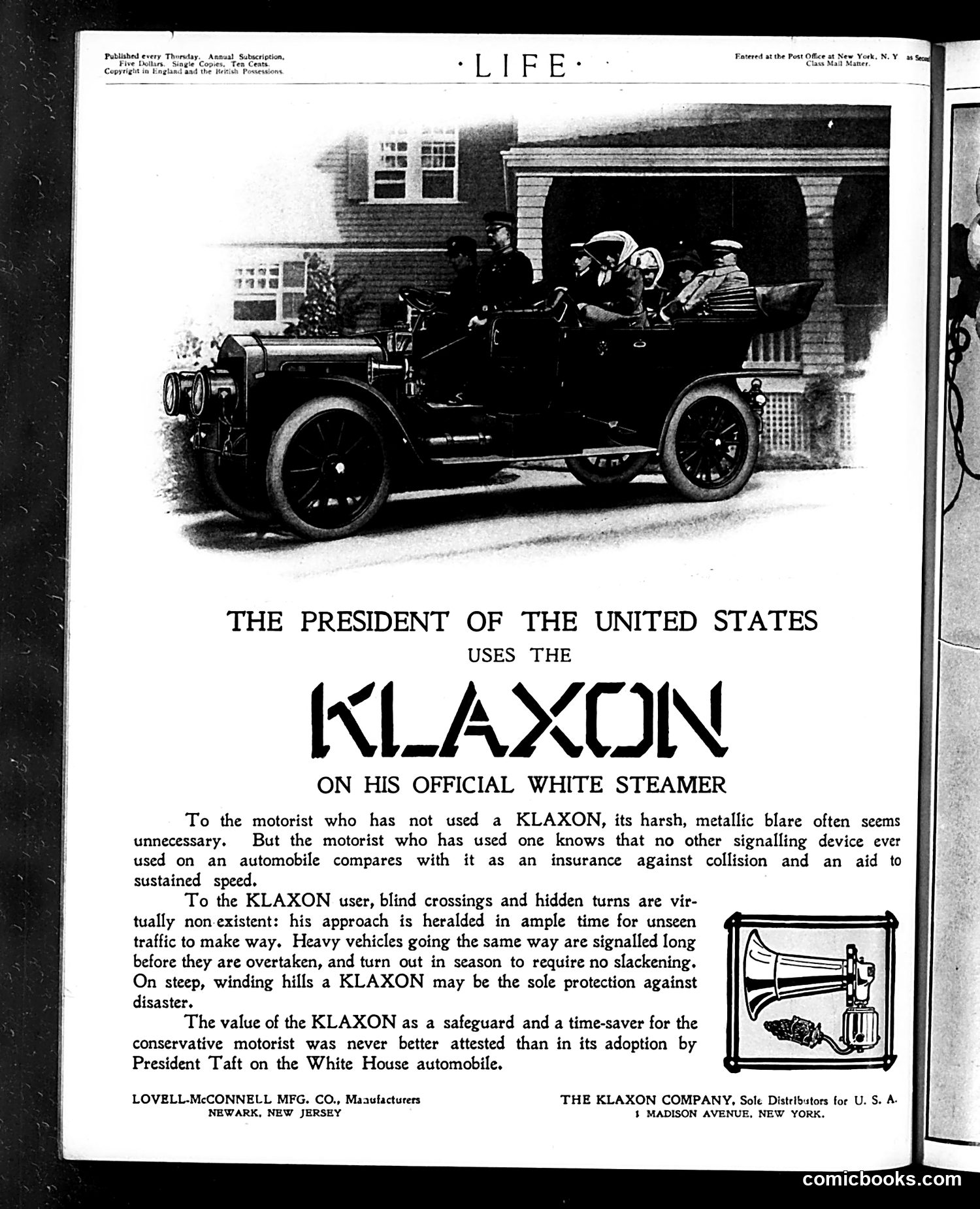
This is primarily **advertising, not satire**. It shows a Klaxon horn—a loud mechanical automobile warning device—being endorsed by President Taft for use on the White House automobile. The ad claims the Klaxon provides safety benefits: its loud noise warns pedestrians and vehicles of approach, especially useful on blind corners and steep hills. The text argues it's superior to other signaling devices and helps prevent collisions. The "appeal to authority" marketing strategy—that if the President uses it, it must be good—was common in early automotive advertising (early 1900s-1910s). The image shows well-dressed passengers in an open car, reflecting aspirational automobile ownership during this era. This is straightforward product promotion, not political commentary.
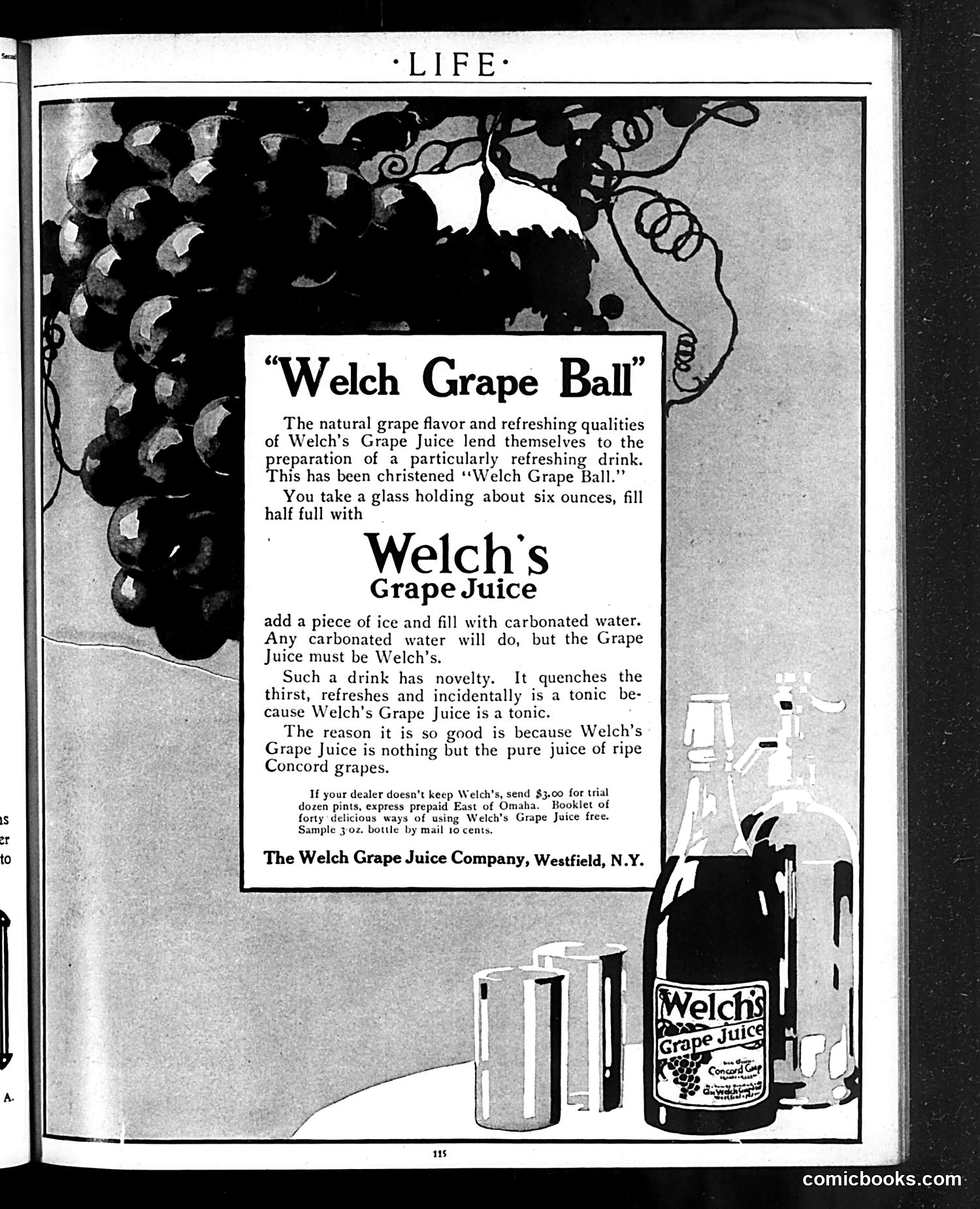
This page is **primarily an advertisement**, not satirical content. It promotes "Welch Grape Ball," a refreshing drink made by mixing Welch's Grape Juice with carbonated water and ice. The ad emphasizes that Welch's product contains "nothing but the pure juice of ripe Concord grapes," positioning it as a wholesome, natural beverage. The company offers a trial dozen pints for $3.50 (shipped east of Omaha) and promises a booklet with "forty delicious ways of using Welch's Grape Juice." The decorative grape vine illustrations and period typography are typical of early 20th-century advertising design. This appears to be a straightforward commercial promotion rather than political or social satire.
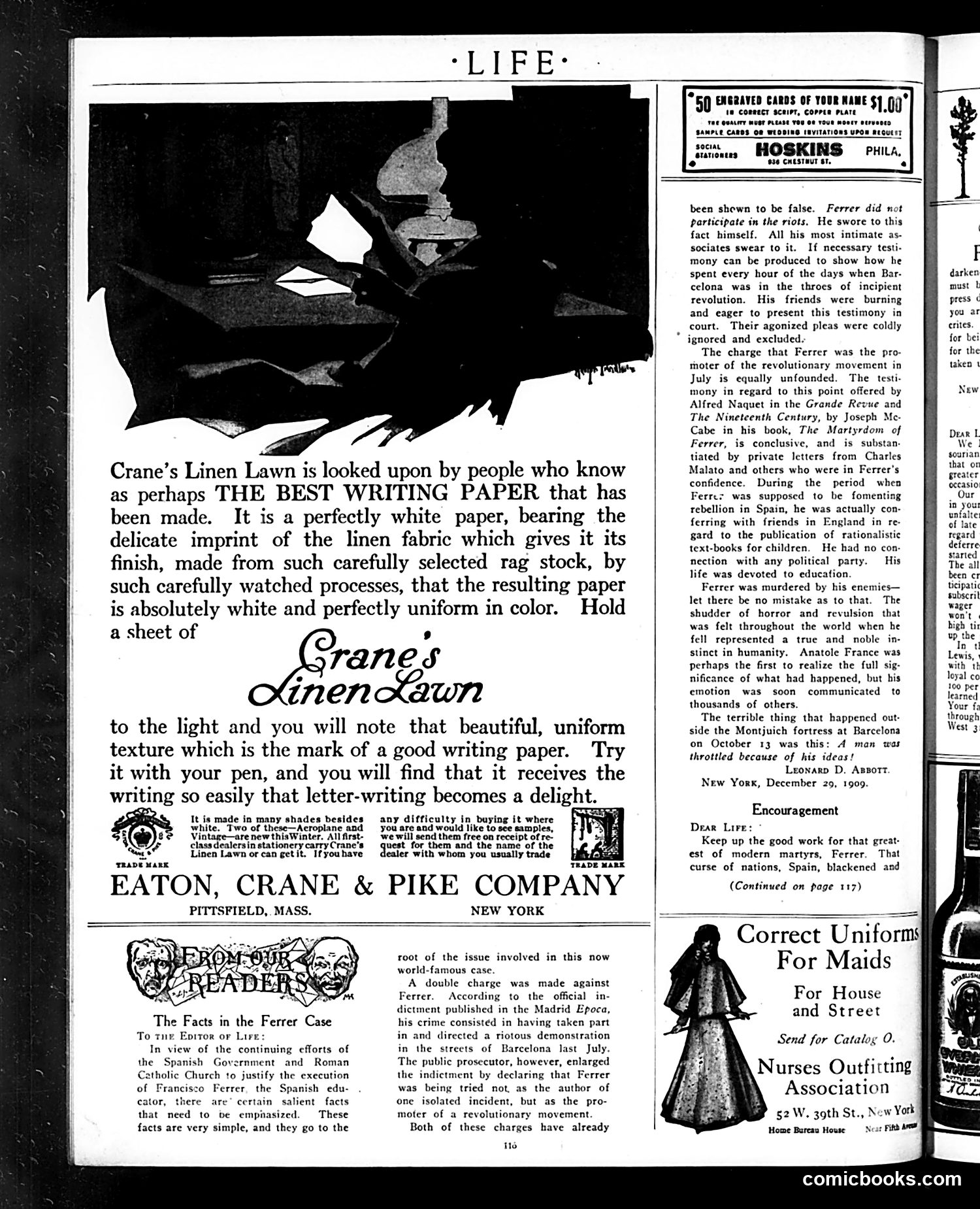
This page is primarily a **product advertisement** for Crane's Linen Lawn writing paper, occupying the left two-thirds of the layout. The large illustration shows a silhouetted figure writing at a desk, emphasizing the paper's quality and texture for correspondence. The right column contains a "From Our Readers" section discussing **the Ferrer Case**—the execution of Spanish anarchist Francisco Ferrer in 1909. The letter defends Ferrer against charges that he promoted revolutionary violence, arguing his actual work focused on education and that testimony supporting him was "coldly ignored." This reflects American intellectual sympathy for Ferrer following his controversial execution in Spain. The remaining space contains small advertisements for stationery and maid uniforms, typical of *Life* magazine's commercial content.
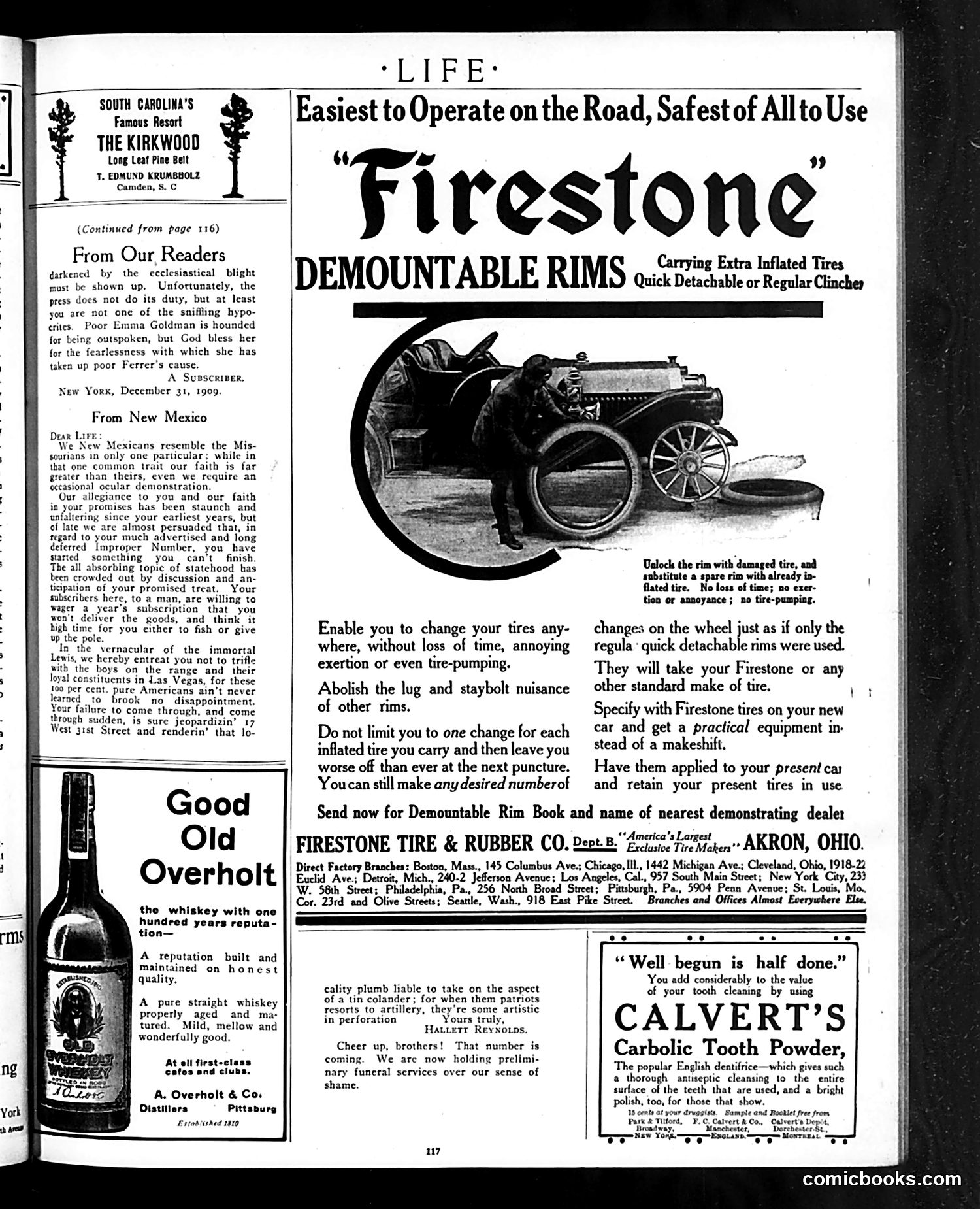
This page is primarily **advertising**, not satire or editorial cartooning. It contains three advertisements: 1. **Firestone Demountable Rims** (center, dominant): Shows an early automobile with a detachable tire system. The ad emphasizes convenience—drivers could change tires anywhere without "loss of time, annoying exertion or even tire-pumping." This addresses a genuine problem of early motoring when tire failures were frequent and repair was laborious. 2. **Good Old Overholt Whiskey** (left): A straightforward liquor advertisement emphasizing the brand's century-old reputation and quality. 3. **Calvert's Carbolic Tooth Powder** (bottom right): A dental product ad using the phrase "Well begun is half done." The page also includes reader letters on the left, unrelated to advertising. There is no political satire present.
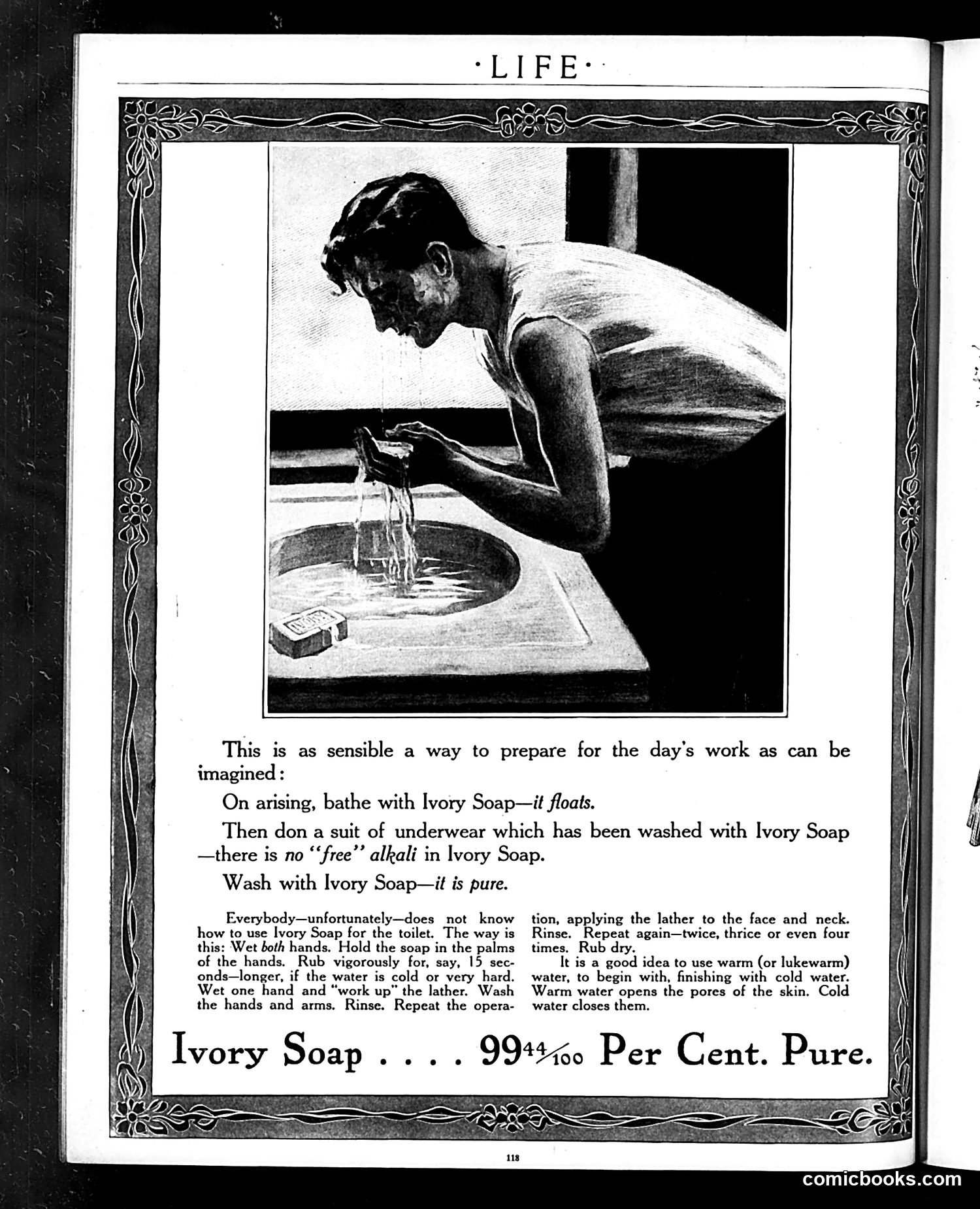
This is **not a cartoon or satire**—it's a straightforward **product advertisement** for Ivory Soap from the early 20th century. The image shows a man washing his face at a sink, demonstrating proper hygiene practices. The accompanying text provides instructions on using Ivory Soap for bathing and toilet washing, emphasizing its purity ("99 44/100 Per Cent. Pure"). The advertisement appeals to health-conscious consumers by positioning soap as essential preparation for "the day's work." It includes detailed washing instructions—rubbing vigorously, rinsing multiple times, and alternating warm and cold water—reflecting contemporary beliefs about proper hygiene. This represents typical early 1900s advertising that educated consumers while promoting the product's key selling point: exceptional purity.
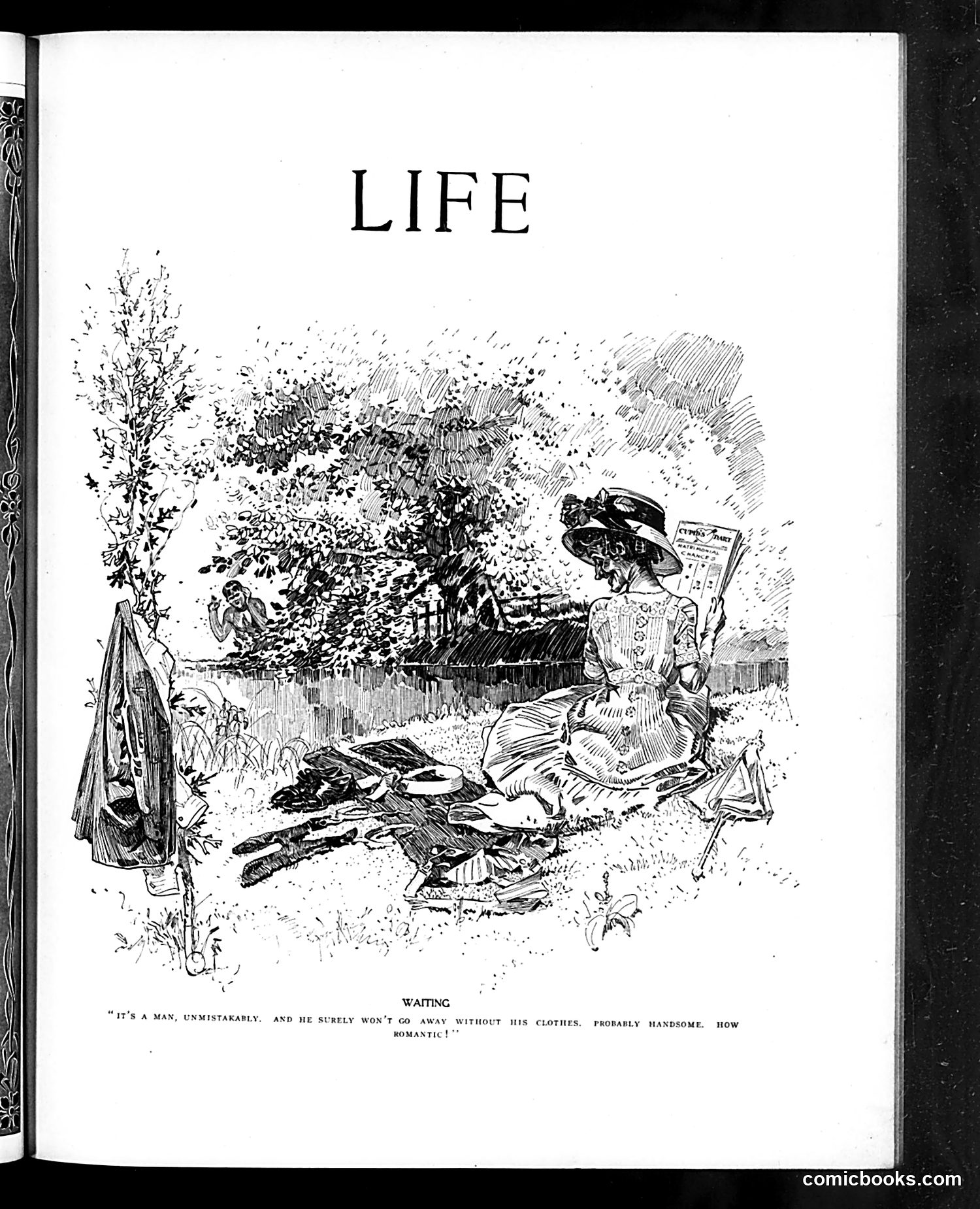
This satirical illustration depicts a woman sitting outdoors with a man's clothing and belongings scattered nearby. The caption reads: "It's a man, unmistakably, and he surely won't go away without his clothes. Probably handsome. How romantic!" The satire targets romantic notions of love and courtship. The woman waits for a man who has left his possessions behind—implying he's gone swimming or otherwise undressed. The humor lies in her rationalization that since he won't abandon his clothes, he must return, and she romanticizes this forced reunion. The joke mocks both her naive faith in romantic destiny and the absurdity of using practical considerations (a man's belongings) as proof of romantic inevitability. It's social commentary on female expectations in courtship.
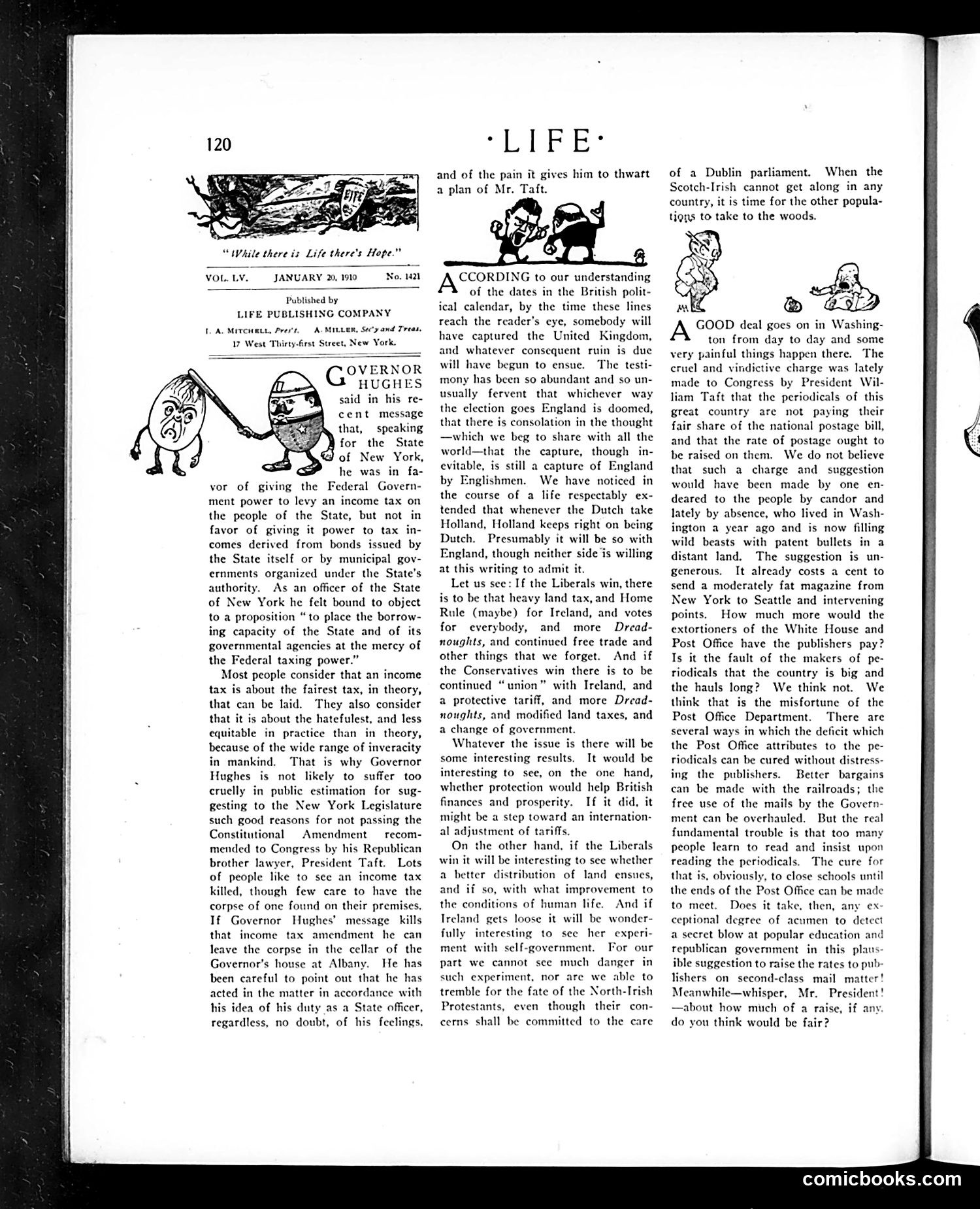
The top cartoon depicts "Governor Hughes" (Charles Evans Hughes, New York's governor) in a tug-of-war with a figure labeled "State of New York," illustrating the political tension over income tax authority. The satire criticizes Hughes's proposal to give the Federal Government power to levy income taxes on state residents—a controversial expansion of federal power that the magazine opposed on states' rights grounds. The accompanying article discusses British and Irish politics, tariff debates, and postal service inefficiencies. The cartoons and text together satirize government overreach and advocate for maintaining state autonomy against federal expansion, reflecting early-1900s Progressive Era debates about federalism.
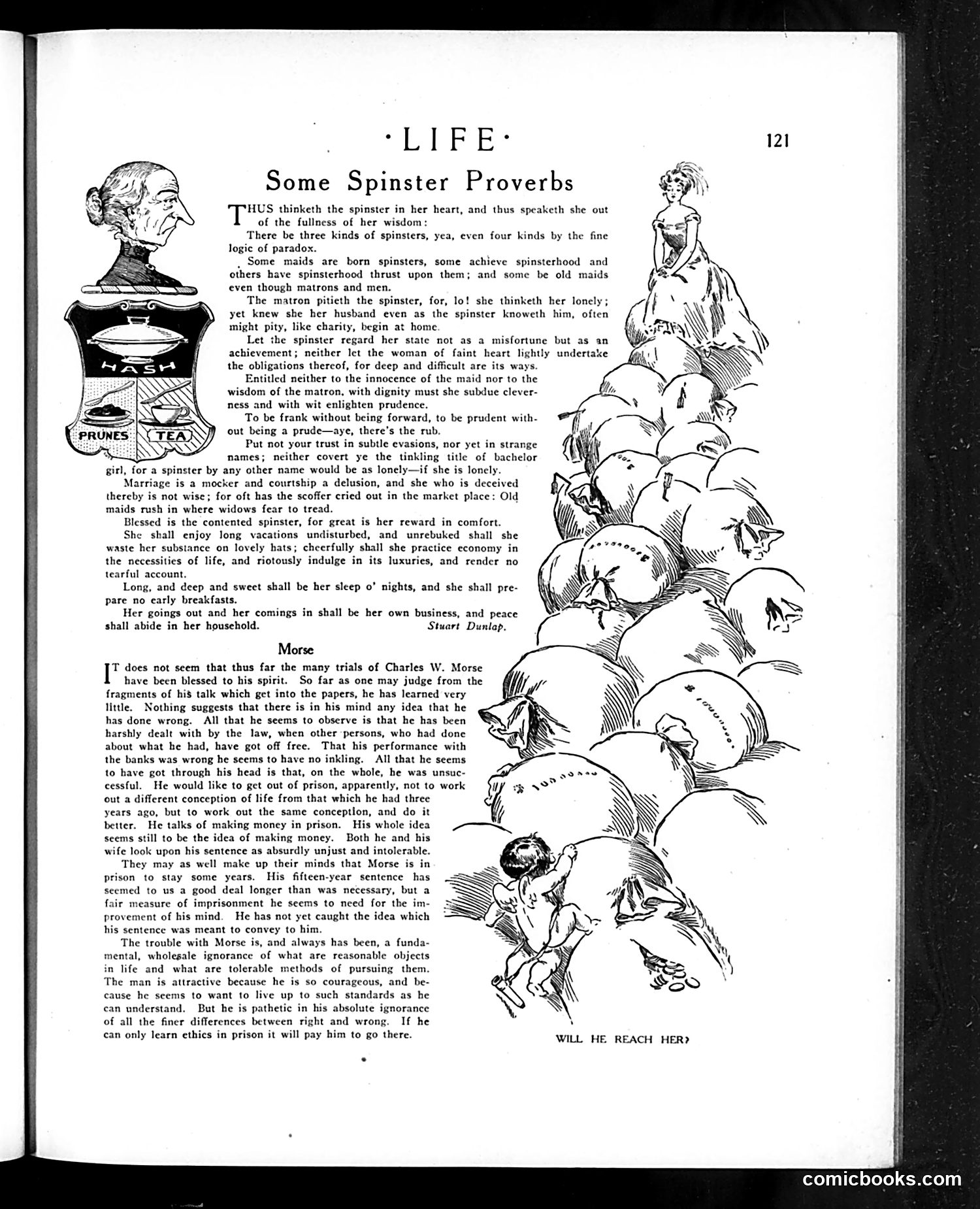
This page contains two distinct pieces: **"Some Spinster Proverbs"** (top left): A satirical essay mocking unmarried women, with a caricatured female head as decoration. The text ironically presents "wisdom" for spinsters, sarcastically suggesting they should accept their unmarried status with dignity and find contentment in solitude and modest work—reflecting late 19th/early 20th-century dismissive attitudes toward single women. **"Morse"** (bottom): A critique of Charles W. Morse, a businessman apparently imprisoned for banking fraud. The article condemns Morse's apparent lack of remorse or understanding of his wrongdoing, suggesting his fundamental ignorance prevents rehabilitation. The accompanying illustration titled "WILL HE REACH HERE?" appears to show Morse struggling up a difficult slope, sarcastically questioning whether he can achieve moral improvement. Both pieces use satire to mock their subjects' perceived failings.
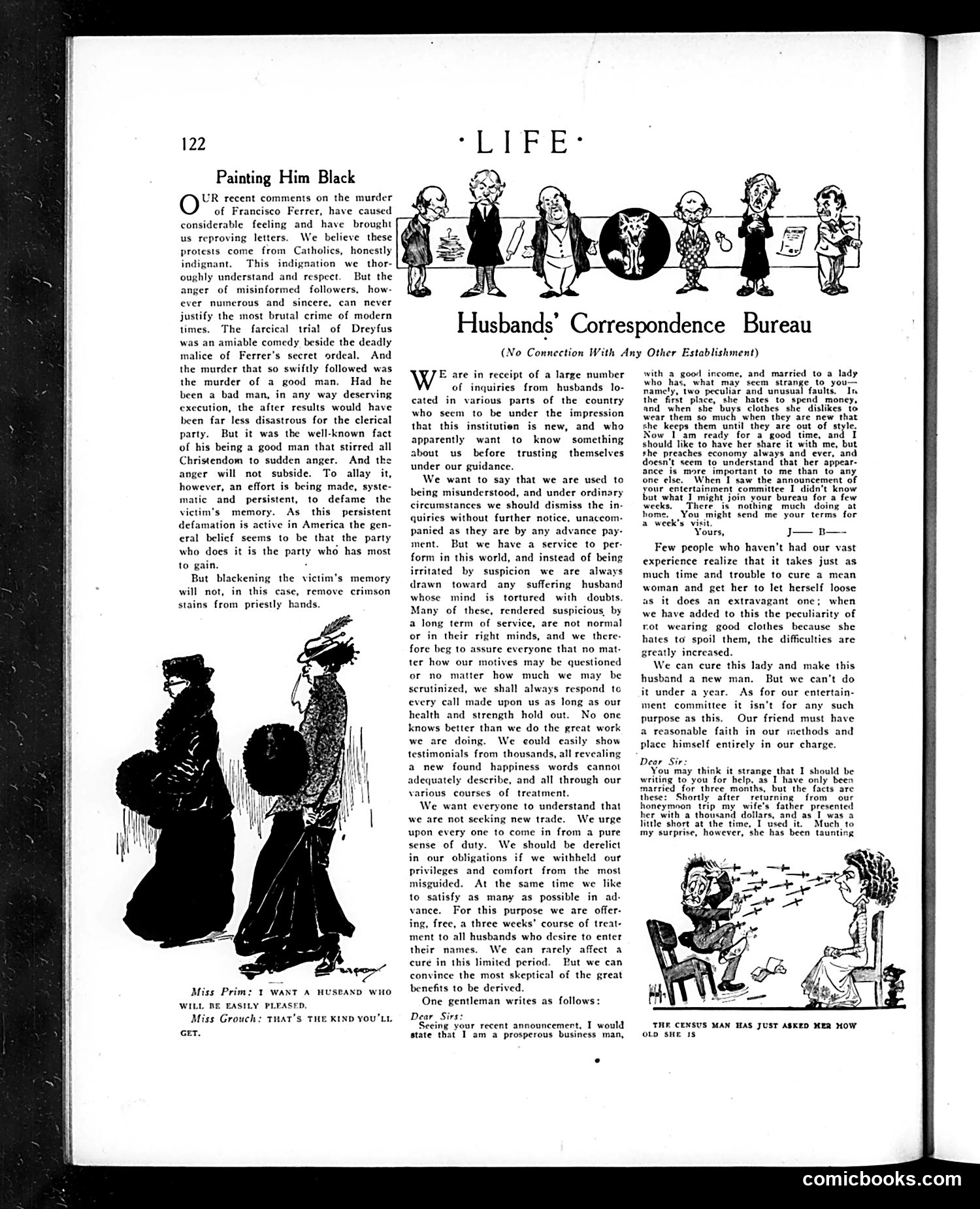
The left cartoon shows two women in conversation, likely satirizing public discourse around Francesco Ferrer's recent murder. The text criticizes how "the clerical party" is being blamed unfairly, suggesting enemies are attempting to blacken Ferrer's memory for political gain. The cartoon mocks this tendency toward partisan character assassination. The right section features a satirical "Husbands' Correspondence Bureau"—a fake advice column where husbands complain about wives. One letter describes a wife who squanders money; another depicts a husband and wife arguing. This mocks marital discord while poking fun at contemporary domestic frustrations and advice-seeking culture. Both pieces use humor to critique social problems and human behavior.
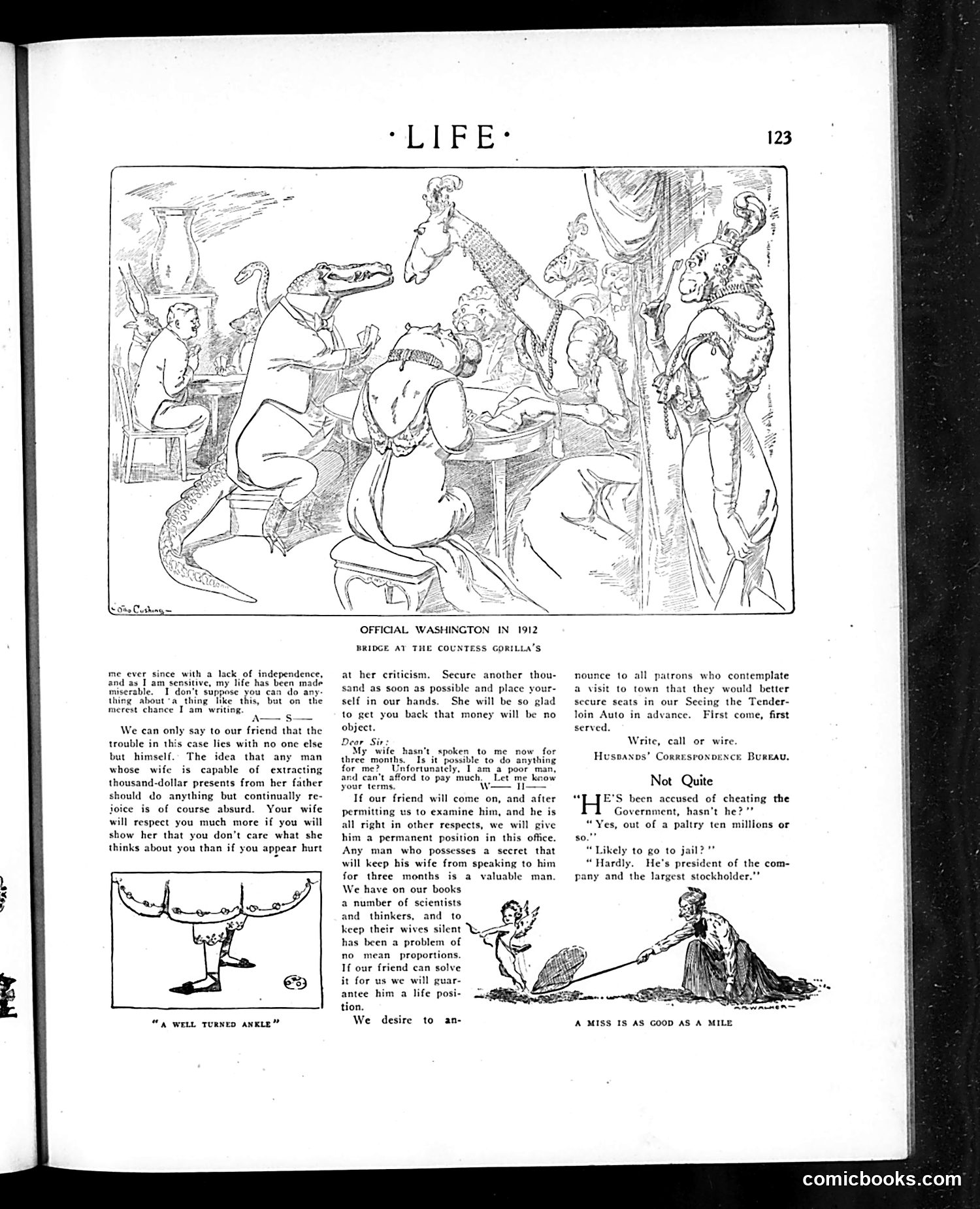
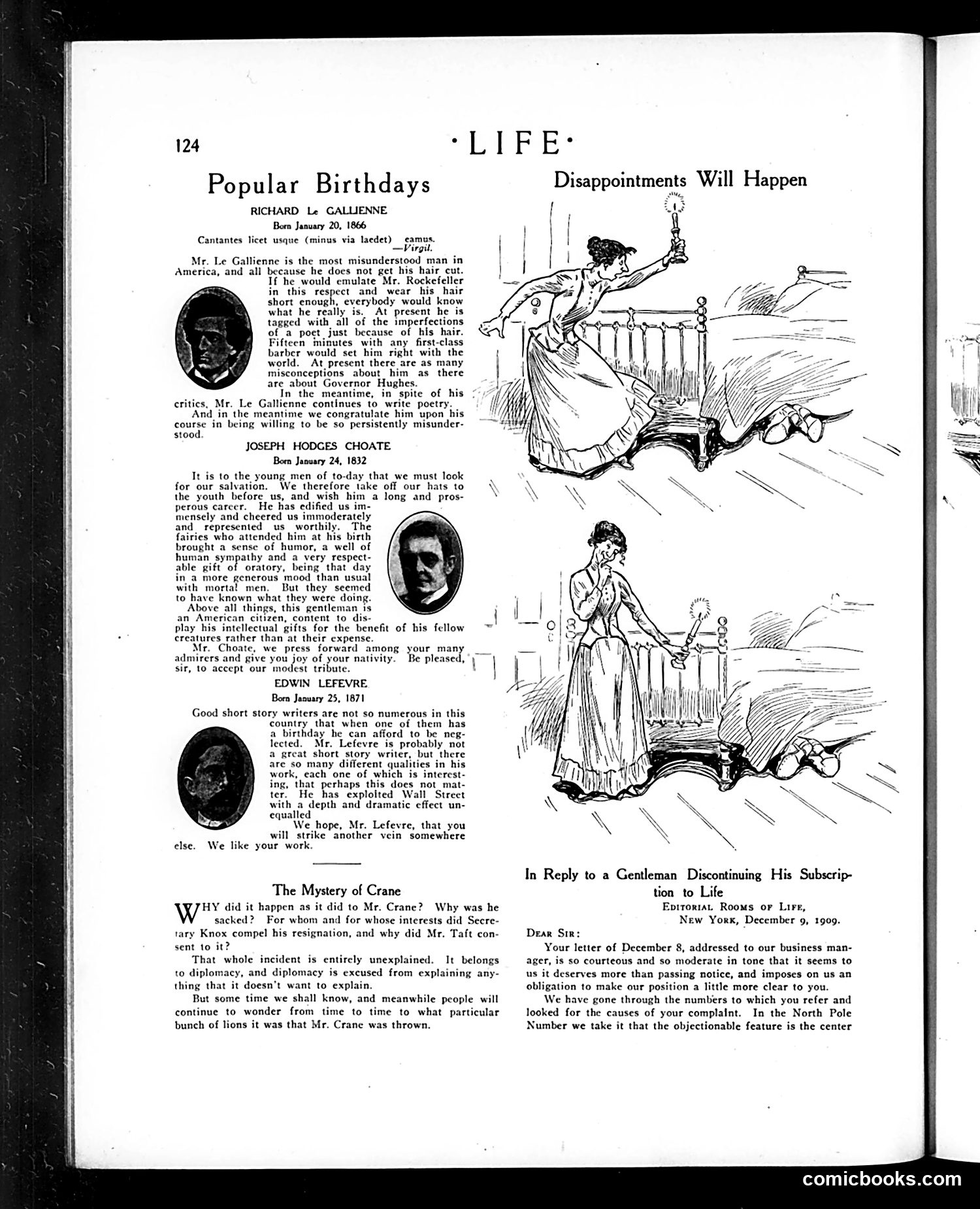
This page contains **"Popular Birthdays"** featuring three biographical sketches with portrait photographs, and **"Disappointments Will Happen,"** an illustrated cartoon. The cartoon depicts a woman at a railing, apparently experiencing romantic disappointment—a man appears to be leaving or departing. The illustration's title and the woman's dramatic gesture suggest the satire concerns failed romantic expectations. The biographical section celebrates three men: Richard Le Gallienne (writer), Joseph Hodges Choate (likely a public figure), and Edwin Lefèvre (writer). The text praises their accomplishments in literature and public service. Below appears an editorial response addressing subscription complaints about a feature called "The Mystery of Crane," suggesting reader engagement with serialized magazine content was active and sometimes contentious.
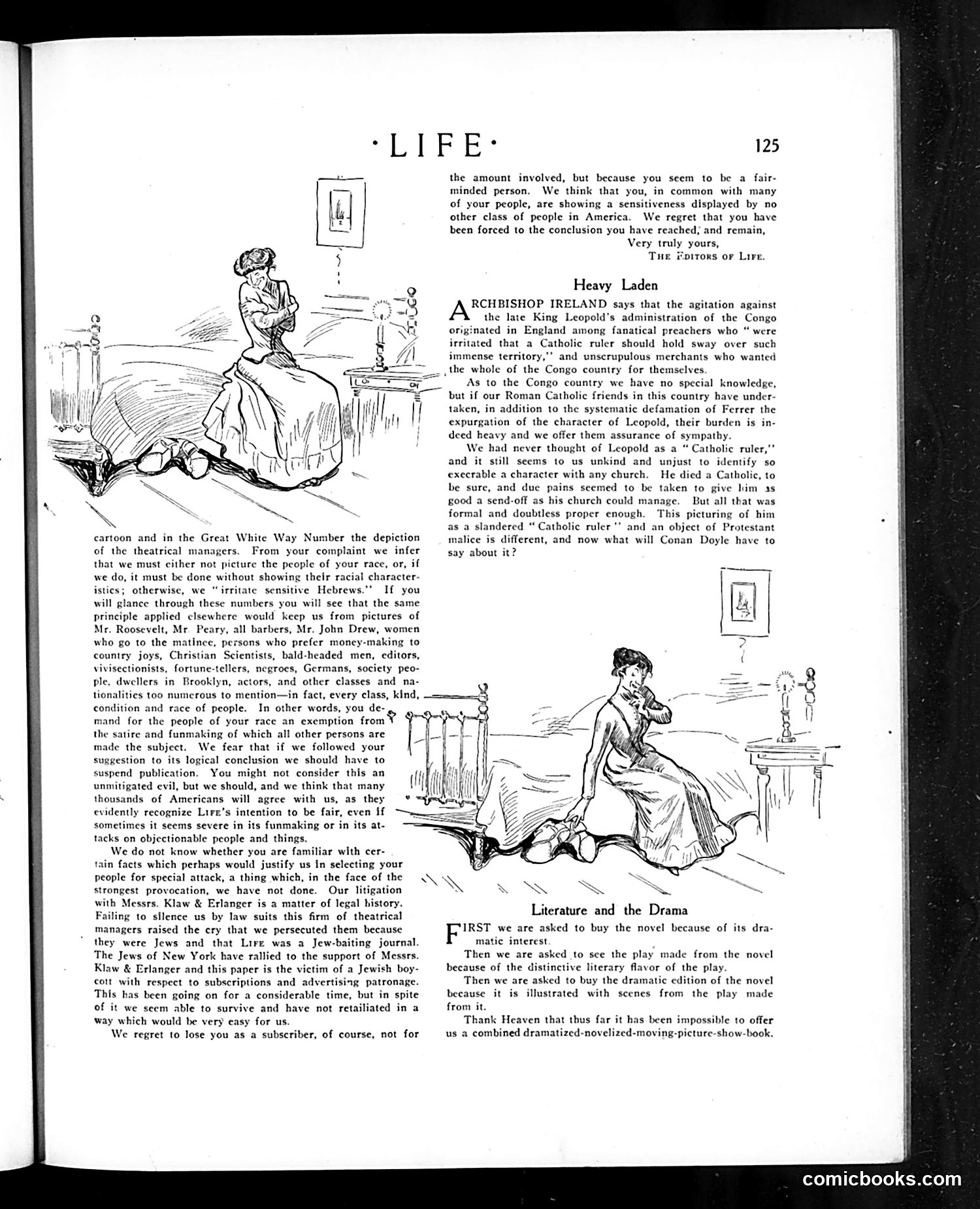
This page contains two editorial cartoons satirizing Life magazine's critics. The top cartoon depicts a woman at a vanity, illustrating an editorial response to complaints about Life's depictions of various ethnic and social groups. The editors defend their satirical approach, arguing they must either avoid caricaturing any race or do so fairly across all types—naming "Roosevelt, Peary, John Drew, women who go to the beach," etc. They assert Life intends fairness despite sometimes seeming severe. The lower cartoon accompanies a section titled "Literature and the Drama," depicting someone reading. The editorial discusses adapting novels into plays, expressing gratitude they haven't yet been asked to create a "combined dramatized-novelized-moving-picture-show-book." Both segments defend Life's editorial choices against reader criticism.
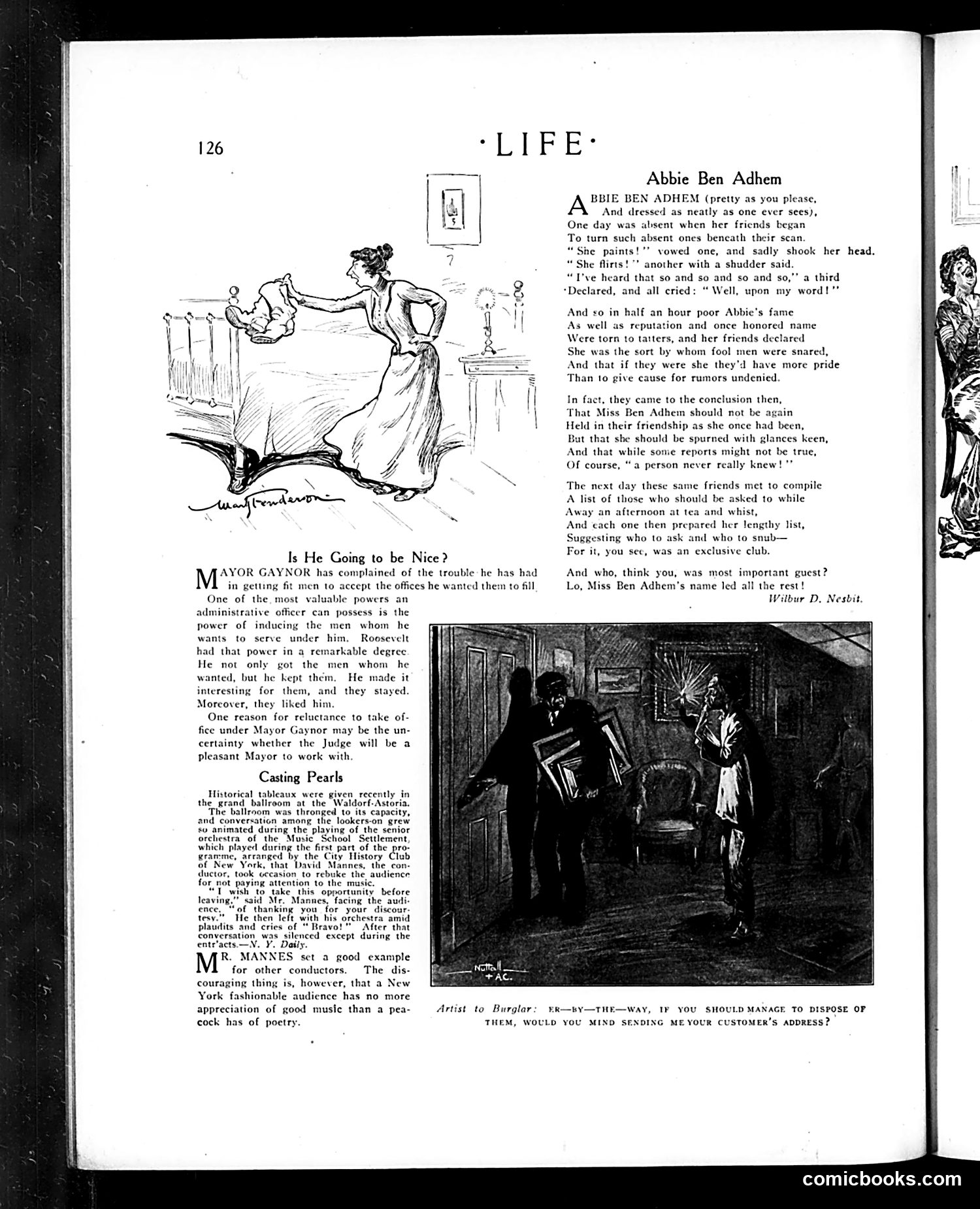
This page contains two distinct satirical pieces: **"Abbie Ben Adhem"** (poem by Wilbur D. Nesbit): A narrative poem mocking social hypocrisy and clique behavior. When a woman is absent from friends' gathering, they gossip viciously about her, spreading rumors about her character. Yet when compiling their exclusive guest list for a tea party, Abbie's name "led all the rest"—revealing that social status matters more than the moral judgments they'd just made. The satire targets women's social circles for superficiality and two-faced behavior. **"Is He Going to be Nice?"**: Commentary on Mayor Gaynor's difficulty finding qualified people to fill city offices. It compares him unfavorably to Theodore Roosevelt, who possessed the "power of inducing men" to serve and kept them satisfied. The piece suggests Gaynor's reluctance to fill positions may stem from uncertainty whether he'll be a pleasant person to work under—a subtle dig at his personality. A small cartoon captioned "Casting Pearls" depicts an artist offering a burglar his client's address, satirizing both the artist's commercial desperation and society's indifference to art.
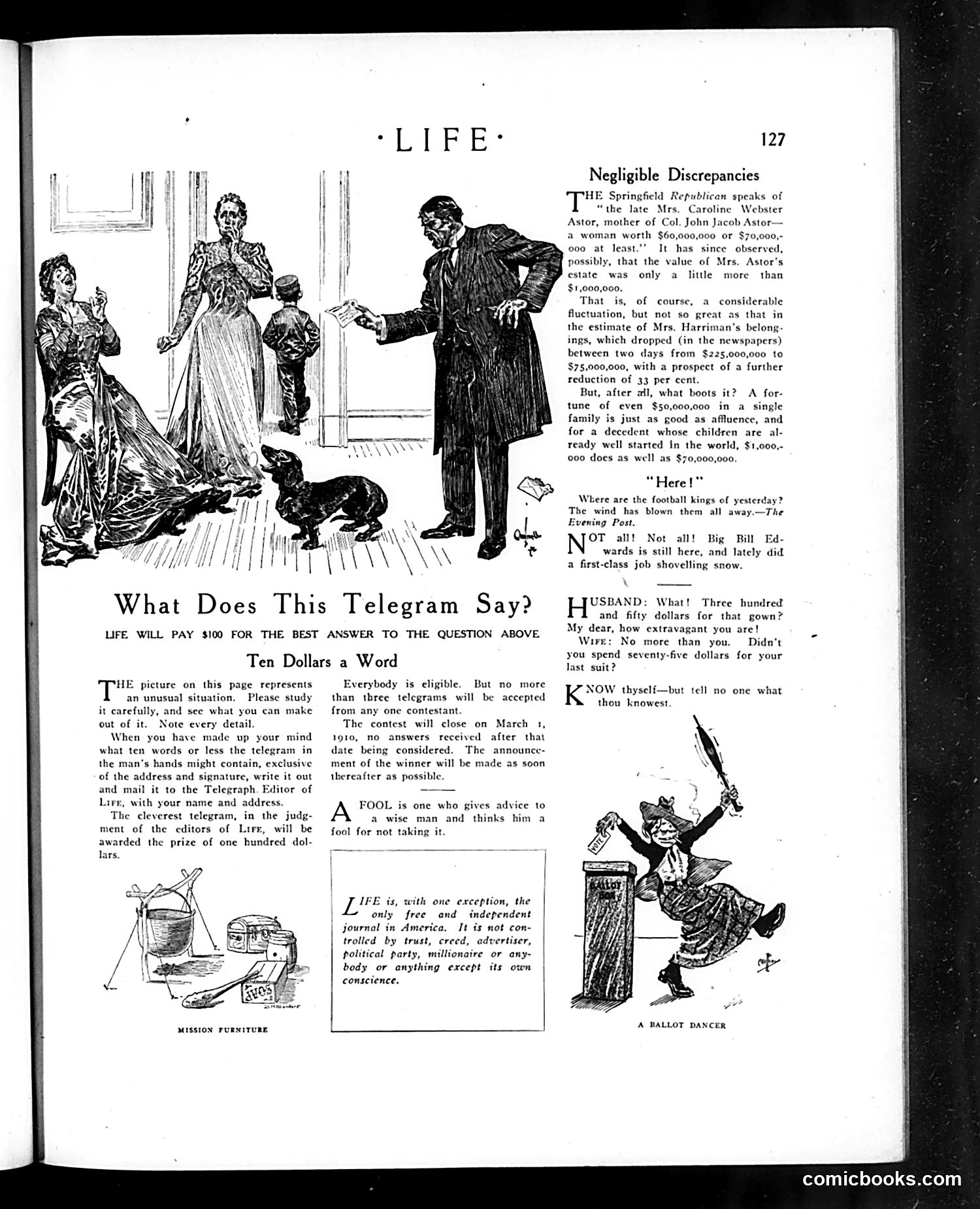
This page features a contest asking readers to decipher a mysterious telegram. The main cartoon shows a well-dressed man gesturing dramatically while holding a telegram, surrounded by family members and a dog in what appears to be an affluent household—the visual setup suggests domestic intrigue or scandal requiring coded communication. The accompanying satirical articles mock wealth disparities and reporting inaccuracies. "Negligible Discrepancies" ridicules newspapers for wildly inconsistent estate valuations of wealthy widows (Caroline Astor's fortune reported between $60-70 million versus $1 million; Mrs. Harriman's dropping from $225 million to $75 million in two days). Life's point: even small fortunes dwarf ordinary people's means, making precise figures meaningless. Other jokes mock marital disputes over spending ("Husband/Wife" dialogue) and reference "Big Bill Edwards," apparently a fallen football celebrity now reduced to manual labor—reinforcing themes of fortune's instability among the wealthy and famous.
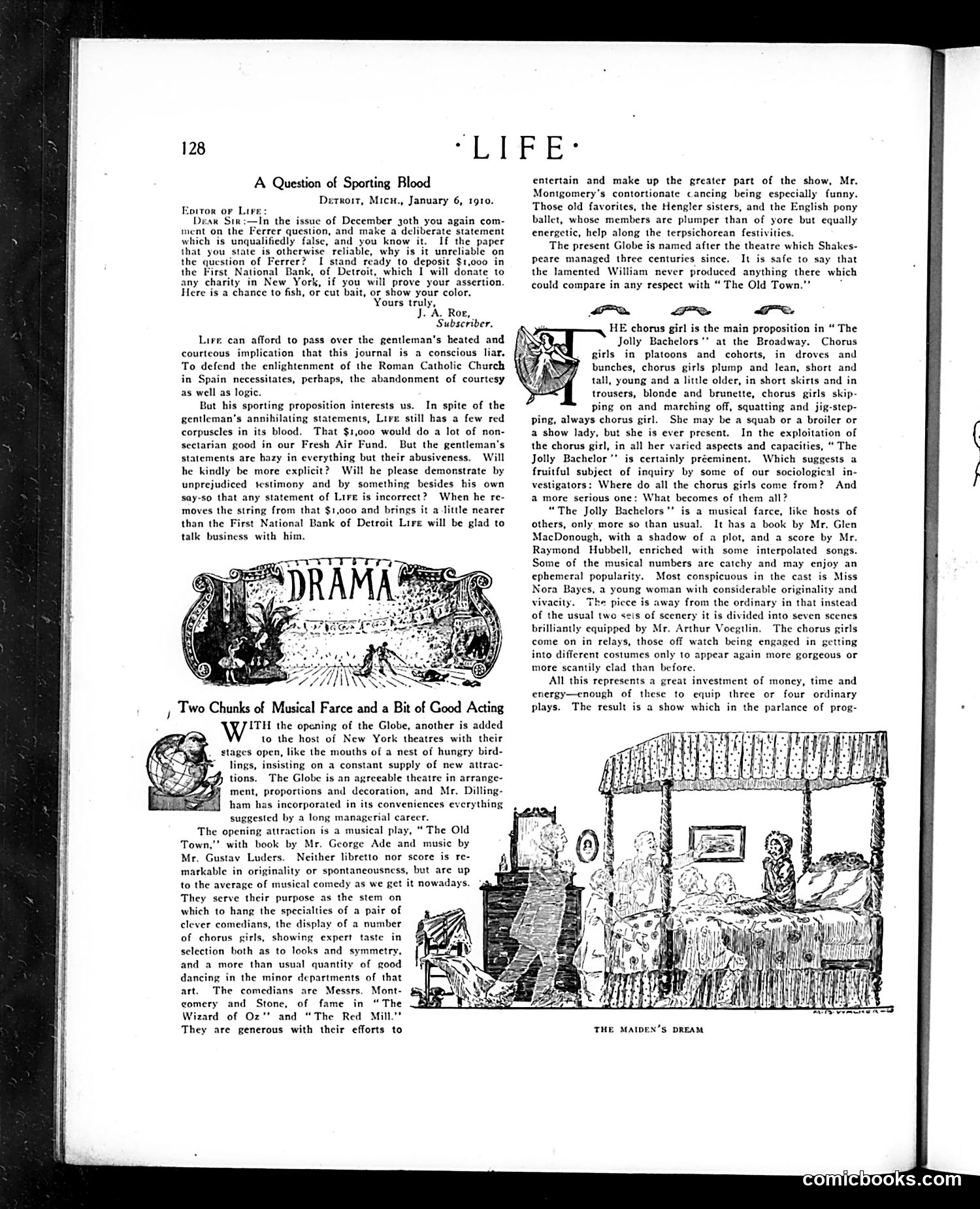
This page contains two distinct sections: **The "Sporting Blood" Letter**: A reader challenges Life magazine's coverage of the Ferrer question (likely Francisco Ferrer, executed in Spain in 1909 for alleged radical activities). The subscriber, J.A. Roe, accuses Life of making false statements and offers $1,000 to charity if Life can prove its claims with "unprejudiced testimony." Life's editor responds sarcastically, accepting the "sporting proposition" but demanding Roe demonstrate Life's errors with evidence rather than mere assertion. The exchange satirizes both the reader's heated accusations and the magazine's defensive position on this apparently contentious Catholic Church/Spanish political issue. **Theater Reviews**: Life reviews two Broadway musicals—"The Old Town" and "The Jolly Bachelors"—focusing primarily on chorus girls and comedians Montgomery and Stone (famous from "The Wizard of Oz"). The reviews are lighthearted, emphasizing spectacle and entertainment value over artistic merit, typical of early-1900s musical comedy criticism.
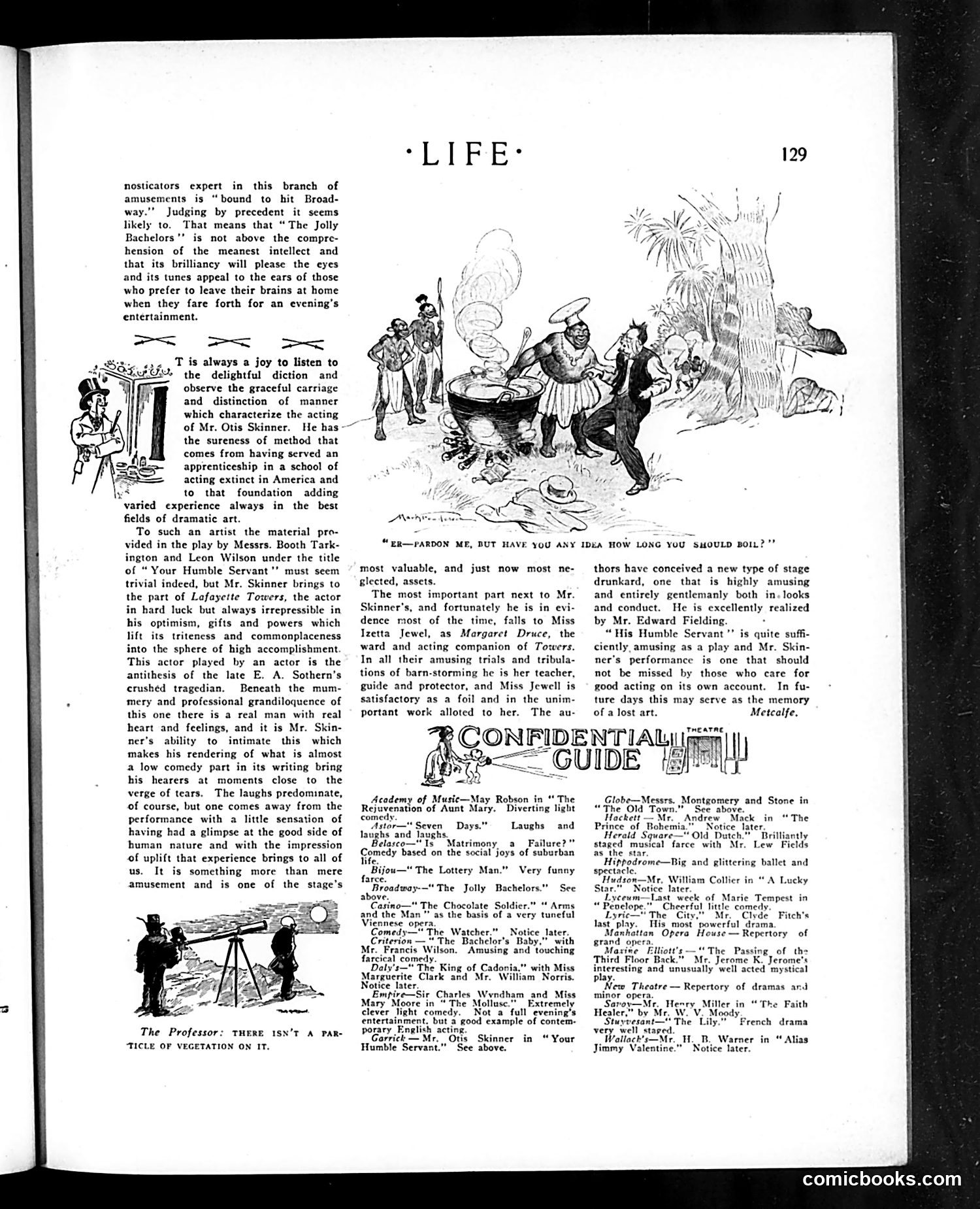
This page reviews Broadway theatrical productions, focusing primarily on Otis Skinner's performance in "Your Humble Servant." The main cartoon depicts a cooking scene with the caption "ER—PARDON ME, BUT HAVE YOU ANY IDEA HOW LONG YOU SHOULD BOIL?" The joke appears to be a domestic/culinary mishap, though the specific reference is unclear from context alone. The text praises Skinner's acting abilities and his capacity to elevate trivial material through genuine emotional depth—noting he brings "real man with real heart" to his role, creating moments that move audiences "close to the verge of tears" despite the play's comedic nature. The criticism of "The Jolly Bachelors" suggests it appeals only to unsophisticated audiences who "prefer to leave their brains at home." The "Confidential Guide" section lists other theatrical productions with brief reviews, indicating this was a theater-focused issue of Life magazine.
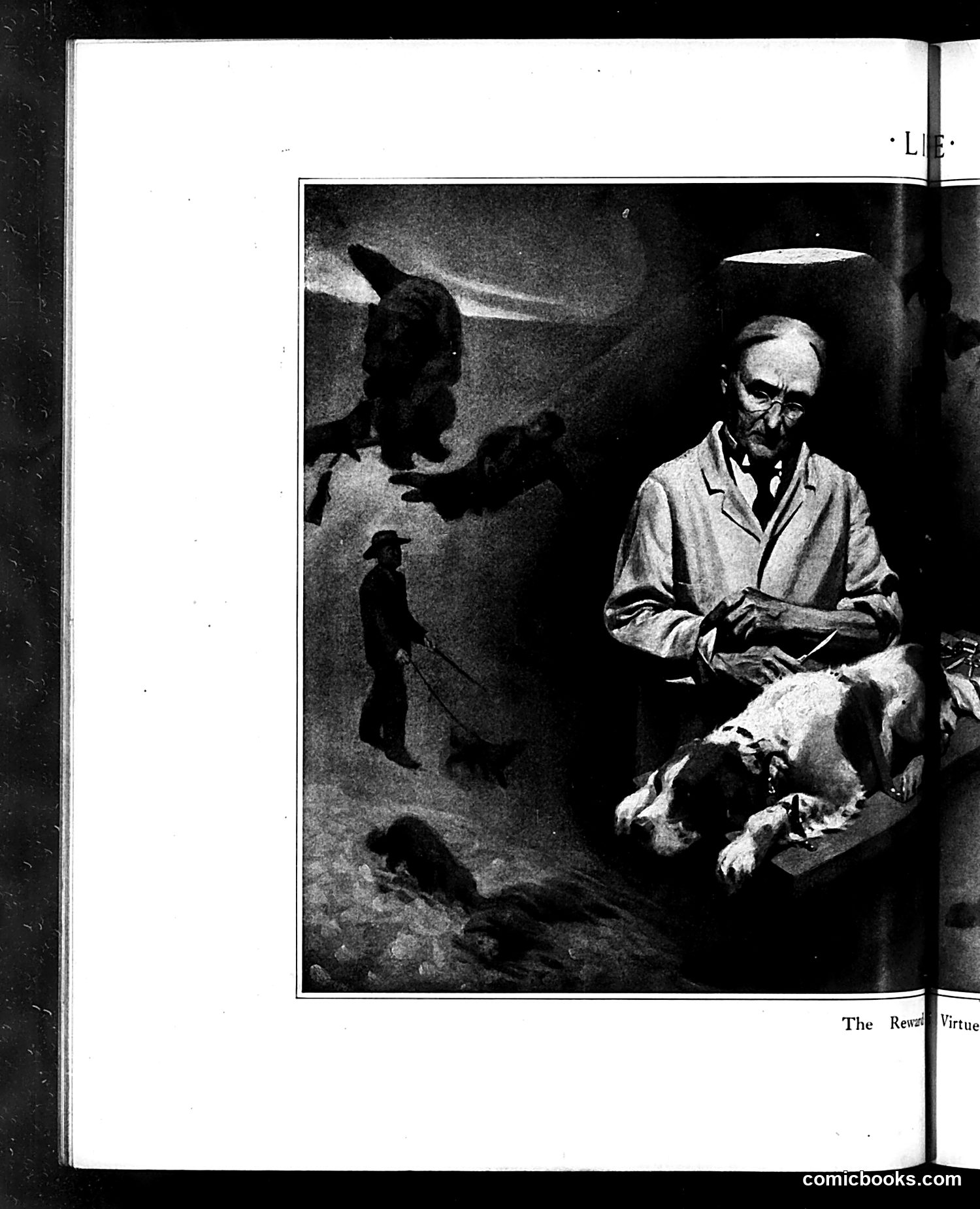
This page appears to be from an early 20th-century satirical illustration, though the OCR text is largely illegible. The black-and-white image shows a man in period clothing (light shirt) examining or holding what appears to be a small animal or creature on the right side of the frame. In the background, a demonic or devilish figure looms, with a smaller human silhouette visible below it. At the top, an oval shape (possibly representing a UFO or celestial object) is visible. Without clearer text, the specific political or social satire remains unclear. The demonic imagery and the man's focused attention on the small creature suggest this may satirize scientific inquiry, spiritualism, or moral concerns of that era, but the exact meaning cannot be definitively determined from the visible elements alone.
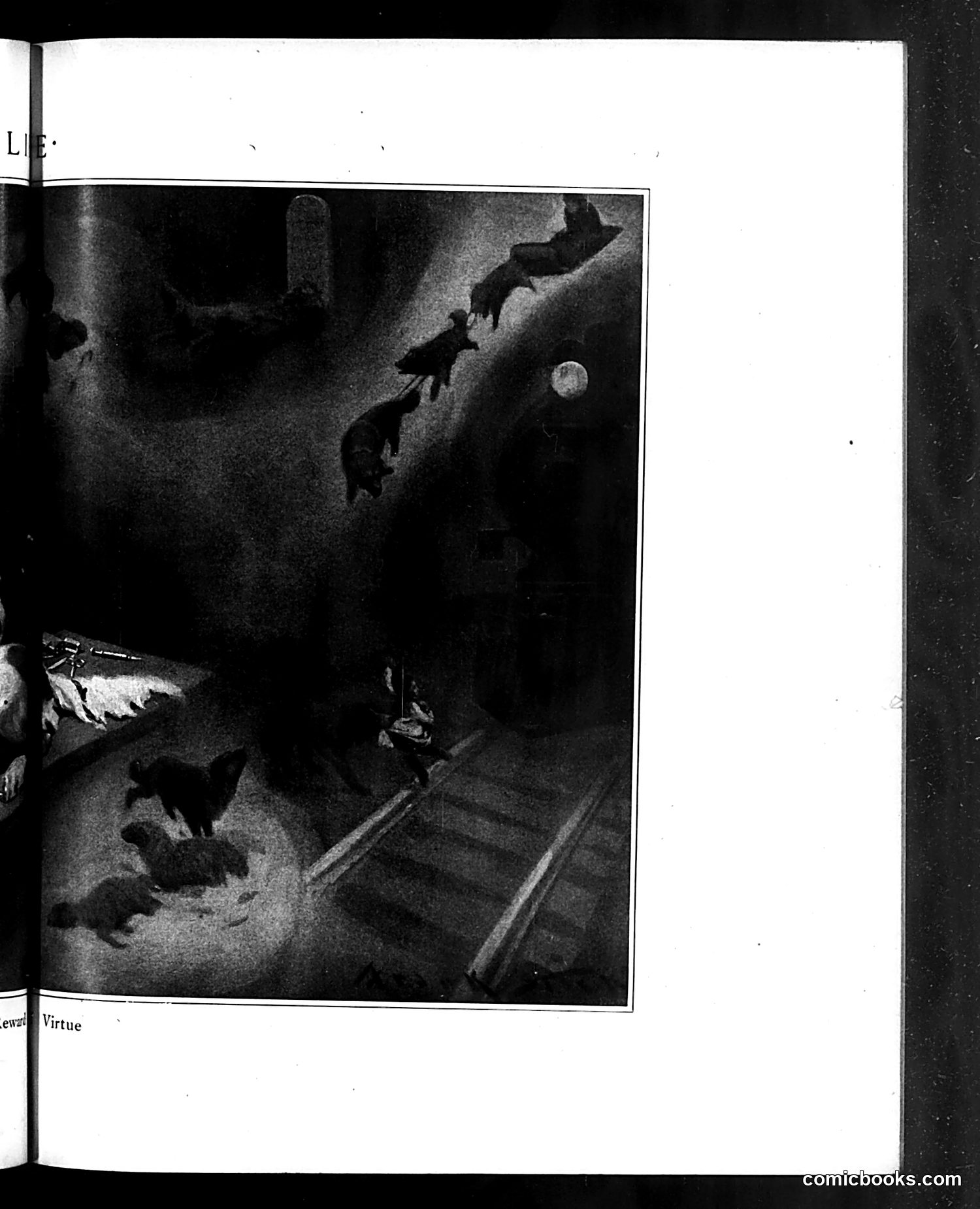
This appears to be a political cartoon from Life magazine titled "Virtue," though the image quality makes specific details difficult to discern with certainty. The illustration depicts what seems to be figures in dark silhouettes positioned on or near railroad tracks, with a full moon visible in the background. The stark, dramatic lighting and composition suggest a commentary on virtue or morality in relation to railroad imagery—possibly referencing railroad corruption, labor issues, or financial scandals that were common satirical subjects in American magazines of this era. However, without clearer visibility of specific caricatured features or additional context clues, I cannot confidently identify the particular individuals or specific political event being referenced. The title "Virtue" suggests ironic commentary on moral failings, but the exact target remains unclear from this reproduction.
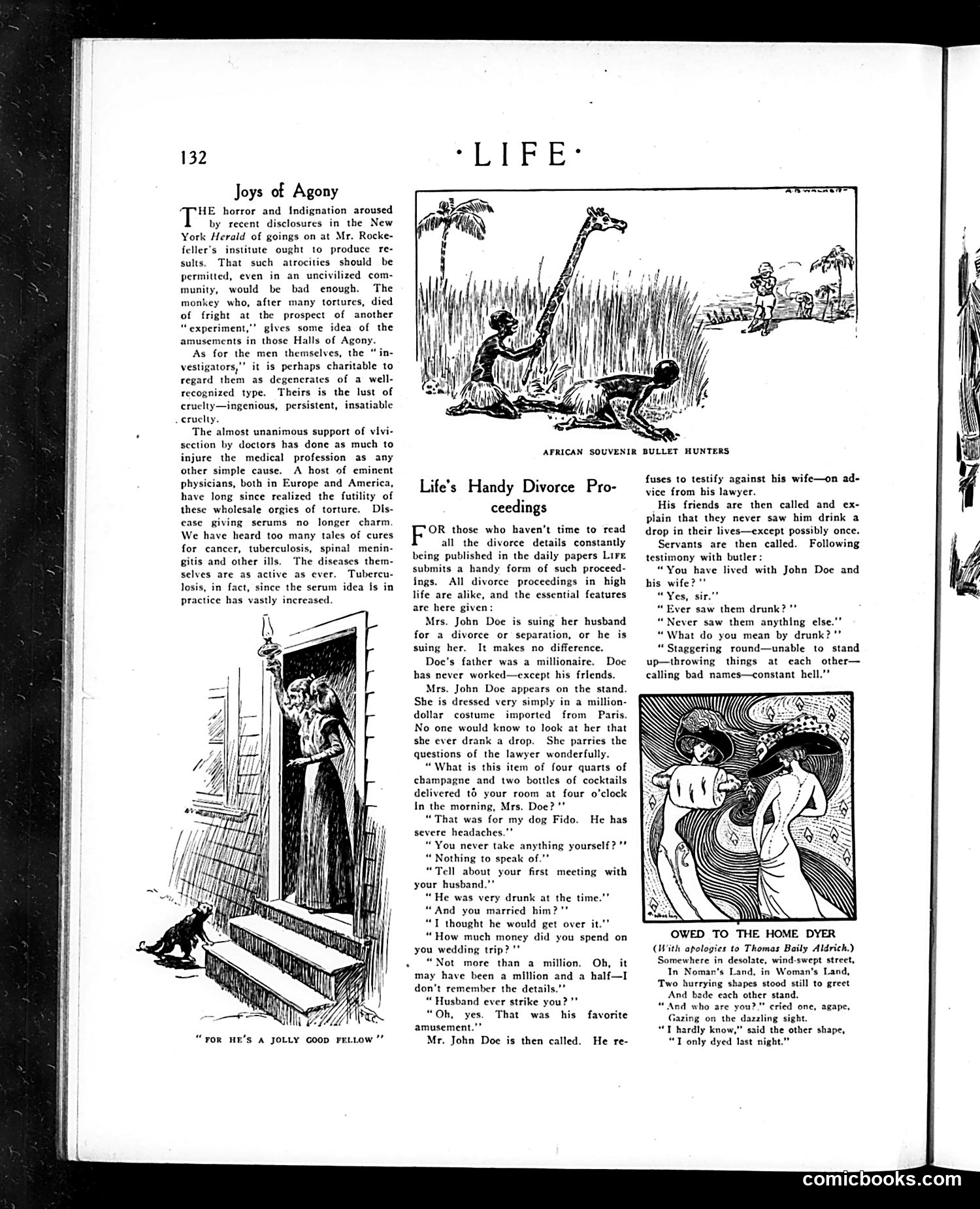
This page contains three distinct pieces of social satire: **"Joys of Agony"** critiques animal testing at Rockefeller Institute, condemning vivisecrion (animal experimentation) as cruel and medically futile. The text argues these experiments haven't produced promised cures for diseases like tuberculosis, which have actually increased. **"Life's Handy Divorce Proceedings"** mocks wealthy divorce cases by presenting a template showing how they unfold identically—featuring a millionaire's idle son, his fashionably-dressed wife claiming she never drinks (while delivery records prove otherwise), and servants who testify the couple drinks constantly and violently. The satire targets the hypocrisy and predictability of high-society divorces covered in newspapers. **"Owed to the Home Dyer"** is a brief poem mocking women who use home hair dye, suggesting they're unrecognizable after dyeing their hair. It's gentle mockery of a contemporary consumer trend. The illustrations include giraffe hunters and bathing figures. All content reflects early 20th-century upper-class anxieties and satirical commentary on medical ethics, marriage, and women's vanity.
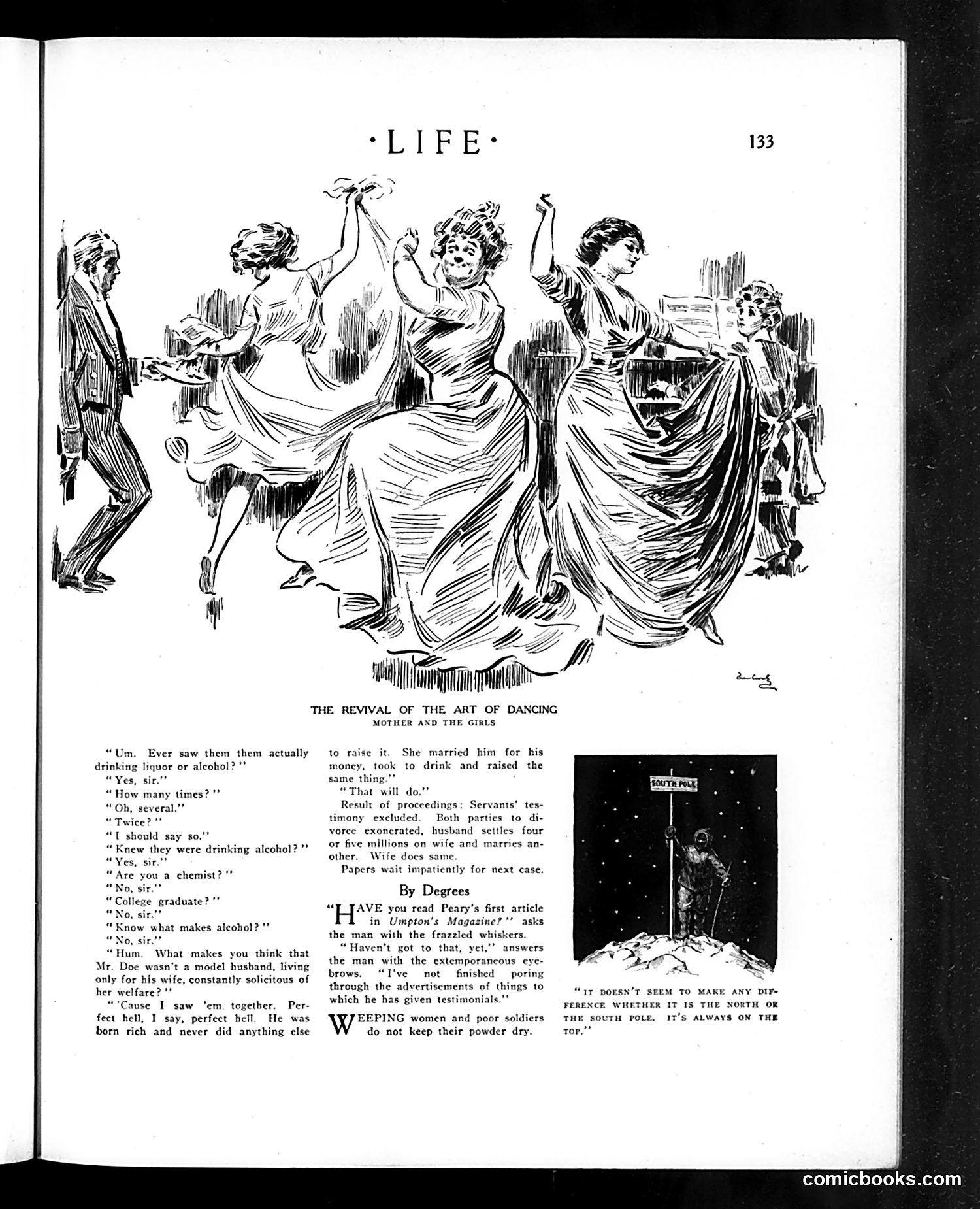
This page contains two distinct satirical pieces from *Life* magazine (likely early 1900s): **"The Revival of the Art of Dancing"** (top illustration): A sketch mocking the era's dance craze, showing a mother and young women dancing energetically with a scandalized man watching. The caption suggests disapproval of modern women's uninhibited public behavior. **Divorce Court Dialogue** (left column): Sharp satire on a divorce proceeding where a witness gives vague, contradictory testimony about whether a husband drank alcohol—answering both "yes" and claiming only "twice" or "several" times. The joke: the testimony is worthless, yet the court apparently rules anyway, awarding the wife a financial settlement. This mocks the era's loose divorce laws and frivolous proceedings. **"By Degrees"** (right): A brief joke about explorer Peary's magazine articles being overshadowed by advertisements—satirizing commercial exploitation even of Arctic exploration. The overall tone criticizes modern moral decay, loose legal standards, and commercialism in contemporary American society.
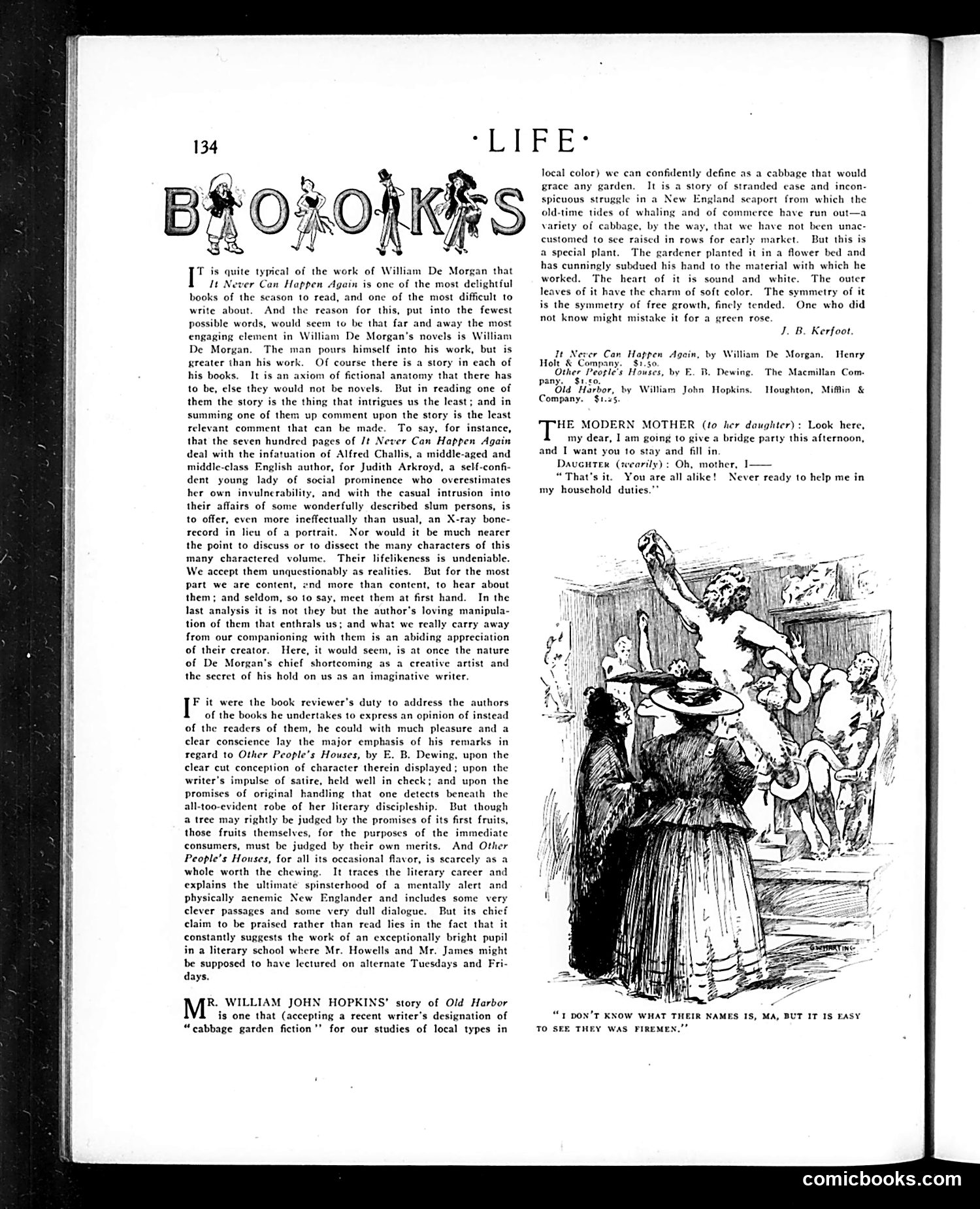
This is a **book review section** discussing three recent novels. The page contains one illustration depicting a domestic scene—likely from one of the reviewed books. **The main content** critiques: 1. **"It Never Can Happen Again"** by William De Morgan—praised primarily for De Morgan's personality and prose style rather than plot. The reviewer notes the actual story (about a middle-aged author's infatuation) matters less than the author's engaging narrative voice. 2. **"Other People's Houses"** by E.B. Dewing—a mixed review of a novel about a "mentally alert and physically anemic New Englander." The reviewer suggests it shows promise but lacks merit on its own terms, comparing it unfavorably to works by Howells and James. 3. **"Old Harbor"** by William John Hopkins—described as "cabbage garden fiction" (local color realism), praised as a worthy example of the genre depicting "stranded case and inconspicuous struggle in New England." The **illustration** shows what appears to be a domestic interior scene, likely supporting one of these narratives. The quote beneath reads: "I DON'T KNOW WHAT THEIR NAMES IS, MA, BUT IT IS EASY TO SEE THEY WAS FIREMEN."
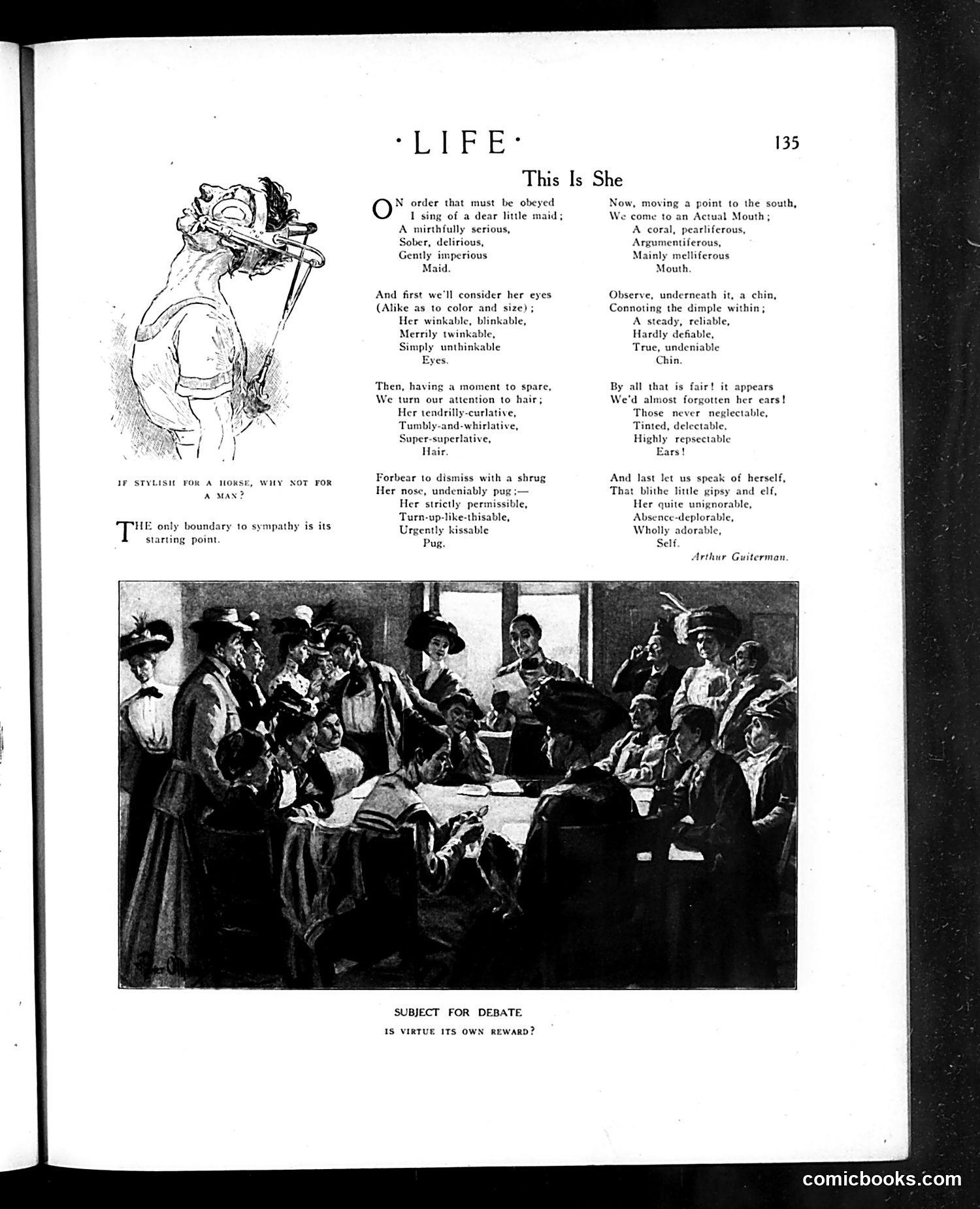
This page features a humorous poem cataloging an idealized young woman's physical features in exaggerated, whimsical language. The poet systematically describes her eyes, hair, nose, mouth, chin, ears, and finally her personality—each section employing absurdist rhyming coinages ("tendrilly-curlative," "melliferous"). **The satire**: The poem gently mocks both Victorian courtship conventions and flowery romantic poetry by taking descriptive excess to absurd extremes. Rather than sincere tribute, the inventory becomes comedic through its mechanical progression and invented adjectives. **The accompanying cartoon** (upper left) shows a caricatured woman in fashionable dress, likely illustrating the "dear little maid" described. The caption "If stylish for a horse, why not for a man?" suggests a separate, unrelated joke about fashion applying equally to both sexes. **The photograph** below depicts what appears to be a formal social gathering or debate, captioned "Subject for Debate: Is Virtue Its Own Reward?"—possibly illustrating societal questions about feminine virtue, or functioning as independent editorial content.
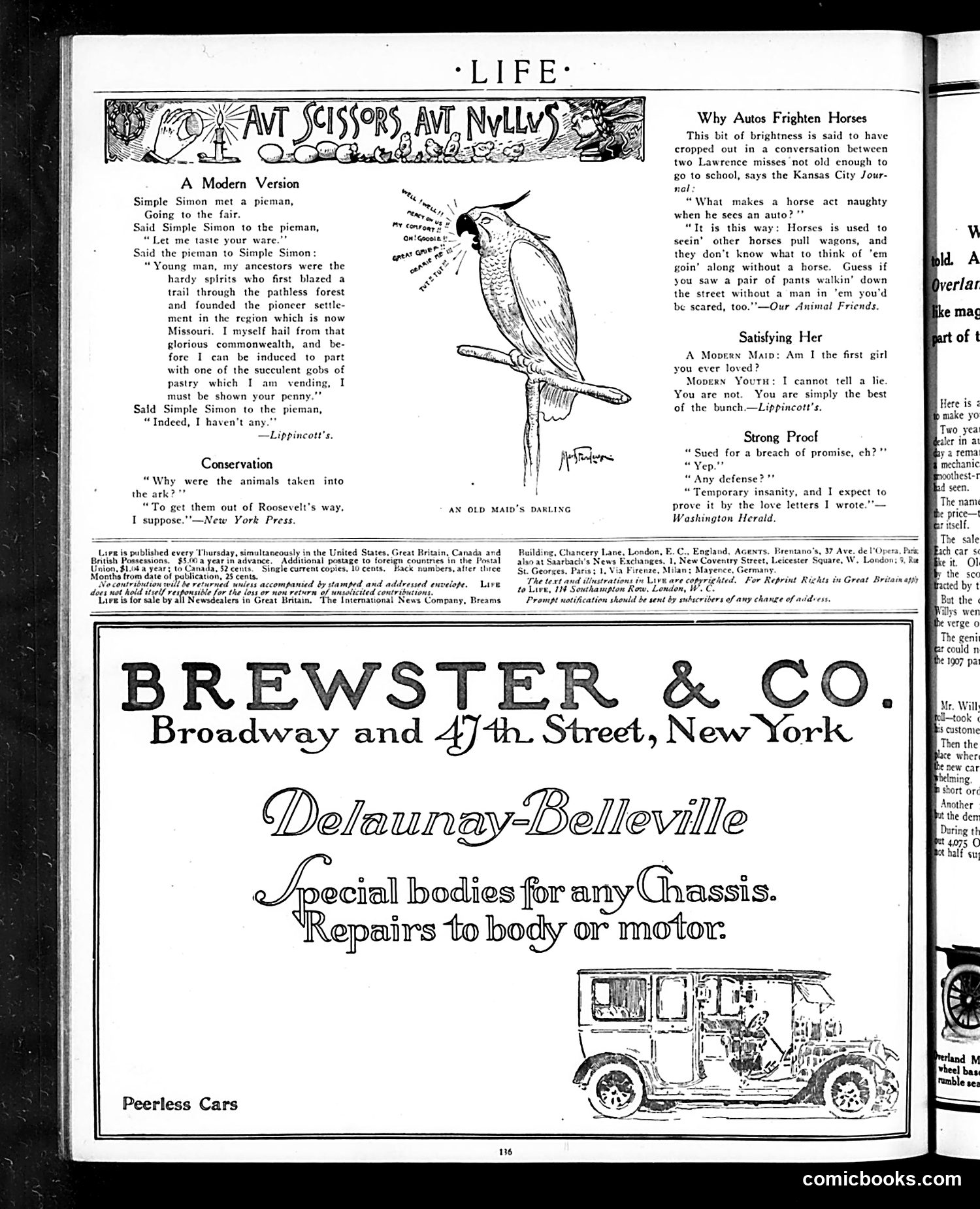
This page from Life magazine contains several humorous pieces satirizing early 20th-century American life: **"Why Autos Frighten Horses"** mocks the recent arrival of automobiles by presenting a comedic explanation from two Kansas City girls. The joke compares a horseless car to "a pair of pants walkin' down the street without a man in 'em"—horses are confused by mechanical movement without an animal pulling it, making them afraid of the inexplicable sight. **"A Modern Version"** is a parody of the nursery rhyme "Simple Simon," where the pieman boasts of his Missouri pioneer ancestry to justify his high prices. It satirizes American frontier mythology and commercialism. **"Strong Proof"** jokes about a breach-of-promise lawsuit, where the defendant claims "temporary insanity" proved by love letters—implying the letters themselves demonstrate insanity, thus disproving genuine intention to marry. The page also contains a Brewster & Co. automobile advertisement, typical of period trade publishing mixed with editorial content.
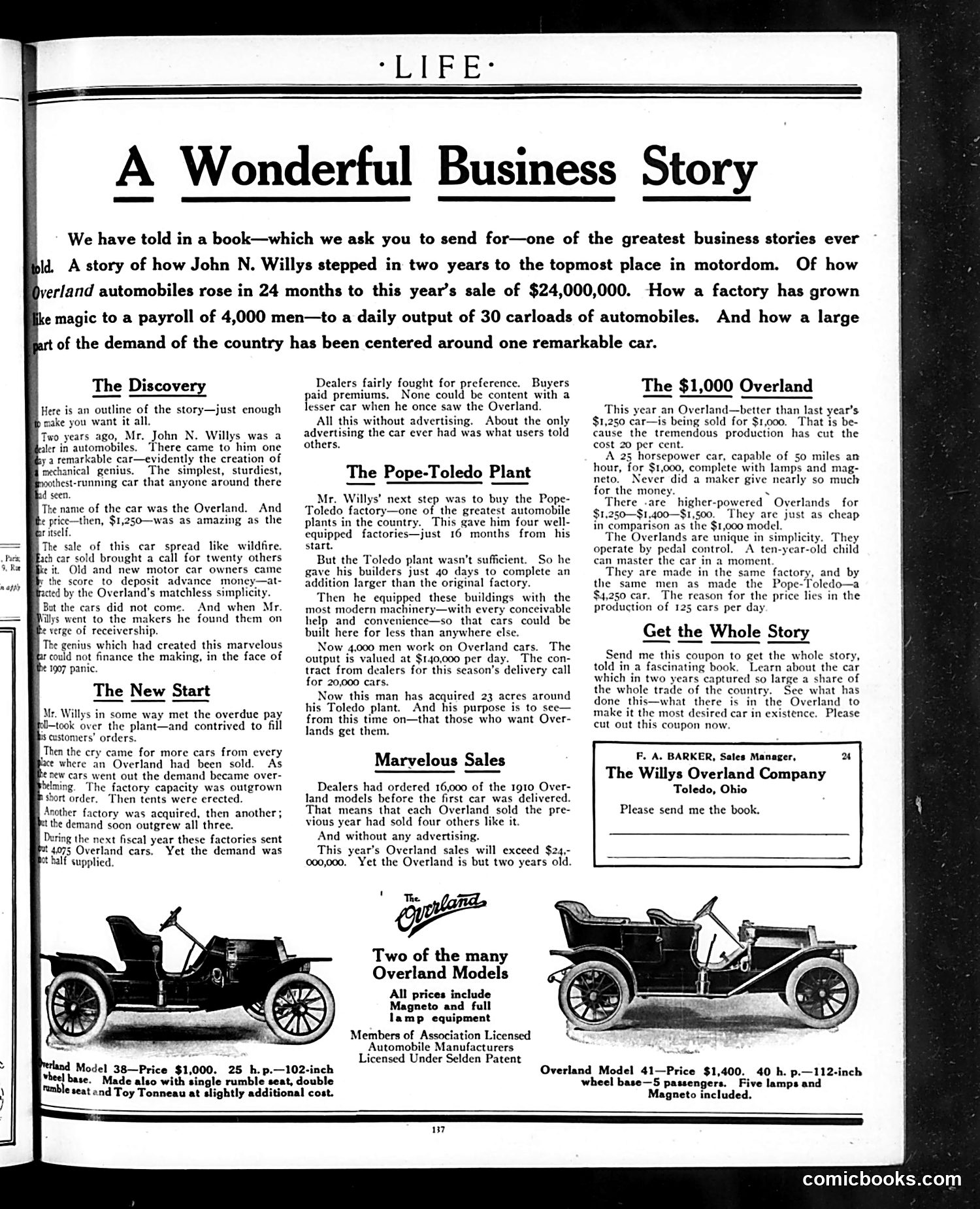
This is **not a cartoon but business advertising** disguised as editorial content in *Life* magazine. It promotes the Overland automobile through a success narrative about entrepreneur John N. Willys. The "story" claims Willys took over a failing automobile company in 1907-1908 and, within two years, built it into a $24 million enterprise with 4,000 workers. The text emphasizes the car's simplicity, reliability, and affordability ($1,000-$1,400)—supposedly so popular it sold "without advertising" through word-of-mouth alone. Two car models are illustrated at the bottom. **The satirical angle** (typical of *Life*'s approach): This reads as parody of American success mythology—the self-made businessman overcoming crisis through genius and determination. For modern readers, it's notably an **advertorial**: promotional content formatted to appear like journalism, a practice common in early 20th-century magazines but now generally disclosed. The piece celebrates industrial scale and mass production as inherently good, reflecting pre-WWI American optimism about capitalism and manufacturing.
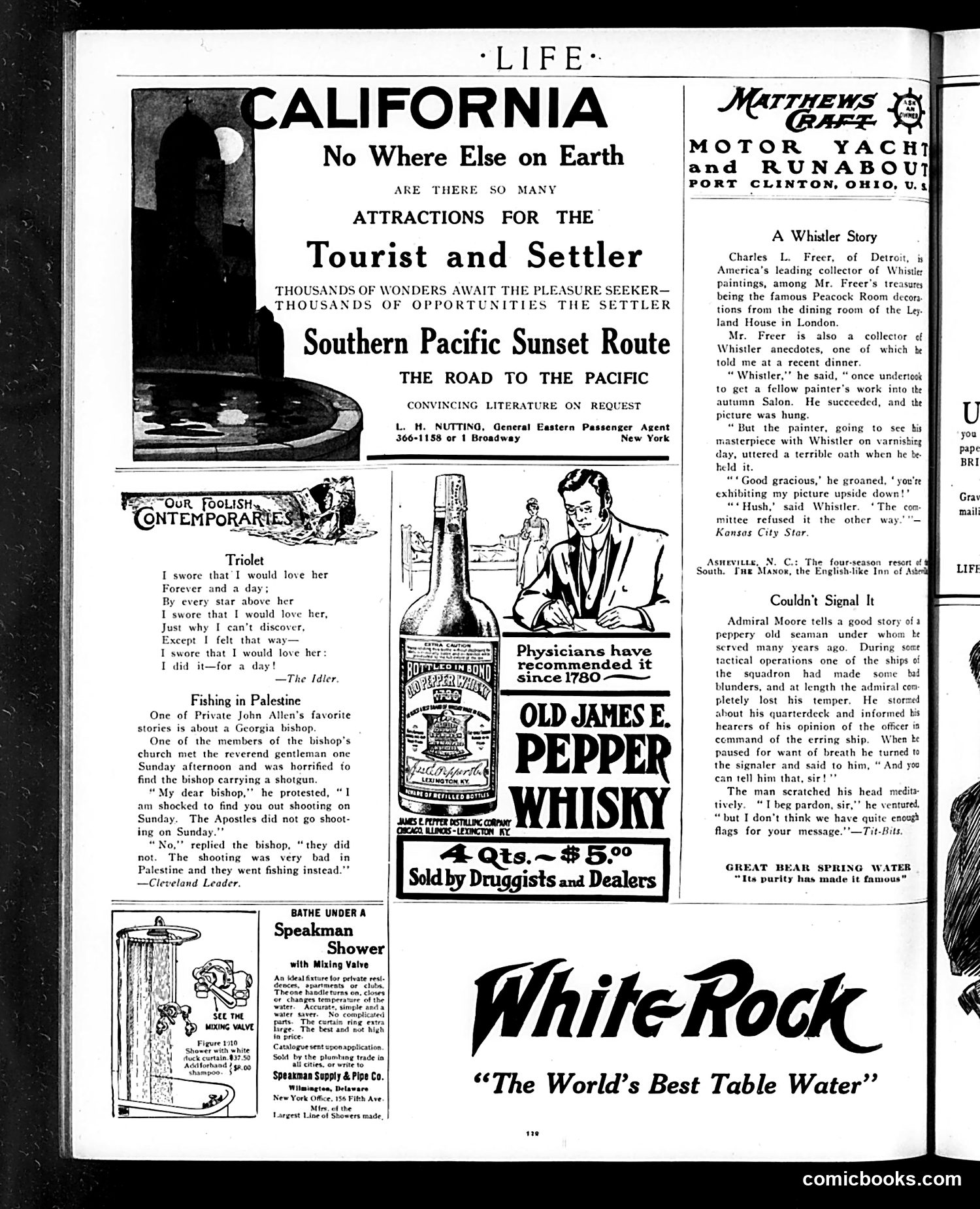
This page is primarily **advertisements and light humor**, not political satire. The main content includes: **"Our Foolish Contemporaries"** section presents three short humorous anecdotes: - A love poem about brief commitment - A joke about a Georgia bishop fishing on Sunday (playing on the hypocrisy of strict religious observance) - A story about an admiral so angry he can't find enough signal flags to express his rage These are gentle jokes about human foibles—romantic inconstancy, religious inconsistency, and uncontrollable anger—rather than pointed political critique. The page is dominated by **product advertisements**: Old James E. Pepper Whisky, Speakman Showers, White Rock water, and tourism promotions for California and Ohio resorts. The California ad emphasizes tourism and settlement opportunities, reflecting early 20th-century westward expansion marketing. The "Whistler Story" is a brief anecdote about the famous painter James McNeill Whistler and artistic committee politics. Overall, this represents typical Life magazine content: light humor, consumer advertising, and travel promotion rather than political commentary.
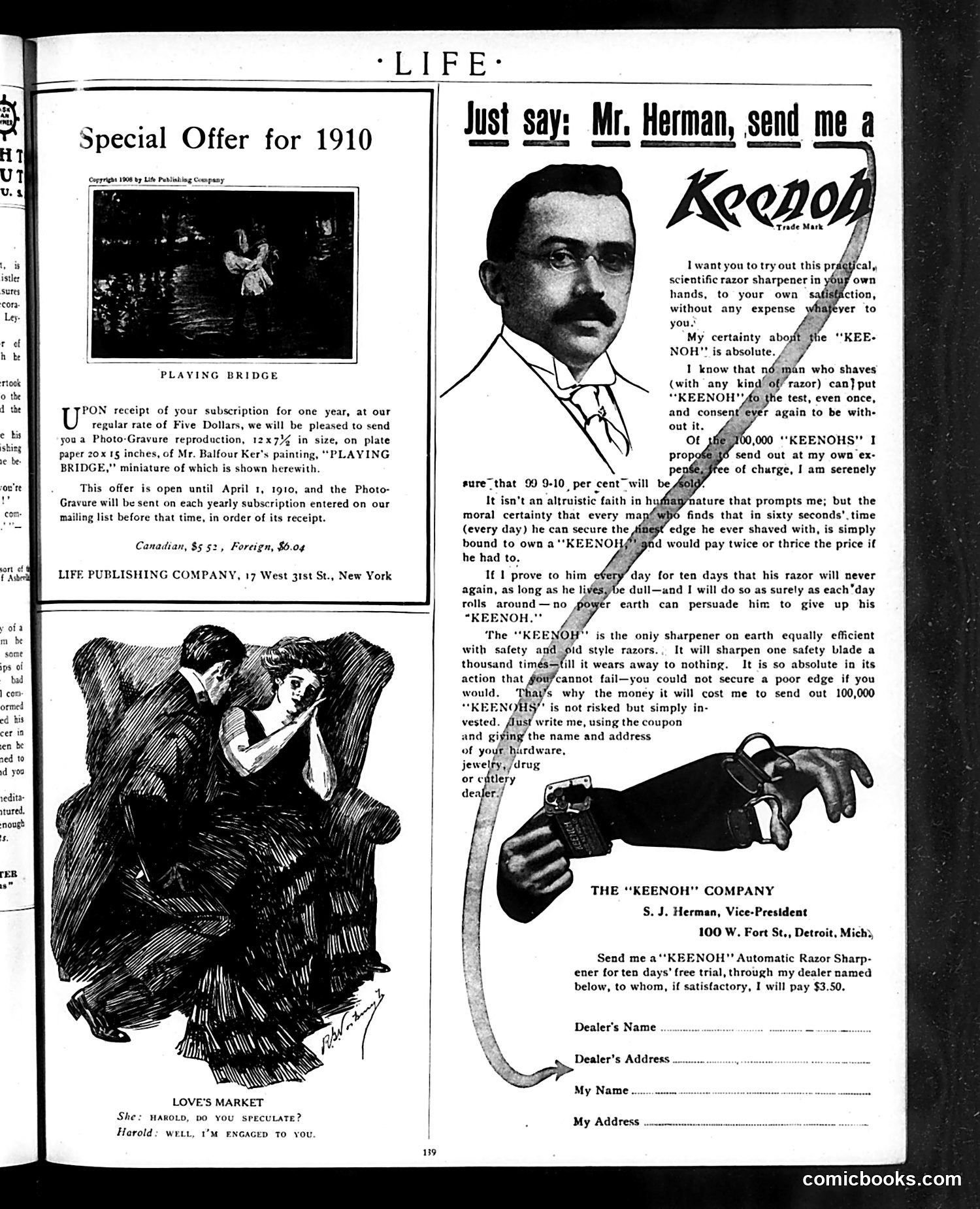
This page contains two unrelated items: a subscription offer and a product advertisement. **Left side:** "Special Offer for 1910" advertises a photo-gravure reproduction of a painting called "Playing Bridge" by Balfour Ker for new subscribers. This is a standard magazine promotion. **Right side:** A "Keenoh" razor sharpener advertisement features S.J. Herman, the company's vice-president, making an aggressive sales pitch. Herman claims absolute certainty that any man who tries his device will become a loyal customer within sixty seconds. The ad employs hyperbolic language typical of early 1900s marketing, promising to send 100,000 free trial units because he's certain of the product's superiority. The implicit satire suggests this exaggerated confidence in a simple mechanical device reflects the era's aggressive advertising culture and unregulated product claims. **Bottom:** A small cartoon titled "Love's Market" shows a brief marital exchange, unrelated to the other content.
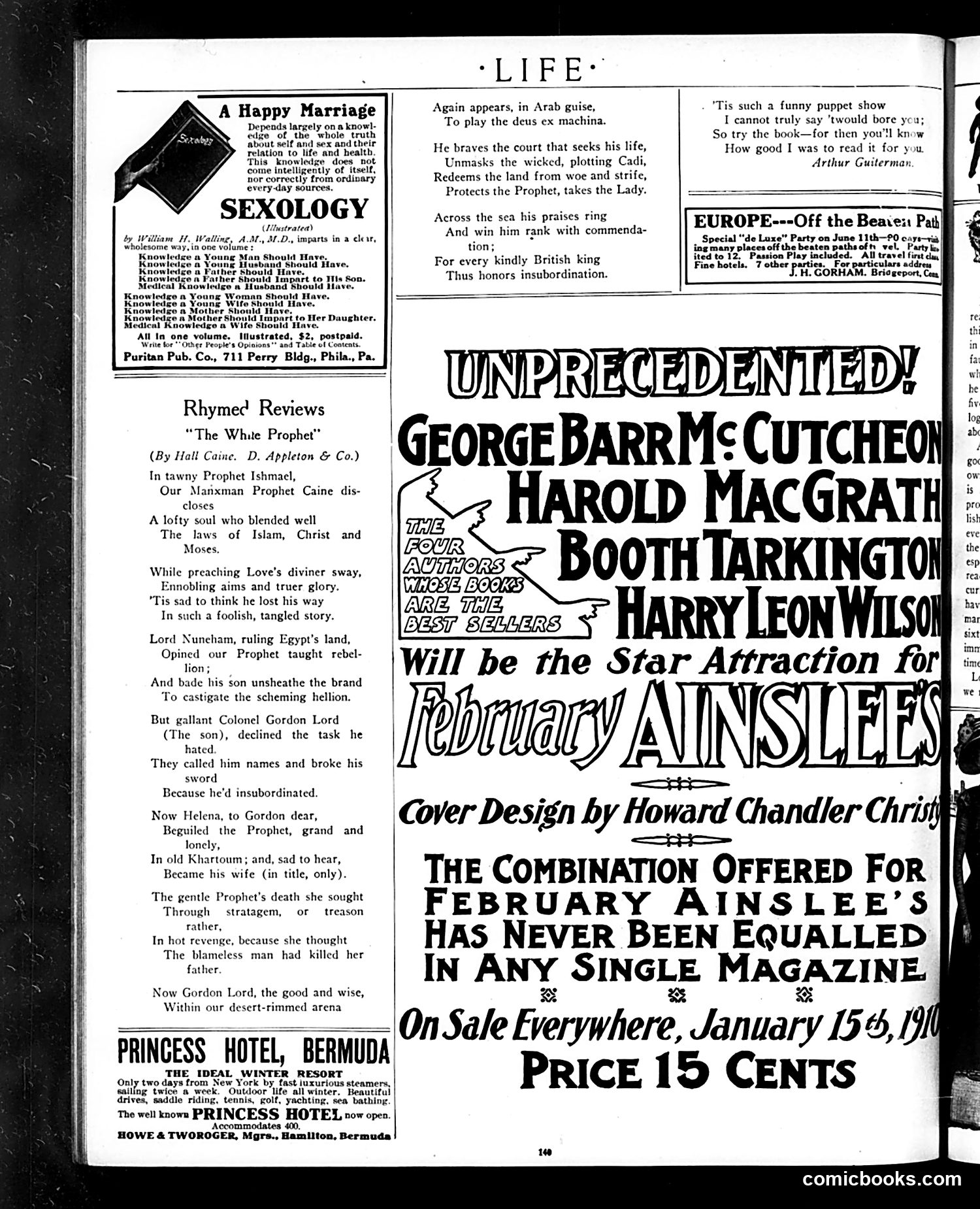
This is primarily a **magazine advertisement and book review page**, not a political cartoon. The main content includes: 1. **"Sexology" book ad** — A medical/educational text by William H. Walling promoting practical knowledge about sex and marriage for husbands, wives, and parents. This represents early-1900s sexual education literature, then considered somewhat progressive but presented cautiously. 2. **Book review of "The White Prophet"** by Hall Caine — A rhymed critique of a melodramatic novel involving Egypt, Islamic prophets, and British colonial figures. The reviewer (Arthur Guiterman) mocks the contrived plot involving a prophet, colonial officials named Lord and Cadi, and romantic entanglements in Khartoum, satirizing the overwrought adventure-romance genre popular at the time. 3. **Travel and magazine advertisements** — Princess Hotel Bermuda resort ads and Ainslee's Magazine promotion. The page reflects early-20th-century American cultural concerns: sexuality education, imperial adventure fiction, and leisure travel marketing.
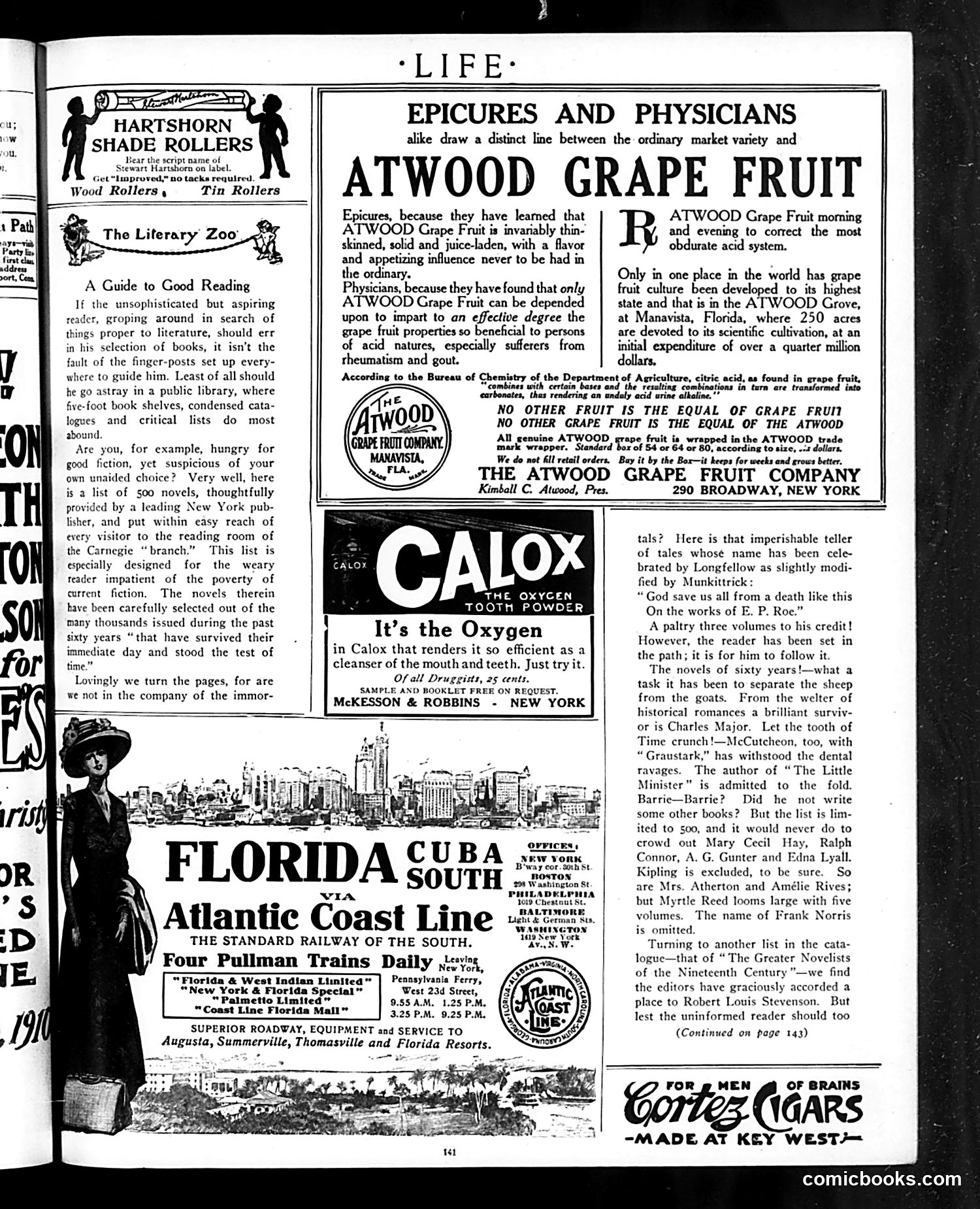
This page is primarily **advertising**, not satirical content. It contains multiple product advertisements typical of an early 20th-century magazine. The notable text sections are: 1. **"The Literary Zoo"** — a brief editorial commentary mocking the pretentiousness of curated book lists. It satirizes the Carnegie Library's "500 novel" reading list as unnecessary gatekeeping, humorously suggesting readers don't need institutional guidance. The reference to "E. P. Roe" appears critical of minor literary figures. 2. **Product advertisements** dominate the page: Atwood Grape Fruit (marketed to both "epicures and physicians"), Calox tooth powder, Hartshorn shade rollers, and Atlantic Coast Line railroad. The humor is light and self-aware rather than political—Life magazine's characteristic style of gently mocking cultural institutions and consumer culture. The "Literary Zoo" section suggests that pretentious reading lists are themselves a form of entertainment/absurdity, much like a zoo.
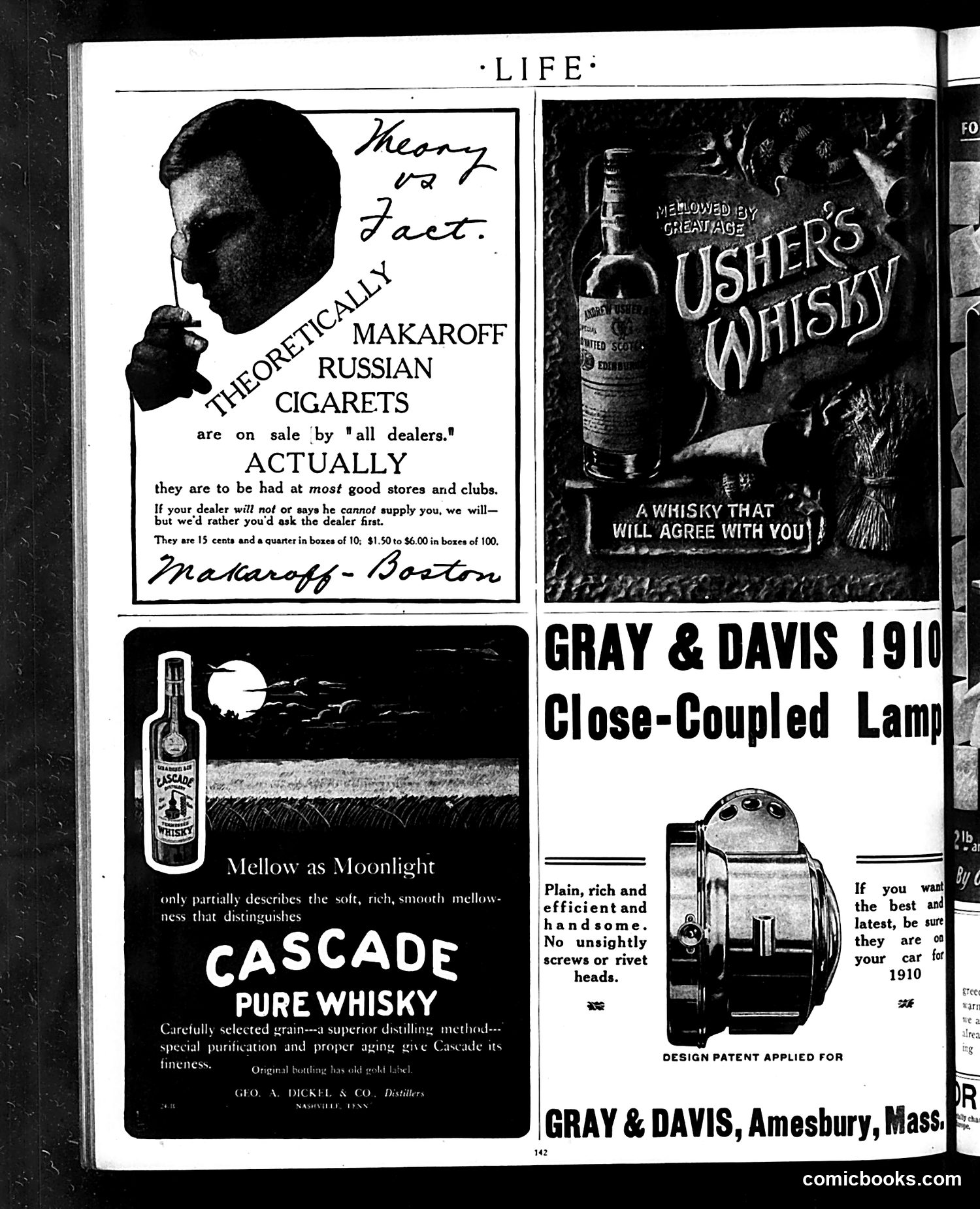
This page is primarily **advertising**, not satire or political commentary. It contains four commercial advertisements from the early 1910s: 1. **Makaroff Russian Cigarets**: Features a man's profile smoking, addressing the claim these cigarets are "on sale by all dealers" while admitting they're actually harder to find—a tongue-in-cheek advertisement acknowledging limited availability. 2. **Cascade Pure Whisky**: A luxury liquor ad emphasizing the product's smooth quality ("Mellow as Moonlight"), appealing to upscale consumers. 3. **Usher's Whisky**: Shows a bottle with text promising the whisky "will agree with you." 4. **Gray & Davis Close-Coupled Lamp**: An automotive lighting device advertisement highlighting practical features like efficient design without visible screws or rivets. The page reflects early 20th-century consumer marketing, before modern advertising regulations, with luxury goods (alcohol, cigarettes) prominently advertised in a mainstream publication.
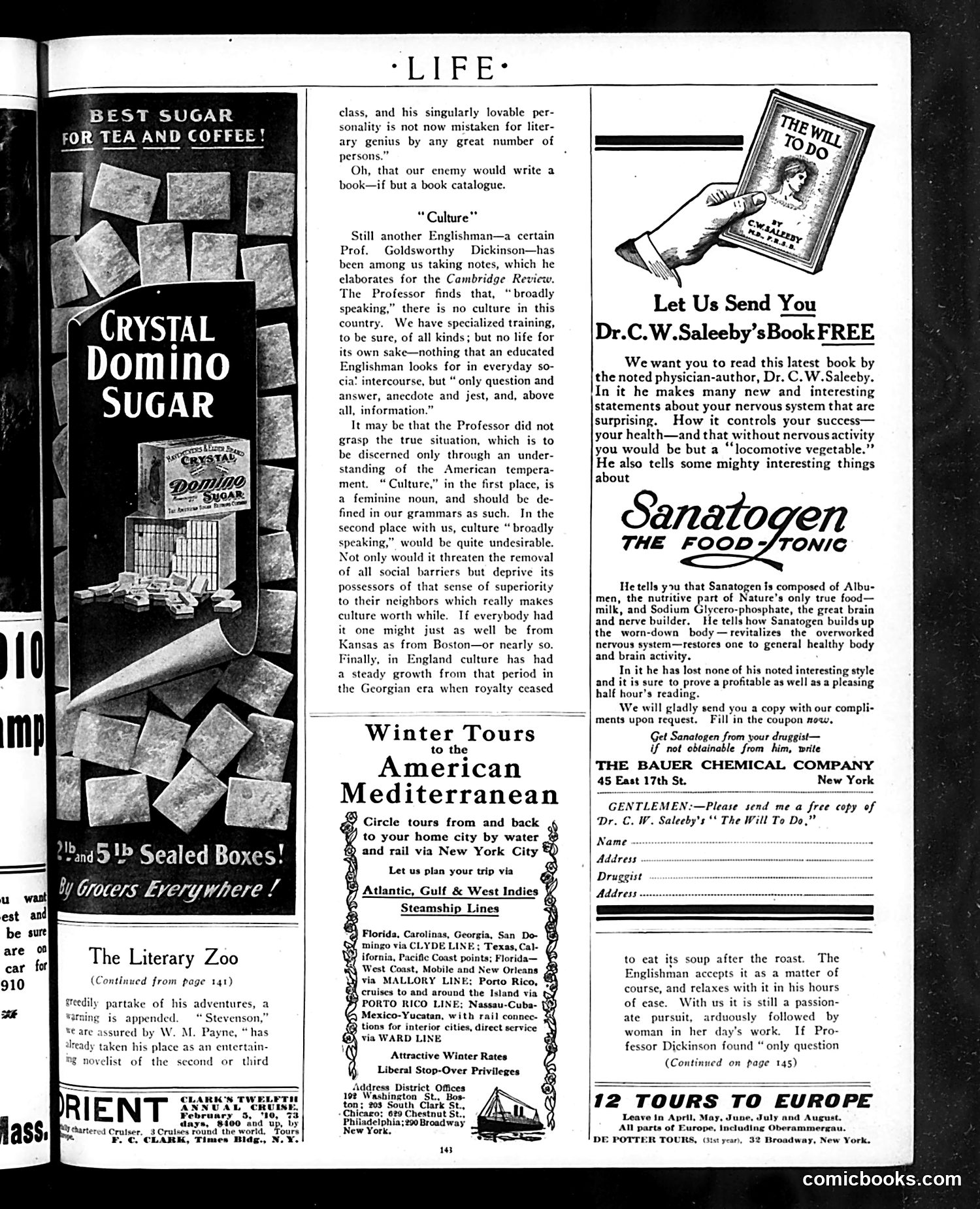
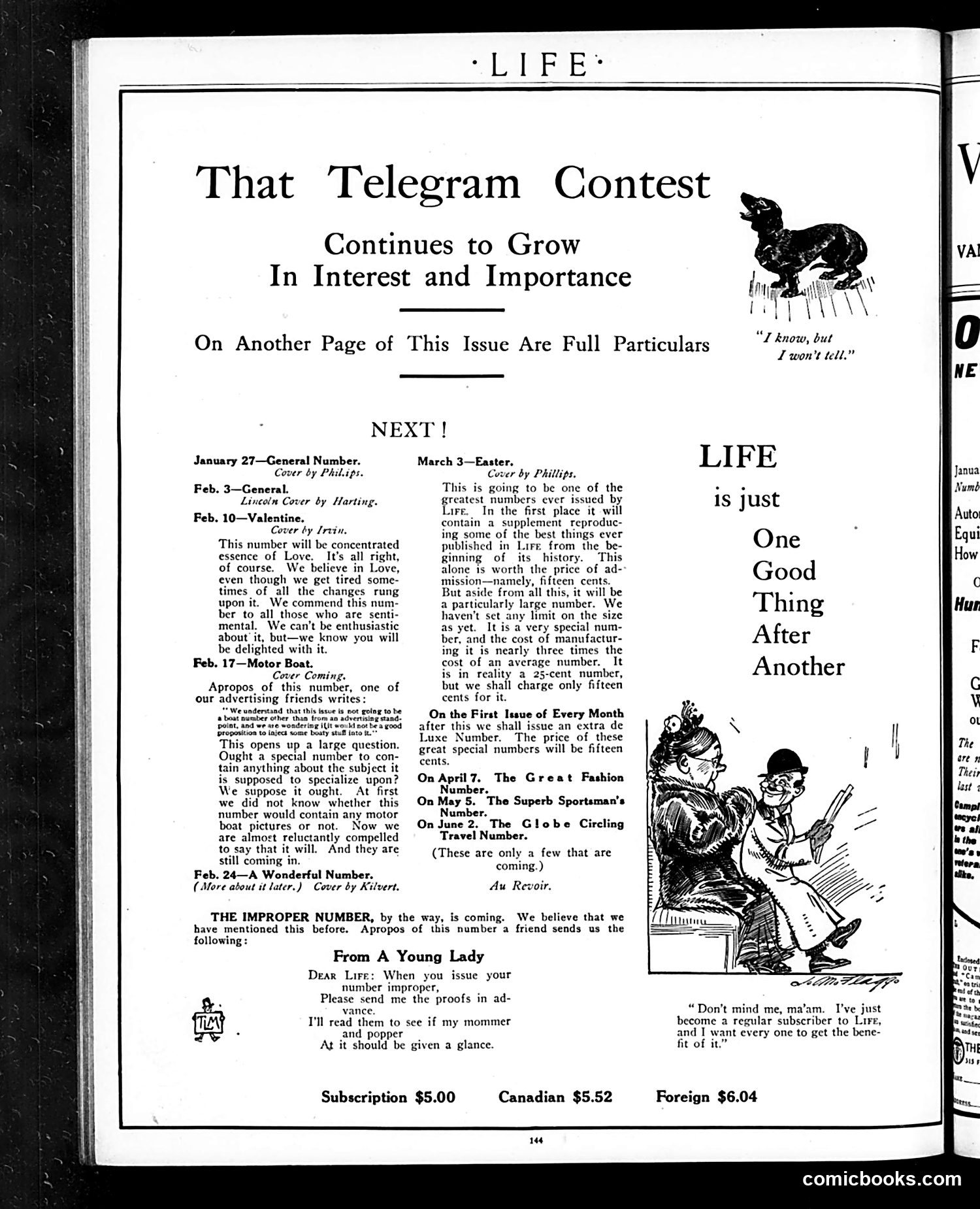
This page is primarily **promotional content** for Life magazine's upcoming special issues, not political satire. It announces a "Telegram Contest" and previews themed issues (Valentine's, Easter, Fashion, etc.). The two cartoons serve as advertising: 1. **Top right**: A dog with the caption "I know, but I won't tell"—likely promoting Life's humorous content. 2. **Bottom right**: An elderly man showing Life magazine to a woman, saying he's become a "regular subscriber" and wants others to benefit—a straightforward subscription advertisement. The page also includes a humorous letter from "A Young Lady" requesting advance proofs of an upcoming "Improper Number," which appears to be Life's playful, cheeky content—suggesting the magazine marketed itself as slightly risqué entertainment for the era. This is essentially **a table of contents and advertising hybrid**, not editorial commentary or political cartooning.
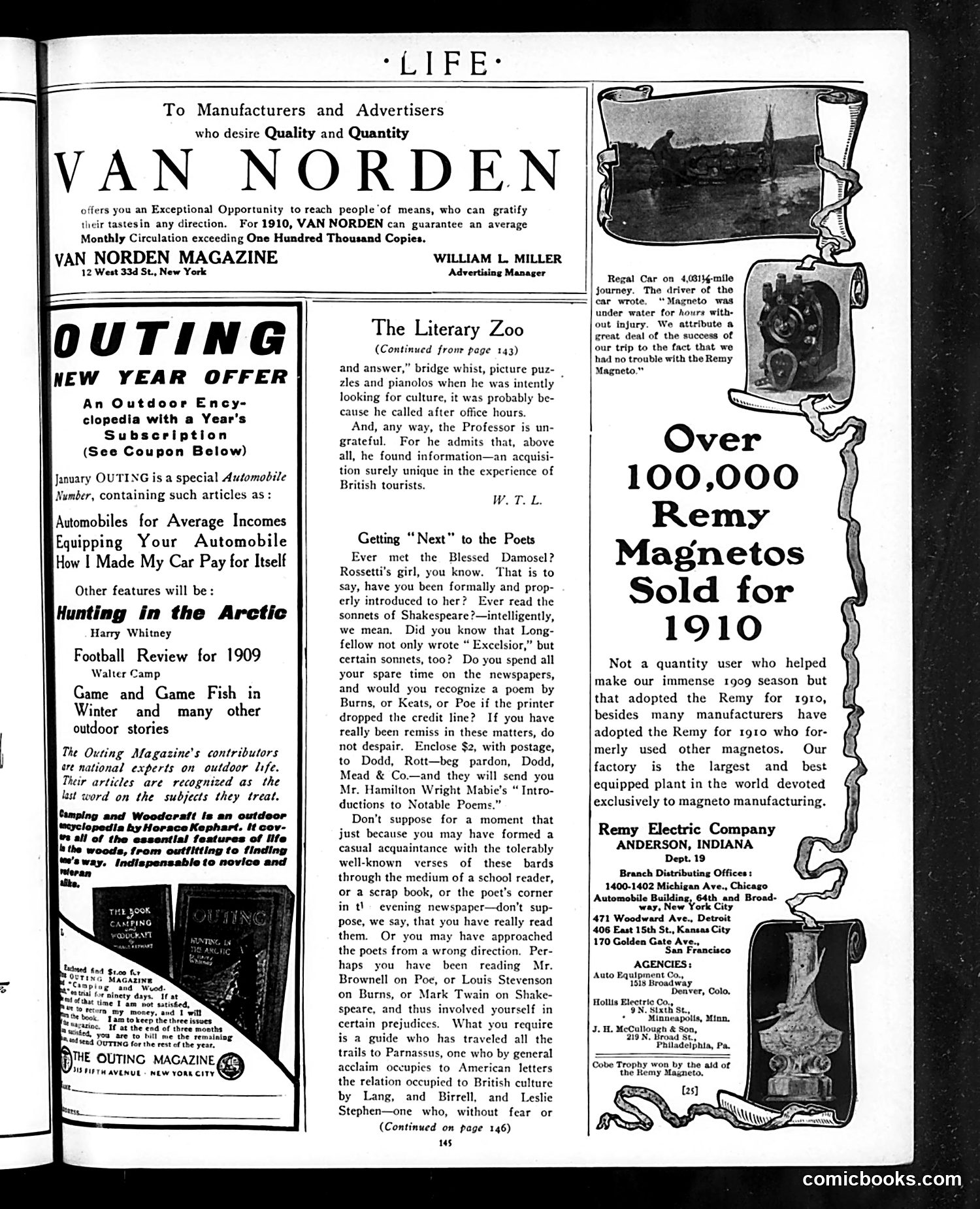
This is primarily an **advertising and content page** from Life magazine (circa 1910), not a political cartoon page. The main content is "The Literary Zoo," a satirical essay mocking pretentious cultural aspiration. It ridicules people who claim literary sophistication without genuine knowledge—those who recognize famous poems only by printer's credit lines or read secondary criticism (by Brownell, Stevenson, Twain) rather than the actual texts. The satire targets social climbers who use cultural references to appear educated. The surrounding advertisements pitch upscale products to wealthy readers: Van Norden Magazine (targeting affluent consumers), Outing Magazine (outdoor pursuits for the well-to-do), and Remy Magnetos (automobile ignition systems). The page reflects 1910 attitudes about class, education, and consumer culture—the assumption that readers aspire to both literary refinement and modern luxury goods as markers of status.
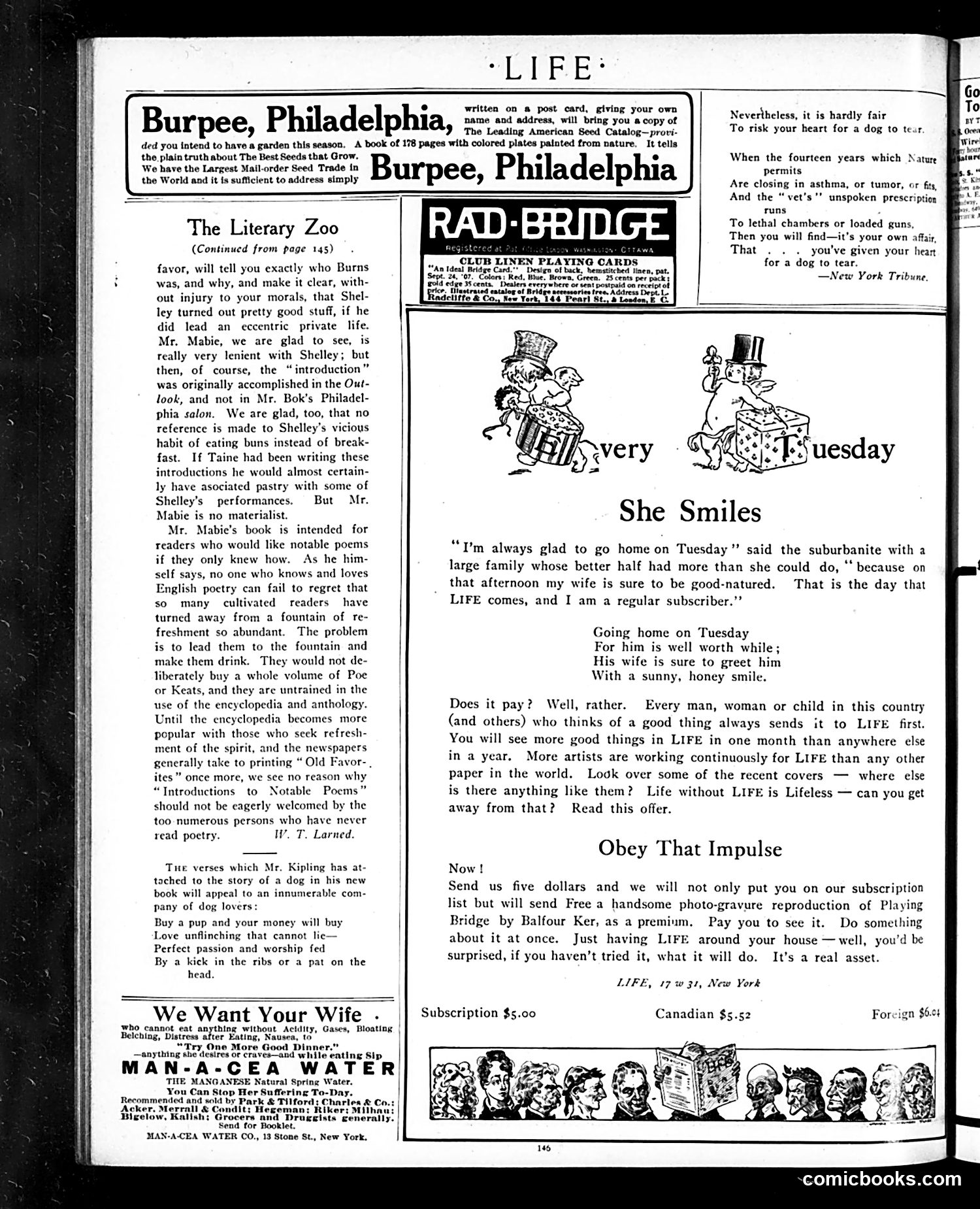
This page from *Life* magazine (a satirical publication, not the later photo-magazine) combines literary criticism, advertising, and subscription promotion. **Main Content:** The left column continues "The Literary Zoo," a critical essay discussing how literature should be made accessible to ordinary readers. It critiques scholars like Henry Mabie for writing introductions to poetry collections, arguing they make classic works seem remote rather than inviting people to actually read them. **The Satire:** The right side features "She Smiles," a humorous advertisement for *Life* magazine itself. A suburban husband explains he's happy to come home on Tuesdays because that's when *Life* arrives, making his wife good-natured. The joke satirizes both marital dynamics (implying his wife needs distraction from domestic duties) and *Life's* self-importance—claiming the magazine is so essential that it literally improves family harmony. **Context:** This is essentially *Life* promoting itself through gentle mockery of middle-class suburban life, while the editorial content debates how to make literature relevant to average readers—an ironic contrast given the magazine's own elitist literary pretensions.
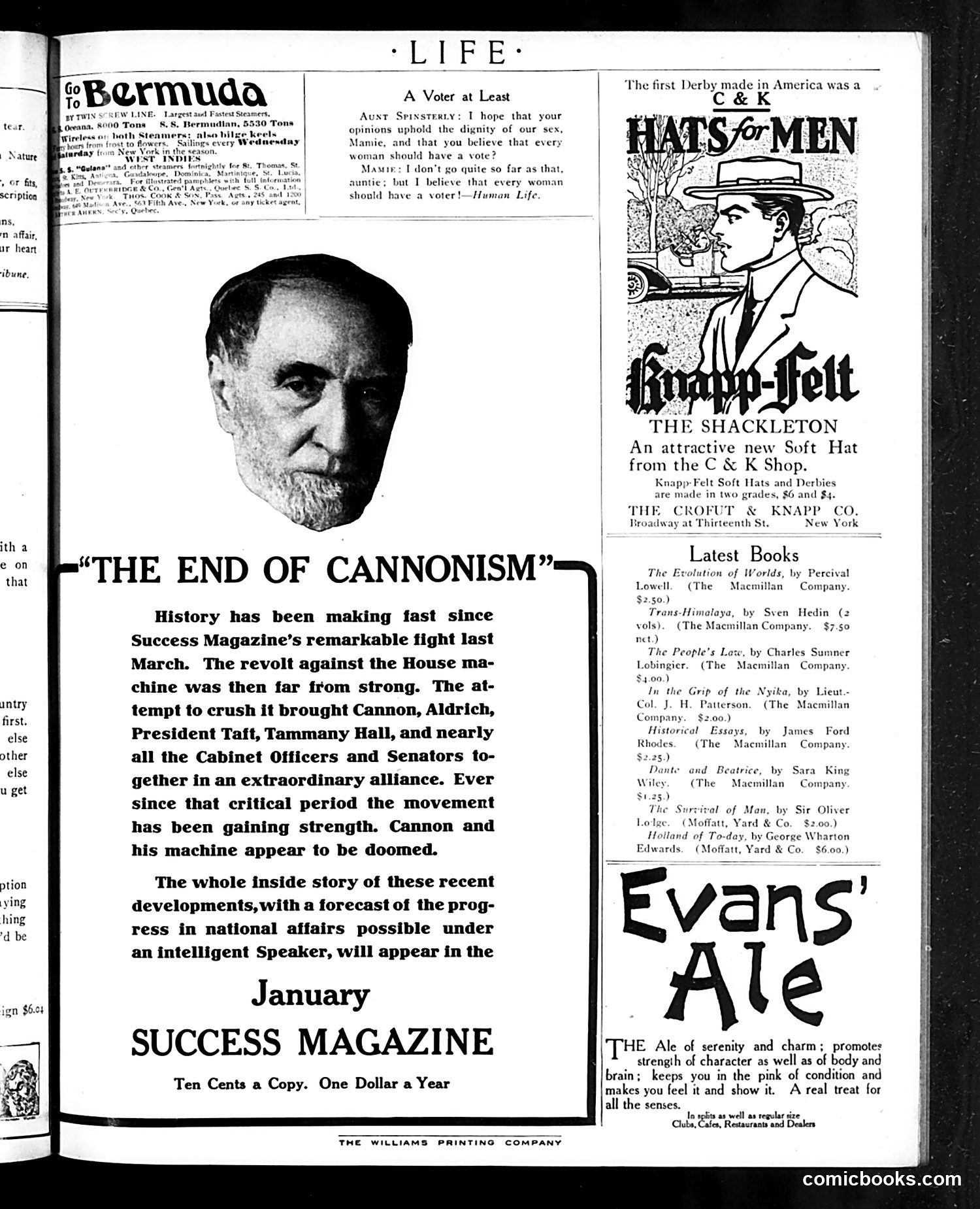
This page features a political cartoon mocking **Joseph G. Cannon**, the powerful Speaker of the House (identified by the portrait and headline). **The Context:** The text celebrates the anti-machine political movement that gained momentum after Success Magazine's March campaign against Cannon's control of the House. Cannon, allied with conservative Republicans like **Senator Aldrich**, **President Taft**, and **Tammany Hall** (NYC's Democratic political machine), represented old-guard political power that reformers sought to overturn. **The Satire's Point:** The headline "The End of Cannonism" declares that despite Cannon's formidable coalition, his political machine "appears to be doomed"—suggesting the reform movement's growing strength would topple this entrenched power structure. **For Modern Readers:** This reflects early 1900s Progressive Era politics, when insurgent Republicans and reformers challenged party bosses' control. The alliance between Republican Cannon and Democratic Tammany Hall illustrates how machine politics transcended party lines, uniting establishment powers against reform.
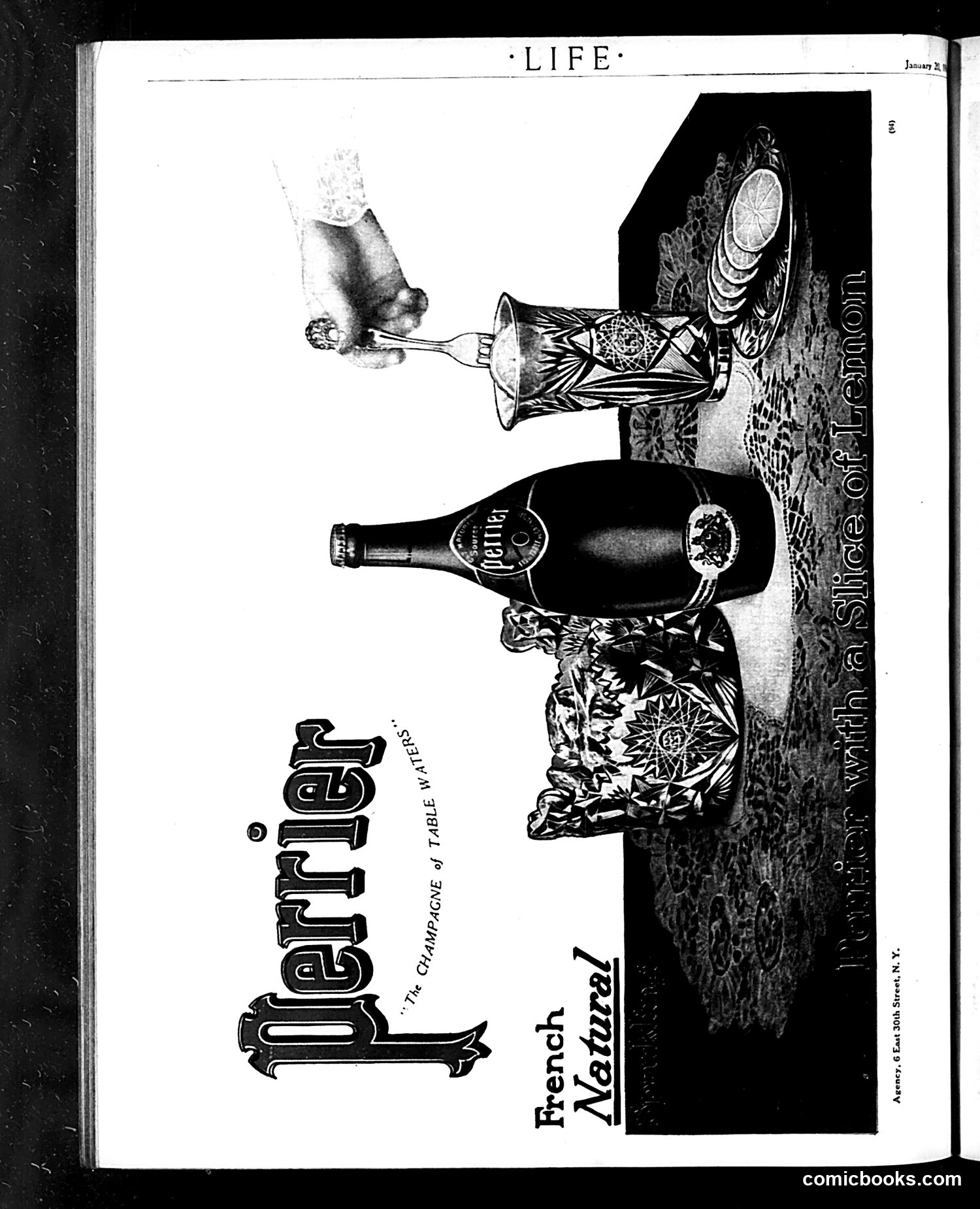
This is a **Pernod absinthe advertisement** disguised as editorial content in Life magazine. The ad shows a bottle of Pernod with decorative glassware and a serving vessel, presented as "The Champagne of Table Spirits." The satire likely mocks the pretentious marketing of French absinthe to American consumers, elevating an alcoholic beverage to champagne-like status. The ornate decorative presentation and flowery language ("Champagne of Table Spirits") exemplify how advertisers used exaggeration and false prestige to sell luxury goods. This appears in Life's satirical tradition of mocking commercial excess and consumer gullibility through fake or ironic advertisements presented as genuine editorial matter.