
Life, 1910-01-20 · page 16 of 36
Life — January 20, 1910 — page 16: what you’re looking at
What you’re looking at
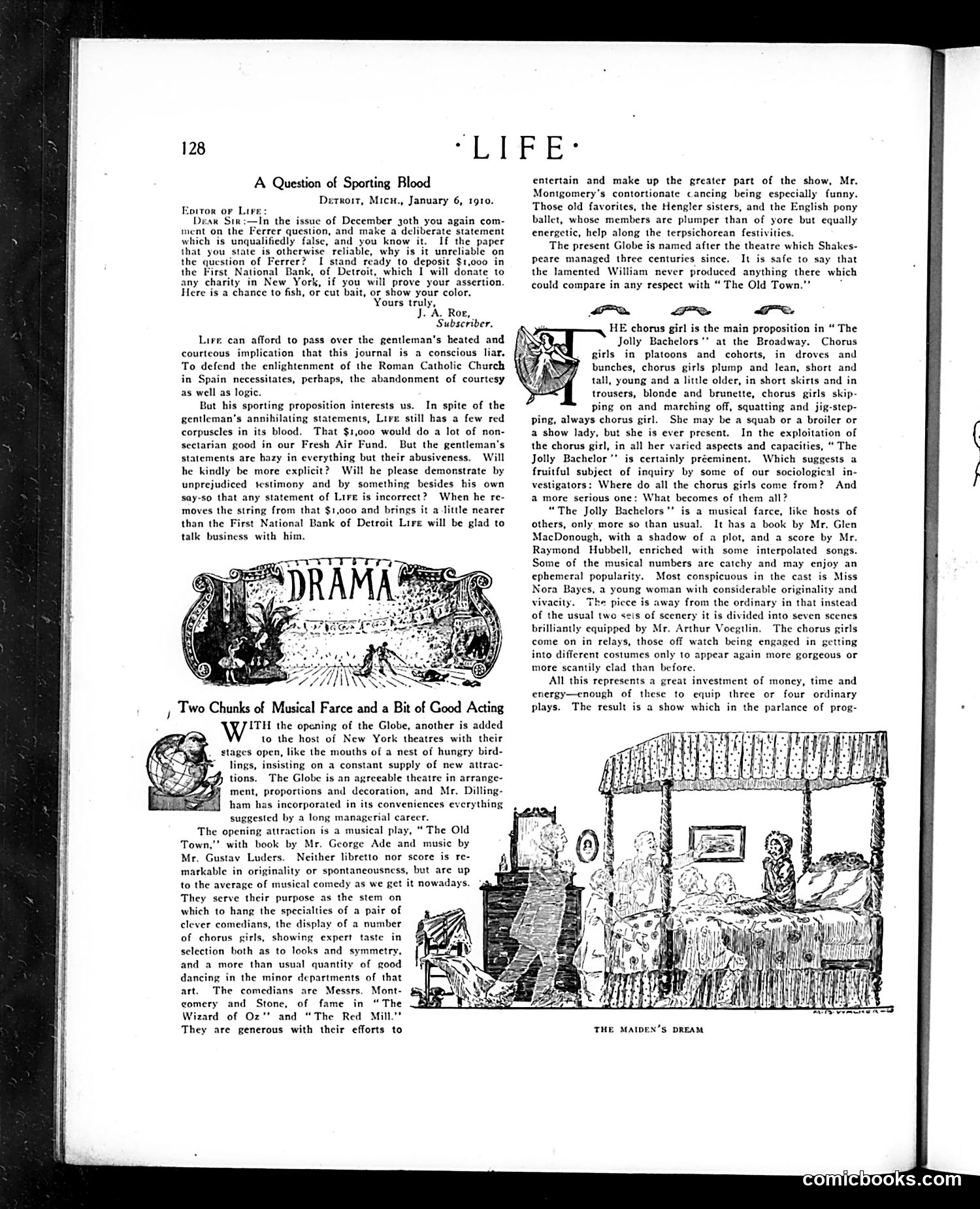
This page contains two distinct sections: **The "Sporting Blood" Letter**: A reader challenges Life magazine's coverage of the Ferrer question (likely Francisco Ferrer, executed in Spain in 1909 for alleged radical activities). The subscriber, J.A. Roe, accuses Life of making false statements and offers $1,000 to charity if Life can prove its claims with "unprejudiced testimony." Life's editor responds sarcastically, accepting the "sporting proposition" but demanding Roe demonstrate Life's errors with evidence rather than mere assertion. The exchange satirizes both the reader's heated accusations and the magazine's defensive position on this apparently contentious Catholic Church/Spanish political issue. **Theater Reviews**: Life reviews two Broadway musicals—"The Old Town" and "The Jolly Bachelors"—focusing primarily on chorus girls and comedians Montgomery and Stone (famous from "The Wizard of Oz"). The reviews are lighthearted, emphasizing spectacle and entertainment value over artistic merit, typical of early-1900s musical comedy criticism.
📄 Transcribed text from this page (OCR, searchable)
Machine-transcribed from the original scan — historical spelling and the odd misread are preserved.
128 “LIFE: A Question of Sporting Blood Detroit, Micu., January 6, 1910. Epttor or Live: . Dean Sir:—in the issue of December 3oth you again com- ment on the Ferrer question, and make a deliberate statement which is unqualifiedly false, and you know it. If the paper that you state is otherwise’ reliable, why is it unreliable on the question of Ferrer? I stand ready to deposit $1,000 in the First National Bank, of Detroit, which I will donate to any charity in New York, if you will prove your assertion. Here is a chance to fish, oF cut bait, or show your color. Yours truly, JA, Ror, Subscriber. Lire. can afford to pass over the gentleman's heated and courteous implication that this journal is a conscious liar. To defend the enlightenment of the Roman Catholic Church in Spain necessitates, perhaps, the abandonment of courtesy as well as logic. But his sporting proposition interests us. In spite of the gentleman's annihilating statements, Live still has a few red corpuscles in its blood. That $1,000 would do a lot of non- sectarian good in our Fresh Air Fund. But the gentleman's statements are hazy in everything but their abusiveness. Will he kindly be more explicit? Will he please demonstrate by unprejudiced testimony and by something besides his own say-so that any statement of Lire is incorrect? When he re- moves the string from that $1,000 and brings it a little nearer than the First National Bank of Detroit Lire will be glad to talk business with him. , Two Chunks of Musical Farce and a Bit of Good Acting ITH the opening of the Globe, another is added to the host of New York theatres with their stages open, like the mouths of a nest of hungry bird- “lings, insisting on a constant supply of new attrac- tions. The Globe is an agreeable theatre in arrange- ment, proportions and decoration, and Mr. Dilling- ham has incorporated in its conveniences everything suggested by a long managerial care! The opening attraction is a musical play, “The Old ."" with book by Mr, George Ade and music by Mr. Gustav Luders. Neither libretto nor score is re- markable in originality or spontaneousness, but are up to the average of musical comedy as we get it nowadays. They serve their purpose as the stem on which to hang the specialties of a pair of clever comedians, the display of a number of chorus girls, showing expert taste in selection both as to looks and symmetry, and a more than usual quantity of good dancing in the minor departments of that art. The comedians are Messrs. Mont- comery and Stone, of fame in “The Wizard of Oz" and “The Red Mill.’* They are generous with their efforts to entertain and make up the greater part of the show, Mr. Montgomery's contortionate cancing being especially funny. Those old favorites, the Hengler sisters, and the English pony ballet, whose members are plumper than of yore but equally energetic, help along the terpsichorean festivities. The present Globe is named after the theatre which Shakes- peare managed three centuries since. It is safe to say that the lamented William never produced anything there which could compare in any respect with “ The Old Town.” Fe Fe Fu HE chorus girl is the main proposition in “ The Jolly Bachelors" at the Broadway. Chorus girls in platoons and cohorts, in droves and bunches, chorus girls plump and lean, short and tall, young and a little older, in short skirts and in trousers, blonde and brunette, chorus girls skip- ping on and marching off, squatting and jig-step- ping, always chorus girl. She may be a squab or a broiler or a show lady, but she is ever present. In the exploitation of the chorus girl, in all her varied aspects and capacities, “ The Jolly Bachelor ’’ is certainly préeminent. Which suggests a fruitful subject of inquiry by some of our sociological in- vestigators: Where do all the chorus girls come from? And a more serious one: What becomes of them all? “The Jolly Bachelors" is a musical farce, like hosts of others, only more so than usual. It has a book by Mr. Glen MacDonough, with a shadow of a plot, and a score by Mr. Raymond Hubbell, enriched with some interpolated songs. Some of the musical numbers are catchy and may enjoy an ephemeral popularity. Most conspicuous in the cast is Miss Nora Bayes, a young woman with considerable originality and vivacity. The picce is away from the ordinary in that instead of the usual two seis of scenery it is divided into seven scenes brilliantly equipped by Mr. Arthur Voegtlin, The chorus girls come on in relays, those off watch being engaged in getting into different costumes only to appear again more gorgeous or more scantily clad than before. All this represents a great investment of money, time and energy—enough of these to equip three or four ordinary plays. The result is a show which in the parlance of prog- THE MAIDEN’S DREAM Comicbooks.com