
Life, 1910-01-20 · page 13 of 36
Life — January 20, 1910 — page 13: what you’re looking at
What you’re looking at
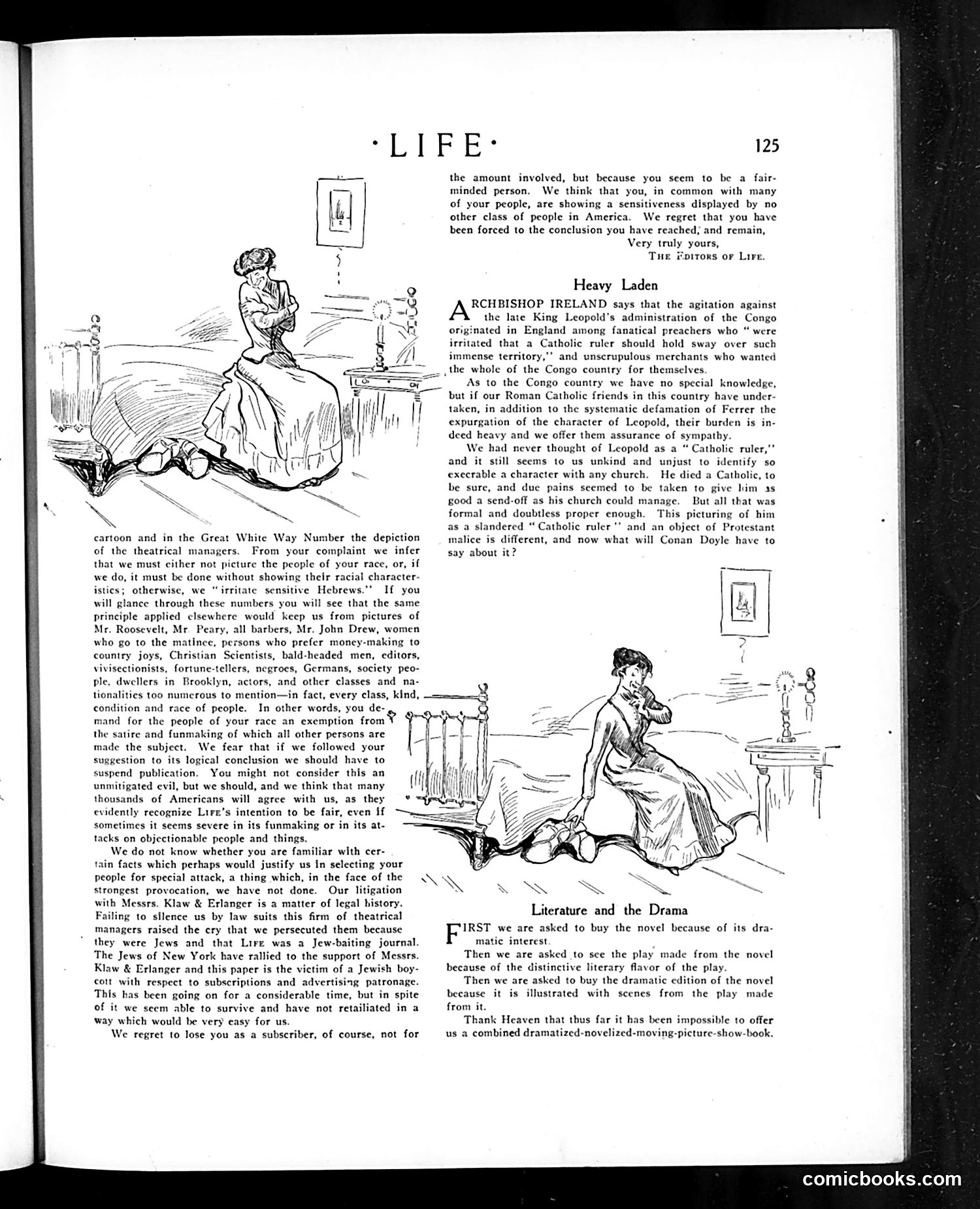
This page contains two editorial cartoons satirizing Life magazine's critics. The top cartoon depicts a woman at a vanity, illustrating an editorial response to complaints about Life's depictions of various ethnic and social groups. The editors defend their satirical approach, arguing they must either avoid caricaturing any race or do so fairly across all types—naming "Roosevelt, Peary, John Drew, women who go to the beach," etc. They assert Life intends fairness despite sometimes seeming severe. The lower cartoon accompanies a section titled "Literature and the Drama," depicting someone reading. The editorial discusses adapting novels into plays, expressing gratitude they haven't yet been asked to create a "combined dramatized-novelized-moving-picture-show-book." Both segments defend Life's editorial choices against reader criticism.
📄 Transcribed text from this page (OCR, searchable)
Machine-transcribed from the original scan — historical spelling and the odd misread are preserved.
“LIFE: cartoon and in the Great White Way Number the depiction of the theatrical managers. From your complaint we infer that we must either not picture the people of your race, or, if we do, it must be done without showing their racial character- istics; otherwise, we “irritate sensitive Hebrews.” If you will glance through these numbers you will see that the same principle applied elsewhere would keep us from pictures of Mr. Roosevelt, Mr Peary, all barbers, Mr. John Drew, women who go to the matinee, persons who prefer money-making to country joys, Christian Scientists, bald-headed men, editors, vivisectionists, fortune-tellers, negroes, Germans, society peo- ple, dwellers in Brooklyn, actors, and other classes and na- tionalities too numerous to mention—in fact, every class, kind, condition and race of people. In other words, you de- mand for the people of your race an exemption from © the satire and funmaking of which all other persons are made the subject. We fear that if we followed your suggestion to its logical conclusion we should have to suspend publication. You might not consider this an unmitigated evil, but we should, and we think that many thousands of Americans will agree with us, as they evidently recognize Live's intention to be fair, even if ——— sometimes it seems severe in its funmaking or in its at. —= tacks on objectionable people and things. We do not know whether you are familiar with cer- tain facts which perhaps would justify us in selecting your people for special attack, a thing which, in the face of the strongest provocation, we have not done. Our litigation with Messrs. Klaw & Erlanger is a matter of legal history. Failing to silence us by law suits this firm of theatrical managers raised the cry that we persecuted them because they were Jews and that Lire was a Jew-baiting journal. The Jews of New York have rallied to the support of Messr: Klaw & Erlanger and this paper is the victim of a Jewish boy- cott with respect to subscriptions and advertising patronage. This has been going on for a considerable time, but in spite of it we seem able to survive and have not retailiated in a way which would be very easy for us. We regret to lose you as a subscriber, of course, not for 125 the amount involved, but because you seem to be a fair- minded person. We think that you, in common with many of your people, are showing a sensitiveness displayed by no other class of people in America. We regret that you have been forced to the conclusion you have reached, and remain, Very truly yours, Tue Horrors oF Live. Heavy Laden RCHBISHOP IRELAND says that the agitation against the late King Leopold's administration of the Congo originated in England among fanatical preachers who “ were irritated that a Catholic ruler should hold sway over such immense territory," and unscrupulous merchants who wanted ,the whole of the Congo country for themselves. As to the Congo country we have no special knowledge, but if our Roman Catholic friends in this country have under- taken, in addition to the systematic defamation of Ferrer the expurgation of the character of Leopold, their burden is in- deed heavy and we offer them assurance of sympathy. We had never thought of Leopold as a “ Catholic ruler,” and it still seems to us unkind and unjust to identify so execrable a character with any church. He died a Catholic, to be sure, and due pains seemed to be taken to give him as good a send-off as his church could manage. But all that was formal and doubtless proper enough. This picturing of him as a slandered “Catholic ruler’ and an object of Protestant malice is different, and now what will Conan Doyle have to say about it? Literature and the Drama IRST we are asked to buy the novel because of its dra- matic interest Then we are asked to see the play made from the novel because of the distinctive literary flavor of the play. Then we are asked to buy the dramatic edition of the novel because it illustrated with scenes from the play made from it. Thank Heaven that thus far it has been impossible to offer us a combined dramatized-novelized-moving-picture-show-book. comicbooks.com