
Life, 1910-01-20 · page 17 of 36
Life — January 20, 1910 — page 17: what you’re looking at
What you’re looking at
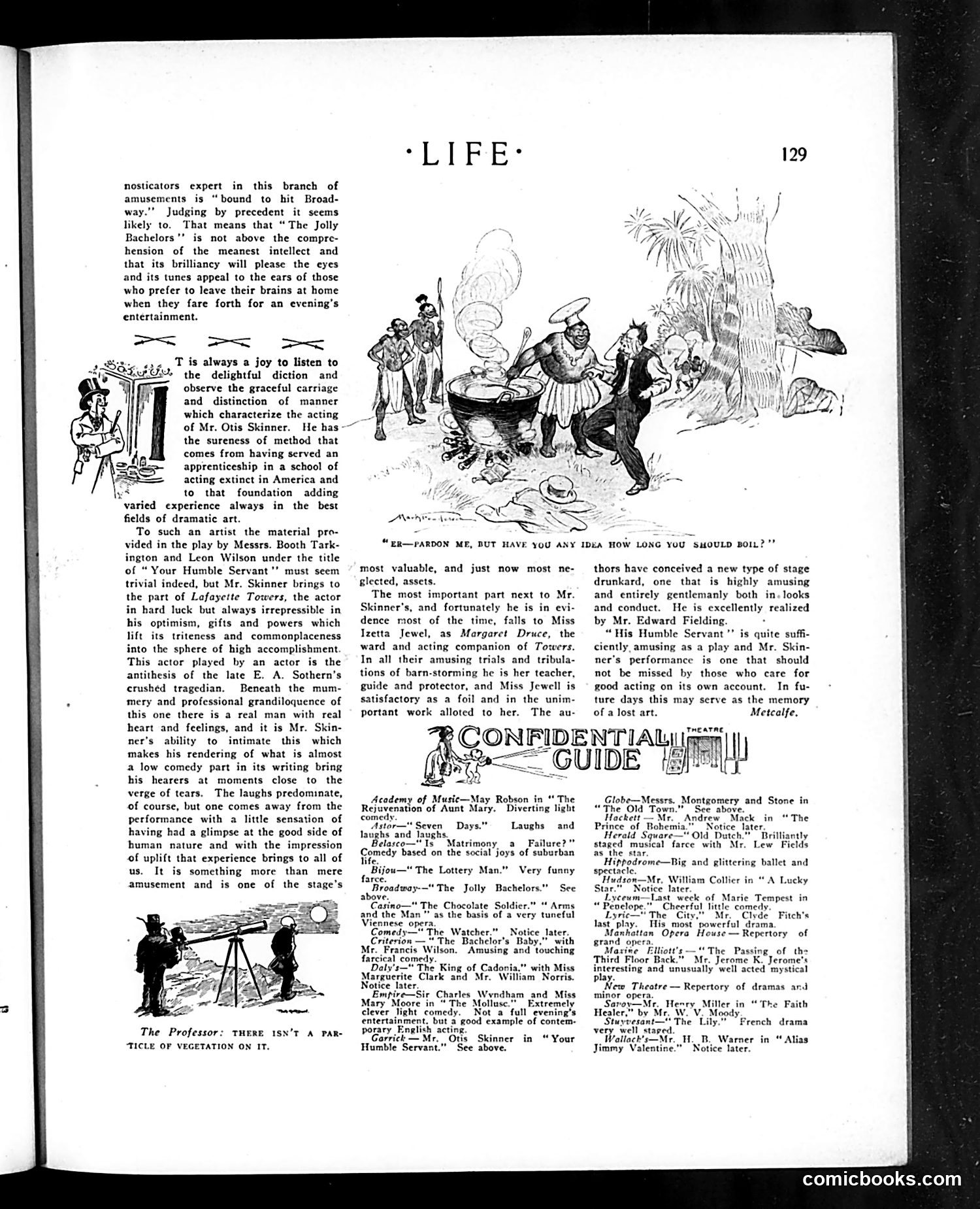
This page reviews Broadway theatrical productions, focusing primarily on Otis Skinner's performance in "Your Humble Servant." The main cartoon depicts a cooking scene with the caption "ER—PARDON ME, BUT HAVE YOU ANY IDEA HOW LONG YOU SHOULD BOIL?" The joke appears to be a domestic/culinary mishap, though the specific reference is unclear from context alone. The text praises Skinner's acting abilities and his capacity to elevate trivial material through genuine emotional depth—noting he brings "real man with real heart" to his role, creating moments that move audiences "close to the verge of tears" despite the play's comedic nature. The criticism of "The Jolly Bachelors" suggests it appeals only to unsophisticated audiences who "prefer to leave their brains at home." The "Confidential Guide" section lists other theatrical productions with brief reviews, indicating this was a theater-focused issue of Life magazine.
📄 Transcribed text from this page (OCR, searchable)
Machine-transcribed from the original scan — historical spelling and the odd misread are preserved.
nosticators expert in this branch of amusements is “bound to hit Broad- way.”’ Judging by precedent it seems likely to. That means that “The Jolly Bachelors ’’ is not above the compre- hension of the meanest intellect and that its brilliancy please the eyes and its tunes appeal to the ears of those who prefer to leave their brains at home when they fare forth for an evening's entertainment. ad a a T is always a joy to listen to the delightful diction and observe the graceful carriage and distinction of manner which characterize the acting of Mr. Otis Skinner. He has the sureness of method that comes from having served an apprenticeship in a school of acting extinct in America and to that foundation adding varied experience always in the best fields of dramatic art. To such an artist the material pro- vided in the play by Messrs. Booth Tark- gton and Leon Wilson under the title of “Your Humble Servant '’ must seem trivial indeed, but Mr. Skinner brings to the part of Lafayette Towers, the actor in hard luck but always irrepressible in his optimism, gifts and powers which lift its triteness and commonplaceness into the sphere of high accomplishment. This actor played by an actor is the antithesis of the late E. A. Sothern’s crushéd tragedian. Beneath the mum- mery and professional grandiloquence of this one there is a real man with real heart and feelings, and it is Mr. Skin- ner’s ability to intimate this which makes his rendering of what is almost a low comedy part in its writing bring his hearers at moments close to the verge of tears. The laughs predominate, ‘of course, but one comes away from the performance with a little sensation of having had a glimpse at the good side of human nature and with the impression of uplift that experience brings to all of us. It is something more than mere amusement and is one of the stage’s The Professor: THERE ISN'T A PAR- ‘TICLE OF VEGETATION ON IT, “LIFE: “ ER—PARDON ME, BUT HAVE YOU ANY IDEA HOW LONG YOU SHOULD BoIL?’? most valuable, and just now most ne- glected, assets. The most important part next to Mr. Skinner's, and fortunately he is in evi- dence most of the time, falls to Miss Izetta Jewel, as Margaret Druce, the ward and acting companion of Towers. In all their amusing trials and tribula- tions of barn-storming he is her teacher, guide and protector, and Miss Jewell is satisfactory as a foil and in the unim- portant work alloted to her. The au- Academy of Music—May Robson in * The Rejuvenation of Aunt Mary. Diverting light comedy. Astor—* Seven Days." Laughs and laughs and laughs. Belasco—"' Is Matrimony a Failure?" Gomedy based on the social joys of suburban fe. Bijou—" The Lottery Man.” Broadway-—" The Jolly Bachelors.” Very funny See farce. o—" The Chocolate Soldier.” “ Arms and the Man "as the basis of a very tuneful Viennese opera. Comedy—" The Watcher.” jon —“* The Bachelor . Francis Wilson. farcical comedy. Daly's—" The King of Cado Marguerite Clark and Mr. V Notice later. Empire—Sir Charles Wyndham and Miss Mary Moore in “The Mollusc.” Extremely clever light comedy. Not a full evening's entertainment. but a good example of contem- tice later. Baby,” with Amusing and touching ” with Miss iam Norris. porary English acti Garrick — Mr. Otis Skinner in “Your Humble Servant." See above. CONFIDENTIAL <= GUIDE | thors have conceived a new type of stage drunkard, one that is highly amusing and entirely gentlemanly both in. looks and conduct. He is excellently realized by Mr. Edward Fielding. “His Humble Servant '’ is quite suffi- ciently, amusing as a play and Mr. Skin- ner’s performance is one that should not be missed by those who care for good acting on its own account. In fu- ture days this may serve as the memory of a lost art. Metcalfe, Globe—Messrs. Montgomery and Stone in “The Old Town.” See above. Hackett — Mr. Andrew Mack in Prince of Bohemia. Notice later. Herald Square—" Old Dutch.” Brilliantly staged musical farce with Mr. Lew Fields as the star. Hippodrome—Big and glittering ballet and spectacle Hudsor Star.” tt "The Mr, William Collier in “A Lucky Notice later. Lyceum—Last week of Marie Tempest in “ Penelope." Cheerful little comedy. Lyrice—" The City," Mr. Clyde Fitch's last play. Tis most ‘powerful drama. Manhattan Opera House — Repertory grand opera Maxine Elliott's —“' The Passing of the Third Floor Back.” Mr. Jerome K. Jerome's interesting and unusually well acted ‘mystical of lay. New Theatre — Repertory of dramas and minor opera. Sarov—Mr. Henry Miller in “The Faith Healer,” by Mr. W. V. Moody. Stuyvesant—" The Lily.” very well staged. Wallack’s—Mr. Jimmy Valentine.’ French drama 1. B. Warner in “ Alias Notice later. comicbooks.com